

- Market Size (2026)
- USD 1266.6 Mn
- Forecast (2036)
- USD 2207.9 Mn
- CAGR (2026 to 2036)
- 5.7%
How big is UV Ink Photoinitiators Market in 2026?
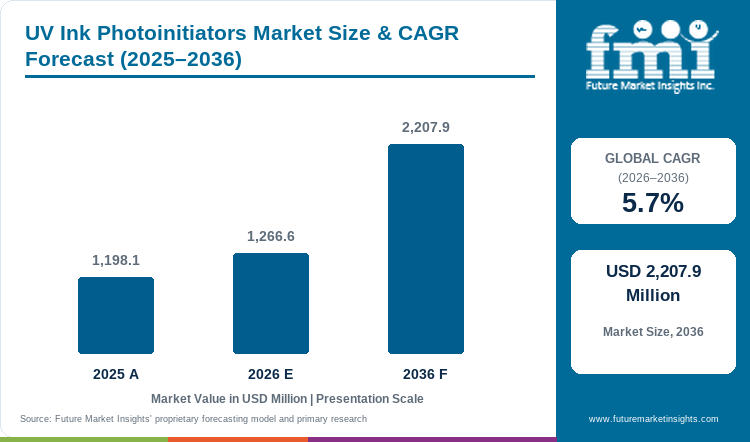
USD 1,266.6 million in 2026 and USD 2,207.9 million by 2036, expanding at 5.7% CAGR.
Sales of UV ink photoinitiators are estimated to rise at 5.7% CAGR through 2036. Value rises from USD 1,198.1 million in 2025 to USD 1,266.6 million in 2026, then reaches USD 2,207.9 million by 2036. Ink makers match photoinitiator absorption with lamp output and pigment load for target cure speed. UV-cured coatings on printed surfaces follow similar cure rules during formulation and press testing. In February 2025, Arkema opened a graphic-arts center for UV and LED printing. Arkema's center supports photoinitiator and cationic-system development for printing and packaging applications.
Germany is projected to grow at 6.2% CAGR through 2036 compared with 5.2% for the USA. German packaging ink demand remains active as publication printing volumes decline. VdL reported in February 2026 that Germany sold 168,000 tonnes of printing inks during 2025. Packaging ink volume increased slightly even though total printing-ink volume fell by about 5%. US demand includes digital printing for packaging and labels across many converting operations. Commercial print jobs also require reliable cure performance across varied press settings.
Key Takeaways
- High-speed packaging and label printing increase demand for photoinitiators that maintain reliable cure at commercial press speeds.
- Alpha-hydroxy ketones are projected to account for 31.0% of chemistry demand in 2026, supported by broad use across free-radical systems.
- UV inkjet inks are estimated to hold 28.0% of ink-system demand in 2026, linked to tight deposition and cure control.
- Regular print volume and costly cure failures keep packaging printing at a projected 34.0% share of end-use demand in 2026.
- Migration and toxicology reviews can extend approval work for inks used in sensitive packaging applications.
- Verified participants include IGM Resins, Arkema, RAHN AG, and Miwon Specialty Chemical Co., Ltd. Additional participants include Tianjin Jiuri New Materials Co., Ltd. and Changzhou Tronly New Electronic Materials Co., Ltd.
Analyst Perspective
"The commercial opportunity improves when ink makers can qualify photoinitiators across existing mercury and LED press fleets without sacrificing cure performance. The main challenge is proving low-migration performance and formula stability before sensitive packaging customers approve a material change."
- Nikhil Kaitwade, Principal Consultant, Future Market Insights
How is the UV ink photoinitiators market segmented?
The UV ink photoinitiators market is segmented by Chemistry, Ink System, End Use, Cure Technology, Sales Channel, and Region.
Five primary axes plus region define the complete segmentation used in this report. Chemistry covers alpha-hydroxy ketones, acylphosphine oxides, benzophenone derivatives, thioxanthones, and cationic photoinitiators. Ink system covers UV inkjet, flexo, offset, screen, and LED-curable inks. End use covers packaging, labels, commercial print, industrial marking, and electronics printing. Cure technology covers mercury UV, LED UV, hybrid UV, and low-migration UV. Sales channel covers ink manufacturers, chemical distributors, direct specialty suppliers, and formulators - compounders.
What supports alpha-hydroxy ketones within the Chemistry category?
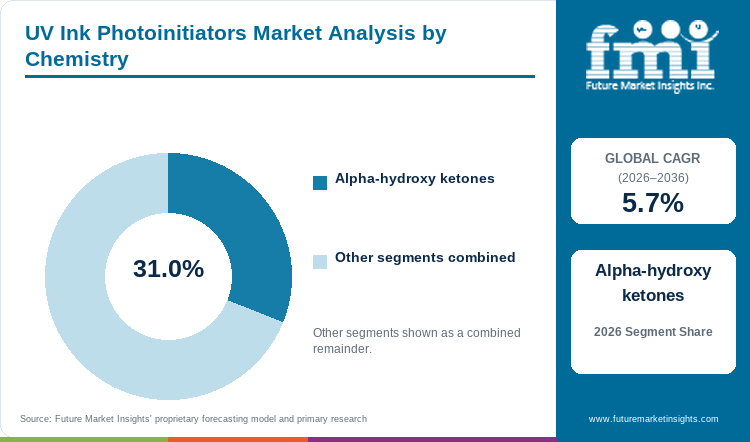
Alpha-hydroxy ketones give ink makers a Type I route for fast surface cure. These initiators work with mercury lamps and flexographic printing inks used in commercial production. Dark or thick films can require longer-wave initiators because deeper layers receive less useful curing energy. Ink makers combine complementary initiators when one chemistry cannot provide enough depth and surface performance together.
- Broad free-radical use places alpha-hydroxy ketones at a projected 31.0% share of chemistry demand in 2026.
- In October 2025, IGM Resins withdrew a temporary Omnirad 184 self-classification change during independent review.
Why do UV inkjet inks hold 28.0% of Ink System demand?
UV inkjet printing combines low-viscosity droplets with a narrow cure window on fast production lines. Photoinitiators must absorb the press wavelength without disrupting jetting through inkjet printers during production. Pigments can reduce the available cure margin, which makes odor and adhesion testing important before formulators approve a new blend.
- Fast pinning and precise cure control help UV inkjet inks reach an expected 28.0% of ink-system demand in 2026.
- In September 2025, Miwon opened a Navi Mumbai lab for UV and LED coating and ink work.
How does packaging printing shape the End Use category?
Fast packaging presses leave little time for weak or incomplete cure before converting begins. Printed films must withstand folding and handling without losing adhesion during normal production. Flexible packaging also needs odor and migration checks because sensitive end uses face tighter qualification requirements. Cure failures waste printed stock, so technical teams provide cure data and formula records before customers approve material changes.
- Steady print volume supports packaging printing's projected 34.0% end-use share, while costly cure failures strengthen the need for reliable formulations.
- In December 2025, IGM Resins introduced Omnipol BL 582 for sensitive packs with low-migration dual-cure use.
What keeps mercury UV important within Cure Technology?
Mercury UV remains common on offset and flexo presses used for commercial printing. Screen and industrial printers use broad-spectrum mercury lamps because thicker pigmented films need reliable cure through greater depth. UV coatings follow similar cure rules during planned reviews for LED retrofit projects. Equipment age and proven recipes influence when printers replace lamps or change curing systems.
- Installed presses and broad lamp output are expected to keep mercury UV at 34.0% of cure-technology demand in 2026.
- In June 2026, IGM Resins launched PHOTOMER SC91 for UV and LED print curing systems.
Why do ink manufacturers lead the Sales Channel category?
Ink makers control formulas and absorb the costs created by failed material changes. Laboratories test photoinitiators with resins and pigments under the lamps used by target presses. Teams also review UV curable coatings because film weight and end use affect approval requirements for regular orders.
- Formula approval control gives ink manufacturers a projected 43.0% share of sales-channel demand in 2026.
- In December 2025, IGM Resins signed an India distribution partnership with IDCC Global Chem for photoinitiators.
What are the drivers, restraints, and opportunities in the UV Ink Photoinitiators Market?
Faster packaging and label printing increase cure demands while regulatory review lengthens qualification and LED-matched chemistry expands sensitive applications.
- Driver: Faster packaging and label printing increases demand for photoinitiators that preserve cure at commercial press speed.
- Restraint: Migration and toxicology reviews can extend qualification work for food packaging and other sensitive ink applications.
- Opportunity: Polymeric and LED-matched photoinitiators can reduce migration risk while supporting presses that use mixed lamp technologies.
High-speed packaging lines leave little time for wet ink to cure before cutting and folding begin. Ink makers match each photoinitiator blend to lamp output and pigment load so the film cures at normal press speed. Weak cure can cause set-off and poor rub resistance during finishing. Incomplete cure can also create scrap and raise production waste. VdL reported in February 2026 that German package printing grew slightly during 2025 while total ink sales declined. Package printing activity keeps digital label printing tied to careful cure work across converted substrates. Printers need repeatable results when jobs move between substrates or press settings. Regular orders depend on stable cure at line speed because delays can stop finishing and waste printed stock.
Sensitive packaging requires extra review whenever an ink formula changes. In December 2025, IGM Resins published an update on the German Printing Ink Ordinance. The update connected food packaging inks with the national substance list and a January 2027 start date. Packaging teams request migration data and impurity records before accepting changes to sensitive ink formulas. Customers also require toxicology support and final-pack trials when an application carries direct contact concerns. A new raw material can trigger another review even when laboratory cure results remain acceptable. Clear records reduce buyer questions but do not replace the customer's complete test plan. Press teams validate the final package under normal production conditions before approval.
Polymeric photoinitiators can reduce small mobile molecules while preserving useful cure speed in sensitive applications. RAHN AG introduced GENOPOL BP-5 for UV-curable inks and coatings in August 2026. The company designed the grade for low migration and low odor in sensitive packaging uses. Ink makers operate mercury and LED equipment across mixed press fleets, so each formulation must suit more than one curing condition. Similar radiation curable coatings require careful formula and lamp matching on each production press. Customer approval depends on proven cure and adhesion plus the odor or migration data required for the final application. Grades that pass these checks can reduce reformulation work during lamp changes without lowering press performance.
Which country CAGRs are profiled in the UV Ink Photoinitiators Market?
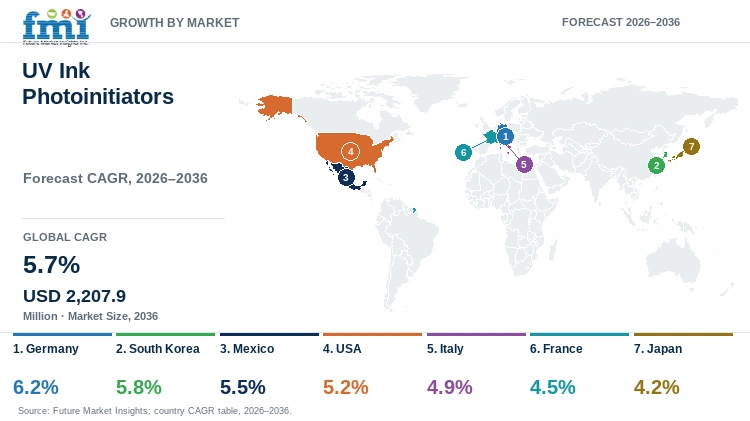
| Country | CAGR |
|---|---|
| Germany | 6.2% |
| South Korea | 5.8% |
| Mexico | 5.5% |
| USA | 5.2% |
| Italy | 4.9% |
| France | 4.5% |
| Japan | 4.2% |
How do country-level CAGRs compare in the UV Ink Photoinitiators Market?
Country CAGRs span 2.0 percentage points between Germany and Japan across the current forecast model. Germany and South Korea form the upper growth group with Mexico, while the USA and Italy occupy middle positions above France and Japan.
- Germany combines active packaging-ink demand with stricter migration checks that increase documentation work during formulation changes.
- South Korean converters test ink performance against updated packaging rules and recycled-plastic requirements before new grades enter production.
- Mexico's carton and film converters serve label printers while relying on local stock and technical support during press trials.
- US printers use digital and flexographic systems that reward dependable cure performance while controlling waste from failed formulation changes.
- Italian converters redesign packaging for recycling while requiring inks that preserve adhesion and cure across revised material structures.
- French printers manage mineral-oil restrictions and formula reviews that increase the value of clear composition records during customer approval.
- Japanese ink makers follow Negative List screening and package-level testing that require stable cure records before material changes receive approval.
The full report provides country-level CAGR analysis across North America, Latin America, Western Europe, Eastern Europe, East Asia, South Asia and Pacific, and the Middle East and Africa.
Country-wise Analysis
- German ink makers work under national controls for food-contact printing applications. Germany is projected to grow at 6.2% CAGR through 2036 as formula reviews become more demanding. In December 2025, Germany amended the Consumer Goods Ordinance and set stronger national printing-ink controls for January 2027. Food packaging formulas must meet listed-material and migration requirements before customers approve sensitive applications. Laboratories use clear purity records to answer compliance questions during formulation work and press trials. Cure performance cannot complete approval when required documentation remains incomplete. Stable composition data can shorten review delays without removing migration or toxicology checks. Local technical support helps customers resolve remaining questions before regular production orders begin.
- Updated packaging standards keep qualification work active across South Korean converting and food-pack operations. The country is projected to grow at 5.8% CAGR through 2036. MFDS revised national standards for containers and packages in March 2026. The notice added requirements for physically recycled polypropylene and clarified several packaging terms. These rules require ink makers to confirm cure and adhesion before new grades enter regular production. Sensitive food packaging also needs migration and odor checks during approval. Local laboratories can shorten customer trials without removing mandatory review steps. Reliable stock and technical support help converters manage formula changes with fewer supply delays.
- Mexican ink plants serve carton converters alongside film users and label printers. Mexico is projected to grow at 5.5% CAGR through 2036 because its mixed print base requires flexible technical support. INEGI reported in May 2026 that its national manufacturing survey covers 206 activity classes. The survey tracks printing-ink manufacturing activity under national class 325910. Local customers need specialty grades that can pass press trials across different printing systems. Mixed press fleets can lengthen qualification work for unfamiliar photoinitiator grades. Distributors reduce sample-to-order delays by holding local stock closer to converting plants. Spanish-language laboratory support helps technical teams solve cure problems during customer approval.
- Digital and flexographic printing keep cost control central to US ink purchasing. The USA is projected to record 5.2% CAGR through 2036, influenced by print activity and formula-change costs. In April 2026, the Bureau of Labor Statistics reported printing-ink producer prices 2.6% above March 2025. Higher prices raise the cost of failed formula changes without proving stronger volume demand. Ink makers compare cure response with lot quality and laboratory support before approving new materials. Grades must limit waste while maintaining output during routine press trials. Local inventory reduces downtime during planned or unexpected supply changes. Clear technical records also reduce supply questions before customers place regular orders.
- Italian pack converters handle large print volumes while redesigning packaging for easier recycling. Italy is forecast to expand at 4.9% CAGR through 2036, supported by recurring qualification work as package structures change. CONAI reported in July 2026 that Italy recycled 77.3% of packaging placed on the market during 2025. That national recycling rate keeps material choices under close review during package redesign. Ink changes must maintain adhesion and cure across revised package structures. Sensitive applications also require migration and odor checks before formula approval. Customer-specific cure data can shorten technical review without removing necessary tests. Stable lots help converters avoid repeated trials as packaging structures change.
- French printers face mineral-oil limits for paper and paperboard packaging applications. France is forecast to expand at 4.5% CAGR through 2036, linked to ongoing formula review under packaging and recycling requirements. Citeo published a January 2025 action plan covering mineral oils in packaging and graphic papers. The plan gives companies forms and screening tools for compliance work. These controls apply to mineral oils rather than photoinitiators used in printing inks. The regulatory distinction keeps the evidence relevant without overstating photoinitiator controls. Complete formula records help printers answer customer questions during material substitution. Suppliers must preserve cure performance while revised formulations move through press trials. Production testing confirms cure on each commercial press and substrate before final approval.
- Japanese ink makers use industry rules to screen materials for food-pack printing applications. Japan is forecast to grow at 4.2% CAGR through 2036, shaped by established approval steps for material changes. JPIMA published migration tests for Negative List-compliant food-package inks in May 2025. The published tests reported structures that met the stated list conditions. Customers review the complete printed package rather than judging one raw material alone. Ink makers compare cure performance with odor and set-off on the target press. Stable composition records support approval decisions and routine production use. Local technical support can speed formula changes during customer approval without removing required packaging review steps.
Who are the notable companies in the UV Ink Photoinitiators Market?
IGM Resins, Arkema, RAHN AG, Miwon Specialty Chemical Co., Ltd., Tianjin Jiuri New Materials Co., Ltd., Changzhou Tronly New Electronic Materials Co., Ltd. are active within the defined UV ink photoinitiators supply boundary.
Six companies supply photoinitiators or direct application support within the defined market boundary. IGM Resins and Arkema cover broad cure chemistries, while RAHN AG and Miwon support formulation work. Tianjin Jiuri New Materials Co., Ltd. and Changzhou Tronly New Electronic Materials Co., Ltd. manufacture photoinitiators for printing uses. New entrants need stable lots and clear technical records before customers approve regular supply.
- IGM Resins and Arkema cover broad radical and cationic cure.
- RAHN AG and Miwon Specialty Chemical Co., Ltd. pair chemistry with ink tests.
- Tianjin Jiuri New Materials Co., Ltd. and Changzhou Tronly New Electronic Materials Co., Ltd. make printing-ink photoinitiators.
Competitive Benchmarking: UV Ink Photoinitiators Market
| Company | Photoinitiator Chemistry Breadth | UV/LED and Low-Migration Readiness | Ink Application Support | Geographic Reach |
|---|---|---|---|---|
| IGM Resins | High | High | High | Global |
| Arkema | High | High | High | Global |
| RAHN AG | High | High | High | Europe, North America, and Asia |
| Miwon Specialty Chemical Co., Ltd. | Medium | High | High | Asia with international application support |
| Tianjin Jiuri New Materials Co., Ltd. | High | Medium | Medium | China with international sales |
| Changzhou Tronly New Electronic Materials Co., Ltd. | High | Medium | Medium | China with international operations |
High requires proof across several chemistries or ink routes, while Medium reflects narrower evidence and Low marks documented limits. Geographic reach describes service coverage and does not affect the benchmark score.
Key Developments in the UV Ink Photoinitiators Market
- In August 2026, RAHN AG introduced GENOPOL BP-5 for low-migration UV-curable inks and varnishes.
- In April 2026, Tianjin Jiuri New Materials Co., Ltd. filed its 2025 annual report on printing-ink photoinitiators.
- In December 2025, IGM Resins introduced Omnipol BL 582 for sensitive packaging with low-migration and dual-cure use.
Key Players in the UV Ink Photoinitiators Market
Global photoinitiator platforms
- IGM Resins
- Arkema
Formulation and application support specialists
- RAHN AG
- Miwon Specialty Chemical Co., Ltd.
China-based photoinitiator producers
- Tianjin Jiuri New Materials Co., Ltd.
- Changzhou Tronly New Electronic Materials Co., Ltd.
UV Ink Photoinitiators Market - Report Scope
| Coverage field | Report scope |
|---|---|
| Market breakdown | By chemistry, ink system, end use, cure technology, sales channel, and region. |
| Quantitative Units | USD million. |
| Market Definition | Revenue includes individual photoinitiator molecules and formulated photoinitiator blends sold for UV-curable printing inks. Finished inks, coatings, adhesives, monomers, oligomers, pigments, curing equipment, and downstream printed-product revenue are excluded. |
| Regions Covered | North America, Latin America, Western Europe, Eastern Europe, East Asia, South Asia and Pacific, and Middle East and Africa. |
| Countries Covered | Germany, South Korea, Mexico, USA, Italy, France, Japan; 30+ countries included in the full report. |
| Key Companies Profiled | IGM Resins, Arkema, RAHN AG, Miwon Specialty Chemical Co., Ltd., Tianjin Jiuri New Materials Co., Ltd., Changzhou Tronly New Electronic Materials Co., Ltd. |
| Forecast Period | 2026 to 2036. |
| Approach | Primary and secondary research with market triangulation. |
UV Ink Photoinitiators Market - Research Methodology
| Method | Approach |
|---|---|
| Primary Research | FMI analysts gathered input from manufacturers, service providers, technology developers, distributors, end users, procurement teams, and subject-matter experts. Interviews examined purchasing decisions, product or service evaluation, adoption barriers, approval requirements, pricing considerations, and expectations for technical or commercial support. Respondents were also asked what evidence is required before a trial, pilot, or initial order develops into regular purchasing. |
| Desk Research | Desk research covered government statistics, regulatory publications, trade data, industry associations, technical literature, standards, company filings, product information, and official corporate announcements. Sources were reviewed for relevance, publication date, geographic coverage, and consistency with the defined market scope. Claims relating to performance, applications, approvals, capacity, investment, and commercial activity were retained only when supported by credible public evidence. |
| Market Sizing and Forecasting | The market model combined the baseline value with historical performance, segment structure, pricing and volume indicators, adoption levels, company participation, and country-level demand conditions. Forecast assumptions considered economic activity, investment trends, regulatory developments, technology adoption, purchasing cycles, supply availability, and barriers to wider market use. Segment and regional estimates were reconciled before the final market total was calculated. |
| Data Validation | Estimates were checked against multiple independent indicators, including public data, company activity, trade patterns, industry developments, and findings from primary interviews. Validation also tested whether products, services, applications, and company revenues fell within the defined market boundaries. Adjacent categories, unsupported claims, overlapping revenues, and activities without direct market relevance were excluded to reduce double counting and maintain consistency across segments and countries. |
UV Ink Photoinitiators Market by Segments
UV Ink Photoinitiators Market segmented by Chemistry:
- Alpha-hydroxy ketones
- Acylphosphine oxides
- Benzophenone derivatives
- Thioxanthones
- Cationic photoinitiators
UV Ink Photoinitiators Market segmented by Ink System:
- UV inkjet inks
- UV flexo inks
- UV offset inks
- UV screen inks
- LED-curable inks
UV Ink Photoinitiators Market segmented by End Use:
- Packaging printing
- Labels
- Commercial printing
- Industrial marking
- Electronics printing
UV Ink Photoinitiators Market segmented by Cure Technology:
- Mercury UV
- LED UV
- Hybrid UV
- Low-migration UV
UV Ink Photoinitiators Market segmented by Sales Channel:
- Ink manufacturers
- Chemical distributors
- Direct specialty suppliers
- Formulators - compounders
UV Ink Photoinitiators Market by Region:
- North America
- United States
- Canada
- Latin America
- Brazil
- Mexico
- Chile
- Rest of Latin America
- Western Europe
- Germany
- United Kingdom
- Italy
- Spain
- France
- Nordics
- Benelux
- Rest of Western Europe
- Eastern Europe
- Russia
- Poland
- Hungary
- Balkan and Baltic States
- Rest of Eastern Europe
- East Asia
- China
- Japan
- South Korea
- South Asia and Pacific
- India
- ASEAN
- Australia and New Zealand
- Rest of South Asia and Pacific
- Middle East and Africa
- Kingdom of Saudi Arabia
- Other GCC Countries
- Türkiye
- South Africa
- Other African Union Countries
- Rest of Middle East and Africa
Research Sources and Bibliography
- Arkema. (2025, February). Graphic Arts Center of Excellence for UV, LED, and electron-beam printing technologies.
- Verband der deutschen Lack- und Druckfarbenindustrie e.V. (2026, February 11). Printing ink market development in 2025.
- IGM Resins. (2025, October 31). Update on the self-classification review of Omnirad 184.
- Miwon Specialty Chemical Co., Ltd. (2025, September). Opening of the Navi Mumbai Application Lab for UV and LED development.
- IGM Resins. (2025, December 5). Omnipol BL 582 for food packaging and other sensitive applications.
- IGM Resins. (2026, June). PHOTOMER SC91 for UV and LED graphic-arts applications.
- IGM Resins. (2025, December 15). Strategic distribution partnership with IDCC Global Chem in India.
- IGM Resins. (2025, December). Food-contact materials and the German Printing Ink Ordinance.
- RAHN AG. (2026, August 7). Introducing GENOPOL BP-5: High efficiency meets low migration.
- U.S. Bureau of Labor Statistics. (2026, April 14). Producer Price Indexes: March 2026.
- Federal Ministry of Justice and Federal Office of Justice. (2025, December 19). Consumer Goods Ordinance, amended December 19, 2025.
- Japan Printing Ink Makers Association. (2025, May). Migration evaluation for Negative List-compliant food-package printing inks.
- Ministry of Food and Drug Safety, Republic of Korea. (2026, March 27). Revision of standards and specifications for utensils, containers, and packages.
- Citeo. (2025, January 8). Mineral oils: Our action plan to support companies.
- CONAI. (2026, July 16). Italy exceeds a 77% packaging recycling rate.
- National Institute of Statistics and Geography, Mexico. (2026, May 15). Monthly Manufacturing Industry Survey: March 2026 indicators.
- Tianjin Jiuri New Materials Co., Ltd. (2026, April 25). 2025 annual report.
- Changzhou Tronly New Electronic Materials Co., Ltd. (2026, April 29). 2025 annual report.
- IGM Resins. (2025, June 3). Milan Laboratory: A New Chapter of Growth and Innovation.
This bibliography is provided for reader reference and is not exhaustive. The full report contains the complete reference list and detailed citations.
This Report Answers
- How large will the UV ink photoinitiators market become through 2036?
- Which printing conditions most directly shape demand for UV ink photoinitiators?
- Which chemistry category leads UV ink photoinitiator demand during 2026?
- Why do UV inkjet inks hold a major share of ink-system demand?
- How does packaging printing affect photoinitiator qualification for regular production?
- Which factors slow material switching for sensitive packaging ink formulations?
- How do country growth rates differ across the current forecast period?
- Which companies actively supply photoinitiators for commercial UV printing applications?
Frequently Asked Questions
How big is the UV ink photoinitiators market in 2026?
The UV ink photoinitiators market is worth USD 1,266.6 million in 2026 and is projected to reach USD 2,207.9 million by 2036. These chemicals initiate UV curing reactions and affect film adhesion and yellowing during printed-product production.
What is the CAGR of the UV ink photoinitiators market from 2026 to 2036?
The UV ink photoinitiators market is projected to grow at 5.7% CAGR from 2026 through 2036. Packaging printing and digital labels provide recurring volume, while LED conversion and migration rules prompt new formulation work.
Which chemistry category leads the UV ink photoinitiators market in 2026?
Alpha-hydroxy ketones are expected to hold 31.0% of chemistry demand in 2026 within the UV ink photoinitiators market. Ink makers use familiar radical-cure routes but still check lamp fit and resin compatibility before approving regular production.
Which end-use segment holds a major share of the UV ink photoinitiators market?
Packaging printing is forecast to represent 34.0% of end-use demand in 2026 because cure failures can waste high-volume printed stock. Sensitive packaging also requires migration and toxicology reviews plus press testing for cure and adhesion before formula approval.
How much value will the UV ink photoinitiators market add from 2026 to 2036?
The UV ink photoinitiators market is expected to add USD 941.3 million in value between 2026 and 2036. Lower-cost grades can require higher loading or slower lines, while supply changes can trigger extra qualification tests.
Which countries are projected to record strong growth in the UV ink photoinitiators market?
Germany is projected to grow at 6.2% CAGR through 2036 within the UV ink photoinitiators market. South Korea is projected at 5.8% CAGR and Mexico at 5.5% as local packaging rules and qualification needs shape orders.
Which companies are active in the UV ink photoinitiators market?
Key companies include IGM Resins, Arkema, RAHN AG, and Miwon Specialty Chemical Co., Ltd. Tianjin Jiuri New Materials Co., Ltd. and Changzhou Tronly New Electronic Materials Co., Ltd. also supply photoinitiators for printing applications.
Preview the report firsthand - request a free sample
Get SampleGet the brochure for pricing and purchase details.
Get PDFTable of Content
- Key Takeaways
- Market Size and CAGR
- Top Growth Driver
- Fastest Growing Segment
- Leading Region
- Key Companies
- Emerging Opportunities
- Executive Summary
- Global Market Outlook
- Demand-side Trends
- Supply-side Trends
- Technology Roadmap Analysis
- Analysis and Recommendations
- Analyst Perspective (What is happening? Why now? What should investors know?)
- Key Questions Answered
- How large is the market?
- What is the CAGR?
- What are key trends?
- Which region dominates?
- Who are the leaders?
- Market Overview
- Market Coverage / Taxonomy
- Market Definition / Scope / Limitations
- Research Methodology
- Chapter Orientation
- Analytical Lens and Working Hypotheses
- Market Structure, Signals, and Trend Drivers
- Benchmarking and Cross-market Comparability
- Market Sizing, Forecasting, and Opportunity Mapping
- Research Design and Evidence Framework
- Desk Research Programme (Secondary Evidence)
- Expert Input and Fieldwork (Primary Evidence)
- Tooling, Models, and Reference Databases
- Data Engineering and Model Build
- Quality Assurance and Audit Trail
- Market Background
- Market Dynamics (Drivers, Restraints, Opportunity, Trends)
- Scenario Forecast (Optimistic, Likely, Conservative)
- Impact Analysis
- AI Impact
- Sustainability Impact
- Regulatory Impact
- Technology Impact
- Consumer / Buyer Analysis
- Purchase Drivers
- Adoption Barriers
- Buyer Journey
- Opportunity Map Analysis
- Product Life Cycle Analysis
- Supply Chain Analysis
- Investment Feasibility Matrix
- Value Chain Analysis
- PESTLE and Porter's Analysis
- Regulatory Landscape
- Regional Parent Market Outlook
- Production and Consumption Statistics
- Import and Export Statistics
- Global Market Analysis and Forecast, 2021 to 2036
- Historical Market Size Value (USD Million) Analysis, 2021 to 2025
- Current and Future Market Size Value (USD Million) Projections, 2026 to 2036
- Y-o-Y Growth Trend Analysis
- Absolute $ Opportunity Analysis
- Global Market Pricing Analysis, 2021 to 2036
- Global Market Analysis and Forecast, By Chemistry, 2021 to 2036
- Introduction / Key Findings
- Historical Market Size Value (USD Million) Analysis By Chemistry, 2021 to 2025
- Current and Future Market Size Value (USD Million) Analysis and Forecast By Chemistry, 2026 to 2036
- Alpha-hydroxy ketones
- Acylphosphine oxides
- Benzophenone derivatives
- Thioxanthones
- Cationic photoinitiators
- Y-o-Y Growth Trend Analysis By Chemistry, 2021 to 2025
- Absolute $ Opportunity Analysis By Chemistry, 2026 to 2036
- Global Market Analysis and Forecast, By Ink System, 2021 to 2036
- Introduction / Key Findings
- Historical Market Size Value (USD Million) Analysis By Ink System, 2021 to 2025
- Current and Future Market Size Value (USD Million) Analysis and Forecast By Ink System, 2026 to 2036
- UV inkjet inks
- UV flexo inks
- UV offset inks
- UV screen inks
- LED-curable inks
- Y-o-Y Growth Trend Analysis By Ink System, 2021 to 2025
- Absolute $ Opportunity Analysis By Ink System, 2026 to 2036
- Global Market Analysis and Forecast, By End Use, 2021 to 2036
- Introduction / Key Findings
- Historical Market Size Value (USD Million) Analysis By End Use, 2021 to 2025
- Current and Future Market Size Value (USD Million) Analysis and Forecast By End Use, 2026 to 2036
- Packaging printing
- Labels
- Commercial printing
- Industrial marking
- Electronics printing
- Y-o-Y Growth Trend Analysis By End Use, 2021 to 2025
- Absolute $ Opportunity Analysis By End Use, 2026 to 2036
- Global Market Analysis and Forecast, By Cure Technology, 2021 to 2036
- Introduction / Key Findings
- Historical Market Size Value (USD Million) Analysis By Cure Technology, 2021 to 2025
- Current and Future Market Size Value (USD Million) Analysis and Forecast By Cure Technology, 2026 to 2036
- Mercury UV
- LED UV
- Hybrid UV
- Low-migration UV
- Y-o-Y Growth Trend Analysis By Cure Technology, 2021 to 2025
- Absolute $ Opportunity Analysis By Cure Technology, 2026 to 2036
- Global Market Analysis and Forecast, By Sales Channel, 2021 to 2036
- Introduction / Key Findings
- Historical Market Size Value (USD Million) Analysis By Sales Channel, 2021 to 2025
- Current and Future Market Size Value (USD Million) Analysis and Forecast By Sales Channel, 2026 to 2036
- Ink manufacturers
- Chemical distributors
- Direct specialty suppliers
- Formulators - compounders
- Y-o-Y Growth Trend Analysis By Sales Channel, 2021 to 2025
- Absolute $ Opportunity Analysis By Sales Channel, 2026 to 2036
- Global Market Analysis and Forecast, By Region, 2021 to 2036
- Introduction
- Historical Market Size Value (USD Million) Analysis By Region, 2021 to 2025
- Current Market Size Value (USD Million) Analysis and Forecast By Region, 2026 to 2036
- North America
- Latin America
- Western Europe
- Eastern Europe
- East Asia
- South Asia and Pacific
- Middle East and Africa
- Market Attractiveness Analysis By Region
- North America Market Analysis and Forecast, By Country, 2021 to 2036
- Historical Market Size Value (USD Million) Trend Analysis By Market Taxonomy, 2021 to 2025
- Market Size Value (USD Million) Forecast By Market Taxonomy, 2026 to 2036
- By Country
- United States
- Canada
- By Chemistry
- By Ink System
- By End Use
- By Cure Technology
- By Sales Channel
- By Country
- Market Attractiveness Analysis
- By Country
- By Chemistry
- By Ink System
- By End Use
- By Cure Technology
- By Sales Channel
- Key Takeaways
- Latin America Market Analysis and Forecast, By Country
- Historical Market Size Value (USD Million) Trend Analysis By Market Taxonomy, 2021 to 2025
- Market Size Value (USD Million) Forecast By Market Taxonomy, 2026 to 2036
- By Country
- Brazil
- Mexico
- Chile
- Rest of Latin America
- By Chemistry
- By Ink System
- By End Use
- By Cure Technology
- By Sales Channel
- By Country
- Market Attractiveness Analysis
- By Country
- By Chemistry
- By Ink System
- By End Use
- By Cure Technology
- By Sales Channel
- Key Takeaways
- Western Europe Market Analysis and Forecast, By Country
- Historical Market Size Value (USD Million) Trend Analysis By Market Taxonomy, 2021 to 2025
- Market Size Value (USD Million) Forecast By Market Taxonomy, 2026 to 2036
- By Country
- Germany
- United Kingdom
- Italy
- Spain
- France
- Nordics
- Benelux
- Rest of Western Europe
- By Chemistry
- By Ink System
- By End Use
- By Cure Technology
- By Sales Channel
- By Country
- Market Attractiveness Analysis
- By Country
- By Chemistry
- By Ink System
- By End Use
- By Cure Technology
- By Sales Channel
- Key Takeaways
- Eastern Europe Market Analysis and Forecast, By Country
- Historical Market Size Value (USD Million) Trend Analysis By Market Taxonomy, 2021 to 2025
- Market Size Value (USD Million) Forecast By Market Taxonomy, 2026 to 2036
- By Country
- Russia
- Poland
- Hungary
- Balkan and Baltic States
- Rest of Eastern Europe
- By Chemistry
- By Ink System
- By End Use
- By Cure Technology
- By Sales Channel
- By Country
- Market Attractiveness Analysis
- By Country
- By Chemistry
- By Ink System
- By End Use
- By Cure Technology
- By Sales Channel
- Key Takeaways
- East Asia Market Analysis and Forecast, By Country
- Historical Market Size Value (USD Million) Trend Analysis By Market Taxonomy, 2021 to 2025
- Market Size Value (USD Million) Forecast By Market Taxonomy, 2026 to 2036
- By Country
- China
- Japan
- South Korea
- By Chemistry
- By Ink System
- By End Use
- By Cure Technology
- By Sales Channel
- By Country
- Market Attractiveness Analysis
- By Country
- By Chemistry
- By Ink System
- By End Use
- By Cure Technology
- By Sales Channel
- Key Takeaways
- South Asia and Pacific Market Analysis and Forecast, By Country
- Historical Market Size Value (USD Million) Trend Analysis By Market Taxonomy, 2021 to 2025
- Market Size Value (USD Million) Forecast By Market Taxonomy, 2026 to 2036
- By Country
- India
- ASEAN
- Australia and New Zealand
- Rest of South Asia and Pacific
- By Chemistry
- By Ink System
- By End Use
- By Cure Technology
- By Sales Channel
- By Country
- Market Attractiveness Analysis
- By Country
- By Chemistry
- By Ink System
- By End Use
- By Cure Technology
- By Sales Channel
- Key Takeaways
- Middle East and Africa Market Analysis and Forecast, By Country
- Historical Market Size Value (USD Million) Trend Analysis By Market Taxonomy, 2021 to 2025
- Market Size Value (USD Million) Forecast By Market Taxonomy, 2026 to 2036
- By Country
- Kingdom of Saudi Arabia
- Other GCC Countries
- Türkiye
- South Africa
- Other African Union Countries
- Rest of Middle East and Africa
- By Chemistry
- By Ink System
- By End Use
- By Cure Technology
- By Sales Channel
- By Country
- Market Attractiveness Analysis
- By Country
- By Chemistry
- By Ink System
- By End Use
- By Cure Technology
- By Sales Channel
- Key Takeaways
- Key Countries Market Analysis
- United States
- Pricing Analysis
- Market Share Analysis, 2025
- By Chemistry
- By Ink System
- By End Use
- By Cure Technology
- By Sales Channel
- Canada
- Pricing Analysis
- Market Share Analysis, 2025
- By Chemistry
- By Ink System
- By End Use
- By Cure Technology
- By Sales Channel
- Mexico
- Pricing Analysis
- Market Share Analysis, 2025
- By Chemistry
- By Ink System
- By End Use
- By Cure Technology
- By Sales Channel
- Brazil
- Pricing Analysis
- Market Share Analysis, 2025
- By Chemistry
- By Ink System
- By End Use
- By Cure Technology
- By Sales Channel
- Chile
- Pricing Analysis
- Market Share Analysis, 2025
- By Chemistry
- By Ink System
- By End Use
- By Cure Technology
- By Sales Channel
- Germany
- Pricing Analysis
- Market Share Analysis, 2025
- By Chemistry
- By Ink System
- By End Use
- By Cure Technology
- By Sales Channel
- United Kingdom
- Pricing Analysis
- Market Share Analysis, 2025
- By Chemistry
- By Ink System
- By End Use
- By Cure Technology
- By Sales Channel
- Italy
- Pricing Analysis
- Market Share Analysis, 2025
- By Chemistry
- By Ink System
- By End Use
- By Cure Technology
- By Sales Channel
- Spain
- Pricing Analysis
- Market Share Analysis, 2025
- By Chemistry
- By Ink System
- By End Use
- By Cure Technology
- By Sales Channel
- France
- Pricing Analysis
- Market Share Analysis, 2025
- By Chemistry
- By Ink System
- By End Use
- By Cure Technology
- By Sales Channel
- India
- Pricing Analysis
- Market Share Analysis, 2025
- By Chemistry
- By Ink System
- By End Use
- By Cure Technology
- By Sales Channel
- ASEAN
- Pricing Analysis
- Market Share Analysis, 2025
- By Chemistry
- By Ink System
- By End Use
- By Cure Technology
- By Sales Channel
- Australia and New Zealand
- Pricing Analysis
- Market Share Analysis, 2025
- By Chemistry
- By Ink System
- By End Use
- By Cure Technology
- By Sales Channel
- China
- Pricing Analysis
- Market Share Analysis, 2025
- By Chemistry
- By Ink System
- By End Use
- By Cure Technology
- By Sales Channel
- Japan
- Pricing Analysis
- Market Share Analysis, 2025
- By Chemistry
- By Ink System
- By End Use
- By Cure Technology
- By Sales Channel
- South Korea
- Pricing Analysis
- Market Share Analysis, 2025
- By Chemistry
- By Ink System
- By End Use
- By Cure Technology
- By Sales Channel
- Russia
- Pricing Analysis
- Market Share Analysis, 2025
- By Chemistry
- By Ink System
- By End Use
- By Cure Technology
- By Sales Channel
- Poland
- Pricing Analysis
- Market Share Analysis, 2025
- By Chemistry
- By Ink System
- By End Use
- By Cure Technology
- By Sales Channel
- Hungary
- Pricing Analysis
- Market Share Analysis, 2025
- By Chemistry
- By Ink System
- By End Use
- By Cure Technology
- By Sales Channel
- Kingdom of Saudi Arabia
- Pricing Analysis
- Market Share Analysis, 2025
- By Chemistry
- By Ink System
- By End Use
- By Cure Technology
- By Sales Channel
- Türkiye
- Pricing Analysis
- Market Share Analysis, 2025
- By Chemistry
- By Ink System
- By End Use
- By Cure Technology
- By Sales Channel
- South Africa
- Pricing Analysis
- Market Share Analysis, 2025
- By Chemistry
- By Ink System
- By End Use
- By Cure Technology
- By Sales Channel
- United States
- Market Structure Analysis
- Competition Dashboard
- Competition Benchmarking
- Market Share Analysis of Top Players
- By Regional
- By Chemistry
- By Ink System
- By End Use
- By Cure Technology
- By Sales Channel
- Emerging Startups
- Innovation Benchmarking
- Competition Analysis
- Competition Deep Dive
- IGM Resins
- Overview
- Product Portfolio
- Profitability by Market Segments
- Sales Footprint
- Strategy Overview
- Marketing Strategy
- Product Strategy
- Channel Strategy
- Arkema
- RAHN AG
- Miwon Specialty Chemical Co., Ltd.
- Tianjin Jiuri New Materials Co., Ltd.
- Changzhou Tronly New Electronic Materials Co., Ltd.
- IGM Resins
- Case Studies
- Success Stories
- Recent Developments
- Competition Deep Dive
- Assumptions & Acronyms Used


