

- Market Size (2026)
- USD 282.8 Mn
- Forecast (2036)
- USD 675.7 Mn
- CAGR (2026 to 2036)
- 9.1%
How big is Vanilla Paste Market in 2026?
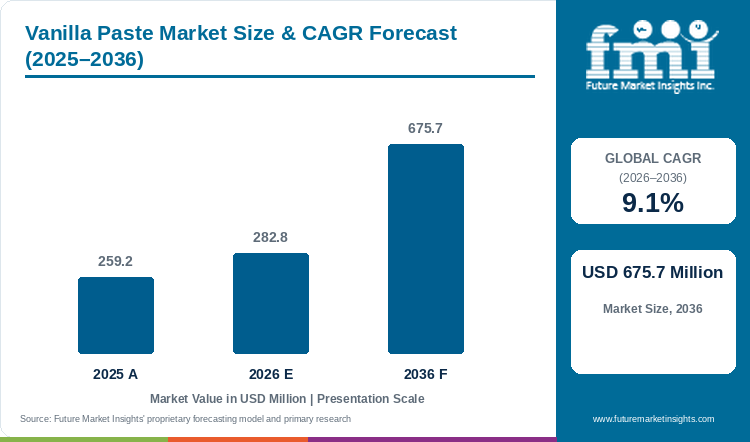
Assessed at USD 259.2 million in 2025 and progressing to USD 282.8 million in 2026, the vanilla paste market valuation is on course to reach USD 675.7 million by 2036, supported by a forecast-period CAGR of 9.1%.
Industrial bakeries and ice cream makers are replacing synthetic vanillin and liquid alcohol extracts with real-bean vanilla paste as lower raw bean costs make clean-label recipe upgrades affordable for mass-market brands. Recipe reformulation gained momentum after a May 2026 Aust & Hachmann market update confirmed that Madagascar ended its USD 4.00 per kilogram vanilla export tax at the close of 2025 amid multi-year cured bean surpluses [1]. Because thick sugar-based pastes keep natural vanilla aroma and visible bean specks intact during high-heat baking, Standard grade formulations are projected to account for a 41.0% share of the product type segment in 2026 and outpace liquid vanilla extract expanding at a 5.7% CAGR. Based on FMI analysis, the global vanilla paste market is forecast to grow from USD 259.2 million in 2025 to USD 282.8 million in 2026 and reach USD 675.7 million by 2036, recording a 9.1% CAGR to generate USD 392.9 million in category expansion. Despite lower raw material prices, mandatory organic import certificates and the months required to test new paste thicknesses on factory production lines still slow down supplier switching.
Key Market Trends & Insights
- By product type: Standard grade is estimated to hold a 41.0% share in 2026 because industrial bakeries require repeatable vanillin intensity and predictable batch dosing costs across high-volume sweet doughs.
- By form: Powder / dry is projected to account for a 43.0% share in 2026 as qualifying dry vanilla-paste preparation systems integrate directly into automated flour and sugar micro-dosing hoppers.
- By application: Bread & rolls is predicted to record a 29.0% share in 2026 driven by continuous brioche, sweet-roll, and enriched pan-bread production runs.
- By claim: Conventional is anticipated to hold a 51.0% share in 2026 owing to multi-origin bean blending flexibility without organic certificate surcharges.
- By sales channel: Direct to industrial bakeries is forecast to register a 54.0% share in 2026 supported by plant-level viscosity calibration and multi-ton bulk tote supply contracts.
Regional Highlights
- Top national expansion: The UAE is projected to lead country growth at a 10.4% CAGR through 2036 supported by luxury hotel pastry kitchens and central bakery commissaries.
- Broader country progression: Saudi Arabia is expected to expand at a 10.1% CAGR ahead of South Korea at 9.8% and the USA at 9.5%, while Japan is forecast to progress at an 8.2% CAGR.
Market Size & Forecast
Table 1: Market Size and Forecast for the Vanilla Paste Market (USD million and CAGR percentage), 2025 to 2036
| Metric | Value |
|---|---|
| 2025 Market Size | USD 259.2 million |
| Estimated Market Size in 2026 | USD 282.8 million |
| Projected Market Size by 2036 | USD 675.7 million |
| CAGR, 2026 to 2036 | 9.1% |
| Added Revenue, 2026 to 2036 | USD 392.9 million |
Commercial bakeries and pastry makers lose significant flavor when liquid alcohol-based vanilla extracts evaporate inside hot commercial ovens. Thick vanilla pastes made with sugar syrups and ground vanilla pods protect natural flavor during baking while leaving visible black bean specks in white creams and icings. Figures from the Central Confederation of the Bakery Trade in Germany (Zentralverband des Deutschen Bäckerhandwerks) show that Germany's 8,659 commercial bakery enterprises employed an average of 26.8 workers per business in 2025, anchoring steady multi-branch demand for standardized flavoring preparations [2]. Formulators now pair concentrated paste preparations with bakery ingredients to standardize crumb aroma across automated brioche and Danish lines.
Bakery-Batch and Flavor-Dosage Sizing
Table 2: Bakery-Batch and Flavor-Dosage Sizing for the Vanilla Paste Market (USD million and operational ranges), 2025 to 2036
| Metric | 2025 | 2026 | 2036 |
|---|---|---|---|
| Market size (USD million) | 259.2 | 282.8 | 675.7 |
| Qualifying vanilla paste volume supplied (thousand metric tons) | 6.8 to 7.6 | 7.4 to 8.3 | 16.5 to 18.4 |
| Flavored bakery and patisserie output treated (million metric tons) | 2.2 to 2.5 | 2.4 to 2.7 | 5.3 to 6.0 |
| Average industrial dosage per kg of dough or cream (grams) | 2.8 to 3.5 | 2.8 to 3.5 | 3.0 to 3.8 |
Operational note: Dosage ranges reflect commercial pastry and enriched-dough inclusion rates of 2.8 to 3.8 grams of concentrated vanilla paste per kilogram of finished batter or custard filling.
Industrial dough mixers require smooth pumpable pastes or free-flowing dry paste powders so automated dosing pumps deliver exact gram weights per batch without clogging. Ingredient compounders co-process Bourbon vanilla bean seeds with encapsulated flavours to lock in top-note vanillin through proofing and baking cycles.
Per Capita & Industrial Bakery Plant Sizing
Table 3: Per Capita and Plant Spending Indicators for the Vanilla Paste Market (USD), 2025 to 2036
| Metric | 2025 | 2026 | 2036 |
|---|---|---|---|
| World population (billion) | 8.2 | 8.3 | 9.0 |
| Spend per 1,000 people (USD) | 31.6 | 34.1 | 75.1 |
| Annual vanilla paste procurement per qualified bakery plant (USD) | 14,200 to 16,800 | 15,300 to 18,100 | 31,500 to 36,900 |
| Direct-to-bakery contracted volume share (%) | 52.0% to 55.0% | 53.0% to 56.0% | 61.0% to 65.0% |
Table 4: Industrial & Artisan Bakery Plant Indicators for the Vanilla Paste Market (USD and percentages), 2026
| Metric | Value | Institutional Reference Basis |
|---|---|---|
| Market size, 2026 | USD 282.8 million | 2026 global vanilla paste valuation baseline |
| Qualified industrial and commercial bakery plants | 17.2 thousand | Global sweet-bakery and patisserie plant registry |
| Market spend per plant | USD 16,441.9 | Annualized flavoring paste procurement per facility |
| Direct to industrial bakeries allocation, 2026 | USD 152.7 million | 54.0% sales channel segment share |
Procurement directors evaluate vanilla paste suppliers on cost-in-use per metric ton of baked goods instead of raw per-kilogram drum prices. Flavor houses that calibrate Brix levels with natural vanilla and sustainable flavor sourcing documentation win multi-year industrial supply agreements.
Analyst Perspective
"Industrial bakeries convert from liquid extracts and synthetic vanillin to vanilla paste only when a supplier proves consistent post-bake aroma retention and zero color bleed across high-speed dough and cream lines. Compounders that pair traceable Madagascar bean specks with automated dry and semi-solid dosing formats will capture multi-year plant contracts."
- Nandini Roy Choudhury, Principal Analyst at Future Market Insights
How is the vanilla paste market segmented?
The vanilla paste market is segmented by product type, form, application, claim, and sales channel. In 2026, Standard grade is projected at 41.0%, Powder / dry at 43.0%, Bread & rolls at 29.0%, Conventional at 51.0%, and Direct to industrial bakeries at 54.0%.
By product type: Standard grade, Premium / specialty grade, Organic certified, and Clean label grade.
By form: Powder / dry, Liquid, Paste / semi-solid, and Granules / pieces.
By application: Bread & rolls, Cakes & muffins, Biscuits & cookies, Viennoiserie & pastry, and Other bakery & snacks.
By claim: Conventional, Clean label, Organic, and Non-GMO / identity preserved.
By sales channel: Direct to industrial bakeries, Ingredient distributors, Foodservice & artisan supply, and Online B2B.
Why does Standard grade anchor purchasing by Product Type?
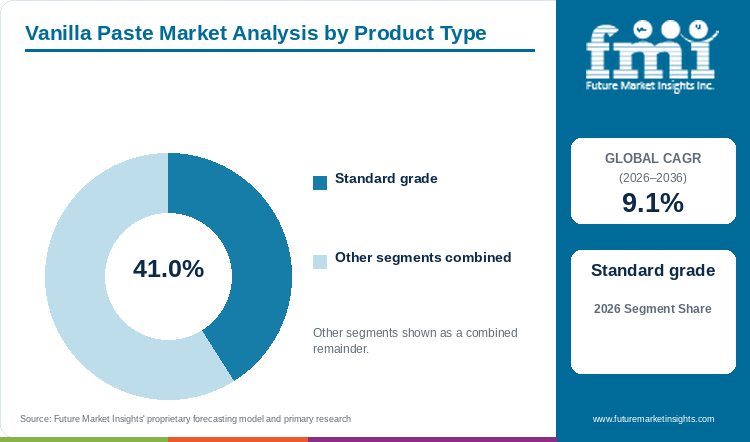
Standard grade is estimated to hold a 41.0% share of the product type segment in 2026, supported by repeatable dosage economics in commercial baking.
Table 5: Product Type Share for the Vanilla Paste Market (percentage share), 2026
| Product Type | Share (2026) |
|---|---|
| Standard grade | 41.0% |
| Other Segments Combined* | 59.0% |
| Total | 100.0% |
*Calculated as the balance remaining after deducting the leading segment's reported share from 100.0%.
Table 6: Product Type Leadership and Market Growth for the Vanilla Paste Market (segment and CAGR percentage), 2026 to 2036
| Metric | Value |
|---|---|
| Global CAGR (2026 to 2036) | 9.1% |
| Leading Segment | Standard grade |
High-throughput bread and cake plants specify Standard grade vanilla paste to lock in fixed vanillin-to-carrier ratios across year-round production without paying single-estate origin premiums. Premium seeded and white-vanilla grades serve specialist pastry creams with vanilla bean infusions where visual black specks or snow-white icing color control justify higher recipe cost.
- Standard grade is estimated to hold a 41.0% share of the product type segment in 2026 owing to standardized flavor strength and predictable batch reordering.
- Barry Callebaut's 2026 Bakery and Pastry Trends report highlights how high-volume commercial bakers balance everyday staple flavor standardization against hyper-sensorial premium pastry formats [3].
How does Powder / dry secure the lead within Form?
Powder / dry is projected to account for a 43.0% share of the form segment in 2026, driven by automated dry-hopper dosing and zero water-weight freight.
Dedicated Powder / dry vanilla-paste preparation systems blend concentrated vanilla extracts and ground bean seeds onto dry carriers that feed directly into flour and sugar mixers without sticky drum waste. Semi-solid pastes and viscous liquids remain preferred in whipped patisserie creams and food flavors where immediate cold-process dispersion is required.
- Powder / dry is projected to account for a 43.0% share of the form segment in 2026 enabled by lower ambient storage costs and automated dry-line metering.
- Puratos operates patisserie filling and dry bakery ingredient plants across 35 countries to supply standardized Cremfil Vanilla and pre-dosed bakery systems with local backup manufacturing [4].
What gives Bread & rolls the largest Application position?
Bread & rolls is predicted to record a 29.0% share of the application segment in 2026, associated with high-tonnage brioche and sweet-roll production.
Sweet pan breads, milk rolls, and packaged brioche buns run on continuous industrial tunnel ovens that consume multi-ton weekly volumes of bake-stable vanilla paste to mask yeast off-notes and enrich crumb aroma. Cake and viennoiserie lines use higher per-kilogram flavor dosages than dinner rolls and sweet-dough systems, yet Bread & rolls generates the largest total volume baseline.
- Bread & rolls is predicted to record a 29.0% share of the application segment in 2026 linked to continuous industrial sweet-bread and brioche batch sizes.
- Royal Zeelandia Group engineers water-based, milk-based, and custard vanilla fillings with custom viscosity and freeze-bake stability to match sweet dough and pastry production equipment [5].
Why does Conventional retain the largest Claim position?
Conventional is anticipated to hold a 51.0% share of the claim segment in 2026, reinforced by multi-origin blending flexibility and lower audit overhead.
Conventional vanilla paste formulations allow flavor houses to blend Madagascar, Indonesian, and Ugandan bean extracts with functional glucose and gum carriers without triggering lot-by-lot organic import certificates. Clean-label and certified-organic pastes capture premium retail bakery launches with clean-label flavors, but require segregated processing lines and electronic customs documentation.
- Conventional is anticipated to hold a 51.0% share of the claim segment in 2026 resulting from broader raw-material sourcing options and faster specification approval.
- The USDA Agricultural Marketing Service updated its Strengthening Organic Enforcement compliance FAQ through June 2026, enforcing mandatory electronic NOP Import Certificates for all certified-organic flavor shipments entering the United States [6].
What sustains Direct to industrial bakeries as the leading Sales Channel?
Direct to industrial bakeries is forecast to register a 54.0% share of the sales channel segment in 2026, owing to plant-specific viscosity and bake-stability trials.
Large commercial bakeries contract directly with flavor manufacturers to co-develop custom Brix, viscosity, and speck-count specifications that match plant pumping pressures and oven dwell times. Specialty ingredient distributors and B2B digital portals serve artisan patisseries and hotel kitchens ordering five-kilogram pails.
- Direct to industrial bakeries is forecast to register a 54.0% share of the sales channel segment in 2026 due to multi-month bench-to-pilot line qualification protocols.
- Dawn Foods expanded its 2026 technical bakery ambassador and application development programs in the United Kingdom to co-create commercial sweet-bakery formulations directly with plant R&D teams [7].
What are the drivers, restraints, and opportunities in the vanilla paste market?
In the vanilla paste market, industrial demand for bake-stable natural vanilla aroma drives volume adoption whereas origin crop cyclicality and organic customs audits restrain rapid switching and neutral-color seeded pastes open up premium patisserie applications.
- Driver: Industrial sweet-bakery automation and anti-dumping tariffs on synthetic vanillin push formulators toward standardized, bake-stable vanilla paste preparations.
- Restraint: Multi-year vanilla vine maturation cycles, EU Regulation 1334/2008 natural-label substantiation, and USDA organic import certificates lengthen supplier qualification.
- Opportunity: White neutral-color vanilla pastes, dry-metered paste powders, and localized regional compounding hubs capture clean-label bakery reformulations.
Growth Analysis and Future Potential: Qualitative Demand Catalysts
Industrial sweet-bakery manufacturers are reformulating brioche, pound cakes, and laminated pastries around concentrated vanilla paste to eliminate batch-to-batch aroma drift and synthetic flavor labeling. Trade duties on synthetic alternatives have also altered procurement math, as United States anti-dumping margins of up to 379.87% on China-origin synthetic vanillin reported in 2025 narrowed the cost-in-use gap for natural bean-derived paste systems. In May 2025, Dawn Foods unveiled its Global Bakery Trends survey at iba showing consumer willingness to pay for authentic ingredient provenance and customized sweet-bakery textures [8]. Because sugar-based and dry vanilla pastes lock natural flavor inside dough during 190-degree-Celsius baking, plants get stronger crumb aroma using smaller batch weights than liquid extracts require. As a result, multi-plant bakery groups lock in annual paste supply contracts to stabilize both sensory quality and clean-label front-of-pack claims.
Risk Assessment of the Vanilla Paste Market: Operational and Formulation Friction
Raw bean price cyclicality and strict statutory rules governing natural origin claims represent the primary commercial barriers restraining rapid recipe conversion. Even when Madagascar export supply is ample, historical swings between USD 50 and USD 600 per kilogram make industrial procurement directors hesitant to lock single-origin specifications without multi-quarter buffer stock. In the European Union, consolidated Regulation (EC) No 1334/2008 updated in February 2025 mandates that at least 95.0% by weight of the flavoring component in a named natural vanilla preparation derive exclusively from the vanilla pod, exposing non-compliant blends to regulatory relabeling [9]. When bakeries evaluate reformulating sponge batters with baking ingredients, any shift in paste carrier sugar or hydrocolloid viscosity requires costly oven-profile revalidation.
Commercial Opportunity Analysis: Formulation Differentiation and Value-Add Formats
Ingredient compounders are capturing higher margins by engineering application-specific vanilla pastes that solve color bleeding in white creams and moisture clumping in dry premixes. Conventional dark brown vanilla extracts tint whipped chantilly creams and white cake icings beige, whereas neutral-base white vanilla pastes deliver black exhausted pod specks without altering base whiteness. In October 2025, Fabbri 1905 expanded commercial distribution of its Delipaste White Vanilla formulation crafted from woody India-origin vanilla pods to provide intense aroma without discoloring white patisserie creams [10]. Formulators also pair heat-stable paste preparations with cookie dough and frozen patisserie batters that undergo freeze-thaw distribution prior to retail bake-off. Suppliers that combine localized short-lead-time compounding with bench-to-line technical service convert artisan patisserie trials into recurring industrial drum and tote orders.
Vanilla Paste Market by Country (2026 to 2036)
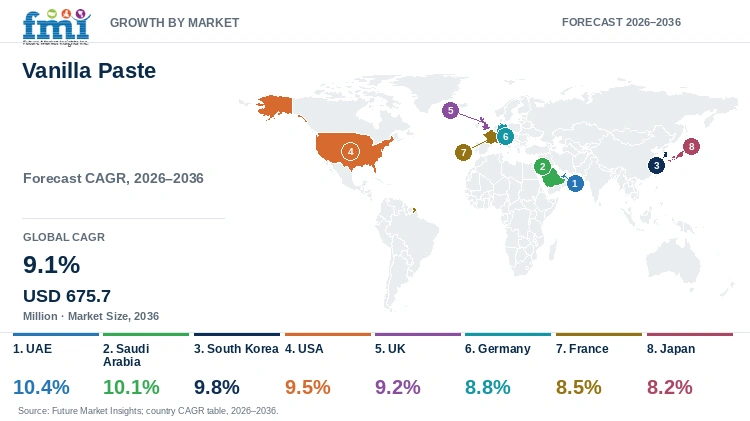
Across the eight covered markets, the UAE leads projected vanilla paste expansion at a 10.4% CAGR through 2036 while Japan advances at an 8.2% CAGR. National growth differences reflect how Gulf hotel commissaries scale alcohol-free halal pastry production while Western industrial bakeries execute clean-label upgrades.
Table 7: Country CAGR and Primary Growth Levers for the Vanilla Paste Market (CAGR percentage and operational drivers), 2026 to 2036
| Country | CAGR (2026 to 2036) | Primary Growth Lever |
|---|---|---|
| UAE | 10.4% | Central hotel patisserie commissaries and premium clean-label dessert menus |
| Saudi Arabia | 10.1% | Industrial bakery capacity expansion and SFDA-compliant halal flavor imports |
| South Korea | 9.8% | Rice-flour and specialty bakery recipe innovation requiring custom flavor dosing |
| USA | 9.5% | Clean-label sweet-bakery reformulation and USDA SOE certified-organic paste demand |
| UK | 9.2% | Out-of-home cafe and retail in-store bakery spending on premium vanilla patisserie |
| Germany | 8.8% | Consolidated industrial and craft bakery networks standardizing bake-stable pastes |
| France | 8.5% | Artisan patisserie and viennoiserie demand for Bourbon seeded vanilla preparations |
| Japan | 8.2% | Precision-dosed white and low-variance vanilla pastes for chilled bakery creams |
Source: Future Market Insights analysis
UAE Vanilla Paste Market Outlook (2026 to 2036)
The UAE vanilla paste market is projected to register a 10.4% CAGR between 2026 and 2036, leading growth across all eight covered nations. Unlike European markets anchored by domestic packaged-bread factories, demand in the UAE is propelled by luxury hotel pastry kitchens and airline flight-catering commissaries that require alcohol-free halal Bourbon vanilla pastes. Dubai Department of Economy and Tourism data released in January 2026 show that Dubai hosted 19.59 million international overnight visitors in 2025, expanding high-end hospitality buffet and patisserie production [11]. Because distributor cold-chain handling and zero-ethanol carrier rules govern customs clearance, European flavor houses win accounts by supplying invert-sugar and glycerol-carried seeded pastes in re-sealable foodservice pails.
Key takeaway: In the UAE, luxury hotel catering and zero-alcohol halal formulation standards are projected to drive imports of invert-sugar-based seeded vanilla pastes.
Saudi Arabia Vanilla Paste Market Outlook (2026 to 2036)
Large-scale industrial bakery automation and Giga-project hospitality procurement distinguish Saudi Arabia from fragmented Levantine bakery markets by creating bulk tender demand for heat-stable vanilla preparations. Commercial vanilla paste demand in Saudi Arabia is forecast to expand at a 10.1% CAGR from 2026 to 2036 across packaged sweet-roll plants and resort commissaries. Saudi Ministry of Tourism figures released via the Saudi Press Agency in June 2026 recorded 123 million inbound and domestic tourists and SAR 304 billion in 2025 tourism spending, accelerating foodservice bakery investments across Riyadh and the Red Sea coast [12]. Mandatory Saudi Food and Drug Authority Arabic ingredient declarations and strict alcohol-free carrier limits require suppliers to localize label documentation before port arrival.
Key takeaway: In Saudi Arabia, industrial sweet-bakery expansion and alcohol-free SFDA labeling rules are forecast to favor compliant bulk vanilla paste systems.
South Korea Vanilla Paste Market Outlook (2026 to 2036)
Rapid substrate diversification into rice-flour breads, cream-filled buns, and cafe dessert bars sets South Korea apart from traditional wheat-only Western bakery markets. Under the Ministry of Agriculture, Food and Rural Affairs floury-rice bakery commercialization program, 30 commercial bakeries developed 120 rice-bread and pastry recipes that require recalibrated vanilla paste dosing to mask starch notes [13]. The South Korea vanilla paste market is estimated to grow at a 9.8% CAGR over the 2026 to 2036 forecast period through franchise bakery chains and convenience-store dessert suppliers. High humidity during summer distribution and rapid menu turnover compel ingredient importers to stock small-lot qualification pails and shear-stable cream pastes.
Key takeaway: In South Korea, rice-flour bakery innovation and premium cafe cream buns are estimated to sustain demand for high-dispersion vanilla pastes.
USA Vanilla Paste Market Outlook (2026 to 2036)
In the USA, a dual market structure combines coast-to-coast industrial sweet-goods plants buying metric-ton totes of dry and semi-solid paste with specialty clean-label bakeries specifying certified-organic Bourbon pastes. High anti-dumping duties on imported synthetic vanillin and supermarket clean-label ingredient pledges have accelerated industrial trials of real-bean paste preparations across brioche and cake lines. Aust & Hachmann's December 2025 vanilla market report noted that the removal of United States import tariffs on Madagascar vanilla with attractive industrial bean pricing created a multi-year contracting window for buyers in North America [14]. Supported by domestic compounding investments and clean-label reformulation, the USA vanilla paste market is anticipated to advance at a 9.5% CAGR through 2036.
Key takeaway: In the USA, clean-label bakery reformulations and domestic paste compounding capacity are anticipated to drive steady industrial adoption.
UK Vanilla Paste Market Outlook (2026 to 2036)
The UK vanilla paste market is predicted to record a 9.2% CAGR between 2026 and 2036 across private-label supermarket cake manufacturers, high-street bakery chains, and foodservice dessert suppliers. Unlike continental Europe where independent craft bakeries dominate, grocery own-label tiering in the UK (such as premium retailer lines requiring visible Madagascar vanilla seeds on front-of-pack labels) dictates ingredient specification. Defra's July 2026 Food Statistics Pocketbook reported that total UK consumer expenditure on food and drink reached GBP 303.3 billion in 2025 with food and non-alcoholic beverage prices rising 2.2% in the 12 months to May 2026 [15]. Tight retailer margin ceilings therefore force compounders to prove that concentrated pastes reduce total flavor cost per baked unit.
Key takeaway: In the UK, supermarket premium own-label cake tiers and out-of-home cafe spending are predicted to anchor demand for seeded Madagascar vanilla pastes.
Germany Vanilla Paste Market Outlook (2026 to 2036)
Continuous consolidation among craft bakeries into larger multi-branch filiale networks shapes ingredient purchasing in Germany, shifting demand from small artisan jars toward automated dry-metered and pumpable paste drums. The Germany vanilla paste market is slated to expand at an 8.8% CAGR from 2026 to 2036 across industrial fine-pastry plants and regional wholesale bakeries. Aachen-based fruit and filling processor Zentis supplies customized warm-flavour water-based vanilla, caramel, and custard fillings engineered to meet the bake-stability standards of industrial pastry lines in Germany [16]. Strict enforcement of European flavoring Regulation (EC) No 1334/2008 requires suppliers to provide full analytical proof before bakers print natural Bourbon vanilla claims.
Key takeaway: In Germany, multi-branch bakery consolidation and strict EU natural-flavoring audits are slated to favor documented industrial paste systems.
France Vanilla Paste Market Outlook (2026 to 2036)
Established culinary standards across artisan boulangeries, viennoiserie plants, and chilled dairy-dessert factories make sensory authenticity and exhausted pod-seed visual density the primary purchasing criteria in France. INSEE's June 2025 commercial retail report documented a rebound in France in-store food retail sales and rising micro-enterprise bakery and commercial craft registrations, supporting specialty ingredient procurement [17]. Demand in the France vanilla paste market is expected to progress at an 8.5% CAGR over the 2026 to 2036 period across industrial brioche and fine-pastry producers. Suppliers compete on single-origin Madagascar and Reunion Bourbon bean profiles that withstand high-butter laminated dough proofing and baking.
Key takeaway: In France, industrial brioche exports and fine-patisserie sensory standards are expected to sustain demand for authentic Bourbon vanilla pastes.
Japan Vanilla Paste Market Outlook (2026 to 2036)
Chilled convenience-store cream puffs and giftable department-store confections govern flavor formulation in Japan, where buyers demand zero color shift and ultra-low microbial counts. The Statistics Bureau of Japan's 2024 Family Income and Expenditure Survey Annual Report published in 2025 recorded average monthly two-or-more-person household consumption expenditure of JPY 300,243 (up 2.1% nominally), sustaining packaged Western-style confectionery demand [18]. Quality-assurance teams in Japan enforce narrow viscosity tolerances and subtle low-phenolic vanilla profiles that harmonize with fresh Hokkaido dairy cream without overpowering delicate sponge crumb. Driven by neutral-color white vanilla pastes and precision-metered liquid-paste hybrids, the Japan vanilla paste market is forecast to register an 8.2% CAGR through 2036.
Key takeaway: In Japan, convenience-store chilled patisserie turnovers and strict color-stability specs are forecast to support adoption of neutral-base vanilla pastes.
Full report country CAGRs cover: North America; Latin America; Western Europe; Eastern Europe; East Asia; South Asia and Pacific; Middle East and Africa.
Who are the notable companies in the vanilla paste market?
Barry Callebaut, Puratos, Dawn Foods, Zeelandia, CSM Ingredients, Bakels, AGRANA, Zentis, Fabbri 1905, and Irca Group are the notable companies covered in this market.
Commercial supply across the vanilla paste market brings together Italian professional pastry-paste manufacturers with dedicated vanilla catalogs, European fruit-and-warm-flavor filling specialists, and global bakery ingredient platforms. Fabbri 1905 and Irca Group market standalone Joypaste, Cremirca, and Delipaste vanilla preparations directly to patisseries and industrial bakeries. Zeelandia and Zentis along with CSM Ingredients and AGRANA formulate bake-stable vanilla custards and warm-flavor preparations, while Puratos and Dawn Foods along with Bakels and Barry Callebaut operate global bakery formulation hubs.
- Direct Vanilla Flavoring Paste Specialists: Fabbri 1905 and Irca Group manufacture concentrated Bourbon, Madagascar, and white neutral-color vanilla pastes with published dosage specifications for bakery and pastry lines.
- Bakery Filling and Warm-Flavor Preparation Producers: Zeelandia and Zentis along with CSM Ingredients and AGRANA engineer bake-stable and freeze-thaw-stable vanilla fillings and customized industrial flavor preparations.
- Global Bakery Ingredient and Compound Platforms: Puratos and Dawn Foods as well as Bakels and Barry Callebaut provide multinational bakery distribution, dry-dosing systems, and vanilla-flavored compound fillings.
Competitive Benchmarking: Vanilla Paste Market
Table 8: Competitive Benchmarking for the Vanilla Paste Market (qualitative capability ratings), 2026
| Company | Paste SKU | Vanilla Process | Industrial Route | Geographic Reach |
|---|---|---|---|---|
| Barry Callebaut | Unscored | Medium | High | Global chocolate and European bakery fillings platform |
| Puratos | Unscored | Medium | High | Over 100 countries with regional bakery innovation hubs |
| Dawn Foods | Unscored | Medium | High | North America, Europe, and AMEAP sweet-bakery distribution |
| Zeelandia | Unscored | High | High | Europe and international industrial bakery service |
| CSM Ingredients | Unscored | High | Medium | European fine-pastry and industrial filling customers |
| Bakels | Unscored | Medium | High | Multi-continent commercial bakery ingredient supply |
| AGRANA | Unscored | Medium | High | Global fruit and warm-flavor bakery preparation plants |
| Zentis | Unscored | High | High | European industrial bakery bulk water-based fillings |
| Fabbri 1905 | High | High | Medium | Italy and 100+ export markets across pastry and gelato |
| Irca Group | High | High | High | Europe, North America, and international pastry channels |
Scoring basis: Paste SKU evaluates publicly documented standalone vanilla flavoring paste products (High for Fabbri 1905 Delipaste and Irca Group Joypaste and Cesarin pastry lines). Vanilla Process rates documented bake-stability and pastry-cream dispersion engineering, while Industrial Route reflects bulk packaging and direct plant technical service.
Key Developments in the Vanilla Paste Market
- Puratos and Dawn Foods entered into a definitive agreement in March 2026 under which Puratos agreed to acquire Dawn Foods, uniting R&D-led European bakery ingredient technology with North America sweet-bakery manufacturing and distribution [19].
- CSM Ingredients launched its Creami range of indulgent bake-stable and post-bake fillings for bakery and pastry professionals in May 2026, expanding ready-to-use sweet flavor systems across European commercial bakeries [20].
- Irca Group expanded its Cesarin and Joypaste artisanal fruit and pastry flavoring portfolio across European and international patisserie accounts to support authentic clean-label pastry creations [21].
Key Players in the Vanilla Paste Market
Direct Vanilla Flavoring Paste Catalogs
- Fabbri 1905
- Irca Group
Vanilla Bakery Filling and Formulation Capabilities
- Zeelandia
- Zentis
- CSM Ingredients
- AGRANA
Broad Bakery Ingredient and Commercial Platforms
- Puratos
- Dawn Foods
- Bakels
- Barry Callebaut
Vanilla Paste Market - Report Scope
Table 9: Report Scope for the Vanilla Paste Market (coverage fields and definitions), 2026 to 2036
| Coverage field | Report scope |
|---|---|
| Market breakdown | Product Type; Form; Application; Claim; Sales Channel |
| Quantitative Units | USD Million |
| Market Definition | Commercial supplier revenue from concentrated vanilla-paste flavoring preparations and dedicated dry or liquid vanilla-paste preparation systems sold into bakery and patisserie production. Excludes retail finished baked goods, generic single-fold liquid alcohol extracts, unflavored bakery mixes, and standalone synthetic vanillin powder. |
| Regions Covered | North America; Latin America; Western Europe; Eastern Europe; East Asia; South Asia and Pacific; Middle East and Africa |
| Countries Covered | UAE, Saudi Arabia, South Korea, USA, UK, Germany, France, Japan, and additional countries in the full report |
| Key Companies Covered | Barry Callebaut, Puratos, Dawn Foods, Zeelandia, CSM Ingredients, Bakels, AGRANA, Zentis, Fabbri 1905, Irca Group |
| Forecast Period | 2026 to 2036 |
| Approach | Primary and secondary research with top-down and bottom-up market triangulation. |
Vanilla Paste Market - Research Methodology
Table 10: Research Methodology for the Vanilla Paste Market (research methods and approach), 2026 edition
| Method | Approach |
|---|---|
| Primary Research | Structured interviews with industrial bakery R&D formulators, flavor-house compounders, cured vanilla bean importers, and patisserie procurement managers to verify paste dosage rates, 190°C bake-off aroma retention, and organic certificate compliance costs. |
| Secondary Research | Analysis of Aust & Hachmann Madagascar vanilla crop reports, USDA Strengthening Organic Enforcement import rules, European Regulation (EC) No 1334/2008 flavoring standards, Zentralverband des Deutschen Bäckerhandwerks statistics, and corporate ingredient filings. |
| Market Sizing and Forecasting | Top-down industrial bakery flavoring budgets reconciled against bottom-up metric-ton shipments of semi-solid, liquid, and dry-plated vanilla paste preparations across sweet-bread, cake, biscuit, and viennoiserie lines from 2026 to 2036. |
| Country Forecasting Model | Econometric national models weight commercial bakery enterprise output, hospitality patisserie expansion, anti-dumping duties on synthetic vanillin, and clean-label retail reformulation velocity across eight covered countries. |
| Operational Benchmark Traceability | Bakery-batch and plant spending indicators in Tables 2, 3, and 4 trace to Zentralverband des Deutschen Bäckerhandwerks enterprise data, Defra out-of-home food expenditure series, and published Fabbri 1905 and Irca Group dosage specifications. |
| Data Triangulation and Validation | Revenue estimates are cross-checked against cured vanilla bean import tonnage and industrial bakery flavor allocations while excluding finished custard fillings, compound chocolate coatings, and retail baking extracts. |
Vanilla Paste Market by Segments
Vanilla Paste Market segmented by Product Type:
- Standard grade
- Premium / specialty grade
- Organic certified
- Clean label grade
Vanilla Paste Market segmented by Form:
- Powder / dry
- Liquid
- Paste / semi-solid
- Granules / pieces
Vanilla Paste Market segmented by Application:
- Bread & rolls
- Cakes & muffins
- Biscuits & cookies
- Viennoiserie & pastry
- Other bakery & snacks
Vanilla Paste Market segmented by Claim:
- Conventional
- Clean label
- Organic
- Non-GMO / identity preserved
Vanilla Paste Market segmented by Sales Channel:
- Direct to industrial bakeries
- Ingredient distributors
- Foodservice & artisan supply
- Online B2B
Vanilla Paste Market by Region
- North America
- United States
- Canada
- Latin America
- Brazil
- Mexico
- Argentina
- Chile
- Western Europe
- Germany
- France
- United Kingdom
- Italy
- Spain
- Benelux
- Nordics
- Eastern Europe
- Poland
- Czech Republic
- Romania
- Hungary
- East Asia
- China
- Japan
- South Korea
- South Asia and Pacific
- India
- ASEAN
- Australia and New Zealand
- Middle East and Africa
- GCC Countries
- South Africa
- Türkiye
- Israel
Research Sources and Bibliography
- [1] Aust & Hachmann. (2026, May 29). Mai 2026 Vanilla Market Report: Prolonged Market Decline, Madagascar Export Tax Removal, and Supply Outlook. Aust & Hachmann Canada.
- [2] Zentralverband des Deutschen Bäckerhandwerks e.V. (2026, March 18). Zahlen und Fakten rund ums Bäckerhandwerk: 8,659 Bakery Enterprises and 26.8 Average Employees. Central Confederation of the Bakery Trade in Germany.
- [3] Barry Callebaut AG. (2026, April 16). Discover the Top Bakery and Pastry Trends of 2026 and Beyond Across Global Sweet Goods. Barry Callebaut Group.
- [4] Puratos Group. (2025, May 12). Dedicated to Bakers, Pastry Chefs, and Chocolatiers: Cremfil Vanilla and Patisserie Fillings Across 35 Countries. Puratos Professional Bakery Division.
- [5] Royal Zeelandia Group B.V. (2025, April 8). Industrial Custard and Vanilla Filling Systems for High-Throughput European Bakery Lines. Zeelandia Technical Bakery Portfolio.
- [6] USDA Agricultural Marketing Service. (2026, June 15). Strengthening Organic Enforcement Frequently Asked Questions: Mandatory Electronic NOP Import Certificates. United States Department of Agriculture.
- [7] BakeryInfo UK. (2025, August 25). Dawn Foods Expands 2026 Student Ambassador and Commercial Bakery Formulation Programs. BakeryInfo UK Industry Report.
- [8] Dawn Foods. (2025, May 18). Dawn Foods Unveils Global Bakery Trends Report on Customization and Ingredient Provenance. Dawn Foods Europe.
- [9] European Parliament and Council of the European Union. (2025, February 19). Consolidated Regulation (EC) No 1334/2008 on Flavourings and Certain Food Ingredients with Flavouring Properties. Official Journal of the European Union.
- [10] Fabbri 1905 S.p.A. (2025, October 30). Delipaste White Vanilla Professional Flavoring Paste Technical Specifications. Fabbri 1905 Product Specifications.
- [11] Dubai Department of Economy and Tourism. (2026, January 7). Tourism Performance Report January to December 2025: Dubai Welcomes 19.59 Million International Overnight Visitors. Government of Dubai.
- [12] Saudi Ministry of Tourism. (2026, June 18). Ministry of Tourism Releases 2025 Annual Statistical Report Announcing Record SAR 304 Billion in Total Tourism Spending. Saudi Press Agency.
- [13] Ministry of Agriculture, Food and Rural Affairs of South Korea. (2025, May 7). Commercialization Program for 120 Floury-Rice Bread and Confectionery Recipes Across 30 South Korea Bakeries. MAFRA Republic of Korea.
- [14] Aust & Hachmann. (2025, December 5). Décembre 2025 Vanilla Market Report: Elimination of US Tariffs and Madagascar Export Duties. Aust & Hachmann Canada.
- [15] UK Department for Environment, Food & Rural Affairs. (2026, July 29). Food Statistics in Your Pocket: UK Agri-Food Sector and Consumer Expenditure Report. Defra National Statistics GOV.UK.
- [16] Zentis GmbH & Co. KG. (2025, June 19). Warm-Flavour Water-Based Vanilla and Caramel Fillings for Pre-Bake and Post-Bake Pastry Applications. Zentis Industrial Bakery Solutions.
- [17] Institut national de la statistique et des études économiques. (2025, June 24). Le compte du commerce en 2024: Evolution des ventes alimentaires en magasin spécialisé et boulangerie. INSEE Première No. 2058.
- [18] Statistics Bureau of Japan. (2025, May 16). Family Income and Expenditure Survey Annual Report: Household Confectionery and Bakery Outlays. Ministry of Internal Affairs and Communications.
- [19] Puratos Group & Dawn Foods. (2026, March 10). Puratos to Acquire Dawn Foods, Bringing Together Complementary Capabilities in Professional Bakery. Puratos USA Corporation.
- [20] CSM Ingredients. (2026, May 14). CSM Ingredients Reveals Creami New Range of Bake-Stable Sweet Fillings for Bakery and Pastry Professionals. WorldBakers Ingredient Report.
- [21] IRCA Group S.p.A. (2025, February 18). Cesarin and IRCA Group Artisanal Pastry and Stabilized Confectionery Ingredients Portfolio. Irca Group Brand Portfolio.
- [22] AGRANA Beteiligungs-AG. (2026, May 12). AGRANA Achieves Solid 2025/26 Operating Profit of EUR 81.2 Million and Scales Food & Beverage Solutions. AGRANA Group Corporate Release.
- [23] Symrise AG. (2026, October 4). Symrise Celebrates Third World Vanilla Day with Global Traceable Madagascar Sourcing Activities. Symrise Taste, Nutrition & Health.
This bibliography is provided for reader reference and is not exhaustive. The full report contains the complete reference list and detailed citations.
This Report Answers
- How large is the vanilla paste market in 2026 and what is forecast for 2036?
- Which industrial baking and bean-pricing pressures support demand for vanilla paste?
- Why does Standard grade lead the Product Type category?
- Why does Powder / dry command the largest share in Form?
- How do growth rates differ across the UAE and Saudi Arabia as well as South Korea and the USA?
- Which leading companies supply standalone vanilla pastes or bake-stable vanilla systems today?
- What regulatory and origin-traceability barriers delay supplier switching in the vanilla paste market?
- What should bakery R&D teams test before qualifying a vanilla paste formulation?
Frequently Asked Questions
How big is the vanilla paste market in 2026, and what is forecast for 2036?
Global vanilla paste valuation stands at an estimated USD 282.8 million in 2026, rising from USD 259.2 million in 2025. Demand is projected to reach USD 675.7 million by 2036 as commercial bakeries replace liquid alcohol extracts and synthetic vanillin with bake-stable paste preparations.
What is the CAGR for the vanilla paste market from 2026 to 2036?
The vanilla paste market is forecast to expand at a 9.1% compound annual growth rate from 2026 to 2036, creating USD 392.9 million in incremental industry value across industrial bakery and patisserie channels.
Which product type segment leads the vanilla paste market?
Standard grade is estimated to hold a 41.0% share of the product type segment in 2026 because high-volume sweet bread and cake plants require repeatable vanillin intensity and predictable batch dosing costs.
Which form segment leads the vanilla paste market?
Powder / dry is projected to account for a 43.0% share of the form segment in 2026 as qualifying dry vanilla-paste preparation systems integrate into automated dry-ingredient micro-dosing hoppers.
Which country has the fastest growth outlook during the assessment period?
The UAE is projected to lead national growth at a 10.4% CAGR through 2036, followed by Saudi Arabia at 10.1%, supported by luxury hotel patisserie commissaries and halal-compliant bakery production.
Who are the key players in the vanilla paste market?
Barry Callebaut, Puratos, Dawn Foods, Zeelandia, CSM Ingredients, Bakels, AGRANA, Zentis, Fabbri 1905, and Irca Group represent the covered companies across direct flavoring pastes, warm-flavor fillings, and bakery ingredient platforms.
Preview the report firsthand - request a free sample
Get SampleGet the brochure for pricing and purchase details.
Get PDFTable of Content
- Key Takeaways
- Market Size and CAGR
- Top Growth Driver
- Fastest Growing Segment
- Leading Region
- Key Companies
- Emerging Opportunities
- Executive Summary
- Global Market Outlook
- Demand-side Trends
- Supply-side Trends
- Technology Roadmap Analysis
- Analysis and Recommendations
- Analyst Perspective (What is happening? Why now? What should investors know?)
- Key Questions Answered
- How large is the market?
- What is the CAGR?
- What are key trends?
- Which region dominates?
- Who are the leaders?
- Market Overview
- Market Coverage / Taxonomy
- Market Definition / Scope / Limitations
- Research Methodology
- Chapter Orientation
- Analytical Lens and Working Hypotheses
- Market Structure, Signals, and Trend Drivers
- Benchmarking and Cross-market Comparability
- Market Sizing, Forecasting, and Opportunity Mapping
- Research Design and Evidence Framework
- Desk Research Programme (Secondary Evidence)
- Expert Input and Fieldwork (Primary Evidence)
- Tooling, Models, and Reference Databases
- Data Engineering and Model Build
- Quality Assurance and Audit Trail
- Market Background
- Market Dynamics (Drivers, Restraints, Opportunity, Trends)
- Scenario Forecast (Optimistic, Likely, Conservative)
- Impact Analysis
- AI Impact
- Sustainability Impact
- Regulatory Impact
- Technology Impact
- Consumer / Buyer Analysis
- Purchase Drivers
- Adoption Barriers
- Buyer Journey
- Opportunity Map Analysis
- Product Life Cycle Analysis
- Supply Chain Analysis
- Investment Feasibility Matrix
- Value Chain Analysis
- PESTLE and Porter's Analysis
- Regulatory Landscape
- Regional Parent Market Outlook
- Production and Consumption Statistics
- Import and Export Statistics
- Global Market Analysis and Forecast, 2021 to 2036
- Historical Market Size Value (USD Million) Analysis, 2021 to 2025
- Current and Future Market Size Value (USD Million) Projections, 2026 to 2036
- Y-o-Y Growth Trend Analysis
- Absolute $ Opportunity Analysis
- Global Market Pricing Analysis, 2021 to 2036
- Global Market Analysis and Forecast, By Product Type, 2021 to 2036
- Introduction / Key Findings
- Historical Market Size Value (USD Million) Analysis By Product Type, 2021 to 2025
- Current and Future Market Size Value (USD Million) Analysis and Forecast By Product Type, 2026 to 2036
- Standard grade
- Premium / specialty grade
- Organic certified
- Clean label grade
- Y-o-Y Growth Trend Analysis By Product Type, 2021 to 2025
- Absolute $ Opportunity Analysis By Product Type, 2026 to 2036
- Global Market Analysis and Forecast, By Form, 2021 to 2036
- Introduction / Key Findings
- Historical Market Size Value (USD Million) Analysis By Form, 2021 to 2025
- Current and Future Market Size Value (USD Million) Analysis and Forecast By Form, 2026 to 2036
- Powder / dry
- Liquid
- Paste / semi-solid
- Granules / pieces
- Y-o-Y Growth Trend Analysis By Form, 2021 to 2025
- Absolute $ Opportunity Analysis By Form, 2026 to 2036
- Global Market Analysis and Forecast, By Application, 2021 to 2036
- Introduction / Key Findings
- Historical Market Size Value (USD Million) Analysis By Application, 2021 to 2025
- Current and Future Market Size Value (USD Million) Analysis and Forecast By Application, 2026 to 2036
- Bread & rolls
- Cakes & muffins
- Biscuits & cookies
- Viennoiserie & pastry
- Other bakery & snacks
- Y-o-Y Growth Trend Analysis By Application, 2021 to 2025
- Absolute $ Opportunity Analysis By Application, 2026 to 2036
- Global Market Analysis and Forecast, By Claim, 2021 to 2036
- Introduction / Key Findings
- Historical Market Size Value (USD Million) Analysis By Claim, 2021 to 2025
- Current and Future Market Size Value (USD Million) Analysis and Forecast By Claim, 2026 to 2036
- Conventional
- Clean label
- Organic
- Non-GMO / identity preserved
- Y-o-Y Growth Trend Analysis By Claim, 2021 to 2025
- Absolute $ Opportunity Analysis By Claim, 2026 to 2036
- Global Market Analysis and Forecast, By Sales Channel, 2021 to 2036
- Introduction / Key Findings
- Historical Market Size Value (USD Million) Analysis By Sales Channel, 2021 to 2025
- Current and Future Market Size Value (USD Million) Analysis and Forecast By Sales Channel, 2026 to 2036
- Direct to industrial bakeries
- Ingredient distributors
- Foodservice & artisan supply
- Online B2B
- Y-o-Y Growth Trend Analysis By Sales Channel, 2021 to 2025
- Absolute $ Opportunity Analysis By Sales Channel, 2026 to 2036
- Global Market Analysis and Forecast, By Region, 2021 to 2036
- Introduction
- Historical Market Size Value (USD Million) Analysis By Region, 2021 to 2025
- Current Market Size Value (USD Million) Analysis and Forecast By Region, 2026 to 2036
- North America
- Latin America
- Western Europe
- Eastern Europe
- East Asia
- South Asia and Pacific
- Middle East and Africa
- Market Attractiveness Analysis By Region
- North America Market Analysis and Forecast, By Country, 2021 to 2036
- Historical Market Size Value (USD Million) Trend Analysis By Market Taxonomy, 2021 to 2025
- Market Size Value (USD Million) Forecast By Market Taxonomy, 2026 to 2036
- By Country
- United States
- Canada
- By Product Type
- By Form
- By Application
- By Claim
- By Sales Channel
- By Country
- Market Attractiveness Analysis
- By Country
- By Product Type
- By Form
- By Application
- By Claim
- By Sales Channel
- Key Takeaways
- Latin America Market Analysis and Forecast, By Country
- Historical Market Size Value (USD Million) Trend Analysis By Market Taxonomy, 2021 to 2025
- Market Size Value (USD Million) Forecast By Market Taxonomy, 2026 to 2036
- By Country
- Brazil
- Mexico
- Argentina
- Chile
- By Product Type
- By Form
- By Application
- By Claim
- By Sales Channel
- By Country
- Market Attractiveness Analysis
- By Country
- By Product Type
- By Form
- By Application
- By Claim
- By Sales Channel
- Key Takeaways
- Western Europe Market Analysis and Forecast, By Country
- Historical Market Size Value (USD Million) Trend Analysis By Market Taxonomy, 2021 to 2025
- Market Size Value (USD Million) Forecast By Market Taxonomy, 2026 to 2036
- By Country
- Germany
- France
- United Kingdom
- Italy
- Spain
- Benelux
- Nordics
- By Product Type
- By Form
- By Application
- By Claim
- By Sales Channel
- By Country
- Market Attractiveness Analysis
- By Country
- By Product Type
- By Form
- By Application
- By Claim
- By Sales Channel
- Key Takeaways
- Eastern Europe Market Analysis and Forecast, By Country
- Historical Market Size Value (USD Million) Trend Analysis By Market Taxonomy, 2021 to 2025
- Market Size Value (USD Million) Forecast By Market Taxonomy, 2026 to 2036
- By Country
- Poland
- Czech Republic
- Romania
- Hungary
- By Product Type
- By Form
- By Application
- By Claim
- By Sales Channel
- By Country
- Market Attractiveness Analysis
- By Country
- By Product Type
- By Form
- By Application
- By Claim
- By Sales Channel
- Key Takeaways
- East Asia Market Analysis and Forecast, By Country
- Historical Market Size Value (USD Million) Trend Analysis By Market Taxonomy, 2021 to 2025
- Market Size Value (USD Million) Forecast By Market Taxonomy, 2026 to 2036
- By Country
- China
- Japan
- South Korea
- By Product Type
- By Form
- By Application
- By Claim
- By Sales Channel
- By Country
- Market Attractiveness Analysis
- By Country
- By Product Type
- By Form
- By Application
- By Claim
- By Sales Channel
- Key Takeaways
- South Asia and Pacific Market Analysis and Forecast, By Country
- Historical Market Size Value (USD Million) Trend Analysis By Market Taxonomy, 2021 to 2025
- Market Size Value (USD Million) Forecast By Market Taxonomy, 2026 to 2036
- By Country
- India
- ASEAN
- Australia and New Zealand
- By Product Type
- By Form
- By Application
- By Claim
- By Sales Channel
- By Country
- Market Attractiveness Analysis
- By Country
- By Product Type
- By Form
- By Application
- By Claim
- By Sales Channel
- Key Takeaways
- Middle East and Africa Market Analysis and Forecast, By Country
- Historical Market Size Value (USD Million) Trend Analysis By Market Taxonomy, 2021 to 2025
- Market Size Value (USD Million) Forecast By Market Taxonomy, 2026 to 2036
- By Country
- GCC Countries
- South Africa
- Türkiye
- Israel
- By Product Type
- By Form
- By Application
- By Claim
- By Sales Channel
- By Country
- Market Attractiveness Analysis
- By Country
- By Product Type
- By Form
- By Application
- By Claim
- By Sales Channel
- Key Takeaways
- Key Countries Market Analysis
- United States
- Pricing Analysis
- Market Share Analysis, 2025
- By Product Type
- By Form
- By Application
- By Claim
- By Sales Channel
- Canada
- Pricing Analysis
- Market Share Analysis, 2025
- By Product Type
- By Form
- By Application
- By Claim
- By Sales Channel
- Mexico
- Pricing Analysis
- Market Share Analysis, 2025
- By Product Type
- By Form
- By Application
- By Claim
- By Sales Channel
- Brazil
- Pricing Analysis
- Market Share Analysis, 2025
- By Product Type
- By Form
- By Application
- By Claim
- By Sales Channel
- Chile
- Pricing Analysis
- Market Share Analysis, 2025
- By Product Type
- By Form
- By Application
- By Claim
- By Sales Channel
- Germany
- Pricing Analysis
- Market Share Analysis, 2025
- By Product Type
- By Form
- By Application
- By Claim
- By Sales Channel
- United Kingdom
- Pricing Analysis
- Market Share Analysis, 2025
- By Product Type
- By Form
- By Application
- By Claim
- By Sales Channel
- Italy
- Pricing Analysis
- Market Share Analysis, 2025
- By Product Type
- By Form
- By Application
- By Claim
- By Sales Channel
- Spain
- Pricing Analysis
- Market Share Analysis, 2025
- By Product Type
- By Form
- By Application
- By Claim
- By Sales Channel
- France
- Pricing Analysis
- Market Share Analysis, 2025
- By Product Type
- By Form
- By Application
- By Claim
- By Sales Channel
- India
- Pricing Analysis
- Market Share Analysis, 2025
- By Product Type
- By Form
- By Application
- By Claim
- By Sales Channel
- ASEAN
- Pricing Analysis
- Market Share Analysis, 2025
- By Product Type
- By Form
- By Application
- By Claim
- By Sales Channel
- Australia and New Zealand
- Pricing Analysis
- Market Share Analysis, 2025
- By Product Type
- By Form
- By Application
- By Claim
- By Sales Channel
- China
- Pricing Analysis
- Market Share Analysis, 2025
- By Product Type
- By Form
- By Application
- By Claim
- By Sales Channel
- Japan
- Pricing Analysis
- Market Share Analysis, 2025
- By Product Type
- By Form
- By Application
- By Claim
- By Sales Channel
- South Korea
- Pricing Analysis
- Market Share Analysis, 2025
- By Product Type
- By Form
- By Application
- By Claim
- By Sales Channel
- Poland
- Pricing Analysis
- Market Share Analysis, 2025
- By Product Type
- By Form
- By Application
- By Claim
- By Sales Channel
- Hungary
- Pricing Analysis
- Market Share Analysis, 2025
- By Product Type
- By Form
- By Application
- By Claim
- By Sales Channel
- Türkiye
- Pricing Analysis
- Market Share Analysis, 2025
- By Product Type
- By Form
- By Application
- By Claim
- By Sales Channel
- South Africa
- Pricing Analysis
- Market Share Analysis, 2025
- By Product Type
- By Form
- By Application
- By Claim
- By Sales Channel
- UAE
- Pricing Analysis
- Market Share Analysis, 2025
- By Product Type
- By Form
- By Application
- By Claim
- By Sales Channel
- Saudi Arabia
- Pricing Analysis
- Market Share Analysis, 2025
- By Product Type
- By Form
- By Application
- By Claim
- By Sales Channel
- United States
- Market Structure Analysis
- Competition Dashboard
- Competition Benchmarking
- Market Share Analysis of Top Players
- By Regional
- By Product Type
- By Form
- By Application
- By Claim
- By Sales Channel
- Emerging Startups
- Innovation Benchmarking
- Competition Analysis
- Competition Deep Dive
- Barry Callebaut
- Overview
- Product Portfolio
- Profitability by Market Segments
- Sales Footprint
- Strategy Overview
- Marketing Strategy
- Product Strategy
- Channel Strategy
- Puratos
- Dawn Foods
- Zeelandia
- CSM Ingredients
- Bakels
- AGRANA
- Zentis
- Fabbri 1905
- Irca Group
- Barry Callebaut
- Case Studies
- Success Stories
- Recent Developments
- Competition Deep Dive
- Assumptions & Acronyms Used


