

- Market Size (2026)
- USD 160.5 Mn
- Forecast (2036)
- USD 366.2 Mn
- CAGR (2026 to 2036)
- 8.6%
How big is Pearl Sugar Market in 2026?
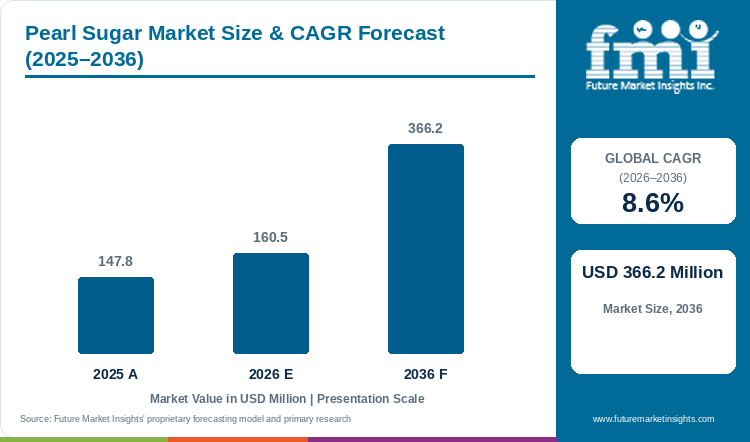
Assessed at USD 147.8 million in 2025 and progressing to USD 160.5 million in 2026, the pearl sugar market valuation is on course to reach USD 366.2 million by 2036, supported by a forecast-period CAGR of 8.6%.
European pearl sugar supply just concentrated, and Nordic bakers who built bake-off programs on Finnish nib lines now buy from whoever survives the consolidation. Nordzucker closed its Porkkala nib sugar line in March 2026 after concluding change negotiations at the refinery [9]. The global pearl sugar market was valued at USD 147.8 million in 2025 and is estimated to reach USD 160.5 million in 2026. The market is projected to reach USD 366.2 million by 2036, expanding at a compound annual growth rate (CAGR) of 8.6% between 2026 and 2036. Fine grades are projected to capture 37.0% of 2026 type demand because calibrated 1.6 to 4.0 millimeter nibs disperse evenly across waffle and bun surfaces without caramelizing into hard shards. Demand growth sits above the beet sugar market at 5.4% CAGR, since commodity sugar sells tonnage into a flat sweetener cycle while pearl sugar sells a bake-off texture specification with no drop-in substitute [2]. Specialty supply is professionalizing as INGREDIUM and Tate & Lyle agreed a transaction in July 2026 valuing the latter at GBP 1.8 billion to build a combined specialty bakery ingredients group [21], and ASR Group documented expanded Bonsucro-certified cane refining in June 2025 [22]. QSR operators expand waffle platforms against surface crunch consistency, and refiners holding certified nib capacity under EU sugar strategy audits win that scarce demand through 2036.
Key Market Trends & Insights
- By type: Fine Grades are projected to capture 37.0% of the type segment in 2026 because calibrated 1.6-millimeter to 4.0-millimeter nibs disperse evenly across automated pastry topping applicators.
- By form: Powder / Dry formats are estimated to command 39.0% of the form segment in 2026 as low-moisture compressed agglomerates prevent caking inside bulk bakery hoppers.
- By application: Bread & Rolls are expected to hold 33.0% of the application segment in 2026 owing to high-volume industrial production of Scandinavian cardamom buns, brioche loaves, and sweet dinner rolls.
- By claim: Conventional offerings are forecast to generate 49.0% of the claim segment in 2026 because standard refined sucrose crystals provide predictable high-temperature melt resistance.
- By sales channel: Direct to Industrial Bakeries is anticipated to account for 45.0% of the sales channel segment in 2026 through multi-tonne bulk tote contracts and annual price-hedged supply agreements.
Regional Highlights
- Top national expansion: The UAE is projected to lead evaluated national markets at a 9.9% CAGR through 2036 as luxury hotel patisseries and European café franchises expand across Dubai and Abu Dhabi.
- Broader country progression: Saudi Arabia is expected to expand at a 9.5% CAGR ahead of the USA at 9.2% and South Korea at 8.9%, while Japan is forecast to progress at a 7.6% CAGR.
Market Size & Forecast
Table 1: Market Size and Forecast for the Pearl Sugar Market (USD million and CAGR percentage), 2025 to 2036
| Metric | Value |
|---|---|
| 2025 Market Size | USD 147.8 million |
| Estimated Market Size in 2026 | USD 160.5 million |
| Projected Market Size by 2036 | USD 366.2 million |
| CAGR, 2026 to 2036 | 8.6% |
| Added Revenue, 2026 to 2036 | USD 205.7 million |
Compressing refined white sucrose under high roller pressure or extruding dampened sugar billets before multi-deck sieving is the core processing mechanism that separates pearl sugar from commodity sweeteners. While standard granulated cane sugar liquefies near 186 degrees Celsius and browns into flat puddles during baking, compacted pearl nibs exhibit low internal porosity that reflects radiant oven heat and preserves stark white surface crunch. Sucrose crystallization studies published in the Journal of Food Engineering in May 2025 confirmed that inline ultrasonic nucleation control narrows crystal chord-length distribution and accelerates uniform sucrose agglomeration by 30% to 45% [2]. This technical barrier allows specialty refiners to sustain price premiums over bulk granulated sugar even during commodity downcycles.
Commercial Compaction and Sieve-Grade Throughput Sizing
Table 2: Commercial Compaction and Sieve-Grade Throughput Sizing for the Pearl Sugar Market (USD million and operational ranges), 2025 to 2036
| Metric | 2025 | 2026 | 2036 |
|---|---|---|---|
| Market size (USD million) | 147.8 | 160.5 | 366.2 |
| Commercial pearl sugar volume (thousand tonnes) | 84.5 to 92.0 | 90.5 to 98.5 | 188.0 to 206.0 |
| Industrial 25-kg bag & FIBCs shipped (million units) | 3.1 to 3.5 | 3.3 to 3.8 | 6.9 to 7.7 |
| Average wholesale realization per tonne (USD) | 1,610 to 1,750 | 1,630 to 1,770 | 1,780 to 1,940 |
Operational note: Volume ranges reconcile roller-compaction and extrusion mill capacities against 18% to 22% fines-recycle screening rates across 25-kilogram kraft sacks and 1,000-kilogram flexible intermediate bulk containers (FIBCs).
Industrial waffle and chouquette lines experience severe deposit weight drift if sugar nibs fracture into dusty fines during pneumatic conveying. Bakery procurement engineers audit supplier attrition indices and coordinate with baking ingredients distributors to guarantee narrow sieve retention across C10 to C45 caliber grades.
Per Capita & Industrial Bakery Channel Sizing
Table 3: Per Capita and Bakery Channel Spending Indicators for the Pearl Sugar Market (USD), 2025 to 2036
| Metric | 2025 | 2026 | 2036 |
|---|---|---|---|
| World population (billion) | 8.2 | 8.3 | 9.0 |
| Spend per 1,000 people (USD) | 18.0 | 19.3 | 40.7 |
| Annual procurement per industrial bakery line (USD) | 14,200 to 16,800 | 15,100 to 17,900 | 28,500 to 33,400 |
| Direct contract & bulk distributor share (%) | 76.0% to 80.0% | 77.0% to 81.0% | 82.0% to 86.0% |
Table 4: Industrial & Channel Spending Indicators for the Pearl Sugar Market (USD and percentages), 2026
| Metric | Value | Institutional Reference Basis |
|---|---|---|
| Market size, 2026 | USD 160.5 million | 2026 global revenue baseline |
| Direct to industrial bakeries revenue, 2026 | USD 72.2 million | 45.0% sales-channel segment allocation |
| Fine grades revenue, 2026 | USD 59.4 million | 37.0% type segment allocation |
| Conventional claim revenue, 2026 | USD 78.6 million | 49.0% claim segment allocation |
Securing multi-year supply agreements with multinational frozen bakery groups requires pairing bulk pearl sugar deliveries with co-located liquid and dry sweetener portfolios. Refiners cross-sell compacted nibs as well as icing sugar and invert syrups to consolidate inbound freight across automated sweet-dough plants.
Analyst Perspective
"Industrial Viennoiserie and Belgian waffle manufacturers buy pearl sugar for thermal crystal integrity and low dust generation rather than baseline sweetness alone. Refiners that guarantee tight 1.6-millimeter to 9.5-millimeter sieve cuts without caking during humid summer transit will capture multi-plant bakery contracts."
- Nandini Roy Choudhury, Principal Analyst at Future Market Insights
How is the pearl sugar market segmented?
The pearl sugar market is segmented by type, form, application, claim, and sales channel. In 2026, Fine Grades are projected at 37.0%, Powder / Dry at 39.0%, Bread & Rolls at 33.0%, Conventional at 49.0%, and Direct to Industrial Bakeries at 45.0%.
By type: Fine Grades, Coarse & Decorative, Extruded Grades, and Specialty Blends.
By form: Powder / Dry, Granules / Pieces, Paste / Semi-Solid, and Liquid.
By application: Bread & Rolls, Cakes & Muffins, Biscuits & Cookies, Viennoiserie & Pastry, and Bakery & Snacks.
By claim: Conventional, Clean Label, Organic, and Identity Preserved.
By sales channel: Direct to Industrial Bakeries, Ingredient Distributors, Foodservice & Artisan, and Online B2B.
Why do Fine Grades lead the type segment?
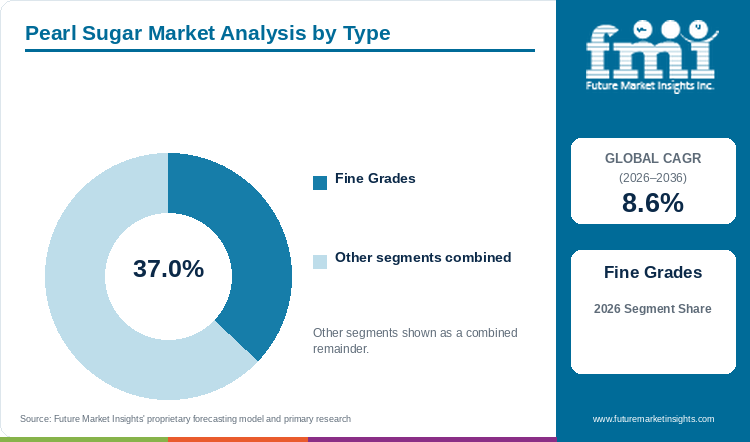
Fine Grades are projected to capture 37.0% of the type segment in 2026, supported by automated rotary topping accuracy.
Table 5: Type Share for the Pearl Sugar Market (percentage share), 2026
| Type | Share (2026) |
|---|---|
| Fine Grades | 37.0% |
| Other Segments Combined | 63.0%* |
| Total | 100.0% |
*Note: Remaining type subsegments sum to 100.0% of 2026 pearl sugar revenue.
Table 6: Type Leadership and Market Growth for the Pearl Sugar Market (segment and CAGR percentage), 2026 to 2036
| Metric | Value |
|---|---|
| Global CAGR (2026 to 2036) | 8.6% |
| Leading Segment | Fine Grades |
Fine Grades covering 1.6-millimeter to 4.0-millimeter particle calibers (P1 to P3 and C10 to C20 standards) anchor industrial bakery procurement because smaller compacted nibs adhere firmly to egg-washed dough surfaces without rolling off on high-speed conveyors. Unlike oversized Liège chunks that require custom dough folding, fine nibs run smoothly through standard waterfall seeders with brown sugar streusel toppings.
- Fine Grades are projected to account for 37.0% of the type segment in 2026 because 1.6-millimeter to 4.0-millimeter granules minimize bounce-off waste on high-speed brioche and chouquette lines.
- In April 2025, UK specialty refiner Ragus Sugars published technical specification guidance detailing how compacted white pearl sugar nibs maintain crystalline structure above 186 degrees Celsius across Scandinavian cinnamon bun and choux-pastry chouquette toppings [3].
Why does Powder / Dry define the largest form segment?
Powder / Dry formats are estimated to secure 39.0% of the form segment in 2026, driven by ambient warehouse stability.
Commercial dry pearl sugar agglomerates packaged at less than 0.05% equilibrium moisture resist microbial spoilage and eliminate the heated tank infrastructure required for liquid sugar syrups. Dry free-flowing crystalline beds allow plant operators to meter exact gram weights onto par-baked frozen pastries prior to blast freezing.
- Powder / Dry formats command an estimated 39.0% share of the form segment in 2026 as low water activity prevents inter-particle bridging inside 1,000-kilogram bulk bags.
- Sweetener thermal-stability trials published in Foods in April 2025 confirmed that dry crystalline sucrose reference formulations in baked matrices retained structural firmness and lifted sensory purchase intent from 44.3% to 69.7% when balanced against moisture-binding humectants [4].
What keeps Bread & Rolls ahead in the application segment?
Bread & Rolls are expected to command 33.0% of the application segment in 2026, reflecting year-round sweet loaf and bun production.
While Liège waffles generate high visibility in foodservice kiosks, industrial sweet bread and roll lines consume the largest baseline tonnage of pearl sugar across grocery in-store bakeries. European brioche loaves, Nordic cardamom buns, and festive panettone programs rely on pearl sugar to create localized sweet pockets and glossy crust decoration across specialty bread flour formulations.
- Bread & Rolls are expected to hold 33.0% of the application segment in 2026 because everyday supermarket brioche and sweet bun programs run continuously across all 52 weeks of the year.
- In March 2026, Belgian bakery group Vandemoortele reported full-year 2025 revenue of EUR 2,215 million (+7% year-on-year), driven by European and U.S. expansion of frozen bake-off sweet buns, pastries, and artisan bread rolls [5].
Why does Conventional lead the claim segment?
Conventional offerings are forecast to generate 49.0% of the claim segment in 2026, owing to refined beet sucrose purity.
Achieving brilliant opaque whiteness in compressed pearl sugar requires ultra-low ICUMSA color refined beet or cane sucrose free from molasses mineral residues. Conventional white sucrose delivers higher compaction hardness and lower ash browning at oven temperatures than unrefined organic cane sugar alternatives.
- Conventional claims are forecast to represent 49.0% of the claim segment in 2026 because high-purity refined sucrose prevents premature Maillard yellowing during 18-minute bake cycles.
- In May 2025, Südzucker Group reported consolidated fiscal 2024/25 revenue of EUR 9.7 billion and Sugar segment revenue of EUR 3.88 billion, confirming ongoing commercial beet sugar refining scale across European Union factories [6].
What gives Direct to Industrial Bakeries the leading position in sales channel?
Direct to Industrial Bakeries is anticipated to account for 45.0% of the sales channel segment in 2026, reinforced by bulk FIBC contracting.
High-speed Viennoiserie and waffle plants procure pearl sugar directly from sugar refiners under annual fixed-price or futures-linked contracts to lock in sieve caliber consistency. Direct mill-to-bakery shipments in 1,000-kilogram big bags eliminate distributor repackaging margins and reduce crystal attrition during secondary handling.
- Direct to Industrial Bakeries is anticipated to capture 45.0% of the sales channel segment in 2026 as automated bakeries specify direct FIBC deliveries to protect granule size distribution.
- In May 2025, Nordzucker AG reported fiscal 2024/25 group revenue of EUR 2.5 billion and allocated EUR 300 million in capital expenditure toward factory modernization and industrial customer supply reliability [7].
What are the drivers, restraints, and opportunities in the pearl sugar market?
In the pearl sugar market, global expansion of thaw-and-bake brioche and Belgian waffle programs propels demand whereas European nib-sugar line closures and added-sugar regulations restrain growth and clean-label hybrid bakery matrices unlock new opportunities.
- Driver: Rapid adoption of par-baked frozen Viennoiserie, chouquettes, and Liège waffles across supermarket in-store bakeries and coffee chains increases demand for bake-stable decorative and inclusion nibs.
- Restraint: Rationalization of regional European nib-sugar compaction lines and mandatory front-of-pack high-sugar warnings pressure procurement budgets and reformulation pipelines.
- Opportunity: Pairing surface pearl sugar nibs with internal fiber or rare-sugar dough matrices enables bakeries to cut total loaf added sugar by 25% while preserving signature visual crunch.
Growth Analysis and Future Potential: Qualitative Demand Catalysts
Supermarket in-store bakeries and international coffee shop chains are expanding premium sweet-bakery assortments by sourcing frozen proof-and-bake pastries topped with calibrated pearl sugar. Visible white sugar pearls signal authentic Belgian and Scandinavian craftsmanship to consumers while masking minor surface blistering after frozen storage. This premiumization wave lifts wholesale procurement across Europe bakery ingredient and North America sweet-goods supply chains. In July 2025, Spanish frozen bakery manufacturer Europastry reported 2024 annual turnover of EUR 1.506 billion (+12% year-on-year) and EUR 114.4 million in R&D and plant capital expenditure to scale global brioche and sweet dough production [8]. Industrial bakers consequently lock in multi-quarter pearl sugar allocations to safeguard seasonal holiday and everyday café launches.
Risk Assessment of the Pearl Sugar Market: Operational and Formulation Friction
Concentrated European compaction capacity and structural sugar price volatility expose downstream bakeries to regional supply bottlenecks. In March 2026, Nordzucker subsidiary Suomen Sokeri Oy concluded employee change negotiations at its Porkkala refinery in Finland and announced the permanent closure of its nib sugar production line to reduce fixed operating costs [9]. Public health taxation and clean-label sugar reduction initiatives across retail sugar confectionery and sweet bakery categories add regulatory friction. In August 2025, the Food and Agriculture Organization (FAO) reported that global sugar price indices experienced multi-month fluctuations tied to variable Brazilian cane crushes and European beet plantings [10]. Bakery buyers relying on single-mill pearl sugar sourcing face freight surcharges and longer lead times when regional compaction lines consolidate.
Commercial Opportunity Analysis: Formulation Differentiation and Value-Add Formats
Forward-looking bakery formulators use localized surface pearl sugar as a sensory anchor to reduce internal dough sucrose without sacrificing perceived indulgence. Because coarse sugar nibs dissolve directly on the tongue during mastication, a 3-gram surface topping delivers immediate sweetness bursts while internal dough sugar is replaced with bulk fibers or sugar substitutes. Suppliers also cross-develop non-hygroscopic organic and identity-preserved pearl grades for clean-label export brands across the United States bakery ingredients sector. In September 2025, clinical nutrition findings released by BENEO confirmed that replacing high-glycemic sucrose with slow-release Palatinose (isomaltulose) in sweet bakery matrices stimulates GLP-1 and PYY gut hormone release for weight-management formulations [11]. Combining surface pearl nibs with reduced-sugar base doughs allows commercial bakers to pass retailer nutrition audits while retaining artisan visual appeal.
Pearl Sugar Market by Country (2026 to 2036)
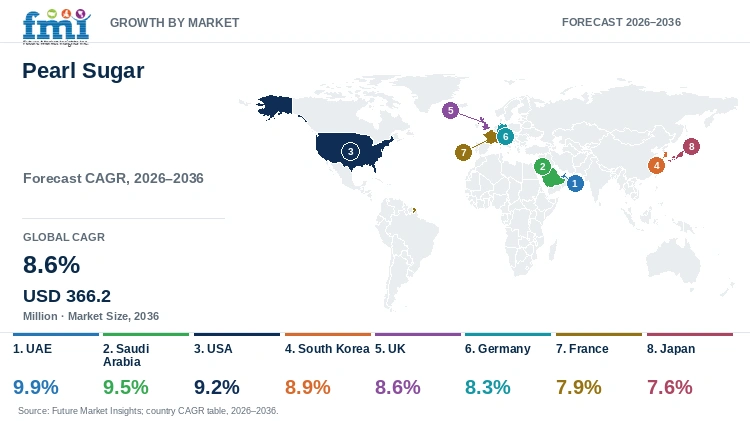
As per FMI, the UAE is projected to lead pearl sugar market growth across evaluated countries at a 9.9% CAGR through 2036, whereas Japan is forecast to expand at a 7.6% CAGR. National growth rates reflect Gulf hospitality patisserie expansion and North America brioche rollouts as well as East Asia café waffle franchises and Western Europe beet-refining consolidation.
Table 7: Country CAGR and Primary Growth Levers for the Pearl Sugar Market (CAGR percentage and operational drivers), 2026 to 2036
| Country | CAGR (2026 to 2036) | Primary Growth Lever |
|---|---|---|
| UAE | 9.9% | Luxury hotel patisserie expansion and Dubai nutrition-compliant portioned pastry innovation |
| Saudi Arabia | 9.5% | Domestic sugar refining scale-up and Vision 2030 café and QSR bakery franchise growth |
| USA | 9.2% | Nationwide supermarket brioche adoption and frozen Liège waffle retail distribution |
| South Korea | 8.9% | Specialty café croissant-waffle (croiffle) chains and premium dessert bakery imports |
| UK | 8.6% | In-store supermarket Scandinavian bun programs and domestic specialty sugar compaction |
| Germany | 8.3% | Domestic beet-sugar refining infrastructure and seasonal festive sweet-bread production |
| France | 7.9% | Artisan boulangerie chouquette traditions and industrial frozen brioche export plants |
| Japan | 7.6% | Convenience-store packaged Belgian waffle turnover and strict moisture-proof nib grading |
Source: Future Market Insights analysis
UAE Pearl Sugar Market Outlook (2026 to 2036)
High-volume international resort buffets and European-style artisan bakery cafés distinguish the UAE from price-sensitive mature grocery markets. Commercial pearl sugar sales in the UAE are projected to expand at a leading 9.9% CAGR from 2026 to 2036 across hotel commissaries and central frozen-dough plants. Gulf arrivals momentum through 2026 continued to support retail in-store bakery formats, where pearl sugar toppings ride specialty pastry listings across the region. Extreme summer coastal humidity and 100% reliance on imported refined sucrose nevertheless require moisture-barrier FIBC liners.
Key takeaway: In the UAE, luxury resort patisserie throughput and portion-controlled café bakery formats are projected to anchor premium pearl sugar import growth.
Saudi Arabia Pearl Sugar Market Outlook (2026 to 2036)
Commercial pearl sugar revenues in Saudi Arabia are forecast to rise at a 9.5% CAGR between 2026 and 2036 across industrial bakery parks and international coffee shop chains. Unlike smaller Gulf import hubs, Saudi Arabia operates massive domestic raw-sugar refining capacity that feeds packaged sweet-roll and pastry manufacturers across Jeddah and Riyadh. According to the April 2026 USDA Foreign Agricultural Service Sugar Annual report for Saudi Arabia (SA2026-0003), national raw and refined sugar imports are projected to rise 29% in 2026/27 to 2.2 million metric tons to satisfy expanding domestic food-processing and regional export demand [14]. SFDA added-sugar disclosure rules still push industrial bakers toward mini pastry portions.
Key takeaway: In Saudi Arabia, large-scale domestic sugar refining throughput and modern café bakery chains are forecast to accelerate industrial pearl sugar procurement.
USA Pearl Sugar Market Outlook (2026 to 2036)
What sets the USA apart from traditional European markets is the rapid mainstream supermarket migration of pearl-sugar-studded brioche loaves and thaw-and-serve Liège waffles from specialty boutiques into national grocery aisles. Data updated by the USDA Economic Research Service in June 2026 confirmed that U.S. food-away-from-home spending reached USD 1.41 trillion in 2025 and food-at-home sales hit USD 1.10 trillion to support high-volume commissary and in-store bakery sweet goods [1]. Commercial pearl sugar turnover in the USA is anticipated to advance at a 9.2% CAGR through 2036 across direct bakery contracts and specialty distributors. Tariff-rate quota duties on imported European beet nibs encourage domestic compaction across cane and beet refineries in the USA.
Key takeaway: In the USA, national grocery brioche rollouts and fast-casual Belgian waffle programs are anticipated to sustain strong industrial pearl sugar demand.
South Korea Pearl Sugar Market Outlook (2026 to 2036)
Trend-driven dessert cafés and hybrid pastry chains across Seoul and Busan differentiate South Korea by use coarse extruded pearl sugar to create caramelized outer crusts on croissant-waffles and sweet buns. Franchise bakery commissaries import calibrated European beet pearl sugar in 25-kilogram moisture-sealed kraft sacks to guarantee uniform surface crunch under high-pressure waffle irons. Data from the 2025 Survey on the Overseas Expansion of Foodservice Industry published by the Ministry of Agriculture, Food and Rural Affairs (MAFRA) in February 2026 confirmed that bakery and dessert café chains from South Korea expanded international store networks across 56 countries [15]. High import freight rates and rapid dessert menu rotation put South Korea on an 8.9% CAGR through 2036.
Key takeaway: In South Korea, premium dessert café chains and hybrid pastry innovations are expected to drive imported coarse and fine pearl sugar consumption.
UK Pearl Sugar Market Outlook (2026 to 2036)
In the UK, supermarket in-store bakeries and artisan high-street coffee chains have popularized Nordic cinnamon and cardamom buns topped with bake-stable white nib sugar. Commercial pearl sugar revenue in the UK is projected to progress at an 8.6% CAGR over the 2026 to 2036 forecast period across industrial plant bakeries and foodservice distributors. The April 2026 USDA Foreign Agricultural Service Sugar Annual report for the United Kingdom (UK2026-0011) noted that domestic sugar beet planted area declined to 85,000 hectares for 2026/27 due to lower contract prices while imports expand to cover domestic processing needs [16]. HFSS promotional restrictions in English supermarkets nonetheless compel bakers to emphasize seasonal and premium artisanal formats.
Key takeaway: In the UK, supermarket in-store Nordic bun programs and domestic specialty sugar refining are projected to support steady pearl sugar growth.
Germany Pearl Sugar Market Outlook (2026 to 2036)
Germany works as a primary European production hub for compacted beet pearl sugar (Hagelzucker), supported by integrated sugar refineries and deep seasonal traditions in yeast-raised Hefezopf and festive pastries. According to the April 2026 USDA Foreign Agricultural Service European Union Sugar Annual report (E42026-0034), EU sugar beet planted area is forecast to contract by 8.2% in 2026/27 to 1.37 million hectares and tighten regional white beet sugar balances across mills in Germany [17]. Domestic pearl sugar sales in Germany are projected to grow at an 8.3% CAGR from 2026 to 2036 across industrial bake-off plants and artisan guilds. Discounter retail price pressure and energy costs restrain domestic margin expansion.
Key takeaway: In Germany, industrial frozen bake-off pastry exports and integrated beet-refining capacity are projected to sustain commercial Hagelzucker demand.
France Pearl Sugar Market Outlook (2026 to 2036)
Market demand for commercial pearl sugar in France is forecast to expand at a 7.9% CAGR between 2026 and 2036 across independent boulangeries and multinational frozen Viennoiserie exporters. France anchors global culinary specifications for calibrated Sucre Perlé across choux-pastry chouquettes, tropéziennes, and northern cramique brioche loaves. National commercial facility data released by INSEE in July 2025 documented 50,106 active bakery-pastry establishments and 14,871 supermarkets and hypermarkets operating across France to provide extensive daily retail outlets for pearl-sugar-topped pastries [18]. Market saturation across traditional neighborhood artisan shops and strict Nutri-Score front-of-pack sugar scrutiny channel incremental domestic volume into exported frozen par-baked brioche and laminated pastry lines.
Key takeaway: In France, daily artisan chouquette production and multinational frozen brioche export factories are forecast to anchor long-term pearl sugar consumption.
Japan Pearl Sugar Market Outlook (2026 to 2036)
Japan distinguishes itself through convenience-store (konbini) chilled and ambient Belgian waffle packs where pearl sugar nibs must resist weeping during humid summer distribution. Industrial bakeries in Japan specify tightly sieved, low-dust pearl sugar grades and specialized fat-coated nibs to prevent moisture migration from soft waffle crumb into the sugar crystal. According to the April 2026 USDA Foreign Agricultural Service Sugar Annual report for Japan (JA2026-0011), total national centrifugal sugar consumption in Japan is forecast at 1.65 million metric tons in 2026/27 as inbound tourism hospitality offsets demographic contraction [19]. High domestic beet logistics costs and demographic aging place Japan on a 7.6% CAGR from 2026 to 2036.
Key takeaway: In Japan, convenience-store packaged Belgian waffle programs and strict anti-melting nib specifications are expected to sustain specialized pearl sugar demand.
Full report country CAGRs cover: North America; Latin America; Western Europe; Eastern Europe; East Asia; South Asia and Pacific; Middle East and Africa.
Who are the notable companies in the pearl sugar market?
Südzucker AG, Nordzucker AG, ASR Group, Cargill, Ragus Sugars, Tate & Lyle, Ingredion, Roquette, BENEO, and ADM are the notable companies in the pearl sugar market.
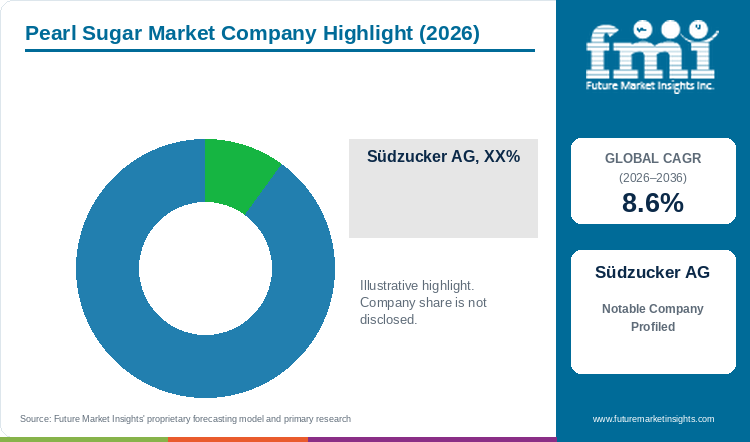
Auditing European beet-refinery product catalogs and industrial bakery ingredient filings shows that market participants divide into primary pearl and nib sugar manufacturers, specialty sugar refiners and packers, and adjacent bakery sweetening platforms. Südzucker AG (operating Belgian pearl-sugar leader Raffinerie Tirlemontoise / Tiense Suikerraffinaderij and France-based subsidiary Saint Louis Sucre) and Nordzucker AG manufacture compacted and extruded beet pearl sugar across calibrated sieve grades. Meanwhile, Ingredion Incorporated announced a recommended cash and share acquisition of Tate & Lyle PLC in July 2026 to form a combined USD 11 billion specialty food and bakery ingredient platform.
- Primary European Beet Pearl & Nib Sugar Producers: Südzucker AG (via Raffinerie Tirlemontoise and Saint Louis Sucre) and Nordzucker AG (via Dansukker and Suomen Sokeri) operate dedicated roller-compaction and extrusion lines for C10 to C45 pearl and nib sugar.
- Specialty Sugar Refiners & Industrial Packers: ASR Group (Domino Specialty Ingredients), Cargill, and Ragus Sugars supply calibrated pearl sugar, decorative sanding sugars, and bulk bakery sucrose across North America and Europe.
- Adjacent Bakery Sweetening & Matrix Platforms: Tate & Lyle, Ingredion, Roquette, BENEO (Südzucker Group subsidiary), and ADM supply functional carbohydrates, polyols, and reduced-sugar dough systems paired with surface pearl sugar toppings.
Competitive Benchmarking: Pearl Sugar Market
Table 8: Competitive Benchmarking for the Pearl Sugar Market (qualitative capability ratings), 2026
| Company | Direct Pearl/Nib Range | Sieve Caliber Breadth | Industrial Bakery Access | Geographic Reach |
|---|---|---|---|---|
| Südzucker AG | High | High | High | High |
| Nordzucker AG | High | High | High | High |
| ASR Group | High | High | High | High |
| Cargill | Medium | Medium | High | High |
| Ragus Sugars | High | High | High | Medium |
| Tate & Lyle | Medium | Medium | High | High |
| Ingredion | Medium | Medium | High | High |
| Roquette | Medium | Medium | High | High |
| BENEO | Medium | Medium | High | High |
| ADM | Medium | Medium | High | High |
Scoring basis: Capability ratings evaluate documented C10-to-C45 extruded and compacted pearl/nib sugar production and sieve grade breadth. Industrial bakery access and geographic scores reflect bulk FIBC delivery infrastructure and multi-region sweet-goods customer reach.
Key Developments in the Pearl Sugar Market
- Nordzucker subsidiary Suomen Sokeri Oy concluded employee change negotiations at its Porkkala refinery in March 2026 and announced the closure of its Finnish nib sugar line to consolidate regional European specialty sugar operations [9], following Nordzucker's January 2026 green-steam decarbonization milestone at its Uelzen sugar plant [20].
- Ingredion Incorporated and Tate & Lyle PLC announced a recommended cash and share transaction on July 6, 2026 valuing Tate & Lyle at GBP 1.8 billion (USD 2.4 billion) to create a combined USD 11 billion specialty bakery and food ingredients leader [21].
- ASR Group released its FY24 Sustainability Report in June 2025 documenting expanded Bonsucro-certified cane refining and a 25% warehouse transfer reduction target across its North America and Europe specialty sugar mills [22].
Key Players in the Pearl Sugar Market
Primary Beet Pearl and Nib Sugar Producers
- Südzucker AG (Raffinerie Tirlemontoise / Saint Louis Sucre)
- Nordzucker AG (Dansukker / Suomen Sokeri)
Specialty Sugar Refiners and Industrial Packers
- ASR Group
- Cargill
- Ragus Sugars
Adjacent Bakery Sweetening and Matrix Platforms
- Tate & Lyle
- Ingredion
- Roquette
- BENEO
- ADM
Pearl Sugar Market - Report Scope
Table 9: Report Scope for the Pearl Sugar Market (coverage fields and definitions), 2026 to 2036
| Coverage field | Report scope |
|---|---|
| Market breakdown | Type; Form; Application; Claim; Sales Channel |
| Quantitative Units | USD Million |
| Market Definition | Includes commercial manufacturer revenue from compacted and extruded pearl sugar (nib sugar / hail sugar / sucre perlé) across covered type, form, application, claim, and channel segments. Category Scope Note: Excludes commodity bulk white granulated sugar, standard powdered icing sugar, liquid sucrose syrups sold outside pearl/nib specifications, and downstream finished bakery product revenues. |
| Regions Covered | North America; Latin America; Western Europe; Eastern Europe; East Asia; South Asia and Pacific; Middle East and Africa |
| Countries Covered | UAE, Saudi Arabia, USA, South Korea, UK, Germany, France, Japan, and additional countries in the full report |
| Key Companies Covered | Südzucker AG, Nordzucker AG, ASR Group, Cargill, Ragus Sugars, Tate & Lyle, Ingredion, Roquette, BENEO, ADM |
| Forecast Period | 2026 to 2036 |
| Approach | Primary and secondary research with top-down and bottom-up market triangulation. |
Pearl Sugar Market - Research Methodology
Table 10: Research Methodology for the Pearl Sugar Market (research methods and approach), 2026 edition
| Method | Approach |
|---|---|
| Primary Research | Structured interviews with European beet-sugar compaction mill engineers, industrial Viennoiserie QA directors, Belgian waffle line managers, and specialty bakery ingredient distributors to verify sieve attrition tolerances and FIBC contract pricing. |
| Secondary Research | Audit of USDA FAS GAIN Sugar Annual reports (EU, Saudi Arabia, UK, Japan), USDA ERS Food Expenditure Series, FAO sugar price releases, corporate financial filings (Südzucker, Nordzucker, Vandemoortele, Europastry, Tate & Lyle, Ingredion), and peer-reviewed sucrose crystallization literature. |
| Market Sizing and Forecasting | Top-down specialty bakery sugar expenditure models reconciled against bottom-up roller-compaction and extrusion line capacities (accounting for 18% to 22% screening fines recycle) from 2026 to 2036. |
| Country Forecasting Model | Econometric national projections weight industrial frozen bake-off capacity, specialty café and hotel patisserie density, domestic beet/cane refining balances, and front-of-pack sugar labeling regulations across eight countries. |
| Operational Benchmark Traceability | Tonnage, bag counts, and per-line spending metrics in Tables 2, 3, and 4 trace to industrial compaction mass balances, 25-kg and 1,000-kg FIBC shipping weights, and audited bakery ingredient procurement accounts. |
| Data Triangulation and Validation | Supplier revenues are cross-checked against verified pearl/nib sugar SKU catalogs (merging Tiense and Saint Louis Sucre under Südzucker AG and accounting for Suomen Sokeri's 2026 Porkkala nib-line closure) while excluding commodity granulated sugar. |
Pearl Sugar Market by Segments
Pearl Sugar Market segmented by Type:
- Fine Grades
- Coarse & Decorative
- Extruded Grades
- Specialty Blends
Pearl Sugar Market segmented by Form:
- Powder / Dry
- Granules / Pieces
- Paste / Semi-Solid
- Liquid
Pearl Sugar Market segmented by Application:
- Bread & Rolls
- Cakes & Muffins
- Biscuits & Cookies
- Viennoiserie & Pastry
- Bakery & Snacks
Pearl Sugar Market segmented by Claim:
- Conventional
- Clean Label
- Organic
- Identity Preserved
Pearl Sugar Market segmented by Sales Channel:
- Direct to Industrial Bakeries
- Ingredient Distributors
- Foodservice & Artisan
- Online B2B
Pearl Sugar Market by Region
- North America
- United States
- Canada
- Latin America
- Brazil
- Mexico
- Argentina
- Chile
- Western Europe
- Germany
- France
- United Kingdom
- Italy
- Spain
- Benelux
- Nordics
- Eastern Europe
- Poland
- Czech Republic
- Romania
- Hungary
- East Asia
- China
- Japan
- South Korea
- South Asia and Pacific
- India
- ASEAN
- Australia and New Zealand
- Middle East and Africa
- GCC Countries
- South Africa
- Türkiye
- Israel
Research Sources and Bibliography
- [1] Zeballos, E., & Sinclair, W. (2026, June 1). Ag and Food Statistics: Charting the Essentials - Food Prices and Spending. U.S. Department of Agriculture, Economic Research Service.
- [2] Polat, S., Sayan, P., & Ulrich, J. (2025, May 1). Population balance modeling and inline monitoring of sucrose crystallization and agglomeration kinetics. Journal of Food Engineering (PubMed PMID 40448499).
- [3] Ragus Sugars Manufacturing Ltd. (2025, April 14). Pearl Sugar vs Nib Sugar: Crystalline Compaction, Sieve Grading, and Bake-Stable Bakery Applications. Ragus Sugars Technical Insights.
- [4] Torrico, D. D., Mehta, A., & Boreczek, J. (2025, April 10). Sensory, Emotional, and Physicochemical Characterization of Chocolate Brownies Formulated with Sucrose and Alternative Sweetener Blends. Foods, 14(8), 1318 (PubMed PMID 40282720).
- [5] Vandemoortele NV. (2026, March 30). Vandemoortele Annual Financial Report 2025: Group Revenue Reaches EUR 2,215 Million Supported by Bakery Acquisitions. Vandemoortele Corporate Press Release.
- [6] Südzucker AG. (2025, May 15). Südzucker with significant decline in earnings in fiscal 2024/25. Südzucker AG Corporate Press Release.
- [7] Nordzucker AG. (2025, May 22). Solid annual result - rigorous cost-saving programme launched. Nordzucker AG Corporate Newsroom.
- [8] Europastry, S.A. (2025, July 29). Europastry dispara su facturación a un récord de 1.506 millones en 2024 impulsada por la innovación en bollería y panadería congelada. Cinco Días / El País.
- [9] Suomen Sokeri Oy (Nordzucker Group). (2026, March 27). Change negotiations at Suomen Sokeri concluded: Nib sugar production line at Porkkala refinery to close. Suomen Sokeri Official Press Release.
- [10] Food and Agriculture Organization of the United Nations. (2025, August 8). FAO Food Price Index edges up in July. FAO Markets and Trade Newsroom.
- [11] Theis, S., & BENEO GmbH. (2025, September 11). Palatinose boosts GLP-1 & PYY for health: Study shows BENEO Palatinose stimulates gut hormone release. BENEO Nutrition Science Communications.
- [12] Dubai Department of Economy and Tourism. (2026, September 9). Tourism Performance Report January - August 2026. Government of Dubai, Department of Economy and Tourism.
- [13] Dubai Municipality. (2025, July 30). Over 34,000 food inspections conducted in first half of 2025. Government of Dubai, Dubai Municipality Newsroom.
- [14] USDA Foreign Agricultural Service. (2026, April 12). Saudi Arabia: Sugar Annual. Global Agricultural Information Network (GAIN) Report No. SA2026-0003.
- [15] Jeong, K., & Ministry of Agriculture, Food and Rural Affairs (MAFRA). (2026, February 6). Key Findings from the 2025 Survey on the Overseas Expansion of Foodservice Industry. Food Industry Policy Bureau, Republic of Korea MAFRA.
- [16] USDA Foreign Agricultural Service. (2026, April 16). United Kingdom: Sugar Annual. Global Agricultural Information Network (GAIN) Report No. UK2026-0011.
- [17] USDA Foreign Agricultural Service. (2026, April 15). European Union: Sugar Annual. Global Agricultural Information Network (GAIN) Report No. E42026-0034.
- [18] Institut national de la statistique et des études économiques (INSEE). (2025, July 10). Équipements et services à la population en 2024 - France entière. INSEE Base permanente des équipements (BPE).
- [19] USDA Foreign Agricultural Service. (2026, April 10). Japan: Sugar Annual. Global Agricultural Information Network (GAIN) Report No. JA2026-0011.
- [20] Nordzucker AG. (2026, January 20). Milestone for green steam at the Uelzen plant. Nordzucker AG Corporate Newsroom.
- [21] Tate & Lyle PLC & Ingredion Incorporated. (2026, July 6). Recommended Cash and Share Acquisition of Tate & Lyle PLC by Ingredion Incorporated. Tate & Lyle PLC Official Regulatory Announcement.
- [22] ASR Group. (2025, June 18). ASR Group Sustainability Report FY24 (English). ASR Group Corporate Sustainability Division.
This bibliography is provided for reader reference and is not exhaustive. The full report contains the complete reference list and detailed citations.
This Report Answers
- How large is the pearl sugar market in 2026 and what value is forecast for 2036?
- Which frozen Viennoiserie and Belgian waffle trends propel demand for pearl sugar?
- Why do Fine Grades lead the type segment?
- Why does Conventional retain the largest share in the claim segment?
- How do projected CAGRs differ across the UAE, Saudi Arabia, the USA, and Germany?
- Which companies manufacture primary beet pearl and nib sugar versus broader bakery sweeteners?
- How does the March 2026 Porkkala nib-sugar line closure affect European regional supply?
- What sieve caliber and attrition specifications should industrial bakeries audit before contracting?
Frequently Asked Questions
How big is the pearl sugar market in 2026, and what is forecast for 2036?
According to FMI, global pearl sugar revenue is estimated to reach USD 160.5 million in 2026 from USD 147.8 million in 2025. Sales are forecast to hit USD 366.2 million by 2036 as commercial bakeries scale frozen brioche and Belgian waffle output.
What is the CAGR for the pearl sugar market from 2026 to 2036?
Future Market Insights projects an 8.6% CAGR between 2026 and 2036. This expansion yields USD 205.7 million in incremental annual revenue across direct industrial bakery and distributor channels.
Which type segment leads the pearl sugar market?
Fine Grades are projected to capture 37.0% of the type segment in 2026 because calibrated 1.6-millimeter to 4.0-millimeter nibs flow evenly through automated pastry topping seeders.
Which claim segment represents the largest share in the pearl sugar market?
Conventional sucrose formulations are estimated to hold 49.0% of the claim segment in 2026 as high-purity refined beet and cane crystals resist yellowing at 200 degrees Celsius.
Which country has the highest growth outlook during the assessment period?
The UAE is projected to lead evaluated national markets at a 9.9% CAGR through 2036, followed by Saudi Arabia at 9.5% and the USA at 9.2%.
Who are the key players in the market?
Primary European beet pearl and nib sugar manufacturers include Südzucker AG (via Raffinerie Tirlemontoise and Saint Louis Sucre) and Nordzucker AG. Additional evaluated suppliers include ASR Group and Cargill as well as Ragus Sugars. Adjacent bakery sweetening platforms include Tate & Lyle and Ingredion in addition to Roquette, BENEO, and ADM.
Preview the report firsthand - request a free sample
Get SampleGet the brochure for pricing and purchase details.
Get PDFTable of Content
- Key Takeaways
- Market Size and CAGR
- Top Growth Driver
- Fastest Growing Segment
- Leading Region
- Key Companies
- Emerging Opportunities
- Executive Summary
- Global Market Outlook
- Demand-side Trends
- Supply-side Trends
- Technology Roadmap Analysis
- Analysis and Recommendations
- Analyst Perspective (What is happening? Why now? What should investors know?)
- Key Questions Answered
- How large is the market?
- What is the CAGR?
- What are key trends?
- Which region dominates?
- Who are the leaders?
- Market Overview
- Market Coverage / Taxonomy
- Market Definition / Scope / Limitations
- Research Methodology
- Chapter Orientation
- Analytical Lens and Working Hypotheses
- Market Structure, Signals, and Trend Drivers
- Benchmarking and Cross-market Comparability
- Market Sizing, Forecasting, and Opportunity Mapping
- Research Design and Evidence Framework
- Desk Research Programme (Secondary Evidence)
- Expert Input and Fieldwork (Primary Evidence)
- Tooling, Models, and Reference Databases
- Data Engineering and Model Build
- Quality Assurance and Audit Trail
- Market Background
- Market Dynamics (Drivers, Restraints, Opportunity, Trends)
- Scenario Forecast (Optimistic, Likely, Conservative)
- Impact Analysis
- AI Impact
- Sustainability Impact
- Regulatory Impact
- Technology Impact
- Consumer / Buyer Analysis
- Purchase Drivers
- Adoption Barriers
- Buyer Journey
- Opportunity Map Analysis
- Product Life Cycle Analysis
- Supply Chain Analysis
- Investment Feasibility Matrix
- Value Chain Analysis
- PESTLE and Porter's Analysis
- Regulatory Landscape
- Regional Parent Market Outlook
- Production and Consumption Statistics
- Import and Export Statistics
- Global Market Analysis and Forecast, 2021 to 2036
- Historical Market Size Value (USD Million) Analysis, 2021 to 2025
- Current and Future Market Size Value (USD Million) Projections, 2026 to 2036
- Y-o-Y Growth Trend Analysis
- Absolute $ Opportunity Analysis
- Global Market Pricing Analysis, 2021 to 2036
- Global Market Analysis and Forecast, By Type, 2021 to 2036
- Introduction / Key Findings
- Historical Market Size Value (USD Million) Analysis By Type, 2021 to 2025
- Current and Future Market Size Value (USD Million) Analysis and Forecast By Type, 2026 to 2036
- Fine Grades
- Coarse & Decorative
- Extruded Grades
- Specialty Blends
- Y-o-Y Growth Trend Analysis By Type, 2021 to 2025
- Absolute $ Opportunity Analysis By Type, 2026 to 2036
- Global Market Analysis and Forecast, By Form, 2021 to 2036
- Introduction / Key Findings
- Historical Market Size Value (USD Million) Analysis By Form, 2021 to 2025
- Current and Future Market Size Value (USD Million) Analysis and Forecast By Form, 2026 to 2036
- Powder / Dry
- Granules / Pieces
- Paste / Semi-Solid
- Liquid
- Y-o-Y Growth Trend Analysis By Form, 2021 to 2025
- Absolute $ Opportunity Analysis By Form, 2026 to 2036
- Global Market Analysis and Forecast, By Application, 2021 to 2036
- Introduction / Key Findings
- Historical Market Size Value (USD Million) Analysis By Application, 2021 to 2025
- Current and Future Market Size Value (USD Million) Analysis and Forecast By Application, 2026 to 2036
- Bread & Rolls
- Cakes & Muffins
- Biscuits & Cookies
- Viennoiserie & Pastry
- Bakery & Snacks
- Y-o-Y Growth Trend Analysis By Application, 2021 to 2025
- Absolute $ Opportunity Analysis By Application, 2026 to 2036
- Global Market Analysis and Forecast, By Claim, 2021 to 2036
- Introduction / Key Findings
- Historical Market Size Value (USD Million) Analysis By Claim, 2021 to 2025
- Current and Future Market Size Value (USD Million) Analysis and Forecast By Claim, 2026 to 2036
- Conventional
- Clean Label
- Organic
- Identity Preserved
- Y-o-Y Growth Trend Analysis By Claim, 2021 to 2025
- Absolute $ Opportunity Analysis By Claim, 2026 to 2036
- Global Market Analysis and Forecast, By Sales Channel, 2021 to 2036
- Introduction / Key Findings
- Historical Market Size Value (USD Million) Analysis By Sales Channel, 2021 to 2025
- Current and Future Market Size Value (USD Million) Analysis and Forecast By Sales Channel, 2026 to 2036
- Direct to Industrial Bakeries
- Ingredient Distributors
- Foodservice & Artisan
- Online B2B
- Y-o-Y Growth Trend Analysis By Sales Channel, 2021 to 2025
- Absolute $ Opportunity Analysis By Sales Channel, 2026 to 2036
- Global Market Analysis and Forecast, By Region, 2021 to 2036
- Introduction
- Historical Market Size Value (USD Million) Analysis By Region, 2021 to 2025
- Current Market Size Value (USD Million) Analysis and Forecast By Region, 2026 to 2036
- North America
- Latin America
- Western Europe
- Eastern Europe
- East Asia
- South Asia and Pacific
- Middle East and Africa
- Market Attractiveness Analysis By Region
- North America Market Analysis and Forecast, By Country, 2021 to 2036
- Historical Market Size Value (USD Million) Trend Analysis By Market Taxonomy, 2021 to 2025
- Market Size Value (USD Million) Forecast By Market Taxonomy, 2026 to 2036
- By Country
- United States
- Canada
- By Type
- By Form
- By Application
- By Claim
- By Sales Channel
- By Country
- Market Attractiveness Analysis
- By Country
- By Type
- By Form
- By Application
- By Claim
- By Sales Channel
- Key Takeaways
- Latin America Market Analysis and Forecast, By Country
- Historical Market Size Value (USD Million) Trend Analysis By Market Taxonomy, 2021 to 2025
- Market Size Value (USD Million) Forecast By Market Taxonomy, 2026 to 2036
- By Country
- Brazil
- Mexico
- Argentina
- Chile
- By Type
- By Form
- By Application
- By Claim
- By Sales Channel
- By Country
- Market Attractiveness Analysis
- By Country
- By Type
- By Form
- By Application
- By Claim
- By Sales Channel
- Key Takeaways
- Western Europe Market Analysis and Forecast, By Country
- Historical Market Size Value (USD Million) Trend Analysis By Market Taxonomy, 2021 to 2025
- Market Size Value (USD Million) Forecast By Market Taxonomy, 2026 to 2036
- By Country
- Germany
- France
- United Kingdom
- Italy
- Spain
- Benelux
- Nordics
- By Type
- By Form
- By Application
- By Claim
- By Sales Channel
- By Country
- Market Attractiveness Analysis
- By Country
- By Type
- By Form
- By Application
- By Claim
- By Sales Channel
- Key Takeaways
- Eastern Europe Market Analysis and Forecast, By Country
- Historical Market Size Value (USD Million) Trend Analysis By Market Taxonomy, 2021 to 2025
- Market Size Value (USD Million) Forecast By Market Taxonomy, 2026 to 2036
- By Country
- Poland
- Czech Republic
- Romania
- Hungary
- By Type
- By Form
- By Application
- By Claim
- By Sales Channel
- By Country
- Market Attractiveness Analysis
- By Country
- By Type
- By Form
- By Application
- By Claim
- By Sales Channel
- Key Takeaways
- East Asia Market Analysis and Forecast, By Country
- Historical Market Size Value (USD Million) Trend Analysis By Market Taxonomy, 2021 to 2025
- Market Size Value (USD Million) Forecast By Market Taxonomy, 2026 to 2036
- By Country
- China
- Japan
- South Korea
- By Type
- By Form
- By Application
- By Claim
- By Sales Channel
- By Country
- Market Attractiveness Analysis
- By Country
- By Type
- By Form
- By Application
- By Claim
- By Sales Channel
- Key Takeaways
- South Asia and Pacific Market Analysis and Forecast, By Country
- Historical Market Size Value (USD Million) Trend Analysis By Market Taxonomy, 2021 to 2025
- Market Size Value (USD Million) Forecast By Market Taxonomy, 2026 to 2036
- By Country
- India
- ASEAN
- Australia and New Zealand
- By Type
- By Form
- By Application
- By Claim
- By Sales Channel
- By Country
- Market Attractiveness Analysis
- By Country
- By Type
- By Form
- By Application
- By Claim
- By Sales Channel
- Key Takeaways
- Middle East and Africa Market Analysis and Forecast, By Country
- Historical Market Size Value (USD Million) Trend Analysis By Market Taxonomy, 2021 to 2025
- Market Size Value (USD Million) Forecast By Market Taxonomy, 2026 to 2036
- By Country
- GCC Countries
- South Africa
- Türkiye
- Israel
- By Type
- By Form
- By Application
- By Claim
- By Sales Channel
- By Country
- Market Attractiveness Analysis
- By Country
- By Type
- By Form
- By Application
- By Claim
- By Sales Channel
- Key Takeaways
- Key Countries Market Analysis
- United States
- Pricing Analysis
- Market Share Analysis, 2025
- By Type
- By Form
- By Application
- By Claim
- By Sales Channel
- Canada
- Pricing Analysis
- Market Share Analysis, 2025
- By Type
- By Form
- By Application
- By Claim
- By Sales Channel
- Mexico
- Pricing Analysis
- Market Share Analysis, 2025
- By Type
- By Form
- By Application
- By Claim
- By Sales Channel
- Brazil
- Pricing Analysis
- Market Share Analysis, 2025
- By Type
- By Form
- By Application
- By Claim
- By Sales Channel
- Chile
- Pricing Analysis
- Market Share Analysis, 2025
- By Type
- By Form
- By Application
- By Claim
- By Sales Channel
- Germany
- Pricing Analysis
- Market Share Analysis, 2025
- By Type
- By Form
- By Application
- By Claim
- By Sales Channel
- United Kingdom
- Pricing Analysis
- Market Share Analysis, 2025
- By Type
- By Form
- By Application
- By Claim
- By Sales Channel
- Italy
- Pricing Analysis
- Market Share Analysis, 2025
- By Type
- By Form
- By Application
- By Claim
- By Sales Channel
- Spain
- Pricing Analysis
- Market Share Analysis, 2025
- By Type
- By Form
- By Application
- By Claim
- By Sales Channel
- France
- Pricing Analysis
- Market Share Analysis, 2025
- By Type
- By Form
- By Application
- By Claim
- By Sales Channel
- India
- Pricing Analysis
- Market Share Analysis, 2025
- By Type
- By Form
- By Application
- By Claim
- By Sales Channel
- ASEAN
- Pricing Analysis
- Market Share Analysis, 2025
- By Type
- By Form
- By Application
- By Claim
- By Sales Channel
- Australia and New Zealand
- Pricing Analysis
- Market Share Analysis, 2025
- By Type
- By Form
- By Application
- By Claim
- By Sales Channel
- China
- Pricing Analysis
- Market Share Analysis, 2025
- By Type
- By Form
- By Application
- By Claim
- By Sales Channel
- Japan
- Pricing Analysis
- Market Share Analysis, 2025
- By Type
- By Form
- By Application
- By Claim
- By Sales Channel
- South Korea
- Pricing Analysis
- Market Share Analysis, 2025
- By Type
- By Form
- By Application
- By Claim
- By Sales Channel
- Poland
- Pricing Analysis
- Market Share Analysis, 2025
- By Type
- By Form
- By Application
- By Claim
- By Sales Channel
- Hungary
- Pricing Analysis
- Market Share Analysis, 2025
- By Type
- By Form
- By Application
- By Claim
- By Sales Channel
- Türkiye
- Pricing Analysis
- Market Share Analysis, 2025
- By Type
- By Form
- By Application
- By Claim
- By Sales Channel
- South Africa
- Pricing Analysis
- Market Share Analysis, 2025
- By Type
- By Form
- By Application
- By Claim
- By Sales Channel
- UAE
- Pricing Analysis
- Market Share Analysis, 2025
- By Type
- By Form
- By Application
- By Claim
- By Sales Channel
- Saudi Arabia
- Pricing Analysis
- Market Share Analysis, 2025
- By Type
- By Form
- By Application
- By Claim
- By Sales Channel
- United States
- Market Structure Analysis
- Competition Dashboard
- Competition Benchmarking
- Market Share Analysis of Top Players
- By Regional
- By Type
- By Form
- By Application
- By Claim
- By Sales Channel
- Emerging Startups
- Innovation Benchmarking
- Competition Analysis
- Competition Deep Dive
- Südzucker AG
- Overview
- Product Portfolio
- Profitability by Market Segments
- Sales Footprint
- Strategy Overview
- Marketing Strategy
- Product Strategy
- Channel Strategy
- Nordzucker AG
- ASR Group
- Cargill
- Ragus Sugars
- Tate & Lyle
- Ingredion
- Roquette
- BENEO
- ADM
- Südzucker AG (Raffinerie Tirlemontoise / Saint Louis Sucre)
- Nordzucker AG (Dansukker / Suomen Sokeri)
- Südzucker AG
- Case Studies
- Success Stories
- Recent Developments
- Competition Deep Dive
- Assumptions & Acronyms Used


