

- Market Size (2026)
- USD 620.7 Mn
- Forecast (2036)
- USD 1020.7 Mn
- CAGR (2026 to 2036)
- 5.1%
How big is Veneer Splicing Adhesives Market in 2026?
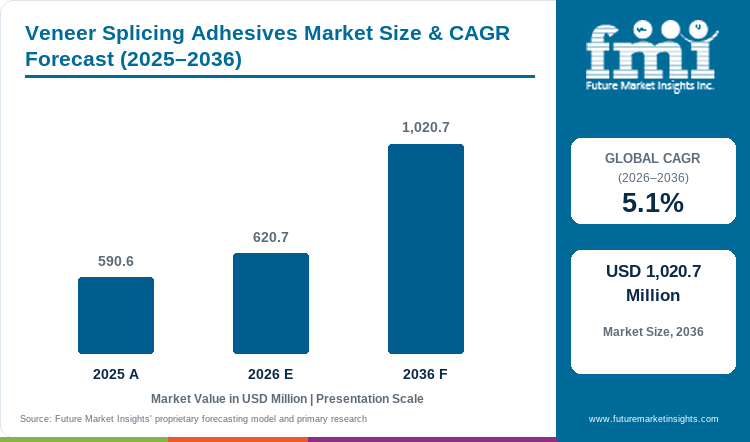
USD 620.7 Million in 2026 and USD 1,020.7 Million by 2036 at a 5.1% CAGR.
Demand for Veneer Splicing Adhesives is estimated at USD 620.7 Million in 2026 and is forecast to reach USD 1,020.7 Million by 2036, growing at a CAGR of 5.1%. The market was valued at USD 590.6 Million in 2025. Adhesive demand is recurring because veneer preparation is repeated across panel and furniture production. Mills qualify a formulation on seam consistency, open time, set speed, and fit with downstream pressing rather than unit price alone. Vietnam illustrates this demand route. In May 2025, the Ministry of Industry and Trade described the country as one of the world’s five largest wood-furniture exporters and highlighted established production capability and supply chains. That manufacturing base supports repeat demand for adhesives that hold thin veneer through handling and pressing.
Country conditions change the route from technical interest to repeat orders. Vietnam and Indonesia combine export-oriented wood processing with continued supply-chain development, which supports qualification of productivity-focused products. Brazil has an established wood and furniture export base, while suppliers still need regional service coverage. The USA and Canada place greater weight on formaldehyde compliance for composite wood and laminated products. Germany combines European emissions requirements with weaker recent furniture demand, while Japan adds strict indoor-air controls to a mature production environment. In each market, an adhesive must fit installed equipment and finished-panel requirements before it becomes a recurring purchase.
Key Takeaways
- Export-oriented veneer, panel, and furniture production supports recurring adhesive demand through ongoing mill throughput.
- Mills favor adhesive systems that reduce handling defects while maintaining production speed during veneer splicing and layup.
- Low-emission formulations are gaining relevance as composite-wood regulations place greater emphasis on product qualification and emissions performance.
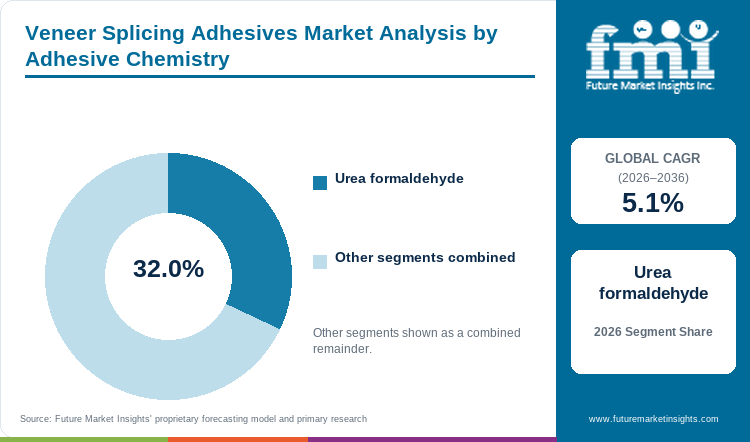
- Urea formaldehyde accounts for 32.0% of Adhesive Chemistry demand in 2026, supported by established use in veneer and panel production workflows.
- Liquid adhesives represent 42.0% of Form demand in 2026 because metering, mixing, and glue-spread parameters can be adjusted directly on production lines.
- Hardwood veneer holds a 34.0% share of Veneer Type demand in 2026, reflecting stricter requirements for visible decorative surfaces, discoloration control, and bleed-through prevention.
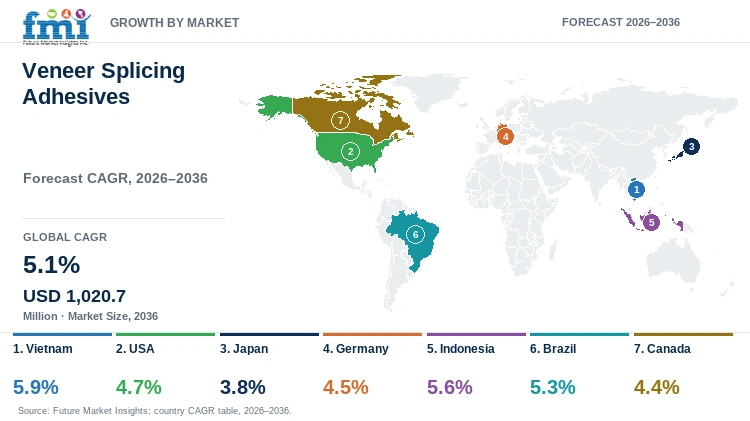
- Vietnam records the highest CAGR among the key countries in this market at 5.9% from 2026 to 2036.
- Indonesia follows at 5.6%, while Brazil is forecast at 5.3% and the USA at 4.7% over the same period.
- Germany, Canada, and Japan are forecast to expand at 4.5%, 4.4%, and 3.8%, respectively, reflecting more mature manufacturing and qualification cycles.
- Competition centers on adhesive chemistry breadth, documented process compatibility, mill-level qualification support, and technical service capability.
- Henkel, Jowat, Kleiberit, AkzoNobel, Dynea, Prefere Resins, H.B. Fuller, Bostik / Arkema, Sika, and Franklin International are among the notable companies serving veneer, woodworking, lamination, or panel adhesive applications.
Analyst Perspective
Chemistry changes succeed when the mill can preserve seam appearance, press speed, moisture performance, and documentation through production. Technical service matters because veneer species, moisture, temperature, and glue spread can change the qualification result. Suppliers that reduce emissions without increasing adhesive consumption or rework are better positioned for repeat orders.
- Nikhil Kaitwade, Principal Analyst at Future Market Insights
How is the veneer splicing adhesives market segmented?
The market is segmented by Adhesive Chemistry, Form, Veneer Type, Application, and Sales Channel.
Adhesive Chemistry separates thermosetting resins from PVAc, EVA hot melt, and polyurethane systems with different cure behavior and compliance profiles. Form distinguishes liquid dosing from powder mixing, hot-melt application, and preformed film or tape formats. Veneer Type captures the appearance and handling requirements of hardwood, softwood, engineered, and decorative materials. Application separates upstream core-sheet joining from face splicing, decorative panel layup, and furniture veneer preparation. Sales Channel reflects where specification authority sits. Wood panel mills buy at production scale, distributors provide local access, adhesive producers support direct qualification, and equipment-linked supply pairs consumables with installed splicing systems.
What makes Urea formaldehyde central to the Adhesive Chemistry category?
Urea formaldehyde remains central because many veneer and panel operations are designed around a low-viscosity thermosetting system that cures quickly under heat. Buyers understand its mix ratio and pot life plus glue spread and press response. That familiarity reduces conversion risk when throughput is the main operating constraint. Its position is increasingly conditioned by emissions rules rather than displaced in one step. Mills can move toward ultra-low-emitting grades or alternative chemistries when certification requirements tighten. The commercial contest is therefore between installed process economics and the combined cost of reformulation and testing plus documentation and line retuning.
- Urea formaldehyde holds a 32.0% share in 2026, supported by established hot-press workflows and a large installed base of panel-processing knowledge.
- The USA EPA stated in January 2025 that formaldehyde is used in resins, glues, composite wood products, furniture, and adhesives. Its risk evaluation increases the compliance pressure around formaldehyde-containing systems.
Why does Liquid lead the Form category?
Liquid formulations fit the way mills control glue application. Operators can adjust spread rate and viscosity while tuning mix ratio and temperature without changing the whole material-handling architecture. This matters in veneer work because too much adhesive can bleed through a thin surface while too little can create weak seams or open joints. Liquid UF and PVAc systems also support both direct adhesive supply and distributor channels. Powder and hot-melt formats remain important where storage stability or rapid setting is decisive. Liquid retains the broadest process fit because the same dosing logic can be tuned across species, veneer thicknesses, and press schedules.
- Liquid holds a 42.0% share in 2026 because mills can meter and tune these formulations within existing glue-spread and mixing systems.
- Jowat presented Jowacoll GROW 125.00 in April 2025 as a 30% bio-based PVAc dispersion adhesive for flat lamination. The same LIGNA program included PUR hot-melt additions for high-tension materials such as thick veneers.
How does Hardwood veneer shape the Veneer Type category?
Hardwood veneer carries a high visual penalty for an imperfect bond. Decorative faces expose discoloration and telegraphing as well as squeeze-out and bleed-through that may be hidden in structural layers. Adhesive selection therefore combines bond strength with neutral color and predictable penetration into thin porous wood. Hardwood species also vary widely in density and extractives. That raises the value of plant trials and species-specific process settings. Softwood and engineered veneer compete on cost and availability. Decorative veneer adds design complexity. Hardwood leads because furniture and interior applications place a premium on a clean finished surface that survives downstream sanding, coating, and assembly.
- Hardwood veneer holds a 34.0% share in 2026, reflecting the importance of clean joints and controlled adhesive penetration in visible furniture and panel surfaces.
- Kleiberit documented its 343.3 formaldehyde-free veneer adhesive in May 2025 as ready to use, discoloration-free, moisture resistant, and resistant to glue penetration through veneer. Its technical sheet lists an approximate press time of 30 seconds at 100 degrees Celsius for 0.6 mm veneer.
What supports Core veneer splicing in the Application category?
Core veneer splicing sits upstream of panel layup, so small improvements can affect a large volume of downstream material. The process converts narrower or irregular sheets into a continuous core that can be handled by layup and pressing equipment. Reliable seams improve sheet integrity during transfer. They also help mills use more of the veneer recovered from logs. The adhesive must set quickly enough to avoid becoming the bottleneck while allowing alignment before the joint is fixed. Face splicing and decorative layup demand tighter appearance controls. Core work matters because throughput, material yield, and stable sheet handling intersect at this stage.
- Indonesia’s planning ministry reported in May 2025 that wood panels and furniture were major contributors to the country’s USD 12.73 billion of 2024 forestry-product exports, underscoring the industrial scale behind veneer and panel preparation.
What drives Wood panel mills in the Sales Channel category?
Wood panel mills combine specification authority with repeat consumption. Production managers can link adhesive performance directly to line speed and scrap as well as finished-panel emissions and customer claims. That encourages direct technical engagement before a formulation change. Bulk logistics and lot consistency also matter because a small shift in viscosity or cure can be amplified across continuous production. Distributors remain valuable for local stock and smaller users. Direct adhesive producers compete where formulation support is needed. Equipment-linked suppliers matter when a splicer requires a defined consumable format. Mills are important buyers because they control both the process window and recurring purchase volume.
- Vietnam’s Ministry of Industry and Trade reported in May 2025 that the country has strong furniture manufacturing capability and established supply chains. This favors suppliers that can support production-scale qualification rather than only spot distribution.
What are the drivers, restraints, and opportunities in the veneer splicing adhesives market?
Export-oriented wood processing supports recurring adhesive demand, while emissions compliance raises qualification costs and low-emission formulations create a route to replacement revenue.
- Driver: Expansion and modernization of veneer-based panel and furniture manufacturing increase recurring adhesive use and raise line-speed requirements.
- Restraint: Formaldehyde, worker-safety, and finished-panel requirements can lengthen qualification and make chemistry switching expensive.
- Opportunity: Low-emission and formaldehyde-free products can win conversions when they run on installed equipment without sacrificing press cycle or appearance.
The demand driver is mill throughput. Export processors add adhesive consumption when they run more veneer through splicing and layup as well as lamination and furniture-preparation lines. In May 2025, Indonesia’s Bappenas reported that wood panels and furniture were major contributors to the country’s 2024 forestry-product exports. Vietnam’s trade ministry also described a strong furniture manufacturing base in May 2025. These facts matter because veneer adhesives are recurring process inputs. A mill that improves utilization of veneer sheets or avoids visible seam defects can justify a formulation on total usable output rather than purchase price per kilogram. Suppliers benefit when products prove that value under production conditions.
The main restraint appears at qualification. The USA EPA’s January 2025 formaldehyde risk evaluation reinforces scrutiny of formaldehyde-containing resins and glues. European Commission Regulation (EU) 2023/1464 adds an emissions limit for formaldehyde released from furniture and wood-based articles after its transition period. Canada also applies formaldehyde-emission rules to composite wood products and laminated products. These requirements do not eliminate UF demand. They raise the documentation burden around resin choice and finished-panel testing. Record keeping and supplier changes add further friction. Mills therefore resist switching when an alternative cannot match press speed or would trigger new certification work.
The opportunity is a lower-emission formulation that fits the existing line. Kleiberit has documented a formaldehyde-free veneer adhesive with fast hot-press curing, while Jowat introduced a bio-based PVAc dispersion for flat lamination and Henkel expanded its MicroEmission hot-melt portfolio for furniture processing. Commercial adoption depends on preserving open time, initial strength, bond appearance, and press productivity. Suppliers with application engineering support are better placed to qualify alternatives against the mill’s veneer species and operating window.
Which country CAGRs are included in the veneer splicing adhesives market analysis?
| Country | CAGR |
|---|---|
| Vietnam | 5.9% |
| USA | 4.7% |
| Japan | 3.8% |
| Germany | 4.5% |
| Indonesia | 5.6% |
| Brazil | 5.3% |
| Canada | 4.4% |
How do country-level CAGRs compare in the veneer splicing adhesives market?
The seven selected countries span a 2.1 percentage-point range from Vietnam at 5.9% to Japan at 3.8% between 2026 and 2036. Vietnam and Indonesia form the faster-growth Southeast Asian band. Brazil follows with a 5.3% CAGR and combines a substantial wood-products export base with furniture manufacturing. The USA sits in the upper part of the mature-market group at 4.7%. Germany at 4.5% and Canada at 4.4% are closely grouped. Japan is lower at 3.8% as a mature manufacturing base with strict product requirements. These rates describe pace, not absolute market size.
- Vietnam at 5.9% and Indonesia at 5.6% are separated by only 0.3 percentage points. Channel investment in both markets should emphasize mill access, export compliance, and application engineering.
- Indonesia at 5.6% exceeds Brazil at 5.3% by 0.3 percentage points. The commercial difference is less about speed than about local service coverage across distinct wood-processing clusters.
- Brazil at 5.3% is 0.6 percentage points above the USA at 4.7%. Brazil offers expansion-linked demand, while the USA places greater weight on formaldehyde certification and established supplier qualification.
- The USA, Germany, and Canada cluster between 4.4% and 4.7%, while Japan sits at 3.8%. In these markets, replacement timing and compliance documentation can matter more than greenfield capacity.
CAGR cannot be read as market rank. A slower-growing country can still represent a large adhesive pool if it has a broad installed base of plywood and furniture production or a large cabinet and decorative-panel sector. Opportunity also depends on the chemistry mix and buyer concentration. The full report therefore evaluates country growth alongside production structure and formaldehyde rules. It also tests channel access and the cost of qualification. Suppliers should use the CAGR table to prioritize timing, then test the size and accessibility of the addressable mill base before allocating technical-service resources.
Country-wise Analysis
- Export-focused manufacturers often qualify adhesives against customer specifications and production yield. Demand for Veneer Splicing Adhesives in Vietnam is forecast to expand at 5.9% CAGR from 2026 to 2036. In May 2025, the Ministry of Industry and Trade described Vietnam as one of the five largest wood-furniture exporting countries and cited strong production capability with established supply chains. Traceability and destination-market technical requirements remain a friction for processors. Suppliers should combine low-emission options with on-line trials, consistent bulk supply, and documentation that can travel with export-focused panel and furniture programs.
- Large panel and furniture plants tend to formalize adhesive changes through quality, environmental, and procurement review. Demand for Veneer Splicing Adhesives in the USA is forecast to expand at 4.7% CAGR from 2026 to 2036. The EPA’s composite-wood framework requires non-exempt laminated products made with formaldehyde-containing resins to meet certification provisions that became applicable in March 2024. The resulting testing and record-keeping burden can delay a resin change. Suppliers need clear emissions documentation, stable lot quality, and technical support that proves a new formulation will not disrupt press cycles or finished-panel performance.
- Japanese buyers operate in a mature quality environment where indoor-air requirements and process consistency carry high weight. Demand for Veneer Splicing Adhesives in Japan is forecast to expand at 3.8% CAGR from 2026 to 2036. METI’s January 2026 industrial-production release showed wood and wood-products output and furniture output moving within an established manufacturing base rather than a rapid capacity-build cycle. Formaldehyde-emitting building materials also remain subject to F-star controls. Suppliers should compete on dependable cure behavior, low emissions, appearance control, and evidence that a formulation fits established production standards without adding qualification risk.
- German furniture and panel buyers balance process efficiency with tightening European emissions expectations. Demand for Veneer Splicing Adhesives in Germany is forecast to expand at 4.5% CAGR from 2026 to 2036. Destatis reported in March 2025 that German furniture-industry revenue fell 7.8% in 2024 to about EUR 16.3 billion. Weak end-market demand increases price discipline even as European formaldehyde rules raise the value of low-emission chemistry. Suppliers should show measurable adhesive-use efficiency and avoid forcing equipment changes. Technical service must connect regulatory compliance to lower total cost per finished panel.
- Panel and furniture exporters in Indonesia buy against both production economics and destination-market requirements. Demand for Veneer Splicing Adhesives in Indonesia is forecast to expand at 5.6% CAGR from 2026 to 2036. Bappenas reported in May 2025 that wood panels and furniture were major contributors to USD 12.73 billion of forestry-product exports in 2024. Legal-origin and sustainability expectations add another qualification layer for export supply chains. Suppliers should support fast-setting products with local process troubleshooting and documentation. Reliable service around veneer moisture, glue spread, and press conditions can be as important as the formulation itself.
- Brazilian wood processors serve both domestic demand and demanding export markets from concentrated regional manufacturing clusters. Demand for Veneer Splicing Adhesives in Brazil is forecast to expand at 5.3% CAGR from 2026 to 2036. Santa Catarina’s industry secretariat reported in July 2025 that the state led Brazil in first-half wood exports at USD 668.7 million and furniture exports at USD 141.3 million. Freight distance and regional service availability can complicate adhesive support. Suppliers should build dependable distribution near major clusters and pair it with technical service for veneer, plywood, and furniture production lines.
- Canadian processors operate under a regulated composite-wood environment and a trade-sensitive manufacturing cycle. Demand for Veneer Splicing Adhesives in Canada is forecast to expand at 4.4% CAGR from 2026 to 2036. Statistics Canada reported in February 2026 that wood-product manufacturers were affected by tariffs and production slowdowns during 2025. Health Canada guidance applicable from March 2025 also covers formaldehyde emissions from laminated products and finished goods. Suppliers need formulations that support compliance without increasing process cost. Flexible packaging, regional stock, and documentation for panel certification can reduce the friction of switching.
Who are the notable companies in the veneer splicing adhesives market?
H.B. Fuller, Henkel, Jowat, Kleiberit, Bostik / Arkema, Dynea, Prefere Resins, Sika, AkzoNobel, and Franklin International are among the notable companies included in this market analysis.
Competition spans thermosetting resins, PVAc systems, hot melts, polyurethane adhesives, and broader woodworking portfolios. Henkel, Jowat, Kleiberit, and AkzoNobel document furniture, lamination, or veneering capabilities across multiple adhesive technologies. Dynea and Prefere Resins bring wood-panel resin depth, while H.B. Fuller adds industrial adhesive scale and woodworking exposure. Bostik / Arkema, Sika, and Franklin International maintain woodworking adhesive portfolios with different application and channel strengths. Buyers compare suppliers on process fit, technical support, emissions documentation, and the ability to manage a chemistry change without disrupting line performance.
- Multi-chemistry furniture and lamination specialists: Henkel, Jowat, Kleiberit, and AkzoNobel compete on broad application coverage and multiple paths to lower-emission bonding.
- Resin and panel-process specialists: Dynea, Prefere Resins, and H.B. Fuller bring thermoset or industrial adhesive depth plus technical support for continuous wood-processing operations.
- Woodworking and application-channel specialists: Bostik / Arkema, Sika, and Franklin International compete through application support, established adhesive channels, and regional product availability.
Competitive Benchmarking: Veneer Splicing Adhesives Market
| Company | Veneer & Lamination Fit | Relevant Chemistry Breadth | Mill Technical Support | Geographic Reach |
|---|---|---|---|---|
| H.B. Fuller | Medium | Medium | High | North America, Europe, Asia-Pacific, and Latin America |
| Henkel | High | High | High | Global with strong Europe, North America, and Asia-Pacific coverage |
| Jowat | High | High | High | Europe, North America, Asia-Pacific, and partner-led Latin America |
| Kleiberit | High | High | High | Europe with international furniture and wood-processing reach |
| Bostik / Arkema | Medium | Medium | Medium | Global group reach with documented woodworking offers in Asia-Pacific and Oceania |
| Dynea | High | High | High | Europe and selected international wood-panel markets |
| Prefere Resins | Medium | High | High | Europe, North America, and Asia through production and technical-service locations |
| Sika | Unscored | Medium | Medium | Global industrial and construction-adhesive reach |
| AkzoNobel | High | High | High | Europe, North America, and other established wood-processing markets |
| Franklin International | Medium | Medium | Medium | North America with adhesive distribution across 60 countries and six continents |
Scoring basis: Veneer & Lamination Fit measures documented products or process guidance for veneer bonding, flat lamination and plywood or closely related furniture operations. Relevant Chemistry Breadth measures documented coverage across the stated resin and adhesive families rather than the company’s total corporate portfolio. Mill Technical Support measures evidence of application engineering and line trials plus formulation adjustment or on-site service for wood processors. High indicates broad documented capability and Medium indicates credible but narrower evidence. Low would mean a documented limitation; unavailable public information is left Unscored.
Key Developments in the Veneer Splicing Adhesives Market
- In May 2025, Henkel presented new furniture and wood-processing adhesive technologies for LIGNA 2025. The portfolio included expanded MicroEmission PUR hot melts, a new polypropylene-based edge-banding adhesive, and new 2D lamination solutions with higher renewable carbon content. The development raises the competitive benchmark for lower-emission production chemistry that can run within modern furniture processes without forcing a broad workflow redesign.
- In April 2025, Jowat announced a new Jowacoll GROW 125.00 PVAc dispersion adhesive with 30% bio-based content for flat lamination. Jowat also introduced PUR hot-melt additions for flat lamination that can bond high-tension materials including thick veneers. The development gives furniture processors more options to reduce fossil-content exposure while preserving familiar flat-lamination and production-speed requirements during high-volume furniture production.
- In May 2025, Kleiberit documented its 343.3 formaldehyde-free veneer adhesive. The technical information describes a ready-to-use system with no VOC emissions, no glue penetration through veneer, and an approximate press time of 30 seconds at 100 degrees Celsius for 0.6 mm veneer. The product addresses the trade-off between lower-emission chemistry and industrial press speed.
- In May 2023, H.B. Fuller completed the acquisition of Beardow Adams, an industrial adhesive manufacturer with manufacturing in Europe and the USA plus sales in more than 70 countries. H.B. Fuller identified woodworking among the markets served by the combined business. The transaction expanded distribution and production options that can support industrial wood customers needing local supply, application expertise, and access to multiple adhesive technologies.
Key Players in the Veneer Splicing Adhesives Market
Multi-Chemistry Furniture and Lamination Specialists
- Henkel
- Jowat
- Kleiberit
- AkzoNobel
Resin and Panel-Process Specialists
- Dynea
- Prefere Resins
- H.B. Fuller
Woodworking and Application-Channel Specialists
- Bostik / Arkema
- Sika
- Franklin International
Veneer Splicing Adhesives Market - Report Scope
| Coverage field | Report scope |
|---|---|
| Market breakdown | Adhesive Chemistry, Form, Veneer Type, Application, and Sales Channel |
| Quantitative Units | USD Million |
| Market Definition | Revenue from adhesives sold for joining, splicing, and preparing natural or engineered veneer sheets within the stated chemistry, form, veneer-type, application, and channel universe. Downstream plywood, panel, furniture, equipment, and adjacent or substitute-product revenue are excluded. |
| Regions Covered | North America; Latin America; Western Europe; Eastern Europe; East Asia; South Asia and Pacific; Middle East and Africa |
| Countries Covered | Vietnam, USA, Japan, Germany, Indonesia, Brazil, Canada, and more than twenty-five additional countries in the full report |
| Key Companies included | H.B. Fuller, Henkel, Jowat, Kleiberit, Bostik / Arkema, Dynea, Prefere Resins, Sika, AkzoNobel, Franklin International |
| Forecast Period | 2026 to 2036 |
| Approach | FMI uses a hybrid bottom-up and top-down sizing approach that reconciles supplier revenues and application demand with country manufacturing indicators and channel checks while applying defined exclusions. |
Veneer Splicing Adhesives Market - Research Methodology
| Method | Approach |
|---|---|
| Primary Research | FMI engages adhesive manufacturers, distributors, wood-panel mills, furniture processors, procurement teams, and subject-matter experts to test purchasing criteria, application requirements, channel behavior, qualification frictions, and switching triggers. |
| Desk Research | FMI reviews official manufacturing and trade statistics, chemical and composite-wood regulations, standards material, company filings, technical product literature, and first-party company announcements. Evidence is retained only when it supports the defined market boundary or an explicitly identified operating mechanism. |
| Market Sizing and Forecasting | Market sizing combines supplier-side revenue checks with application demand and country manufacturing activity. Forecast assumptions consider veneer and panel output, furniture production, adhesive replacement patterns, regulatory change, chemistry migration, and channel development across the 2026 to 2036 period. |
| Data Validation | FMI cross-checks company, application, and country evidence before reconciliation. Downstream finished-product revenue, equipment revenue, duplicate channel flows, general wood adhesives outside the defined use cases, and unsupported adjacent categories are excluded from market totals. |
Veneer Splicing Adhesives Market by Segments
Veneer Splicing Adhesives Market segmented by Adhesive Chemistry:
- Urea formaldehyde
- PVAc adhesives
- EVA hot melts
- Polyurethane adhesives
- Phenolic resins
Veneer Splicing Adhesives Market segmented by Form:
- Liquid
- Powder
- Hot melt
- Film/tape adhesive
Veneer Splicing Adhesives Market segmented by Veneer Type:
- Hardwood veneer
- Softwood veneer
- Engineered veneer
- Decorative veneer
Veneer Splicing Adhesives Market segmented by Application:
- Core veneer splicing
- Face veneer splicing
- Decorative panel layup
- Furniture veneer preparation
Veneer Splicing Adhesives Market segmented by Sales Channel:
- Wood panel mills
- Adhesive distributors
- Direct adhesive producers
- Equipment-linked supply
Veneer Splicing Adhesives Market by Region:
- North America
- United States
- Canada
- Latin America
- Brazil
- Mexico
- Argentina
- Chile
- Western Europe
- Germany
- France
- United Kingdom
- Italy
- Spain
- Benelux
- Nordics
- Eastern Europe
- Poland
- Czech Republic
- Romania
- Hungary
- East Asia
- China
- Japan
- South Korea
- South Asia and Pacific
- India
- ASEAN
- Australia and New Zealand
- Middle East and Africa
- GCC Countries
- South Africa
- Türkiye
- Israel
Research Sources and Bibliography
- USA Environmental Protection Agency (2025, January 2). EPA Finalizes TSCA Risk Evaluation for Formaldehyde. URL: https://www.epa.gov/chemicals-under-tsca/epa-finalizes-tsca-risk-evaluation-formaldehyde
- European Commission (2023, July 14). Commission Regulation (EU) 2023/1464 amending Annex XVII to REACH as regards formaldehyde and formaldehyde releasers. URL: https://eur-lex.europa.eu/legal-content/EN/TXT/?uri=CELEX%3A32023R1464
- Health Canada (2025, March 18). Guidance document on the Formaldehyde Emissions from Composite Wood Products Regulations. URL: https://www.canada.ca/en/health-canada/services/chemical-substances/chemicals-management-plan/initiatives/guidance-document-formaldehyde-emissions-composite-wood-products-regulations.html
- Vietnam Ministry of Industry and Trade (2025, May 22). More than 100 enterprises attend webinar on Vietnam-India cooperation in wood and furniture. URL: https://moit.gov.vn/tin-tuc/thi-truong-nuoc-ngoai/hon-100-doanh-nghiep-tham-du-webinar-hop-tac-viet-nam-an-do-trong-linh-vuc-go-va-noi-that-ket-noi-thuc-chat-mo-rong-hop-.html
- Indonesia Ministry of National Development Planning / Bappenas (2025, May 10). Through Business Forum at World Expo 2025 Osaka, Indonesia Encourages Exports of Quality Forestry Products. URL: https://www.bappenas.go.id/berita/lewat-forum-bisnis-di-world-expo-2025-osaka-indonesia-dorong-ekspor-produk-kehutanan-berkualitas-3zDC1
- Santa Catarina Secretariat of Industry, Commerce and Services (2025, July 21). Santa Catarina is the national leader in wood and furniture exports. URL: https://www.sicos.sc.gov.br/santa-catarina-e-lider-nacional-em-exportacao-de-madeira-e-moveis/
- Federal Statistical Office of Germany (Destatis) (2025, March 20). Furniture industry records 7.8% decline in sales in 2024. URL: https://www.destatis.de/DE/Presse/Pressemitteilungen/2025/03/PD25_N011_421.html
- Japan Ministry of Economy, Trade and Industry (2026, January 30). Preliminary Indices of Industrial Production, December 2025. URL: https://www.meti.go.jp/statistics/tyo/iip/result/book/b2020_202512sj.html
- Statistics Canada (2026, February 16). Monthly Survey of Manufacturing, December 2025. URL: https://www150.statcan.gc.ca/n1/daily-quotidien/260216/dq260216a-eng.htm
- Henkel (2025, May 7). Sustainability across the entire value chain: Henkel at Ligna 2025. URL: https://www.henkel.in/press-media/press-releases-and-kits/2025-05-07-sustainability-across-the-entire-value-chain-2057250
- LIGNA / Deutsche Messe (2025, April 7). Wide-ranging Adhesive Portfolio for sustainable manufacturing Process. URL: https://www.ligna.de/en/news/news-articles/wide-ranging-adhesive-portfolio-for-sustainable-manufacturing-process
- Kleiberit SE & Co. KG (2025, May). KLEIBERIT 343.3 Formaldehyde-Free Veneer Adhesive. URL: https://www.kleiberit.com/fileadmin/Content_new/Infoblaetter/englisch/343_3_FastFormaldehydeFreeAdhesive_GBUS.pdf
- H.B. Fuller (2023, May 10). H.B. Fuller Acquires Beardow Adams. URL: https://newsroom.hbfuller.com/press-releases/press-release-details/2023/H.B.-Fuller-Acquires-Beardow-Adams/default.aspx
- USA Environmental Protection Agency (2026, April 1). Frequent Questions for Regulated Stakeholders about Implementing the Formaldehyde Standards for Composite Wood Products Act. URL: https://www.epa.gov/formaldehyde/frequent-questions-regulated-stakeholders-about-implementing-formaldehyde-standards
- Prefere Resins (2022, July 25). One Rock Capital Partners Completes Acquisition of Prefere Resins. URL: https://prefere.com/en/company/news/one-rock-capital-partners-completes-acquisition-of-prefere-resins
- Bostik (n.d.). Woodworking Adhesives. URL: https://www.bostik.com/uk/en_GB/markets-applications/industrial-solutions/building-materials/woodworking/
- Dynea (n.d.). Wood Adhesives. URL: https://www.dynea.com/en/product-areas/wood-adhesives
- AkzoNobel (n.d.). Adhesives for furniture, flooring and building products. URL: https://woodadhesives.akzonobel.com/en/applications
- Sika (n.d.). Wood Adhesive Bonding. URL: https://gbr.sika.com/en/distribution/adhesives/wood.html
- Franklin International (n.d.). Our Businesses. URL: https://franklininternational.com/our-businesses
This bibliography is provided for reader reference and is not exhaustive. The full report contains the complete reference list and detailed citations.
This Report Answers
- What is the Veneer Splicing Adhesives Market size in 2026 and what value is forecast for 2036?
- Which wood-processing and compliance pressures support demand for veneer splicing adhesives?
- Why does Urea formaldehyde hold the leading position within Adhesive Chemistry?
- How does the leading Liquid form influence dosing, process control, and downstream veneer handling?
- Why does Hardwood veneer hold the leading position within Veneer Type?
- How do growth rates differ across Vietnam, USA, Japan, Germany, Indonesia, Brazil, and Canada?
- Which companies provide multi-chemistry, resin-focused, or woodworking-oriented adhesive capabilities?
- How do formaldehyde rules and mill qualification costs limit adhesive switching?
- What should mill procurement and process teams evaluate before selecting a veneer splicing adhesive?
Frequently Asked Questions
What is driving growth in the Veneer Splicing Adhesives Market?
Growth is driven by recurring adhesive consumption as veneer and plywood plants raise throughput while decorative-panel and furniture plants seek better material yield. The strongest purchases occur when a formulation improves seam integrity or line speed while remaining compatible with downstream pressing and finishing.
Who are the key players in the Veneer Splicing Adhesives Market?
The companies included are H.B. Fuller, Henkel, Jowat, Kleiberit, Bostik / Arkema, Dynea, Prefere Resins, Sika, AkzoNobel, and Franklin International. They compete through different combinations of veneer-process fit and resin chemistry plus industrial service and regional channel access.
What notable restraint affects the Veneer Splicing Adhesives Market?
The main restraint is the cost and time needed to qualify a chemistry change on a live wood-processing line. Formaldehyde-emission requirements can add finished-panel testing and documentation; process changes can affect cure speed and appearance as well as total usable output.
Why should executives track the Veneer Splicing Adhesives Market?
The market sits at the intersection of recurring consumables spending, manufacturing yield, and composite-wood compliance. Executives should track whether low-emission alternatives can move from trial to repeat purchase without requiring costly equipment changes or slower press cycles.
What business problem does the Veneer Splicing Adhesives Market address?
Veneer splicing adhesives help processors create stable veneer sheets and joints that survive handling and layup plus pressing, sanding and finishing. The commercial job is to reduce gaps, visible defects, and scrap while keeping production speed inside the mill’s required operating window.
What should mill procurement teams evaluate in the Veneer Splicing Adhesives Market?
Mill teams should evaluate bond appearance and open time plus set speed and moisture resistance; adhesive spread and emissions profile must be checked against installed equipment. They should compare technical-service response and adhesive cost per usable finished panel rather than unit price alone.
What limits return on investment in the Veneer Splicing Adhesives Market?
Return on investment weakens when a lower-cost adhesive increases scrap, requires longer press time, or creates more cleaning and rework. Switching also loses value when certification work and training plus storage or equipment adjustments consume the savings expected from the new formulation.
What supports long-term commercial confidence in the Veneer Splicing Adhesives Market?
Long-term confidence comes from the recurring nature of adhesive consumption and the continuing need to join thin veneer reliably in industrial production. Regulatory pressure also creates replacement cycles for suppliers that can lower emissions without compromising productivity, appearance, or moisture performance. Key Players
Preview the report firsthand - request a free sample
Get SampleGet the brochure for pricing and purchase details.
Get PDFTable of Content
- Key Takeaways
- Market Size and CAGR
- Top Growth Driver
- Fastest Growing Segment
- Leading Region
- Key Companies
- Emerging Opportunities
- Executive Summary
- Global Market Outlook
- Demand-side Trends
- Supply-side Trends
- Technology Roadmap Analysis
- Analysis and Recommendations
- Analyst Perspective (What is happening? Why now? What should investors know?)
- Key Questions Answered
- How large is the market?
- What is the CAGR?
- What are key trends?
- Which region dominates?
- Who are the leaders?
- Market Overview
- Market Coverage / Taxonomy
- Market Definition / Scope / Limitations
- Research Methodology
- Chapter Orientation
- Analytical Lens and Working Hypotheses
- Market Structure, Signals, and Trend Drivers
- Benchmarking and Cross-market Comparability
- Market Sizing, Forecasting, and Opportunity Mapping
- Research Design and Evidence Framework
- Desk Research Programme (Secondary Evidence)
- Expert Input and Fieldwork (Primary Evidence)
- Tooling, Models, and Reference Databases
- Data Engineering and Model Build
- Quality Assurance and Audit Trail
- Market Background
- Market Dynamics (Drivers, Restraints, Opportunity, Trends)
- Scenario Forecast (Optimistic, Likely, Conservative)
- Impact Analysis
- AI Impact
- Sustainability Impact
- Regulatory Impact
- Technology Impact
- Consumer / Buyer Analysis
- Purchase Drivers
- Adoption Barriers
- Buyer Journey
- Opportunity Map Analysis
- Product Life Cycle Analysis
- Supply Chain Analysis
- Investment Feasibility Matrix
- Value Chain Analysis
- PESTLE and Porter's Analysis
- Regulatory Landscape
- Regional Parent Market Outlook
- Production and Consumption Statistics
- Import and Export Statistics
- Global Market Analysis and Forecast, 2021 to 2036
- Historical Market Size Value (USD Million) Analysis, 2021 to 2025
- Current and Future Market Size Value (USD Million) Projections, 2026 to 2036
- Y-o-Y Growth Trend Analysis
- Absolute $ Opportunity Analysis
- Global Market Pricing Analysis, 2021 to 2036
- Global Market Analysis and Forecast, By Adhesive Chemistry, 2021 to 2036
- Introduction / Key Findings
- Historical Market Size Value (USD Million) Analysis By Adhesive Chemistry, 2021 to 2025
- Current and Future Market Size Value (USD Million) Analysis and Forecast By Adhesive Chemistry, 2026 to 2036
- Urea formaldehyde
- PVAc adhesives
- EVA hot melts
- Polyurethane adhesives
- Phenolic resins
- Y-o-Y Growth Trend Analysis By Adhesive Chemistry, 2021 to 2025
- Absolute $ Opportunity Analysis By Adhesive Chemistry, 2026 to 2036
- Global Market Analysis and Forecast, By Form, 2021 to 2036
- Introduction / Key Findings
- Historical Market Size Value (USD Million) Analysis By Form, 2021 to 2025
- Current and Future Market Size Value (USD Million) Analysis and Forecast By Form, 2026 to 2036
- Liquid
- Powder
- Hot melt
- Film/tape adhesive
- Y-o-Y Growth Trend Analysis By Form, 2021 to 2025
- Absolute $ Opportunity Analysis By Form, 2026 to 2036
- Global Market Analysis and Forecast, By Veneer Type, 2021 to 2036
- Introduction / Key Findings
- Historical Market Size Value (USD Million) Analysis By Veneer Type, 2021 to 2025
- Current and Future Market Size Value (USD Million) Analysis and Forecast By Veneer Type, 2026 to 2036
- Hardwood veneer
- Softwood veneer
- Engineered veneer
- Decorative veneer
- Y-o-Y Growth Trend Analysis By Veneer Type, 2021 to 2025
- Absolute $ Opportunity Analysis By Veneer Type, 2026 to 2036
- Global Market Analysis and Forecast, By Application, 2021 to 2036
- Introduction / Key Findings
- Historical Market Size Value (USD Million) Analysis By Application, 2021 to 2025
- Current and Future Market Size Value (USD Million) Analysis and Forecast By Application, 2026 to 2036
- Core veneer splicing
- Face veneer splicing
- Decorative panel layup
- Furniture veneer preparation
- Y-o-Y Growth Trend Analysis By Application, 2021 to 2025
- Absolute $ Opportunity Analysis By Application, 2026 to 2036
- Global Market Analysis and Forecast, By Sales Channel, 2021 to 2036
- Introduction / Key Findings
- Historical Market Size Value (USD Million) Analysis By Sales Channel, 2021 to 2025
- Current and Future Market Size Value (USD Million) Analysis and Forecast By Sales Channel, 2026 to 2036
- Wood panel mills
- Adhesive distributors
- Direct adhesive producers
- Equipment-linked supply
- Y-o-Y Growth Trend Analysis By Sales Channel, 2021 to 2025
- Absolute $ Opportunity Analysis By Sales Channel, 2026 to 2036
- Global Market Analysis and Forecast, By Region, 2021 to 2036
- Introduction
- Historical Market Size Value (USD Million) Analysis By Region, 2021 to 2025
- Current Market Size Value (USD Million) Analysis and Forecast By Region, 2026 to 2036
- North America
- Latin America
- Western Europe
- Eastern Europe
- East Asia
- South Asia and Pacific
- Middle East and Africa
- Market Attractiveness Analysis By Region
- North America Market Analysis and Forecast, By Country, 2021 to 2036
- Historical Market Size Value (USD Million) Trend Analysis By Market Taxonomy, 2021 to 2025
- Market Size Value (USD Million) Forecast By Market Taxonomy, 2026 to 2036
- By Country
- United States
- Canada
- By Adhesive Chemistry
- By Form
- By Veneer Type
- By Application
- By Sales Channel
- By Country
- Market Attractiveness Analysis
- By Country
- By Adhesive Chemistry
- By Form
- By Veneer Type
- By Application
- By Sales Channel
- Key Takeaways
- Latin America Market Analysis and Forecast, By Country
- Historical Market Size Value (USD Million) Trend Analysis By Market Taxonomy, 2021 to 2025
- Market Size Value (USD Million) Forecast By Market Taxonomy, 2026 to 2036
- By Country
- Brazil
- Mexico
- Argentina
- Chile
- By Adhesive Chemistry
- By Form
- By Veneer Type
- By Application
- By Sales Channel
- By Country
- Market Attractiveness Analysis
- By Country
- By Adhesive Chemistry
- By Form
- By Veneer Type
- By Application
- By Sales Channel
- Key Takeaways
- Western Europe Market Analysis and Forecast, By Country
- Historical Market Size Value (USD Million) Trend Analysis By Market Taxonomy, 2021 to 2025
- Market Size Value (USD Million) Forecast By Market Taxonomy, 2026 to 2036
- By Country
- Germany
- France
- United Kingdom
- Italy
- Spain
- Benelux
- Nordics
- By Adhesive Chemistry
- By Form
- By Veneer Type
- By Application
- By Sales Channel
- By Country
- Market Attractiveness Analysis
- By Country
- By Adhesive Chemistry
- By Form
- By Veneer Type
- By Application
- By Sales Channel
- Key Takeaways
- Eastern Europe Market Analysis and Forecast, By Country
- Historical Market Size Value (USD Million) Trend Analysis By Market Taxonomy, 2021 to 2025
- Market Size Value (USD Million) Forecast By Market Taxonomy, 2026 to 2036
- By Country
- Poland
- Czech Republic
- Romania
- Hungary
- By Adhesive Chemistry
- By Form
- By Veneer Type
- By Application
- By Sales Channel
- By Country
- Market Attractiveness Analysis
- By Country
- By Adhesive Chemistry
- By Form
- By Veneer Type
- By Application
- By Sales Channel
- Key Takeaways
- East Asia Market Analysis and Forecast, By Country
- Historical Market Size Value (USD Million) Trend Analysis By Market Taxonomy, 2021 to 2025
- Market Size Value (USD Million) Forecast By Market Taxonomy, 2026 to 2036
- By Country
- China
- Japan
- South Korea
- By Adhesive Chemistry
- By Form
- By Veneer Type
- By Application
- By Sales Channel
- By Country
- Market Attractiveness Analysis
- By Country
- By Adhesive Chemistry
- By Form
- By Veneer Type
- By Application
- By Sales Channel
- Key Takeaways
- South Asia and Pacific Market Analysis and Forecast, By Country
- Historical Market Size Value (USD Million) Trend Analysis By Market Taxonomy, 2021 to 2025
- Market Size Value (USD Million) Forecast By Market Taxonomy, 2026 to 2036
- By Country
- India
- ASEAN
- Australia and New Zealand
- By Adhesive Chemistry
- By Form
- By Veneer Type
- By Application
- By Sales Channel
- By Country
- Market Attractiveness Analysis
- By Country
- By Adhesive Chemistry
- By Form
- By Veneer Type
- By Application
- By Sales Channel
- Key Takeaways
- Middle East and Africa Market Analysis and Forecast, By Country
- Historical Market Size Value (USD Million) Trend Analysis By Market Taxonomy, 2021 to 2025
- Market Size Value (USD Million) Forecast By Market Taxonomy, 2026 to 2036
- By Country
- GCC Countries
- South Africa
- Türkiye
- Israel
- By Adhesive Chemistry
- By Form
- By Veneer Type
- By Application
- By Sales Channel
- By Country
- Market Attractiveness Analysis
- By Country
- By Adhesive Chemistry
- By Form
- By Veneer Type
- By Application
- By Sales Channel
- Key Takeaways
- Key Countries Market Analysis
- United States
- Pricing Analysis
- Market Share Analysis, 2025
- By Adhesive Chemistry
- By Form
- By Veneer Type
- By Application
- By Sales Channel
- Canada
- Pricing Analysis
- Market Share Analysis, 2025
- By Adhesive Chemistry
- By Form
- By Veneer Type
- By Application
- By Sales Channel
- Mexico
- Pricing Analysis
- Market Share Analysis, 2025
- By Adhesive Chemistry
- By Form
- By Veneer Type
- By Application
- By Sales Channel
- Brazil
- Pricing Analysis
- Market Share Analysis, 2025
- By Adhesive Chemistry
- By Form
- By Veneer Type
- By Application
- By Sales Channel
- Chile
- Pricing Analysis
- Market Share Analysis, 2025
- By Adhesive Chemistry
- By Form
- By Veneer Type
- By Application
- By Sales Channel
- Germany
- Pricing Analysis
- Market Share Analysis, 2025
- By Adhesive Chemistry
- By Form
- By Veneer Type
- By Application
- By Sales Channel
- United Kingdom
- Pricing Analysis
- Market Share Analysis, 2025
- By Adhesive Chemistry
- By Form
- By Veneer Type
- By Application
- By Sales Channel
- Italy
- Pricing Analysis
- Market Share Analysis, 2025
- By Adhesive Chemistry
- By Form
- By Veneer Type
- By Application
- By Sales Channel
- Spain
- Pricing Analysis
- Market Share Analysis, 2025
- By Adhesive Chemistry
- By Form
- By Veneer Type
- By Application
- By Sales Channel
- France
- Pricing Analysis
- Market Share Analysis, 2025
- By Adhesive Chemistry
- By Form
- By Veneer Type
- By Application
- By Sales Channel
- India
- Pricing Analysis
- Market Share Analysis, 2025
- By Adhesive Chemistry
- By Form
- By Veneer Type
- By Application
- By Sales Channel
- ASEAN
- Pricing Analysis
- Market Share Analysis, 2025
- By Adhesive Chemistry
- By Form
- By Veneer Type
- By Application
- By Sales Channel
- Australia and New Zealand
- Pricing Analysis
- Market Share Analysis, 2025
- By Adhesive Chemistry
- By Form
- By Veneer Type
- By Application
- By Sales Channel
- China
- Pricing Analysis
- Market Share Analysis, 2025
- By Adhesive Chemistry
- By Form
- By Veneer Type
- By Application
- By Sales Channel
- Japan
- Pricing Analysis
- Market Share Analysis, 2025
- By Adhesive Chemistry
- By Form
- By Veneer Type
- By Application
- By Sales Channel
- South Korea
- Pricing Analysis
- Market Share Analysis, 2025
- By Adhesive Chemistry
- By Form
- By Veneer Type
- By Application
- By Sales Channel
- Poland
- Pricing Analysis
- Market Share Analysis, 2025
- By Adhesive Chemistry
- By Form
- By Veneer Type
- By Application
- By Sales Channel
- Hungary
- Pricing Analysis
- Market Share Analysis, 2025
- By Adhesive Chemistry
- By Form
- By Veneer Type
- By Application
- By Sales Channel
- Türkiye
- Pricing Analysis
- Market Share Analysis, 2025
- By Adhesive Chemistry
- By Form
- By Veneer Type
- By Application
- By Sales Channel
- South Africa
- Pricing Analysis
- Market Share Analysis, 2025
- By Adhesive Chemistry
- By Form
- By Veneer Type
- By Application
- By Sales Channel
- Vietnam
- Pricing Analysis
- Market Share Analysis, 2025
- By Adhesive Chemistry
- By Form
- By Veneer Type
- By Application
- By Sales Channel
- Indonesia
- Pricing Analysis
- Market Share Analysis, 2025
- By Adhesive Chemistry
- By Form
- By Veneer Type
- By Application
- By Sales Channel
- United States
- Market Structure Analysis
- Competition Dashboard
- Competition Benchmarking
- Market Share Analysis of Top Players
- By Regional
- By Adhesive Chemistry
- By Form
- By Veneer Type
- By Application
- By Sales Channel
- Emerging Startups
- Innovation Benchmarking
- Competition Analysis
- Competition Deep Dive
- H.B. Fuller
- Overview
- Product Portfolio
- Profitability by Market Segments
- Sales Footprint
- Strategy Overview
- Marketing Strategy
- Product Strategy
- Channel Strategy
- Henkel
- Jowat
- Kleiberit
- Bostik / Arkema
- Dynea
- Prefere Resins
- Sika
- AkzoNobel
- Franklin International
- H.B. Fuller
- Case Studies
- Success Stories
- Recent Developments
- Competition Deep Dive
- Assumptions & Acronyms Used


