

- Market Size (2026)
- USD 420.6 Mn
- Forecast (2036)
- USD 672.2 Mn
- CAGR (2026 to 2036)
- 4.8%
How big is Veneer Softening Agents Market in 2026?
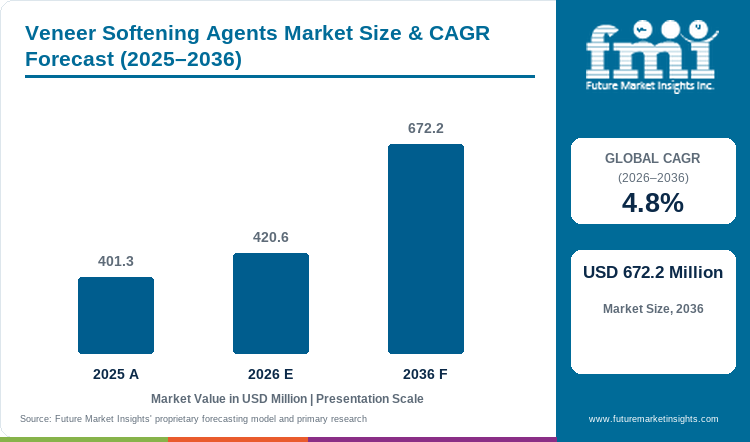
USD 420.6 million in 2026 and USD 672.2 million by 2036 at a 4.8% CAGR.
Demand for veneer softening agents is projected to expand at a 4.8% CAGR from USD 420.6 million in 2026 to USD 672.2 million by 2036 as mills protect usable-sheet recovery during higher-value veneer processing. The market was valued at USD 401.3 million in 2025. Roseburg Forest Products announced in February 2026 that prior investments had expanded veneer production at its Riddle Plywood facility and repositioned Coquille as its primary specialty-plywood operation. Higher veneer throughput increases conditioning decisions where suppliers must prove fewer checks without compromising drying or downstream bond performance.
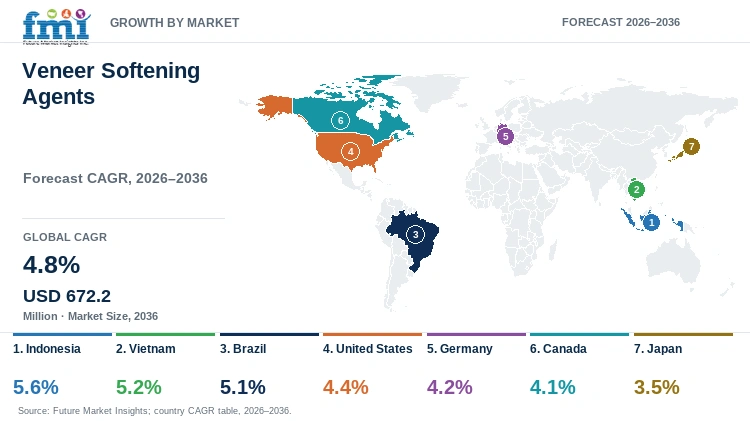
Country growth paths differ because export-oriented processors handle broader furnish variation while mature production systems place more weight on repeatability. Indonesia is projected to rise at 5.6% CAGR exceeds Japan’s 3.5% CAGR by 2036. Japan’s agriculture ministry reported 209,572 cubic meters of ordinary plywood production in April 2026, down 3.4% year over year, while special plywood output rose 7.4% to 40,425 cubic meters. That mixed production pattern favors low-disruption qualification instead of a capacity-only conversion case.
Key Takeaways
- Veneer-softener spending depends on whether fewer checks and splits recover enough saleable sheet value to justify treatment cost.
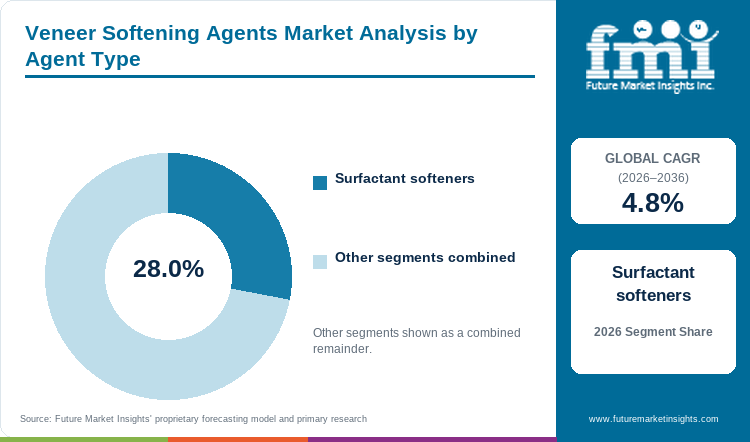
- Surfactant softeners are estimated to hold 28.0% in 2026 because liquid conditioning depends on controlled wetting across exposed wood.
- Hardwood veneer is projected to hold 39.0% in 2026 because visible defects can reduce the value of face-grade sheets.
- Pre-peeling is expected to lead application stage with 31.0% in 2026 because treatment occurs before knife defects form.
- Qualification slows adoption because mills must protect color, drying behavior, adhesive performance, and wastewater controls before routine production use.
- Some of the companies assessed include Buckman, Solenis, Kemira, BASF, Clariant, Evonik, Ashland, Nouryon, Dow, and Nalco Water / Ecolab, although public disclosures vary from plant-facing chemistry to adjacent formulation platforms.
Analyst Perspective
"Veneer softeners should be judged against recovered sheet value because defect reduction determines the economic return. Repeat purchasing depends on a stable dose window that preserves drying and adhesive performance during normal mill production."
- Nikhil Kaitwade, Principal Consultant, Future Market Insights
How is the veneer softening agents market segmented?
The veneer softening agents market is segmented by agent type, wood type, application stage, function, sales channel, and region.
Agent type covers surfactant, urea-based, ammonia-based, polyol, and enzyme-assisted softeners used in conditioning formulations. Wood type covers hardwood, softwood, tropical, and engineered veneer with different moisture responses during processing. Application stage spans pre-peeling through layup preparation, while function and sales-channel categories separate operating outcomes from purchasing routes.
Why do surfactant softeners hold the specified share within the agent type category?
Surfactants lower liquid surface tension and help treatment spread across exposed wood before cutting or pressing. Paper recycling surfactants provide a nearby wetting reference, but veneer conditioning still requires separate wood-surface qualification.
- Surfactant softeners are estimated to hold 28.0% in 2026 owing to their role in liquid wetting and penetration.
- BASF and Hannong Chemicals inaugurated new non-ionic surfactant capacity in Seosan in March 2026. The action expands current wetting-chemistry supply in Asia, but veneer mills must still qualify the chemistry against wood penetration, foam behavior, drying, and bonding.
Why does hardwood veneer account for the specified share within the wood type category?
Hardwood veneer carries a larger penalty for visible splits where face quality affects recovered sheet value. Mills also protect wood adhesive systems because any conditioning change must preserve downstream bond performance during panel production.
- Hardwood veneer is projected to hold 39.0% in 2026 owing to the higher cost of visible defects on varied hardwood furnish.
- The USA Department of Commerce issued preliminary countervailing-duty determinations on hardwood and decorative plywood from China, Indonesia, and Vietnam in January 2026. The trade action changes panel sourcing economics, so mills have a stronger reason to document whether conditioning trials recover enough usable sheet to justify treatment cost.
Why does pre-peeling account for the specified share within the application stage category?
Pre-peeling treatment reaches wood before the knife generates checks that lower usable sheet recovery. Mills can adjust dose beside temperature while tracking defects during routine plywood production and conditioning trials.
- Pre-peeling is expected to lead application stage with 31.0% in 2026 because treatment occurs before cutting stresses become surface defects.
- Raute introduced AI-based veneer defect detection for engineered-wood manufacturing in June 2026 after production use in veneer, plywood, and LVL lines. Better defect measurement gives mills a clearer baseline for judging whether pre-peeling conditioning actually improves recovery.
Why does improved flexibility account for the specified share within the function category?
Improved flexibility reduces the tendency of thin veneer to split during handling and pressing. Formulators comparing surfactants with polyol chemistry must also preserve drying and bond performance during mill qualification.
- Improved flexibility is projected to account for 36.0% in 2026 because pliability directly affects crack control and handling.
- Shine Machinery announced a new veneer-dryer launch in January 2026 following field testing. The launch reinforces the need to qualify softening chemistry against downstream drying quality because a gain in flexibility is not commercially useful if moisture or surface behavior becomes less stable.
Why do plywood mills account for the specified share within the sales channel category?
Plywood mills see treatment use and recovered veneer on the same production line, which ties chemical cost directly to usable output. Paper process chemicals provide a related plant-validation model, but veneer-softener purchasing still depends on wood-specific production proof.
- Plywood mills are projected to lead sales channels with 41.0% in 2026 because they control conditioning and peeling economics directly.
- ARAUCO selected Raute panel-repair analyzers for two mills in June 2026 with deliveries planned for late 2026. The investment links mill purchasing to measurable quality and productivity, which is the same operating environment in which plywood mills evaluate conditioning cost against recovered output.
What are the drivers, restraints and opportunities in the Veneer Softening Agents Market?
Yield recovery supports demand, while qualification against species and downstream bonding limits conversion speed and lower-dose application packages create a practical route to repeat mill use.
- Driver: Mills adopt softening chemistry where fewer checks and splits recover enough saleable veneer to outweigh treatment cost.
- Restraint: Adoption slows when treatments alter color, drying, bonding, or wastewater behavior and require additional mill qualification.
- Opportunity: Lower-dose packages can gain repeat orders when formulators pair controlled wetting with species-specific dosing and local trial support.
Recoverable Yield Keeps Chemical Spending Tied to Mill Output
Mills absorb log and conditioning costs before a veneer sheet is accepted or downgraded. The Federal Reserve recorded seasonally adjusted USA veneer-and-plywood production between 76.8 and 77.3 from November 2025 through April 2026. Active output makes reject costs visible, while specialty pulp chemistry remains a separate adjacent category rather than evidence of veneer-softener use.
Qualification Extends Beyond the Peeling Trial
A treatment can improve peelability and still fail if drying or bonding performance changes. The European Commission updated EUDR implementation tools for covered wood products in July 2026. The rule adds origin-documentation work, while wood adhesive qualification remains a separate mill-performance check before recipe changes are accepted.
Connected Quality Data Gives Formulators a Practical Trial Route
Species and sheet condition change the dose window a mill can use reliably. Raute reported in August 2026 that integrated analyzers can connect visual, moisture, strength, and process data across veneer and plywood production. Those measurements give formulators a stronger trial baseline before screening lower-dose packages or bio-based nonionic surfactants for commercial qualification.
Which country CAGRs are profiled in the Veneer Softening Agents Market?
| Country | CAGR |
|---|---|
| Indonesia | 5.6% |
| Vietnam | 5.2% |
| Brazil | 5.1% |
| United States | 4.4% |
| Germany | 4.2% |
| Canada | 4.1% |
| Japan | 3.5% |
How do country-level CAGRs compare in the Veneer Softening Agents Market?
The 2.1-point CAGR spread separates export-oriented countries handling larger supply swings from mature systems where qualification and documentation carry more weight. Indonesia, Vietnam, and Brazil occupy the upper group under the authorized forecasts. The United States, Germany, and Canada form the middle range, while Japan’s lower rate reflects a more mature production base.
- Indonesia’s export-focused panel industry must balance tropical wood-furnish variability with recovery optimization, making conditioning performance an important operational lever.
- Rising timber availability in Vietnam is supporting greater processing throughput, while export markets continue to demand tighter origin tracking and production documentation.
- For Brazil, recovery economics remain a key consideration as manufacturers seek efficiency gains amid fluctuations in plywood export activity.
- The USA combines substantial domestic panel production with cost and yield pressures that keep mill efficiency and process control under close scrutiny.
- In Germany, any formulation or process adjustment must align with stringent compliance and due-diligence requirements, increasing the value of documented performance.
- Canada’s mature milling sector places emphasis on cost control and operational consistency, while established qualification procedures can lengthen adoption timelines.
- Japan offers a more measured growth profile, where consistent product performance and repeatable results tend to matter more than capacity-driven expansion..
The spread therefore reflects different conversion conditions rather than one universal demand story. Export volatility, regulation, plant measurement, and mature quality controls affect how quickly a successful trial becomes repeat purchasing. The full report provides country-level CAGR analysis across North America, Latin America, Western Europe, Eastern Europe, East Asia, South Asia and Pacific, and Middle East and Africa.
Country-wise Analysis
- Indonesia's plywood producers continue managing tropical wood variability while serving export programs with different veneer specifications across destination markets. Supported by the need to maintain consistent veneer handling across diverse tropical furnish streams, Indonesia is expected to help the veneer softening agent market register a 5.6% CAGR through 2036. Conditioning systems become more important when mills need to preserve veneer flexibility across changing species mixes. APKINDO reported national plywood production of 971,000 cubic meters during January-April 2026. Output was 22% below the prior-year period while first-quarter export volume reached 670,000 cubic meters. Lower throughput increases scrutiny of process inputs because recovery gains must deliver measurable operating value before broader implementation.
- Rising wood output is increasing processing activity across Vietnam's export-oriented manufacturing base. Veneer conditioning becomes more valuable when larger production volumes expose mills to wider variation in moisture content and species behavior. Sales of veneer softening agents in Vietnam are forecast to rise at a 5.2% CAGR during the assessment period, supported by demand for process controls that improve consistency across multiple raw-material batches. The National Statistics Office estimated first-half 2026 wood production at 11.77 million cubic meters. The total was 4.5% higher than a year earlier. Rising throughput increases the number of conditioning cycles completed during routine production.
- Recovery economics remain an important purchasing consideration across Brazil's plywood industry. Conditioning chemicals are more likely to secure routine approval when mills can document improvements in veneer flexibility and sheet utilization under existing operating conditions. A June 2026 Epagri synthesis using MDIC/SECEX data reported that Brazil's 2025 pine-plywood export volume declined by 4.0% from 2024. Slower export performance places greater attention on efficiency measures that can be validated directly at the mill level. An estimated 5.1% CAGR is projected for the Brazilian veneer softening agent sector between 2026 and 2036 as processors continue evaluating recovery gains across pine and other commercial wood inputs.
- Trade policy developments continue influencing sourcing decisions across portions of the USA hardwood and decorative plywood industry. Commercial uptake of veneer softening agents in the United States is anticipated to advance at a 4.4% CAGR over the assessment period with growth tied to recovery-oriented process improvements. Mills place additional value on material-efficiency programs when changing input economics affect production planning. The USA Department of Commerce issued final affirmative antidumping and countervailing-duty determinations on July 16, 2026 for hardwood and decorative plywood imports from China, Indonesia, and Vietnam. The action does not measure conditioning-agent demand directly. It does increase attention on operating metrics linked to recovered-sheet economics.
- German wood processors must adapt to expanding due-diligence obligations while preserving established manufacturing performance. Qualification programs frequently evaluate process changes alongside broader compliance requirements. The federal government approved its EUDR implementation draft on August 12, 2026. The proposal covers wood among the regulated commodities. Documentation-driven qualification activity is expected to help Germany register a 4.2% CAGR through 2036 as mills review conditioning systems supported by clear composition and compatibility records. Additional documentation requirements can lengthen approval timelines for newly introduced processing inputs.
- Canadian plywood manufacturers operate within a mature panel industry where process modifications receive extensive operational review. New conditioning technologies compete on demonstrated plant-level performance instead of expansion-driven capacity requirements. The Canadian veneer softening agent sector is likely to climb at a 4.1% CAGR during the forecast period because mills continue prioritizing low-disruption process improvements that fit existing manufacturing systems. The Canada Border Services Agency published preliminary findings on September 8, 2026 after provisional duties were imposed on specified decorative and non-structural plywood from China. The proceeding mainly affects competitive conditions within the plywood sector. It also reinforces management focus on production efficiency and cost control.
- Japanese plywood manufacturers place significant emphasis on repeatable production performance. Conditioning products must preserve veneer quality without introducing variability that affects bonding behavior or appearance standards. MAFF reported ordinary plywood production of 232,967 cubic meters in June 2026. Output increased 7.5% from the prior year while shipments rose 19.3%. Adoption of veneer softening agents in Japan is forecast to post a 3.5% CAGR between 2026 and 2036 because conditioning systems that support stable operating results remain more likely to secure routine approval. The rebound creates a larger base for commercial evaluations while maintaining strict qualification discipline.
Who are the notable companies in the Veneer Softening Agents Market?
The competitive assessment covers Buckman, Solenis, Kemira, BASF, Clariant, Evonik, Ashland, Nouryon, Dow, and Nalco Water / Ecolab for relevant process-chemistry, surfactant, formulation, and mill-service capabilities. Public disclosures do not establish dedicated veneer-softener participation for every company.
The named companies are assessed only for process chemistry, surfactant, formulation, or mill-service capabilities that can matter during a veneer trial. None is presented as a verified dedicated veneer-softener supplier without direct public evidence.
- Buckman and Solenis document plant-facing process chemistry, while Kemira and Nalco Water / Ecolab document mill-service capability relevant to industrial qualification.
- BASF, Clariant, Evonik, and Nouryon document wetting or formulation chemistry that still requires veneer-specific qualification before dedicated supplier claims.
- Ashland and Dow document adjacent formulation materials, but reviewed public disclosures do not establish dedicated veneer-softener participation.
Competitive Benchmarking: Veneer Softening Agents Market
| Company | Wood/Fiber Process Chemistry | Wetting/Plasticizer Chemistry | Mill Application Support | Geographic Reach |
|---|---|---|---|---|
| Buckman | High | Medium | High | Global |
| Solenis | High | Medium | High | Global |
| Kemira | High | Low | High | Global |
| BASF | Medium | High | Medium | Global |
| Clariant | Low | High | Medium | Global |
| Evonik | Low | High | Medium | Global |
| Ashland | Medium | Medium | Medium | Global |
| Nouryon | High | High | High | Global |
| Dow | Low | High | Medium | Global |
| Nalco Water / Ecolab | High | Medium | High | Global |
Benchmark ratings describe documented adjacent capabilities rather than veneer-softener market share. Process-chemistry scores use mill-facing evidence, wetting scores use surfactant or formulation scope, and application-support scores use plant-service records. Every rating should therefore be read as a qualification capability, not proof of dedicated veneer-softener sales.
Key Developments in the Veneer Softening Agents Market
- In June 2026, Columbia Forest Products launched a new Class A veneer-core platform, creating another hardwood-plywood specification that conditioning chemistry must clear during downstream qualification.
- In August 2026, UPM shareholders approved the partial demerger of the UPM Plywood business into WISA Group Plc, creating a standalone plywood company with its own investment and operating priorities.
- In February 2026, Greenlam Industries opened the first Mikasa Decowood Veneers shop in Meerut, extending a dedicated veneer channel where finish and handling consistency remain part of purchase evaluation.
Key Players in the Veneer Softening Agents Market
Mill-Integrated Process Chemistry
- Buckman
- Solenis
- Kemira
- Nalco Water / Ecolab
Surfactant and Functional Chemistry Platforms
- BASF
- Clariant
- Evonik
- Nouryon
Formulation and Materials Additives
- Ashland
- Dow
Veneer Softening Agents Market - Report Scope
| Coverage field | Report scope |
|---|---|
| Market breakdown | By agent type, wood type, application stage, function, sales channel and region. |
| Quantitative Units | USD million. |
| Market Definition | Chemical treatments used in veneer processing to improve wetting, flexibility, peelability, crack control or surface condition within the defined production scope. |
| Regions Covered | North America, Latin America, Western Europe, Eastern Europe, East Asia, South Asia and Pacific, and Middle East and Africa. |
| Countries Covered | Indonesia, Vietnam, Brazil, United States, Germany, Canada, Japan, and 20+ countries included in the full report. |
| Key Companies Profiled | Buckman, Solenis, Kemira, BASF, Clariant, Evonik, Ashland, Nouryon, Dow, Nalco Water / Ecolab. |
| Forecast Period | 2026 to 2036. |
| Approach | Primary and secondary research with market triangulation. |
Veneer Softening Agents Market - Research Methodology
| Method | Approach |
|---|---|
| Primary Research | FMI analysts gathered input from manufacturers, service providers, technology developers, distributors, end users, procurement teams, and subject-matter experts. Interviews examined purchasing decisions, product or service evaluation, adoption barriers, approval requirements, pricing considerations, and expectations for technical or commercial support. Respondents were also asked what evidence is required before a trial, pilot, or initial order develops into regular purchasing. |
| Desk Research | Desk research covered government statistics, regulatory publications, trade data, industry associations, technical literature, standards, company filings, product information, and official corporate announcements. Sources were reviewed for relevance, publication date, geographic coverage, and consistency with the defined market scope. Claims relating to performance, applications, approvals, capacity, investment, and commercial activity were retained only when supported by credible public evidence. |
| Market Sizing and Forecasting | The market model combined the baseline value with historical performance, segment structure, pricing and volume indicators, adoption levels, company participation, and country-level demand conditions. Forecast assumptions considered economic activity, investment trends, regulatory developments, technology adoption, purchasing cycles, supply availability, and barriers to wider market use. Segment and regional estimates were reconciled before the final market total was calculated. |
| Data Validation | Estimates were checked against multiple independent indicators, including public data, company activity, trade patterns, industry developments, and findings from primary interviews. Validation also tested whether products, services, applications, and company revenues fell within the defined market boundaries. Adjacent categories, unsupported claims, overlapping revenues, and activities without direct market relevance were excluded to reduce double counting and maintain consistency across segments and countries. |
Veneer Softening Agents Market by Segments
Veneer Softening Agents Market segmented by Agent Type:
- Surfactant softeners
- Urea-based softeners
- Ammonia-based softeners
- Polyol softeners
- Enzyme-assisted softeners
Veneer Softening Agents Market segmented by Wood Type:
- Hardwood veneer
- Softwood veneer
- Tropical species
- Engineered veneer
Veneer Softening Agents Market segmented by Application Stage:
- Pre-peeling
- Veneer clipping
- Drying preparation
- Layup preparation
Veneer Softening Agents Market segmented by Function:
- Improved flexibility
- Reduced cracking
- Peeling yield improvement
- Surface conditioning
Veneer Softening Agents Market segmented by Sales Channel:
- Plywood mills
- Specialty chemical suppliers
- Woodworking distributors
- Direct formulators
Veneer Softening Agents Market by Region:
- North America
- United States
- Canada
- Latin America
- Brazil
- Mexico
- Argentina
- Chile
- Western Europe
- Germany
- France
- United Kingdom
- Italy
- Spain
- Benelux
- Nordics
- Eastern Europe
- Poland
- Czech Republic
- Romania
- Hungary
- East Asia
- China
- Japan
- South Korea
- South Asia and Pacific
- India
- ASEAN
- Australia and New Zealand
- Middle East and Africa
- GCC Countries
- South Africa
- Türkiye
- Israel
Research Sources and Bibliography
- Roseburg Forest Products. (2026, February 4). Roseburg Forest Products Realigns Production at Oregon Mills to Support its Engineered Wood and Specialty Plywood Products.
- Ministry of Agriculture, Forestry and Fisheries, Japan. (2026, May 25). 合板統計(令和8年4月分).
- BASF. (2026, March 18). BASF-Hannong Chemicals Joint Venture inaugurates the new non-ionic surfactant (NIS) site in Seosan, Korea.
- USA Department of Commerce. (2026, January 16). Preliminary Affirmative Determinations in the Countervailing Duty Investigations of Hardwood and Decorative Plywood.
- Raute. (2026, June 15). Raute introduces production-proven AI defect detection for engineered wood manufacturing.
- Shine Machinery. (2026, January 5). Setting a New Benchmark for Precision and Sustainability in the Woodworking Industry.
- Raute. (2026, June 10). ARAUCO invests in AI-based panel repair analyzers from Raute.
- Board of Governors of the Federal Reserve System. (2026, May 15). Industrial Production and Capacity Utilization - G.17: Table 1B.
- European Commission. (2026, July 13). Commission updates product scope and tools to support EUDR.
- Raute. (2026, August 31). Integrated analyzer technologies help mills optimize production with connected quality data.
- Asosiasi Panel Kayu Indonesia (APKINDO). (2026, May 26). Indonesia’s Plywood Industry: Standing Firm Amid Global Turbulence, Navigating the Waves of International Trade.
- National Statistics Office of Vietnam. (2026, July 3). Press release Socio-Economic Performance in the Q2 and in the first half of 2026.
- Epagri/Cepa. (2026, June). Síntese Anual da Agricultura de Santa Catarina | 2025.
- USA Department of Commerce. (2026, July 16). Final Affirmative Determinations in the Antidumping and Countervailing Duty Investigations of Hardwood and Decorative Plywood.
- Federal Government of Germany. (2026, August 12). EU-Entwaldungsverordnung: Bundesregierung beschließt Durchführungsgesetz.
- Canada Border Services Agency. (2026, September 8). Statement of Reasons - Preliminary Determinations: Decorative and Other Non-Structural Plywood 2.
- Ministry of Agriculture, Forestry and Fisheries, Japan. (2026, July 27). 合板統計(令和8年6月分).
- Columbia Forest Products. (2026, June 17). Introducing: FireBrand.
- UPM-Kymmene Corporation. (2026, August 31). Resolutions of UPM-Kymmene Corporation's Extraordinary General Meeting.
- Greenlam Industries. (2026, February 10). Mikasa Decowood Strengthens Retail Presence with Launch of First Mikasa Shoppe in Meerut.
- Columbia Forest Products. (2026, June 5). COLUMBIA FOREST PRODUCTS ACQUIRES PRO PALLET, LLC.
- Century Plyboards (India) Limited. (2026, Q1 FY27). Q1 FY 27 Investor Presentation.
- UPM-Kymmene Corporation. (2026, April 29). The Board of Directors of UPM-Kymmene Corporation has approved a demerger plan concerning the separation of the Plywood business into a new listed company.
- Greenlam Industries. (2026, April 24). Intimation for acquisition of shares of PT. Greenlam Indo Pacific, Indonesia.
- UPM-Kymmene Corporation. (2026, July 16). The Finnish Financial Supervisory Authority has approved WISA Group Plc’s demerger and listing prospectus. WISA Group Plc’s Group Leadership Team appointed.
This bibliography is provided for reader reference and is not exhaustive. The full report contains the complete reference list and detailed citations.
This Report Answers
- How large is the veneer softening agents market in 2026 and 2036?
- Why does usable-sheet recovery influence chemical purchasing?
- Why do surfactant softeners hold 28.0% share?
- How does hardwood variation affect chemistry qualification?
- Why is pre-peeling treatment commercially important?
- Which downstream checks can delay adoption?
- How do growth conditions differ by country?
- Which companies serve veneer conditioning applications?
Frequently Asked Questions
How big is the veneer softening agents market in 2026?
The veneer softening agents market is valued at USD 420.6 million in 2026 and is projected to reach USD 672.2 million by 2036. Purchasing expands where conditioning reduces rejected veneer without damaging drying behavior or downstream adhesive performance during routine production.
What is the CAGR of the veneer softening agents market from 2026 to 2036?
The veneer softening agents market is projected to grow at a CAGR of 4.8% between 2026 and 2036. Growth follows repeated conditioning needs as processors work to recover usable veneer from variable wood without extending production cycles.
Which agent type leads the veneer softening agents market?
The surfactant softeners segment is expected to hold 28.0% of the veneer softening agents market in 2026, supported by wetting requirements. Mill trials must still confirm foam control and downstream compatibility before regular purchasing begins at production scale.
Which wood type holds the documented share in the veneer softening agents market?
The hardwood veneer segment is expected to hold 39.0% of the veneer softening agents market in 2026, attributable to higher defect costs. Mills qualify treatments against species response plus color and bond performance before routine production use begins.
Which companies are active in the veneer softening agents market?
The competitive assessment covers Buckman, Solenis, Kemira, BASF, Clariant, Evonik, Ashland, Nouryon, Dow, and Nalco Water / Ecolab. Their public disclosures document process chemistry, surfactants, formulation additives, or plant-facing service, but they do not establish dedicated veneer-softener participation for every company.
Preview the report firsthand - request a free sample
Get SampleGet the brochure for pricing and purchase details.
Get PDFTable of Content
- Key Takeaways
- Market Size and CAGR
- Top Growth Driver
- Fastest Growing Segment
- Leading Region
- Key Companies
- Emerging Opportunities
- Executive Summary
- Global Market Outlook
- Demand-side Trends
- Supply-side Trends
- Technology Roadmap Analysis
- Analysis and Recommendations
- Analyst Perspective (What is happening? Why now? What should investors know?)
- Key Questions Answered
- How large is the market?
- What is the CAGR?
- What are key trends?
- Which region dominates?
- Who are the leaders?
- Market Overview
- Market Coverage / Taxonomy
- Market Definition / Scope / Limitations
- Research Methodology
- Chapter Orientation
- Analytical Lens and Working Hypotheses
- Market Structure, Signals, and Trend Drivers
- Benchmarking and Cross-market Comparability
- Market Sizing, Forecasting, and Opportunity Mapping
- Research Design and Evidence Framework
- Desk Research Programme (Secondary Evidence)
- Expert Input and Fieldwork (Primary Evidence)
- Tooling, Models, and Reference Databases
- Data Engineering and Model Build
- Quality Assurance and Audit Trail
- Market Background
- Market Dynamics (Drivers, Restraints, Opportunity, Trends)
- Scenario Forecast (Optimistic, Likely, Conservative)
- Impact Analysis
- AI Impact
- Sustainability Impact
- Regulatory Impact
- Technology Impact
- Consumer / Buyer Analysis
- Purchase Drivers
- Adoption Barriers
- Buyer Journey
- Opportunity Map Analysis
- Product Life Cycle Analysis
- Supply Chain Analysis
- Investment Feasibility Matrix
- Value Chain Analysis
- PESTLE and Porter's Analysis
- Regulatory Landscape
- Regional Parent Market Outlook
- Production and Consumption Statistics
- Import and Export Statistics
- Global Market Analysis and Forecast, 2021 to 2036
- Historical Market Size Value (USD Million) Analysis, 2021 to 2025
- Current and Future Market Size Value (USD Million) Projections, 2026 to 2036
- Y-o-Y Growth Trend Analysis
- Absolute $ Opportunity Analysis
- Global Market Pricing Analysis, 2021 to 2036
- Global Market Analysis and Forecast, By Agent Type, 2021 to 2036
- Introduction / Key Findings
- Historical Market Size Value (USD Million) Analysis By Agent Type, 2021 to 2025
- Current and Future Market Size Value (USD Million) Analysis and Forecast By Agent Type, 2026 to 2036
- Surfactant softeners
- Urea-based softeners
- Ammonia-based softeners
- Polyol softeners
- Enzyme-assisted softeners
- Y-o-Y Growth Trend Analysis By Agent Type, 2021 to 2025
- Absolute $ Opportunity Analysis By Agent Type, 2026 to 2036
- Global Market Analysis and Forecast, By Wood Type, 2021 to 2036
- Introduction / Key Findings
- Historical Market Size Value (USD Million) Analysis By Wood Type, 2021 to 2025
- Current and Future Market Size Value (USD Million) Analysis and Forecast By Wood Type, 2026 to 2036
- Hardwood veneer
- Softwood veneer
- Tropical species
- Engineered veneer
- Y-o-Y Growth Trend Analysis By Wood Type, 2021 to 2025
- Absolute $ Opportunity Analysis By Wood Type, 2026 to 2036
- Global Market Analysis and Forecast, By Application Stage, 2021 to 2036
- Introduction / Key Findings
- Historical Market Size Value (USD Million) Analysis By Application Stage, 2021 to 2025
- Current and Future Market Size Value (USD Million) Analysis and Forecast By Application Stage, 2026 to 2036
- Pre-peeling
- Veneer clipping
- Drying preparation
- Layup preparation
- Y-o-Y Growth Trend Analysis By Application Stage, 2021 to 2025
- Absolute $ Opportunity Analysis By Application Stage, 2026 to 2036
- Global Market Analysis and Forecast, By Function, 2021 to 2036
- Introduction / Key Findings
- Historical Market Size Value (USD Million) Analysis By Function, 2021 to 2025
- Current and Future Market Size Value (USD Million) Analysis and Forecast By Function, 2026 to 2036
- Improved flexibility
- Reduced cracking
- Peeling yield improvement
- Surface conditioning
- Y-o-Y Growth Trend Analysis By Function, 2021 to 2025
- Absolute $ Opportunity Analysis By Function, 2026 to 2036
- Global Market Analysis and Forecast, By Sales Channel, 2021 to 2036
- Introduction / Key Findings
- Historical Market Size Value (USD Million) Analysis By Sales Channel, 2021 to 2025
- Current and Future Market Size Value (USD Million) Analysis and Forecast By Sales Channel, 2026 to 2036
- Plywood mills
- Specialty chemical suppliers
- Woodworking distributors
- Direct formulators
- Y-o-Y Growth Trend Analysis By Sales Channel, 2021 to 2025
- Absolute $ Opportunity Analysis By Sales Channel, 2026 to 2036
- Global Market Analysis and Forecast, By Region, 2021 to 2036
- Introduction
- Historical Market Size Value (USD Million) Analysis By Region, 2021 to 2025
- Current Market Size Value (USD Million) Analysis and Forecast By Region, 2026 to 2036
- North America
- Latin America
- Western Europe
- Eastern Europe
- East Asia
- South Asia and Pacific
- Middle East and Africa
- Market Attractiveness Analysis By Region
- North America Market Analysis and Forecast, By Country, 2021 to 2036
- Historical Market Size Value (USD Million) Trend Analysis By Market Taxonomy, 2021 to 2025
- Market Size Value (USD Million) Forecast By Market Taxonomy, 2026 to 2036
- By Country
- United States
- Canada
- By Agent Type
- By Wood Type
- By Application Stage
- By Function
- By Sales Channel
- By Country
- Market Attractiveness Analysis
- By Country
- By Agent Type
- By Wood Type
- By Application Stage
- By Function
- By Sales Channel
- Key Takeaways
- Latin America Market Analysis and Forecast, By Country
- Historical Market Size Value (USD Million) Trend Analysis By Market Taxonomy, 2021 to 2025
- Market Size Value (USD Million) Forecast By Market Taxonomy, 2026 to 2036
- By Country
- Brazil
- Mexico
- Argentina
- Chile
- By Agent Type
- By Wood Type
- By Application Stage
- By Function
- By Sales Channel
- By Country
- Market Attractiveness Analysis
- By Country
- By Agent Type
- By Wood Type
- By Application Stage
- By Function
- By Sales Channel
- Key Takeaways
- Western Europe Market Analysis and Forecast, By Country
- Historical Market Size Value (USD Million) Trend Analysis By Market Taxonomy, 2021 to 2025
- Market Size Value (USD Million) Forecast By Market Taxonomy, 2026 to 2036
- By Country
- Germany
- France
- United Kingdom
- Italy
- Spain
- Benelux
- Nordics
- By Agent Type
- By Wood Type
- By Application Stage
- By Function
- By Sales Channel
- By Country
- Market Attractiveness Analysis
- By Country
- By Agent Type
- By Wood Type
- By Application Stage
- By Function
- By Sales Channel
- Key Takeaways
- Eastern Europe Market Analysis and Forecast, By Country
- Historical Market Size Value (USD Million) Trend Analysis By Market Taxonomy, 2021 to 2025
- Market Size Value (USD Million) Forecast By Market Taxonomy, 2026 to 2036
- By Country
- Poland
- Czech Republic
- Romania
- Hungary
- By Agent Type
- By Wood Type
- By Application Stage
- By Function
- By Sales Channel
- By Country
- Market Attractiveness Analysis
- By Country
- By Agent Type
- By Wood Type
- By Application Stage
- By Function
- By Sales Channel
- Key Takeaways
- East Asia Market Analysis and Forecast, By Country
- Historical Market Size Value (USD Million) Trend Analysis By Market Taxonomy, 2021 to 2025
- Market Size Value (USD Million) Forecast By Market Taxonomy, 2026 to 2036
- By Country
- China
- Japan
- South Korea
- By Agent Type
- By Wood Type
- By Application Stage
- By Function
- By Sales Channel
- By Country
- Market Attractiveness Analysis
- By Country
- By Agent Type
- By Wood Type
- By Application Stage
- By Function
- By Sales Channel
- Key Takeaways
- South Asia and Pacific Market Analysis and Forecast, By Country
- Historical Market Size Value (USD Million) Trend Analysis By Market Taxonomy, 2021 to 2025
- Market Size Value (USD Million) Forecast By Market Taxonomy, 2026 to 2036
- By Country
- India
- ASEAN
- Australia and New Zealand
- By Agent Type
- By Wood Type
- By Application Stage
- By Function
- By Sales Channel
- By Country
- Market Attractiveness Analysis
- By Country
- By Agent Type
- By Wood Type
- By Application Stage
- By Function
- By Sales Channel
- Key Takeaways
- Middle East and Africa Market Analysis and Forecast, By Country
- Historical Market Size Value (USD Million) Trend Analysis By Market Taxonomy, 2021 to 2025
- Market Size Value (USD Million) Forecast By Market Taxonomy, 2026 to 2036
- By Country
- GCC Countries
- South Africa
- Türkiye
- Israel
- By Agent Type
- By Wood Type
- By Application Stage
- By Function
- By Sales Channel
- By Country
- Market Attractiveness Analysis
- By Country
- By Agent Type
- By Wood Type
- By Application Stage
- By Function
- By Sales Channel
- Key Takeaways
- Key Countries Market Analysis
- United States
- Pricing Analysis
- Market Share Analysis, 2025
- By Agent Type
- By Wood Type
- By Application Stage
- By Function
- By Sales Channel
- Canada
- Pricing Analysis
- Market Share Analysis, 2025
- By Agent Type
- By Wood Type
- By Application Stage
- By Function
- By Sales Channel
- Mexico
- Pricing Analysis
- Market Share Analysis, 2025
- By Agent Type
- By Wood Type
- By Application Stage
- By Function
- By Sales Channel
- Brazil
- Pricing Analysis
- Market Share Analysis, 2025
- By Agent Type
- By Wood Type
- By Application Stage
- By Function
- By Sales Channel
- Chile
- Pricing Analysis
- Market Share Analysis, 2025
- By Agent Type
- By Wood Type
- By Application Stage
- By Function
- By Sales Channel
- Germany
- Pricing Analysis
- Market Share Analysis, 2025
- By Agent Type
- By Wood Type
- By Application Stage
- By Function
- By Sales Channel
- United Kingdom
- Pricing Analysis
- Market Share Analysis, 2025
- By Agent Type
- By Wood Type
- By Application Stage
- By Function
- By Sales Channel
- Italy
- Pricing Analysis
- Market Share Analysis, 2025
- By Agent Type
- By Wood Type
- By Application Stage
- By Function
- By Sales Channel
- Spain
- Pricing Analysis
- Market Share Analysis, 2025
- By Agent Type
- By Wood Type
- By Application Stage
- By Function
- By Sales Channel
- France
- Pricing Analysis
- Market Share Analysis, 2025
- By Agent Type
- By Wood Type
- By Application Stage
- By Function
- By Sales Channel
- India
- Pricing Analysis
- Market Share Analysis, 2025
- By Agent Type
- By Wood Type
- By Application Stage
- By Function
- By Sales Channel
- ASEAN
- Pricing Analysis
- Market Share Analysis, 2025
- By Agent Type
- By Wood Type
- By Application Stage
- By Function
- By Sales Channel
- Australia and New Zealand
- Pricing Analysis
- Market Share Analysis, 2025
- By Agent Type
- By Wood Type
- By Application Stage
- By Function
- By Sales Channel
- China
- Pricing Analysis
- Market Share Analysis, 2025
- By Agent Type
- By Wood Type
- By Application Stage
- By Function
- By Sales Channel
- Japan
- Pricing Analysis
- Market Share Analysis, 2025
- By Agent Type
- By Wood Type
- By Application Stage
- By Function
- By Sales Channel
- South Korea
- Pricing Analysis
- Market Share Analysis, 2025
- By Agent Type
- By Wood Type
- By Application Stage
- By Function
- By Sales Channel
- Poland
- Pricing Analysis
- Market Share Analysis, 2025
- By Agent Type
- By Wood Type
- By Application Stage
- By Function
- By Sales Channel
- Hungary
- Pricing Analysis
- Market Share Analysis, 2025
- By Agent Type
- By Wood Type
- By Application Stage
- By Function
- By Sales Channel
- Türkiye
- Pricing Analysis
- Market Share Analysis, 2025
- By Agent Type
- By Wood Type
- By Application Stage
- By Function
- By Sales Channel
- South Africa
- Pricing Analysis
- Market Share Analysis, 2025
- By Agent Type
- By Wood Type
- By Application Stage
- By Function
- By Sales Channel
- Indonesia
- Pricing Analysis
- Market Share Analysis, 2025
- By Agent Type
- By Wood Type
- By Application Stage
- By Function
- By Sales Channel
- Vietnam
- Pricing Analysis
- Market Share Analysis, 2025
- By Agent Type
- By Wood Type
- By Application Stage
- By Function
- By Sales Channel
- United States
- Market Structure Analysis
- Competition Dashboard
- Competition Benchmarking
- Market Share Analysis of Top Players
- By Regional
- By Agent Type
- By Wood Type
- By Application Stage
- By Function
- By Sales Channel
- Emerging Startups
- Innovation Benchmarking
- Competition Analysis
- Competition Deep Dive
- Buckman
- Overview
- Product Portfolio
- Profitability by Market Segments
- Sales Footprint
- Strategy Overview
- Marketing Strategy
- Product Strategy
- Channel Strategy
- Solenis
- Kemira
- BASF
- Clariant
- Evonik
- Ashland
- Nouryon
- Dow
- Nalco Water / Ecolab
- Buckman
- Case Studies
- Success Stories
- Recent Developments
- Competition Deep Dive
- Assumptions & Acronyms Used


