

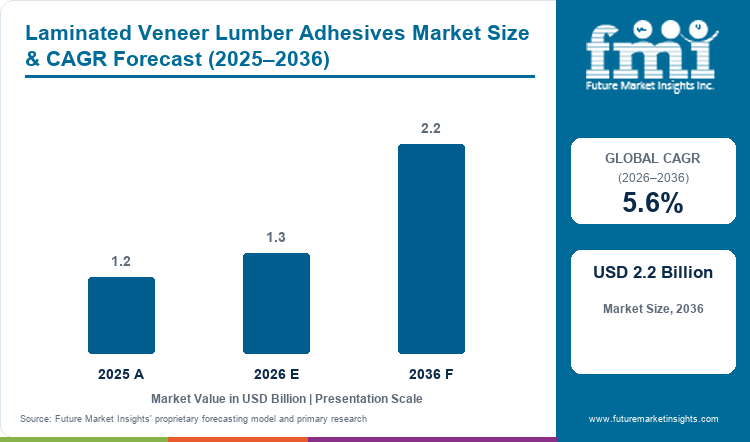
- Market Size (2026)
- USD 1.3 Bn
- Forecast (2036)
- USD 2.2 Bn
- CAGR (2026 to 2036)
- 5.6%
How big is Laminated Veneer Lumber Adhesives Market in 2026?
USD 1.3 billion in 2026 and USD 2.2 billion by 2036 at a 5.6% CAGR.
Demand for laminated veneer lumber adhesives is projected to expand at a 5.6% CAGR between 2026 and 2036, increasing valuation from USD 1.3 billion to USD 2.2 billion. Expansion outlook reflects new LVL capacity that requires stable structural bonds at commercial press speeds. Metsä Wood stated in September 2025 that its Äänekoski Kerto LVL mill is planned for 160,000 cubic meters of annual output. That capacity gives construction adhesives a direct route into new laminated structural production once the mill completes qualification.
North America demand depends more on project conversion than on mill capacity alone. Natural Resources Canada documented four Ontario wood-construction projects in March 2025 that together cover 319 residential units and a new automated nail-laminated timber line. Those projects widen the addressable engineered-wood base, although each adhesive system still has to match structural testing and the selected production process.
Key Takeaways of Laminated Veneer Lumber Adhesives Market
- LVL adhesive demand rises when engineered-wood mills expand structural output and require repeatable bond performance under controlled press conditions.
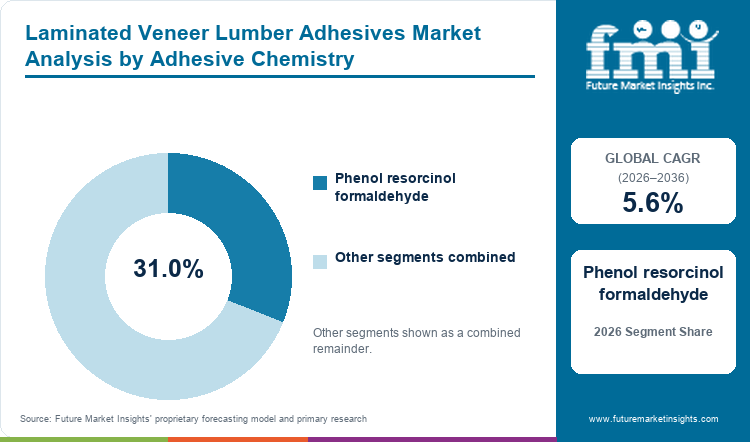
- Based on adhesive chemistry, phenol resorcinol formaldehyde is projected to account for 31.0% in 2026 due to its established exterior structural bonding record.
- By cure type, hot press cure is estimated to hold 39.0% in 2026 owing to continuous mill lines that tie adhesive reaction time to press throughput.
- In 2026, structural LVL is expected to account for 51.0% of the LVL grade category because load-bearing applications require documented bond durability.
- Formaldehyde exposure controls, adhesive qualification time and weaker construction orders can delay conversion even where LVL production equipment is already available.
- Some of the key players in this market include Hexion, H.B. Fuller, Henkel, AkzoNobel, Dynea, Prefere Resins, Sika, BASF, Arclin, and Jowat.
Analyst Perspective
"LVL mills should evaluate adhesives by cured-bond consistency under their own veneer moisture and press settings, not by resin price alone. The commercial advantage sits in reducing rejected billets and requalification work without weakening structural approvals or mill throughput."
- Nikhil Kaitwade, Principal Consultant, Future Market Insights
How is the Laminated Veneer Lumber Adhesives Market segmented?
The market is segmented by adhesive chemistry, cure type, LVL grade, end use, sales channel and region.
Adhesive chemistry covers phenol resorcinol formaldehyde, phenol formaldehyde, melamine formaldehyde, polyurethane adhesives, and emulsion polymer isocyanate. Cure types include hot press cure, cold cure, RF cure, and moisture cure. LVL grades include structural LVL, non-structural LVL, marine - exterior grade, and fire-resistant LVL. End uses cover beams and headers, I-joists/flanges, scaffold planks, formwork panels, and industrial components. Sales channels include engineered wood mills, direct resin producers, specialty adhesive distributors, and technical service contracts.
What supports phenol resorcinol formaldehyde within the adhesive chemistry category?
Structural LVL producers use thermosetting resins where exterior durability and documented load-bearing performance outweigh faster handling alone. Dynea reported in November 2025 that its newly certified MUF system covered common hardwood species and industrial structural bonding routes. The approval illustrates why resin chemistry selection remains tied to a defined wood species and process window in adjacent phenolic resins applications.
- Based on adhesive chemistry, phenol resorcinol formaldehyde is projected to account for 31.0% in 2026 due to established durability in demanding structural service.
- LVL mills retain PRF where weather exposure, thick bond lines or long service requirements justify its slower cure against faster alternatives.
How does hot press cure shape selection within the cure type category?
Hot press cure ties adhesive reaction time directly to line speed, veneer moisture control and press temperature during continuous LVL production. Raute announced in September 2025 that LVL Global ordered an R7 lay-up line with moisture detection and curtain-coating technology for delivery in 2026. That equipment profile makes controlled adhesive spread and press response central to mill output rather than a laboratory-only specification.
- In 2026, hot press cure is expected to represent 39.0% of cure type demand because integrated lines reward predictable curing under scheduled press cycles. Wood adhesives and binders that tolerate normal veneer variation reduce the number of process adjustments needed between production runs.
- Production teams select hot-cure systems after validating spread rate, assembly time and bond quality against their actual press temperature profile.
Why does structural LVL account for the largest supplied LVL grade share?
Structural LVL carries load-transfer requirements that make adhesive qualification part of the product approval path. Metsä Wood announced in April 2025 that its Äänekoski research laboratory would test material-efficient load-bearing veneer structures beside the new Kerto LVL mill. The investment links wood adhesives to full-scale structural validation rather than adhesive strength values considered in isolation.
- Structural LVL is likely to capture 51.0% share in 2026 attributable to load-bearing beams, columns and flange applications that require verified bond durability.
- Manufacturers qualify structural grades through strength, delamination and process-control evidence before shifting a resin system onto recurring commercial production.
What makes beams and headers central to the end use category?
Beams and headers concentrate high bending loads in components that often stay hidden after installation, so bond-line performance has little tolerance for field correction. Henkel launched the Loctite HB XE structural timber adhesive line in February 2025 with fire testing and shorter processing times for CLT and glulam production. The development shows how adhesive suppliers are pairing structural performance with mill productivity for load-bearing wood components.
- By end use, beams and headers are forecast to represent 34.0% in 2026 driven by repeat structural specifications in residential and commercial framing. Structural adhesives gain acceptance here only after production and design evidence match the required component class.
- Fabricators value systems that preserve open-time control during lay-up while limiting press delays that can disrupt scheduled beam production.
Why do engineered wood mills hold the supplied sales channel share?
Adhesive selection is usually locked into mill recipes, press settings and quality records before LVL enters a building project. Natural Resources Canada said in March 2025 that Quebec wood-manufacturing projects included modernization work for glulam, I-joists and CLT production. That operating model favors direct mill relationships because polyurethane adhesives and thermosetting resins need application support during line qualification.
- Engineered wood mills are projected to hold 45.0% share in 2026 owing to direct control over adhesive dosing, pressing and production quality records.
- Resin producers win repeat volumes by resolving line-specific spread, cure and veneer-moisture issues before commercial production schedules are committed.
What are the drivers, restraints and opportunities in the Laminated Veneer Lumber Adhesives Market?
Driver: engineered-wood construction expands qualified LVL output. Restraint: cyclical mill investment and qualification work delay resin changes. Opportunity: renewable and lower-emission chemistries can enter once structural performance is demonstrated.
- Driver: New engineered-wood projects increase adhesive consumption as each additional LVL line requires qualified resin systems for routine structural production.
- Restraint: Weak equipment orders and lengthy structural qualification can postpone adhesive switching even where a chemistry offers lower emissions or faster cure.
- Opportunity: Resin producers can convert renewable feedstocks into repeat volume by proving bond performance on commercial veneer and press conditions.
Engineered-wood programs are widening the installed base that consumes structural adhesives. Natural Resources Canada listed five Green Construction through Wood initiatives in December 2025 covering technical support, education, code work and project costing. Those activities reduce specification barriers for wood-based panels and LVL systems that already have documented structural performance.
Mill investment can slow before adhesive demand disappears because existing lines continue consuming qualified resin while operators delay expansion. Raute announced possible temporary layoffs of up to 90 days in May 2025 after weak new-order accumulation in its Wood Processing and Analyzers units. The same caution can postpone new adhesive trials because mills avoid process changes during uncertain capital cycles.
Renewable feedstock can become a commercial adhesive route once the chemistry survives mill-scale qualification. Hexion announced a partnership with Bloom Biorenewables in June 2025 to commercialize adhesive-grade lignin for wood panels. LVL producers still need structural bond evidence before substitution, but successful validation would reduce dependence on fully fossil-derived resin inputs.
Which country CAGRs are profiled in the Laminated Veneer Lumber Adhesives Market?
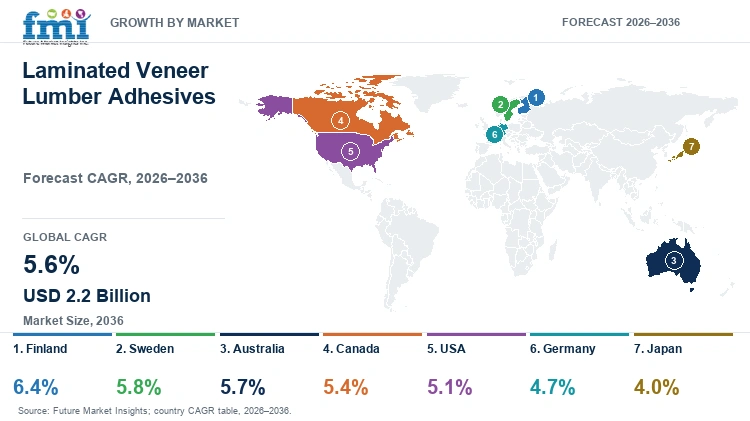
| Country | CAGR |
|---|---|
| Finland | 6.4% |
| Sweden | 5.8% |
| Australia | 5.7% |
| Canada | 5.4% |
| USA | 5.1% |
| Germany | 4.7% |
| Japan | 4.0% |
How do country-level CAGRs compare in the Laminated Veneer Lumber Adhesives Market?
The 2.4 percentage-point spread separates Finland from Japan, with Sweden and Australia forming a compact middle group near the supplied global trajectory. Canada and the USA follow within three-tenths of a point, while Germany and Japan carry slower construction conversion. The spacing reflects different combinations of LVL capacity, timber-building activity and local qualification requirements rather than current market size.
- Finland has dedicated Kerto LVL capacity under construction, giving adhesive qualification a direct route into new structural output.
- Sweden’s climate-declaration regime makes embodied-carbon records part of project documentation for a growing set of completed buildings.
- Australia combines plantation softwood supply with rising dwelling starts, although long transport distances complicate resin service coverage.
- Canada is funding wood-construction demonstrations and manufacturing upgrades that give new bonding systems more production sites for validation.
- The USA has a large housing base, but monthly permitting shifts keep mill-order visibility sensitive to residential construction cycles.
- Germany’s permit recovery is gradual, so adhesive gains depend on timber projects converting from design approval into factory orders.
- Japan is expanding formal wood-use agreements, yet fragmented domestic supply keeps project economics dependent on regional material availability.
Comparable CAGRs therefore mask different qualification timing, service distances and construction pipelines that alter the commercial path in each country. The full report provides country-level CAGR analysis across North America, Latin America, Western Europe, Eastern Europe, East Asia, South Asia and Pacific, and the Middle East and Africa.
Country-wise Analysis
- Finland operates one of the clearest new-volume routes because Metsä Wood is commissioning dedicated Kerto LVL capacity at Äänekoski. Cross-laminated timber demand also keeps structural timber specifications active beyond LVL alone. Finland is projected to grow at 6.4% CAGR through 2036 as new veneer-based capacity raises the number of qualified bond lines. Natural Resources Institute Finland reported in April 2026 that forest-industry roundwood consumption reached 66.1 million cubic meters in 2025, up 6% from the prior year. Domestic fiber access supports mill scale, although resin changes still require line trials and structural documentation before full-volume use. Local technical support therefore matters most during commissioning and grade changeovers.
- Swedish construction teams increasingly work with documented building-climate data before final clearance, which raises the value of traceable material inputs. Sweden is forecast to grow at 5.8% CAGR over the assessment period as timber systems remain compatible with carbon-accounting requirements. Boverket published in February 2026 that 1,509 climate declarations were registered during 2025, compared with 1,041 in 2024. That reporting structure favors adhesive systems backed by stable process and emissions records. The friction is administrative rather than chemical alone because project teams must align declarations with product documentation. Companies entering Sweden therefore need local technical files that fit both mill qualification and building-level reporting workflows.
- Australian LVL supply operates through long freight corridors, so resin reliability and field support must work beyond the main processing centers. Australia is anticipated to record 5.7% CAGR through 2036 because softwood construction demand gives veneer processors a stable structural outlet. ABARES reported in June 2026 that softwood log harvest reached 14.4 million cubic meters in 2024-25 and rose 3.9% from the prior year. Plantation supply supports engineered-wood production, although service distance and uneven fiber availability raise the cost of troubleshooting a new adhesive system. Local distributors can assist routine supply, but technical qualification still benefits from direct resin-producer involvement at the mill.
- Canadian engineered-wood investment increasingly links product development with demonstration buildings and mill modernization. Canada is expected to maintain 5.4% CAGR through 2036 as provincial wood-manufacturing clusters widen the addressable base for structural bonding. Natural Resources Canada announced in June 2026 that 56 forest-sector transformation projects would receive federal support, including work on processing automation and construction products. That project density supports new timber construction applications, but qualification evidence must still fit provincial code and customer requirements. Producers with application laboratories near major mills can shorten troubleshooting cycles. Long transport routes between resin supply and western or northern plants remain a practical service constraint.
- United States LVL demand remains tied to housing starts, engineered-wood plants and code-compliant structural framing rather than one national project program. The USA is set to post 5.1% CAGR during the forecast period because replacement and new-build volumes keep beams and headers in regular mill schedules. The USA Census Bureau and HUD reported in March 2026 that January housing starts ran at a 1,487,000 seasonally adjusted annual rate. That volume gives qualified adhesives a broad consumption base. Month-to-month permit weakness can still reduce production visibility for mills. Resin suppliers therefore need dependable regional inventory and technical service.
- German structural-timber projects pass through detailed approvals and factory production planning before adhesive volume converts into repeat mill orders. Germany is predicted to expand at 4.7% CAGR by 2036 as residential permitting begins to recover from a weak construction cycle. Destatis recorded 19,322 dwellings in new-building permits during December 2025, providing a measurable construction pipeline for engineered wood components. The enabler is Germany’s established timber engineering and testing network. The friction is timing because permitted projects can still be delayed by financing or tender schedules. Adhesive companies gain more from documented structural approvals and local application support than from broad construction exposure without mill-level qualification.
- Japan’s timber-building policy increasingly uses formal agreements that connect building owners with forestry and wood-industry participants. Japan is positioned to record 4.0% CAGR through 2036 because those agreements create defined projects for structural wood use. The Forestry Agency reported in 2026 that 5,002 buildings used wood under agreements during 2025 and consumed about 132,738 cubic meters. The route supports melamine formaldehyde and other qualified structural chemistries where local production standards accept the system. Regional fiber supply and seismic design requirements can narrow the addressable project set. Companies need Japanese technical documentation and a service route that can resolve mill questions without long overseas response times.
Who are the notable companies in the Laminated Veneer Lumber Adhesives Market?
Hexion, H.B. Fuller, Henkel, AkzoNobel, Dynea, Prefere Resins, Sika, BASF, Arclin and Jowat are the key companies profiled in this market.
Competition is concentrated among resin specialists, diversified adhesive companies and engineered-wood chemistry providers with documented access to structural timber applications. Entry is difficult because a resin formulation must fit veneer species, press conditions and structural approval routes before it can displace an incumbent system at a running LVL mill.
- Hexion, Dynea, Prefere Resins, BASF and Arclin compete through thermosetting resin chemistry, wood-panel relationships and production-scale material supply.
- Henkel, Jowat and AkzoNobel hold documented structural timber adhesive approvals, while H.B. Fuller and Sika bring broader adhesive formulation and application-service networks.
Competitive Benchmarking: Laminated Veneer Lumber Adhesives Market
| Company | Structural Wood Bonding Evidence | Mill Process Support | Lower-Emission / Renewable Route | Geographic Reach |
|---|---|---|---|---|
| Hexion | High | High | High | Global |
| H.B. Fuller | High | High | Medium | Global |
| Henkel | High | High | High | Global |
| AkzoNobel | High | Medium | Medium | Europe and international |
| Dynea | High | High | High | Europe and international |
| Prefere Resins | High | Medium | High | Europe and international |
| Sika | Medium | Medium | Medium | Global |
| BASF | High | Medium | High | Global |
| Arclin | High | High | Medium | North America and international |
| Jowat | High | High | Medium | Global |
Scoring basis: High structural-bonding evidence requires current load-bearing timber approval or documented engineered-wood resin use, Medium covers adjacent construction bonding, and Low identifies narrower evidence. High process support requires mill-scale application or production evidence, while Medium reflects one documented route. High lower-emission or renewable evidence requires a current certified or commercialized chemistry pathway; Medium reflects a documented development program.
Key Developments in the Laminated Veneer Lumber Adhesives Market
- In April 2026, Hexion and CitroTech formed a 50/50 joint venture to commercialize integrated fire-retardant chemistry for plywood, OSB and other engineered wood manufacturing.
- In October 2025, Arclin completed the acquisition of Polymer Solutions Group, adding polymer additives and complementary chemistries used in engineered wood production.
- In September 2026, Sika closed its acquisition of Akkim, expanding adhesive and sealant manufacturing capacity and distribution reach in several construction markets.
Key Players in the Laminated Veneer Lumber Adhesives Market
Thermosetting Resin and Engineered-Wood Chemistry Platforms
- Hexion
- Dynea
- Prefere Resins
- BASF
- Arclin
Structural Timber and Industrial Adhesive Platforms
- Henkel
- Jowat
- AkzoNobel
Diversified Construction and Application Adhesive Platforms
- H.B. Fuller
- Sika
Laminated Veneer Lumber Adhesives Market - Report Scope
| Coverage field | Report scope |
|---|---|
| Market breakdown | By adhesive chemistry, cure type, LVL grade, end use, sales channel and region. |
| Quantitative Units | USD billion. |
| Market Definition | Adhesive systems used to bond veneer layers and structural joints in laminated veneer lumber production and directly related engineered-wood applications. |
| Regions Covered | North America, Latin America, Western Europe, Eastern Europe, East Asia, South Asia and Pacific, and Middle East and Africa. |
| Countries Covered | Finland, Sweden, Australia, Canada, USA, Germany, Japan, and 20+ countries included in the full report. |
| Key Companies Profiled | Hexion, H.B. Fuller, Henkel, AkzoNobel, Dynea, Prefere Resins, Sika, BASF, Arclin, Jowat. |
| Forecast Period | 2026 to 2036. |
| Approach | Primary and secondary research with market triangulation. |
Laminated Veneer Lumber Adhesives Market - Research Methodology
| Method | Approach |
|---|---|
| Primary Research | FMI analysts gathered input from manufacturers, service providers, technology developers, distributors, end users, procurement teams, and subject-matter experts. Interviews examined purchasing decisions, product or service evaluation, adoption barriers, approval requirements, pricing considerations, and expectations for technical or commercial support. Respondents were also asked what evidence is required before a trial, pilot, or initial order develops into regular purchasing. |
| Desk Research | Desk research covered government statistics, regulatory publications, trade data, industry associations, technical literature, standards, company filings, product information, and official corporate announcements. Sources were reviewed for relevance, publication date, geographic coverage, and consistency with the defined market scope. Claims relating to performance, applications, approvals, capacity, investment, and commercial activity were retained only when supported by credible public evidence. |
| Market Sizing and Forecasting | The market model combined the baseline value with historical performance, segment structure, pricing and volume indicators, adoption levels, company participation, and country-level demand conditions. Forecast assumptions considered economic activity, investment trends, regulatory developments, technology adoption, purchasing cycles, supply availability, and barriers to wider market use. Segment and regional estimates were reconciled before the final market total was calculated. |
| Data Validation | Estimates were checked against multiple independent indicators, including public data, company activity, trade patterns, industry developments, and findings from primary interviews. Validation also tested whether products, services, applications, and company revenues fell within the defined market boundaries. Adjacent categories, unsupported claims, overlapping revenues, and activities without direct market relevance were excluded to reduce double counting and maintain consistency across segments and countries. |
Laminated Veneer Lumber Adhesives Market by Segments
Laminated Veneer Lumber Adhesives Market segmented by Adhesive Chemistry:
- Phenol resorcinol formaldehyde
- Phenol formaldehyde
- Melamine formaldehyde
- Polyurethane adhesives
- Emulsion polymer isocyanate
Laminated Veneer Lumber Adhesives Market segmented by Cure Type:
- Hot press cure
- Cold cure
- RF cure
- Moisture cure
Laminated Veneer Lumber Adhesives Market segmented by LVL Grade:
- Structural LVL
- Non-structural LVL
- Marine - exterior grade
- Fire-resistant LVL
Laminated Veneer Lumber Adhesives Market segmented by End Use:
- Beams and headers
- I-joists/flanges
- Scaffold planks
- Formwork panels
- Industrial components
Laminated Veneer Lumber Adhesives Market segmented by Sales Channel:
- Engineered wood mills
- Direct resin producers
- Specialty adhesive distributors
- Technical service contracts
Laminated Veneer Lumber Adhesives Market by Region:
- North America
- United States
- Canada
- Latin America
- Brazil
- Mexico
- Chile
- Rest of Latin America
- Western Europe
- Germany
- United Kingdom
- Italy
- Spain
- France
- Nordics
- Benelux
- Rest of Western Europe
- Eastern Europe
- Russia
- Poland
- Hungary
- Balkan and Baltic States
- Rest of Eastern Europe
- East Asia
- China
- Japan
- South Korea
- South Asia and Pacific
- India
- ASEAN
- Australia and New Zealand
- Rest of South Asia and Pacific
- Middle East and Africa
- Kingdom of Saudi Arabia
- Other GCC Countries
- Türkiye
- South Africa
- Other African Union Countries
- Rest of Middle East and Africa
Research Sources and Bibliography
- Metsä Wood. (2025, September 23). Test production is starting at new Äänekoski Kerto LVL mill.
- Natural Resources Canada. (2025, March 6). Canada Invests in Sustainable Wood Construction in Ontario, Creating 319 New Residential Units.
- Dynea. (2025, November 19). MUF Adhesive Opens New Perspectives for Hardwood Construction.
- Raute. (2025, September 3). LVL Global, Canada invests in Raute’s latest LVL technology.
- Metsä Wood. (2025, April 29). Metsä Group will build a Research and Development laboratory for veneer-based wood products.
- Henkel. (2025, February 25). Setting new standards for sustainable timber construction.
- Natural Resources Canada. (2025, March 20). Canada and Quebec Invest in Sustainable Wood Construction.
- Natural Resources Canada. (2025, December 15). Advancing protections and support for Canada’s forest sector.
- Raute Corporation. (2025, May 28). Raute to initiate change negotiations on possible temporary layoffs of up to 90 days in the Wood Processing and Analyzers business units in Finland.
- Hexion. (2025, June 23). Hexion and Bloom Pioneer Industry-First Renewable Adhesive Technology.
- Natural Resources Institute Finland. (2026, April 28). Forest industries’ wood consumption 2025.
- Boverket. (2026, February 16). Climate declaration follow-up and statistics.
- Australian Bureau of Agricultural and Resource Economics and Sciences. (2026, June 18). Australian Forest and Wood Product Statistics: Production and trade to 2024-25.
- Natural Resources Canada. (2026, June 3). Canada advances forest sector transformation to protect jobs and strengthen communities nationwide.
- U.S. Census Bureau and U.S. Department of Housing and Urban Development. (2026, March 12). Monthly New Residential Construction, January 2026.
- Federal Statistical Office of Germany. (2026). Building permits, construction of new buildings.
- Forestry Agency, Ministry of Agriculture, Forestry and Fisheries. (2026). Wood use trends in buildings.
- Hexion. (2026, April 21). CitroTech and Hexion launch global joint venture.
- Arclin. (2025, October 2). Arclin Accelerates Growth Through Acquisition of Polymer Solutions Group, Unlocking New Markets and Complementary Chemistries.
- Sika. (2026, September 3). Sika closes acquisition of Akkim - Accelerating global expansion in adhesives and sealants.
- Deutsches Institut für Bautechnik. (2025-2026). Adhesives and bonded connections in timber construction.
- H.B. Fuller. (2025, November 10). Engineered Wood Adhesives Guide.
- H.B. Fuller. (2026, January 22). Form 10-K for the fiscal year ended November 29, 2025.
- AkzoNobel. (2026, February 24). AkzoNobel’s 2025 annual report published online.
- Dynea. (2025, October 31). Successful ISCC PLUS & ISO45001 Audits.
- Prefere Resins. (2025, May 26). Prefere Resins reaches an EcoVadis Gold and improves ESG performance.
- BASF. (2025, November 19). BASF adds ISCC EU certification to certified biomass-balanced methanol portfolio.
- Arclin. (2025, February 24). Arclin to acquire new assets to support growing demand for Firepoint product.
- KOMO. (2025). Certificate 33458/25 - Jowat SE.
- Hexion. (2025, May 26). Hexion and Smartech Unveil SmartQuality.
- Arclin. (2026, February 2). Arclin Completes Acquisition of The Willamette Valley Company, Strengthening Materials Science Portfolio & Expanding Global Presence.
- Prefere Resins. (2025, February). Prefere Resins publishes first Group Sustainability Report.
- BASF. (2025, February 6). For sustainable sound absorption: the world’s first high-quality melamine resin foam with a reduced PCF.
- Sika. (2025, March 3). Sika acquires one of the leading roofing system providers in the UK.
- Henkel. (2025, September 22). Henkel Opens Inspiration Center Shanghai for Adhesive Technologies in China.
- Sika. (2025, January 16). Sika expands its global footprint with new plants in Singapore and China.
This bibliography is provided for reader reference and is not exhaustive. The full report contains the complete reference list and detailed citations
This Report Answers
- How large is the laminated veneer lumber adhesives market in 2026 and 2036?
- Which operating changes are increasing adhesive consumption at LVL mills?
- Why does phenol resorcinol formaldehyde account for 31.0% of adhesive chemistry demand?
- How does hot press cure affect resin selection on continuous LVL lines?
- Why does structural LVL represent 51.0% of the supplied LVL grade mix?
- How do the seven profiled country growth rates differ through 2036?
- Which companies hold documented structural timber adhesive or engineered-wood chemistry positions?
- What slows adhesive switching after a new chemistry has passed laboratory testing?
- Where can renewable or lower-emission resin routes convert into recurring LVL mill volume?
Frequently Asked Questions
How big is the Laminated Veneer Lumber Adhesives Market in 2026?
The laminated veneer lumber adhesives market is valued at USD 1.3 billion in 2026 and is projected to reach USD 2.2 billion by 2036. Expansion follows new LVL capacity and structural timber projects that require qualified mill-scale bonding systems.
What is the CAGR of the Laminated Veneer Lumber Adhesives Market from 2026 to 2036?
The laminated veneer lumber adhesives market is projected to grow at a CAGR of 5.6% between 2026 and 2036. Growth is tied to engineered-wood production, structural timber use and adhesive qualification for repeatable factory pressing conditions.
Which adhesive chemistry leads the Laminated Veneer Lumber Adhesives Market?
The phenol resorcinol formaldehyde segment is expected to hold 31.0% of the laminated veneer lumber adhesives market in 2026, attributable to established exterior durability and structural bonding records. Mills still qualify each system against veneer species and press conditions.
Which cure type holds the supplied share in the Laminated Veneer Lumber Adhesives Market?
The hot press cure segment is expected to hold 39.0% of the laminated veneer lumber adhesives market in 2026, driven by continuous mill lines that link reaction time to press throughput. Qualification centers on spread rate, assembly time and cured-bond consistency.
Which LVL grade accounts for the supplied share in the Laminated Veneer Lumber Adhesives Market?
The structural LVL segment is expected to hold 51.0% of the laminated veneer lumber adhesives market in 2026, supported by load-bearing beams and flange applications. Structural grades require documented bond performance before resin changes move into regular mill production.
Which countries are included in the country growth comparison for the Laminated Veneer Lumber Adhesives Market?
Finland is projected at 6.4% CAGR, followed by Sweden at 5.8% and Australia at 5.7% through 2036. Canada, the USA, Germany and Japan follow with different construction pipelines, mill investment conditions and local qualification requirements.
Which companies are active in the Laminated Veneer Lumber Adhesives Market?
Key companies operating in the market include Hexion, H.B. Fuller, Henkel, AkzoNobel, Dynea, Prefere Resins, Sika, BASF, Arclin, and Jowat. Their positions differ by resin chemistry, structural timber approvals, mill application support and geographic production coverage.
Preview the report firsthand - request a free sample
Get SampleGet the brochure for pricing and purchase details.
Get PDFTable of Content
- Key Takeaways
- Market Size and CAGR
- Top Growth Driver
- Fastest Growing Segment
- Leading Region
- Key Companies
- Emerging Opportunities
- Executive Summary
- Global Market Outlook
- Demand-side Trends
- Supply-side Trends
- Technology Roadmap Analysis
- Analysis and Recommendations
- Analyst Perspective (What is happening? Why now? What should investors know?)
- Key Questions Answered
- How large is the market?
- What is the CAGR?
- What are key trends?
- Which region dominates?
- Who are the leaders?
- Market Overview
- Market Coverage / Taxonomy
- Market Definition / Scope / Limitations
- Research Methodology
- Chapter Orientation
- Analytical Lens and Working Hypotheses
- Market Structure, Signals, and Trend Drivers
- Benchmarking and Cross-market Comparability
- Market Sizing, Forecasting, and Opportunity Mapping
- Research Design and Evidence Framework
- Desk Research Programme (Secondary Evidence)
- Expert Input and Fieldwork (Primary Evidence)
- Tooling, Models, and Reference Databases
- Data Engineering and Model Build
- Quality Assurance and Audit Trail
- Market Background
- Market Dynamics (Drivers, Restraints, Opportunity, Trends)
- Scenario Forecast (Optimistic, Likely, Conservative)
- Impact Analysis
- AI Impact
- Sustainability Impact
- Regulatory Impact
- Technology Impact
- Consumer / Buyer Analysis
- Purchase Drivers
- Adoption Barriers
- Buyer Journey
- Opportunity Map Analysis
- Product Life Cycle Analysis
- Supply Chain Analysis
- Investment Feasibility Matrix
- Value Chain Analysis
- PESTLE and Porter's Analysis
- Regulatory Landscape
- Regional Parent Market Outlook
- Production and Consumption Statistics
- Import and Export Statistics
- Global Market Analysis and Forecast, 2021 to 2036
- Historical Market Size Value (USD Billion) Analysis, 2021 to 2025
- Current and Future Market Size Value (USD Billion) Projections, 2026 to 2036
- Y-o-Y Growth Trend Analysis
- Absolute $ Opportunity Analysis
- Global Market Pricing Analysis, 2021 to 2036
- Global Market Analysis and Forecast, By Adhesive Chemistry, 2021 to 2036
- Introduction / Key Findings
- Historical Market Size Value (USD Billion) Analysis By Adhesive Chemistry, 2021 to 2025
- Current and Future Market Size Value (USD Billion) Analysis and Forecast By Adhesive Chemistry, 2026 to 2036
- Phenol resorcinol formaldehyde
- Phenol formaldehyde
- Melamine formaldehyde
- Polyurethane adhesives
- Emulsion polymer isocyanate
- Y-o-Y Growth Trend Analysis By Adhesive Chemistry, 2021 to 2025
- Absolute $ Opportunity Analysis By Adhesive Chemistry, 2026 to 2036
- Global Market Analysis and Forecast, By Cure Type, 2021 to 2036
- Introduction / Key Findings
- Historical Market Size Value (USD Billion) Analysis By Cure Type, 2021 to 2025
- Current and Future Market Size Value (USD Billion) Analysis and Forecast By Cure Type, 2026 to 2036
- Hot press cure
- Cold cure
- RF cure
- Moisture cure
- Y-o-Y Growth Trend Analysis By Cure Type, 2021 to 2025
- Absolute $ Opportunity Analysis By Cure Type, 2026 to 2036
- Global Market Analysis and Forecast, By LVL Grade, 2021 to 2036
- Introduction / Key Findings
- Historical Market Size Value (USD Billion) Analysis By LVL Grade, 2021 to 2025
- Current and Future Market Size Value (USD Billion) Analysis and Forecast By LVL Grade, 2026 to 2036
- Structural LVL
- Non-structural LVL
- Marine - exterior grade
- Fire-resistant LVL
- Y-o-Y Growth Trend Analysis By LVL Grade, 2021 to 2025
- Absolute $ Opportunity Analysis By LVL Grade, 2026 to 2036
- Global Market Analysis and Forecast, By End Use, 2021 to 2036
- Introduction / Key Findings
- Historical Market Size Value (USD Billion) Analysis By End Use, 2021 to 2025
- Current and Future Market Size Value (USD Billion) Analysis and Forecast By End Use, 2026 to 2036
- Beams and headers
- I-joists/flanges
- Scaffold planks
- Formwork panels
- Industrial components
- Y-o-Y Growth Trend Analysis By End Use, 2021 to 2025
- Absolute $ Opportunity Analysis By End Use, 2026 to 2036
- Global Market Analysis and Forecast, By Sales Channel, 2021 to 2036
- Introduction / Key Findings
- Historical Market Size Value (USD Billion) Analysis By Sales Channel, 2021 to 2025
- Current and Future Market Size Value (USD Billion) Analysis and Forecast By Sales Channel, 2026 to 2036
- Engineered wood mills
- Direct resin producers
- Specialty adhesive distributors
- Technical service contracts
- Y-o-Y Growth Trend Analysis By Sales Channel, 2021 to 2025
- Absolute $ Opportunity Analysis By Sales Channel, 2026 to 2036
- Global Market Analysis and Forecast, By Region, 2021 to 2036
- Introduction
- Historical Market Size Value (USD Billion) Analysis By Region, 2021 to 2025
- Current Market Size Value (USD Billion) Analysis and Forecast By Region, 2026 to 2036
- North America
- Latin America
- Western Europe
- Eastern Europe
- East Asia
- South Asia and Pacific
- Middle East and Africa
- Market Attractiveness Analysis By Region
- North America Market Analysis and Forecast, By Country, 2021 to 2036
- Historical Market Size Value (USD Billion) Trend Analysis By Market Taxonomy, 2021 to 2025
- Market Size Value (USD Billion) Forecast By Market Taxonomy, 2026 to 2036
- By Country
- United States
- Canada
- By Adhesive Chemistry
- By Cure Type
- By LVL Grade
- By End Use
- By Sales Channel
- By Country
- Market Attractiveness Analysis
- By Country
- By Adhesive Chemistry
- By Cure Type
- By LVL Grade
- By End Use
- By Sales Channel
- Key Takeaways
- Latin America Market Analysis and Forecast, By Country
- Historical Market Size Value (USD Billion) Trend Analysis By Market Taxonomy, 2021 to 2025
- Market Size Value (USD Billion) Forecast By Market Taxonomy, 2026 to 2036
- By Country
- Brazil
- Mexico
- Chile
- Rest of Latin America
- By Adhesive Chemistry
- By Cure Type
- By LVL Grade
- By End Use
- By Sales Channel
- By Country
- Market Attractiveness Analysis
- By Country
- By Adhesive Chemistry
- By Cure Type
- By LVL Grade
- By End Use
- By Sales Channel
- Key Takeaways
- Western Europe Market Analysis and Forecast, By Country
- Historical Market Size Value (USD Billion) Trend Analysis By Market Taxonomy, 2021 to 2025
- Market Size Value (USD Billion) Forecast By Market Taxonomy, 2026 to 2036
- By Country
- Germany
- United Kingdom
- Italy
- Spain
- France
- Nordics
- Benelux
- Rest of Western Europe
- By Adhesive Chemistry
- By Cure Type
- By LVL Grade
- By End Use
- By Sales Channel
- By Country
- Market Attractiveness Analysis
- By Country
- By Adhesive Chemistry
- By Cure Type
- By LVL Grade
- By End Use
- By Sales Channel
- Key Takeaways
- Eastern Europe Market Analysis and Forecast, By Country
- Historical Market Size Value (USD Billion) Trend Analysis By Market Taxonomy, 2021 to 2025
- Market Size Value (USD Billion) Forecast By Market Taxonomy, 2026 to 2036
- By Country
- Russia
- Poland
- Hungary
- Balkan and Baltic States
- Rest of Eastern Europe
- By Adhesive Chemistry
- By Cure Type
- By LVL Grade
- By End Use
- By Sales Channel
- By Country
- Market Attractiveness Analysis
- By Country
- By Adhesive Chemistry
- By Cure Type
- By LVL Grade
- By End Use
- By Sales Channel
- Key Takeaways
- East Asia Market Analysis and Forecast, By Country
- Historical Market Size Value (USD Billion) Trend Analysis By Market Taxonomy, 2021 to 2025
- Market Size Value (USD Billion) Forecast By Market Taxonomy, 2026 to 2036
- By Country
- China
- Japan
- South Korea
- By Adhesive Chemistry
- By Cure Type
- By LVL Grade
- By End Use
- By Sales Channel
- By Country
- Market Attractiveness Analysis
- By Country
- By Adhesive Chemistry
- By Cure Type
- By LVL Grade
- By End Use
- By Sales Channel
- Key Takeaways
- South Asia and Pacific Market Analysis and Forecast, By Country
- Historical Market Size Value (USD Billion) Trend Analysis By Market Taxonomy, 2021 to 2025
- Market Size Value (USD Billion) Forecast By Market Taxonomy, 2026 to 2036
- By Country
- India
- ASEAN
- Australia and New Zealand
- Rest of South Asia and Pacific
- By Adhesive Chemistry
- By Cure Type
- By LVL Grade
- By End Use
- By Sales Channel
- By Country
- Market Attractiveness Analysis
- By Country
- By Adhesive Chemistry
- By Cure Type
- By LVL Grade
- By End Use
- By Sales Channel
- Key Takeaways
- Middle East and Africa Market Analysis and Forecast, By Country
- Historical Market Size Value (USD Billion) Trend Analysis By Market Taxonomy, 2021 to 2025
- Market Size Value (USD Billion) Forecast By Market Taxonomy, 2026 to 2036
- By Country
- Kingdom of Saudi Arabia
- Other GCC Countries
- Türkiye
- South Africa
- Other African Union Countries
- Rest of Middle East and Africa
- By Adhesive Chemistry
- By Cure Type
- By LVL Grade
- By End Use
- By Sales Channel
- By Country
- Market Attractiveness Analysis
- By Country
- By Adhesive Chemistry
- By Cure Type
- By LVL Grade
- By End Use
- By Sales Channel
- Key Takeaways
- Key Countries Market Analysis
- United States
- Pricing Analysis
- Market Share Analysis, 2025
- By Adhesive Chemistry
- By Cure Type
- By LVL Grade
- By End Use
- By Sales Channel
- Canada
- Pricing Analysis
- Market Share Analysis, 2025
- By Adhesive Chemistry
- By Cure Type
- By LVL Grade
- By End Use
- By Sales Channel
- Mexico
- Pricing Analysis
- Market Share Analysis, 2025
- By Adhesive Chemistry
- By Cure Type
- By LVL Grade
- By End Use
- By Sales Channel
- Brazil
- Pricing Analysis
- Market Share Analysis, 2025
- By Adhesive Chemistry
- By Cure Type
- By LVL Grade
- By End Use
- By Sales Channel
- Chile
- Pricing Analysis
- Market Share Analysis, 2025
- By Adhesive Chemistry
- By Cure Type
- By LVL Grade
- By End Use
- By Sales Channel
- Germany
- Pricing Analysis
- Market Share Analysis, 2025
- By Adhesive Chemistry
- By Cure Type
- By LVL Grade
- By End Use
- By Sales Channel
- United Kingdom
- Pricing Analysis
- Market Share Analysis, 2025
- By Adhesive Chemistry
- By Cure Type
- By LVL Grade
- By End Use
- By Sales Channel
- Italy
- Pricing Analysis
- Market Share Analysis, 2025
- By Adhesive Chemistry
- By Cure Type
- By LVL Grade
- By End Use
- By Sales Channel
- Spain
- Pricing Analysis
- Market Share Analysis, 2025
- By Adhesive Chemistry
- By Cure Type
- By LVL Grade
- By End Use
- By Sales Channel
- France
- Pricing Analysis
- Market Share Analysis, 2025
- By Adhesive Chemistry
- By Cure Type
- By LVL Grade
- By End Use
- By Sales Channel
- India
- Pricing Analysis
- Market Share Analysis, 2025
- By Adhesive Chemistry
- By Cure Type
- By LVL Grade
- By End Use
- By Sales Channel
- ASEAN
- Pricing Analysis
- Market Share Analysis, 2025
- By Adhesive Chemistry
- By Cure Type
- By LVL Grade
- By End Use
- By Sales Channel
- Australia and New Zealand
- Pricing Analysis
- Market Share Analysis, 2025
- By Adhesive Chemistry
- By Cure Type
- By LVL Grade
- By End Use
- By Sales Channel
- China
- Pricing Analysis
- Market Share Analysis, 2025
- By Adhesive Chemistry
- By Cure Type
- By LVL Grade
- By End Use
- By Sales Channel
- Japan
- Pricing Analysis
- Market Share Analysis, 2025
- By Adhesive Chemistry
- By Cure Type
- By LVL Grade
- By End Use
- By Sales Channel
- South Korea
- Pricing Analysis
- Market Share Analysis, 2025
- By Adhesive Chemistry
- By Cure Type
- By LVL Grade
- By End Use
- By Sales Channel
- Russia
- Pricing Analysis
- Market Share Analysis, 2025
- By Adhesive Chemistry
- By Cure Type
- By LVL Grade
- By End Use
- By Sales Channel
- Poland
- Pricing Analysis
- Market Share Analysis, 2025
- By Adhesive Chemistry
- By Cure Type
- By LVL Grade
- By End Use
- By Sales Channel
- Hungary
- Pricing Analysis
- Market Share Analysis, 2025
- By Adhesive Chemistry
- By Cure Type
- By LVL Grade
- By End Use
- By Sales Channel
- Kingdom of Saudi Arabia
- Pricing Analysis
- Market Share Analysis, 2025
- By Adhesive Chemistry
- By Cure Type
- By LVL Grade
- By End Use
- By Sales Channel
- Türkiye
- Pricing Analysis
- Market Share Analysis, 2025
- By Adhesive Chemistry
- By Cure Type
- By LVL Grade
- By End Use
- By Sales Channel
- South Africa
- Pricing Analysis
- Market Share Analysis, 2025
- By Adhesive Chemistry
- By Cure Type
- By LVL Grade
- By End Use
- By Sales Channel
- Finland
- Pricing Analysis
- Market Share Analysis, 2025
- By Adhesive Chemistry
- By Cure Type
- By LVL Grade
- By End Use
- By Sales Channel
- Sweden
- Pricing Analysis
- Market Share Analysis, 2025
- By Adhesive Chemistry
- By Cure Type
- By LVL Grade
- By End Use
- By Sales Channel
- Australia
- Pricing Analysis
- Market Share Analysis, 2025
- By Adhesive Chemistry
- By Cure Type
- By LVL Grade
- By End Use
- By Sales Channel
- United States
- Market Structure Analysis
- Competition Dashboard
- Competition Benchmarking
- Market Share Analysis of Top Players
- By Regional
- By Adhesive Chemistry
- By Cure Type
- By LVL Grade
- By End Use
- By Sales Channel
- Emerging Startups
- Innovation Benchmarking
- Competition Analysis
- Competition Deep Dive
- Hexion
- Overview
- Product Portfolio
- Profitability by Market Segments
- Sales Footprint
- Strategy Overview
- Marketing Strategy
- Product Strategy
- Channel Strategy
- Dynea
- Prefere Resins
- BASF
- Arclin
- Henkel
- Jowat
- AkzoNobel
- H.B. Fuller
- Sika
- Hexion
- Case Studies
- Success Stories
- Recent Developments
- Competition Deep Dive
- Assumptions & Acronyms Used


