

- Market Size (2026)
- USD 3.9 Bn
- Forecast (2036)
- USD 7.2 Bn
- CAGR (2026 to 2036)
- 6.5%
How big is Polyurethane Binders Market in 2026?
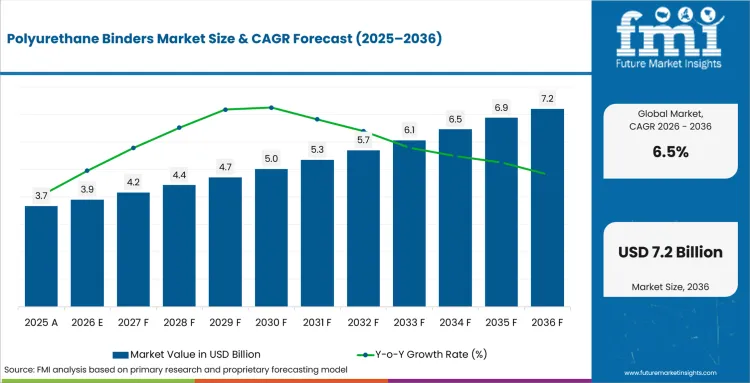
USD 3.9 billion in 2026 and USD 7.2 billion by 2036 at a 6.5% CAGR.
Demand for polyurethane binders is projected to expand at 6.5% CAGR between 2026 and 2036, increasing valuation from USD 3.9 billion in 2026 to USD 7.2 billion by 2036. Recovered tire rubber gives formulators a recurring substrate stream for track and playground base layers. The USA Tire Manufacturers Association reported in January 2025 that the country generates more than 230 million end-of-life tires annually. Consistent grading then determines binder dosage and installed cohesion across repeated track and playground specifications.
Formulators apply lessons from the polyurethane adhesives outlook to balance wetting and cure speed across mixed rubber granules. Facility teams compare installed resilience with adjacent flooring systems during approval of track or playground packages. Regional conversion depends on technical support that accounts for substrate moisture and local installation temperatures.
Key Takeaways of Polyurethane Binders Market
- Recovered tire rubber provides a recurring substrate stream for track bases and playground safety layers across established collection systems.
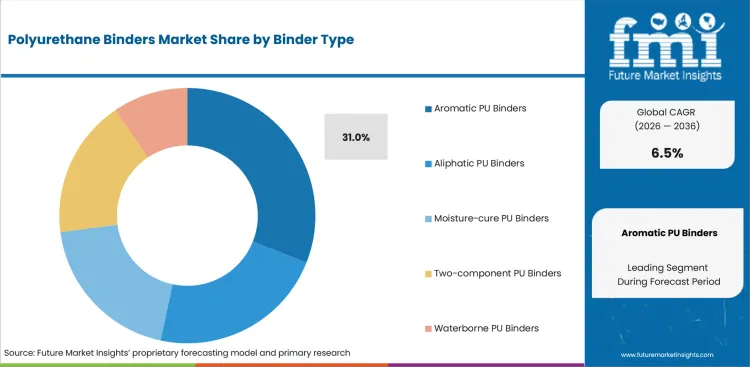
- Aromatic PU binders are projected to represent 31.0% share in 2026 owing to established compatibility with SBR and EPDM granules.
- Running tracks are estimated to account for 27.0% share in 2026 due to recurring certification and surface-renewal requirements.
- Moisture-curing systems are forecast to capture 44.0% share in 2026 driven by practical one-component handling across outdoor projects.
- Granule moisture and contamination remain material restraints as uneven reactions can weaken cohesion across continuous installed layers.
- BASF, Dow, STOCKMEIER Urethanes, CONICA, Carlisle, Rosehill, Melos and Pearl compete through binder breadth and application support.
Analyst Perspective
"Polyurethane binder economics are decided during installation as granule moisture and dosage determine whether a track cures evenly across its full area. Producers that validate the complete layer system under local weather conditions can protect installer margins and secure repeat refurbishment specifications."
- Nikhil Kaitwade, Principal Consultant, Future Market Insights
How is the Polyurethane Binders Market segmented?
The polyurethane binders industry is segmented by binder type, application, substrate, cure system, end use, sales channel and region.
The polyurethane binders market is organized around binder type, application, substrate, cure system, end use, sales channel and region. Binder type covers aromatic, aliphatic, moisture-cure, two-component and waterborne systems for distinct color, handling and cure requirements. Applications include running tracks, playground surfaces, turf binding, rubber flooring, bound aggregates and industrial composites across public facilities. Substrate, cure and sales analysis covers SBR, EPDM, cork, mineral and recycled inputs across moisture, catalyst, heat-assisted and UV-stable routes sold directly or through contractors, distributors and system houses.
What makes aromatic PU binders central to the binder type category?
Cost-sensitive rubber surfaces need binders that wet SBR and EPDM granules without excessive material use across base layers and colored wear courses. In August 2024, BASF and STOCKMEIER Urethanes USA announced commercial production of Stobielast S polyurethane binders for playground and recreational surfacing using domestically produced Biomass Balance Lupranate MDI, showing how aromatic binder platforms are being repositioned around lower-carbon feedstock claims without changing downstream equipment. Formulators use PU coatings experience to control viscosity and UV exposure across colored rubber wear layers.
- Aromatic PU binders are set to lead the binder type category with 31.0% share in 2026 due to established granule compatibility and practical formulation costs.
- Surface compounders select aromatic grades for base layers and darker wear courses as color change matters less than dependable cohesion across repeated specifications.
What drives running tracks within the application category?
Running-track systems require uniform force reduction across elastic base layers exposed to repeated spike loading. Facility projects place tracks beside artificial turf systems and therefore require coordinated drainage and shock-attenuation decisions across adjoining zones. In June 2025, CONICA completed a 9,000-square-meter retopping project at Ostrava's athletics stadium within fifteen days, giving track owners a recent example of rapid polyurethane surface renewal under a fixed event deadline.
- Based on application, running tracks are projected to account for 27.0% in 2026 due to recurring certification and refurbishment requirements across institutional facilities.
- Track installers favor coordinated primers and pore sealers as one approved system reduces interface failures during new construction and retopping work.
How does moisture curing influence selection within the cure system category?
One-component moisture curing reduces proportioning errors across outdoor projects that lack automated mixing equipment and dedicated dosing staff. The USA Environmental Protection Agency and CDC/ATSDR released the final Part 2 tire-crumb exposure characterization report in April 2024, keeping recycled-rubber sports and playground surfaces in the public evidence base that specifiers review during material approval. Related construction chemicals support primers and repairs without replacing the binder's central bonding function during surface rehabilitation.
- Moisture curing is projected to hold 44.0% share in 2026 owing to straightforward field handling across dispersed installation sites under changing ambient conditions.
- Regional installers adopt these systems more readily as local technical teams define storage limits and workable application windows for prevailing weather conditions.
What role does sports flooring play within the end use category?
Sports flooring joins impact attenuation and wear resistance inside one installed system for schools and stadiums. Facility planners coordinate drainage and maintenance access with synthetic turf options across multi-sport sites during approval. Surface owners also need repair materials that preserve texture without replacing a complete elastic layer.
- By end use, sports flooring is forecast to represent 34.0% in 2026 driven by recurring performance checks and scheduled surface refurbishment.
- System houses favor complete material families that align primers, base layers and topcoats across repeat facility layouts. In May 2025, CONICA formed a CATY partnership that combines prefabricated rubber mats with in-situ polyurethane binders through a confirmed first commercial order in China, reinforcing demand for blended system routes.
What are the drivers, restraints and opportunities in the Polyurethane Binders Market?
Driver: Graded tire rubber supports substrate demand for bound surfacing. Restraint: Moisture and contamination can disrupt cure across continuous layers. Opportunity: Complete material packages can shorten project qualification.
- Driver: Consistent crumb-rubber grading supports stable binder dosage across repeat track and playground surface specification programs.
- Restraint: Granule moisture or contamination can shorten working time and weaken cohesion across large continuous layers.
- Opportunity: Coordinated binder packages reduce interface failures during repeat qualification and surface-renewal approval cycles across complex installations.
Clean, graded crumb rubber lets formulators control binder dosage across track bases and wet-pour playgrounds. Formulators compare reclaimed rubber grades to limit binder waste and rejected batches during surface qualification.
Granule moisture or open containers can trigger uneven reactions during placement across large outdoor surfaces. Storage controls and weather-specific application windows protect working time and cohesion across connected layers outdoors.
Complete packages let contractors evaluate primers, base binders and repair materials through one qualification route. Contractors compare prefabricated track surfaces through installation time and documented climate limits during approval decisions.
Which country CAGRs are profiled in the polyurethane binders market?
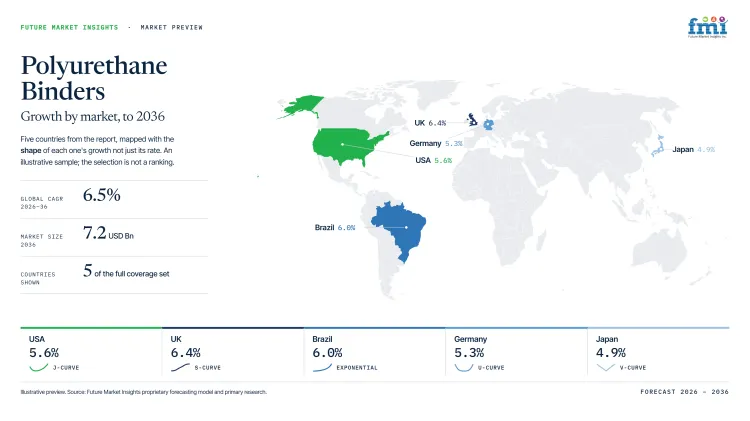
| Country | CAGR |
|---|---|
| United Kingdom | 6.4% |
| Brazil | 6.0% |
| United States | 5.6% |
| Germany | 5.3% |
| Japan | 4.9% |
How do country-level CAGRs compare in the Polyurethane Binders Market?
The displayed country CAGRs span 1.4 percentage points and form three practical growth bands across the assessment period.
- The United Kingdom and Brazil share a narrow upper band despite different waste-tire collection and project-financing systems.
- The United States and Germany occupy the middle band with a 0.3-point gap shaped by distinct funding and specification routes.
- Japan closes the displayed range as detailed domestic qualification can lengthen conversion despite dependable material recovery.
- CAGR does not equal current market size as a larger installed base can add more revenue at a lower growth rate.
- Comparable growth rates can produce different entry conditions due to recycling rules and technical support networks. Full report coverage includes North America, Latin America, Europe, East Asia, South Asia and Pacific, and Middle East and Africa.
The wider regional model therefore separates percentage growth from the absolute revenue contribution of established national markets.
Country-wise Analysis
- UK waste-tire processors now operate under enhanced export checks and national facility inspections that influence recycled-rubber documentation for public track and playground specifications and local refurbishment tenders. The Environment Agency found in March 2026 that 25 of 90 inspected tire-treatment facilities had minor compliance failures across its national campaign. Adoption of polyurethane binders in the United Kingdom is estimated to expand at 6.4% CAGR through 2036, shaped by experienced installers and recurring refurbishment programs. Regional processor compliance remains uneven, which results into distributors needing traceable feedstock records and flexible sourcing routes for scheduled municipal projects during narrow summer construction windows across local delivery networks.
- Brazilian tire manufacturers and importers finance collection and approved disposal through a national reverse-logistics system that feeds rubber processors serving urban tracks and resilient flooring projects across several city networks. Brazil is estimated to post 6.0% CAGR over the forecast period, supported by formal recovery obligations and continued sports construction outside major metropolitan regions. Ibama reported in December 2025 that nine in ten discarded tires receive environmentally adequate treatment across the country. Long transport distances remain a material friction as system houses need regional stock and technical partners to protect installation schedules during seasonal public construction cycles across distant interior municipalities.
- California separates tire-derived products by grant eligibility, so school districts and recreation authorities cannot assume identical public funding treatment across sports-surface projects and annual facility capital plans. CalRecycle's fiscal 2025-26 Tire Incentive Program explicitly excluded sports tracks and poured playgrounds from its eligible project list during that funding cycle. By 2036, the United States is projected to grow at 5.6% CAGR, aided by accessible rubber processors and technical laboratories. State-specific approvals remain a material friction, so national product programs require local funding analysis and distributor planning across several capital cycles without relying on a uniform national purchasing model and public tender schedules.
- Germany operates a mature tire-recycling network that supplies granules and rubber powder to municipal tracks and playground contractors through established regional processors serving schools and training facilities. The German polyurethane binders sector is projected to record 5.3% CAGR during the assessment period, reinforced by experienced installers and documented renovation specifications across recurring public projects. The German Rubber Industry Association reported in November 2025 that 193 thousand tonnes entered granulate or rubber-powder routes during 2024. Untracked tire exports reduce feedstock certainty, so system houses must protect tender pricing through diversified processor relationships and seasonal installation schedules during annual public budget cycles.
- Japan maintains an organized end-of-life tire network that provides sports-surface producers with documented crumb-rubber streams and established collection responsibilities across domestic processors serving schools and municipal facilities. JATMA recorded 708 thousand tonnes of effective tire utilization during 2025 including 89 thousand tonnes of crumb rubber across recognized recovery routes. Polyurethane binder demand in Japan is forecast to rise at 4.9% CAGR over the forecast period, influenced by disciplined system approval and stable technical service.
Who are the notable companies in the Polyurethane Binders Market?
BASF, Dow, STOCKMEIER Urethanes, CONICA, Beynon Sports Surfaces (Tarkett Sports), Rosehill Group and Melos GmbH are notable companies serving this market.
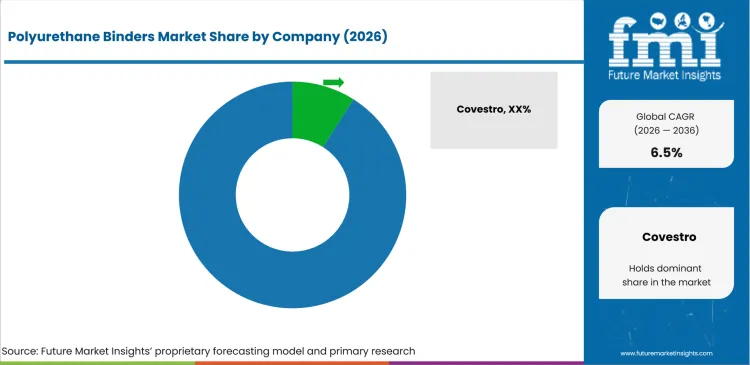
The competition remains moderately fragmented as global chemical groups compete with specialists and regional system houses. Polyurethane foam systems give integrated chemical producers shared isocyanate and polyol expertise across adjacent formulations. Polyurethane resins support raw-material access, but repeat specifications depend on verified layer systems and responsive field support.
- Global platforms: BASF, Dow and STOCKMEIER Urethanes combine formulation breadth with verified track systems and international coverage.
- Sports-surface specialists: CONICA and Carlisle offer layer packages across sports-surface systems and Rosehill supplies technical materials for climate-sensitive projects.
- Regional producers: Melos connects binder chemistry with granule processing and direct project support.
Competitive Benchmarking: Polyurethane Binders Market
| Company | Binder Breadth | Cure Options | Technical Support | Geographic Reach |
|---|---|---|---|---|
| BASF | High | Medium | High | Global |
| Dow | High | Medium | High | Global |
| STOCKMEIER Urethanes | High | High | High | Global |
| CONICA | High | High | High | Global |
| Carlisle Polyurethane Systems | High | High | High | North America |
| Rosehill Group | High | High | High | Europe and selected exports |
| Melos GmbH | High | Medium | High | Europe and selected exports |
Key Developments in the Polyurethane Binders Market
- In July 2025, STOCKMEIER Urethanes commenced construction of a new polyurethane production facility in Dubai, with operations scheduled to begin in 2026.
- In June 2025, CONICA completed a 9,000-square-meter retopping project at Ostrava's athletics stadium within fifteen days. The fixed event deadline demonstrated the value of rapid surface renewal planning and coordinated application support.
- In May 2025, CONICA formed a CATY partnership that combines prefabricated rubber mats with in-situ polyurethane binders through a confirmed first commercial order in China.
- In January 2025, CONICA announced two sports-surface systems incorporating Nike Grind rubber from February 2025. The launch gave multipurpose projects another documented route for using recovered rubber in installed surfaces.
Polyurethane Binders Market - Report Scope
| Coverage field | Report scope |
|---|---|
| Market breakdown | By binder type, application, substrate, cure system, end use, sales channel and region. |
| Quantitative Units | Revenue in USD billion and CAGR in %. |
| Market Definition | The market covers polyurethane binders sold for rubber-granule surfacing, bound aggregates and related commercial systems. |
| Regions Covered | North America, Latin America, Europe, East Asia, South Asia and Pacific, and Middle East and Africa. |
| Countries Covered | United Kingdom, Brazil, United States, Germany, Japan, and 20+ countries included in the full report. |
| Key Companies Profiled | BASF, Dow, STOCKMEIER Urethanes, CONICA, Carlisle Polyurethane Systems, Rosehill Group, Melos GmbH and Pearl Polyurethane Systems. |
| Forecast Period | 2026 to 2036. |
| Approach | Primary and secondary research with market triangulation. |
Polyurethane Binders Market - Research Methodology
| Method | Approach |
|---|---|
| Primary Research | FMI analysts gathered input from manufacturers, service providers, technology developers, distributors, end users, procurement teams, and subject-matter experts. Interviews examined purchasing decisions, product or service evaluation, adoption barriers, approval requirements, pricing considerations, and expectations for technical or commercial support. Respondents were also asked what evidence is required before a trial, pilot, or initial order develops into regular purchasing. |
| Desk Research | Desk research covered government statistics, regulatory publications, trade data, industry associations, technical literature, standards, company filings, product information, and official corporate announcements. Sources were reviewed for relevance, publication date, geographic coverage, and consistency with the defined market scope. Claims relating to performance, applications, approvals, capacity, investment, and commercial activity were retained only when supported by credible public evidence. |
| Market Sizing and Forecasting | The market model combined the baseline value with historical performance, segment structure, pricing and volume indicators, adoption levels, company participation, and country-level demand conditions. Forecast assumptions considered economic activity, investment trends, regulatory developments, technology adoption, purchasing cycles, supply availability, and barriers to wider market use. Segment and regional estimates were reconciled before the final market total was calculated. |
| Data Validation | Estimates were checked against multiple independent indicators, including public data, company activity, trade patterns, industry developments, and findings from primary interviews. Validation also tested whether products, services, applications, and company revenues fell within the defined market boundaries. Adjacent categories, unsupported claims, overlapping revenues, and activities without direct market relevance were excluded to reduce double counting and maintain consistency across segments and countries. |
Polyurethane Binders Market by Segments
Polyurethane Binders Market segmented by Binder Type:
- Aromatic PU Binders
- Aliphatic PU Binders
- Moisture-cure PU Binders
- Two-component PU Binders
- Waterborne PU Binders
Polyurethane Binders Market segmented by Application:
- Running Tracks
- Playground Surfaces
- Synthetic Turf Infill Binding
- Rubber Flooring
- Stone Carpet / Bound Aggregates
- Industrial Composites
Polyurethane Binders Market segmented by Substrate:
- SBR Rubber
- EPDM Granules
- Cork / Rubber Blends
- Mineral Aggregates
- Recycled Rubber
Polyurethane Binders Market segmented by Cure System:
- Moisture Curing
- Catalyst Assisted
- Heat Assisted
- UV-stable Aliphatic Systems
Polyurethane Binders Market segmented by End Use:
- Sports Flooring
- Playground Safety Surfacing
- Construction Flooring
- Recycled Rubber Products
Polyurethane Binders Market segmented by Sales Channel:
- Direct Chemical Supply
- Sports Surface Contractors
- Distributors
- System House Supply
Polyurethane Binders Market by Region:
- North America
- United States
- Canada
- Latin America
- Brazil
- Mexico
- Argentina
- Chile
- Western Europe
- Germany
- France
- United Kingdom
- Italy
- Spain
- Benelux
- Nordics
- Eastern Europe
- Poland
- Czech Republic
- Romania
- Hungary
- East Asia
- China
- Japan
- South Korea
- South Asia and Pacific
- India
- ASEAN
- Australia and New Zealand
- Middle East and Africa
- GCC Countries
- South Africa
- Türkiye
- Israel
Research Sources and Bibliography
- U.S. Tire Manufacturers Association (USTMA). (2025, January 16). The Strategic Roadmap for End-of-Life Tire Management.
- California Department of Resources Recycling and Recovery. (2025). Notice of Funds Available: Tire Incentive Program (FY 2025-26).
- Environment Agency. (2026, March 31). Progress update (March 2026): Environment Agency's regulation of waste pneumatic tyres and their export.
- Wirtschaftsverband der deutschen Kautschukindustrie e.V. (2025, November 6). Stärkung der Kreislaufwirtschaft nötig: Deutschen Altreifenrecyclern entgehen 100.000 Tonnen Altreifen jährlich.
- Japan Automobile Tyre Manufacturers Association. (n.d.). End of Life Tyres(ELT).
- Instituto Brasileiro do Meio Ambiente e dos Recursos Naturais Renováveis. (2025, December 29). 9 em cada 10 pneus inservíveis têm destinação ambientalmente adequada no Brasil.
- USA Environmental Protection Agency. (2024, April 16; updated 2026, March 24). Tire Crumb Exposure Characterization Report (Volumes 1 and 2).
- BASF. (2024, August 20). BASF and STOCKMEIER Urethanes USA, Inc. partner to offer more sustainable polyurethane playground and recreational surfacing products.
- STOCKMEIER Urethanes. (2025, August 21). Breaking Ground in Dubai: STOCKMEIER Urethanes Group Expands Presence in MEA/APAC Region.
- CONICA. (2025, June 24). World-Class in 15 Days: CONICA Retops Ostrava's Stadium Ahead of Golden Spike 2025.
- CONICA. (2025, May 16). CONICA Launches Strategic Partnership with Chinese Manufacturer CATY.
- CONICA. (2025, January 23). Exciting News: Introducing “CONICA Made with Nike Grind”.
This bibliography is provided for reader reference and is not exhaustive. The full report contains the complete reference list and detailed citations
This Report Answers
- How large is the polyurethane binders market in 2026 and 2036?
- Which binder types shape rubber-granule bonding across outdoor surface systems?
- Why do running tracks remain a major polyurethane binder application?
- How do moisture-curing systems affect outdoor installation and project qualification?
- Which national conditions influence polyurethane binder adoption through the 2036 forecast period?
- How do recovered tire flows affect substrate availability for bound surfacing?
- Which companies provide verified polyurethane binder capabilities for sports surfaces?
- How are binder breadth and technical support compared across verified producers?
- What recent company actions are changing regional supply and application support?
Frequently Asked Questions
How big is the Polyurethane Binders Market in 2026?
The polyurethane binders market is valued at USD 3.9 billion in 2026 and is forecast to reach USD 7.2 billion by 2036. Growth is supported by recovered tire rubber supplying track and playground base layers, with consistent grading determining binder dosage across repeated installation specifications.
What is the CAGR of the Polyurethane Binders Market from 2026 to 2036?
The polyurethane binders market grows at a CAGR of 6.5% between 2026 and 2036, supported by recurring track and playground refurbishment programs and consistent crumb-rubber grading that stabilizes binder dosage across repeat surface specifications at schools, stadiums and public recreation facilities.
Which binder type leads the Polyurethane Binders Market?
Aromatic PU binders lead the polyurethane binders market with a 31.0% share in 2026, because they offer established compatibility with SBR and EPDM granules at practical formulation costs, giving compounders dependable cohesion across base layers and darker wear courses in repeated specifications.
How much will the Polyurethane Binders Market add between 2026 and 2036?
The polyurethane binders market is set to add USD 3.3 billion between 2026 and 2036, growing from USD 3.9 billion to USD 7.2 billion as recovered tire rubber streams and coordinated binder packages expand across track, playground, sports flooring and bound-aggregate applications worldwide.
Who are the leading companies in the Polyurethane Binders Market?
The polyurethane binders market is led by 8 companies, including BASF, Dow, STOCKMEIER Urethanes, CONICA, Carlisle, Rosehill, Melos and Pearl, competing through binder breadth, cure-system options and technical support for track, playground and sports-flooring installation programs across regional distribution networks.
Preview the report firsthand - request a free sample
Get SampleGet the brochure for pricing and purchase details.
Get PDFTable of Content
- Key Takeaways
- Market Size and CAGR
- Top Growth Driver
- Fastest Growing Segment
- Leading Region
- Key Companies
- Emerging Opportunities
- Executive Summary
- Global Market Outlook
- Demand-side Trends
- Supply-side Trends
- Technology Roadmap Analysis
- Analysis and Recommendations
- Analyst Perspective (What is happening? Why now? What should investors know?)
- Key Questions Answered
- How large is the market?
- What is the CAGR?
- What are key trends?
- Which region dominates?
- Who are the leaders?
- Market Overview
- Market Coverage / Taxonomy
- Market Definition / Scope / Limitations
- Research Methodology
- Chapter Orientation
- Analytical Lens and Working Hypotheses
- Market Structure, Signals, and Trend Drivers
- Benchmarking and Cross-market Comparability
- Market Sizing, Forecasting, and Opportunity Mapping
- Research Design and Evidence Framework
- Desk Research Programme (Secondary Evidence)
- Expert Input and Fieldwork (Primary Evidence)
- Tooling, Models, and Reference Databases
- Data Engineering and Model Build
- Quality Assurance and Audit Trail
- Market Background
- Market Dynamics (Drivers, Restraints, Opportunity, Trends)
- Scenario Forecast (Optimistic, Likely, Conservative)
- Impact Analysis
- AI Impact
- Sustainability Impact
- Regulatory Impact
- Technology Impact
- Consumer / Buyer Analysis
- Purchase Drivers
- Adoption Barriers
- Buyer Journey
- Opportunity Map Analysis
- Product Life Cycle Analysis
- Supply Chain Analysis
- Investment Feasibility Matrix
- Value Chain Analysis
- PESTLE and Porter's Analysis
- Regulatory Landscape
- Regional Parent Market Outlook
- Production and Consumption Statistics
- Import and Export Statistics
- Global Market Analysis and Forecast, 2021 to 2036
- Historical Market Size Value (USD Billion) Analysis, 2021 to 2025
- Current and Future Market Size Value (USD Billion) Projections, 2026 to 2036
- Y-o-Y Growth Trend Analysis
- Absolute $ Opportunity Analysis
- Global Market Pricing Analysis, 2021 to 2036
- Global Market Analysis and Forecast, By Binder Type, 2021 to 2036
- Introduction / Key Findings
- Historical Market Size Value (USD Billion) Analysis By Binder Type, 2021 to 2025
- Current and Future Market Size Value (USD Billion) Analysis and Forecast By Binder Type, 2026 to 2036
- Aromatic PU Binders
- Aliphatic PU Binders
- Moisture-cure PU Binders
- Two-component PU Binders
- Waterborne PU Binders
- Aromatic PU Binders
- Y-o-Y Growth Trend Analysis By Binder Type, 2021 to 2025
- Absolute $ Opportunity Analysis By Binder Type, 2026 to 2036
- Global Market Analysis and Forecast, By Application, 2021 to 2036
- Introduction / Key Findings
- Historical Market Size Value (USD Billion) Analysis By Application, 2021 to 2025
- Current and Future Market Size Value (USD Billion) Analysis and Forecast By Application, 2026 to 2036
- Running Tracks
- Playground Surfaces
- Synthetic Turf Infill Binding
- Rubber Flooring
- Stone Carpet / Bound Aggregates
- Industrial Composites
- Running Tracks
- Y-o-Y Growth Trend Analysis By Application, 2021 to 2025
- Absolute $ Opportunity Analysis By Application, 2026 to 2036
- Global Market Analysis and Forecast, By Substrate, 2021 to 2036
- Introduction / Key Findings
- Historical Market Size Value (USD Billion) Analysis By Substrate, 2021 to 2025
- Current and Future Market Size Value (USD Billion) Analysis and Forecast By Substrate, 2026 to 2036
- SBR Rubber
- EPDM Granules
- Cork / Rubber Blends
- Mineral Aggregates
- Recycled Rubber
- SBR Rubber
- Y-o-Y Growth Trend Analysis By Substrate, 2021 to 2025
- Absolute $ Opportunity Analysis By Substrate, 2026 to 2036
- Global Market Analysis and Forecast, By Cure System, 2021 to 2036
- Introduction / Key Findings
- Historical Market Size Value (USD Billion) Analysis By Cure System, 2021 to 2025
- Current and Future Market Size Value (USD Billion) Analysis and Forecast By Cure System, 2026 to 2036
- Moisture Curing
- Catalyst Assisted
- Heat Assisted
- UV-stable Aliphatic Systems
- Moisture Curing
- Y-o-Y Growth Trend Analysis By Cure System, 2021 to 2025
- Absolute $ Opportunity Analysis By Cure System, 2026 to 2036
- Global Market Analysis and Forecast, By End Use, 2021 to 2036
- Introduction / Key Findings
- Historical Market Size Value (USD Billion) Analysis By End Use, 2021 to 2025
- Current and Future Market Size Value (USD Billion) Analysis and Forecast By End Use, 2026 to 2036
- Sports Flooring
- Playground Safety Surfacing
- Construction Flooring
- Recycled Rubber Products
- Sports Flooring
- Y-o-Y Growth Trend Analysis By End Use, 2021 to 2025
- Absolute $ Opportunity Analysis By End Use, 2026 to 2036
- Global Market Analysis and Forecast, By Sales Channel
- Introduction / Key Findings
- Historical Market Size Value (USD Billion) Analysis By Sales Channel, 2021 to 2025
- Current and Future Market Size Value (USD Billion) Analysis and Forecast By Sales Channel, 2026 to 2036
- Direct Chemical Supply
- Sports Surface Contractors
- Distributors
- System House Supply
- Direct Chemical Supply
- Y-o-Y Growth Trend Analysis By Sales Channel, 2021 to 2025
- Absolute $ Opportunity Analysis By Sales Channel, 2026 to 2036
- Global Market Analysis and Forecast, By Region, 2021 to 2036
- Introduction
- Historical Market Size Value (USD Billion) Analysis By Region, 2021 to 2025
- Current Market Size Value (USD Billion) Analysis and Forecast By Region, 2026 to 2036
- North America
- Latin America
- Western Europe
- Eastern Europe
- East Asia
- South Asia and Pacific
- Middle East & Africa
- Market Attractiveness Analysis By Region
- North America Market Analysis and Forecast, By Country, 2021 to 2036
- Historical Market Size Value (USD Billion) Trend Analysis By Market Taxonomy, 2021 to 2025
- Market Size Value (USD Billion) Forecast By Market Taxonomy, 2026 to 2036
- By Country
- USA
- Canada
- By Binder Type
- By Application
- By Substrate
- By Cure System
- By End Use
- By Sales Channel
- By Country
- Market Attractiveness Analysis
- By Country
- By Binder Type
- By Application
- By Substrate
- By Cure System
- By End Use
- By Sales Channel
- Key Takeaways
- Latin America Market Analysis and Forecast, By Country
- Historical Market Size Value (USD Billion) Trend Analysis By Market Taxonomy, 2021 to 2025
- Market Size Value (USD Billion) Forecast By Market Taxonomy, 2026 to 2036
- By Country
- Brazil
- Mexico
- Chile
- Rest of Latin America
- By Binder Type
- By Application
- By Substrate
- By Cure System
- By End Use
- By Sales Channel
- By Country
- Market Attractiveness Analysis
- By Country
- By Binder Type
- By Application
- By Substrate
- By Cure System
- By End Use
- By Sales Channel
- Key Takeaways
- Western Europe Market Analysis and Forecast, By Country
- Historical Market Size Value (USD Billion) Trend Analysis By Market Taxonomy, 2021 to 2025
- Market Size Value (USD Billion) Forecast By Market Taxonomy, 2026 to 2036
- By Country
- Germany
- UK
- Italy
- Spain
- France
- Nordic
- BENELUX
- Rest of Western Europe
- By Binder Type
- By Application
- By Substrate
- By Cure System
- By End Use
- By Sales Channel
- By Country
- Market Attractiveness Analysis
- By Country
- By Binder Type
- By Application
- By Substrate
- By Cure System
- By End Use
- By Sales Channel
- Key Takeaways
- Eastern Europe Market Analysis and Forecast, By Country
- Historical Market Size Value (USD Billion) Trend Analysis By Market Taxonomy, 2021 to 2025
- Market Size Value (USD Billion) Forecast By Market Taxonomy, 2026 to 2036
- By Country
- Russia
- Poland
- Hungary
- Balkan & Baltic
- Rest of Eastern Europe
- By Binder Type
- By Application
- By Substrate
- By Cure System
- By End Use
- By Sales Channel
- By Country
- Market Attractiveness Analysis
- By Country
- By Binder Type
- By Application
- By Substrate
- By Cure System
- By End Use
- By Sales Channel
- Key Takeaways
- East Asia Market Analysis and Forecast, By Country
- Historical Market Size Value (USD Billion) Trend Analysis By Market Taxonomy, 2021 to 2025
- Market Size Value (USD Billion) Forecast By Market Taxonomy, 2026 to 2036
- By Country
- China
- Japan
- South Korea
- By Binder Type
- By Application
- By Substrate
- By Cure System
- By End Use
- By Sales Channel
- By Country
- Market Attractiveness Analysis
- By Country
- By Binder Type
- By Application
- By Substrate
- By Cure System
- By End Use
- By Sales Channel
- Key Takeaways
- South Asia and Pacific Market Analysis and Forecast, By Country
- Historical Market Size Value (USD Billion) Trend Analysis By Market Taxonomy, 2021 to 2025
- Market Size Value (USD Billion) Forecast By Market Taxonomy, 2026 to 2036
- By Country
- India
- ASEAN
- Australia & New Zealand
- Rest of South Asia and Pacific
- By Binder Type
- By Application
- By Substrate
- By Cure System
- By End Use
- By Sales Channel
- By Country
- Market Attractiveness Analysis
- By Country
- By Binder Type
- By Application
- By Substrate
- By Cure System
- By End Use
- By Sales Channel
- Key Takeaways
- Middle East & Africa Market Analysis and Forecast, By Country
- Historical Market Size Value (USD Billion) Trend Analysis By Market Taxonomy, 2021 to 2025
- Market Size Value (USD Billion) Forecast By Market Taxonomy, 2026 to 2036
- By Country
- Kingdom of Saudi Arabia
- Other GCC Countries
- Türkiye
- South Africa
- Other African Union
- Rest of Middle East & Africa
- By Binder Type
- By Application
- By Substrate
- By Cure System
- By End Use
- By Sales Channel
- By Country
- Market Attractiveness Analysis
- By Country
- By Binder Type
- By Application
- By Substrate
- By Cure System
- By End Use
- By Sales Channel
- Key Takeaways
- Key Countries Market Analysis
- USA
- Pricing Analysis
- Market Share Analysis, 2025
- By Binder Type
- By Application
- By Substrate
- By Cure System
- By End Use
- By Sales Channel
- Canada
- Pricing Analysis
- Market Share Analysis, 2025
- By Binder Type
- By Application
- By Substrate
- By Cure System
- By End Use
- By Sales Channel
- Mexico
- Pricing Analysis
- Market Share Analysis, 2025
- By Binder Type
- By Application
- By Substrate
- By Cure System
- By End Use
- By Sales Channel
- Brazil
- Pricing Analysis
- Market Share Analysis, 2025
- By Binder Type
- By Application
- By Substrate
- By Cure System
- By End Use
- By Sales Channel
- Chile
- Pricing Analysis
- Market Share Analysis, 2025
- By Binder Type
- By Application
- By Substrate
- By Cure System
- By End Use
- By Sales Channel
- Germany
- Pricing Analysis
- Market Share Analysis, 2025
- By Binder Type
- By Application
- By Substrate
- By Cure System
- By End Use
- By Sales Channel
- UK
- Pricing Analysis
- Market Share Analysis, 2025
- By Binder Type
- By Application
- By Substrate
- By Cure System
- By End Use
- By Sales Channel
- Italy
- Pricing Analysis
- Market Share Analysis, 2025
- By Binder Type
- By Application
- By Substrate
- By Cure System
- By End Use
- By Sales Channel
- Spain
- Pricing Analysis
- Market Share Analysis, 2025
- By Binder Type
- By Application
- By Substrate
- By Cure System
- By End Use
- By Sales Channel
- France
- Pricing Analysis
- Market Share Analysis, 2025
- By Binder Type
- By Application
- By Substrate
- By Cure System
- By End Use
- By Sales Channel
- India
- Pricing Analysis
- Market Share Analysis, 2025
- By Binder Type
- By Application
- By Substrate
- By Cure System
- By End Use
- By Sales Channel
- ASEAN
- Pricing Analysis
- Market Share Analysis, 2025
- By Binder Type
- By Application
- By Substrate
- By Cure System
- By End Use
- By Sales Channel
- Australia & New Zealand
- Pricing Analysis
- Market Share Analysis, 2025
- By Binder Type
- By Application
- By Substrate
- By Cure System
- By End Use
- By Sales Channel
- China
- Pricing Analysis
- Market Share Analysis, 2025
- By Binder Type
- By Application
- By Substrate
- By Cure System
- By End Use
- By Sales Channel
- Japan
- Pricing Analysis
- Market Share Analysis, 2025
- By Binder Type
- By Application
- By Substrate
- By Cure System
- By End Use
- By Sales Channel
- South Korea
- Pricing Analysis
- Market Share Analysis, 2025
- By Binder Type
- By Application
- By Substrate
- By Cure System
- By End Use
- By Sales Channel
- Russia
- Pricing Analysis
- Market Share Analysis, 2025
- By Binder Type
- By Application
- By Substrate
- By Cure System
- By End Use
- By Sales Channel
- Poland
- Pricing Analysis
- Market Share Analysis, 2025
- By Binder Type
- By Application
- By Substrate
- By Cure System
- By End Use
- By Sales Channel
- Hungary
- Pricing Analysis
- Market Share Analysis, 2025
- By Binder Type
- By Application
- By Substrate
- By Cure System
- By End Use
- By Sales Channel
- Kingdom of Saudi Arabia
- Pricing Analysis
- Market Share Analysis, 2025
- By Binder Type
- By Application
- By Substrate
- By Cure System
- By End Use
- By Sales Channel
- Türkiye
- Pricing Analysis
- Market Share Analysis, 2025
- By Binder Type
- By Application
- By Substrate
- By Cure System
- By End Use
- By Sales Channel
- South Africa
- Pricing Analysis
- Market Share Analysis, 2025
- By Binder Type
- By Application
- By Substrate
- By Cure System
- By End Use
- By Sales Channel
- USA
- Market Structure Analysis
- Competition Dashboard
- Competition Benchmarking
- Market Share Analysis of Top Players
- By Regional
- By Binder Type
- By Application
- By Substrate
- By Cure System
- By End Use
- By Sales Channel
- Emerging Startups
- Innovation Benchmarking
- Competition Analysis
- Competition Deep Dive
- Covestro
- Overview
- Product Portfolio
- Profitability by Market Segments
- Sales Footprint
- Strategy Overview
- Marketing Strategy
- Product Strategy
- Channel Strategy
- BASF
- Huntsman
- Dow
- Wanhua Chemical
- Stockmeier Urethanes
- Coim Group
- Lanxess
- Synthesia Technology
- Pearl Polyurethane
- Covestro
- Case Studies
- Success Stories
- Recent Developments
- Competition Deep Dive
- Assumptions & Acronyms Used


