

- Market Size (2026)
- USD 7.1 Bn
- Forecast (2036)
- USD 34.4 Bn
- CAGR (2026 to 2036)
- 17.1%
How big is the Vibe Coding Market in 2026?
USD 7.1 billion in 2026 and USD 34.4 billion by 2036 at a 17.1% CAGR.
Sales in the vibe coding market are projected to grow at 17.1% CAGR through 2036, driving valuation to USD 34.4 billion by 2036 from USD 7.1 billion in 2026. Repository-aware agents reduce routine implementation effort, but production adoption depends on reviewable changes and accountable release control.
Production teams therefore examine whether generated code remains understandable across low-code platforms and shared repositories. Stack Overflow reported in July 2025 that 84% of respondents used or planned to use AI code assistants while 46% distrusted output accuracy. That trust gap directs recurring demand toward platforms with traceable changes, testing support and human approval before release.
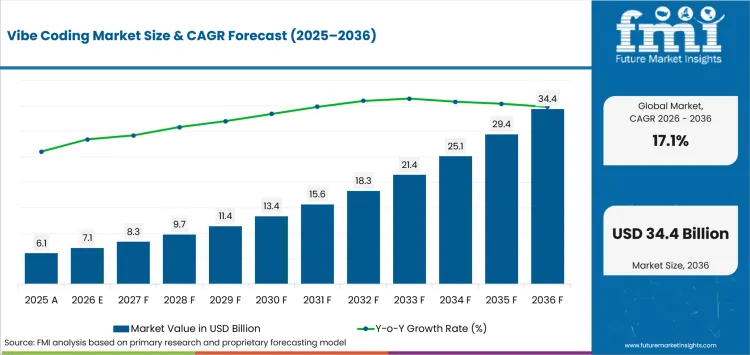
Key Takeaways of Vibe Coding Market
- Natural-language software creation supports multi-file execution under engineering ownership for final releases and continuing production support.
- AI coding assistants are projected at 39.0% share in 2026 owning to repository and editor integration.
- Cloud-based platforms are estimated at 62.0% share in 2026 due to the ability of managed workspaces reducing local configuration.
- Professional developers are forecast at 43.0% share in 2026 as engineers retain production release responsibility.
- Web and mobile application development is anticipated at 34.0% share in 2026 driven by rapid iteration.
- Incomplete project context restrains adoption by producing architecture conflicts or unapproved access paths during release.
- Microsoft Corporation, Anysphere, Replit, Lovable, Google, OpenAI, Vercel and Anthropic compete across software creation workflows.
Analyst Perspective
"Prompt-to-code output earns commercial value once engineers can inspect repository context, test results and permission boundaries across every change. Platforms that preserve rollback and named release ownership reduce rework as generated code enters production software programs."
- Sudip Saha, Principal Consultant, Future Market Insights
How is the Vibe Coding Market segmented?
The Vibe Coding Market is segmented by product type, deployment model, user type, application, end user and region.
Product type covers coding assistants, AI-native editors, application builders and autonomous agents for software development and debugging. Deployment spans hosted, desktop and local environments, plus hybrid cloud-local and remote execution models for engineering teams. User types include developers, entrepreneurs, business users, students, bootcamp learners, designers and product managers across commercial workflows. Applications cover web and mobile development, prototypes, enterprise workflows, business automation and developer productivity across software programs. End users include technology companies, startups, small businesses, enterprise IT teams, independent developers and freelancers.
Why do AI coding assistants hold the largest share within the product type category?
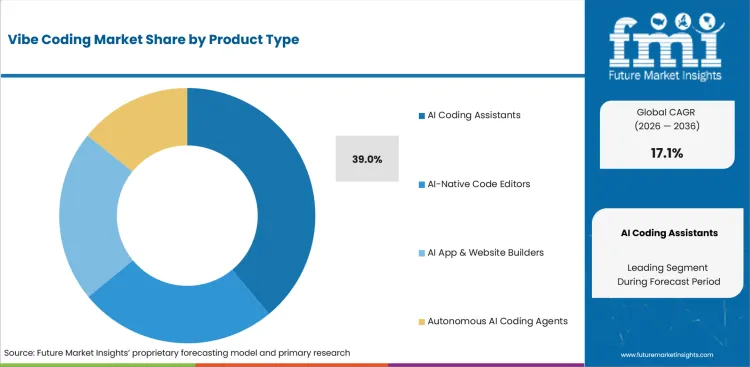
AI coding assistants fit established repositories through editors and review systems that preserve familiar engineering practices. Software teams can adopt them incrementally without replacing source control or formal peer review across active commercial projects.
- Based on product type, AI coding assistants are projected to account for 39.0% in 2026 due to repository integration supporting code completion and generation inside active projects.
- Engineering groups require approval controls for multi-file changes that affect shared services and protected release branches. Google Developers Blog reported in August 2025 that Gemini Code Assist presents a reviewable plan and supports batched tool approvals across automation testing workflows.
Why do cloud-based platforms retain the largest share within the deployment model category?
Hosted AI platforms provide secure isolated workspaces and managed compute for agents operating beyond local developer machines. OpenAI introduced Codex in May 2025 as a cloud software engineering agent that completes parallel tasks inside isolated repository sandboxes.
- The deployment model is forecast to be led by cloud-based platforms at 62.0% share in 2026 due to managed execution across distributed engineering teams.
- Distributed engineering groups use hosted workspaces to run parallel tasks without repeated workstation configuration across remote locations. AI platforms must also enforce approved networks and controlled repository access for private dependencies or sensitive source code.
How do professional developers support demand within the user type category?
Professional developers retain responsibility for architecture and production support even as agents complete work across several files. Their review authority remains essential for releases affecting security and long-term operational reliability across complex systems.
- In 2026, professional developers are expected to lead the user type with 43.0% share because software engineers remain accountable for complex production delivery. Anthropic reinforced that role in September 2025 through checkpoints and a native editor extension for longer DevSecOps workflows.
- Engineering leaders require traceable approvals and named ownership for generated changes entering protected branches or customer-facing services during production release and support.
What supports web and mobile application development within the application category?
Application builders produce visible interfaces and connected backends that help product teams compare no-code AI platforms during early commercial decisions. Vercel connected this route to existing codebases in February 2026 through GitHub imports and branch creation with managed pull requests and deployment.
- By application, web and mobile application development is forecast to represent 34.0% in 2026 driven by rapid evaluation across connected interfaces and services.
- Product teams use mobile application platforms to test working behavior before assigning broader engineering budgets across delivery groups. Production use requires dependable authentication and secure data handling across customer-facing services beyond a functional demonstration.
What are the drivers, restraints and opportunities in the Vibe Coding Market?
Driver: Repository-aware agents reduce coding effort. Restraint: Generated changes require security review. Opportunity: Integrated controls support accountable deployment.
- Driver: Repository-aware agents convert conversational requirements into multi-file execution across engineering environments and review systems.
- Restraint: Incomplete project context introduces defects or policy conflicts requiring experienced review prior to production deployment.
- Opportunity: Integrated controls connect generation with testing and accountable release across governed software delivery workflows.
Repository-aware agents translate a stated requirement into coordinated file changes inside established version-control workflows for shared commercial repositories. Engineering teams gain time on routine implementation without surrendering authority over architecture and security, while AI-enabled testing tools support documented release decisions across production services.
An agent can generate functional code without understanding older design decisions or restricted dependencies across the complete repository. Security testing must inspect secrets, permissions and policy conflicts before generated changes enter protected branches. That mandatory review extends qualification time for complex production applications that serve customers or regulated operations.
Platforms connect identity controls with testing and documented approval inside one delivery path for enterprise software teams. Enterprise AI governance then provides a traceable record of agent actions and reviewer decisions across each release. That record reduces repeated qualification work as organizations extend vibe coding from pilots into recurring production use.
Which country CAGRs are profiled in the Vibe Coding Market?
| Country | CAGR |
|---|---|
| South Korea | 18.1% |
| United Kingdom | 16.9% |
| United States | 16.8% |
| Canada | 16.6% |
| Germany | 16.5% |
| Australia | 16.4% |
| Japan | 16.2% |
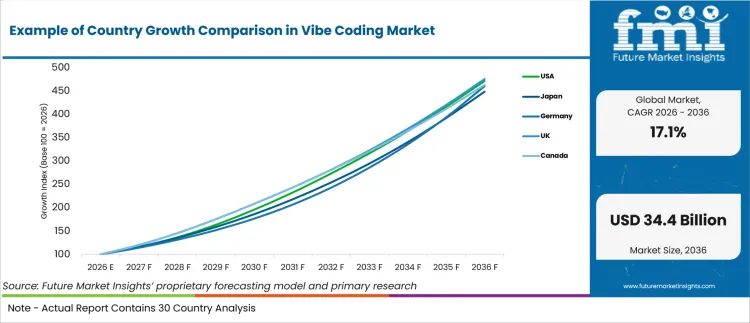
How do country-level CAGRs compare in the Vibe Coding Market?
The displayed country CAGRs span 1.9 percentage points across the complete ten-year assessment period for this category.
These rates describe expected expansion instead of current revenue or installed adoption across national software ecosystems.
- South Korea and the United Kingdom form an upper band shaped by separate national AI frameworks.
- The United States and Canada remain closely spaced despite different compute access and qualification conditions.
- Germany and Australia share a narrow range although governance duties and specialist availability differ materially.
- Japan follows a quality-assurance route centered on language performance and legacy-system validation during enterprise deployment.
- Comparable growth rates produce different entry conditions for platforms requiring local compliance and implementation support.
The full report provides country-level CAGR analysis across North America, Latin America, Europe, East Asia, South Asia and Pacific, and the Middle East and Africa.
Country-wise Analysis
- Korean cloud services and local-language engineering teams allow coding agents to enter domestic repositories across large enterprises and public agencies with onshore support and domestic-language product guidance. Adoption of vibe coding in South Korea is estimated to expand at 18.1% CAGR through 2036, supported by local implementation capacity. The Ministry of Science and ICT brought the AI Basic Act into force in January 2026 and established transparency duties with business guidance during a one-year grace period. Regulated organizations therefore require trained reviewers and strict controls for source code that handles sensitive data across essential infrastructure, financial services and government software programs.
- British software-service firms and cloud integrators provide implementation capacity for AI-assisted development across commercial systems plus national public-service modernization programs and regulated enterprise applications. The Department for Science, Innovation and Technology accepted the AI Opportunities Action Plan in January 2025 and committed to wider adoption plus a twentyfold sovereign compute expansion by 2030. The United Kingdom's vibe coding outlook is anticipated to advance at 16.9% CAGR over the assessment period, aided by mature engineering talent. Copyright rules and data-protection duties extend approval for generated code used in regulated applications that require clear release responsibility across complex enterprise repositories and external customer services nationwide.
- Major coding platforms and cloud providers give United States engineering teams broad access to repository agents across commercial software programs and critical infrastructure systems. Intellectual-property rules and federal security requirements extend qualification for persistent access to regulated codebases across government agencies and regulated industries. The White House released America's AI Action Plan in July 2025 with more than ninety federal actions covering innovation, infrastructure and AI adoption across government and industry. Vibe coding sales in the United States are forecast to expand at 16.8% CAGR by 2036, driven by platform availability and software modernization despite formal approval requirements for customer-facing and public-sector systems.
- Canadian cloud providers and regional technology hubs support managed coding agents across commercial software programs and domestic application development with local implementation partners across provincial technology centers. Canada is estimated to post 16.6% CAGR over the forecast period, reinforced by startup activity and enterprise modernization across domestic software programs. Innovation, Science and Economic Development Canada opened the AI Compute Access Fund in June 2025 to improve affordable high-performance computing access for Canadian small and medium-sized enterprises. Compute expense and data-location requirements remain harder for smaller firms outside major technology centers with limited bilingual implementation capacity and regional specialist support outside major cities.
- German industrial software teams use specialist integrators and cloud services to modernize long-lived applications across manufacturing systems and export-oriented industrial software estates with regulated business operations. The German Federal Statistical Office reported in November 2025 that 26% of enterprises used AI and 35% of those users applied natural-language generation including programming code. The German vibe coding sector is projected to record 16.5% CAGR during the assessment period, shaped by demand for controlled repository agents across complex production applications. Legacy systems require auditable changes and clear responsibility for generated code entering production environments across export-oriented industrial groups and regulated domestic services with formal release controls.
- Cloud delivery supports AI-assisted development across Australia's dispersed organizations and regional software teams with nationwide access to hosted development environments across remote commercial operations. The Department of Industry, Science and Resources published the National AI Plan in December 2025 to strengthen infrastructure and workforce skills for responsible adoption across public agencies and commercial organizations. In Australia, vibe coding demand is predicted to advance at 16.4% CAGR through 2036 due to browser access and startup activity. Uneven specialist availability and data-governance requirements preserve demand for experienced reviewers and local implementation support across national enterprise software programs outside major cities and regional technology hubs.
- Japanese integrators and internal engineering teams support modernization across long-lived enterprise applications in industrial and public-service environments with local-language implementation expertise and established enterprise service networks. Vibe coding demand in Japan is forecast to rise at 16.2% CAGR over the forecast period, attributable to modernization needs across industrial and public-service software estates. The Digital Agency approved Version 2.0 of its generative AI procurement and utilization guideline in June 2026 with risk-management rules and documented approval requirements for government systems and national agencies. Japanese-language accuracy plus legacy-system integration require detailed validation for coding agents entering regulated production workflows across national service organizations with formal oversight and documented release controls.
Who are the notable companies in the Vibe Coding Market?
Microsoft Corporation (GitHub Copilot), Google (Gemini Code Assist), OpenAI (Codex), Anthropic (Claude Code), Anysphere (Cursor), Replit, Lovable and Vercel (v0) are the notable companies serving this market.
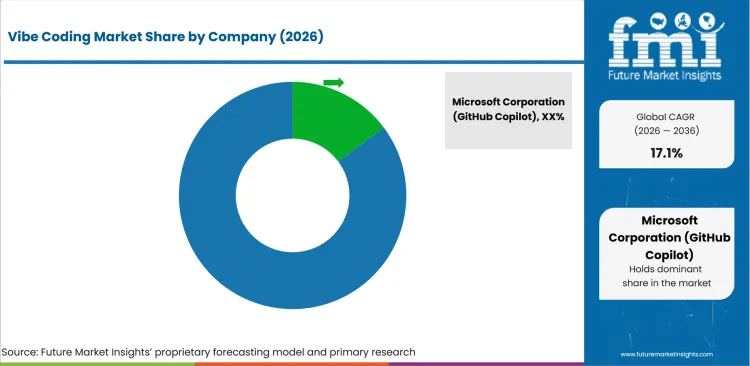
The competitive field spans platform-scale coding assistants, AI-native development environments and prompt-to-application builders with distinct commercial models. Established developer distribution raises entry barriers for new platforms without trusted repository access or installed engineering relationships. Specialist platforms compete through repository depth, controlled execution and managed application delivery across software teams.
- Microsoft Corporation, Google, OpenAI and Anthropic compete through repository context, editor integration, terminal execution and formal review controls for professional engineering teams.
- Anysphere and Replit position agents as the operating layer for editing, execution and coordinated project work across managed development environments.
- Lovable and Vercel focus on prompt-led application delivery that combines interface creation with backend services and hosted publishing routes.
Competitive Benchmarking: Vibe Coding Market
| Company | Repository and IDE Depth | Agentic Task Execution | App-to-Deployment Coverage | Geographic Reach |
|---|---|---|---|---|
| Microsoft Corporation (GitHub Copilot) | High | High | Medium | Global enterprise |
| Google (Gemini Code Assist) | High | High | Medium | Global online |
| OpenAI (Codex) | High | High | Medium | Global online |
| Anthropic (Claude Code) | High | High | Medium | Global online |
| Anysphere (Cursor) | High | High | Medium | Global online |
| Replit | Medium | High | High | Global online |
| Lovable | Medium | High | High | Global online |
| Vercel (v0) | High | Medium | High | Global cloud service |
Key Developments in the Vibe Coding Market
- In April 2026, Anysphere introduced Cursor 3 for parallel local and cloud agents working across repositories from one coordinated workspace.
- In March 2026, OpenAI introduced Codex Security in research preview to build project-specific threat models and validate vulnerabilities through proposed remediation.
- In September 2025, Microsoft Corporation made GitHub Copilot coding agent generally available for delegated tasks that return draft pull requests for human review.
Key Players in the Vibe Coding Market
Repository Coding Assistants and Agents
- Microsoft Corporation (GitHub Copilot)
- Google (Gemini Code Assist)
- OpenAI (Codex)
- Anthropic (Claude Code)
AI-Native Development Environments
- Anysphere (Cursor)
- Replit
Prompt-to-Application Builders
- Lovable
- Vercel (v0)
Vibe Coding Market - Report Scope
| Coverage field | Report scope |
|---|---|
| Market breakdown | By product type, deployment model, user type, application, end user and region. |
| Market Definition | AI-enabled software platforms that convert natural-language intent into code, applications, tests or deployment across commercial workflows. |
| Regions Covered | North America, Latin America, Europe, East Asia, South Asia and Pacific and Middle East and Africa. |
| Countries Covered | South Korea, United Kingdom, United States, Canada, Germany, Australia, Japan and 20+ additional countries. |
| Key Companies Profiled | Microsoft Corporation, Anysphere, Replit, Lovable, Google, OpenAI, Vercel and Anthropic. |
| Forecast Period | 2026 to 2036. |
| Approach | Primary and secondary research with market triangulation. |
Vibe Coding Market - Research Methodology
| Method | Approach |
|---|---|
| Primary Research | FMI analysts gathered input from manufacturers, service providers, technology developers, distributors, end users, procurement teams, and subject-matter experts. Interviews examined purchasing decisions, product or service evaluation, adoption barriers, approval requirements, pricing considerations, and expectations for technical or commercial support. Respondents were also asked what evidence is required before a trial, pilot, or initial order develops into regular purchasing. |
| Desk Research | Desk research covered government statistics, regulatory publications, trade data, industry associations, technical literature, standards, company filings, product information, and official corporate announcements. Sources were reviewed for relevance, publication date, geographic coverage, and consistency with the defined market scope. Claims relating to performance, applications, approvals, capacity, investment, and commercial activity were retained only when supported by credible public evidence. |
| Market Sizing and Forecasting | The market model combined the baseline value with historical performance, segment structure, pricing and volume indicators, adoption levels, company participation, and country-level demand conditions. Forecast assumptions considered economic activity, investment trends, regulatory developments, technology adoption, purchasing cycles, supply availability, and barriers to wider market use. Segment and regional estimates were reconciled before the final market total was calculated. |
| Data Validation | Estimates were checked against multiple independent indicators, including public data, company activity, trade patterns, industry developments, and findings from primary interviews. Validation also tested whether products, services, applications, and company revenues fell within the defined market boundaries. Adjacent categories, unsupported claims, overlapping revenues, and activities without direct market relevance were excluded to reduce double counting and maintain consistency across segments and countries. |
Vibe Coding Market by Segments
Vibe Coding Market segmented by Product Type:
- AI Coding Assistants
- AI Code Completion
- AI Code Generation
- AI-Native Code Editors
- AI Integrated IDEs
- Context-Aware Coding Environments
- AI App & Website Builders
- Natural Language App Builders
- AI Website Generators
- Autonomous AI Coding Agents
- Agentic Software Development
- Autonomous Code Debugging
Vibe Coding Market segmented by Deployment Model:
- Cloud-Based
- Browser-Based Platforms
- Cloud Development Environments
- Desktop-Based
- AI-Powered IDEs
- Local Development Environments
- Hybrid
- Cloud-Local Development
- Remote Development Environments
Vibe Coding Market segmented by User Type:
- Professional Developers
- Software Engineers
- Full-Stack Developers
- Non-Technical Users
- Entrepreneurs
- Business Users
- Students & Learners
- Programming Students
- Coding Bootcamp Learners
- Designers & Product Teams
- UI-UX Designers
- Product Managers
Vibe Coding Market segmented by Application:
- Web & Mobile Application Development
- Web Applications
- Mobile Applications
- Rapid Prototyping & MVP Development
- Startup Prototyping
- Proof-of-Concept Development
- Enterprise Software Development
- Internal Business Applications
- Enterprise Workflow Applications
- Automation & Productivity
- Business Process Automation
- Developer Productivity
Vibe Coding Market segmented by End User:
- Technology Companies
- Software & SaaS Companies
- AI Technology Companies
- Startups & Small Businesses
- Tech Startups
- Small & Medium Businesses
- Large Enterprises
- Enterprise IT Departments
- Digital Transformation Teams
- Individual Developers & Freelancers
- Independent Developers
- Freelance Software Professionals
Vibe Coding Market by Region:
- North America
- United States
- Canada
- Mexico
- Latin America
- Brazil
- Chile
- Rest of Latin America
- Western Europe
- Germany
- United Kingdom
- Italy
- Spain
- France
- Nordics
- Benelux
- Rest of Western Europe
- Eastern Europe
- Russia
- Poland
- Hungary
- Balkan and Baltic States
- Rest of Eastern Europe
- East Asia
- China
- Japan
- South Korea
- South Asia and Pacific
- India
- ASEAN
- Australia and New Zealand
- Rest of South Asia and Pacific
- Middle East and Africa
- Kingdom of Saudi Arabia
- Other GCC Countries
- Türkiye
- South Africa
- Other African Union Countries
- Rest of Middle East and Africa
Research Sources and Bibliography
- Stack Overflow. (2025, July 29). Stack Overflow’s 2025 Developer Survey Reveals Trust in AI at an All Time Low.
- GitHub. (2025, September 25). Copilot coding agent is now generally available.
- OpenAI. (2025, May 16). Introducing Codex.
- OpenAI. (2026, March 6). Codex Security: now in research preview.
- Anysphere. (2026, April 2). Meet the new Cursor.
- Google Developers Blog. (2025, August 21). What's new in Gemini Code Assist.
- Replit. (2026, March 11). Introducing Replit Agent 4: Built for Creativity.
- Lovable. (2025, September 29). Introducing Lovable Cloud and AI.
- Lovable. (2025, June 30). Introducing Agent Mode (Beta): enabling Lovable to think, plan, and take actions autonomously.
- Vercel. (2026, February 3). Introducing the new v0.
- Anthropic. (2025, September 29). Enabling Claude Code to work more autonomously.
- Ministry of Science and ICT, Republic of Korea. (2026, January 22). The AI Basic Act Comes into Force to Lay the Foundation for Korea to Become an AI G3.
- Department for Science, Innovation and Technology. (2025, January 13). AI Opportunities Action Plan: government response.
- The White House. (2025, July 23). White House Unveils America's AI Action Plan.
- Innovation, Science and Economic Development Canada. (2025, June 25). Government of Canada opens applications for the AI Compute Access Fund.
- German Federal Statistical Office. (2025, November 24). Enterprises using artificial intelligence (AI) technologies, by employment size class.
- Department of Industry, Science and Resources. (2025, December 2). National AI Plan.
- Digital Agency, Government of Japan. (2026, June 12). The Guideline for Japanese Government’s Procurements and Utilizations of Generative AI for the sake of Evolution and Innovation of Public Administration (Version 2.0).
This Report Answers
- How large is the global Vibe Coding market in 2026, and what value is forecast for 2036?
- Which software development workflows are supporting demand for AI-assisted and prompt-to-code platforms?
- Which product type segment holds the largest share of the market in 2026?
- How does cloud-based deployment influence adoption, scalability, and operational efficiency?
- Which user groups retain responsibility for production release planning, governance, and execution?
- How do market growth rates and adoption trends differ across key countries and regions?
- Which leading companies provide AI coding assistants, AI-native editors, and application builders?
- What technical, security, integration, and organizational challenges limit enterprise adoption of vibe coding platforms?`
Frequently Asked Questions
How big is the vibe coding market in 2026?
The vibe coding market is valued at USD 7.1 billion in 2026 across coding assistants and application platforms. Repository context and controlled deployment support adoption as valuation approaches USD 34.4 billion by 2036.
What is the CAGR of the vibe coding market from 2026 to 2036?
The vibe coding market is projected to expand at 17.1% CAGR between 2026 and 2036. Multi-file agents support complex tasks although human review and security controls remain necessary across production repositories today.
Which product type is projected to account for leading share in the vibe coding market?
AI coding assistants are projected to account for 39.0% of product demand in 2026 across established development workflows. Repository integration supports adoption as software teams retain review authority for production releases and maintenance.
Which deployment model is projected to dominate the vibe coding market?
Cloud-based platforms are estimated to hold 62.0% of deployment demand in 2026. Remote execution simplifies distributed work although data-location rules and private dependencies require controlled commercial repository access.
Which user type is forecast to lead the vibe coding market?
Professional developers are forecast to account for 43.0% of user demand in 2026. Software engineers retain responsibility for architecture and release decisions affecting customer-facing services and long-term support.
Which application is anticipated to capture dominant share in the vibe coding market?
Web and mobile application development is anticipated to capture 34.0% of application demand in 2026. Visible interfaces and connected backends support initial commercial evaluation prior to broader engineering investment across product teams.
How much value is expected to be added to the vibe coding market by 2036?
USD 27.1 billion is expected to be added to the vibe coding market between 2026 and 2036. Coding agents and application builders connect natural-language requirements with testing and deployment across commercial software workflows.
Which companies are active in the vibe coding market?
Active companies include Microsoft Corporation, Anysphere, Replit, Lovable, Google, OpenAI, Vercel and Anthropic across this market. Their offerings span repository agents and AI-native editors alongside prompt-led application builders and deployment services.
Preview the report firsthand - request a free sample
Get SampleGet the brochure for pricing and purchase details.
Get PDFTable of Content
- Key Takeaways
- Market Size and CAGR
- Top Growth Driver
- Fastest Growing Segment
- Leading Region
- Key Companies
- Emerging Opportunities
- Executive Summary
- Global Market Outlook
- Demand-side Trends
- Supply-side Trends
- Technology Roadmap Analysis
- Analysis and Recommendations
- Analyst Perspective (What is happening? Why now? What should investors know?)
- Key Questions Answered
- How large is the market?
- What is the CAGR?
- What are key trends?
- Which region dominates?
- Who are the leaders?
- Market Overview
- Market Coverage / Taxonomy
- Market Definition / Scope / Limitations
- Research Methodology
- Chapter Orientation
- Analytical Lens and Working Hypotheses
- Market Structure, Signals, and Trend Drivers
- Benchmarking and Cross-market Comparability
- Market Sizing, Forecasting, and Opportunity Mapping
- Research Design and Evidence Framework
- Desk Research Programme (Secondary Evidence)
- Expert Input and Fieldwork (Primary Evidence)
- Tooling, Models, and Reference Databases
- Data Engineering and Model Build
- Quality Assurance and Audit Trail
- Market Background
- Market Dynamics (Drivers, Restraints, Opportunity, Trends)
- Scenario Forecast (Optimistic, Likely, Conservative)
- Impact Analysis
- AI Impact
- Sustainability Impact
- Regulatory Impact
- Technology Impact
- Consumer / Buyer Analysis
- Purchase Drivers
- Adoption Barriers
- Buyer Journey
- Opportunity Map Analysis
- Product Life Cycle Analysis
- Supply Chain Analysis
- Investment Feasibility Matrix
- Value Chain Analysis
- PESTLE and Porter's Analysis
- Regulatory Landscape
- Regional Parent Market Outlook
- Production and Consumption Statistics
- Import and Export Statistics
- Global Market Analysis and Forecast, 2021 to 2036
- Historical Market Size Value (USD Billion) Analysis, 2021 to 2025
- Current and Future Market Size Value (USD Billion) Projections, 2026 to 2036
- Y-o-Y Growth Trend Analysis
- Absolute $ Opportunity Analysis
- Global Market Pricing Analysis, 2021 to 2036
- Global Market Analysis and Forecast, By Product Type, 2021 to 2036
- Introduction / Key Findings
- Historical Market Size Value (USD Billion) Analysis By Product Type, 2021 to 2025
- Current and Future Market Size Value (USD Billion) Analysis and Forecast By Product Type, 2026 to 2036
- AI Coding Assistants
- AI Code Completion
- AI Code Generation
- AI-Native Code Editors
- AI Integrated IDEs
- Context-Aware Coding Environments
- AI App & Website Builders
- Natural Language App Builders
- AI Website Generators
- Autonomous AI Coding Agents
- Agentic Software Development
- Autonomous Code Debugging
- AI Coding Assistants
- Y-o-Y Growth Trend Analysis By Product Type, 2021 to 2025
- Absolute $ Opportunity Analysis By Product Type, 2026 to 2036
- Global Market Analysis and Forecast, By Deployment Model, 2021 to 2036
- Introduction / Key Findings
- Historical Market Size Value (USD Billion) Analysis By Deployment Model, 2021 to 2025
- Current and Future Market Size Value (USD Billion) Analysis and Forecast By Deployment Model, 2026 to 2036
- Cloud-Based
- Browser-Based Platforms
- Cloud Development Environments
- Desktop-Based
- AI-Powered IDEs
- Local Development Environments
- Hybrid
- Cloud-Local Development
- Remote Development Environments
- Cloud-Based
- Y-o-Y Growth Trend Analysis By Deployment Model, 2021 to 2025
- Absolute $ Opportunity Analysis By Deployment Model, 2026 to 2036
- Global Market Analysis and Forecast, By User Type, 2021 to 2036
- Introduction / Key Findings
- Historical Market Size Value (USD Billion) Analysis By User Type, 2021 to 2025
- Current and Future Market Size Value (USD Billion) Analysis and Forecast By User Type, 2026 to 2036
- Professional Developers
- Software Engineers
- Full-Stack Developers
- Non-Technical Users
- Entrepreneurs
- Business Users
- Students & Learners
- Programming Students
- Coding Bootcamp Learners
- Designers & Product Teams
- UI-UX Designers
- Product Managers
- Professional Developers
- Y-o-Y Growth Trend Analysis By User Type, 2021 to 2025
- Absolute $ Opportunity Analysis By User Type, 2026 to 2036
- Global Market Analysis and Forecast, By Application, 2021 to 2036
- Introduction / Key Findings
- Historical Market Size Value (USD Billion) Analysis By Application, 2021 to 2025
- Current and Future Market Size Value (USD Billion) Analysis and Forecast By Application, 2026 to 2036
- Web & Mobile Application Development
- Web Applications
- Mobile Applications
- Rapid Prototyping & MVP Development
- Startup Prototyping
- Proof-of-Concept Development
- Enterprise Software Development
- Internal Business Applications
- Enterprise Workflow Applications
- Automation & Productivity
- Business Process Automation
- Developer Productivity
- Web & Mobile Application Development
- Y-o-Y Growth Trend Analysis By Application, 2021 to 2025
- Absolute $ Opportunity Analysis By Application, 2026 to 2036
- Global Market Analysis and Forecast, By End User, 2021 to 2036
- Introduction / Key Findings
- Historical Market Size Value (USD Billion) Analysis By End User, 2021 to 2025
- Current and Future Market Size Value (USD Billion) Analysis and Forecast By End User, 2026 to 2036
- Technology Companies
- Software & SaaS Companies
- AI Technology Companies
- Startups & Small Businesses
- Tech Startups
- Small & Medium Businesses
- Large Enterprises
- Enterprise IT Departments
- Digital Transformation Teams
- Individual Developers & Freelancers
- Independent Developers
- Freelance Software Professionals
- Technology Companies
- Y-o-Y Growth Trend Analysis By End User, 2021 to 2025
- Absolute $ Opportunity Analysis By End User, 2026 to 2036
- Global Market Analysis and Forecast, By Region, 2021 to 2036
- Introduction
- Historical Market Size Value (USD Billion) Analysis By Region, 2021 to 2025
- Current Market Size Value (USD Billion) Analysis and Forecast By Region, 2026 to 2036
- North America
- Latin America
- Western Europe
- Eastern Europe
- East Asia
- South Asia and Pacific
- Middle East & Africa
- Market Attractiveness Analysis By Region
- North America Market Analysis and Forecast, By Country, 2021 to 2036
- Historical Market Size Value (USD Billion) Trend Analysis By Market Taxonomy, 2021 to 2025
- Market Size Value (USD Billion) Forecast By Market Taxonomy, 2026 to 2036
- By Country
- USA
- Canada
- By Product Type
- By Deployment Model
- By User Type
- By Application
- By End User
- By Country
- Market Attractiveness Analysis
- By Country
- By Product Type
- By Deployment Model
- By User Type
- By Application
- By End User
- Key Takeaways
- Latin America Market Analysis and Forecast, By Country
- Historical Market Size Value (USD Billion) Trend Analysis By Market Taxonomy, 2021 to 2025
- Market Size Value (USD Billion) Forecast By Market Taxonomy, 2026 to 2036
- By Country
- Brazil
- Mexico
- Chile
- Rest of Latin America
- By Product Type
- By Deployment Model
- By User Type
- By Application
- By End User
- By Country
- Market Attractiveness Analysis
- By Country
- By Product Type
- By Deployment Model
- By User Type
- By Application
- By End User
- Key Takeaways
- Western Europe Market Analysis and Forecast, By Country
- Historical Market Size Value (USD Billion) Trend Analysis By Market Taxonomy, 2021 to 2025
- Market Size Value (USD Billion) Forecast By Market Taxonomy, 2026 to 2036
- By Country
- Germany
- UK
- Italy
- Spain
- France
- Nordic
- BENELUX
- Rest of Western Europe
- By Product Type
- By Deployment Model
- By User Type
- By Application
- By End User
- By Country
- Market Attractiveness Analysis
- By Country
- By Product Type
- By Deployment Model
- By User Type
- By Application
- By End User
- Key Takeaways
- Eastern Europe Market Analysis and Forecast, By Country
- Historical Market Size Value (USD Billion) Trend Analysis By Market Taxonomy, 2021 to 2025
- Market Size Value (USD Billion) Forecast By Market Taxonomy, 2026 to 2036
- By Country
- Russia
- Poland
- Hungary
- Balkan & Baltic
- Rest of Eastern Europe
- By Product Type
- By Deployment Model
- By User Type
- By Application
- By End User
- By Country
- Market Attractiveness Analysis
- By Country
- By Product Type
- By Deployment Model
- By User Type
- By Application
- By End User
- Key Takeaways
- East Asia Market Analysis and Forecast, By Country
- Historical Market Size Value (USD Billion) Trend Analysis By Market Taxonomy, 2021 to 2025
- Market Size Value (USD Billion) Forecast By Market Taxonomy, 2026 to 2036
- By Country
- China
- Japan
- South Korea
- By Product Type
- By Deployment Model
- By User Type
- By Application
- By End User
- By Country
- Market Attractiveness Analysis
- By Country
- By Product Type
- By Deployment Model
- By User Type
- By Application
- By End User
- Key Takeaways
- South Asia and Pacific Market Analysis and Forecast, By Country
- Historical Market Size Value (USD Billion) Trend Analysis By Market Taxonomy, 2021 to 2025
- Market Size Value (USD Billion) Forecast By Market Taxonomy, 2026 to 2036
- By Country
- India
- ASEAN
- Australia & New Zealand
- Rest of South Asia and Pacific
- By Product Type
- By Deployment Model
- By User Type
- By Application
- By End User
- By Country
- Market Attractiveness Analysis
- By Country
- By Product Type
- By Deployment Model
- By User Type
- By Application
- By End User
- Key Takeaways
- Middle East & Africa Market Analysis and Forecast, By Country
- Historical Market Size Value (USD Billion) Trend Analysis By Market Taxonomy, 2021 to 2025
- Market Size Value (USD Billion) Forecast By Market Taxonomy, 2026 to 2036
- By Country
- Kingdom of Saudi Arabia
- Other GCC Countries
- Türkiye
- South Africa
- Other African Union
- Rest of Middle East & Africa
- By Product Type
- By Deployment Model
- By User Type
- By Application
- By End User
- By Country
- Market Attractiveness Analysis
- By Country
- By Product Type
- By Deployment Model
- By User Type
- By Application
- By End User
- Key Takeaways
- Key Countries Market Analysis
- USA
- Pricing Analysis
- Market Share Analysis, 2025
- By Product Type
- By Deployment Model
- By User Type
- By Application
- By End User
- Canada
- Pricing Analysis
- Market Share Analysis, 2025
- By Product Type
- By Deployment Model
- By User Type
- By Application
- By End User
- Mexico
- Pricing Analysis
- Market Share Analysis, 2025
- By Product Type
- By Deployment Model
- By User Type
- By Application
- By End User
- Brazil
- Pricing Analysis
- Market Share Analysis, 2025
- By Product Type
- By Deployment Model
- By User Type
- By Application
- By End User
- Chile
- Pricing Analysis
- Market Share Analysis, 2025
- By Product Type
- By Deployment Model
- By User Type
- By Application
- By End User
- Germany
- Pricing Analysis
- Market Share Analysis, 2025
- By Product Type
- By Deployment Model
- By User Type
- By Application
- By End User
- UK
- Pricing Analysis
- Market Share Analysis, 2025
- By Product Type
- By Deployment Model
- By User Type
- By Application
- By End User
- Italy
- Pricing Analysis
- Market Share Analysis, 2025
- By Product Type
- By Deployment Model
- By User Type
- By Application
- By End User
- Spain
- Pricing Analysis
- Market Share Analysis, 2025
- By Product Type
- By Deployment Model
- By User Type
- By Application
- By End User
- France
- Pricing Analysis
- Market Share Analysis, 2025
- By Product Type
- By Deployment Model
- By User Type
- By Application
- By End User
- India
- Pricing Analysis
- Market Share Analysis, 2025
- By Product Type
- By Deployment Model
- By User Type
- By Application
- By End User
- ASEAN
- Pricing Analysis
- Market Share Analysis, 2025
- By Product Type
- By Deployment Model
- By User Type
- By Application
- By End User
- Australia & New Zealand
- Pricing Analysis
- Market Share Analysis, 2025
- By Product Type
- By Deployment Model
- By User Type
- By Application
- By End User
- China
- Pricing Analysis
- Market Share Analysis, 2025
- By Product Type
- By Deployment Model
- By User Type
- By Application
- By End User
- Japan
- Pricing Analysis
- Market Share Analysis, 2025
- By Product Type
- By Deployment Model
- By User Type
- By Application
- By End User
- South Korea
- Pricing Analysis
- Market Share Analysis, 2025
- By Product Type
- By Deployment Model
- By User Type
- By Application
- By End User
- Russia
- Pricing Analysis
- Market Share Analysis, 2025
- By Product Type
- By Deployment Model
- By User Type
- By Application
- By End User
- Poland
- Pricing Analysis
- Market Share Analysis, 2025
- By Product Type
- By Deployment Model
- By User Type
- By Application
- By End User
- Hungary
- Pricing Analysis
- Market Share Analysis, 2025
- By Product Type
- By Deployment Model
- By User Type
- By Application
- By End User
- Kingdom of Saudi Arabia
- Pricing Analysis
- Market Share Analysis, 2025
- By Product Type
- By Deployment Model
- By User Type
- By Application
- By End User
- Türkiye
- Pricing Analysis
- Market Share Analysis, 2025
- By Product Type
- By Deployment Model
- By User Type
- By Application
- By End User
- South Africa
- Pricing Analysis
- Market Share Analysis, 2025
- By Product Type
- By Deployment Model
- By User Type
- By Application
- By End User
- USA
- Market Structure Analysis
- Competition Dashboard
- Competition Benchmarking
- Market Share Analysis of Top Players
- By Regional
- By Product Type
- By Deployment Model
- By User Type
- By Application
- By End User
- Emerging Startups
- Innovation Benchmarking
- Competition Analysis
- Competition Deep Dive
- Microsoft Corporation (GitHub Copilot)
- Overview
- Product Portfolio
- Profitability by Market Segments
- Sales Footprint
- Strategy Overview
- Marketing Strategy
- Product Strategy
- Channel Strategy
- Anysphere (Cursor)
- Replit
- Lovable
- Google (Gemini Code Assist)
- OpenAI (Codex)
- Windsurf
- Vercel (v0)
- Bolt.new (StackBlitz)
- Anthropic (Claude Code)
- Others
- Microsoft Corporation (GitHub Copilot)
- Case Studies
- Success Stories
- Recent Developments
- Competition Deep Dive
- Assumptions & Acronyms Used


