

- Market Size (2026)
- USD 309.3 Mn
- Forecast (2036)
- USD 847.2 Mn
- CAGR (2026 to 2036)
- 10.6%
How big is Vinasse Crop Inputs Market in 2026?
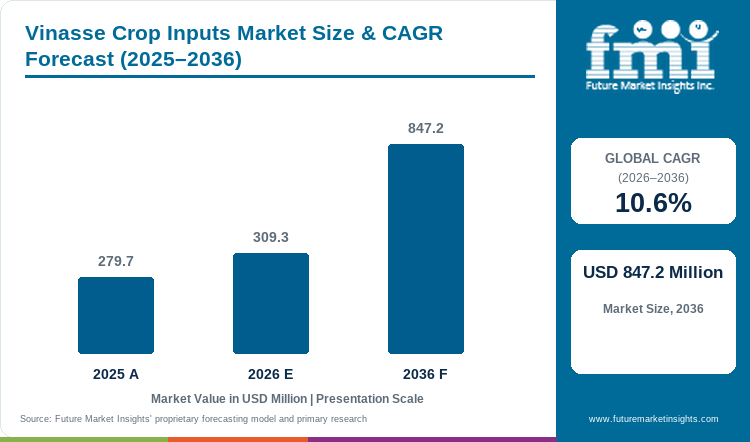
USD 309.3 million in 2026 and USD 847.2 million by 2036, expanding at 10.6% CAGR.
Sales of vinasse crop inputs are estimated to rise at 10.6% CAGR through 2036, increasing valuation from USD 279.7 million in 2025 to USD 309.3 million in 2026, and reaching b by 2036. Ethanol plants produce vinasse as a liquid residue that contains potassium and organic matter for crop nutrition. Processors test each batch before they sell it through biofertilizer formulations for farm use. A May 2026 Scientific Reports study tested vinasse on maize and recorded higher growth and yield at the tested doses. Processors can improve sales value by controlling water content and salt levels before sale. Steady nutrient levels and practical storage help farms add vinasse to farm fertilizer plans.
Fertilizer rules and local sales networks shape country growth in different ways. US farms can buy through large dealer networks that already handle fertilizer products and farm advice. Federal programs are supporting domestic fertilizer supply and new production capacity across the country. USDA made USD 500 million available through the FIELDS program in July 2026 to expand fertilizer production capacity. Japan is promoting fertilizer made from local resources because many key raw materials come from overseas. Vinasse sellers need clear product tests and workable freight costs before farms can place repeat orders. Local approval adds another step because fertilizer rules differ across sales routes.
Key Takeaways
- Distilleries can sell tested vinasse as a crop input when its nutrient value can replace part of a farm fertilizer plan.
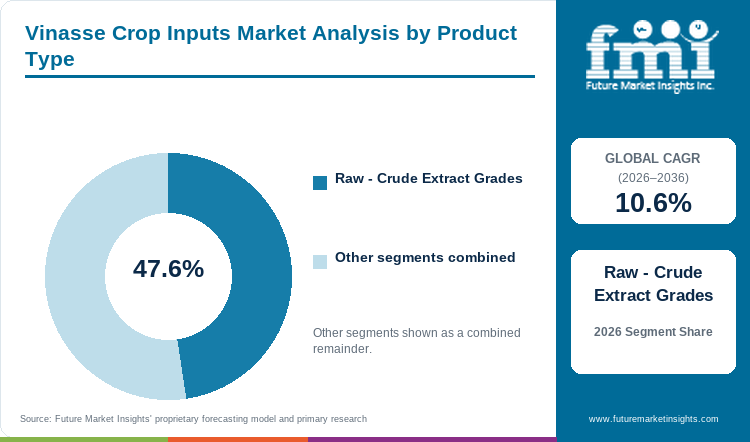
- By Product Type, raw / crude extract grades are estimated to hold 47.6% in 2026, supported by low processing needs near distilleries.
- By Crop Type, cereals & grains are forecast to represent 43.0% in 2026, tied to large farm areas and repeat nutrient use.
- In 2026, soil application is expected to lead Application Method with 40.9% share, supported by placing nutrients close to crop roots.
- High water content and salt can limit untreated vinasse because both raise transport cost and make product use harder to control.
- Key players include PressCane Limited and Benefert BV. Syngenta Biologicals and Cocal also compete in the market. Kimitec and Seipasa form another active company group. Acadian Plant Health and Olmix Group complete the company list.
Analyst Perspective
"Vinasse becomes easier to sell again when processors control nutrient levels and keep freight costs within farm budgets. Clear test results and safe use limits help suppliers reach farms beyond the area around each distillery."
- Nandini Roy Choudhury, Principal Consultant, Future Market Insights
How is the vinasse crop inputs market segmented?
The vinasse crop inputs market is segmented by Product Type, Crop Type, Application Method, Farm Type, Sales Channel, and Region.
The vinasse crop inputs market is segmented by product type, crop type, application method, farm type, sales channel, and region. Product type covers raw / crude extract grades, refined & standardized fractions, formulated end-use blends, and others. Crop type covers cereals & grains, fruits & vegetables, oilseeds & pulses, turf & ornamentals, and others. Application method covers soil, foliar, fertigation / drip, seed, and other uses. Farm type groups farms by size and operating scale. Sales channel shows how farms buy the product.
What keeps raw / crude extract grades central to the product type category?
Raw vinasse costs less to prepare near a distillery because the product needs little processing. Farms with bulk tanks can add it to organic fertilizer programs after they test nutrient levels in each batch. SICO's 2026 specification lists vinasse powder with at least 38% water-soluble K2O for organo-mineral fertilizer production. Refined grades contain less water and offer steadier quality, which makes them easier to move over longer distances. Raw grades therefore stay useful near supply points while processed grades serve farms that are farther from the source. Each route works best when product quality and freight cost match the farm's needs.
- Based on Product Type, raw / crude extract grades are projected to account for 47.6% in 2026, supported by low processing costs near distilleries.
- Refined fractions become more useful as farms seek steady nutrient levels and lower water content for longer shipping routes.
Why do cereals & grains account for the largest crop type share?
Large cereal farms can spread testing and field-use costs across more hectares than smaller crop operations. Cereals also support repeat crop nutrition programs that can replace part of a farm's purchased potassium supply. A May 2026 Scientific Reports study tested vinasse on maize and recorded higher growth and yield at the tested doses. Fruit and vegetable farms may pay more for refined grades that offer tighter nutrient control and cleaner handling. Bulk vinasse remains easier to use on large fields near the supply point because transport costs stay lower. This operating pattern supports repeat use in broad-acre crop programs.
- By Crop Type, cereals & grains are estimated to hold 43.0% in 2026, linked to large farm areas and repeat soil use.
- Fruit and vegetable farms may choose higher-value grades when they need tighter nutrient control and cleaner product handling.
How does soil application shape the application method category?
Soil application uses the potassium and organic matter that vinasse already contains. It also keeps concentrated liquid away from crop leaves and gives farms a direct route to the root zone. Irrigation systems need careful fertigation monitoring because salt and solids can block equipment or reduce flow. An April 2026 sunflower study tested vinasse as a foliar amendment and measured crop response. Foliar and seed use need cleaner grades with steady composition and fewer solids. Soil application remains the simpler bulk route because farms can place nutrients in soil without extra liquid-cleaning steps.
- In 2026, soil application is expected to lead Application Method with 40.9% share, influenced by direct placement of nutrients near crop roots.
- Fertigation / drip use can reach more farms as processors keep solids and salt within safe limits for irrigation equipment.
What supports large commercial farms within the farm type category?
Large farms can afford tanks and pumps that make heavy liquid inputs easier to store and apply. Testing tools and calibrated equipment also help these farms compare specialty fertilizer grades with mineral fertilizer on a cost basis. In May 2026 Cocal moved vinasse with 44 biomethane trucks at its São Paulo plants. The fleet links transport planning with repeat fertilizer use across large sugarcane operations. Large farms can manage those delivery steps because they already use storage and farm equipment across broad areas. Smaller farms may need contractors or shared systems before repeat use becomes practical.
- By Farm Type, large commercial farms are forecast to represent 38.5% in 2026, enabled by on-farm storage and farm equipment.
- Mid-size farms can use contractors or cooperatives for shared equipment, while small farms depend more on short freight routes and local storage.
Why do agri-input distributors lead the sales channel category?
Distributors make heavy vinasse products easier for farms to buy again because they manage storage and local delivery. They can sell plant biostimulants with other crop nutrients through the same farm sales route and support product use. Local distribution also helps growers avoid direct transport from a distillery over long distances. Benefert sought more distributors in June 2026 as it expanded sales of organic fertilizer products. Vinasse grades need similar local coverage as they move from bulk supply into packaged or blended products. Strong local stock and product advice can turn a first farm trial into repeat orders.
- Agri-input distributors are set to lead Sales Channel with 43.4% share in 2026, tied to local delivery and product support.
- Cooperatives work well for farms that share storage and farm equipment, while direct sales remain strongest near the processor.
What are the drivers, restraints and opportunities in the Vinasse Crop Inputs Market?
Local nutrient recovery supports demand, composition and logistics limit raw use, and concentration creates wider distribution options.
- Driver: Local supply risk is raising the value of nutrients that distilleries can recover and test for farm sale.
- Restraint: Uneven nutrient content and high salt levels can increase testing needs and reduce safe use rates on farms.
- Opportunity: Lower-water grades with steady nutrient levels can travel farther and move through dealer networks with less handling cost.
Farms are paying more attention to local and recovered nutrients as imported fertilizer supply faces more risk. Japan's agriculture ministry is promoting fertilizer made from local resources because many key raw materials come from overseas. Vinasse already contains potassium and organic matter at ethanol plants and can support sustainable agriculture inputs. Producers need test results before farms can compare its nutrient value with mineral fertilizer. Local recovery can reduce exposure to imported fertilizer supply during periods of tight availability. Clear batch data also help farm managers set safer use rates for each crop. Farms gain another local nutrient source when producers prove the product and explain how to apply it.
Uneven composition and field dose remain the main limits for untreated vinasse. A 2026 Chemosphere study found that local vinasse use raised soil potassium and cane yield under the tested conditions. The study also recorded changes in soil biology and sugarcane quality. Farms need controlled use rates because each batch may contain different nutrient and salt levels. High water content also raises transport cost over long distances. Other options such as silicon soil conditioners compete for the same farm budget when vinasse needs extra handling. Suppliers must prove nutrient value and manage salt before farms accept repeat use. Storage and freight costs set another limit on how far untreated liquid can move.
Processing can extend the shipping range by removing water and making product quality more even. Benefert's September 2026 sheets list vinasse-based organic fertilizers that release nutrients over 90 to 120 days. These products can be sold with humic and fulvic acid biostimulants in farm programs that use several nutrient tools. The finished grades avoid much of the cost that comes with moving large volumes of raw liquid. Formulators can offer cleaner products for crops that need steady potassium release and easier handling. Lower water content reduces freight cost and saves storage space. Clear labels help dealers explain dose and use. Dealers then have a product that is easier to store and sell than raw liquid.
Which country CAGRs are profiled in the Vinasse Crop Inputs Market?
| Country | CAGR |
|---|---|
| USA | 10.2% |
| Germany | 9.9% |
| South Korea | 9.6% |
| UK | 9.0% |
| Japan | 8.4% |
How do country-level CAGRs compare in the Vinasse Crop Inputs Market?
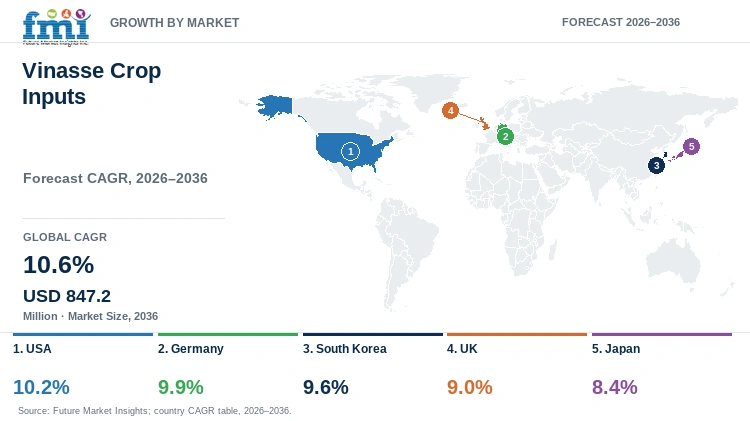
The five country forecasts stay within a narrow growth range through 2036. The USA is projected at 10.2% CAGR while Germany reaches 9.9% and South Korea reaches 9.6%. The UK and Japan have lower forecast rates within this group. The 1.8-point spread compares growth speed and does not measure current market size. Registration rules and sales channels differ across these countries. Delivery costs also change the business case for liquid vinasse in each market.
- State fertilizer rules require US dealers to use clear labels and nutrient records before they support regular product sales.
- Germany links fertilizer type and timing to crop needs, which makes steady nutrient content and clear use rates important.
- South Korea requires waste-based fertilizer makers to list raw materials and promised nutrient levels before they sell each product.
- UK reform plans would add conformity checks and technical rules for newer fertilising products sold across the country.
- Japan is promoting local fertilizer sources to reduce reliance on imported raw materials and limit exposure to price swings.
Similar CAGRs can still create different business conditions because approval rules and freight costs vary by country. Dense farm networks can lower transport cost even when a country's forecast growth rate is slower than another market.
The full report provides country-level CAGR analysis across every listed region and covers more than the five profiled countries. Coverage spans North America and Latin America as well as Western Europe and Eastern Europe. East Asia and South Asia and Pacific form another part of the regional review. Middle East and Africa complete the report's geographic coverage.
Country-wise Analysis
- USA is estimated to post 10.2% CAGR over the forecast period, supported by domestic fertilizer investment. Large farms and dealer networks can handle standard vinasse grades once products meet state fertilizer rules. USDA made USD 500 million available through the FIELDS program in July 2026 to expand US fertilizer production capacity. The program supports more domestic fertilizer supply and gives local producers another route to investment. State registration still adds work because product rules can differ across the country. Concentrated grades cost less to move than untreated liquid across long routes. Clear labels and steady nutrient data help dealers place repeat orders with less product risk.
- Germany's vinasse crop inputs outlook is anticipated to advance at 9.9% CAGR over the assessment period, shaped by national nutrient rules. German rules link fertilizer type and amount with plant needs and soil conditions. The federal agriculture ministry says fertilizers must meet European or German law and follow good farm practice. Those rules make reliable nutrient tests important for a variable by-product such as vinasse. Suppliers need stable batch data before farms can include the product in formal nutrient plans. Standardized grades are easier to compare with other fertilizer options because their nutrient content changes less. Untreated liquid can remain useful near ethanol plants, but long routes raise handling cost.
- Vinasse crop input sales in South Korea are forecast to expand at 9.6% CAGR by 2036, linked to fertilizer registration rules. South Korea allows firms to sell recycled waste as fertilizer under a defined legal route. The Fertilizer Control Act took effect on October 1 2025 and covers firms that turn waste into fertilizer for sale. Makers must list raw materials and promised nutrient levels for each fertilizer type. Product records help dealers explain the input to farms and reduce uncertainty around changing nutrient levels. Steady batch quality also supports repeat sales through registered channels. Local approval support matters because firms must keep product details current as sales expand.
- The UK vinasse crop inputs sector is projected to record 9.0% CAGR during the assessment period, influenced by planned fertilizer rule changes. All four UK governments are working on a new framework for fertilising products sold across the country. The March 2026 consultation closed in June and received 83 responses on conformity checks and technical rules. Newer products still need a clear legal route before suppliers can sell them through farm sales channels. Standard grades with traceable content are easier to assess than untreated bulk liquid. Clear product status can reduce uncertainty for dealers serving farms in more than one UK nation. Suppliers still need workable freight costs because regulation does not reduce liquid weight.
- Adoption of vinasse crop inputs in Japan is estimated to expand at 8.4% CAGR through 2036, reinforced by domestic fertilizer programs. Japan imports many key raw materials used in fertilizer and is promoting more use of local resources. The Kanto regional farm office scheduled an October 2026 event to share local fertilizer practices and support wider use. The event brings fertilizer makers and users together with other farm groups. Bulky liquid vinasse still costs more to move over long routes. Concentrated forms are easier to store and use in local fertilizer production. Suppliers can reach more farms through existing channels when they reduce water content and provide clear nutrient data.
Who are the notable companies in the Vinasse Crop Inputs Market?
PressCane Limited, Benefert BV, Syngenta Biologicals, Cocal, Kimitec, Seipasa, Acadian Plant Health, and Olmix Group are active in vinasse-derived or closely related bio-based crop input routes.
The market includes direct vinasse fertilizer sellers and makers of bio-based crop inputs that use similar farm approval routes. Direct sellers compete on nutrient levels and freight cost because both affect repeat farm orders. They also need clear product records so farms can compare one batch with the next. Bio-based input makers compete on crop use and field support through regulated sales channels. Local approval can decide which products reach dealers in each country. New entrants need steady product content before dealers can trust repeat supply. They also need clear use limits so farms know how much product to apply.
- PressCane Limited and Benefert BV form part of the direct vinasse and organic fertilizer group. Cocal also belongs to this group because it uses vinasse-based fertilizer products.
- Syngenta Biologicals and Kimitec form the large bio-based crop input group through product development and farm support across several countries.
- Seipasa and Acadian Plant Health form part of the registered biostimulant group. Olmix Group also competes through approved products and crop-specific farm programs.
Competitive Benchmarking: Vinasse Crop Inputs Market
| Company | Vinasse / Organic Feedstock Relevance | Agricultural Formulation Capability | Application Support | Geographic Reach |
|---|---|---|---|---|
| PressCane Limited | High | Medium | Medium | Malawi with regional export development |
| Benefert BV | High | High | High | Europe with distributor expansion |
| Syngenta Biologicals | Medium | High | High | Global |
| Cocal | High | Medium | Medium | Brazil |
| Kimitec | Medium | High | High | Europe and international crop markets |
| Seipasa | Medium | High | High | Europe and Americas |
| Acadian Plant Health | Medium | High | High | North America and Europe |
| Olmix Group | Medium | High | High | Europe and international markets |
The scoring method uses three tests that connect each rating to public proof. High feedstock relevance means direct work with vinasse or fertilizer that contains vinasse. Medium feedstock relevance covers a close bio-based crop input rather than direct vinasse work. High formulation capability requires proven farm product development and sales support. Medium formulation capability means the public proof covers a narrower product or sales route. High farm-use support means a company serves several crops or use routes. Medium farm-use support means public records show fewer proven routes.
Key Developments in the Vinasse Crop Inputs Market
- In September 2026, PressCane Limited said it was finalizing sales and shipping plans for its vinasse fertilizer in Mozambique.
- In May 2026, Cocal said 44 biomethane trucks were moving vinasse at its São Paulo plants for use on company sugarcane fields.
- In April 2026, Seipasa secured European PFC 6(B) registration for Kynetic4 and strengthened its route for regulated biostimulant sales.
Key Players in the Vinasse Crop Inputs Market
Direct vinasse and organic fertilizer operators
- PressCane Limited
- Benefert BV
- Cocal
Global biological crop-input platforms
- Syngenta Biologicals
- Kimitec
Registered biostimulant specialists
- Seipasa
- Acadian Plant Health
- Olmix Group
Vinasse Crop Inputs Market - Report Scope
| Coverage field | Report scope |
|---|---|
| Market breakdown | By product type, crop type, application method, farm type, sales channel and region. |
| Quantitative Units | USD million. |
| Market Definition | Commercial vinasse-derived crop inputs sold as raw or crude grades, standardized fractions and formulated blends for agricultural use. Downstream crop value and non-vinasse substitute inputs are excluded. |
| Regions Covered | North America, Latin America, Western Europe, Eastern Europe, East Asia, South Asia and Pacific, and Middle East and Africa. |
| Countries Covered | USA, Germany, South Korea, UK, Japan, and 20+ countries included in the full report. |
| Key Companies Profiled | PressCane Limited, Benefert BV, Syngenta Biologicals, Cocal, Kimitec, Seipasa, Acadian Plant Health, and Olmix Group. |
| Forecast Period | 2026 to 2036. |
| Approach | Primary and secondary research with market triangulation. |
Vinasse Crop Inputs Market - Research Methodology
| Method | Approach |
|---|---|
| Primary Research | FMI analysts gathered input from manufacturers, service providers, technology developers, distributors, end users, procurement teams, and subject-matter experts. Interviews examined purchasing decisions, product or service evaluation, adoption barriers, approval requirements, pricing considerations, and expectations for technical or commercial support. Respondents were also asked what evidence is required before a trial, pilot, or initial order develops into regular purchasing. |
| Desk Research | Desk research covered government statistics, regulatory publications, trade data, industry associations, technical literature, standards, company filings, product information, and official corporate announcements. Sources were reviewed for relevance, publication date, geographic coverage, and consistency with the defined market scope. Claims relating to performance, applications, approvals, capacity, investment, and commercial activity were retained only when supported by credible public evidence. |
| Market Sizing and Forecasting | The market model combined the baseline value with historical performance, segment structure, pricing and volume indicators, adoption levels, company participation, and country-level demand conditions. Forecast assumptions considered economic activity, investment trends, regulatory developments, technology adoption, purchasing cycles, supply availability, and barriers to wider market use. Segment and regional estimates were reconciled before the final market total was calculated. |
| Data Validation | Estimates were checked against multiple independent indicators, including public data, company activity, trade patterns, industry developments, and findings from primary interviews. Validation also tested whether products, services, applications, and company revenues fell within the defined market boundaries. Adjacent categories, unsupported claims, overlapping revenues, and activities without direct market relevance were excluded to reduce double counting and maintain consistency across segments and countries. |
Vinasse Crop Inputs Market by Segments
Vinasse Crop Inputs Market segmented by Product Type:
- Raw - Crude Extract Grades
- Refined & Standardized Fractions
- Formulated End-Use Blends
- Others
Vinasse Crop Inputs Market segmented by Crop Type:
- Cereals & Grains
- Fruits & Vegetables
- Oilseeds & Pulses
- Turf & Ornamentals
- Others
Vinasse Crop Inputs Market segmented by Application Method:
- Soil Application
- Foliar Application
- Fertigation - Drip
- Seed Application
- Others
Vinasse Crop Inputs Market segmented by Farm Type:
- Large Commercial Farms
- Mid-Size Farms
- Smallholders
- Greenhouses & Nurseries
- Others
Vinasse Crop Inputs Market segmented by Sales Channel:
- Agri-Input Distributors
- Cooperatives
- Agri-Retail Chains
- Online - Direct-to-Farm
- Others
Vinasse Crop Inputs Market by Region:
- North America
- United States
- Canada
- Latin America
- Brazil
- Mexico
- Chile
- Rest of Latin America
- Western Europe
- Germany
- United Kingdom
- Italy
- Spain
- France
- Nordics
- Benelux
- Rest of Western Europe
- Eastern Europe
- Russia
- Poland
- Hungary
- Balkan and Baltic States
- Rest of Eastern Europe
- East Asia
- China
- Japan
- South Korea
- South Asia and Pacific
- India
- ASEAN
- Australia and New Zealand
- Rest of South Asia and Pacific
- Middle East and Africa
- Kingdom of Saudi Arabia
- Other GCC Countries
- Türkiye
- South Africa
- Other African Union Countries
- Rest of Middle East and Africa
Research Sources and Bibliography
- Mohamed, A. A., Usman, A. R. A., Gameh, M. A., et al. (2026, May 13). Sustainable improvement of single cross maize performance using vinasse-based biofertilizer.
- U.S. Department of Agriculture Rural Development. (2026, July 8). USDA makes $500 million available for Fertilizer Investment and Expansion Program.
- Sap International Corporation BV. (2026, January). SICO-VINASSE min. 38% K2O powder.
- Mohamed, A. A., Bakheit, B. R., & Gameh, M. A. (2026, April 27). Sustainable use of vinasse as a foliar amendment to enhance growth, physiology, and yield of sunflower crops.
- Cocal. (2026, May 8). Biometano passa a mover os resíduos nobres do etanol na Cocal.
- Benefert BV. (2026, June 12). Distributors wanted.
- Ministry of Agriculture, Forestry and Fisheries, Kanto Regional Agricultural Administration Office. (2026, August 18). Symposium on expanding the use of domestic fertilizer resources in Kanto.
- Monico, A. C., et al. (2026, July 4). Vinasse fertigation modifies soil-microbiota-plant interactions and metabolism in sugarcane.
- Benefert BV. (2026, September 10). BeneSOL 8-0-14.
- U.S. Department of Agriculture Rural Development. (2026, July 8). Fertilizer Investment and Expansion Program announcement.
- Federal Ministry of Food and Agriculture, Germany. (2024, November 12). Fertilisation.
- Korea National Law Information Center. (2025, October 1). Fertilizer Control Act, Act No. 21065.
- Department for Environment, Food & Rural Affairs. (2026, March 19; updated September 9, 2026). Marketing fertilising products in the UK: regulatory reform.
- PressCane Limited. (2026, September 19). PressCane Limited touts environment conservation strides.
- Seipasa. (2026, April 28). Seipasa secures new European biostimulant registration for Kynetic4® and strengthens its portfolio of biotechnological solutions.
- Syngenta. (2026, July 14). Syngenta and Groundwork BioAg enter partnership to bring innovation in biologicals and soil carbon solutions to farmers.
- Acadian Plant Health. (2026, August 25). Acadian Plant Health secures CE Mark for Ready for Stress®, its first registered abiotic stress management product in the EU.
- Olmix Group. (2026, April 24). European PFC7 certification for Seamel PREVENT.
- Kimitec. (2026, July 28). SEAWEX®: El bioestimulante que acompaña cada fase fenológica para maximizar el potencial productivo del cultivo.
- Benefert BV. (2026, August 20). Control Union certification extended.
- Seipasa. (2026, June 1). Seipasa presents its new Citrus Line.
- Cocal. (2026, September 4). Cocal is highlighted in Copersucar sustainability report for biomethane production and BioRota participation.
This bibliography gives readers the main sources used for the article and keeps the source list separate from internal report links. The full report contains the complete reference list and detailed citations used in the wider analysis.
This Report Answers
- How large is the vinasse crop inputs market in 2026 and what value is forecast for 2036?
- How does distillery vinasse become a crop input that farms can buy again?
- Why do raw / crude extract grades hold the largest product type share?
- Why do cereals & grains support repeat use of vinasse-based nutrients?
- Why does soil application hold the largest application method share in 2026?
- What storage and farm equipment help large commercial farms use vinasse inputs?
- Why do agri-input distributors hold the largest sales channel share?
- How do growth conditions differ across the USA, Germany, South Korea, UK, and Japan?
- Which companies work with vinasse fertilizer or close bio-based crop inputs?
- How do product mix, salt levels, and transport limits slow wider use?
Frequently Asked Questions
How big is the vinasse crop inputs market in 2026?
The vinasse crop inputs market stands at USD 309.3 million in 2026. It is projected to reach USD 847.2 million by 2036. Growth comes from turning distillery residue into tested farm inputs with known nutrient levels and clear use limits. Better control of water and salt also helps plants move the product through farm sales channels.
What is the CAGR of the vinasse crop inputs market from 2026 to 2036?
The vinasse crop inputs market is projected to grow at 10.6% CAGR between 2026 and 2036. Nutrient recovery from vinasse and demand for local fertilizer options support that growth. Farms can replace part of conventional fertilizer use when the product has clear nutrient data and safe use guidance.
Which product type leads the vinasse crop inputs market in 2026?
Raw / crude extract grades are expected to hold 47.6% of Product Type revenue in 2026. They need little processing near distilleries and can move into farm use with fewer production steps. Short freight routes also help keep handling cost lower for bulk liquid grades.
Which application method leads the vinasse crop inputs market in 2026?
Soil application is projected to hold 40.9% of Application Method revenue in 2026. It places nutrients near crop roots and keeps concentrated liquid away from leaves. Farms can also use bulk grades through soil routes without the extra cleaning needed for finer application systems.
Which additional segment is dominant in the vinasse crop inputs market in 2026?
Cereals & grains are estimated to hold 43.0% of Crop Type revenue in 2026. Large cereal areas support repeat use and spread bulk freight costs across more land. These farms can also plan storage and field work across broad fields with fewer separate delivery points.
How much value will the vinasse crop inputs market add between 2026 and 2036?
The vinasse crop inputs market is expected to add USD 537.9 million between 2026 and 2036. Growth depends on removing water and making product quality more even across batches. Strong local sales routes can lower freight cost and help processed grades reach farms beyond areas close to distilleries.
Which countries are projected to record the highest growth in the vinasse crop inputs market?
The USA is projected to grow at 10.2% CAGR through 2036. Germany reaches 9.9% and South Korea reaches 9.6%. Local fertilizer rules and sales networks shape how fast standard vinasse products move into repeat farm use. The rates compare forecast growth and do not measure the current size of each country market.
Which companies are active in the vinasse crop inputs market?
Key companies include PressCane Limited and Benefert BV. Syngenta Biologicals and Cocal also compete through farm input routes. Kimitec and Seipasa add product design and approval support. Acadian Plant Health and Olmix Group complete the company set. Field support and access to farm sales channels affect how each company reaches customers.
Preview the report firsthand - request a free sample
Get SampleGet the brochure for pricing and purchase details.
Get PDFTable of Content
- Key Takeaways
- Market Size and CAGR
- Top Growth Driver
- Fastest Growing Segment
- Leading Region
- Key Companies
- Emerging Opportunities
- Executive Summary
- Global Market Outlook
- Demand-side Trends
- Supply-side Trends
- Technology Roadmap Analysis
- Analysis and Recommendations
- Analyst Perspective (What is happening? Why now? What should investors know?)
- Key Questions Answered
- How large is the market?
- What is the CAGR?
- What are key trends?
- Which region dominates?
- Who are the leaders?
- Market Overview
- Market Coverage / Taxonomy
- Market Definition / Scope / Limitations
- Research Methodology
- Chapter Orientation
- Analytical Lens and Working Hypotheses
- Market Structure, Signals, and Trend Drivers
- Benchmarking and Cross-market Comparability
- Market Sizing, Forecasting, and Opportunity Mapping
- Research Design and Evidence Framework
- Desk Research Programme (Secondary Evidence)
- Expert Input and Fieldwork (Primary Evidence)
- Tooling, Models, and Reference Databases
- Data Engineering and Model Build
- Quality Assurance and Audit Trail
- Market Background
- Market Dynamics (Drivers, Restraints, Opportunity, Trends)
- Scenario Forecast (Optimistic, Likely, Conservative)
- Impact Analysis
- AI Impact
- Sustainability Impact
- Regulatory Impact
- Technology Impact
- Consumer / Buyer Analysis
- Purchase Drivers
- Adoption Barriers
- Buyer Journey
- Opportunity Map Analysis
- Product Life Cycle Analysis
- Supply Chain Analysis
- Investment Feasibility Matrix
- Value Chain Analysis
- PESTLE and Porter's Analysis
- Regulatory Landscape
- Regional Parent Market Outlook
- Production and Consumption Statistics
- Import and Export Statistics
- Global Market Analysis and Forecast, 2021 to 2036
- Historical Market Size Value (USD Million) Analysis, 2021 to 2025
- Current and Future Market Size Value (USD Million) Projections, 2026 to 2036
- Y-o-Y Growth Trend Analysis
- Absolute $ Opportunity Analysis
- Global Market Pricing Analysis, 2021 to 2036
- Global Market Analysis and Forecast, By Product Type, 2021 to 2036
- Introduction / Key Findings
- Historical Market Size Value (USD Million) Analysis By Product Type, 2021 to 2025
- Current and Future Market Size Value (USD Million) Analysis and Forecast By Product Type, 2026 to 2036
- Raw - Crude Extract Grades
- Refined & Standardized Fractions
- Formulated End-Use Blends
- Others
- Y-o-Y Growth Trend Analysis By Product Type, 2021 to 2025
- Absolute $ Opportunity Analysis By Product Type, 2026 to 2036
- Global Market Analysis and Forecast, By Crop Type, 2021 to 2036
- Introduction / Key Findings
- Historical Market Size Value (USD Million) Analysis By Crop Type, 2021 to 2025
- Current and Future Market Size Value (USD Million) Analysis and Forecast By Crop Type, 2026 to 2036
- Cereals & Grains
- Fruits & Vegetables
- Oilseeds & Pulses
- Turf & Ornamentals
- Others
- Y-o-Y Growth Trend Analysis By Crop Type, 2021 to 2025
- Absolute $ Opportunity Analysis By Crop Type, 2026 to 2036
- Global Market Analysis and Forecast, By Application Method, 2021 to 2036
- Introduction / Key Findings
- Historical Market Size Value (USD Million) Analysis By Application Method, 2021 to 2025
- Current and Future Market Size Value (USD Million) Analysis and Forecast By Application Method, 2026 to 2036
- Soil Application
- Foliar Application
- Fertigation - Drip
- Seed Application
- Others
- Y-o-Y Growth Trend Analysis By Application Method, 2021 to 2025
- Absolute $ Opportunity Analysis By Application Method, 2026 to 2036
- Global Market Analysis and Forecast, By Farm Type, 2021 to 2036
- Introduction / Key Findings
- Historical Market Size Value (USD Million) Analysis By Farm Type, 2021 to 2025
- Current and Future Market Size Value (USD Million) Analysis and Forecast By Farm Type, 2026 to 2036
- Large Commercial Farms
- Mid-Size Farms
- Smallholders
- Greenhouses & Nurseries
- Others
- Y-o-Y Growth Trend Analysis By Farm Type, 2021 to 2025
- Absolute $ Opportunity Analysis By Farm Type, 2026 to 2036
- Global Market Analysis and Forecast, By Sales Channel, 2021 to 2036
- Introduction / Key Findings
- Historical Market Size Value (USD Million) Analysis By Sales Channel, 2021 to 2025
- Current and Future Market Size Value (USD Million) Analysis and Forecast By Sales Channel, 2026 to 2036
- Agri-Input Distributors
- Cooperatives
- Agri-Retail Chains
- Online - Direct-to-Farm
- Others
- Y-o-Y Growth Trend Analysis By Sales Channel, 2021 to 2025
- Absolute $ Opportunity Analysis By Sales Channel, 2026 to 2036
- Global Market Analysis and Forecast, By Region, 2021 to 2036
- Introduction
- Historical Market Size Value (USD Million) Analysis By Region, 2021 to 2025
- Current Market Size Value (USD Million) Analysis and Forecast By Region, 2026 to 2036
- North America
- Latin America
- Western Europe
- Eastern Europe
- East Asia
- South Asia and Pacific
- Middle East and Africa
- Market Attractiveness Analysis By Region
- North America Market Analysis and Forecast, By Country, 2021 to 2036
- Historical Market Size Value (USD Million) Trend Analysis By Market Taxonomy, 2021 to 2025
- Market Size Value (USD Million) Forecast By Market Taxonomy, 2026 to 2036
- By Country
- United States
- Canada
- By Product Type
- By Crop Type
- By Application Method
- By Farm Type
- By Sales Channel
- By Country
- Market Attractiveness Analysis
- By Country
- By Product Type
- By Crop Type
- By Application Method
- By Farm Type
- By Sales Channel
- Key Takeaways
- Latin America Market Analysis and Forecast, By Country
- Historical Market Size Value (USD Million) Trend Analysis By Market Taxonomy, 2021 to 2025
- Market Size Value (USD Million) Forecast By Market Taxonomy, 2026 to 2036
- By Country
- Brazil
- Mexico
- Chile
- Rest of Latin America
- By Product Type
- By Crop Type
- By Application Method
- By Farm Type
- By Sales Channel
- By Country
- Market Attractiveness Analysis
- By Country
- By Product Type
- By Crop Type
- By Application Method
- By Farm Type
- By Sales Channel
- Key Takeaways
- Western Europe Market Analysis and Forecast, By Country
- Historical Market Size Value (USD Million) Trend Analysis By Market Taxonomy, 2021 to 2025
- Market Size Value (USD Million) Forecast By Market Taxonomy, 2026 to 2036
- By Country
- Germany
- United Kingdom
- Italy
- Spain
- France
- Nordics
- Benelux
- Rest of Western Europe
- By Product Type
- By Crop Type
- By Application Method
- By Farm Type
- By Sales Channel
- By Country
- Market Attractiveness Analysis
- By Country
- By Product Type
- By Crop Type
- By Application Method
- By Farm Type
- By Sales Channel
- Key Takeaways
- Eastern Europe Market Analysis and Forecast, By Country
- Historical Market Size Value (USD Million) Trend Analysis By Market Taxonomy, 2021 to 2025
- Market Size Value (USD Million) Forecast By Market Taxonomy, 2026 to 2036
- By Country
- Russia
- Poland
- Hungary
- Balkan and Baltic States
- Rest of Eastern Europe
- By Product Type
- By Crop Type
- By Application Method
- By Farm Type
- By Sales Channel
- By Country
- Market Attractiveness Analysis
- By Country
- By Product Type
- By Crop Type
- By Application Method
- By Farm Type
- By Sales Channel
- Key Takeaways
- East Asia Market Analysis and Forecast, By Country
- Historical Market Size Value (USD Million) Trend Analysis By Market Taxonomy, 2021 to 2025
- Market Size Value (USD Million) Forecast By Market Taxonomy, 2026 to 2036
- By Country
- China
- Japan
- South Korea
- By Product Type
- By Crop Type
- By Application Method
- By Farm Type
- By Sales Channel
- By Country
- Market Attractiveness Analysis
- By Country
- By Product Type
- By Crop Type
- By Application Method
- By Farm Type
- By Sales Channel
- Key Takeaways
- South Asia and Pacific Market Analysis and Forecast, By Country
- Historical Market Size Value (USD Million) Trend Analysis By Market Taxonomy, 2021 to 2025
- Market Size Value (USD Million) Forecast By Market Taxonomy, 2026 to 2036
- By Country
- India
- ASEAN
- Australia and New Zealand
- Rest of South Asia and Pacific
- By Product Type
- By Crop Type
- By Application Method
- By Farm Type
- By Sales Channel
- By Country
- Market Attractiveness Analysis
- By Country
- By Product Type
- By Crop Type
- By Application Method
- By Farm Type
- By Sales Channel
- Key Takeaways
- Middle East and Africa Market Analysis and Forecast, By Country
- Historical Market Size Value (USD Million) Trend Analysis By Market Taxonomy, 2021 to 2025
- Market Size Value (USD Million) Forecast By Market Taxonomy, 2026 to 2036
- By Country
- Kingdom of Saudi Arabia
- Other GCC Countries
- Türkiye
- South Africa
- Other African Union Countries
- Rest of Middle East and Africa
- By Product Type
- By Crop Type
- By Application Method
- By Farm Type
- By Sales Channel
- By Country
- Market Attractiveness Analysis
- By Country
- By Product Type
- By Crop Type
- By Application Method
- By Farm Type
- By Sales Channel
- Key Takeaways
- Key Countries Market Analysis
- United States
- Pricing Analysis
- Market Share Analysis, 2025
- By Product Type
- By Crop Type
- By Application Method
- By Farm Type
- By Sales Channel
- Canada
- Pricing Analysis
- Market Share Analysis, 2025
- By Product Type
- By Crop Type
- By Application Method
- By Farm Type
- By Sales Channel
- Mexico
- Pricing Analysis
- Market Share Analysis, 2025
- By Product Type
- By Crop Type
- By Application Method
- By Farm Type
- By Sales Channel
- Brazil
- Pricing Analysis
- Market Share Analysis, 2025
- By Product Type
- By Crop Type
- By Application Method
- By Farm Type
- By Sales Channel
- Chile
- Pricing Analysis
- Market Share Analysis, 2025
- By Product Type
- By Crop Type
- By Application Method
- By Farm Type
- By Sales Channel
- Germany
- Pricing Analysis
- Market Share Analysis, 2025
- By Product Type
- By Crop Type
- By Application Method
- By Farm Type
- By Sales Channel
- United Kingdom
- Pricing Analysis
- Market Share Analysis, 2025
- By Product Type
- By Crop Type
- By Application Method
- By Farm Type
- By Sales Channel
- Italy
- Pricing Analysis
- Market Share Analysis, 2025
- By Product Type
- By Crop Type
- By Application Method
- By Farm Type
- By Sales Channel
- Spain
- Pricing Analysis
- Market Share Analysis, 2025
- By Product Type
- By Crop Type
- By Application Method
- By Farm Type
- By Sales Channel
- France
- Pricing Analysis
- Market Share Analysis, 2025
- By Product Type
- By Crop Type
- By Application Method
- By Farm Type
- By Sales Channel
- India
- Pricing Analysis
- Market Share Analysis, 2025
- By Product Type
- By Crop Type
- By Application Method
- By Farm Type
- By Sales Channel
- ASEAN
- Pricing Analysis
- Market Share Analysis, 2025
- By Product Type
- By Crop Type
- By Application Method
- By Farm Type
- By Sales Channel
- Australia and New Zealand
- Pricing Analysis
- Market Share Analysis, 2025
- By Product Type
- By Crop Type
- By Application Method
- By Farm Type
- By Sales Channel
- China
- Pricing Analysis
- Market Share Analysis, 2025
- By Product Type
- By Crop Type
- By Application Method
- By Farm Type
- By Sales Channel
- Japan
- Pricing Analysis
- Market Share Analysis, 2025
- By Product Type
- By Crop Type
- By Application Method
- By Farm Type
- By Sales Channel
- South Korea
- Pricing Analysis
- Market Share Analysis, 2025
- By Product Type
- By Crop Type
- By Application Method
- By Farm Type
- By Sales Channel
- Russia
- Pricing Analysis
- Market Share Analysis, 2025
- By Product Type
- By Crop Type
- By Application Method
- By Farm Type
- By Sales Channel
- Poland
- Pricing Analysis
- Market Share Analysis, 2025
- By Product Type
- By Crop Type
- By Application Method
- By Farm Type
- By Sales Channel
- Hungary
- Pricing Analysis
- Market Share Analysis, 2025
- By Product Type
- By Crop Type
- By Application Method
- By Farm Type
- By Sales Channel
- Kingdom of Saudi Arabia
- Pricing Analysis
- Market Share Analysis, 2025
- By Product Type
- By Crop Type
- By Application Method
- By Farm Type
- By Sales Channel
- Türkiye
- Pricing Analysis
- Market Share Analysis, 2025
- By Product Type
- By Crop Type
- By Application Method
- By Farm Type
- By Sales Channel
- South Africa
- Pricing Analysis
- Market Share Analysis, 2025
- By Product Type
- By Crop Type
- By Application Method
- By Farm Type
- By Sales Channel
- United States
- Market Structure Analysis
- Competition Dashboard
- Competition Benchmarking
- Market Share Analysis of Top Players
- By Regional
- By Product Type
- By Crop Type
- By Application Method
- By Farm Type
- By Sales Channel
- Emerging Startups
- Innovation Benchmarking
- Competition Analysis
- Competition Deep Dive
- PressCane Limited
- Overview
- Product Portfolio
- Profitability by Market Segments
- Sales Footprint
- Strategy Overview
- Marketing Strategy
- Product Strategy
- Channel Strategy
- Benefert BV
- Syngenta Biologicals
- Cocal
- Kimitec
- Seipasa
- Acadian Plant Health
- Olmix Group
- PressCane Limited
- Case Studies
- Success Stories
- Recent Developments
- Competition Deep Dive
- Assumptions & Acronyms Used


