

- Market Size (2026)
- USD 39.1 Bn
- Forecast (2036)
- USD 330.7 Bn
- CAGR (2026 to 2036)
- 23.8%
How big is the Virtual Fitness Market in 2026?
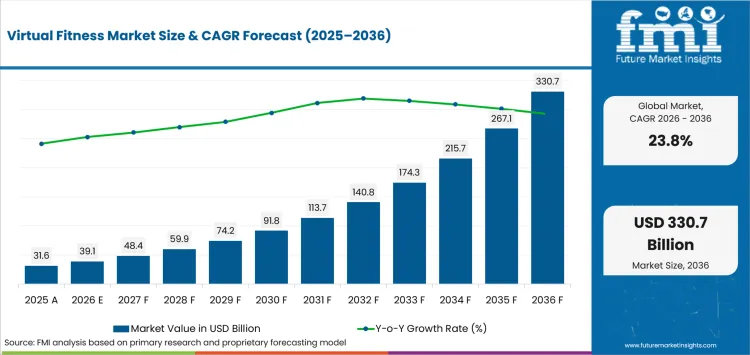
USD 39.1 billion in 2026 and USD 330.7 billion by 2036 at a 23.8% CAGR.
Demand for virtual fitness services is projected to expand at 23.8% CAGR between 2026 and 2036, increasing valuation from USD 39.1 billion in 2026 to USD 330.7 billion by 2036. Virtual fitness platforms, including fitness applications and connected home gym equipment, enable users to access guided workouts conveniently through devices they already use in their daily lives.
Sustained growth is driven in part by the ongoing gap between recommended physical activity levels and actual participation rates across major consumer markets. According to the WHO Regional Office for Europe, 27% of adults in the region did not meet recommended physical activity levels as of July 2025. Virtual fitness services help address this challenge by offering flexible, on-demand workout options that eliminate the need for travel and accommodate varying schedules without requiring attendance at fixed class times.
Key Takeaways
- Flexible digital instruction fits exercise around work schedules and limited access to nearby facilities during busy working weeks.
- Group sessions are projected to hold 56.0% share in 2026 as scheduled instruction strengthens attendance and accountability.
- On-demand delivery is estimated at 58.0% in 2026 because users can select suitable duration and intensity immediately.
- Smartphones are forecast to account for 36.0% in 2026 owing to portable playback and established application distribution.
- Weak habit formation and health-data obligations can reduce subscription returns for providers despite broad content availability.
- Peloton Interactive, Inc., Apple Inc., NIKE, Inc., Zwift, Inc., Les Mills International Limited, Fitbit LLC (Google), The Beachbody Company, Inc., and Nexercise, Inc. (Sworkit Health) serve connected training, mobile coaching, instructor content and employer wellbeing routes.
Analyst Perspective
“Workout history must direct virtual fitness users toward a credible next session across connected devices. Product teams earn recurring value through clear progression and trusted coaching instead of larger content libraries.”
- Rahul Pandita, Principal Consultant, Future Market Insights
How is the Virtual Fitness Market segmented?
The virtual fitness industry is segmented by session type, streaming type, device type, revenue model, end user and region.
Session type covers group sessions through live group classes and virtual group training, alongside solo sessions through individual on-demand workouts and AI-personalized training. Streaming type separates on-demand libraries from live-interactive classes and live personal training, and device type includes smartphones, smart TVs, laptops and desktops, and tablets. Revenue models cover subscriptions, advertising, pay-per-class and hybrid arrangements, and end users include individual consumers, gyms and studios, corporate institutions and educational institutions.
Why do group sessions hold the largest share within the session type category?
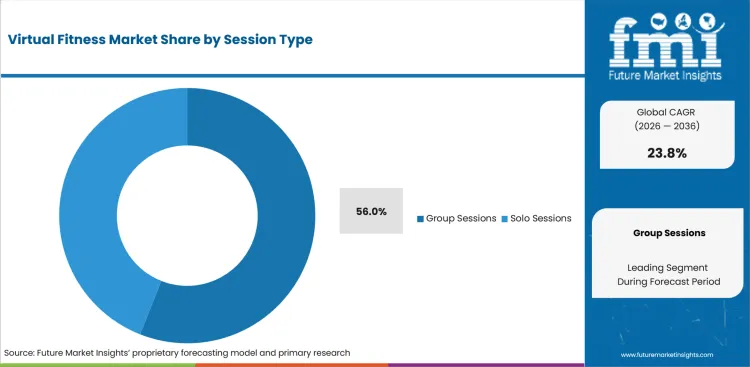
Group sessions require consistent instruction across club classes and self-directed smart home gym equipment to preserve shared pacing for participants. In June 2026, Les Mills reported 100,000 certified instructors across 22,600 clubs in 110 countries alongside streaming access. That network gives group formats a repeatable delivery base across facilities and corporate wellness programs.
- By session type, group sessions are forecast to represent 56.0% in 2026 driven by scheduled participation that reduces daily workout choice.
- Shared schedules reduce missed sessions by giving participants a fixed class time and visible peer accountability across household and workplace groups.
Why does on-demand retain the largest share within the streaming type category?
On-demand libraries let users choose workout length and intensity around changing schedules throughout each week. Health coaching apps gain value once workout choices form a weekly progression instead of an undirected catalogue. In January 2025, Apple added progressive strength programming and Strava workout sharing to Fitness+ for members. AI fitness products can use activity to guide the next session without requiring users to search large libraries.
- On-demand delivery is set to lead the streaming type category with 58.0% share in 2026 due to immediate access across supported screens.
- Immediate access supports short workout windows that fixed live schedules cannot accommodate across changing workdays.
How do smartphones support demand within the device type category?
Smartphones combine workout discovery and payment with playback and notifications inside a device carried throughout the day. Wearable fitness trackers add activity signals without requiring a separate display during home or outdoor exercise.
- By device type, smartphones are estimated to hold 36.0% in 2026 owing to established app stores and portable access.
- Portable coaching gains value through app distribution that also connects workout records from wearable devices. In November 2024, NIKE reported that the Nike Run Club app served more than 160 countries and connected with major watches. Smart wearables reinforce that route through prompts and performance feedback during home and outdoor training.
What supports subscription-based demand within the revenue model category?
Subscriptions combine updated programs with progress history and community access under recurring payment across wearable computing devices.
- In 2026, subscription-based services are expected to lead the revenue model category with 61.0% share because recurring access funds continuing content and coaching support.
- Recurring payment depends on visible progression through a catalogue with regular program updates and sequencing. Short challenges give members clear targets that reinforce accountability between longer training plans and milestones. In December 2025, Sworkit reported 1.1 million completed workouts and 225 challenges across 104 countries during 2025. Those participation records support subscription value across household accounts and employer programs with measurable engagement.
What are the drivers, restraints and opportunities in the Virtual Fitness Market?
Flexible access removes travel barriers, privacy duties pressure revenue, and hybrid delivery expands partner channels.
- Driver: Guided digital sessions remove travel and timetable barriers without sacrificing instruction or program structure.
- Restraint: Weak habit formation and health-data obligations increase service costs and weaken recurring membership returns.
- Opportunity: Hybrid delivery lets one training record connect household routines with gyms and employer programs.
Flexible delivery enables consumers to integrate guided exercise into their daily routines without the need for travel or fixed class schedules. This convenience lowers participation barriers and supports sustained engagement, driving recurring demand for virtual fitness services.
Weak habit formation directly pressures recurring revenue through continuing content production and member support expenses. In April 2024 the Federal Trade Commission confirmed that updated breach rules cover health apps, adding consent and response duties for services handling workout or device data.
Hybrid delivery lets training plans continue across household and partner settings without restarting progress records. In April 2026, Spotify announced that Peloton instructor audio would enter its fitness category in supported markets. Online fitness services can use similar channels to reach established audiences without building separate institutional libraries.
Which country CAGRs are profiled in the Virtual Fitness Market?
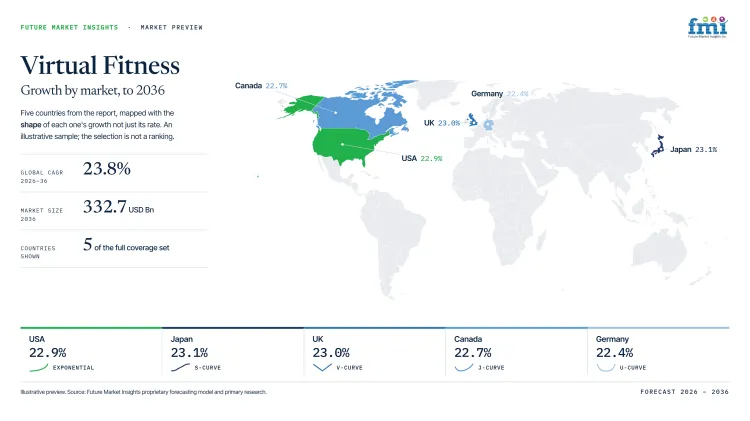
| Country | CAGR |
|---|---|
| South Korea | 24.8% |
| Japan | 23.1% |
| UK | 23.0% |
| USA | 22.9% |
| Germany | 22.4% |
How do country-level CAGRs compare in the Virtual Fitness Market?
The country outlook range spans 2.4 percentage points across five countries and describes forecast pace without measuring current revenue or installed volume.
- South Korea’s forecast pace reflects mobile-first delivery and public familiarity with measurable exercise participation across household routines.
- Japan’s outlook reflects demand for short sessions and precise Japanese-language instruction among working adults with limited weekly time.
- The United Kingdom combines broad digital access with persistent participation gaps across income groups and people living with disabilities.
- The United States reflects broad device access alongside dense competition and stronger duties for services handling personal health data.
- Germany reflects an insurer-linked route that rewards documented course quality but raises qualification requirements for participating services.
Comparable CAGRs can produce different market entry conditions. The full report provides country-level CAGR analysis across North America, Latin America, Europe, East Asia, South Asia and Pacific, and the Middle East and Africa.
Country-wise Analysis
- South Korea combines mobile-first service habits with public exercise programs that normalize guided digital routines across households and make low-equipment participation practical for adults living beyond regular access to traditional fitness clubs nationwide. South Korea is estimated to post 24.8% CAGR over the forecast period, supported by Korean-language coaching and short sessions that connect exercise assessment with measurable progress across daily household routines and age groups. The Ministry of Culture, Sports and Tourism reported in January 2026 that sports participation reached 62.9% in 2025 but remained weaker among teenagers and older adults, requiring age-specific pacing for paid services.
- Japan combines long working hours and caregiving duties with strong expectations for precise instruction, making short Japanese-language sessions more practical than generic programs built around extended workouts on home screens each week. Virtual fitness demand in Japan is forecast to rise at 23.1% CAGR over the forecast period, shaped by guided routines that fit limited time and provide dependable local-language support for regular weekly progression. The Japan Sports Agency reported in March 2026 that 51.7% of adults exercised weekly but participation remained lower among people aged 20 to 50 years, requiring clearer movement cues and reliable customer support.
- The United Kingdom combines broad digital access with established public and club-based exercise resources, giving paid services a familiar market that demands clear differences in coaching depth across income and disability groups. The UK virtual fitness sector is projected to record 23.0% CAGR during the assessment period, driven by accessible programs that connect household routines with gym-linked memberships and specialist instruction across changing weekly schedules. Sport England reported in April 2026 that 64.6% of adults met activity guidelines but participation remained lower among lower-income adults and people with disabilities, requiring inclusive sessions and progression beyond basic video access.
- The United States supports mature app distribution and connected-equipment channels, giving virtual fitness providers broad household reach through devices already linked with subscriptions and employer wellness programs across urban and suburban communities nationwide. Virtual fitness sales in the USA are forecast to expand at 22.9% CAGR by 2036, supported by established device use and recurring services that combine content with performance feedback across several screens. The CDC reported in August 2025 that one in four American adults met aerobic and muscle-strengthening guidelines but participation remained limited, requiring visible progress measures and clear privacy terms in a densely competitive market.
- Germany provides an insurer-linked route for documented online prevention courses through statutory health programs, giving qualified virtual fitness services a formal channel beyond direct consumer subscriptions across covered populations and age groups. Adoption of virtual fitness services in Germany is estimated to expand at 22.4% CAGR through 2036, reinforced by insurer-backed courses and consumer familiarity with approved digital movement programs that document progression for users. GKV-Spitzenverband reported in November 2025 that 27% of supported health courses occurred online and 63% focused on movement, although certification and data-protection requirements raise entry costs and demand documented outcomes from providers for reimbursement.
Who are the notable companies in the Virtual Fitness Market?
Peloton Interactive, Inc., Apple Inc., NIKE, Inc., Zwift, Inc., Les Mills International Limited, Fitbit LLC (Google), The Beachbody Company, Inc., and Nexercise, Inc. (Sworkit Health) are the notable companies serving this market.
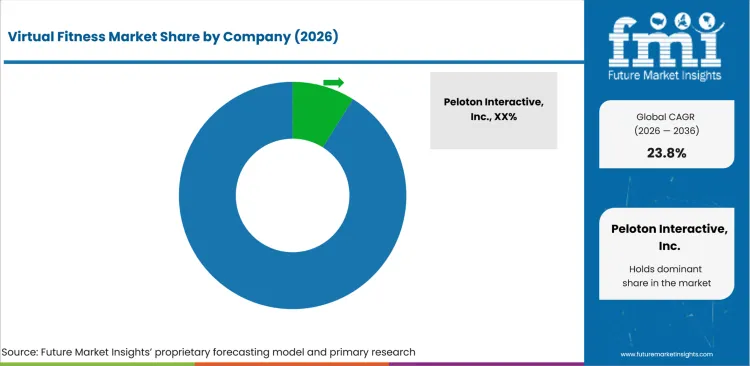
The field remains fragmented across low-infrastructure mobile services and capital-intensive connected-equipment platforms with different content and support economics. Basic video libraries face limited technical entry barriers, but sustained competition requires credible instruction and measurable progression. Providers also need cross-device delivery and dependable privacy controls to retain paying users across recurring services.
- Peloton Interactive, Inc., Apple Inc. and Fitbit LLC (Google) compete through connected devices, personal metrics and guided digital services.
- NIKE, Inc., Zwift, Inc. and Les Mills International Limited compete through coaching depth, community participation and specialized training formats.
- The Beachbody Company, Inc. and Nexercise, Inc. (Sworkit Health) compete through structured libraries, subscriptions and employer distribution.
Competitive Benchmarking: Virtual Fitness Market
| Company | Program Breadth | Personalization & Feedback | Device & Delivery Support | Geographic Reach |
|---|---|---|---|---|
| Peloton Interactive, Inc. | High | High | High | United States, Canada, UK, Germany, Australia and Austria |
| Apple Inc. | High | High | High | 49 countries and regions |
| NIKE, Inc. | Medium | Medium | High | Global app distribution |
| Zwift, Inc. | Medium | High | High | North America, Europe and Asia Pacific |
| Les Mills International Limited | High | Medium | High | Global club and streaming routes |
| Fitbit LLC (Google) | Medium | High | High | 37 countries in public preview |
| The Beachbody Company, Inc. | High | Medium | Medium | Global Reebok Fitness App audience |
| Nexercise, Inc. (Sworkit Health) | High | Medium | Medium | Global consumer and employer channels |
Scoring basis: Program breadth is High for several documented workout families, Medium for a narrower specialty and Low for limited exact-market content. Personalization and feedback is High for adaptive guidance, Medium for configurable plans and Low for basic tracking. Device and delivery support is High across several screens or connected devices, Medium across app and web routes and Low for one delivery route.
Key Developments in the Virtual Fitness Market
- In February 2026, The Beachbody Company, Inc. launched P90X Generation Next as a 90-day home program combining strength, cardio and recovery within its BODi subscription.
- In December 2025, Apple Inc. expanded Fitness+ into 28 new markets and added German and Spanish dubbing with Japanese support planned for 2026.
- In October 2025, Peloton Interactive, Inc. launched Peloton IQ and the Peloton Cross Training Series with adaptive guidance and updated connected equipment.
Key Players in the Virtual Fitness Market
Connected Fitness and Data Platforms
- Peloton Interactive, Inc.
- Apple Inc.
- Fitbit LLC (Google)
Immersive and Instructor-Led Platforms
- NIKE, Inc.
- Zwift, Inc.
- Les Mills International Limited
Subscription and Employer Wellness Platforms
- The Beachbody Company, Inc.
- Nexercise, Inc. (Sworkit Health)
Virtual Fitness Market - Report Scope
| Coverage field | Report scope |
|---|---|
| Market breakdown | By session type, streaming type, device type, revenue model, end user and region. |
| Market Definition | Virtual fitness platforms, applications, instructor-led digital content and connected training services delivered to consumers or institutions. |
| Regions Covered | North America, Latin America, Europe, East Asia, South Asia and Pacific, and Middle East and Africa. |
| Countries Covered | South Korea, Japan, UK, USA, Germany and 20+ countries included in the full report. |
| Key Companies Profiled | Peloton Interactive, Inc., Apple Inc., NIKE, Inc., Zwift, Inc., Les Mills International Limited, Fitbit LLC (Google), The Beachbody Company, Inc., and Nexercise, Inc. (Sworkit Health) |
| Forecast Period | 2026 to 2036. |
| Approach | Primary and secondary research with market triangulation. |
Virtual Fitness Market - Research Methodology
| Method | Approach |
|---|---|
| Primary Research | FMI analysts gathered input from manufacturers, service providers, technology developers, distributors, end users, procurement teams, and subject-matter experts. Interviews examined purchasing decisions, product or service evaluation, adoption barriers, approval requirements, pricing considerations, and expectations for technical or commercial support. Respondents were also asked what evidence is required before a trial, pilot, or initial order develops into regular purchasing. |
| Desk Research | Desk research covered government statistics, regulatory publications, trade data, industry associations, technical literature, standards, company filings, product information, and official corporate announcements. Sources were reviewed for relevance, publication date, geographic coverage, and consistency with the defined market scope. Claims relating to performance, applications, approvals, capacity, investment, and commercial activity were retained only when supported by credible public evidence. |
| Market Sizing and Forecasting | The market model combined the baseline value with historical performance, segment structure, pricing and volume indicators, adoption levels, company participation, and country-level demand conditions. Forecast assumptions considered economic activity, investment trends, regulatory developments, technology adoption, purchasing cycles, supply availability, and barriers to wider market use. Segment and regional estimates were reconciled before the final market total was calculated. |
| Data Validation | Estimates were checked against multiple independent indicators, including public data, company activity, trade patterns, industry developments, and findings from primary interviews. Validation also tested whether products, services, applications, and company revenues fell within the defined market boundaries. Adjacent categories, unsupported claims, overlapping revenues, and activities without direct market relevance were excluded to reduce double counting and maintain consistency across segments and countries. |
Virtual Fitness Market by Segments
Virtual Fitness Market segmented by Session Type:
- Group Sessions
- Live Group Classes
- Virtual Group Training
- Solo Sessions
- Individual On-Demand Workouts
- AI-Personalized Training
Virtual Fitness Market segmented by Streaming Type:
- On-Demand
- Pre-Recorded Workout Classes
- Personalized Workout Libraries
- Live
- Live-Interactive Classes
- Live Personal Training
Virtual Fitness Market segmented by Device Type:
- Smartphones
- iOS Fitness Applications
- Android Fitness Applications
- Smart TVs
- Connected TV Platforms
- Smart TV Fitness Applications
- Laptops & Desktops
- Web-Based Fitness Platforms
- Desktop Fitness Applications
- Tablets
- iPad Fitness Applications
- Android Tablet Applications
Virtual Fitness Market segmented by Revenue Model:
- Subscription-Based
- Monthly Subscriptions
- Annual Subscriptions
- Advertising-Based
- In-App Advertising
- Sponsored Fitness Content
- Pay-Per-Class
- Individual Class Purchases
- Virtual Personal Training
- Hybrid Revenue Models
- Subscription & Advertising
- Subscription & Equipment Bundles
Virtual Fitness Market segmented by End User:
- Individual Consumers
- Home Fitness Users
- Fitness Enthusiasts
- Professional Gyms & Fitness Studios
- Gyms
- Fitness Studios
- Corporate Institutions
- Employee Wellness Programs
- Corporate Fitness Platforms
- Educational Institutions
- Schools
- Universities
Virtual Fitness Market by Region:
- North America
- United States
- Canada
- Latin America
- Brazil
- Chile
- Mexico
- Rest of Latin America
- Western Europe
- Germany
- United Kingdom
- Italy
- Spain
- France
- Nordics
- Benelux
- Rest of Western Europe
- Eastern Europe
- Russia
- Poland
- Hungary
- Balkan and Baltic States
- Rest of Eastern Europe
- East Asia
- China
- Japan
- South Korea
- South Asia and Pacific
- India
- ASEAN
- Australia and New Zealand
- Rest of South Asia and Pacific
- Middle East and Africa
- Kingdom of Saudi Arabia
- Other GCC Countries
- Türkiye
- South Africa
- Other African Union Countries
- Rest of Middle East and Africa
Research Sources and Bibliography
- World Health Organization Regional Office for Europe. (2025, July 17)
- Les Mills International Limited. (2026, June 10).
- Apple Inc. (2025, January 3).
- NIKE, Inc. (2024, November 13).
- Hanna, R. (2025, December 28).
- Federal Trade Commission. (2024, April 30).
- Spotify. (2026, April 27).
- Republic of Korea Ministry of Culture, Sports and Tourism. (2026, January 23).
- Japan Sports Agency. (2026, March 11).
- Sport England. (2026, April 23)
- Centers for Disease Control and Prevention. (2025, August 12).
- Peloton Interactive, Inc. (2025, October 1).
- Apple Inc. (2025, December 8).
- Zwift, Inc. (2026, March 24).
- Google. (2026, April 9)
- The Beachbody Company, Inc. (2025, December 3).
- The Beachbody Company, Inc. (2026, February 3).
This bibliography is provided for reader reference and is not exhaustive. The full report contains the complete reference list and detailed citations
This Report Answers
- How large is the virtual fitness market in 2026 and 2036?
- Which operating conditions support recurring demand for guided virtual exercise?
- Why do group sessions hold the largest session type share in 2026?
- How does on-demand delivery shape access and workout selection?
- Why do smartphones support portable virtual fitness participation?
- What limits retention across subscription-based virtual fitness services?
- How do growth conditions differ across the five profiled countries?
- Which companies provide connected training, coaching content and employer programs?
- How should institutions compare virtual fitness services during wider deployment?
Frequently Asked Questions
How big is the Virtual Fitness Market in 2026?
In 2026, the virtual fitness market is valued at USD 39.1 billion and is forecast to reach USD 332.7 billion by 2036. Flexible instruction across phones and televisions supports expansion, although recurring revenue depends on services turning occasional use into a clear training routine across connected equipment.
What is the CAGR of the Virtual Fitness Market from 2026 to 2036?
The virtual fitness market is projected to expand at 23.8% CAGR between 2026 and 2036. Digital access supports this pace as platforms provide guided progression across household and institutional channels, with retention and health-data controls shaping the returns available from recurring subscriptions.
Which session type leads the Virtual Fitness Market?
Group sessions account for 56.0% of session type demand in the virtual fitness market in 2026. Scheduled instruction and peer visibility support participation by giving users a defined class time, consistent pacing and visible accountability without travelling to a physical studio.
How much revenue will the Virtual Fitness Market add between 2026 and 2036?
Around USD 293.6 billion is expected to be added to the virtual fitness market between 2026 and 2036. The increase depends on repeat subscription use across consumer and institutional channels as content production, device support and privacy controls influence the revenue retained from each active account.
Which companies are active in the Virtual Fitness Market?
Companies active in the virtual fitness market include Peloton Interactive, Inc., Apple Inc., NIKE, Inc. and Zwift, Inc. Les Mills International Limited, Fitbit LLC, The Beachbody Company, Inc. and Nexercise, Inc. complete the group across connected training, coaching content and employer wellbeing routes.
Preview the report firsthand - request a free sample
Get SampleGet the brochure for pricing and purchase details.
Get PDFTable of Content
- Key Takeaways
- Market Size and CAGR
- Top Growth Driver
- Fastest Growing Segment
- Leading Region
- Key Companies
- Emerging Opportunities
- Executive Summary
- Global Market Outlook
- Demand-side Trends
- Supply-side Trends
- Technology Roadmap Analysis
- Analysis and Recommendations
- Analyst Perspective (What is happening? Why now? What should investors know?)
- Key Questions Answered
- How large is the market?
- What is the CAGR?
- What are key trends?
- Which region dominates?
- Who are the leaders?
- Market Overview
- Market Coverage / Taxonomy
- Market Definition / Scope / Limitations
- Research Methodology
- Chapter Orientation
- Analytical Lens and Working Hypotheses
- Market Structure, Signals, and Trend Drivers
- Benchmarking and Cross-market Comparability
- Market Sizing, Forecasting, and Opportunity Mapping
- Research Design and Evidence Framework
- Desk Research Programme (Secondary Evidence)
- Expert Input and Fieldwork (Primary Evidence)
- Tooling, Models, and Reference Databases
- Data Engineering and Model Build
- Quality Assurance and Audit Trail
- Market Background
- Market Dynamics (Drivers, Restraints, Opportunity, Trends)
- Scenario Forecast (Optimistic, Likely, Conservative)
- Impact Analysis
- AI Impact
- Sustainability Impact
- Regulatory Impact
- Technology Impact
- Consumer / Buyer Analysis
- Purchase Drivers
- Adoption Barriers
- Buyer Journey
- Opportunity Map Analysis
- Product Life Cycle Analysis
- Supply Chain Analysis
- Investment Feasibility Matrix
- Value Chain Analysis
- PESTLE and Porter's Analysis
- Regulatory Landscape
- Regional Parent Market Outlook
- Production and Consumption Statistics
- Import and Export Statistics
- Global Market Analysis and Forecast, 2021 to 2036
- Historical Market Size Value (USD Billion) Analysis, 2021 to 2025
- Current and Future Market Size Value (USD Billion) Projections, 2026 to 2036
- Y-o-Y Growth Trend Analysis
- Absolute $ Opportunity Analysis
- Global Market Pricing Analysis, 2021 to 2036
- Global Market Analysis and Forecast, By Session Type, 2021 to 2036
- Introduction / Key Findings
- Historical Market Size Value (USD Billion) Analysis By Session Type, 2021 to 2025
- Current and Future Market Size Value (USD Billion) Analysis and Forecast By Session Type, 2026 to 2036
- Group Sessions
- Live Group Classes
- Virtual Group Training
- Solo Sessions
- Individual On-Demand Workouts
- AI-Personalized Training
- Group Sessions
- Y-o-Y Growth Trend Analysis By Session Type, 2021 to 2025
- Absolute $ Opportunity Analysis By Session Type, 2026 to 2036
- Global Market Analysis and Forecast, By Streaming Type, 2021 to 2036
- Introduction / Key Findings
- Historical Market Size Value (USD Billion) Analysis By Streaming Type, 2021 to 2025
- Current and Future Market Size Value (USD Billion) Analysis and Forecast By Streaming Type, 2026 to 2036
- On-Demand
- Pre-Recorded Workout Classes
- Personalized Workout Libraries
- Live
- Live-Interactive Classes
- Live Personal Training
- On-Demand
- Y-o-Y Growth Trend Analysis By Streaming Type, 2021 to 2025
- Absolute $ Opportunity Analysis By Streaming Type, 2026 to 2036
- Global Market Analysis and Forecast, By Device Type, 2021 to 2036
- Introduction / Key Findings
- Historical Market Size Value (USD Billion) Analysis By Device Type, 2021 to 2025
- Current and Future Market Size Value (USD Billion) Analysis and Forecast By Device Type, 2026 to 2036
- Smartphones
- iOS Fitness Applications
- Android Fitness Applications
- Smart TVs
- Connected TV Platforms
- Smart TV Fitness Applications
- Laptops & Desktops
- Web-Based Fitness Platforms
- Desktop Fitness Applications
- Tablets
- iPad Fitness Applications
- Android Tablet Applications
- Smartphones
- Y-o-Y Growth Trend Analysis By Device Type, 2021 to 2025
- Absolute $ Opportunity Analysis By Device Type, 2026 to 2036
- Global Market Analysis and Forecast, By Revenue Model, 2021 to 2036
- Introduction / Key Findings
- Historical Market Size Value (USD Billion) Analysis By Revenue Model, 2021 to 2025
- Current and Future Market Size Value (USD Billion) Analysis and Forecast By Revenue Model, 2026 to 2036
- Subscription-Based
- Monthly Subscriptions
- Annual Subscriptions
- Advertising-Based
- In-App Advertising
- Sponsored Fitness Content
- Pay-Per-Class
- Individual Class Purchases
- Virtual Personal Training
- Hybrid Revenue Models
- Subscription & Advertising
- Subscription & Equipment Bundles
- Subscription-Based
- Y-o-Y Growth Trend Analysis By Revenue Model, 2021 to 2025
- Absolute $ Opportunity Analysis By Revenue Model, 2026 to 2036
- Global Market Analysis and Forecast, By End User, 2021 to 2036
- Introduction / Key Findings
- Historical Market Size Value (USD Billion) Analysis By End User, 2021 to 2025
- Current and Future Market Size Value (USD Billion) Analysis and Forecast By End User, 2026 to 2036
- Individual Consumers
- Home Fitness Users
- Fitness Enthusiasts
- Professional Gyms & Fitness Studios
- Gyms
- Fitness Studios
- Corporate Institutions
- Employee Wellness Programs
- Corporate Fitness Platforms
- Educational Institutions
- Schools
- Universities
- Individual Consumers
- Y-o-Y Growth Trend Analysis By End User, 2021 to 2025
- Absolute $ Opportunity Analysis By End User, 2026 to 2036
- Global Market Analysis and Forecast, By Region, 2021 to 2036
- Introduction
- Historical Market Size Value (USD Billion) Analysis By Region, 2021 to 2025
- Current Market Size Value (USD Billion) Analysis and Forecast By Region, 2026 to 2036
- North America
- Latin America
- Western Europe
- Eastern Europe
- East Asia
- South Asia and Pacific
- Middle East & Africa
- Market Attractiveness Analysis By Region
- North America Market Analysis and Forecast, By Country, 2021 to 2036
- Historical Market Size Value (USD Billion) Trend Analysis By Market Taxonomy, 2021 to 2025
- Market Size Value (USD Billion) Forecast By Market Taxonomy, 2026 to 2036
- By Country
- USA
- Canada
- By Session Type
- By Streaming Type
- By Device Type
- By Revenue Model
- By End User
- By Country
- Market Attractiveness Analysis
- By Country
- By Session Type
- By Streaming Type
- By Device Type
- By Revenue Model
- By End User
- Key Takeaways
- Latin America Market Analysis and Forecast, By Country
- Historical Market Size Value (USD Billion) Trend Analysis By Market Taxonomy, 2021 to 2025
- Market Size Value (USD Billion) Forecast By Market Taxonomy, 2026 to 2036
- By Country
- Brazil
- Mexico
- Chile
- Rest of Latin America
- By Session Type
- By Streaming Type
- By Device Type
- By Revenue Model
- By End User
- By Country
- Market Attractiveness Analysis
- By Country
- By Session Type
- By Streaming Type
- By Device Type
- By Revenue Model
- By End User
- Key Takeaways
- Western Europe Market Analysis and Forecast, By Country
- Historical Market Size Value (USD Billion) Trend Analysis By Market Taxonomy, 2021 to 2025
- Market Size Value (USD Billion) Forecast By Market Taxonomy, 2026 to 2036
- By Country
- Germany
- UK
- Italy
- Spain
- France
- Nordic
- BENELUX
- Rest of Western Europe
- By Session Type
- By Streaming Type
- By Device Type
- By Revenue Model
- By End User
- By Country
- Market Attractiveness Analysis
- By Country
- By Session Type
- By Streaming Type
- By Device Type
- By Revenue Model
- By End User
- Key Takeaways
- Eastern Europe Market Analysis and Forecast, By Country
- Historical Market Size Value (USD Billion) Trend Analysis By Market Taxonomy, 2021 to 2025
- Market Size Value (USD Billion) Forecast By Market Taxonomy, 2026 to 2036
- By Country
- Russia
- Poland
- Hungary
- Balkan & Baltic
- Rest of Eastern Europe
- By Session Type
- By Streaming Type
- By Device Type
- By Revenue Model
- By End User
- By Country
- Market Attractiveness Analysis
- By Country
- By Session Type
- By Streaming Type
- By Device Type
- By Revenue Model
- By End User
- Key Takeaways
- East Asia Market Analysis and Forecast, By Country
- Historical Market Size Value (USD Billion) Trend Analysis By Market Taxonomy, 2021 to 2025
- Market Size Value (USD Billion) Forecast By Market Taxonomy, 2026 to 2036
- By Country
- China
- Japan
- South Korea
- By Session Type
- By Streaming Type
- By Device Type
- By Revenue Model
- By End User
- By Country
- Market Attractiveness Analysis
- By Country
- By Session Type
- By Streaming Type
- By Device Type
- By Revenue Model
- By End User
- Key Takeaways
- South Asia and Pacific Market Analysis and Forecast, By Country
- Historical Market Size Value (USD Billion) Trend Analysis By Market Taxonomy, 2021 to 2025
- Market Size Value (USD Billion) Forecast By Market Taxonomy, 2026 to 2036
- By Country
- India
- ASEAN
- Australia & New Zealand
- Rest of South Asia and Pacific
- By Session Type
- By Streaming Type
- By Device Type
- By Revenue Model
- By End User
- By Country
- Market Attractiveness Analysis
- By Country
- By Session Type
- By Streaming Type
- By Device Type
- By Revenue Model
- By End User
- Key Takeaways
- Middle East & Africa Market Analysis and Forecast, By Country
- Historical Market Size Value (USD Billion) Trend Analysis By Market Taxonomy, 2021 to 2025
- Market Size Value (USD Billion) Forecast By Market Taxonomy, 2026 to 2036
- By Country
- Kingdom of Saudi Arabia
- Other GCC Countries
- Türkiye
- South Africa
- Other African Union
- Rest of Middle East & Africa
- By Session Type
- By Streaming Type
- By Device Type
- By Revenue Model
- By End User
- By Country
- Market Attractiveness Analysis
- By Country
- By Session Type
- By Streaming Type
- By Device Type
- By Revenue Model
- By End User
- Key Takeaways
- Key Countries Market Analysis
- USA
- Pricing Analysis
- Market Share Analysis, 2025
- By Session Type
- By Streaming Type
- By Device Type
- By Revenue Model
- By End User
- Canada
- Pricing Analysis
- Market Share Analysis, 2025
- By Session Type
- By Streaming Type
- By Device Type
- By Revenue Model
- By End User
- Mexico
- Pricing Analysis
- Market Share Analysis, 2025
- By Session Type
- By Streaming Type
- By Device Type
- By Revenue Model
- By End User
- Brazil
- Pricing Analysis
- Market Share Analysis, 2025
- By Session Type
- By Streaming Type
- By Device Type
- By Revenue Model
- By End User
- Chile
- Pricing Analysis
- Market Share Analysis, 2025
- By Session Type
- By Streaming Type
- By Device Type
- By Revenue Model
- By End User
- Germany
- Pricing Analysis
- Market Share Analysis, 2025
- By Session Type
- By Streaming Type
- By Device Type
- By Revenue Model
- By End User
- UK
- Pricing Analysis
- Market Share Analysis, 2025
- By Session Type
- By Streaming Type
- By Device Type
- By Revenue Model
- By End User
- Italy
- Pricing Analysis
- Market Share Analysis, 2025
- By Session Type
- By Streaming Type
- By Device Type
- By Revenue Model
- By End User
- Spain
- Pricing Analysis
- Market Share Analysis, 2025
- By Session Type
- By Streaming Type
- By Device Type
- By Revenue Model
- By End User
- France
- Pricing Analysis
- Market Share Analysis, 2025
- By Session Type
- By Streaming Type
- By Device Type
- By Revenue Model
- By End User
- India
- Pricing Analysis
- Market Share Analysis, 2025
- By Session Type
- By Streaming Type
- By Device Type
- By Revenue Model
- By End User
- ASEAN
- Pricing Analysis
- Market Share Analysis, 2025
- By Session Type
- By Streaming Type
- By Device Type
- By Revenue Model
- By End User
- Australia & New Zealand
- Pricing Analysis
- Market Share Analysis, 2025
- By Session Type
- By Streaming Type
- By Device Type
- By Revenue Model
- By End User
- China
- Pricing Analysis
- Market Share Analysis, 2025
- By Session Type
- By Streaming Type
- By Device Type
- By Revenue Model
- By End User
- Japan
- Pricing Analysis
- Market Share Analysis, 2025
- By Session Type
- By Streaming Type
- By Device Type
- By Revenue Model
- By End User
- South Korea
- Pricing Analysis
- Market Share Analysis, 2025
- By Session Type
- By Streaming Type
- By Device Type
- By Revenue Model
- By End User
- Russia
- Pricing Analysis
- Market Share Analysis, 2025
- By Session Type
- By Streaming Type
- By Device Type
- By Revenue Model
- By End User
- Poland
- Pricing Analysis
- Market Share Analysis, 2025
- By Session Type
- By Streaming Type
- By Device Type
- By Revenue Model
- By End User
- Hungary
- Pricing Analysis
- Market Share Analysis, 2025
- By Session Type
- By Streaming Type
- By Device Type
- By Revenue Model
- By End User
- Kingdom of Saudi Arabia
- Pricing Analysis
- Market Share Analysis, 2025
- By Session Type
- By Streaming Type
- By Device Type
- By Revenue Model
- By End User
- Türkiye
- Pricing Analysis
- Market Share Analysis, 2025
- By Session Type
- By Streaming Type
- By Device Type
- By Revenue Model
- By End User
- South Africa
- Pricing Analysis
- Market Share Analysis, 2025
- By Session Type
- By Streaming Type
- By Device Type
- By Revenue Model
- By End User
- USA
- Market Structure Analysis
- Competition Dashboard
- Competition Benchmarking
- Market Share Analysis of Top Players
- By Regional
- By Session Type
- By Streaming Type
- By Device Type
- By Revenue Model
- By End User
- Emerging Startups
- Innovation Benchmarking
- Competition Analysis
- Competition Deep Dive
- Peloton Interactive, Inc.
- Overview
- Product Portfolio
- Profitability by Market Segments
- Sales Footprint
- Strategy Overview
- Marketing Strategy
- Product Strategy
- Channel Strategy
- Apple Inc.
- Nike, Inc.
- Zwift, Inc.
- Les Mills International
- Fitbit LLC (Google)
- Beachbody Company, Inc.
- Lululemon Athletica Inc.
- ClassPass Inc.
- Sworkit
- Others
- Peloton Interactive, Inc.
- Case Studies
- Success Stories
- Recent Developments
- Competition Deep Dive
- Assumptions & Acronyms Used


