

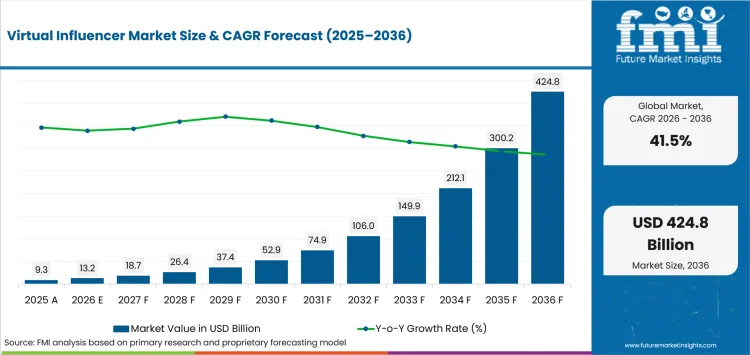
- Market Size (2026)
- USD 13.2 Bn
- Forecast (2036)
- USD 424.8 Bn
- CAGR (2026 to 2036)
- 41.5%
How big is the Virtual Influencer Market in 2026?
USD 13.2 billion in 2026 and USD 424.8 billion by 2036 at a 41.5% CAGR.
Demand for virtual influencer services is projected to expand at 41.5% CAGR between 2026 and 2036, increasing valuation from USD 13.2 billion in 2026 to USD 424.8 billion by 2036. Influencer marketing teams must preserve sponsorship labels as one character appears across several campaign assets. The Advertising Standards Authority reported in May 2025 that 57% of sampled advertisements met disclosure requirements and 34% carried no disclosure. Campaign directors therefore need asset-level controls that preserve sponsorship information across feeds and automated replies.
Creation teams combine reusable appearance and voice assets with approved scripts for recurring campaign work. Generative AI systems shorten production, while content creation software organizes releases through an approval calendar. Commercial agreements must assign likeness rights and response limits so a persistent persona cannot publish unsupported product claims.
Key Takeaways
- Persistent character operations increase demand as brands reuse approved identity assets across recurring campaigns and audience channels.
- Human avatars are projected to represent 68.0% of type demand in 2026 driven by realistic and AI-generated personas.
- Solutions are estimated to account for 62.0% share in 2026 as platforms organize creation and content production.
- Social media platforms are forecast to capture 48.0% of platform demand owing to short-form publishing and direct audience interaction.
- Unclear sponsorship labels and likeness permissions restrain adoption as each public asset requires accountable review and documented approval.
- Meta Platforms, Epic Games, Soul Machines, UneeQ, DeepBrain AI, Didimo, Aww Inc. and TikTok address distinct campaign functions.
Analyst Perspective
"Virtual influencers justify repeat campaign budgets through stable identity, visible sponsorship labels and controlled replies across channels. Brand teams should verify character ownership and claim limits as approval gates for multilingual publishing or automated audience interaction."
- Sudip saha, Principal Consultant, Future Market Insights
How is the virtual influencer market segmented?
The Virtual Influencer Market is segmented by type, offering, application, end use, platform and region.
The taxonomy separates the persona's form from the purchased offering, campaign purpose, end-use industry, and publishing platform. Type covers human avatars and non-human characters, while offering includes creation solutions and managed services. Application covers fashion and lifestyle, entertainment and media, gaming, and advertising across recurring brand campaigns. End use includes food and entertainment, fashion and lifestyle, sports and fitness, and banking and finance. Platform coverage spans social media, video and streaming, gaming and metaverse environments, and brand-owned channels.
Why do human avatars lead the type category?
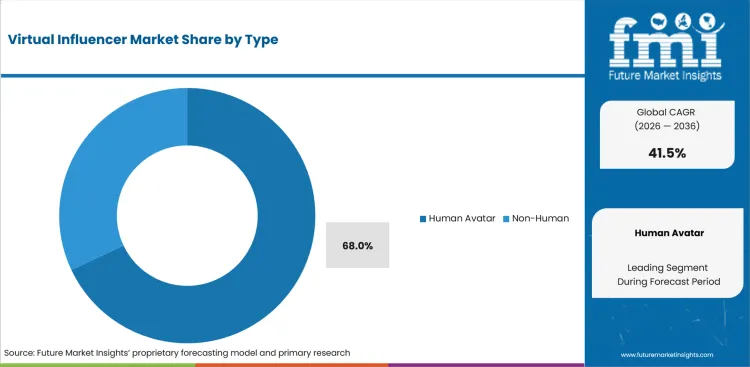
Human-shaped personas fit presenter roles that depend on a stable face across campaign releases and language variants. Epic Games moved MetaHuman Creator into Unreal Engine in June 2025 and added broader body variation with real-time animation tools. The integrated workflow helps production teams preserve recognizable character features during repeated campaign asset revisions.
- By type, human avatars are forecast to represent 68.0% in 2026 driven by familiar presenter formats that support recurring branded campaigns and scheduled product releases.
- Creative directors reuse approved appearance and voice specifications so one persona remains recognizable across still images and short campaign videos.
Why do solutions lead the offering category?
Persistent personas need coordinated controls for appearance and voice alongside approved responses across each campaign release. Marketing operations test behavior changes and restrict approved knowledge to defined public channels, reducing version conflicts across scripts and persona settings. Campaign calendars also require consistent version control across repeated language editions and channel adaptations worldwide.
- Solutions are projected to hold 62.0% share in 2026 owing to consolidated creation and campaign-control workflows that reduce specialist production handoffs.
- Platform selection depends on response governance as UneeQ launched UneeQ 2.0 in January 2025 with real-time conversational AI responses and analytics supporting structured deployment reviews.
Why does fashion and lifestyle lead the application category?
Fashion campaigns depend on recognizable styling across seasonal product drops and visual stories for consumer brands. H&M released digital-twin campaign images in July 2025 through a co-created process involving models and a dedicated creative team. The approach preserves human direction while allowing reusable synthetic presentation across recurring brand content programs.
- Based on application, fashion and lifestyle is projected to account for 29.0% in 2026 due to visual identity requirements across seasonal product storytelling.
- Design teams revise clothing and settings through approved persona specifications that preserve visual continuity across lookbooks and branded tutorials without scheduling repeated studio shoots.
Why do social media platforms lead the platform category?
Social feeds combine publishing cadence and public identity with visible audience reaction inside one daily campaign environment. Direct channel access supports testing across videos and replies without separating distribution from audience response. Channel teams also compare campaign performance without exporting every interaction into a separate approval system.
- By platform, social media platforms are estimated to hold 48.0% in 2026 owing to combined posting and reply workflows. UneeQ and Qatar Airways launched Sama on Instagram in January 2025 to support direct follower engagement.
- Persistent personas need an approved channel plan that preserves identity across video streaming and related campaign touchpoints during each scheduled release.
What are the drivers, restraints and opportunities in the virtual influencer market?
Integrated avatar systems reduce specialist handoffs across recurring character campaigns, but disclosure and likeness-permission requirements can delay releases, creating opportunities for governed personas that enable scalable, compliant digital engagement.
- Driver: Combined authoring and animation systems reduce specialist handoffs across recurring character production and channel adaptation.
- Restraint: Missing sponsorship labels or likeness permissions expose brands to complaints and costly campaign withdrawal.
- Opportunity: One approved persona can support product education and service interaction across controlled digital channels.
Avatar frameworks combine authoring and animation capabilities within a unified workflow, helping organizations streamline content production. They reduce version conflicts across recurring digital assets and improve consistency across streaming media services and other customer-facing platforms. This efficiency is driving broader adoption among content creators and enterprises.
Governance processes can slow public release timelines when automated dialogue systems lack documented consent records or required approvals. Additional product-claim reviews and regulatory checks across multiple audience channels often extend deployment cycles. These compliance requirements can limit the speed and scalability of avatar-based communication solutions.
Brand-owned channels give campaign directors direct control over disclosures and automated response boundaries during product education. Aww introduced HITO in June 2026 for product explanation, multilingual assistance and FAQ support onsite. AI media tools let one approved persona serve these settings while the brand retains response control.
Which country CAGRs are profiled in the virtual influencer market?
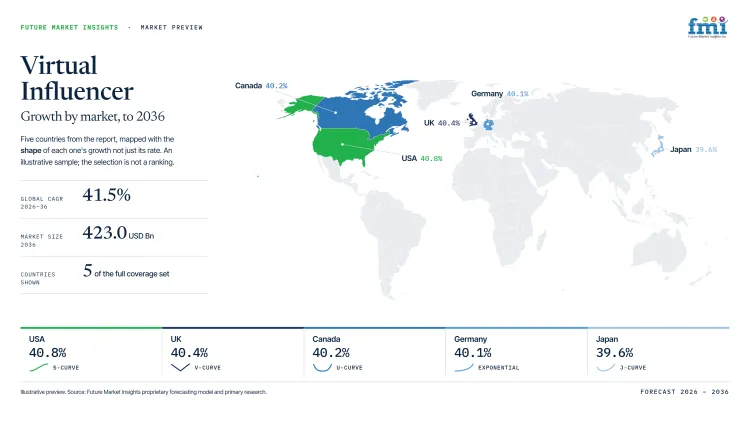
| Country | CAGR |
|---|---|
| South Korea | 43.1% |
| United States | 40.8% |
| United Kingdom | 40.4% |
| Canada | 40.2% |
| Germany | 40.1% |
How do country-level CAGRs compare in the virtual influencer market?
The CAGRs span 3.0 percentage points across markets with different advertising and AI-content rules.
The range measures forecast pace rather than current spending or installed character volume across markets.
- South Korea's margin reflects national AI-labeling guidance that changes release planning for synthetic media campaigns.
- The United States combines agency capacity with testimonial rules requiring documented product experience and truthful claims.
- The United Kingdom pairs creator services with brand responsibility for clear labels on every paid endorsement.
- Canada requires visible material-connection disclosure across bilingual campaigns and adds guidance for AI-generated influencer content.
- Germany combines creative production with European interaction notices and machine-readable marking duties for synthetic content.
Comparable CAGRs can produce different market entry conditions as national disclosure rules change approval work and release timing. The full report provides country-level CAGR analysis across North America, Latin America, Europe, East Asia, South Asia and Pacific, and the Middle East and Africa.
Country-wise Analysis
- South Korean campaign teams distribute synthetic characters through entertainment and retail channels that require clear content labels across domestic media and exported multilingual releases for fashion, travel and entertainment brands serving younger audiences. In South Korea, virtual influencer demand is predicted to advance at 43.1% CAGR through 2036 due to strong platform use and experienced digital-character production across consumer campaigns and active entertainment production networks. Ministry of Science and ICT guidance issued in January 2026 requires clear labels for AI-manipulated content and grants at least a one-year grace period, yet incomplete labeling can delay avatar releases across public channels.
- United States campaign operators combine nationwide social reach with experienced agencies and digital-human production teams that support recurring branded content across regulated products and diverse audience groups through shared multi-platform national release calendars. Virtual influencer demand in the United States is forecast to rise at 40.8% CAGR over the forecast period, supported by mature campaign operations and broad production capacity across national advertising channels at scale. The Federal Trade Commission warned ten companies in December 2025 that reviews cannot misrepresent product use, so a virtual persona cannot present invented experience as a consumer testimonial across sponsored assets or automated endorsements.
- United Kingdom campaigns rely on experienced creator agencies that coordinate paid endorsements across isolated social posts and regulated consumer categories within national brand programs with several review stages for each approved public asset. Competition and Markets Authority guidance updated in August 2025 requires brands to ensure paid public endorsements carry clear advertising labels that remain visible without prior knowledge of each commercial relationship and campaign format. By 2036, the United Kingdom is projected to grow at 40.4% CAGR due to specialist campaign services and recurring social storytelling despite longer approval schedules across national commercial campaigns for regulated product categories.
- Canadian campaign teams coordinate English and French content under disclosure guidance that Ad Standards updated in October 2025 to address AI-generated influencers, affiliates and child audiences across social video and regional campaign formats. Canada is estimated to post 40.2% CAGR over the forecast period due to bilingual production capability and broad social-platform reach supported by established media agencies and recurring consumer brand activity at national scale. The updated guidance supports clearer planning for synthetic characters, although language review and visible material-connection disclosures can lengthen preparation across regional campaign variants and regulated product categories without changing the approved character identity.
- German campaign teams apply European advertising and data-protection requirements across realistic synthetic characters distributed through social platforms and multilingual branded experiences for regulated consumer categories and coordinated regional release programs for international consumer brands. Adoption of virtual influencer programs in Germany is estimated to expand at 40.1% CAGR through 2036 due to specialist creative agencies and established synthetic-media production across national campaigns and multilingual asset production nationwide. European Commission guidelines published in July 2026 clarify AI-interaction notices and machine-readable marking duties from August 2026, while layered interaction notices and content marking can lengthen approval for realistic public-facing avatars at scale.
Who are the notable companies in the Virtual Influencer Market?
Meta Platforms, Inc., Epic Games, Inc., Soul Machines, UneeQ Limited, DeepBrain AI, Didimo Inc., Aww Inc. and TikTok are the notable companies serving this market.
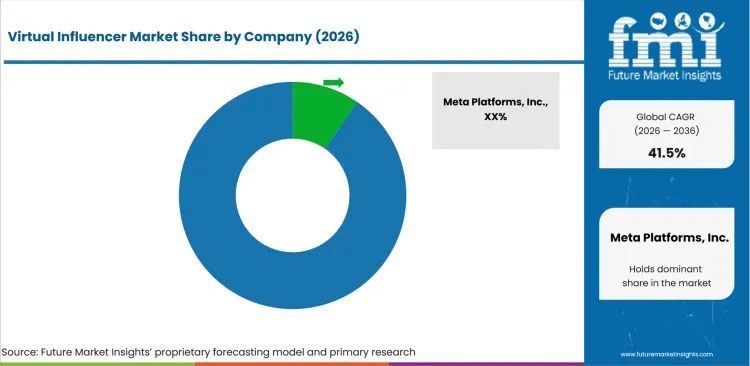
The field remains fragmented as social platforms control audience distribution across recurring campaign releases worldwide. Specialist developers compete through character production, controlled conversation and owned persona IP for persistent brand programs. Consumer metaverse programs reward brand managers who preserve one character across interactive environments and repeated audience contact. Social media analytics tools help agencies compare response patterns across approved campaign releases and public interactions.
- Meta Platforms and TikTok connect social distribution with avatar-led campaign production, while Epic Games supplies real-time character infrastructure. Affiliate storefronts link audience activity with measurable commerce during character-led product releases and recurring live campaigns.
- Soul Machines, UneeQ Limited and DeepBrain AI compete through controlled conversation and avatar-video workflows for customer-facing brand experiences.
- Aww and Didimo focus on owned virtual-character IP and scalable 3D production for retail or virtual-world deployment.
Competitive Benchmarking: Virtual Influencer Market
| Company | Character Creation Depth | Interactive Capability | Campaign Deployment Coverage | Geographic Reach |
|---|---|---|---|---|
| Meta Platforms, Inc. | Medium | High | High | Multi-region social platforms |
| Epic Games, Inc. | High | Medium | Medium | Global Unreal Engine distribution |
| Soul Machines | High | High | High | Multi-region enterprise deployment |
| UneeQ Limited | High | High | High | Multi-region enterprise deployment |
| DeepBrain AI | High | High | High | Multi-region avatar platform |
| Didimo Inc. | High | Low | Low | Global developer distribution |
| Aww Inc. | Medium | High | High | Japan and international brand projects |
| TikTok | Medium | Low | High | Multi-region social platform |
Scoring basis: Character creation depth is High for customizable humans with production rigging, Medium for configurable avatars or owned character IP, and Low for distribution tools without meaningful creation controls. Interactive capability is High for live conversation, Medium for real-time performance or platform replies, and Low for documented pre-rendered output. Campaign deployment coverage is High for repeatable multi-channel programs, Medium for one principal environment with adjacent uses, and Low for isolated projects or production tools. Geographic reach records documented platform availability and commercial deployment, while missing evidence never receives a Low score.
Key Developments in the Virtual Influencer Market
- In June 2026, Epic Games released MetaHuman 5.8 with crowd tools that scale from tens to thousands of characters and broader performance-capture support.
- In April 2026, Aww Inc. launched Amazon Japan's first AI influencer campaign with MIRAI hosting fully autonomous livestreams during the New Life sales period.
- In June 2025, TikTok introduced Symphony Image to Video, Text to Video and Showcase Products for TikTok-first content using digital avatars.
Key Players in the Virtual Influencer Market
Social platform and real-time framework providers
- Meta Platforms, Inc.
- TikTok
- Epic Games, Inc.
Enterprise digital-human platforms
- Soul Machines
- UneeQ Limited
- DeepBrain AI
Virtual character and 3D production specialists
- Aww Inc.
- Didimo Inc.
Virtual Influencer Market - Report Scope
| Coverage field | Report scope |
|---|---|
| Market breakdown | By type, offering, application, end use, platform and region. |
| Market Definition | Computer-generated human and non-human personas with creation solutions and campaign services used for recurring branded audience engagement. |
| Regions Covered | North America, Latin America, Western Europe, Eastern Europe, East Asia, South Asia and Pacific, and Middle East and Africa. |
| Countries Covered | South Korea, United States, United Kingdom, Canada, Germany, and 20+ countries included in the full report. |
| Key Companies Profiled | Meta Platforms, Inc., Epic Games, Inc., Soul Machines, UneeQ Limited, DeepBrain AI, Didimo Inc., Aww Inc., and TikTok. |
| Forecast Period | 2026-2036. |
| Approach | Primary and secondary research with market triangulation. |
Virtual Influencer Market - Research Methodology
| Method | Approach |
|---|---|
| Primary Research | FMI analysts gathered input from manufacturers, service providers, technology developers, distributors, end users, procurement teams, and subject-matter experts. Interviews examined purchasing decisions, product or service evaluation, adoption barriers, approval requirements, pricing considerations, and expectations for technical or commercial support. Respondents were also asked what evidence is required before a trial, pilot, or initial order develops into regular purchasing. |
| Desk Research | Desk research covered government statistics, regulatory publications, trade data, industry associations, technical literature, standards, company filings, product information, and official corporate announcements. Sources were reviewed for relevance, publication date, geographic coverage, and consistency with the defined market scope. Claims relating to performance, applications, approvals, capacity, investment, and commercial activity were retained only when supported by credible public evidence. |
| Market Sizing and Forecasting | The market model combined the baseline value with historical performance, segment structure, pricing and volume indicators, adoption levels, company participation, and country-level demand conditions. Forecast assumptions considered economic activity, investment trends, regulatory developments, technology adoption, purchasing cycles, supply availability, and barriers to wider market use. Segment and regional estimates were reconciled before the final market total was calculated. |
| Data Validation | Estimates were checked against multiple independent indicators, including public data, company activity, trade patterns, industry developments, and findings from primary interviews. Validation also tested whether products, services, applications, and company revenues fell within the defined market boundaries. Adjacent categories, unsupported claims, overlapping revenues, and activities without direct market relevance were excluded to reduce double counting and maintain consistency across segments and countries. |
Virtual Influencer Market by Segments
Virtual Influencer Market segmented by Type:
- Human avatar
- Realistic human avatars
- AI-generated human personas
- Non-human
- Animated characters
- Fantasy and virtual characters
Virtual Influencer Market segmented by Offering:
- Solutions
- Virtual influencer creation platforms
- AI avatar and content generation platforms
- Services
- Influencer management services
- Content creation and campaign services
Virtual Influencer Market segmented by Application:
- Fashion and lifestyle
- Fashion promotion
- Beauty and lifestyle campaigns
- Entertainment and media
- Music and film promotion
- Digital entertainment
- Gaming
- Game promotion
- Virtual gaming personalities
- Advertising and marketing
- Brand campaigns
- Product promotion
Virtual Influencer Market segmented by End Use:
- Food and entertainment
- Food and beverage marketing
- Entertainment campaigns
- Fashion and lifestyle
- Fashion brands
- Cosmetics and beauty brands
- Sports and fitness
- Sports promotion
- Fitness and wellness campaigns
- Banking and finance
- Financial services marketing
- Fintech promotion
Virtual Influencer Market segmented by Platform:
- Social media platforms
- TikTok
- Video and streaming platforms
- YouTube
- Live streaming platforms
- Gaming and metaverse platforms
- Virtual worlds
- Gaming platforms
- Others
- Brand-owned platforms
- Virtual events and experiences
Virtual Influencer Market by Region:
- North America
- United States
- Canada
- Latin America
- Brazil
- Chile
- Mexico
- Rest of Latin America
- Western Europe
- Germany
- United Kingdom
- Italy
- Spain
- France
- Nordics
- Benelux
- Rest of Western Europe
- Eastern Europe
- Russia
- Poland
- Hungary
- Balkan and Baltic States
- Rest of Eastern Europe
- East Asia
- China
- Japan
- South Korea
- South Asia and Pacific
- India
- ASEAN
- Australia and New Zealand
- Rest of South Asia and Pacific
- Middle East and Africa
- Kingdom of Saudi Arabia
- Other GCC Countries
- Türkiye
- South Africa
- Other African Union Countries
- Rest of Middle East and Africa
Research Sources and Bibliography
- Advertising Standards Authority. (2025, May 9). Influencer Ad Disclosure on Social Media: Instagram and TikTok Report (2024).
- Epic Games. (2025, June 3). All the big news and announcements from the State of Unreal 2025.
- Soul Machines. (2025, March 2). Getting Started with Soul Machines Studio.
- H&M Group. (2025, July 2). H&M continues its exploration of creativity with AI.
- UneeQ Staff. (2025, January 14). World's first AI cabin crew, Sama, debuts on Instagram through Qatar Airways and UneeQ collaboration.
- Aww Inc. (2026, June 9).
- Ministry of Science and ICT. (2026, January 22). MSIT Releases Guidelines on Ensuring AI Transparency.
- Federal Trade Commission. (2025, December 22). FTC Warns 10 Companies About Possible Violations of the Agency's New Consumer Review Rule.
- Competition and Markets Authority. (2025, August 28). Social media endorsements: guidance for brands.
- Ad Standards. (2025, October 8). Influencer Marketing Disclosure Guidelines Updated.
- European Commission. (2026, July 20). Guidelines on transparency obligations for providers and deployers of AI systems.
- Meta. (2024, July 29). Create Your Own Custom AI With AI Studio.
- UneeQ Staff. (2025, January 21). Launch of UneeQ 2.0 sets a new standard for AI digital workforces, driving innovation in the autonomous digital human avatar industry.
- Rida S. (2025, August 29). Introducing Product Avatar and Product to Video. DeepBrain AI.
- Magalhães, K. (2026, May 11). Popul8 Express 6.0.0 - alpha 20260511.
- TikTok. (2025, June 16). Creativity at Scale: Meet our latest Symphony Generative AI Tools.
- Epic Games. (2026, June 17). MetaHuman 5.8 Released!
- Aww Inc. (2026, April 14). Amazon Japan Launches First AI Influencer Campaign Featuring Fully Autonomous Livestreams by MIRAI
This bibliography is provided for reader reference and is not exhaustive. The full report contains the complete reference list and detailed citations.
This Report Answers
- How large is the virtual influencer market in 2026 and 2036?
- Which operating conditions support demand for virtual influencer solutions and services?
- Which persona type accounts for the significant 2026 share?
- How does the offering mix shape commercial adoption across campaign workflows?
- Which application category represents the approved 2026 share?
- Which platform category captures the largest approved 2026 share?
- How do selected country growth rates differ for virtual influencer demand?
- Which companies provide virtual influencer or digital-human capabilities?
Frequently Asked Questions
How big is the virtual influencer market in 2026?
The virtual influencer market is valued at USD 13.2 billion in 2026 across creation solutions and managed campaign services. Recurring character operations support demand as brands standardize identity rights, disclosure controls and publishing routines across social channels and brand-owned digital experiences.
What is the CAGR of the virtual influencer market from 2026 to 2036?
The virtual influencer market is projected to expand at 41.5% CAGR between 2026 and 2036. Expansion depends on repeatable character production and accountable disclosure processes that support recurring campaigns without weakening audience trust through inconsistent identity or unsupported product claims.
Which type segment is projected to account for 68.0% of the virtual influencer market?
Human avatars are projected to account for 68.0% of type demand in the virtual influencer market during 2026. Their familiar presenter format supports campaign use and gives brand teams direct control over appearance, voice and scheduled publishing across recurring audience channels.
Which offering segment is estimated to hold 62.0% of the virtual influencer market?
Solutions are estimated to hold 62.0% of offering demand in the virtual influencer market during 2026. Integrated systems reduce production handoffs and preserve approved appearance, knowledge and response boundaries across repeated campaign releases, language adaptations and public channel formats.
Which application segment is forecast to represent 29.0% of the virtual influencer market?
Fashion and lifestyle is forecast to represent 29.0% of application demand in the virtual influencer market during 2026. Reusable character identity supports seasonal storytelling with model consent and sponsorship controls attached to each approved image or video asset during recurring product launches.
Which platform segment is projected to capture 48.0% of the virtual influencer market?
Social media platforms are projected to capture 48.0% of platform demand in the virtual influencer market during 2026. Shared persona calendars help channel teams coordinate approved posts, short-form videos and direct replies across recurring campaign activity without changing character identity.
How much is the virtual influencer market expected to add between 2026 and 2036?
The virtual influencer market is expected to add USD 409.8 billion between 2026 and 2036. Commercial expansion depends on character systems that connect approved identity assets with scalable video, controlled conversation and audience-interaction workflows across public and brand-owned channels.
Which companies are active in the virtual influencer market?
Companies are active in the virtual influencer market through distinct creation, distribution and interaction roles. Meta Platforms and TikTok cover social publishing, while Epic Games, Soul Machines, UneeQ, DeepBrain AI, Didimo and Aww cover real-time characters, controlled conversation and avatar-led video.
Preview the report firsthand - request a free sample
Get SampleGet the brochure for pricing and purchase details.
Get PDFTable of Content
- Key Takeaways
- Market Size and CAGR
- Top Growth Driver
- Fastest Growing Segment
- Leading Region
- Key Companies
- Emerging Opportunities
- Executive Summary
- Global Market Outlook
- Demand-side Trends
- Supply-side Trends
- Technology Roadmap Analysis
- Analysis and Recommendations
- Analyst Perspective (What is happening? Why now? What should investors know?)
- Key Questions Answered
- How large is the market?
- What is the CAGR?
- What are key trends?
- Which region dominates?
- Who are the leaders?
- Market Overview
- Market Coverage / Taxonomy
- Market Definition / Scope / Limitations
- Research Methodology
- Chapter Orientation
- Analytical Lens and Working Hypotheses
- Market Structure, Signals, and Trend Drivers
- Benchmarking and Cross-market Comparability
- Market Sizing, Forecasting, and Opportunity Mapping
- Research Design and Evidence Framework
- Desk Research Programme (Secondary Evidence)
- Expert Input and Fieldwork (Primary Evidence)
- Tooling, Models, and Reference Databases
- Data Engineering and Model Build
- Quality Assurance and Audit Trail
- Market Background
- Market Dynamics (Drivers, Restraints, Opportunity, Trends)
- Scenario Forecast (Optimistic, Likely, Conservative)
- Impact Analysis
- AI Impact
- Sustainability Impact
- Regulatory Impact
- Technology Impact
- Consumer / Buyer Analysis
- Purchase Drivers
- Adoption Barriers
- Buyer Journey
- Opportunity Map Analysis
- Product Life Cycle Analysis
- Supply Chain Analysis
- Investment Feasibility Matrix
- Value Chain Analysis
- PESTLE and Porter's Analysis
- Regulatory Landscape
- Regional Parent Market Outlook
- Production and Consumption Statistics
- Import and Export Statistics
- Global Market Analysis and Forecast, 2021 to 2036
- Historical Market Size Value (USD Billion) Analysis, 2021 to 2025
- Current and Future Market Size Value (USD Billion) Projections, 2026 to 2036
- Y-o-Y Growth Trend Analysis
- Absolute $ Opportunity Analysis
- Global Market Pricing Analysis, 2021 to 2036
- Global Market Analysis and Forecast, By Type, 2021 to 2036
- Introduction / Key Findings
- Historical Market Size Value (USD Billion) Analysis By Type, 2021 to 2025
- Current and Future Market Size Value (USD Billion) Analysis and Forecast By Type, 2026 to 2036
- Human Avatar
- Realistic Human Avatars
- AI-Generated Human Personas
- Non-Human
- Animated Characters
- Fantasy & Virtual Characters
- Human Avatar
- Y-o-Y Growth Trend Analysis By Type, 2021 to 2025
- Absolute $ Opportunity Analysis By Type, 2026 to 2036
- Global Market Analysis and Forecast, By Offering, 2021 to 2036
- Introduction / Key Findings
- Historical Market Size Value (USD Billion) Analysis By Offering, 2021 to 2025
- Current and Future Market Size Value (USD Billion) Analysis and Forecast By Offering, 2026 to 2036
- Solutions
- Virtual Influencer Creation Platforms
- AI Avatar & Content Generation Platforms
- Services
- Influencer Management Services
- Content Creation & Campaign Services
- Solutions
- Y-o-Y Growth Trend Analysis By Offering, 2021 to 2025
- Absolute $ Opportunity Analysis By Offering, 2026 to 2036
- Global Market Analysis and Forecast, By Application, 2021 to 2036
- Introduction / Key Findings
- Historical Market Size Value (USD Billion) Analysis By Application, 2021 to 2025
- Current and Future Market Size Value (USD Billion) Analysis and Forecast By Application, 2026 to 2036
- Fashion & Lifestyle
- Fashion Promotion
- Beauty & Lifestyle Campaigns
- Entertainment & Media
- Music & Film Promotion
- Digital Entertainment
- Gaming
- Game Promotion
- Virtual Gaming Personalities
- Advertising & Marketing
- Brand Campaigns
- Product Promotion
- Fashion & Lifestyle
- Y-o-Y Growth Trend Analysis By Application, 2021 to 2025
- Absolute $ Opportunity Analysis By Application, 2026 to 2036
- Global Market Analysis and Forecast, By End Use, 2021 to 2036
- Introduction / Key Findings
- Historical Market Size Value (USD Billion) Analysis By End Use, 2021 to 2025
- Current and Future Market Size Value (USD Billion) Analysis and Forecast By End Use, 2026 to 2036
- Food & Entertainment
- Food & Beverage Marketing
- Entertainment Campaigns
- Fashion & Lifestyle
- Fashion Brands
- Cosmetics & Beauty Brands
- Sports & Fitness
- Sports Promotion
- Fitness & Wellness Campaigns
- Banking & Finance
- Financial Services Marketing
- Fintech Promotion
- Food & Entertainment
- Y-o-Y Growth Trend Analysis By End Use, 2021 to 2025
- Absolute $ Opportunity Analysis By End Use, 2026 to 2036
- Global Market Analysis and Forecast, By Platform, 2021 to 2036
- Introduction / Key Findings
- Historical Market Size Value (USD Billion) Analysis By Platform, 2021 to 2025
- Current and Future Market Size Value (USD Billion) Analysis and Forecast By Platform, 2026 to 2036
- Social Media Platforms
- TikTok
- Video & Streaming Platforms
- YouTube
- Live Streaming Platforms
- Gaming & Metaverse Platforms
- Virtual Worlds
- Gaming Platforms
- Others
- Brand-Owned Platforms
- Virtual Events & Experiences
- Social Media Platforms
- Y-o-Y Growth Trend Analysis By Platform, 2021 to 2025
- Absolute $ Opportunity Analysis By Platform, 2026 to 2036
- Global Market Analysis and Forecast, By Region, 2021 to 2036
- Introduction
- Historical Market Size Value (USD Billion) Analysis By Region, 2021 to 2025
- Current Market Size Value (USD Billion) Analysis and Forecast By Region, 2026 to 2036
- North America
- Latin America
- Western Europe
- Eastern Europe
- East Asia
- South Asia and Pacific
- Middle East & Africa
- Market Attractiveness Analysis By Region
- North America Market Analysis and Forecast, By Country, 2021 to 2036
- Historical Market Size Value (USD Billion) Trend Analysis By Market Taxonomy, 2021 to 2025
- Market Size Value (USD Billion) Forecast By Market Taxonomy, 2026 to 2036
- By Country
- USA
- Canada
- By Type
- By Offering
- By Application
- By End Use
- By Platform
- By Country
- Market Attractiveness Analysis
- By Country
- By Type
- By Offering
- By Application
- By End Use
- By Platform
- Key Takeaways
- Latin America Market Analysis and Forecast, By Country
- Historical Market Size Value (USD Billion) Trend Analysis By Market Taxonomy, 2021 to 2025
- Market Size Value (USD Billion) Forecast By Market Taxonomy, 2026 to 2036
- By Country
- Brazil
- Mexico
- Chile
- Rest of Latin America
- By Type
- By Offering
- By Application
- By End Use
- By Platform
- By Country
- Market Attractiveness Analysis
- By Country
- By Type
- By Offering
- By Application
- By End Use
- By Platform
- Key Takeaways
- Western Europe Market Analysis and Forecast, By Country
- Historical Market Size Value (USD Billion) Trend Analysis By Market Taxonomy, 2021 to 2025
- Market Size Value (USD Billion) Forecast By Market Taxonomy, 2026 to 2036
- By Country
- Germany
- UK
- Italy
- Spain
- France
- Nordic
- BENELUX
- Rest of Western Europe
- By Type
- By Offering
- By Application
- By End Use
- By Platform
- By Country
- Market Attractiveness Analysis
- By Country
- By Type
- By Offering
- By Application
- By End Use
- By Platform
- Key Takeaways
- Eastern Europe Market Analysis and Forecast, By Country
- Historical Market Size Value (USD Billion) Trend Analysis By Market Taxonomy, 2021 to 2025
- Market Size Value (USD Billion) Forecast By Market Taxonomy, 2026 to 2036
- By Country
- Russia
- Poland
- Hungary
- Balkan & Baltic
- Rest of Eastern Europe
- By Type
- By Offering
- By Application
- By End Use
- By Platform
- By Country
- Market Attractiveness Analysis
- By Country
- By Type
- By Offering
- By Application
- By End Use
- By Platform
- Key Takeaways
- East Asia Market Analysis and Forecast, By Country
- Historical Market Size Value (USD Billion) Trend Analysis By Market Taxonomy, 2021 to 2025
- Market Size Value (USD Billion) Forecast By Market Taxonomy, 2026 to 2036
- By Country
- China
- Japan
- South Korea
- By Type
- By Offering
- By Application
- By End Use
- By Platform
- By Country
- Market Attractiveness Analysis
- By Country
- By Type
- By Offering
- By Application
- By End Use
- By Platform
- Key Takeaways
- South Asia and Pacific Market Analysis and Forecast, By Country
- Historical Market Size Value (USD Billion) Trend Analysis By Market Taxonomy, 2021 to 2025
- Market Size Value (USD Billion) Forecast By Market Taxonomy, 2026 to 2036
- By Country
- India
- ASEAN
- Australia & New Zealand
- Rest of South Asia and Pacific
- By Type
- By Offering
- By Application
- By End Use
- By Platform
- By Country
- Market Attractiveness Analysis
- By Country
- By Type
- By Offering
- By Application
- By End Use
- By Platform
- Key Takeaways
- Middle East & Africa Market Analysis and Forecast, By Country
- Historical Market Size Value (USD Billion) Trend Analysis By Market Taxonomy, 2021 to 2025
- Market Size Value (USD Billion) Forecast By Market Taxonomy, 2026 to 2036
- By Country
- Kingdom of Saudi Arabia
- Other GCC Countries
- Türkiye
- South Africa
- Other African Union
- Rest of Middle East & Africa
- By Type
- By Offering
- By Application
- By End Use
- By Platform
- By Country
- Market Attractiveness Analysis
- By Country
- By Type
- By Offering
- By Application
- By End Use
- By Platform
- Key Takeaways
- Key Countries Market Analysis
- USA
- Pricing Analysis
- Market Share Analysis, 2025
- By Type
- By Offering
- By Application
- By End Use
- By Platform
- Canada
- Pricing Analysis
- Market Share Analysis, 2025
- By Type
- By Offering
- By Application
- By End Use
- By Platform
- Mexico
- Pricing Analysis
- Market Share Analysis, 2025
- By Type
- By Offering
- By Application
- By End Use
- By Platform
- Brazil
- Pricing Analysis
- Market Share Analysis, 2025
- By Type
- By Offering
- By Application
- By End Use
- By Platform
- Chile
- Pricing Analysis
- Market Share Analysis, 2025
- By Type
- By Offering
- By Application
- By End Use
- By Platform
- Germany
- Pricing Analysis
- Market Share Analysis, 2025
- By Type
- By Offering
- By Application
- By End Use
- By Platform
- UK
- Pricing Analysis
- Market Share Analysis, 2025
- By Type
- By Offering
- By Application
- By End Use
- By Platform
- Italy
- Pricing Analysis
- Market Share Analysis, 2025
- By Type
- By Offering
- By Application
- By End Use
- By Platform
- Spain
- Pricing Analysis
- Market Share Analysis, 2025
- By Type
- By Offering
- By Application
- By End Use
- By Platform
- France
- Pricing Analysis
- Market Share Analysis, 2025
- By Type
- By Offering
- By Application
- By End Use
- By Platform
- India
- Pricing Analysis
- Market Share Analysis, 2025
- By Type
- By Offering
- By Application
- By End Use
- By Platform
- ASEAN
- Pricing Analysis
- Market Share Analysis, 2025
- By Type
- By Offering
- By Application
- By End Use
- By Platform
- Australia & New Zealand
- Pricing Analysis
- Market Share Analysis, 2025
- By Type
- By Offering
- By Application
- By End Use
- By Platform
- China
- Pricing Analysis
- Market Share Analysis, 2025
- By Type
- By Offering
- By Application
- By End Use
- By Platform
- Japan
- Pricing Analysis
- Market Share Analysis, 2025
- By Type
- By Offering
- By Application
- By End Use
- By Platform
- South Korea
- Pricing Analysis
- Market Share Analysis, 2025
- By Type
- By Offering
- By Application
- By End Use
- By Platform
- Russia
- Pricing Analysis
- Market Share Analysis, 2025
- By Type
- By Offering
- By Application
- By End Use
- By Platform
- Poland
- Pricing Analysis
- Market Share Analysis, 2025
- By Type
- By Offering
- By Application
- By End Use
- By Platform
- Hungary
- Pricing Analysis
- Market Share Analysis, 2025
- By Type
- By Offering
- By Application
- By End Use
- By Platform
- Kingdom of Saudi Arabia
- Pricing Analysis
- Market Share Analysis, 2025
- By Type
- By Offering
- By Application
- By End Use
- By Platform
- Türkiye
- Pricing Analysis
- Market Share Analysis, 2025
- By Type
- By Offering
- By Application
- By End Use
- By Platform
- South Africa
- Pricing Analysis
- Market Share Analysis, 2025
- By Type
- By Offering
- By Application
- By End Use
- By Platform
- USA
- Market Structure Analysis
- Competition Dashboard
- Competition Benchmarking
- Market Share Analysis of Top Players
- By Regional
- By Type
- By Offering
- By Application
- By End Use
- By Platform
- Emerging Startups
- Innovation Benchmarking
- Competition Analysis
- Competition Deep Dive
- Meta Platforms, Inc.
- Overview
- Product Portfolio
- Profitability by Market Segments
- Sales Footprint
- Strategy Overview
- Marketing Strategy
- Product Strategy
- Channel Strategy
- Epic Games, Inc.
- Soul Machines
- Superplastic
- NEON
- UneeQ Limited
- Pinscreen Inc.
- Dapper Labs, Inc.
- DeepBrain AI
- Didimo Inc.
- Others
- Meta Platforms, Inc.
- Case Studies
- Success Stories
- Recent Developments
- Competition Deep Dive
- Assumptions & Acronyms Used


