

- Market Size (2026)
- USD 301.0 Mn
- Forecast (2036)
- USD 449.9 Mn
- CAGR (2026 to 2036)
- 4.1%
How Big is the Wine Bottle Alternatives Flat PET Market in 2026?
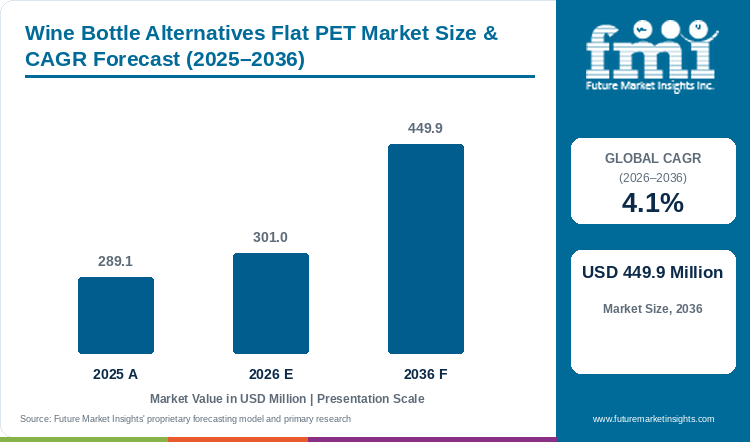
Wineries and food brands will spend USD 301 Million on flat PET and other wine bottle alternatives in 2026, against USD 289.1 Million in 2025. An estimated 4.1% CAGR takes the forecast valuation to USD 449.9 Million by 2036.
Sales of wine bottle alternatives flat PET are projected to rise at 4.1% CAGR between 2026 and 2036, as per FMI. Industry value grows from USD 289.1 Million in 2025 to USD 301.0 Million in 2026 and is projected to reach USD 449.9 Million by 2036, adding USD 148.9 Million. Increasing pressure on heavy glass from packaging rules is supporting the demand for flat PET wine bottles. New EU packaging rules began to apply on 12 August 2026 and will require all packaging on the EU market to be recyclable from 2030, according to the European Commission [1]. In the UK, plastic packaging components carrying under 30% recycled plastic are taxed at GBP 228.82 per tonne from 1 April 2026 [2].
Due to this, everyday 75cl still wines in supermarkets and own-label ranges are expected to switch first. The UAE is projected at 5.6% CAGR and Japan at 3.5% through 2036. Sales of PET bottles are also projected to rise from USD 48.0 Billion to USD 69.6 Billion. FMI predicts that premium and oxidation-sensitive wines will move last, as each wine needs oxygen and closure testing before a winery gives up glass.
Key Takeaways
- Notable companies in the wine bottle alternatives flat PET market include Amcor, Alpla, Ardagh Group, Ball Corporation, CANPACK, Crown Holdings and Berry Global.
- Based on format type, standard formats are projected to account for 41% in 2026, owing to low conversion cost on existing filling lines.
- By material, PET and rPET are estimated to hold 38% in 2026, as lighter bottles cut freight cost and carry recycled content.
- The UAE is projected at 5.6% CAGR through 2036, followed by Saudi Arabia at 5.3%, as Gulf retailers are asking for recyclable wine packaging.
Analyst Perspective
“Everyday 75cl still wine in supermarket and own-label ranges will give flat PET the biggest opportunity through 2036. Converters able to supply food-grade rPET with a proven oxygen barrier on existing filling lines will receive the multi-year retail contracts.”
- Nandini Roy Choudhury, Principal Consultant, Future Market Insights
How is the Wine Bottle Alternatives Flat PET Market Segmented?
The wine bottle alternatives flat PET market is segmented into format type, material, capacity, end use, sales channel and region.
As per FMI, the market is segmented by format type into standard formats, recyclable-optimized formats, premium and branded formats, and custom-engineered formats. By material, the market is segmented into PET and rPET, PP and HDPE, metal, and glass and other. By capacity, the market is segmented into below 250 ml, 250-750 ml, 750 ml-2 L and above 2 L. By end use, the market is segmented into food, beverage, home and personal care, and pharma and industrial. By sales channel, the market is segmented into direct brand contracts, distributors and online B2B. The regional analysis covers seven regions and more than 25 countries.
Why Do Standard Formats Lead the Wine Bottle Alternatives Flat PET Market by Format Type?
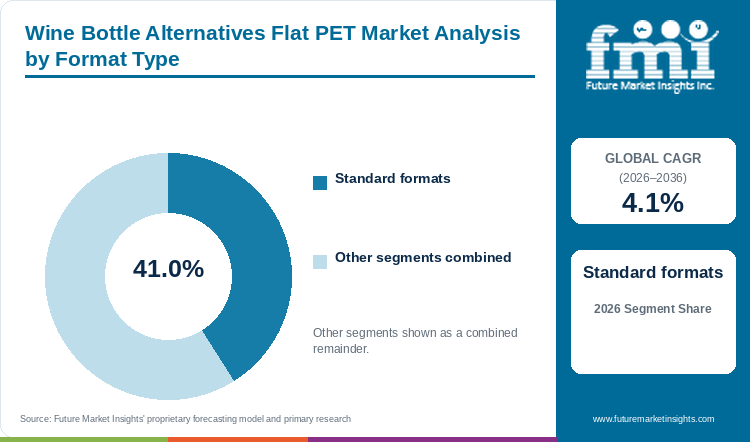
By format type, standard formats will account for 41% of market share in 2026.
Increasing trials of lighter bottles by wineries and food brands are supporting the demand for standard formats. Fillers can run these bottles with existing closures, cappers and case packs, due to which conversion cost stays lowest for a first trial or a volume program. Recyclable-optimized formats are growing at a slower pace, as new resin grades and recyclability tests add time. Premium and branded formats carry higher mold and decoration costs, and custom-engineered formats need dedicated tooling and longer validation. However, shelf-life results for each wine will decide the speed at which trials turn into regular orders.
- Standard formats are projected to account for 41% of demand by format type in 2026, owing to low conversion cost on existing filling lines.
- In December 2025, Alpla and the German start-up weinton presented a PET wine bottle of about 50 grams with a ultra-thin silicon oxide barrier layer [3].
Why Do PET and rPET Lead the Wine Bottle Alternatives Flat PET Market by Material?
Based on material, PET and rPET will account for 38% of market share in 2026.
Wineries are buying more PET and rPET bottles to cut weight and freight cost, supporting the demand for flat PET in this material. Converters run PET on mature stretch blow molding lines and draw recycled content from the feedstock pool tracked in the recycled PET packaging market, due to which brands can make a recycled-content claim at low added cost. PP and HDPE are used in smaller volumes, as clarity and gas barrier are weaker for wine. Metal gives stronger oxygen and light protection at a higher unit cost, and wineries need to requalify closures. Glass and other materials keep shelf familiarity, but heavier units raise freight cost per pallet. However, barrier performance on oxygen-sensitive wines will decide the pace of switching from glass.
- PET and rPET are estimated to hold 38% of demand by material in 2026, supported by lower freight weight and access to recycled content.
- In January 2026, Packamama began work with Avantium on a flat wine bottle in PEF, a plant-based polymer with a stronger gas barrier than PET, supported by AUD 1 million in Australian government funding [4].
Why Does the 250-750 ml Band Lead the Wine Bottle Alternatives Flat PET Market by Capacity?
In 2026, the 250-750 ml band will account for 37% of market share by capacity.
The 75cl bottle is widely used as the reference unit for shelf pricing, case packing and pallet planning, supporting the demand for flat bottles in the 250-750 ml band. Retailers and wineries plan whole ranges around this size, due to which most switching projects start with the standard pour across the wider wine packaging market. Packs below 250 ml serve single-serve and travel occasions in smaller numbers. The 750 ml-2 L and above 2 L bands are growing at a slower pace, as bag-in-box and bulk formats carry lower bottle counts. Glass suppliers are also cutting weight in this band, as Ardagh Group launched a 300 g, 75cl glass wine bottle in July 2025 for high-speed filling lines [5]. However, pallet efficiency against lightweight glass will decide flat PET gains in this band.
- The 250-750 ml band is expected to account for 37% of demand by capacity in 2026, owing to the standard 75cl pour used for shelf pricing and case packing.
- Flat 75cl formats are expected to gain the most volume in retail channels paying freight on a per-pallet basis.
Why Does Food Lead the Wine Bottle Alternatives Flat PET Market by End Use?
By end use, food will account for 36% of market share in 2026.
Sauces, syrups and other liquid foods are widely filled on the same PET and rPET bottle platforms covered in the PET packaging market, supporting the demand for these bottles in food. Food brands fill at high and steady volume, due to which converters holding food-grade rPET clearance receive the widest order book from this group. Beverage use, including wine, is growing at a slower pace, as each product needs oxygen and closure validation before scale orders. Home and personal care buyers specify different resin grades and decoration, and pharma and industrial users order smaller batches with more documentation. However, food-contact approval for recycled resin will decide the volume each converter can supply.
- Food is projected to account for 36% of demand by end use in 2026, owing to sauces, syrups and other liquid foods filled on shared bottle lines.
- Wine programs are expected to benefit from food-grade rPET clearances first obtained for sauces and syrups.
Why Do Direct Brand Contracts Lead the Wine Bottle Alternatives Flat PET Market by Sales Channel?
Based on sales channel, direct brand contracts will account for 50% of market share in 2026.
Brand owners buying custom flat bottles are supporting the demand for direct brand contracts, as molds, barrier trials and line validation are agreed with the converter before the first order. Each new shape needs joint testing on the brand's own filling line, due to which brands prefer to buy straight from the converter. Distributors receive repeat orders mainly after a shape is qualified, and online B2B serves small wineries buying stock formats in low volume. Local production is also supporting the direct model, as Packamama started making flat rPET wine bottles in Cape Town with Safripol resin and Polyoak, reaching a six-figure volume after Cape Wine 2025 [6]. A similar contract pattern is seen across the beverage packaging market. However, the time needed for line trials will decide the speed of new contracts.
- Direct brand contracts are projected to hold 50% of demand by sales channel in 2026, supported by supplier-to-brand validation work before the first commercial order.
- In January 2026, Packamama reported that the eco-flat bottle was available across ten international markets [6].
What are the Drivers, Restraints, and Opportunities in the Wine Bottle Alternatives Flat PET Market?
According to FMI, packaging regulation is pushing demand, oxygen and food-contact validation is slowing conversion, and barrier-coated rPET bottles with standard closures will open the largest revenue pool till 2036.
- Driver: Recyclability and recycled-content rules are pricing heavy or hard-to-recycle wine packaging into procurement decisions, due to which retailers are reviewing glass ranges.
- Restraint: Each wine needs oxygen, light and closure validation before a filler switches away from glass, and this testing slows conversion.
- Opportunity: Barrier-coated rPET bottles designed for deposit systems can serve wineries looking for lower weight and lower packaging tax.
Deposit systems are opening a new route for PET wine bottles in Germany. The Alpla and weinton bottle is certified for the German DPG deposit system, letting wine enter the national return stream for the first time, and Alpla put the lifecycle CO2 saving at up to 49% against a 450-gram glass bottle [3]. France is also working on collection, with a voluntary and territorialized deposit proposed in September 2026 to move plastic bottle collection toward the EU target of 90% by 2029 [7].
Key challenges in the market remain at the qualification stage, as a light and recyclable bottle can still fail a shelf-life test for an oxidation-sensitive wine. Pilot runs are turning into standing orders slowly, and suppliers offering barrier data, migration evidence and line trials together are expected to shorten this cycle.
Which Country CAGRs are Profiled in the Wine Bottle Alternatives Flat PET Market?
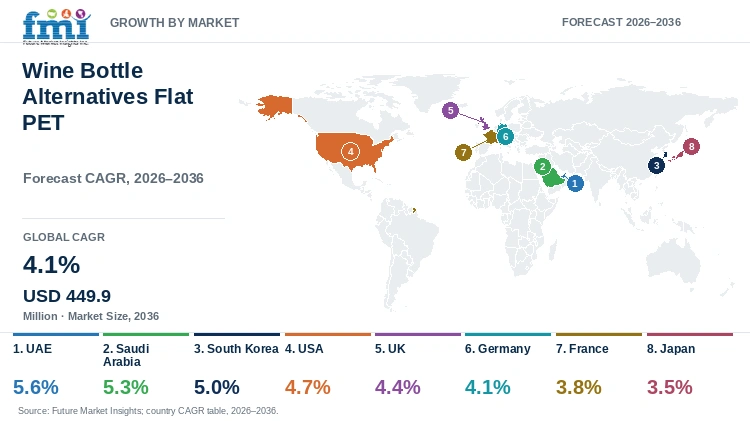
| Country | CAGR, 2026 to 2036 |
|---|---|
| UAE | 5.6% |
| Saudi Arabia | 5.3% |
| South Korea | 5% |
| USA | 4.7% |
| UK | 4.4% |
| Germany | 4.1% |
| France | 3.8% |
| Japan | 3.5% |
How do Country-level CAGRs Compare in the Wine Bottle Alternatives Flat PET Market?
Demand for flat PET wine bottles across the eight profiled countries falls into three growth bands, as per FMI's analysis. South Korea, Saudi Arabia and the UAE are projected at 5% or above, the USA, UK and Germany between 4.1% and 4.7%, and France and Japan below 4%. Large wine-trading countries in the slower bands will continue to generate bigger revenue, as Gulf import markets grow from a small base.
- UAE leads at 5.6% as single-use plastic rules push retailers toward recyclable formats.
- Saudi Arabia follows at 5.3%, with transport protection steering supplier selection.
- Recycled-content policy for beverage PET will carry South Korea to 5%.
- Growth of 4.7% in the USA will track state recycled-content rules.
- Demand in the UK is projected to rise at 4.4% under a tax that rewards recycled plastic.
- Germany grows at 4.1% as deposit access opens up for PET wine bottles.
- France will expand at 3.8% as collection policy shapes recyclability claims.
- Japan grows slowest at 3.5%, guided by design-for-recycling certification.
The full report carries CAGR estimates past these eight profiled markets, covering over 25 national and grouped markets within seven regions.
Country Outlook
- The UAE is projected at 5.6% CAGR, the highest in the profiled group, owing to Gulf import channels. Single-use plastic rules are pushing importers and retailers to document recyclability, due to which flat PET bottles with a clear recycled-content record are expected to gain listings faster.
- Saudi Arabia is forecast at 5.3% CAGR through 2036, as heat and long transport routes set the packaging standard. PET suppliers showing heat and transport test data are expected to convert more trials into supply contracts.
- South Korea is projected at 5% CAGR, as recycled raw material policy for beverage PET bottles is making rPET supply a qualification item for buyers. Wine and food formats will still need product-specific barrier and safety validation before scale orders follow.
- Demand in the USA is projected at 4.7% CAGR till 2036, owing to two layers of rules. State recycled-content standards for plastic beverage containers are raising rPET requirements, and federal food-contact review asks recycled resin suppliers to prove contaminant control.
- The UK is projected at 4.4% CAGR through 2036, as a direct tax signal favors recycled content. Plastic packaging components below 30% recycled plastic carry a charge of GBP 228.82 per tonne from 1 April 2026 [2]. Packamama counts The Wine Society and Aldi among current wine clients in the country [4].
- Germany is projected at 4.1% CAGR, as deposit access is opening a new route for PET wine packaging. The Alpla and weinton bottle carries DPG certification, the first time wine can join the German deposit return system [3].
- France is projected at 3.8% CAGR, as collection performance is shaping packaging policy. The government proposed a voluntary, territorialized deposit for plastic bottles in September 2026 to approach the 90% collection target set for 2029 [7].
- Japan is projected at 3.5%, the slowest in the group, and certification is becoming the main selling point for PET bottles in the country. METI announced the first product design certifications under the Plastic Resource Circulation Act in February 2026, including a beverage PET bottle made from fully recycled material [8].
Who are the Notable Companies in the Wine Bottle Alternatives Flat PET Market?
Competition among the PET, metal and glass suppliers profiled by FMI, including Amcor, Alpla, Ardagh Group, Ball Corporation, Crown Holdings and CANPACK, turns on barrier performance, bottle weight and filling-line validation.
Wine bottle alternatives are supplied from three material camps, due to which supply is fragmented at market level and tiered within each camp around a few global converters. PET converters are competing on barrier technology and line fit, as the 50-gram Alpla bottle with a silicon oxide coating shows [3]. Metal suppliers are offering oxygen and light protection, with CANPACK formalizing a June 2026 collaboration with Canovation on the resealable CanReseal can end [9]. Glass suppliers are defending share through lighter bottles, as Ardagh Group brought a 75cl wine bottle down to 300 g in July 2025 [5]. Wineries repeat oxygen, closure and filling tests before changing supplier, owing to which switching remains slow. Converters holding in-house barrier coatings and food-grade rPET supply are expected to hold the strongest pricing power, and Berry Global is now part of Amcor. Partnerships are also opening new materials, as Packamama's PEF bottle work with Avantium shows [4]. However, each newly certified bottle in deposit markets will give retailers a second qualified source, and competition is expected to increase through 2036.
- PET and rPET Bottle Platforms: Amcor, Berry Global, Alpla, Silgan Holdings and Greiner Packaging supply PET and rPET bottles, barrier systems and custom rigid containers.
- Metal and Glass Beverage Alternatives: Ball Corporation, Crown Holdings, CANPACK and Ardagh Group offer aluminum bottles, wine cans and lightweight glass.
- Food-Led rPET Rigid Packaging: Pactiv Evergreen brings PET and rPET food packaging capability adjacent to wine bottle formats.
Competitive Benchmarking
| Company | Format Engineering | PET and rPET Capability | Wine and Beverage Relevance | Geographic Reach |
|---|---|---|---|---|
| Amcor | High | High | High | North America, Europe and global operations |
| Berry Global | High | High | Medium | Global network, part of Amcor |
| Alpla | High | High | High | Global manufacturing footprint |
| Silgan Holdings | Medium | High | Medium | North America, Europe and Asia |
| Greiner Packaging | Medium | High | Medium | Europe, North America and selected international markets |
| Ball Corporation | High | Low | High | North America, Europe, South America and selected Asia and EMEA markets |
| Crown Holdings | High | Low | High | Americas, Europe, Middle East, Africa and Asia-Pacific |
| CANPACK | High | Low | High | Europe, Americas, Asia and Middle East |
| Ardagh Group | High | Low | High | Europe and North America |
| Pactiv Evergreen | Medium | Medium | Low | North America |
Scoring basis: Format Engineering is High for documented beverage bottle, can or comparable custom rigid formats and Medium for adjacent rigid formats. PET and rPET Capability is High for documented food or beverage PET with substantial recycled content and Medium for rPET in adjacent rigid packaging. Wine and Beverage Relevance is High for direct wine or beverage alternative formats and Medium for adjacent beverage or liquid-food packaging. A Low rating marks limited public documentation for the criterion.
Key Developments
- In July 2025, Ardagh Group launched a 300 g, 75cl glass wine bottle built for high-speed filling lines, setting a lower weight benchmark for PET alternatives [5].
- In December 2025, Alpla and weinton introduced a PET wine bottle of about 50 grams with a silicon oxide barrier and DPG certification for the German deposit system [3].
- In June 2026, CANPACK and Canovation formalized a collaboration to move the CanReseal aluminum can end toward pilot production and commercial launch [9].
Key Players
PET and rPET Bottle Platforms
- Amcor
- Berry Global
- Alpla
- Silgan Holdings
- Greiner Packaging
Metal and Glass Beverage Alternatives
- Ball Corporation
- Crown Holdings
- CANPACK
- Ardagh Group
Food-Led rPET Rigid Packaging
- Pactiv Evergreen
Report Scope and Methodology
| Coverage field | Report scope |
|---|---|
| Market breakdown | 5 categories plus region: Format Type (Standard formats, Recyclable-optimized formats, Premium & branded formats, Custom-engineered formats), Material (PET & rPET, PP & HDPE, Metal, Glass & other), Capacity (250-750 ml, Below 250 ml, 750 ml-2 L, Above 2 L), End Use (Food, Beverage, Home & personal care, Pharma & industrial), Sales Channel (Direct brand contracts, Distributors, Online B2B), and Region |
| Quantitative units | USD Million |
| Market definition | Revenue from flat or profile-optimized PET and rPET bottles and directly comparable rigid alternative formats, counted at the packaging-unit level across the report segments. Filled-product revenue, stand-alone filling or logistics services, recycling services, and adjacent or substitute package revenue sit outside this definition. |
| Regions covered | North America, Latin America, Western Europe, Eastern Europe, East Asia, South Asia and Pacific, Middle East and Africa |
| Countries covered | Over 25 national and grouped markets, with the USA, Germany, France, the UK, Japan, South Korea, Saudi Arabia and the UAE profiled in detail |
| Key companies profiled | Amcor, Ball Corporation, Silgan Holdings, Pactiv Evergreen, Ardagh Group, Crown Holdings, CANPACK, Alpla, Greiner Packaging, and Berry Global, selected from a wider field of bottle, can and rigid packaging suppliers |
| Forecast period | 2026 to 2036 |
| Approach | Bottle volumes, material pricing and supplier revenue indicators triangulated by FMI from primary interviews and secondary sources. |
Research Methodology
| Method | Approach |
|---|---|
| Primary research | Interviews with wineries, bottle converters, resin and barrier suppliers, food and beverage brand owners, distributors and procurement teams test purchase drivers, approval requirements and pricing, plus the proof a winery asks for before a bottle trial turns into repeat orders. |
| Desk research | The analysis reviews government and regulatory publications, standards, technical literature, company filings, product information and corporate announcements. Sources are retained for relevance, publication date, geographic coverage and fit with the defined market scope. |
| Market sizing and forecasting | Baseline value is built up through segment splits, bottle prices and unit volumes, format adoption, supplier participation and demand conditions in each country. Regulation, technology adoption, purchasing cycles and supply availability shape the forecast path. |
| Data validation | Public data, company activity, trade patterns and interview findings serve as cross-checks on each estimate. Adjacent categories, overlapping revenues and unverified claims are removed so no revenue is counted twice across segments or countries. |
Wine Bottle Alternatives Flat PET Market by Segments
Wine Bottle Alternatives Flat PET Market Segmented by Format Type
- Standard formats
- Recyclable-optimized formats
- Premium & branded formats
- Custom-engineered formats
Wine Bottle Alternatives Flat PET Market Segmented by Material
- PET & rPET
- PP & HDPE
- Metal
- Glass & other
Wine Bottle Alternatives Flat PET Market Segmented by Capacity
- 250-750 ml
- Below 250 ml
- 750 ml-2 L
- Above 2 L
Wine Bottle Alternatives Flat PET Market Segmented by End Use
- Food
- Beverage
- Home & personal care
- Pharma & industrial
Wine Bottle Alternatives Flat PET Market Segmented by Sales Channel
- Direct brand contracts
- Distributors
- Online B2B
Wine Bottle Alternatives Flat PET Market Segmented by Region
- North America
- Latin America
- Western Europe
- Eastern Europe
- East Asia
- South Asia and Pacific
- Middle East and Africa
Research Sources and Bibliography
- [1] European Commission (2026, August 11). New EU packaging rules start to apply, including restrictions on PFAS in food-contact packaging.
- [2] HM Revenue & Customs (2026, February 12). Plastic Packaging Tax: steps to take.
- [3] ALPLA (2025, December 22). Innovative barrier technology for PET wine bottles.
- [4] The Drinks Business (2026, January 19). Packamama plumps for PEF over PET in industry first.
- [5] Glass Online (2025, July 23). Ardagh Glass launches its lightest glass wine bottle at just 300g.
- [6] Packaging Insights (2026, January 5). Packamama expands polymer wine bottle production to South Africa.
- [7] French Ministry for Ecological Transition (2026, September 4). Plan plastique: the Government proposes a voluntary and territorialized deposit for plastic bottles.
- [8] Ministry of Agriculture, Forestry and Fisheries and Ministry of Economy, Trade and Industry of Japan (2026, February 10). First certifications under the design certification system of the Plastic Resource Circulation Act.
- [9] Canovation and CANPACK (2026, June 2). Canovation and CANPACK Formalize Collaboration to Accelerate CanReseal Toward Commercial Launch.
This bibliography is provided for reader reference and is not exhaustive. The full report contains the complete reference list and detailed citations.
This Report Answers
- What revenue will flat PET and other wine bottle alternatives generate in 2026, and what total value is expected by 2036?
- Which regulatory and cost pressures will continue to move wineries away from heavy glass bottles?
- Why will standard bottle shapes carry the largest format type share in 2026 as fillers keep existing closures?
- Why will PET and rPET lead the Material category, and what role will barrier technology play in adoption?
- Which growth rates will Japan, France, Germany, the UK, the USA and South Korea post against the Gulf pace of Saudi Arabia and the UAE by 2036?
- What effect will deposit systems and packaging taxes have on the economics of flat rPET wine bottles?
- Why will oxygen, closure and food-contact validation slow supplier switching?
- Which barrier, closure and food-contact evidence will wineries request from a flat PET or other alternative bottle supplier before approval?
Frequently Asked Questions
How Big Is the Wine Bottle Alternatives Flat PET Market Expected to Be in 2026?
Flat PET and other alternative wine bottles will generate USD 301.0 Million in 2026, compared with USD 289.1 Million in 2025, as FMI estimates show. By 2036, sales will rise to USD 449.9 Million as wineries and food brands keep trialing lighter containers.
What Is the CAGR of the Wine Bottle Alternatives Flat PET Market from 2026 to 2036?
Flat PET and alternative wine formats will grow on a 4.1% CAGR over the 2026 to 2036 period. Barrier, closure and filling-line validation will govern the speed of adoption, since wineries will shift volume only after a bottle protects the wine across a full shelf life.
Which Format Type Holds the Largest Share of the Wine Bottle Alternatives Flat PET Market?
Standard formats will lead with 41% of market share by format type in 2026. Familiar shapes will keep standard closures and existing bottling routines in place, lowering conversion cost for fillers.
Which Material Leads the Wine Bottle Alternatives Flat PET Market?
PET and rPET bottles will lead with 38% of market share by material in 2026. Low package weight and recycled-content potential will support the position, and barrier performance will stay specific to each wine or food application.
Which Country Is Expected to Grow Fastest in the Wine Bottle Alternatives Flat PET Market?
Flat PET bottle demand in the UAE will post the quickest rise, a 5.6% CAGR till 2036, with Saudi Arabia next at 5.3% and South Korea third at 5%. Japan, at 3.5%, will post the slowest rate of the eight profiled countries.
What Notable Restraint Affects the Wine Bottle Alternatives Flat PET Market?
Key challenges will include oxygen and light protection, closure fit and food-contact evidence for recycled resin. A light and recyclable bottle will still need to pass each buyer's shelf-life and compliance checks before a pilot becomes a standing order.
Which Are the Key Companies in the Wine Bottle Alternatives Flat PET Market?
Bottle, can and rigid pack suppliers covered by FMI include Amcor, Ball Corporation, Silgan Holdings, Pactiv Evergreen, Ardagh Group, Crown Holdings, CANPACK, Alpla, Greiner Packaging and Berry Global. The suppliers fall into three groups, covering PET and rPET bottle platforms, metal and glass alternatives, and food-led rPET rigid packaging.
Preview the report firsthand - request a free sample
Get SampleGet the brochure for pricing and purchase details.
Get PDFTable of Content
- Key Takeaways
- Market Size and CAGR
- Top Growth Driver
- Fastest Growing Segment
- Leading Region
- Key Companies
- Emerging Opportunities
- Executive Summary
- Global Market Outlook
- Demand-side Trends
- Supply-side Trends
- Technology Roadmap Analysis
- Analysis and Recommendations
- Analyst Perspective (What is happening? Why now? What should investors know?)
- Key Questions Answered
- How large is the market?
- What is the CAGR?
- What are key trends?
- Which region dominates?
- Who are the leaders?
- Market Overview
- Market Coverage / Taxonomy
- Market Definition / Scope / Limitations
- Research Methodology
- Chapter Orientation
- Analytical Lens and Working Hypotheses
- Market Structure, Signals, and Trend Drivers
- Benchmarking and Cross-market Comparability
- Market Sizing, Forecasting, and Opportunity Mapping
- Research Design and Evidence Framework
- Desk Research Programme (Secondary Evidence)
- Expert Input and Fieldwork (Primary Evidence)
- Tooling, Models, and Reference Databases
- Data Engineering and Model Build
- Quality Assurance and Audit Trail
- Market Background
- Market Dynamics (Drivers, Restraints, Opportunity, Trends)
- Scenario Forecast (Optimistic, Likely, Conservative)
- Impact Analysis
- AI Impact
- Sustainability Impact
- Regulatory Impact
- Technology Impact
- Consumer / Buyer Analysis
- Purchase Drivers
- Adoption Barriers
- Buyer Journey
- Opportunity Map Analysis
- Product Life Cycle Analysis
- Supply Chain Analysis
- Investment Feasibility Matrix
- Value Chain Analysis
- PESTLE and Porter's Analysis
- Regulatory Landscape
- Regional Parent Market Outlook
- Production and Consumption Statistics
- Import and Export Statistics
- Global Market Analysis and Forecast, 2021 to 2036
- Historical Market Size Value (USD Million) Analysis, 2021 to 2025
- Current and Future Market Size Value (USD Million) Projections, 2026 to 2036
- Y-o-Y Growth Trend Analysis
- Absolute $ Opportunity Analysis
- Global Market Pricing Analysis, 2021 to 2036
- Global Market Analysis and Forecast, By Format Type, 2021 to 2036
- Introduction / Key Findings
- Historical Market Size Value (USD Million) Analysis By Format Type, 2021 to 2025
- Current and Future Market Size Value (USD Million) Analysis and Forecast By Format Type, 2026 to 2036
- Standard formats
- Recyclable-optimized formats
- Premium & branded formats
- Custom-engineered formats
- Y-o-Y Growth Trend Analysis By Format Type, 2021 to 2025
- Absolute $ Opportunity Analysis By Format Type, 2026 to 2036
- Global Market Analysis and Forecast, By Material, 2021 to 2036
- Introduction / Key Findings
- Historical Market Size Value (USD Million) Analysis By Material, 2021 to 2025
- Current and Future Market Size Value (USD Million) Analysis and Forecast By Material, 2026 to 2036
- PET & rPET
- PP & HDPE
- Metal
- Glass & other
- Y-o-Y Growth Trend Analysis By Material, 2021 to 2025
- Absolute $ Opportunity Analysis By Material, 2026 to 2036
- Global Market Analysis and Forecast, By Capacity, 2021 to 2036
- Introduction / Key Findings
- Historical Market Size Value (USD Million) Analysis By Capacity, 2021 to 2025
- Current and Future Market Size Value (USD Million) Analysis and Forecast By Capacity, 2026 to 2036
- 250-750 ml
- Below 250 ml
- 750 ml-2 L
- Above 2 L
- Y-o-Y Growth Trend Analysis By Capacity, 2021 to 2025
- Absolute $ Opportunity Analysis By Capacity, 2026 to 2036
- Global Market Analysis and Forecast, By End Use, 2021 to 2036
- Introduction / Key Findings
- Historical Market Size Value (USD Million) Analysis By End Use, 2021 to 2025
- Current and Future Market Size Value (USD Million) Analysis and Forecast By End Use, 2026 to 2036
- Food
- Beverage
- Home & personal care
- Pharma & industrial
- Y-o-Y Growth Trend Analysis By End Use, 2021 to 2025
- Absolute $ Opportunity Analysis By End Use, 2026 to 2036
- Global Market Analysis and Forecast, By Sales Channel, 2021 to 2036
- Introduction / Key Findings
- Historical Market Size Value (USD Million) Analysis By Sales Channel, 2021 to 2025
- Current and Future Market Size Value (USD Million) Analysis and Forecast By Sales Channel, 2026 to 2036
- Direct brand contracts
- Distributors
- Online B2B
- Y-o-Y Growth Trend Analysis By Sales Channel, 2021 to 2025
- Absolute $ Opportunity Analysis By Sales Channel, 2026 to 2036
- Global Market Analysis and Forecast, By Region, 2021 to 2036
- Introduction
- Historical Market Size Value (USD Million) Analysis By Region, 2021 to 2025
- Current Market Size Value (USD Million) Analysis and Forecast By Region, 2026 to 2036
- North America
- Latin America
- Western Europe
- Eastern Europe
- East Asia
- South Asia and Pacific
- Middle East and Africa
- Market Attractiveness Analysis By Region
- North America Market Analysis and Forecast, By Country, 2021 to 2036
- Historical Market Size Value (USD Million) Trend Analysis By Market Taxonomy, 2021 to 2025
- Market Size Value (USD Million) Forecast By Market Taxonomy, 2026 to 2036
- By Country
- By Format Type
- By Material
- By Capacity
- By End Use
- By Sales Channel
- Market Attractiveness Analysis
- By Country
- By Format Type
- By Material
- By Capacity
- By End Use
- By Sales Channel
- Key Takeaways
- Latin America Market Analysis and Forecast, By Country
- Historical Market Size Value (USD Million) Trend Analysis By Market Taxonomy, 2021 to 2025
- Market Size Value (USD Million) Forecast By Market Taxonomy, 2026 to 2036
- By Country
- By Format Type
- By Material
- By Capacity
- By End Use
- By Sales Channel
- Market Attractiveness Analysis
- By Country
- By Format Type
- By Material
- By Capacity
- By End Use
- By Sales Channel
- Key Takeaways
- Western Europe Market Analysis and Forecast, By Country
- Historical Market Size Value (USD Million) Trend Analysis By Market Taxonomy, 2021 to 2025
- Market Size Value (USD Million) Forecast By Market Taxonomy, 2026 to 2036
- By Country
- By Format Type
- By Material
- By Capacity
- By End Use
- By Sales Channel
- Market Attractiveness Analysis
- By Country
- By Format Type
- By Material
- By Capacity
- By End Use
- By Sales Channel
- Key Takeaways
- Eastern Europe Market Analysis and Forecast, By Country
- Historical Market Size Value (USD Million) Trend Analysis By Market Taxonomy, 2021 to 2025
- Market Size Value (USD Million) Forecast By Market Taxonomy, 2026 to 2036
- By Country
- By Format Type
- By Material
- By Capacity
- By End Use
- By Sales Channel
- Market Attractiveness Analysis
- By Country
- By Format Type
- By Material
- By Capacity
- By End Use
- By Sales Channel
- Key Takeaways
- East Asia Market Analysis and Forecast, By Country
- Historical Market Size Value (USD Million) Trend Analysis By Market Taxonomy, 2021 to 2025
- Market Size Value (USD Million) Forecast By Market Taxonomy, 2026 to 2036
- By Country
- By Format Type
- By Material
- By Capacity
- By End Use
- By Sales Channel
- Market Attractiveness Analysis
- By Country
- By Format Type
- By Material
- By Capacity
- By End Use
- By Sales Channel
- Key Takeaways
- South Asia and Pacific Market Analysis and Forecast, By Country
- Historical Market Size Value (USD Million) Trend Analysis By Market Taxonomy, 2021 to 2025
- Market Size Value (USD Million) Forecast By Market Taxonomy, 2026 to 2036
- By Country
- By Format Type
- By Material
- By Capacity
- By End Use
- By Sales Channel
- Market Attractiveness Analysis
- By Country
- By Format Type
- By Material
- By Capacity
- By End Use
- By Sales Channel
- Key Takeaways
- Middle East and Africa Market Analysis and Forecast, By Country
- Historical Market Size Value (USD Million) Trend Analysis By Market Taxonomy, 2021 to 2025
- Market Size Value (USD Million) Forecast By Market Taxonomy, 2026 to 2036
- By Country
- By Format Type
- By Material
- By Capacity
- By End Use
- By Sales Channel
- Market Attractiveness Analysis
- By Country
- By Format Type
- By Material
- By Capacity
- By End Use
- By Sales Channel
- Key Takeaways
- Key Countries Market Analysis
- UAE
- Pricing Analysis
- Market Share Analysis, 2025
- By Format Type
- By Material
- By Capacity
- By End Use
- By Sales Channel
- Saudi Arabia
- Pricing Analysis
- Market Share Analysis, 2025
- By Format Type
- By Material
- By Capacity
- By End Use
- By Sales Channel
- South Korea
- Pricing Analysis
- Market Share Analysis, 2025
- By Format Type
- By Material
- By Capacity
- By End Use
- By Sales Channel
- USA
- Pricing Analysis
- Market Share Analysis, 2025
- By Format Type
- By Material
- By Capacity
- By End Use
- By Sales Channel
- UK
- Pricing Analysis
- Market Share Analysis, 2025
- By Format Type
- By Material
- By Capacity
- By End Use
- By Sales Channel
- Germany
- Pricing Analysis
- Market Share Analysis, 2025
- By Format Type
- By Material
- By Capacity
- By End Use
- By Sales Channel
- France
- Pricing Analysis
- Market Share Analysis, 2025
- By Format Type
- By Material
- By Capacity
- By End Use
- By Sales Channel
- Japan
- Pricing Analysis
- Market Share Analysis, 2025
- By Format Type
- By Material
- By Capacity
- By End Use
- By Sales Channel
- UAE
- Market Structure Analysis
- Competition Dashboard
- Competition Benchmarking
- Market Share Analysis of Top Players
- By Regional
- By Format Type
- By Material
- By Capacity
- By End Use
- By Sales Channel
- Emerging Startups
- Innovation Benchmarking
- Competition Analysis
- Competition Deep Dive
- Amcor
- Overview
- Product Portfolio
- Profitability by Market Segments
- Sales Footprint
- Strategy Overview
- Marketing Strategy
- Product Strategy
- Channel Strategy
- Berry Global
- Alpla
- Silgan Holdings
- Greiner Packaging
- Ball Corporation
- Crown Holdings
- CANPACK
- Ardagh Group
- Pactiv Evergreen
- Amcor
- Case Studies
- Success Stories
- Recent Developments
- Competition Deep Dive
- Assumptions & Acronyms Used


