

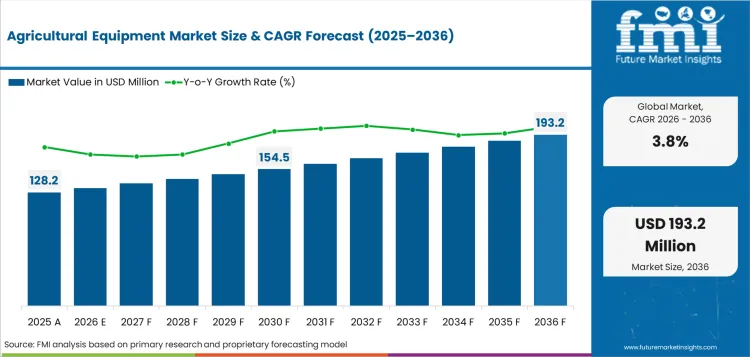
- Market Size (2026)
- USD 82.6 Bn
- Forecast (2036)
- USD 132.0 Bn
- CAGR (2026 to 2036)
- 4.8%
How big is Agricultural Equipment Market in 2026?
USD 82.6 billion in 2026 and USD 132.0 billion by 2036 at a 4.8% CAGR.
Agricultural equipment demand is projected to rise at a 4.8% CAGR between 2026 and 2036 as farms protect narrow operating windows with higher machine utilization. USDA reported in May 2025 that farm operators paid hired workers USD 19.52 per hour during the April reference week, up 3% from 2024. Higher labor expense strengthens the case for equipment that completes more field work per operator without extending planting or harvesting schedules.
Capital support changes the conversion rate between operating need and an equipment order across otherwise comparable farm systems. Defra made GBP 50 million available under the February 2026 Farming Equipment and Technology Fund guidance with GBP 20 million allocated to productivity equipment and technology. Grant-backed UK purchases therefore face a different initial-cost test than USA replacement purchases because farm liquidity carries more weight in unsupported transactions.
Key Takeaways of Agricultural Equipment Market
- Demand is supported by replacement needs and labor-saving investments that protect planting, crop-care, and harvesting schedules during short field windows.
- Based on product type, tractors are projected to account for 49.0% in 2026 due to implement compatibility that spreads capital cost across recurring field tasks.
- By power rating, below 30 HP is estimated to hold 18.0% in 2026 owing to compact dimensions that fit small plots and specialty crops.
- In 2026, diesel / ICE is expected to lead propulsion with 87.0% share because established refueling supports long-duty-cycle operating practices.
- High acquisition cost restrains replacement where annual utilization cannot support financing, maintenance, and depreciation across a short operating season.
- Some of the key players in this market include Deere & Company, CNH Industrial N.V., AGCO Corporation, CLAAS KGaA mbH, Kubota Corporation, Mahindra & Mahindra Ltd., Yanmar Holdings Co., Ltd., and SDF S.p.A.
Analyst Perspective
"Equipment offers should be judged by completed field work per hour and dealer response time rather than headline machine specifications. Commercial value rises when a tractor or harvester protects seasonal capacity without forcing farms into underused horsepower or unsupported digital systems."
- Nikhil Kaitwade, Principal Consultant, Future Market Insights
How is the Agricultural Equipment Market segmented?
The agricultural equipment market is segmented by product type, power rating, propulsion, farm size and region.
Product type includes tractors, harvesters, planting equipment, tillage equipment, hay & forage, and others. Power rating covers below 30 HP, 30-70 HP, 71-130 HP, and above 130 HP. Propulsion includes diesel / ICE, electric, and hybrid / alternative systems. Farm size comprises small, medium, and large operations, while regional coverage follows the report taxonomy.
Why do tractors lead the product type category?
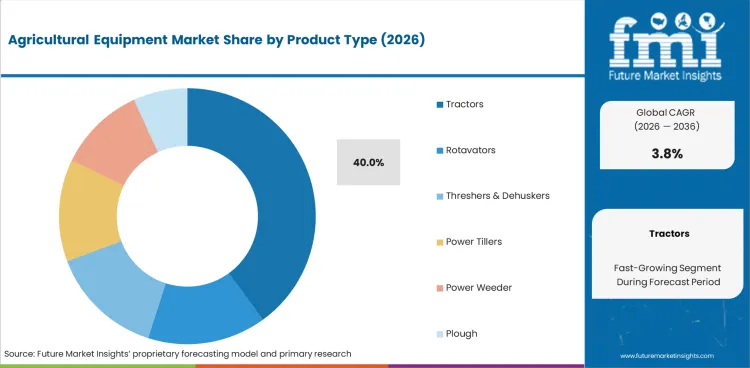
Tractors spread capital cost across tillage and hauling while supporting planting work and other recurring implement tasks. Mounted agricultural sprayers extend the powered platform into seasonal crop-care windows and increase annual machine utilization. Agricultural tractors also carry guidance and autonomy upgrades that help farms protect field capacity during labor-constrained operations.
- By product type, tractors are forecast to represent 49.0% in 2026 driven by interchangeable implements that raise annual machine utilization across crop cycles.
- Deere & Company revealed an autonomous 9RX and 5ML orchard tractor in January 2025, extending second-generation autonomy across large-scale tillage and high-value crop spraying workflows.
Why does below 30 HP lead the power rating category?
Below 30 HP machines fit acreage and task profiles where acquisition cost matters more than maximum drawbar power. Compact dimensions also suit orchard tractors and specialized property operations that require frequent turning around narrow working spaces.
- The below 30 HP segment is likely to capture 18.0% share in 2026 attributable to compact dimensions and a lower ownership threshold for smaller operations.
- Mahindra & Mahindra Ltd. launched OJA tractors in Australia in September 2025 with 23 HP and 26 HP subcompact models, confirming current OEM investment in low-power tractor formats.
Why does Diesel / ICE lead the propulsion category?
Diesel remains the operating default for long shifts because refueling is fast and service knowledge is already embedded across farm equipment fleets. Alternative power faces a harder test where implements raise continuous load away from fixed charging infrastructure during peak seasons.
- Diesel / ICE is set to lead propulsion with 87.0% share in 2026 due to established fuel access that supports high-load equipment across dispersed operating areas.
- USDA reported in July 2026 that USA farms spent USD 10 billion on diesel during 2025, equal to 64.1% of total farm fuel expenditure.
Why does small lead the farm size category?
Small farms often need mechanization without enough annual machine hours to support full ownership of every task-specific asset. Shared services and compact smart agriculture solutions reduce the capital threshold while preserving access during peak work periods in rural districts.
- Small farms are projected to hold 31.0% share in 2026 owing to compact equipment and shared-access models that fit lower machine utilization.
- India’s Press Information Bureau reported in April 2025 that mechanization support includes Custom Hiring Centers and Farm Machinery Banks that provide rental access to farm machinery.
What are the drivers, restraints and opportunities in the Agricultural Equipment Market?
Time-sensitive field work supports mechanization demand, farm liquidity constrains replacement cycles, and compact electrification permits selective fleet upgrades.
- Driver: Labor pressure and seasonal operating windows increase the value of equipment that raises completed field work per operator.
- Restraint: Weak farm liquidity and high inventory exposure extend replacement cycles for capital-intensive tractors and harvesting equipment.
- Opportunity: Compact electrification and mixed-fleet digital upgrades let farms modernize selected machines without replacing the entire fleet.
Field Capacity Makes Mechanization Economically Relevant
Farm operators value extra machine capacity most during narrow weather windows that limit the hours available for critical field work. AEM reported in March 2026 that USA year-to-date combine sales increased 15.4% even as tractor categories weakened. The split favors planting machinery and harvesting equipment that can raise seasonal throughput without requiring additional operator shifts during peak periods.
Farm Liquidity Extends Replacement Cycles
Replacement slows once crop margins and financing costs cannot support the annual hours needed to recover a machine’s capital cost. SDF reported in May 2026 that its reference global tractor market contracted 9% from about 226 thousand units in 2024 to 206 thousand in 2025. Manufacturers therefore need disciplined inventory and financing programs that limit dealer exposure as agricultural tires and parts availability continue to shape ownership cost.
Compact Electrification Fits Selective Upgrade Programs
Compact electric machinery fits most readily in operations with predictable duty cycles and scheduled charging windows that match daily work patterns. Yanmar said in June 2025 that its Save The Farms program would combine regenerative agriculture with agrivoltaics — solar panels installed above farmland to help farms generate renewable energy and protect future farmland in Japan. Agriculture IoT can coordinate charging and equipment schedules in these settings before heavier field machines achieve comparable diesel runtime economics.
Which country CAGRs are profiled in the Agricultural Equipment Market?
| Country | CAGR |
|---|---|
| United Kingdom | 7.5% |
| Japan | 5.8% |
| Germany | 4.6% |
| United States | 4.4% |
| Brazil | 2.8% |
How do country-level CAGRs compare in the Agricultural Equipment Market?
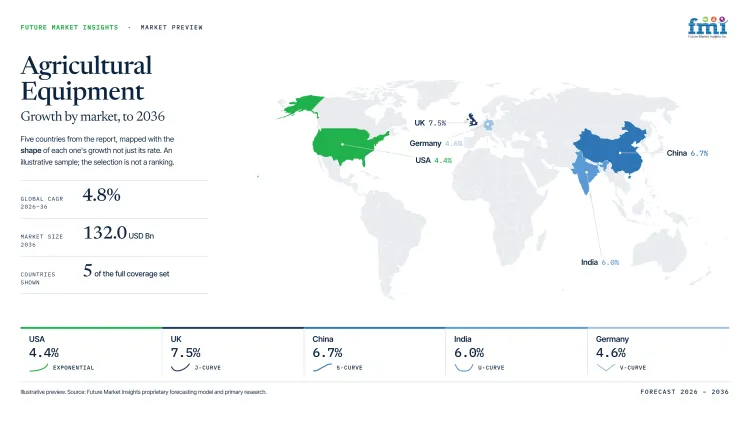
The five countries span a 4.7 percentage-point range from the United Kingdom at 7.5% to Brazil at 2.8%. The United Kingdom and Japan form the upper group, while Germany and the United States cluster near the mid-4% range. Brazil remains separated by financing-sensitive investment timing rather than basic machinery availability.
- United Kingdom grants lower capital hurdles for approved machinery during funding windows.
- Japan’s labor shortages strengthen crop weeding robots for repeated seasonal field operations.
- Germany’s data-access rules make interoperability a purchase criterion for connected machinery fleets.
- United States replacement timing remains sensitive to crop margins and inventory levels.
- Brazilian machinery orders depend on subsidized rural credit and farm cash flow.
Similar growth rates can conceal financing and service conditions that change order conversion across comparable markets. The full report provides country-level CAGR analysis across North America, Latin America, Europe, East Asia, South Asia, Oceania and the Middle East and Africa.
Country-wise Analysis
- United Kingdom: English farm businesses often time machinery orders around grant windows because eligible equipment lists determine which dealer quotations can qualify for support. Public funding is expected to lift agricultural equipment demand in the United Kingdom at a 7.5% CAGR through 2036 by lowering the initial capital hurdle for approved machinery. Defra reported in July 2026 that the Farming Equipment and Technology Fund had received 30,200 full applications and paid GBP 140.3 million by March 2026. This grant-backed route improves order conversion for qualifying equipment, although fixed application periods can bunch dealer demand and reward manufacturers with ready specifications plus dependable local service.
- Japan: Compact rice and horticultural farms place a premium on labor-saving functions that reduce steering or spraying time without requiring larger field layouts. MAFF reported in January 2025 that smart-agriculture demonstrations reduced drone pesticide-spraying hours by 61% on average. Labor scarcity is strengthening the payback case for compact automation, with agricultural equipment demand in Japan estimated to expand at a 5.8% CAGR through 2036. Higher equipment prices and specialized operating knowledge remain practical frictions across dispersed service territories, so manufacturers need simple controls and regional training routes that keep machines productive during seasonal maintenance peaks and reduce technician travel across remote prefectures.
- Germany: Connected tractors and harvesters increasingly enter purchase reviews with data-access terms alongside implement compatibility and dealer service commitments. Germany's Federal Information Centre for Agriculture stated in June 2026 that the EU Data Act changed agricultural data access from September 2025 and gave farms greater control over machine data. Regulated data access improves independent farm-management and maintenance options, while mixed-brand fleets still require workable interfaces and trained dealer technicians across local service networks and software environments. Agricultural equipment demand in Germany is projected to record a 4.6% CAGR during the assessment period, supported by manufacturers that clarify data interfaces and reduce integration friction for connected machinery fleets.
- United States: Commercial farms schedule replacement around crop margins and dealer inventory because expensive horsepower must earn enough seasonal machine hours to justify ownership. A large installed base is forecast to sustain agricultural equipment demand in the United States at a 4.4% CAGR over the forecast period, with replacement needs and precision upgrades anchoring order activity. AEM reported in February 2025 that low-horsepower tractor shipments were 13% below the prior year and roughly 24% below the five-year average. Profitability and inventory exposure can delay approvals, which makes disciplined dealer stocks and measurable labor or input savings essential for defending premium configurations during volatile crop-income cycles.
- Brazil: Machinery investment in large production regions remains closely tied to formal rural credit because planting and harvest fleets require heavy capital before farm income is realized. The Ministry of Agrarian Development and Family Agriculture's 2026/27 Pronaf summary sets a 5% rate with seven-year repayment and one-year grace for qualifying tractors, harvesters and agricultural implements. Subsidized credit supports access beyond cash purchases, helping agricultural equipment demand in Brazil grow at a projected 2.8% CAGR over the forecast period. Currency swings and commodity-income volatility can still postpone approvals, favoring OEMs that maintain finance-channel relationships and regionally dispersed parts coverage outside peak buying windows.
Who are the notable companies in the Agricultural Equipment Market?
Deere & Company, CNH Industrial N.V., AGCO Corporation, CLAAS KGaA mbH, Kubota Corporation, Mahindra & Mahindra Ltd., Yanmar Holdings Co., Ltd., and SDF S.p.A. are the notable companies serving this market.
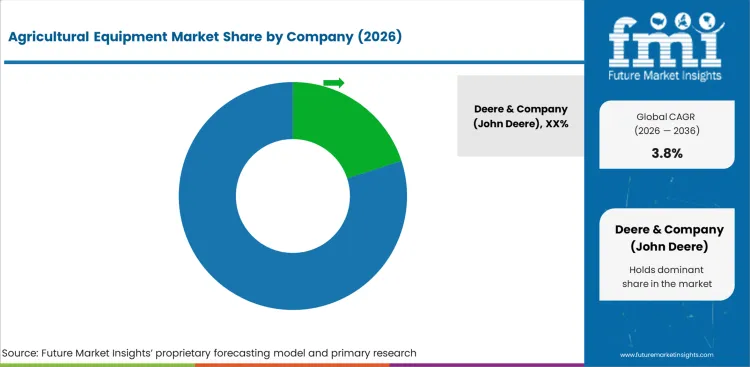
The field is concentrated among broad-line OEMs and compact-equipment specialists because farm fleets require product depth plus dependable dealer and parts support. Integrated smart agriculture systems matter most in mixed fleets that need machine data and precision control across recurring field operations. Entry remains difficult without a service network that protects uptime during short field windows even when the underlying machine specification is competitive.
- Broad-line crop-cycle and precision platforms include Deere & Company, CNH Industrial N.V., AGCO Corporation, and CLAAS KGaA mbH.
- Compact and diversified farm-machinery platforms include Kubota Corporation, Mahindra & Mahindra Ltd., and Yanmar Holdings Co., Ltd.
- SDF S.p.A. occupies the specialty tractor and electrification position with specialized-crop machinery and autonomous electric development across selected regional applications.
Competitive Benchmarking: Agricultural Equipment Market
| Company | Crop-Cycle Equipment Breadth | Precision & Autonomy Integration | Alternative-Propulsion Readiness | Geographic Reach |
|---|---|---|---|---|
| Deere & Company | High | High | Medium | Global |
| CNH Industrial N.V. | High | High | High | Global |
| AGCO Corporation | High | High | High | Global |
| CLAAS KGaA mbH | High | High | Medium | Europe, North America and international markets |
| Kubota Corporation | Medium | High | High | Japan, North America, Europe and Asia |
| Mahindra & Mahindra Ltd. | Medium | Medium | Medium | India, North America and 50+ markets |
| Yanmar Holdings Co., Ltd. | Medium | High | High | Japan, Asia, Europe and the Americas |
| SDF S.p.A. | Medium | High | High | Europe, Asia and selected global markets |
Key Developments in the Agricultural Equipment Market
- In July 2026, CNH Industrial N.V. rolled out its 800,000th Greater Noida tractor and said annual capacity was increasing from about 60,000 to 70,000 units.
- In August 2025, CLAAS KGaA mbH unveiled the JAGUAR 1000 forage-harvester series with four models spanning 850 to 1,110 HP and throughput up to 500 tons per hour.
- In February 2025, AGCO Corporation and SDF S.p.A. signed a supply agreement under which SDF would produce proprietary Massey Ferguson tractors up to 85 HP from mid-2025.
Key Players in the Agricultural Equipment Market
Broad-Line Crop-Cycle Platforms
- Deere & Company
- CNH Industrial N.V.
- AGCO Corporation
- CLAAS KGaA mbH
Compact and Diversified Farm-Machinery Platforms
- Kubota Corporation
- Mahindra & Mahindra Ltd.
- Yanmar Holdings Co., Ltd.
Specialty Tractor and Electrification Platform
- SDF S.p.A.
Agricultural Equipment Market - Report Scope
| Coverage field | Report scope |
|---|---|
| Market breakdown | By product type, power rating, propulsion, farm size and region. |
| Quantitative Units | Revenue in USD billion and CAGR in %. |
| Market Definition | Revenue from new agricultural equipment sold for on-farm crop and forage operations within the defined product type universe. Used equipment, standalone parts and services, standalone software, downstream crop revenue, and adjacent construction, forestry, turf, or irrigation-system revenue are excluded. |
| Regions Covered | North America, Latin America, Europe, East Asia, South Asia and Pacific, and Middle East and Africa. |
| Countries Covered | United Kingdom, Japan, Germany, United States, Brazil, and 20+ countries included in the full report. |
| Key Companies Profiled | Deere & Company, CNH Industrial N.V., AGCO Corporation, CLAAS KGaA mbH, Kubota Corporation, Mahindra & Mahindra Ltd., Yanmar Holdings Co., Ltd., and SDF S.p.A. |
| Forecast Period | 2026 to 2036. |
| Approach | Primary and secondary research with market triangulation. |
Agricultural Equipment Market - Research Methodology
| Method | Approach |
|---|---|
| Primary Research | FMI analysts gathered input from manufacturers, service providers, technology developers, distributors, end users, procurement teams, and subject-matter experts. Interviews examined purchasing decisions, product or service evaluation, adoption barriers, approval requirements, pricing considerations, and expectations for technical or commercial support. Respondents were also asked what evidence is required before a trial, pilot, or initial order develops into regular purchasing. |
| Desk Research | Desk research covered government statistics, regulatory publications, trade data, industry associations, technical literature, standards, company filings, product information, and official corporate announcements. Sources were reviewed for relevance, publication date, geographic coverage, and consistency with the defined market scope. Claims relating to performance, applications, approvals, capacity, investment, and commercial activity were retained only when supported by credible public evidence. |
| Market Sizing and Forecasting | The market model combined the baseline value with historical performance, segment structure, pricing and volume indicators, adoption levels, company participation, and country-level demand conditions. Forecast assumptions considered economic activity, investment trends, regulatory developments, technology adoption, purchasing cycles, supply availability, and barriers to wider market use. Segment and regional estimates were reconciled before the final market total was calculated. |
| Data Validation | Estimates were checked against multiple independent indicators, including public data, company activity, trade patterns, industry developments, and findings from primary interviews. Validation also tested whether products, services, applications, and company revenues fell within the defined market boundaries. Adjacent categories, unsupported claims, overlapping revenues, and activities without direct market relevance were excluded to reduce double counting and maintain consistency across segments and countries. |
Agricultural Equipment Market by Segments
Agricultural Equipment Market segmented by Product Type:
- Tractors
- Harvesters
- Planting Equipment
- Tillage Equipment
- Hay & Forage
- Others
Agricultural Equipment Market segmented by Power Rating:
- Below 30 HP
- 30-70 HP
- 71-130 HP
- Above 130 HP
Agricultural Equipment Market segmented by Propulsion:
- Diesel / ICE
- Electric
- Hybrid / Alternative
Agricultural Equipment Market segmented by Farm Size:
- Small
- Medium
- Large
Agricultural Equipment Market by Region:
- North America
- United States
- Canada
- Latin America
- Brazil
- Mexico
- Argentina
- Chile
- Western Europe
- Germany
- France
- United Kingdom
- Italy
- Spain
- Benelux
- Nordics
- Eastern Europe
- Poland
- Czech Republic
- Romania
- Hungary
- East Asia
- China
- Japan
- South Korea
- South Asia and Pacific
- India
- ASEAN
- Australia and New Zealand
- Middle East and Africa
- GCC Countries
- South Africa
- Türkiye
- Israel
Research Sources and Bibliography
- USA Department of Agriculture, National Agricultural Statistics Service. (2025, May 21). Farm Labor.
- Department for Environment, Food & Rural Affairs. (2026, February 24). Farming Equipment and Technology Fund 2026: guidance now available.
- Deere & Company. (2025, January 6). John Deere reveals new autonomous machines & technology at CES 2025.
- Mahindra & Mahindra Ltd. (2025, September 18). Mahindra launches next-generation range of OJA Tractors in Australia.
- USA Department of Agriculture, National Agricultural Statistics Service. (2026, July 24). Farm Production Expenditures 2025 Summary.
- Press Information Bureau, Government of India. (2025, April 4). Promotion of New Technologies in Agriculture.
- Association of Equipment Manufacturers. (2026, March 17). USA and Canadian Agricultural Tractor and Combine Sales Show Mixed Results in February.
- SDF S.p.A. (2026, May 26). In a global market that declined again in 2025, SDF increased its market share.
- Yanmar Holdings Co., Ltd. (2025, March 10). Yanmar Launches New Electrification Unit to Drive Zero-Emission Solutions for Compact Off-Highway Machinery.
- Department for Environment, Food & Rural Affairs. (2026, July 30). Farming Investment Fund statistics March 2026.
- Ministry of Agriculture, Forestry and Fisheries, Japan. (2025, January 31). Promotion of Smart Agriculture.
- Bundesinformationszentrum Landwirtschaft (BZL). (2026, June 15).Digitalisierung in der Landwirtschaft.
- Association of Equipment Manufacturers. (2025, February 20). Ag, Construction Equipment Markets Hope for Much-Needed Momentum in 2025.
- Ministry of Agrarian Development and Family Agriculture, Brazil. (2026, July). Resumo das linhas de crédito rural do Pronaf - Safra 2026/2027.
- CNH Industrial N.V. (2026, July 2). CNH India Rolls Out 800,000th Tractor from Greater Noida Facility.
- CLAAS KGaA mbH. (2025, August 14). New CLAAS JAGUAR 1000 Series Forage Harvesters Offer Unmatched Throughput, Efficiency.
- AGCO Corporation. (2025, February 11). AGCO and SDF Enter New Partnership to Strengthen Global Position in Low-Mid Horsepower Tractor Segment.
- Deere & Company. (2025, August 27). John Deere Acquires GUSS Automation to Strengthen High-Value Crop Autonomy Portfolio.
- CNH Industrial N.V. (2026, June 23). New Holland Strengthens Farm Mechanization Portfolio with Launch of HD and XHD Series Rotary Tillers (Rotavators).
- AGCO Corporation. (2025, September 22). AGCO Breaks Ground on New European Parts Distribution Centre in France to Better Serve Dealers and Farmers.
- Kubota Corporation. (2025, September 18). Unveiling Concept Model of Autonomous Fuel Cell Tractor for the First Time at Expo 2025 Osaka Kansai.
- CLAAS KGaA mbH. (2026, May 10). Commitment to Nebraska and North America Recognized at CLAAS in Omaha.
- Mahindra & Mahindra Ltd. (2025, September 22). Mahindra Launches YUVO TECH+ 475 DI with High Cubic Capacity mBULL engine.
- Yanmar Holdings Co., Ltd. (2025, August 18). Yanmar to Invest R$ 280 Million in New Factory in Brazil.
- SDF S.p.A. (2026, January 27). SDF inaugurates a new Competence Centre in Shanghai.
- AGCO Corporation. (2025, November 5). AGCO to Showcase Full-Line Innovation and Smart Farming Technologies at AGRITECHNICA 2025.
- CNH Industrial N.V. (2025, November 11). CNH 2025 Tech Day: showcasing customer-centric farming innovations across AI, Autonomy, Robotics and Automation.
- Kubota Corporation. (2025, February 28). CES 2025 “Smart Innovation for You”.
- Mahindra & Mahindra Ltd. (2026, July 4). Integrated Annual Report 2025-26.
- Yanmar Holdings Co., Ltd. (2026, April 3). Development of the Straight Driving Assist Tractor Series Driving Control Improvements to Expand Lineup of Autonomous Agricultural Machinery.
- Yanmar Holdings Co., Ltd. (2025, June 11). Yanmar Launches “Save The Farms by Yanmar” to Protect the Future of Farmland Through Food Production and Energy Transformation Technologies.
- Deere & Company. (2025, April 30). All Quiet on the Farm.
- CLAAS KGaA mbH. (2025, November 8). New AXION 9 large tractors from CLAAS: premium comfort meets high automation, increased productivity and optimised efficiency.
- CLAAS KGaA mbH. (2025, November 8). Available from 2026: TORION 537e SINUS from CLAAS with locally emission-free battery-electric drive.
- Mahindra & Mahindra Ltd. (2025, July 8). Mahindra Tractors' advanced mLIFT Precision Hydraulics system set to enhance local farm productivity in Rajasthan.
- SDF S.p.A. (2025, April 23). SDF, from Agriculture 4.0 Comes the Push to Grow Further on the Market.
This bibliography is provided for reader reference and is not exhaustive. The full report contains the complete reference list and detailed citations.
This Report Answers
- What is the Agricultural Equipment Market size in 2026 and 2036?
- What operating pressures support replacement and mechanization demand?
- Why do tractors hold the largest product type share in 2026?
- Why does below 30 HP equipment retain a meaningful position in power rating demand?
- Why does diesel / ICE remain the largest propulsion category?
- How do the United Kingdom, Japan, Germany, United States, and Brazil compare by CAGR?
- Which companies compete across broad-line, compact, and specialty agricultural equipment platforms?
- What financing and service conditions limit order conversion?
- Which technology and propulsion routes broaden equipment upgrade options?
Frequently Asked Questions
What is the Agricultural Equipment Market size in 2026?
The agricultural equipment market is estimated at USD 82.6 billion in 2026 and is projected to reach USD 132.0 billion by 2036. Replacement demand and labor-saving equipment purchases support the valuation path as farms protect seasonal field capacity across major farming regions.
What is the forecast CAGR for the Agricultural Equipment Market?
The agricultural equipment market is forecast to expand at 4.8% CAGR between 2026 and 2036. Replacement economics and field-window productivity shape growth, while financing access and dealer support determine how quickly operating need becomes a machinery order.
Which product type leads the Agricultural Equipment Market?
The tractors segment is expected to hold 49.0% of the agricultural equipment market by product type in 2026, driven by implement compatibility and high annual utilization. One powered platform can cover repeated field tasks while spreading acquisition cost across more annual operating hours.
Which propulsion segment is projected to grow at the significant pace in the Agricultural Equipment Market?
The electric segment is projected to grow at the significant pace within propulsion in the agricultural equipment market through 2036, driven by compact machines with predictable charging windows. Battery cost and field runtime remain the main tests for extending electrification beyond compact duty cycles.
Which companies are key players in the Agricultural Equipment Market?
The agricultural equipment market includes Deere & Company, CNH Industrial N.V., AGCO Corporation, CLAAS KGaA mbH, Kubota Corporation, Mahindra & Mahindra Ltd., Yanmar Holdings Co., Ltd., and SDF S.p.A. Their positions differ by crop-cycle breadth and regional service coverage across agricultural equipment fleets worldwide.
Preview the report firsthand - request a free sample
Get SampleGet the brochure for pricing and purchase details.
Get PDFTable of Content
- Key Takeaways
- Market Size and CAGR
- Top Growth Driver
- Fastest Growing Segment
- Leading Region
- Key Companies
- Emerging Opportunities
- Executive Summary
- Global Market Outlook
- Demand-side Trends
- Supply-side Trends
- Technology Roadmap Analysis
- Analysis and Recommendations
- Analyst Perspective (What is happening? Why now? What should investors know?)
- Key Questions Answered
- How large is the market?
- What is the CAGR?
- What are key trends?
- Which region dominates?
- Who are the leaders?
- Market Overview
- Market Coverage / Taxonomy
- Market Definition / Scope / Limitations
- Research Methodology
- Chapter Orientation
- Analytical Lens and Working Hypotheses
- Market Structure, Signals, and Trend Drivers
- Benchmarking and Cross-market Comparability
- Market Sizing, Forecasting, and Opportunity Mapping
- Research Design and Evidence Framework
- Desk Research Programme (Secondary Evidence)
- Expert Input and Fieldwork (Primary Evidence)
- Tooling, Models, and Reference Databases
- Data Engineering and Model Build
- Quality Assurance and Audit Trail
- Market Background
- Market Dynamics (Drivers, Restraints, Opportunity, Trends)
- Scenario Forecast (Optimistic, Likely, Conservative)
- Impact Analysis
- AI Impact
- Sustainability Impact
- Regulatory Impact
- Technology Impact
- Consumer / Buyer Analysis
- Purchase Drivers
- Adoption Barriers
- Buyer Journey
- Opportunity Map Analysis
- Product Life Cycle Analysis
- Supply Chain Analysis
- Investment Feasibility Matrix
- Value Chain Analysis
- PESTLE and Porter's Analysis
- Regulatory Landscape
- Regional Parent Market Outlook
- Production and Consumption Statistics
- Import and Export Statistics
- Global Market Analysis and Forecast, 2021 to 2036
- Historical Market Size Value (USD Billion) Analysis, 2021 to 2025
- Current and Future Market Size Value (USD Billion) Projections, 2026 to 2036
- Y-o-Y Growth Trend Analysis
- Absolute $ Opportunity Analysis
- Global Market Pricing Analysis, 2021 to 2036
- Global Market Analysis and Forecast, By Product Type, 2021 to 2036
- Introduction / Key Findings
- Historical Market Size Value (USD Billion) Analysis By Product Type, 2021 to 2025
- Current and Future Market Size Value (USD Billion) Analysis and Forecast By Product Type, 2026 to 2036
- Tractors
- Harvesters
- Planting Equipment
- Tillage Equipment
- Hay & Forage
- Others
- Tractors
- Y-o-Y Growth Trend Analysis By Product Type, 2021 to 2025
- Absolute $ Opportunity Analysis By Product Type, 2026 to 2036
- Global Market Analysis and Forecast, By Power Rating, 2021 to 2036
- Introduction / Key Findings
- Historical Market Size Value (USD Billion) Analysis By Power Rating, 2021 to 2025
- Current and Future Market Size Value (USD Billion) Analysis and Forecast By Power Rating, 2026 to 2036
- 30–70 HP
- Below 30 HP
- 71–130 HP
- Above 130 HP
- 30–70 HP
- Y-o-Y Growth Trend Analysis By Power Rating, 2021 to 2025
- Absolute $ Opportunity Analysis By Power Rating, 2026 to 2036
- Global Market Analysis and Forecast, By Propulsion, 2021 to 2036
- Introduction / Key Findings
- Historical Market Size Value (USD Billion) Analysis By Propulsion, 2021 to 2025
- Current and Future Market Size Value (USD Billion) Analysis and Forecast By Propulsion, 2026 to 2036
- Diesel - ICE
- Electric
- Hybrid - Alternative
- Diesel - ICE
- Y-o-Y Growth Trend Analysis By Propulsion, 2021 to 2025
- Absolute $ Opportunity Analysis By Propulsion, 2026 to 2036
- Global Market Analysis and Forecast, By Farm Size, 2021 to 2036
- Introduction / Key Findings
- Historical Market Size Value (USD Billion) Analysis By Farm Size, 2021 to 2025
- Current and Future Market Size Value (USD Billion) Analysis and Forecast By Farm Size, 2026 to 2036
- Medium
- Small
- Large
- Medium
- Y-o-Y Growth Trend Analysis By Farm Size, 2021 to 2025
- Absolute $ Opportunity Analysis By Farm Size, 2026 to 2036
- Global Market Analysis and Forecast, By Region, 2021 to 2036
- Introduction
- Historical Market Size Value (USD Billion) Analysis By Region, 2021 to 2025
- Current Market Size Value (USD Billion) Analysis and Forecast By Region, 2026 to 2036
- North America
- Latin America
- Western Europe
- Eastern Europe
- East Asia
- South Asia and Pacific
- Middle East & Africa
- Market Attractiveness Analysis By Region
- North America Market Analysis and Forecast, By Country, 2021 to 2036
- Historical Market Size Value (USD Billion) Trend Analysis By Market Taxonomy, 2021 to 2025
- Market Size Value (USD Billion) Forecast By Market Taxonomy, 2026 to 2036
- By Country
- USA
- Canada
- By Product Type
- By Power Rating
- By Propulsion
- By Farm Size
- By Country
- Market Attractiveness Analysis
- By Country
- By Product Type
- By Power Rating
- By Propulsion
- By Farm Size
- Key Takeaways
- Latin America Market Analysis and Forecast, By Country
- Historical Market Size Value (USD Billion) Trend Analysis By Market Taxonomy, 2021 to 2025
- Market Size Value (USD Billion) Forecast By Market Taxonomy, 2026 to 2036
- By Country
- Brazil
- Mexico
- Chile
- Rest of Latin America
- By Product Type
- By Power Rating
- By Propulsion
- By Farm Size
- By Country
- Market Attractiveness Analysis
- By Country
- By Product Type
- By Power Rating
- By Propulsion
- By Farm Size
- Key Takeaways
- Western Europe Market Analysis and Forecast, By Country
- Historical Market Size Value (USD Billion) Trend Analysis By Market Taxonomy, 2021 to 2025
- Market Size Value (USD Billion) Forecast By Market Taxonomy, 2026 to 2036
- By Country
- Germany
- UK
- Italy
- Spain
- France
- Nordic
- BENELUX
- Rest of Western Europe
- By Product Type
- By Power Rating
- By Propulsion
- By Farm Size
- By Country
- Market Attractiveness Analysis
- By Country
- By Product Type
- By Power Rating
- By Propulsion
- By Farm Size
- Key Takeaways
- Eastern Europe Market Analysis and Forecast, By Country
- Historical Market Size Value (USD Billion) Trend Analysis By Market Taxonomy, 2021 to 2025
- Market Size Value (USD Billion) Forecast By Market Taxonomy, 2026 to 2036
- By Country
- Russia
- Poland
- Hungary
- Balkan & Baltic
- Rest of Eastern Europe
- By Product Type
- By Power Rating
- By Propulsion
- By Farm Size
- By Country
- Market Attractiveness Analysis
- By Country
- By Product Type
- By Power Rating
- By Propulsion
- By Farm Size
- Key Takeaways
- East Asia Market Analysis and Forecast, By Country
- Historical Market Size Value (USD Billion) Trend Analysis By Market Taxonomy, 2021 to 2025
- Market Size Value (USD Billion) Forecast By Market Taxonomy, 2026 to 2036
- By Country
- China
- Japan
- South Korea
- By Product Type
- By Power Rating
- By Propulsion
- By Farm Size
- By Country
- Market Attractiveness Analysis
- By Country
- By Product Type
- By Power Rating
- By Propulsion
- By Farm Size
- Key Takeaways
- South Asia and Pacific Market Analysis and Forecast, By Country
- Historical Market Size Value (USD Billion) Trend Analysis By Market Taxonomy, 2021 to 2025
- Market Size Value (USD Billion) Forecast By Market Taxonomy, 2026 to 2036
- By Country
- India
- ASEAN
- Australia & New Zealand
- Rest of South Asia and Pacific
- By Product Type
- By Power Rating
- By Propulsion
- By Farm Size
- By Country
- Market Attractiveness Analysis
- By Country
- By Product Type
- By Power Rating
- By Propulsion
- By Farm Size
- Key Takeaways
- Middle East & Africa Market Analysis and Forecast, By Country
- Historical Market Size Value (USD Billion) Trend Analysis By Market Taxonomy, 2021 to 2025
- Market Size Value (USD Billion) Forecast By Market Taxonomy, 2026 to 2036
- By Country
- Kingdom of Saudi Arabia
- Other GCC Countries
- Türkiye
- South Africa
- Other African Union
- Rest of Middle East & Africa
- By Product Type
- By Power Rating
- By Propulsion
- By Farm Size
- By Country
- Market Attractiveness Analysis
- By Country
- By Product Type
- By Power Rating
- By Propulsion
- By Farm Size
- Key Takeaways
- Key Countries Market Analysis
- USA
- Pricing Analysis
- Market Share Analysis, 2025
- By Product Type
- By Power Rating
- By Propulsion
- By Farm Size
- Canada
- Pricing Analysis
- Market Share Analysis, 2025
- By Product Type
- By Power Rating
- By Propulsion
- By Farm Size
- Mexico
- Pricing Analysis
- Market Share Analysis, 2025
- By Product Type
- By Power Rating
- By Propulsion
- By Farm Size
- Brazil
- Pricing Analysis
- Market Share Analysis, 2025
- By Product Type
- By Power Rating
- By Propulsion
- By Farm Size
- Chile
- Pricing Analysis
- Market Share Analysis, 2025
- By Product Type
- By Power Rating
- By Propulsion
- By Farm Size
- Germany
- Pricing Analysis
- Market Share Analysis, 2025
- By Product Type
- By Power Rating
- By Propulsion
- By Farm Size
- UK
- Pricing Analysis
- Market Share Analysis, 2025
- By Product Type
- By Power Rating
- By Propulsion
- By Farm Size
- Italy
- Pricing Analysis
- Market Share Analysis, 2025
- By Product Type
- By Power Rating
- By Propulsion
- By Farm Size
- Spain
- Pricing Analysis
- Market Share Analysis, 2025
- By Product Type
- By Power Rating
- By Propulsion
- By Farm Size
- France
- Pricing Analysis
- Market Share Analysis, 2025
- By Product Type
- By Power Rating
- By Propulsion
- By Farm Size
- India
- Pricing Analysis
- Market Share Analysis, 2025
- By Product Type
- By Power Rating
- By Propulsion
- By Farm Size
- ASEAN
- Pricing Analysis
- Market Share Analysis, 2025
- By Product Type
- By Power Rating
- By Propulsion
- By Farm Size
- Australia & New Zealand
- Pricing Analysis
- Market Share Analysis, 2025
- By Product Type
- By Power Rating
- By Propulsion
- By Farm Size
- China
- Pricing Analysis
- Market Share Analysis, 2025
- By Product Type
- By Power Rating
- By Propulsion
- By Farm Size
- Japan
- Pricing Analysis
- Market Share Analysis, 2025
- By Product Type
- By Power Rating
- By Propulsion
- By Farm Size
- South Korea
- Pricing Analysis
- Market Share Analysis, 2025
- By Product Type
- By Power Rating
- By Propulsion
- By Farm Size
- Russia
- Pricing Analysis
- Market Share Analysis, 2025
- By Product Type
- By Power Rating
- By Propulsion
- By Farm Size
- Poland
- Pricing Analysis
- Market Share Analysis, 2025
- By Product Type
- By Power Rating
- By Propulsion
- By Farm Size
- Hungary
- Pricing Analysis
- Market Share Analysis, 2025
- By Product Type
- By Power Rating
- By Propulsion
- By Farm Size
- Kingdom of Saudi Arabia
- Pricing Analysis
- Market Share Analysis, 2025
- By Product Type
- By Power Rating
- By Propulsion
- By Farm Size
- Türkiye
- Pricing Analysis
- Market Share Analysis, 2025
- By Product Type
- By Power Rating
- By Propulsion
- By Farm Size
- South Africa
- Pricing Analysis
- Market Share Analysis, 2025
- By Product Type
- By Power Rating
- By Propulsion
- By Farm Size
- USA
- Market Structure Analysis
- Competition Dashboard
- Competition Benchmarking
- Market Share Analysis of Top Players
- By Regional
- By Product Type
- By Power Rating
- By Propulsion
- By Farm Size
- Emerging Startups
- Innovation Benchmarking
- Competition Analysis
- Competition Deep Dive
- Deere & Company
- Overview
- Product Portfolio
- Profitability by Market Segments
- Sales Footprint
- Strategy Overview
- Marketing Strategy
- Product Strategy
- Channel Strategy
- CNH Industrial N.V.
- AGCO Corporation
- Kubota Corporation
- CLAAS KGaA mbH
- Mahindra & Mahindra Ltd.
- Yanmar Holdings Co., Ltd.
- SDF S.p.A.
- Escorts Kubota Limited
- Iseki & Co., Ltd.
- Deere & Company
- Case Studies
- Success Stories
- Recent Developments
- Competition Deep Dive
- Assumptions & Acronyms Used


