


Automotive MEMS Market
Automotive MEMS Market Size and Share Forecast Outlook 2025 to 2035
Historical Data Covered: 2015 to 2023 | Base Year: 2024 | Estimated Year: 2025 | Forecast Period: 2026 to 2035
Automotive MEMS Market Size and Share Forecast Outlook 2025 to 2035
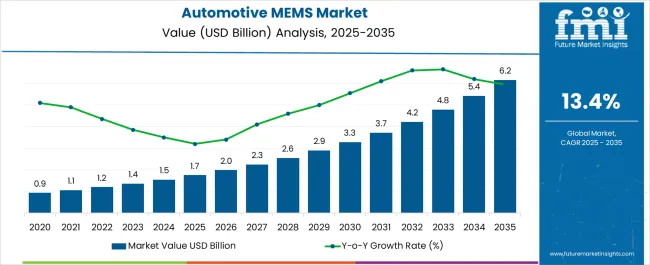
The Automotive MEMS Market is estimated to be valued at USD 1.7 billion in 2025 and is projected to reach USD 6.2 billion by 2035, registering a compound annual growth rate (CAGR) of 13.4% over the forecast period.
Quick Stats for Automotive MEMS Market
- Automotive MEMS Market Value (2025): USD 1.7 billion
- Automotive MEMS Market Forecast Value (2035): USD 6.2 billion
- Automotive MEMS Market Forecast CAGR: 13.4%
- Leading Segment in Automotive MEMS Market in 2025: Pressure Sensor (30.2%)
- Key Growth Regions in Automotive MEMS Market: North America, Asia-Pacific, Europe
- Top Key Players in Automotive MEMS Market: Robert Bosch GmbH (Germany), Continental AG (Germany), Denso Corporation (Japan), Sensata Technologies (USA), Infineon Technologies AG (Germany), Delphi Technologies (UK), NXP Semiconductors (Netherlands), TDK Corporation (InvenSense) (Japan), Murata Manufacturing Co., Ltd. (Japan), Toshiba Electronic Devices & Storage Corporation (Japan), STMicroelectronics (Switzerland), ROHM Semiconductor (Japan), Analog Devices, Inc. (USA), TE Connectivity (Switzerland), Amphenol Corporation (USA)
Automotive MEMS Market Key Takeaways
| Metric | Value |
|---|---|
| Automotive MEMS Market Estimated Value in (2025 E) | USD 1.7 billion |
| Automotive MEMS Market Forecast Value in (2035 F) | USD 6.2 billion |
| Forecast CAGR (2025 to 2035) | 13.4% |
Why is the Automotive MEMS Market Growing?
The automotive MEMS market is experiencing steady expansion, driven by increasing integration of advanced sensing technologies into vehicles for improved safety, efficiency, and performance. Microelectromechanical systems are being adopted widely as automakers enhance electronic content across both passenger and commercial vehicles. Demand growth is strongly influenced by regulatory frameworks that mandate the inclusion of safety-critical features, such as electronic stability control, airbag systems, and tire pressure monitoring.
MEMS-based sensors are also playing a central role in supporting the transition toward connected and autonomous vehicles, where accurate, real-time data is critical for decision-making and control systems. Growing emphasis on vehicle electrification is further supporting demand, as MEMS devices contribute to battery monitoring, powertrain efficiency, and thermal management.
Continuous innovations in miniaturization, durability, and cost-effectiveness are improving adoption rates across multiple automotive applications As the global automotive sector invests in advanced driver assistance systems and smart mobility, MEMS technology is positioned as a fundamental enabler of future vehicle architectures, ensuring consistent growth momentum in the market.
Segmental Analysis
The automotive mems market is segmented by type, application, and geographic regions. By type, automotive mems market is divided into Pressure Sensor, Accelerometer, Gyroscope, Flow Sensor, and Others. In terms of application, automotive mems market is classified into Safety and Chassis, Powertrain, Body and Convenience, Infotainment, Other Applications, Engine Management System, Peripheral Pressure Sensors, Fuel Injection Systems, Seat Occupancy, and Oil Pressure Sensing. Regionally, the automotive mems industry is classified into North America, Latin America, Western Europe, Eastern Europe, Balkan & Baltic Countries, Russia & Belarus, Central Asia, East Asia, South Asia & Pacific, and the Middle East & Africa.
Insights into the Pressure Sensor Type Segment
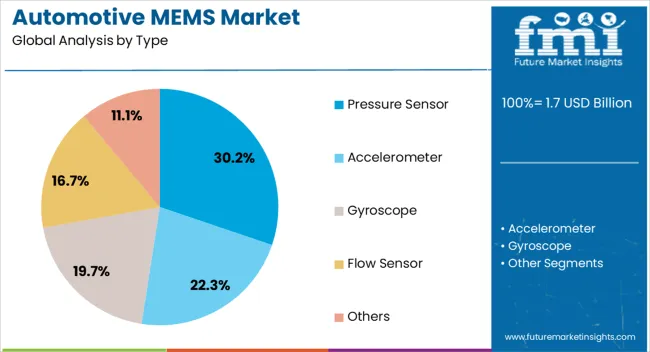
The pressure sensor segment is projected to hold 30.2% of the automotive MEMS market revenue share in 2025, making it the largest type segment. This leadership is being reinforced by its extensive use in monitoring tire pressure, engine performance, and fuel injection systems. The ability of MEMS-based pressure sensors to provide accurate, real-time measurements under varying environmental conditions has made them essential for ensuring safety, compliance, and efficiency.
Their role in critical applications, such as airbag deployment systems and braking systems, is further strengthening demand. Rising adoption of advanced driver assistance systems has also heightened the need for precision sensing to ensure optimal performance of safety features.
Technological improvements in sensitivity, thermal stability, and cost reduction are broadening deployment across mass-market vehicles as well as premium models With increasing regulatory requirements for tire pressure monitoring systems and emission control, MEMS pressure sensors are expected to remain a key component of automotive electronics, reinforcing their dominant position within the market.
Insights into the Safety and Chassis Application Segment
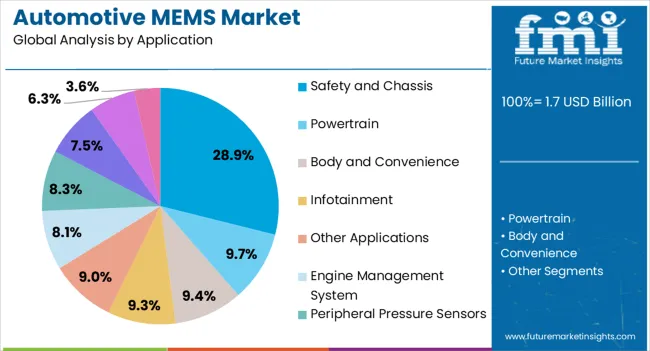
The safety and chassis application segment is anticipated to account for 28.9% of the automotive MEMS market revenue share in 2025, making it the leading application area. This dominance is being supported by the critical role MEMS devices play in airbag systems, rollover detection, stability control, and anti-lock braking systems. As global automotive regulations mandate stricter safety compliance, manufacturers are increasingly integrating MEMS sensors into safety architectures to ensure reliability and compliance.
These sensors provide the high-speed and accurate data required for immediate response in crash or instability situations, significantly improving occupant safety. The application segment is also benefiting from the growing demand for advanced driver assistance systems, where MEMS devices support lane departure warnings, collision avoidance, and adaptive cruise control by monitoring vehicle dynamics.
Increasing electrification of vehicles is adding new dimensions of demand, as MEMS sensors contribute to managing thermal conditions and enhancing vehicle stability As safety becomes a central factor in consumer purchasing decisions, MEMS adoption in safety and chassis systems is expected to accelerate, cementing this segment’s leadership in the market.
Market Overview
Automotive MEMS Market: Key Drivers
-
Consumer Inclination toward Enhanced Vehicle Features
A growing population of carowners is seeking enhanced vehicle features for better safety, comfort, and stability within cars. This being a prime driving force for boosting the market growth globally, vehicle manufacturers on the other hand are constantly upgrading vehicle models with state-of-the-art features through MEMS technology.
-
Strict Government Regulations
Various governments are implementing stringent regulations setting the standards for vehicles' fuel efficiency and emission standards. As a result, major players in the market are increasingly striving to meet the standards through adoption of MEMS, thereby escalating the demand for automotive MEMS in the market. China and India are particularly expected to grow into attractive markets during the forecast period.
Key Restraint to Widespread Adoption of Automotive MEMS
-
Inadequate Awareness
Lack of awareness among drivers and vehicle technicians about the evolving technical mechanism of MEMS is identified to be a key challenge to market expansion.
-
Regions with Adverse Climatic Conditions
Studies depict that harsh climatic conditions such as heavy snowfall or rainfall may negatively influence the functioning of MEMS systems in vehicles. Moreover, it is not feasible to replace the entire MEMS system, if it faces a minor fault. This is expected to be a major challenge that might reflect a shift in consumer behaviour.
Automotive MEMS: Notable Trends in the Market
- The most extensively sought after MEMS application remains safety through the detection of an accidental possibility through air bags control. However, apart from safety, the trend reflects growing demand for performance-based sensors. One of the key players already working on this is InvenSense Inc.
- Currently, the market is trending with a number of other application developments, including tyre pressure sensing, rollover and skidding detection, vehicle's dynamic control, parking brakes sensing, anti-theft sensing, efficient engine management, traffic density signalling, and superior navigation.
- Autonomous driving sensors are also trending at a high pace.
- Manufacturers are concentrating on developing new, safer, smaller, and cost-effective MEMS sensors, which could efficiently replace the older ones.
- A number of companies are researching on the development of next generation MEMS technology, which would effectively address the issues related to adverse climate and exhaust.
- The demand for MEMS microphones, which signal drivers about noise ratios.
Automotive MEMS Market: Regional Outlook
With some of the top OEMs in the industry, including Ford Motor Company, General Motors Company, Volkswagen, Chrysler, and Peugeot, North America and Western Europe currently lead the global automotive MEMS market.
Moreover, these regions have strong communicating channels and are increasingly hosting miniaturisation R&D. The focus of N. American and W. European manufacturers on integrating MEMS systems in vehicles keeping their basic mechanisms intact, is estimated to play a role in pushing the market growth in these regions.
The market is anticipated to witness remarkable growth in developing economies, including China, India, South Africa, and Brazil. FMI predicts these regions to gain substantial market shares over the forecast period.
Key Players in the Global Automotive MEMS Market
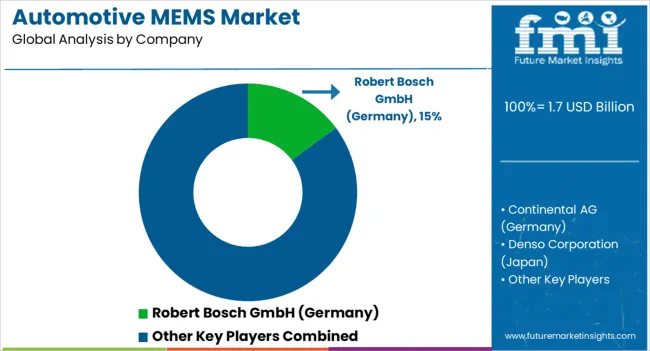
The prominent players in the global automotive MEMS market include Robert Bosch GmbH, General Motors Company, Analog Devices Inc., STMicroelectronics N.V., Sensata Technologies Inc., Panasonic Corporation, Infineon Technologies AG, Delphi Automotive PLC, and Freescale Semiconductors Ltd. (previously NXP), Denso Corporation, and Murata Manufacturing Co. Ltd.
Some of the key players are currently expanding their production plants internationally, for gaining better presence on a global level. Recently, Denso Corporation has announced the construction of a new plant based in Cambodia in order to cater to the MEMS-related requirements in that region.
With the aim of expanding the customer base, few of the prominent players in the automotive MEMS market are setting up their production plants in the foreign market thereby further boosting the market revenues. For instance, on February 20, 2025, Denso Corporation, one of the prominent players in automotive MEMS market confirmed the plans of constructing another plant in Cambodia that would cater to the automotive industries in the region.
The report covers exhaustive analysis on
- Global Automotive MEMS Market Segments
- Global Automotive MEMS Market Dynamics
- Historical Actual Market Size, 2025 - 2025
- Global Automotive MEMS Market Size & Forecast 2025 to 2026
- Supply & Demand Value Chain
- Global Automotive MEMS Market Current Trends/Issues/Challenges
- Competition & Companies involved
- Technology
- Value Chain
- Global Automotive MEMS Market Drivers and Restraints
Regional analysis for Global Automotive MEMS Market includes
- North America
- US & Canada
- Latin America
- Brazil, Mexico, Others
- Western Europe
- Germany
- France
- UK
- Spain
- Italy
- Nordic
- BENELUX
- Rest of Western Europe
- Eastern Europe
- Russia
- Poland
- Rest of Eastern Europe
- Asia Pacific
- Australia and New Zealand (ANZ)
- Greater China
- India
- ASEAN
- Rest of Asia Pacific
- Japan
- Middle East and Africa
- GCC Countries
- Other Middle East
- North Africa
- South Africa
- Other Africa
The report is a compilation of first-hand information, qualitative and quantitative assessment by industry analysts, inputs from industry experts and industry participants across the value chain. The report provides in-depth analysis of parent market trends, macro-economic indicators and governing factors along with market attractiveness as per segments. The report also maps the qualitative impact of various market factors on market segments and geographies.
Analysis of Automotive MEMS Market By Key Countries
| Country | CAGR |
|---|---|
| China | 18.1% |
| India | 16.8% |
| Germany | 15.4% |
| France | 14.1% |
| UK | 12.7% |
| USA | 11.4% |
| Brazil | 10.1% |
Country-wise Analysis
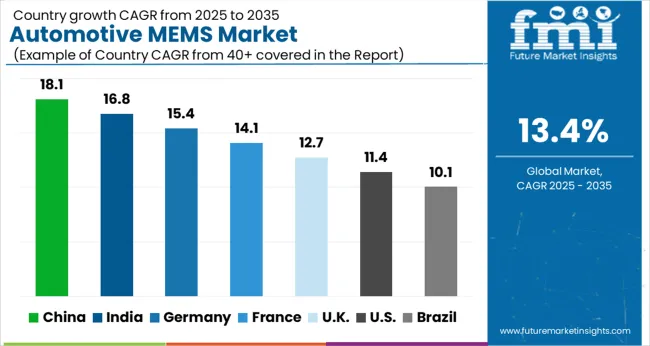
The Automotive MEMS Market is expected to register a CAGR of 13.4% during the forecast period, exhibiting varied country level momentum. China leads with the highest CAGR of 18.1%, followed by India at 16.8%. Developed markets such as Germany, France, and the UK continue to expand steadily, while the USA is likely to grow at consistent rates. Brazil posts the lowest CAGR at 10.1%, yet still underscores a broadly positive trajectory for the global Automotive MEMS Market. In 2024, Germany held a dominant revenue in the Western Europe market and is expected to grow with a CAGR of 15.4%. The USA Automotive MEMS Market is estimated to be valued at USD 628.2 million in 2025 and is anticipated to reach a valuation of USD 1.8 billion by 2035. Sales are projected to rise at a CAGR of 11.4% over the forecast period between 2025 and 2035. While Japan and South Korea markets are estimated to be valued at USD 79.7 million and USD 61.2 million respectively in 2025.
Key Players in the Automotive MEMS Market
- Robert Bosch GmbH (Germany)
- Continental AG (Germany)
- Denso Corporation (Japan)
- Sensata Technologies (USA)
- Infineon Technologies AG (Germany)
- Delphi Technologies (UK)
- NXP Semiconductors (Netherlands)
- TDK Corporation (InvenSense) (Japan)
- Murata Manufacturing Co., Ltd. (Japan)
- Toshiba Electronic Devices & Storage Corporation (Japan)
- STMicroelectronics (Switzerland)
- ROHM Semiconductor (Japan)
- Analog Devices, Inc. (USA)
- TE Connectivity (Switzerland)
- Amphenol Corporation (USA)
Scope of the Report
| Item | Value |
|---|---|
| Quantitative Units | USD 1.7 Billion |
| Type | Pressure Sensor, Accelerometer, Gyroscope, Flow Sensor, and Others |
| Application | Safety and Chassis, Powertrain, Body and Convenience, Infotainment, Other Applications, Engine Management System, Peripheral Pressure Sensors, Fuel Injection Systems, Seat Occupancy, and Oil Pressure Sensing |
| Regions Covered | North America, Europe, Asia-Pacific, Latin America, Middle East & Africa |
| Country Covered | United States, Canada, Germany, France, United Kingdom, China, Japan, India, Brazil, South Africa |
| Key Companies Profiled | Robert Bosch GmbH (Germany), Continental AG (Germany), Denso Corporation (Japan), Sensata Technologies (USA), Infineon Technologies AG (Germany), Delphi Technologies (UK), NXP Semiconductors (Netherlands), TDK Corporation (InvenSense) (Japan), Murata Manufacturing Co., Ltd. (Japan), Toshiba Electronic Devices & Storage Corporation (Japan), STMicroelectronics (Switzerland), ROHM Semiconductor (Japan), Analog Devices, Inc. (USA), TE Connectivity (Switzerland), and Amphenol Corporation (USA) |
Automotive MEMS Market by Segments
Type:
- Pressure Sensor
- Accelerometer
- Gyroscope
- Flow Sensor
- Others
Application:
- Safety and Chassis
- Powertrain
- Body and Convenience
- Infotainment
- Other Applications
- Engine Management System
- Peripheral Pressure Sensors
- Fuel Injection Systems
- Seat Occupancy
- Oil Pressure Sensing
Region:
- North America
- USA
- Canada
- Mexico
- Latin America
- Brazil
- Chile
- Rest of Latin America
- Western Europe
- Germany
- UK
- Italy
- Spain
- France
- Nordic
- BENELUX
- Rest of Western Europe
- Eastern Europe
- Russia
- Poland
- Hungary
- Balkan & Baltic
- Rest of Eastern Europe
- East Asia
- China
- Japan
- South Korea
- South Asia and Pacific
- India
- ASEAN
- Australia & New Zealand
- Rest of South Asia and Pacific
- Middle East & Africa
- Kingdom of Saudi Arabia
- Other GCC Countries
- Turkiye
- South Africa
- Other African Union
- Rest of Middle East & Africa
Frequently Asked Questions
How big is the automotive mems market in 2025?
The global automotive mems market is estimated to be valued at USD 1.7 billion in 2025.
What will be the size of automotive mems market in 2035?
The market size for the automotive mems market is projected to reach USD 6.2 billion by 2035.
How much will be the automotive mems market growth between 2025 and 2035?
The automotive mems market is expected to grow at a 13.4% CAGR between 2025 and 2035.
What are the key product types in the automotive mems market?
The key product types in automotive mems market are pressure sensor, accelerometer, gyroscope, flow sensor and others.
Which application segment to contribute significant share in the automotive mems market in 2025?
In terms of application, safety and chassis segment to command 28.9% share in the automotive mems market in 2025.
Table of Content
- Executive Summary
- Global Market Outlook
- Demand-side Trends
- Supply-side Trends
- Technology Roadmap Analysis
- Analysis and Recommendations
- Market Overview
- Market Coverage / Taxonomy
- Market Definition / Scope / Limitations
- Market Background
- Market Dynamics
- Drivers
- Restraints
- Opportunity
- Trends
- Scenario Forecast
- Demand in Optimistic Scenario
- Demand in Likely Scenario
- Demand in Conservative Scenario
- Opportunity Map Analysis
- Product Life Cycle Analysis
- Supply Chain Analysis
- Investment Feasibility Matrix
- Value Chain Analysis
- PESTLE and Porter’s Analysis
- Regulatory Landscape
- Regional Parent Market Outlook
- Production and Consumption Statistics
- Import and Export Statistics
- Market Dynamics
- Global Market Analysis 2020 to 2024 and Forecast, 2025 to 2035
- Historical Market Size Value (USD Million) Analysis, 2020 to 2024
- Current and Future Market Size Value (USD Million) Projections, 2025 to 2035
- Y-o-Y Growth Trend Analysis
- Absolute $ Opportunity Analysis
- Global Market Pricing Analysis 2020 to 2024 and Forecast 2025 to 2035
- Global Market Analysis 2020 to 2024 and Forecast 2025 to 2035, By Type
- Introduction / Key Findings
- Historical Market Size Value (USD Million) Analysis By Type , 2020 to 2024
- Current and Future Market Size Value (USD Million) Analysis and Forecast By Type , 2025 to 2035
- Pressure Sensor
- Accelerometer
- Gyroscope
- Flow Sensor
- Others
- Y-o-Y Growth Trend Analysis By Type , 2020 to 2024
- Absolute $ Opportunity Analysis By Type , 2025 to 2035
- Global Market Analysis 2020 to 2024 and Forecast 2025 to 2035, By Application
- Introduction / Key Findings
- Historical Market Size Value (USD Million) Analysis By Application, 2020 to 2024
- Current and Future Market Size Value (USD Million) Analysis and Forecast By Application, 2025 to 2035
- Safety and Chassis
- Powertrain
- Body and Convenience
- Infotainment
- Other Applications
- Engine Management System
- Peripheral Pressure Sensors
- Fuel Injection Systems
- Seat Occupancy
- Oil Pressure Sensing
- Y-o-Y Growth Trend Analysis By Application, 2020 to 2024
- Absolute $ Opportunity Analysis By Application, 2025 to 2035
- Global Market Analysis 2020 to 2024 and Forecast 2025 to 2035, By Region
- Introduction
- Historical Market Size Value (USD Million) Analysis By Region, 2020 to 2024
- Current Market Size Value (USD Million) Analysis and Forecast By Region, 2025 to 2035
- North America
- Latin America
- Western Europe
- Eastern Europe
- East Asia
- South Asia and Pacific
- Middle East & Africa
- Market Attractiveness Analysis By Region
- North America Market Analysis 2020 to 2024 and Forecast 2025 to 2035, By Country
- Historical Market Size Value (USD Million) Trend Analysis By Market Taxonomy, 2020 to 2024
- Market Size Value (USD Million) Forecast By Market Taxonomy, 2025 to 2035
- By Country
- USA
- Canada
- Mexico
- By Type
- By Application
- By Country
- Market Attractiveness Analysis
- By Country
- By Type
- By Application
- Key Takeaways
- Latin America Market Analysis 2020 to 2024 and Forecast 2025 to 2035, By Country
- Historical Market Size Value (USD Million) Trend Analysis By Market Taxonomy, 2020 to 2024
- Market Size Value (USD Million) Forecast By Market Taxonomy, 2025 to 2035
- By Country
- Brazil
- Chile
- Rest of Latin America
- By Type
- By Application
- By Country
- Market Attractiveness Analysis
- By Country
- By Type
- By Application
- Key Takeaways
- Western Europe Market Analysis 2020 to 2024 and Forecast 2025 to 2035, By Country
- Historical Market Size Value (USD Million) Trend Analysis By Market Taxonomy, 2020 to 2024
- Market Size Value (USD Million) Forecast By Market Taxonomy, 2025 to 2035
- By Country
- Germany
- UK
- Italy
- Spain
- France
- Nordic
- BENELUX
- Rest of Western Europe
- By Type
- By Application
- By Country
- Market Attractiveness Analysis
- By Country
- By Type
- By Application
- Key Takeaways
- Eastern Europe Market Analysis 2020 to 2024 and Forecast 2025 to 2035, By Country
- Historical Market Size Value (USD Million) Trend Analysis By Market Taxonomy, 2020 to 2024
- Market Size Value (USD Million) Forecast By Market Taxonomy, 2025 to 2035
- By Country
- Russia
- Poland
- Hungary
- Balkan & Baltic
- Rest of Eastern Europe
- By Type
- By Application
- By Country
- Market Attractiveness Analysis
- By Country
- By Type
- By Application
- Key Takeaways
- East Asia Market Analysis 2020 to 2024 and Forecast 2025 to 2035, By Country
- Historical Market Size Value (USD Million) Trend Analysis By Market Taxonomy, 2020 to 2024
- Market Size Value (USD Million) Forecast By Market Taxonomy, 2025 to 2035
- By Country
- China
- Japan
- South Korea
- By Type
- By Application
- By Country
- Market Attractiveness Analysis
- By Country
- By Type
- By Application
- Key Takeaways
- South Asia and Pacific Market Analysis 2020 to 2024 and Forecast 2025 to 2035, By Country
- Historical Market Size Value (USD Million) Trend Analysis By Market Taxonomy, 2020 to 2024
- Market Size Value (USD Million) Forecast By Market Taxonomy, 2025 to 2035
- By Country
- India
- ASEAN
- Australia & New Zealand
- Rest of South Asia and Pacific
- By Type
- By Application
- By Country
- Market Attractiveness Analysis
- By Country
- By Type
- By Application
- Key Takeaways
- Middle East & Africa Market Analysis 2020 to 2024 and Forecast 2025 to 2035, By Country
- Historical Market Size Value (USD Million) Trend Analysis By Market Taxonomy, 2020 to 2024
- Market Size Value (USD Million) Forecast By Market Taxonomy, 2025 to 2035
- By Country
- Kingdom of Saudi Arabia
- Other GCC Countries
- Turkiye
- South Africa
- Other African Union
- Rest of Middle East & Africa
- By Type
- By Application
- By Country
- Market Attractiveness Analysis
- By Country
- By Type
- By Application
- Key Takeaways
- Key Countries Market Analysis
- USA
- Pricing Analysis
- Market Share Analysis, 2024
- By Type
- By Application
- Canada
- Pricing Analysis
- Market Share Analysis, 2024
- By Type
- By Application
- Mexico
- Pricing Analysis
- Market Share Analysis, 2024
- By Type
- By Application
- Brazil
- Pricing Analysis
- Market Share Analysis, 2024
- By Type
- By Application
- Chile
- Pricing Analysis
- Market Share Analysis, 2024
- By Type
- By Application
- Germany
- Pricing Analysis
- Market Share Analysis, 2024
- By Type
- By Application
- UK
- Pricing Analysis
- Market Share Analysis, 2024
- By Type
- By Application
- Italy
- Pricing Analysis
- Market Share Analysis, 2024
- By Type
- By Application
- Spain
- Pricing Analysis
- Market Share Analysis, 2024
- By Type
- By Application
- France
- Pricing Analysis
- Market Share Analysis, 2024
- By Type
- By Application
- India
- Pricing Analysis
- Market Share Analysis, 2024
- By Type
- By Application
- ASEAN
- Pricing Analysis
- Market Share Analysis, 2024
- By Type
- By Application
- Australia & New Zealand
- Pricing Analysis
- Market Share Analysis, 2024
- By Type
- By Application
- China
- Pricing Analysis
- Market Share Analysis, 2024
- By Type
- By Application
- Japan
- Pricing Analysis
- Market Share Analysis, 2024
- By Type
- By Application
- South Korea
- Pricing Analysis
- Market Share Analysis, 2024
- By Type
- By Application
- Russia
- Pricing Analysis
- Market Share Analysis, 2024
- By Type
- By Application
- Poland
- Pricing Analysis
- Market Share Analysis, 2024
- By Type
- By Application
- Hungary
- Pricing Analysis
- Market Share Analysis, 2024
- By Type
- By Application
- Kingdom of Saudi Arabia
- Pricing Analysis
- Market Share Analysis, 2024
- By Type
- By Application
- Turkiye
- Pricing Analysis
- Market Share Analysis, 2024
- By Type
- By Application
- South Africa
- Pricing Analysis
- Market Share Analysis, 2024
- By Type
- By Application
- USA
- Market Structure Analysis
- Competition Dashboard
- Competition Benchmarking
- Market Share Analysis of Top Players
- By Regional
- By Type
- By Application
- Competition Analysis
- Competition Deep Dive
- Robert Bosch GmbH (Germany)
- Overview
- Product Portfolio
- Profitability by Market Segments (Product/Age /Sales Channel/Region)
- Sales Footprint
- Strategy Overview
- Marketing Strategy
- Product Strategy
- Channel Strategy
- Continental AG (Germany)
- Denso Corporation (Japan)
- Sensata Technologies (USA)
- Infineon Technologies AG (Germany)
- Delphi Technologies (UK)
- NXP Semiconductors (Netherlands)
- TDK Corporation (InvenSense) (Japan)
- Murata Manufacturing Co., Ltd. (Japan)
- Toshiba Electronic Devices & Storage Corporation (Japan)
- STMicroelectronics (Switzerland)
- ROHM Semiconductor (Japan)
- Analog Devices, Inc. (USA)
- TE Connectivity (Switzerland)
- Amphenol Corporation (USA)
- Robert Bosch GmbH (Germany)
- Competition Deep Dive
- Assumptions & Acronyms Used
- Research Methodology
List of Tables
- Table 1: Global Market Value (USD Million) Forecast by Region, 2020-2035
- Table 2: Global Market Value (USD Million) Forecast by Type , 2020-2035
- Table 3: Global Market Value (USD Million) Forecast by Application, 2020-2035
- Table 4: North America Market Value (USD Million) Forecast by Country, 2020-2035
- Table 5: North America Market Value (USD Million) Forecast by Type , 2020-2035
- Table 6: North America Market Value (USD Million) Forecast by Application, 2020-2035
- Table 7: Latin America Market Value (USD Million) Forecast by Country, 2020-2035
- Table 8: Latin America Market Value (USD Million) Forecast by Type , 2020-2035
- Table 9: Latin America Market Value (USD Million) Forecast by Application, 2020-2035
- Table 10: Western Europe Market Value (USD Million) Forecast by Country, 2020-2035
- Table 11: Western Europe Market Value (USD Million) Forecast by Type , 2020-2035
- Table 12: Western Europe Market Value (USD Million) Forecast by Application, 2020-2035
- Table 13: Eastern Europe Market Value (USD Million) Forecast by Country, 2020-2035
- Table 14: Eastern Europe Market Value (USD Million) Forecast by Type , 2020-2035
- Table 15: Eastern Europe Market Value (USD Million) Forecast by Application, 2020-2035
- Table 16: East Asia Market Value (USD Million) Forecast by Country, 2020-2035
- Table 17: East Asia Market Value (USD Million) Forecast by Type , 2020-2035
- Table 18: East Asia Market Value (USD Million) Forecast by Application, 2020-2035
- Table 19: South Asia and Pacific Market Value (USD Million) Forecast by Country, 2020-2035
- Table 20: South Asia and Pacific Market Value (USD Million) Forecast by Type , 2020-2035
- Table 21: South Asia and Pacific Market Value (USD Million) Forecast by Application, 2020-2035
- Table 22: Middle East & Africa Market Value (USD Million) Forecast by Country, 2020-2035
- Table 23: Middle East & Africa Market Value (USD Million) Forecast by Type , 2020-2035
- Table 24: Middle East & Africa Market Value (USD Million) Forecast by Application, 2020-2035
List of Figures
- Figure 1: Global Market Pricing Analysis
- Figure 2: Global Market Value (USD Million) Forecast 2020-2035
- Figure 3: Global Market Value (USD Million) Share and BPS Analysis by Region, 2025 and 2035
- Figure 4: Global Market Y-o-Y Growth Comparison by Region, 2025-2035
- Figure 5: Global Market Attractiveness Analysis by Region
- Figure 6: North America Market Incremental Dollar Opportunity, 2025-2035
- Figure 7: Latin America Market Incremental Dollar Opportunity, 2025-2035
- Figure 8: Western Europe Market Incremental Dollar Opportunity, 2025-2035
- Figure 9: Eastern Europe Market Incremental Dollar Opportunity, 2025-2035
- Figure 10: East Asia Market Incremental Dollar Opportunity, 2025-2035
- Figure 11: South Asia and Pacific Market Incremental Dollar Opportunity, 2025-2035
- Figure 12: Middle East & Africa Market Incremental Dollar Opportunity, 2025-2035
- Figure 13: North America Market Value Share and BPS Analysis by Country, 2025 and 2035
- Figure 14: Latin America Market Value Share and BPS Analysis by Country, 2025 and 2035
- Figure 15: Western Europe Market Value Share and BPS Analysis by Country, 2025 and 2035
- Figure 16: Eastern Europe Market Value Share and BPS Analysis by Country, 2025 and 2035
- Figure 17: East Asia Market Value Share and BPS Analysis by Country, 2025 and 2035
- Figure 18: South Asia and Pacific Market Value Share and BPS Analysis by Country, 2025 and 2035
- Figure 19: Middle East & Africa Market Value Share and BPS Analysis by Country, 2025 and 2035
- Figure 20: Global Market - Tier Structure Analysis
- Figure 21: Global Market - Company Share Analysis
Full Research Suite comprises of:

Market outlook & trends analysis
Interviews & case studies
Strategic recommendations
Vendor profiles & capabilities analysis
5-year forecasts
8 regions and 60+ country-level data splits
Market segment data splits
12 months of continuous data updates
DELIVERED AS:
PDF EXCEL ONLINE


