


- Airports create the highest equipment value per site because aviation weather systems require multi-parameter, high-availability, standards-based monitoring.
- Agriculture creates the widest distributed deployment opportunity because farms, irrigation systems, crop advisory platforms, and agrometeorological networks require local weather data at scale.
- Renewable energy is emerging as the strongest specialist growth pool, particularly for wind, solar, hybrid projects, and resource-assessment applications.
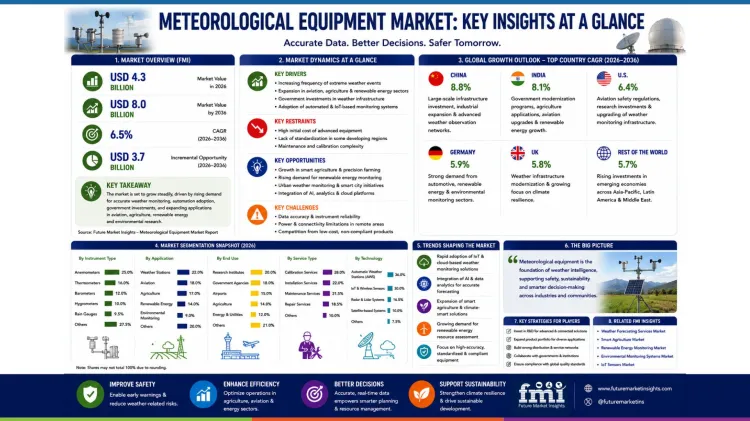
- FMI identifies research institutes as the largest visible end-use category at 20.0% in 2026, while airports, technical institutes, and scientific studies sit within the "other" end-use grouping.
- Anemometers lead the instrument category at 25.0%, reflecting the broad relevance of wind measurement across aviation, agriculture, industrial safety, and renewable energy.
- No single end use dominates every metric. Airports lead in system value, agriculture in sensor-network volume, and renewable energy in specialist measurement intensity.
Meteorological equipment demand does not move evenly across end uses. A standard weather station deployed for agricultural advice carries a very different commercial profile from an airport automatic weather observing system. A wind farm resource-assessment site needs different instruments from a crop-monitoring network. A research institute may buy high-accuracy equipment for long-term measurement, while a solar developer may need irradiance sensors, data loggers, and telemetry to support project development and operations.
The key question is not only which end use buys the most equipment. It is which end use creates the most attractive demand for a particular type of supplier.
FMI values the meteorological equipment market at USD 4.3 billion in 2026 and forecasts USD 8.0 billion by 2036. Research institutes account for 20.0% of the end-use segment, while anemometers hold 25.0% of instrument demand. Airports, weather stations, environmental studies, technical institutes, and scientific studies sit within the wider end-use taxonomy, but the public report page does not publish individual shares for airports, agriculture, or renewable energy.
That makes a direct numeric ranking between airports, agriculture, and renewable energy inappropriate without project-level data. The stronger approach is to compare them through the type of equipment they require, procurement cycle, installation density, system complexity, and buyer willingness to pay.
Airports Carry the Highest System Value per Location
Airport meteorology is one of the more demanding end-use environments because operational decisions depend on real-time, reliable, and standardised weather data. Runway operations require wind speed and direction. Low-visibility conditions require visibility and runway visual range information. Aircraft approach and landing operations need cloud-base data, pressure, temperature, humidity, and atmospheric information.
An airport weather system is rarely a single sensor purchase. It usually forms a system comprising anemometers, barometers, thermometers, hygrometers, ceilometers, transmissometers, data-processing platforms, communications interfaces, displays, alarms, and sometimes backup or redundancy architecture.
ICAO documentation on automated weather observing systems shows the range of parameters involved. Automated aviation systems may measure or assess wind, visibility, runway visual range, cloud-base height, air temperature, dew-point temperature, and atmospheric pressure.
This makes airport projects attractive for suppliers of premium meteorological systems. The equipment must remain dependable, accurately sited, maintained, calibrated, and integrated into aviation weather reporting and air-navigation communications. The project cycle can run long because procurement often involves civil aviation authorities, airport operators, meteorological agencies, and regulatory approvals.
The value per airport can therefore run high. A major international airport may require multiple observation points, runway-specific systems, data transmission, redundancy, and specialized instruments. The barrier to entry also runs high. Suppliers must demonstrate technical capability, service support, compliance alignment, and long-term maintenance capacity.
India illustrates this demand pattern. ICAO material states that IMD has initiated integrated Automatic Weather Observing Systems, including runway visual range systems, at 18 airports with more than 500 weekly flights. These systems monitor parameters such as wind direction, wind speed, air temperature, dew point, humidity, pressure, runway visual range, and cloud cover.
The airport segment may not generate the highest number of sensor units globally, but it creates high-value, specification-intensive installations. Suppliers serving this market are likely to compete on accuracy, certification, maintenance, communication reliability, and system integration rather than only device price.
Agriculture Creates the Broadest Distributed Network Opportunity
Agriculture represents a different demand model. A farm does not need the same level of aviation-grade redundancy. It often needs local, practical, and timely information. Rainfall, air temperature, humidity, wind, soil moisture, solar radiation, leaf wetness, evapotranspiration, and frost conditions can all affect irrigation, crop protection, disease risk, spraying, harvest timing, and water use.
The commercial opportunity comes from deployment density.
One airport may require a sophisticated system. One agricultural region may require hundreds or thousands of smaller weather-monitoring points. The adoption model can include agricultural universities, government extension programmes, irrigation authorities, agri-tech firms, crop insurers, cooperatives, greenhouse operators, plantation owners, and large commercial farms.
The WMO work on agrometeorological observation includes technical material on automatic weather stations for agricultural applications. This indicates that agricultural weather measurement is not simply a consumer use case. It forms part of a structured effort to improve climate resilience, crop advisory, risk management, and farm decision-making.
The equipment mix is also broad. A basic agricultural station may use a thermometer, hygrometer, rain gauge, anemometer, solar radiation sensor, soil probe, and data logger. More advanced systems may include disease-risk models, irrigation control links, cloud dashboards, mobile alerts, and remote sensing integration.
Agriculture is especially relevant in countries where weather risk affects a large share of livelihoods and food production. India's weather-monitoring networks are expanding in response to urban flooding, monsoon variability, agricultural needs, and disaster preparedness. IMD's dense AWS and automatic rain-gauge networks illustrate how local observations can support real-time alerts and operational decision-making.
The commercial limitation is price sensitivity. Many farms cannot afford high-end stations without government support, cooperative models, leasing, service subscriptions, or data-platform partnerships. Agricultural suppliers need to balance sensor cost, ruggedness, installation ease, battery life, wireless connectivity, and farmer usability.
This means agriculture may create the largest unit opportunity for affordable connected sensors, even when airport systems create higher revenue per installation.
Renewable Energy Is Becoming a Specialist Measurement Market
Renewable energy is the most specialised of the three end uses. Solar projects need irradiance, temperature, humidity, dust, wind, and atmospheric data. Wind projects need wind speed, wind direction, turbulence data, atmospheric pressure, temperature, and long-term resource measurements. Hybrid projects and green hydrogen facilities depend on reliable renewable-resource information for sizing, operating, forecasting, and optimizing assets.
Meteorological equipment has a direct operational role in renewable energy. In a wind project, anemometers and wind vanes are not simply weather instruments. They help determine resource availability, turbine siting, expected output, and operational performance. In a solar project, pyranometers, irradiance sensors, temperature sensors, and soiling measurements can support generation forecasts and maintenance decisions.
The FMI finding that anemometers account for 25.0% of instrument demand is particularly relevant here. Wind data is essential across aviation and industrial safety, and renewable energy adds an expanding commercial case for precise wind measurement.
India's renewable energy policy environment supports this opportunity. MNRE states that it works with the National Institute of Wind Energy and BISAG-N to make solar radiation and wind speed resource maps available through the Gati Shakti platform. This confirms that meteorological data is being treated as a planning input for renewable energy development rather than a peripheral service.
India's wider renewable energy base also provides demand context. MNRE material notes that the country ranked fourth globally in renewable energy installed capacity and wind power capacity, and fifth in solar power capacity based on IRENA statistics cited by the ministry.
Renewable energy buyers are often willing to pay more than agricultural users for reliable instruments because the financial consequence of inaccurate resource data can run significant. A poor wind measurement can affect turbine selection or site estimation. Weak solar data can affect output modelling, financing assumptions, and maintenance planning. This raises the value of calibrated, traceable, project-grade sensors.
The challenge is that this market is more specialised. It does not require the same number of weather stations as agriculture, and it does not hold the formal safety-critical requirements of aviation. It rewards suppliers that understand energy-project engineering, bankability, data quality, and integration with asset-performance systems.
The Three End Uses Have Different Buying Logic
The comparison can be organised through three questions.
Which segment creates the largest system value per site? Airports are likely to lead because a single aviation weather installation requires multiple instruments, high availability, communications, standards alignment, and long-term support.
Which segment creates the largest number of distributed deployment points? Agriculture appears strongest because farms, irrigation zones, plantations, research stations, agricultural extension programmes, and digital advisory platforms all need local measurements.
Which segment creates the strongest specialist demand for high-quality measurement? Renewable energy is likely to lead because wind and solar project development depends on resource assessment, monitoring accuracy, and data continuity.
There is also overlap. Airport weather stations may include renewable-grade wind sensors. Agricultural networks may support water-resources management and environmental research. Renewable projects may use IoT-connected weather stations that resemble agricultural systems but require stronger calibration and operational data quality.
The most effective suppliers are unlikely to treat these sectors as one meteorological equipment market. They will build sector-specific offers.
For airports, the product package should include aviation-compliant sensors, runway weather systems, data-processing software, redundancy, calibration, and maintenance agreements.
For agriculture, the offer may focus on modular AWS platforms, rain gauges, soil sensors, mobile connectivity, cloud dashboards, irrigation integration, and lower-cost deployment models.
For renewable energy, the offer should combine resource-grade anemometers, wind vanes, radiation sensors, data loggers, telemetry, calibration, and integration with project analytics.
Research institutes remain important because they provide a stable base for high-accuracy instruments and long-term environmental studies. The FMI 20.0% research-institute share indicates that formal scientific procurement is still the largest visible end-use category in the published segmentation.
The market therefore does not have a single end-use winner. Airports are likely to drive premium system value. Agriculture is likely to drive deployment scale. Renewable energy is likely to drive specialised, high-accuracy instrumentation. Suppliers should choose their growth path based on whether they are built for regulated systems, distributed networks, or energy-grade measurement.

