


- Allergen-free food is not only a claim-led market. It is a manufacturing discipline built around ingredient qualification, segregation, testing, and cross-contact control.
- Gluten-free leads claim type because it has broad shopper recognition and applies across bakery, snacks, ready meals, pantry staples, and packaged foods.
- Bakery and snacks lead product category demand because they are high-frequency household products, but they also create difficult texture, taste, and cross-contact challenges.
- Retailers and supermarkets support mainstream conversion, but they require reliable suppliers that can deliver safe, repeatable, clearly labelled products.
- The real capacity bottleneck is not only production volume. It is validated allergen controls, supplier documentation, cleaning protocols, and consistent formulation performance.
- The biggest misconception is that allergen-free scale is achieved by removing one ingredient. In reality, allergen-free scale requires a controlled production ecosystem.
The Allergen-Free Food Market is often described as a consumer demand story, but the stronger commercial reality is operational. Consumers want safe, clearly labelled products, but brands can only build repeat purchase when production systems are disciplined enough to make allergen-free claims reliable.
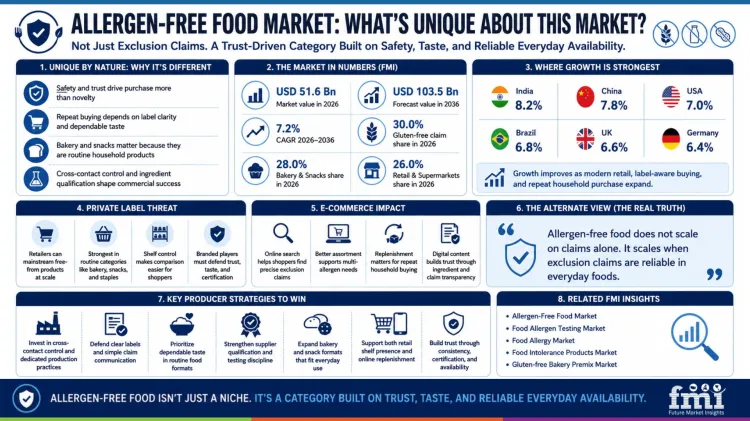
FMI’s preview identifies gluten-free as the leading claim type with 30.0% share in 2026. This is not surprising because gluten-free has the widest shopper recognition and works across many everyday categories. Bread, biscuits, snacks, pasta, breakfast foods, ready meals, and baking mixes can all carry the claim. However, broad recognition also raises execution pressure. A familiar claim invites more purchases, but it also creates higher expectations around safety and taste.
The production problem is particularly evident in the bakery and snacks category, which FMI considers the dominant category with a market share of 28.0% in 2026. Bakery and snack items are basic necessities in every home, so the absence will be immediately noticed by consumers. For instance, when a household needs an allergen-free bread, cookie, cracker, lunch item, or breakfast item, the household is expecting a replacement without compromising on taste and texture.
This makes the Gluten-free Bakery Premix Market highly relevant. Gluten-free bakery is technically difficult because gluten contributes structure, elasticity, gas retention, chew, and volume. When gluten is removed, manufacturers must rebuild texture through starches, fibers, hydrocolloids, proteins, enzymes, and processing adjustments. The claim may be simple, but the formulation work is complex.
Cross-contact control is key to addressing the central capability concern. It is impossible to create allergen-free food products without strict line discipline. Shared lines, shared storage facilities, air-born particles, ingredient management, cleaning validation, and package segregation are all important. The formulation might be perfect; however, failure in production facilities can lead to a lack of consumer confidence.
The Food Allergen Testing Market supports this point because allergen-free credibility depends on verification. Testing is not just a compliance activity. It helps manufacturers prove that cleaning, segregation, and supplier controls are working. As allergen-free products move from specialty shelves into mainstream retail, testing and documentation become part of commercial readiness.
Another potential choke point lies in the qualification of ingredients. The producers will require suppliers who will be able to determine the allergen nature of ingredients, provide traceability, deal with processing aids and maintain consistency in the specifications. In case of allergen-free products, the procurement process is not just about the cost. The supplier should be able to defend the claim on the product.
The Food Intolerance Products Market is also relevant because consumers often shop across allergen-free, intolerance-friendly, and free-from categories together. This means manufacturers may need to manage multiple exclusions at once: gluten-free, dairy-free, nut-free, soy-free, egg-free, or multi-allergen-free. Each additional claim increases formulation and production complexity.
Confidence on the part of the retailer is vital. According to FMI, the sales channel category of retail & supermarkets holds a leading position in 2026, having a share of 26.0%. The point is that mainstream retailers will not be interested in producing products free from allergens that will generate recalls and inconsistency in the shelves.
The Food Allergy Market provides the broader demand context. Households dealing with allergy risk are cautious. They inspect labels, remember brands that feel safe, and punish uncertainty. This makes allergen-free food more trust-driven than trend-driven.
There needs to be three levels to capacity definition. First is formulation capacity. Is the manufacturer capable of developing a taste good product without the use of the excluded allergen? Second is production capacity. Is the manufacturer able to operate with validated controls? The third level is commercial capacity.
The most successful companies will make commitments to investing in dedicated lines, cleaning validation, supplier qualification, allergen testing, and reusable formulations. They will not see allergen free as an add-on line extension. They will create capabilities that can help them succeed across bakery products, snack items, ready meals, children’s foods, drinks, and confectioneries.
The misconception to be avoided is that allergen-free scaling is just the removal of one ingredient. Elimination of gluten, dairy, nuts, soy, or eggs is just the beginning. It is in finding replacements, avoiding cross contact, and maintaining the quality so that it becomes suitable for regular purchases by consumers.
Bottom line: Allergen-free food capacity is not only about producing more products. It is about producing safer, better, more repeatable products through controlled sourcing, validated manufacturing, and reliable cross-contact management.

