


- Ambulatory Surgical Centers Market is valued at USD 110.1 billion in 2026 and is projected to reach USD 171.0 billion by 2036, growing at a CAGR of 4.5% during the forecast period as healthcare systems are increasingly shifting procedures to lower-cost outpatient settings.
- Ambulatory surgical centers (ASCs) face reimbursement pressure as one of their biggest operational challenges, with implications for profitability, procedure mix, and investment decisions.
- Government and commercial payers are more aggressively pursuing cost-containment initiatives, which are resulting in slower reimbursement growth and, in some instances, declining payment rates for certain outpatient procedures.
- Different levels of reimbursement pressure exist for orthopedic, pain management, gastroenterology, ophthalmology and cardiovascular procedures according to the complexity of the procedure, clinical outcomes and payer policies.
- Bundled payment programs and value-based reimbursement models are altering the way that ASCs assess procedure profitability and resource utilization.
- Margin compression is being driven by rising labor, equipment and supply costs, while reimbursement increases often lag operational costs.
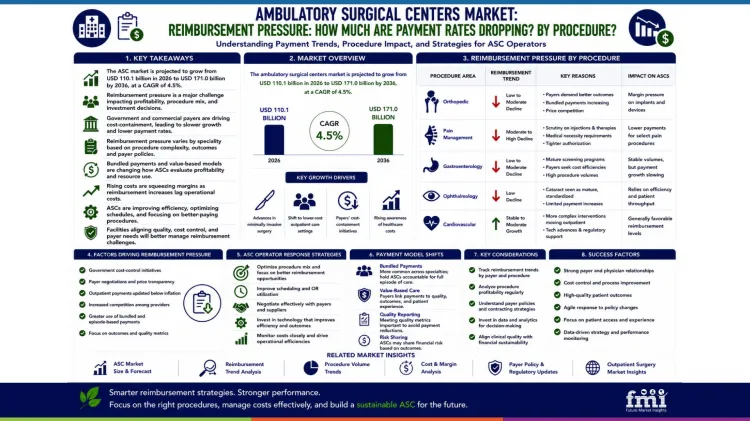
The ambulatory surgical centers market is growing because healthcare providers, payers, and patients prefer outpatient surgical care over traditional inpatient hospital settings. The market is expected to grow from USD 110.1 billion in 2026 to USD 171.0 billion by 2036, growing at a CAGR of 4.5% over the forecast period. Advances in minimally invasive surgery and growing awareness of healthcare costs to shift procedures to lower-cost care settings are supporting growth.
As the ASC industry changes, the reimbursement environment is becoming a key driver of financial performance. Outpatient surgery volumes continue to rise but reimbursement rates are coming under greater scrutiny from public and private payers looking to control healthcare costs. For this reason, it is important for ASC operators, investors and healthcare providers to understand reimbursement trends by procedure category.
Previously, ASCs were beneficiaries of favorable reimbursement policies that encouraged moving procedures out of hospitals. Payers saved significant amounts while maintaining quality outcomes, thanks to lower operating costs and shorter patient stays. But the growth in reimbursement has slowed as outpatient care has become more common and competitive pricing pressures have increased.
One of the primary factors driving reimbursement pressure is the continued efforts of government healthcare programs to reign in rising healthcare costs. Annual updates to outpatient procedure payments often fall behind inflation and rising costs of operations. Although reimbursement changes differ by procedure category, many ASC operators say the payment increases are not enough to make up for the rising costs of staffing, technology adoption, regulatory compliance and facility operations.
Orthopedic procedures remain some of the most important revenue generators for ASCs, particularly joint replacements, arthroscopic procedures and sports medicine procedures. The number of procedures continues to increase, but the growth in reimbursement is becoming more limited. Many payers are requiring providers to demonstrate measurable clinical outcomes and cost efficiencies before approving higher reimbursement levels. Bundled payment arrangements are also increasing the financial accountability of providers across the episode of care.
Pain management procedures have received especially intense scrutiny with regard to reimbursement in recent years. Some payers are reviewing the use and clinical effectiveness of certain injections and interventional pain therapies resulting in reductions in payment for these services. Insurers are demanding more evidence of medical necessity, which is resulting in tighter authorization requirements and downward pressure on reimbursement rates for selected services.
Strong patient demand for gastroenterology procedures continues, particularly colonoscopies and diagnostic endoscopic procedures. But reimbursement growth in this sector has slowed as preventive screening programs mature and insurers look for added cost efficiencies. Still, large volumes of procedures continue to make gastroenterology among the more resilient specialties within many ASC portfolios, despite these pressures.
Reimbursement for ophthalmology procedures is mixed. Cataract surgery remains one of the most frequently performed outpatient procedures worldwide. This is driven by aging populations and increasing demand for vision correction services. But payments have grown only modestly, as payers view cataract surgery as a mature, highly standardized category of procedures. Healthcare facilities have become more reliant on operational efficiency and patient throughput to achieve profitability.
Cardiovascular procedures are one of the fastest growing segments within ambulatory surgery. Regulatory changes and technological advances are allowing more cardiovascular interventions to be performed in outpatient settings. Given the complexity of many of these procedures, reimbursement rates for many cardiovascular procedures remain relatively attractive. Still, with increasing volumes of procedures, payers continue to monitor utilization closely.
Commercial insurers are feeling the squeeze of reimbursement from network negotiations and value-based contracting initiatives. Insurers are increasingly asking ASCs to demonstrate better patient outcomes, fewer complications and lower readmission rates. Facilities with poor performance data may face less favorable reimbursement terms upon contract renewal.
ASCs are moving toward value-based payment models. Historically, fee-for-service models have been based on volume of procedures, while value-based models are based on clinical outcomes and cost efficiency. Reimbursement is increasingly tied to metrics such as quality indicators, patient satisfaction scores and effectiveness of care, not just the volume of procedures performed.
Another major challenge is the widening gap between the growth of reimbursement and the rise in operating expenses. Wage costs have risen significantly because of shortages of nurses, anesthetists and surgical support staff. At the same time, the costs of surgical instruments, implants, disposable supplies, information technology systems and regulatory compliance continue to rise. Profit margins in ASCs are coming under increasing pressure when cost increases outpace growth in reimbursement.
The pressure to reimburse affects specialties differently in the ASC setting. Facilities benefit from economies of scale, so high-volume procedures with standardized workflows can often remain financially viable with modest reimbursement growth. But, more specialized procedures may be less profitable if reimbursement adjustments are not reflective of the complexity of the procedure and resources needed.
Geography also contributes in reimbursement trends. Payment structures vary by geography, driven by local concentration of payers, healthcare regulations and market competition. Some markets have a relatively favorable reimbursement environment, while others are more aggressive in cost control measures. When ASC operators are planning for growth and capital expenditures, they tend to look at the local reimbursement environment.
Technology adoption is also increasingly affecting reimbursement performance. Facilities can improve operational efficiency and reduce administrative costs with advanced analytics, electronic health records, AI-powered scheduling systems and automated revenue cycle management tools. The ability to do more with less is becoming more and more valuable as reimbursement pressures increase.
Consequently, many ASC operators are changing their mix of procedures. Facilities are concentrating on specialties and procedures with high patient demand and sustainable reimbursement economics. Strategic partnerships with physician groups, hospitals and payers are also on the rise as providers look to gain more negotiating leverage and operational scale.
The notion that reimbursement challenges are a payer-driven issue is becoming increasingly outdated. In the modern ASC environment an organization must be able to deliver efficiency, quality outcomes, cost containment and integration with evolving reimbursement models to be successful. Facilities that anticipate these changes are often better able to sustain margins and support long-term growth.
As health systems continue to shift care to outpatient settings, reimbursement policy will continue to be a key driver of ASC competitiveness. The next decade should see steady growth in procedure volumes, but providers must be prepared for ongoing scrutiny of payment rates, increasing calls for value-based reimbursement, and continued cost-containment efforts by both public and private payers.
Bottom Line
Reimbursement pressure is becoming a key determinant in the ambulatory surgical centers market. Despite the continued growth in outpatient procedure volume, payment growth often lags behind the rising costs of operations. Orthopedic, pain management, gastroenterology, ophthalmology and cardiovascular procedures all carry varying reimbursement dynamics that affect profitability and investment decisions. The ASCs most likely to thrive will be those that can blend clinical excellence with operational efficiency and strong payer alignment, adjusting to reimbursement models that are increasingly driven by outcomes.

