


- Animal feed additive adoption is shaped by authorization status, species-specific use conditions, safety dossiers, and label credibility.
- Large feed mills and integrators need suppliers that can support formulation, dosage, regulatory files, and on-farm validation, not only ingredient supply.
- Direct technical selling matters because additives are often tested, approved, and scaled through nutrition managers and premix teams before broad rollout.
- Supplier switching is slower when approvals, claims, trial data, and compatibility evidence must be revalidated across species and regions.
- Documentation quality becomes a commercial advantage where retailers, regulators, and livestock buyers demand traceable and compliant inputs.
- The misconception to avoid is that feed additives compete only on efficacy. They also compete on permission to use, proof to claim, and confidence to scale.
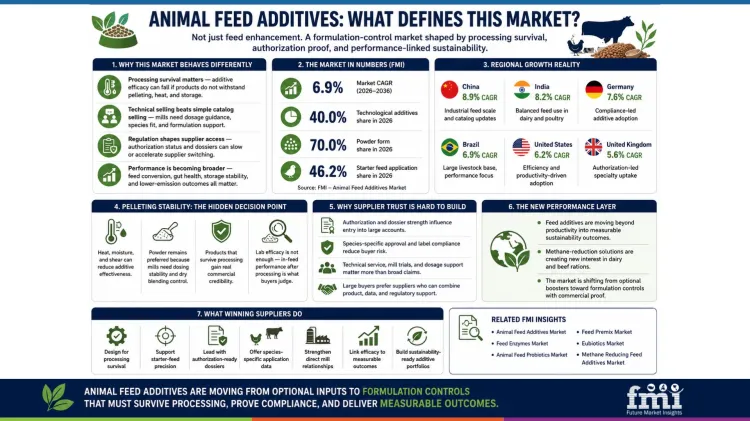
Animal feed additives are not sold like ordinary feed raw materials. They sit inside a regulated, technical, and species-specific procurement environment. A product may have strong biological potential, but it cannot scale if the buyer lacks confidence in its authorization status, safety dossier, label instructions, dosage guidance, and field evidence. This makes supplier trust a market structure issue, not only a marketing issue.
The Animal Feed Additives Market is therefore well suited to an evergreen benchmark angle focused on authorization and documentation. Feed additive buyers are not simply asking whether an ingredient is promising. They are asking whether it is approved for the target market, suitable for the target species, stable in the intended feed form, compatible with the ration, and supported by evidence that can withstand customer and regulatory scrutiny.
FMI’s Animal Feed Additives Market definition covers additives used in livestock, poultry, aquaculture, and companion animal feed, including preservatives, stabilizers, sweeteners, flavor enhancers, vitamins, minerals, amino acids, enzymes, probiotics, and specialty functional additives. This breadth matters because each category has different approval, dosage, and claim requirements. A preservative system, probiotic strain, enzyme blend, flavor enhancer, mineral source, and methane-reduction additive do not carry the same evidence burden.
Authorization is a practical gate. In many markets, additives cannot be sold or used freely without meeting local regulatory requirements. Even when the active ingredient is familiar, the specific source, manufacturing process, species, dose, and intended claim can affect approval. This creates friction for new entrants but protects suppliers with strong regulatory teams and established technical files.
The importance of documentation is visible in high-value additive categories. Enzymes require activity declarations, storage stability data, species fit, and feed-processing guidance. Probiotics require strain identity, viability, safety, and benefit logic. Prebiotics and eubiotics often need gut-health positioning without overstepping into medical claims. Palatability enhancers need intake and masking data. Mineral and vitamin systems need bioavailability and dosage control. The supplier’s dossier becomes part of the product.
The Feed Enzymes Market is a good example of why documentation matters. Enzyme buyers need more than a catalogue description. They need to know activity units, thermal stability, substrate fit, recommended inclusion level, compatibility with pelleting, and expected performance under commercial conditions. If a supplier cannot explain why an enzyme works in a corn-soy poultry ration, a wheat-based swine ration, or an aquaculture feed, adoption slows.
The Animal Feed Probiotic Market adds another layer because strain identity is central. A probiotic cannot be treated as a generic bacterial category. Buyers need strain-level clarity, viability through shelf life, safety support, and practical instructions on inclusion and handling. Multi-strain and single-strain systems may both be valuable, but the commercial question is whether the supplier can prove the intended effect in the relevant animal and feeding system.
The Eubiotics Market is relevant because antibiotic-reduction programs have increased demand for gut-health alternatives such as probiotics, prebiotics, organic acids, essential oils, and phytogenic systems. However, these inputs are also more exposed to claim discipline. Suppliers must avoid positioning that sounds like veterinary treatment unless authorized. The strongest suppliers provide language that nutrition teams can use safely in commercial communication and customer audits.
Direct sales and technical service are therefore important. FMI identifies direct sales as a meaningful route in the animal feed additives ecosystem because large feed mills need supplier dosage support before broad account rollout. Complex additives are rarely adopted through a purely transactional channel. They are tested, compared, validated, and scaled through nutritionists, procurement teams, quality managers, and operations leads. A supplier that can support these stakeholders gains advantage.
Supplier switching is also slower in feed additives than in many bulk ingredients. Replacing a commodity grain source may involve price and logistics. Replacing an enzyme, probiotic, preservative, mineral system, or acidifier may require lab testing, feed trial validation, label review, species-specific recalibration, and customer approval. This creates switching costs for buyers and relationship value for suppliers with trusted documentation.
The Feed Premix Market shows why downstream blending context matters. Additives often enter final feed through premixes, and premix manufacturers need ingredient documentation that supports batch control, storage, stability, and regulatory compliance. When additive suppliers provide clear certificates, specification sheets, allergen or contaminant statements, and safety files, they reduce friction for premix partners.
Traceability is becoming more important as food retailers and animal protein buyers increase scrutiny over the supply chain. Poultry, pork, dairy, beef, aquaculture, and egg supply chains are under pressure to document antibiotic policies, sustainability claims, animal welfare compliance, and ingredient sourcing. Feed additives are small in inclusion rate, but they can carry large reputational risk if documentation is weak.
The Trace Minerals in Feed Market is a useful related reference because trace minerals are purchased through technical B2B relationships where dosage, species fit, and documentation matter. This logic applies across the broader additive market. Small ingredients can have significant biological effects; therefore, buyers need confidence in source, form, stability, and safe use.
For suppliers, the benchmark is no longer only efficacy. It is efficacy plus permission plus proof. A strong commercial file should include regulatory status, species approvals, recommended dosages, stability data, safety information, trial summaries, storage instructions, compatibility notes, and claim guidance. Suppliers that make this easy for customers lower the buyer’s adoption risk.
The misconception to avoid is that feed additives compete only on performance. Performance is critical, but it is not sufficient. An additive that works but is difficult to approve, explain, document, or scale will lose to a slightly less dramatic product that is easier for customers to use with confidence.
Bottom line: supplier trust in animal feed additives is built through authorization, dossier quality, technical support, and field validation. The market rewards suppliers that make adoption safe, documented, and repeatable.

