


- The black maca extract market is projected to reach USD 126.3 million in 2036 from USD 70.5 million in 2026, at a CAGR of 6.0% driven by the growing demand for botanical-based nutraceutical ingredients and functional wellness formulations.
- Buyers are re-evaluating the dangers of single-source suppliers of botanical extracts as supply chain resilience becomes a key procurement priority.
- Companies with a single country or single supplier sourcing model are more exposed to raw material volatility, logistics disruptions and regulatory bottlenecks.
- As supply continuity becomes more critical, diverse supplier networks are a growing competitive advantage for buyers across geographies and production ecosystems.
- China continues to be a major manufacturing hub, but sourcing strategies are growing multi-origin with new suppliers in India and Latin America considered more and more.
- Suppliers are increasingly chosen on the basis of resilience factors like redundancy, geographic dispersion, backup manufacturing capacity and ability to contingency plan.
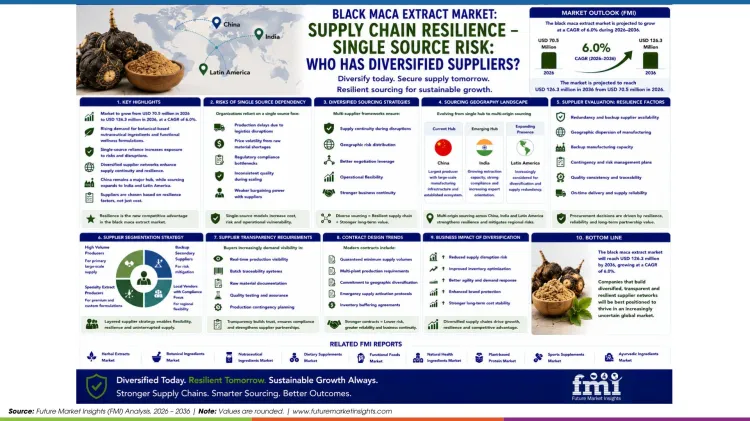
The market for black maca extract is steadily growing, with rising needs for plant-based wellness ingredients in dietary supplements, functional food and pharmaceutical formulations. The market is projected to increase from USD 70.5 million in 2026 to USD 126.3 million by 2036, at a CAGR of 6.0% during the forecast period. Growth is driven by a rising consumer interest in energy enhancement, hormonal balance and natural solutions that promote cognition and vitality.
As demand rises, the structure of the supply chain becomes a key determinant of the procurement strategy.
In contrast to many standardized commodity ingredients, black maca extract is very dependent on the agricultural source, climate stability and processing consistency. This makes it particularly vulnerable to breakdowns in the supply of raw materials and logistical networks.
Hence, supply chain resilience has become one of the most important criteria for evaluation in procurement decisions.
Historically, the sourcing decisions of botanical extracts were primarily cost- and supplier relationship-driven. A huge number of buyers were heavily reliant on single country sourcing models, especially from large manufacturing hubs.
But recent global disruptions have significantly changed procurement priorities.
Single-source dependency has been exposed by events such as logistics breakdowns related to the pandemic, geopolitical trade tensions and the volatility of shipping costs.
This has resulted in a structural shift towards diversified supplier ecosystems.
One of the most important questions today for procurement teams is not where to source black maca extract, but how many sourcing channels are needed for an uninterrupted supply.
Single source dependency has a lot of structural risks.
Single-supplier or single-geography organizations may see:
- Production delays caused by disruptions in logistics
- Price fluctuation caused by lack of raw materials
- Regulatory compliance bottlenecks
- Non-uniform quality in scaling periods
- Weaker bargaining power
Diversified sourcing strategies are now recognized as a vital component of supply chain risk management.
Multi-supplier frameworks allow procurement teams to source from multiple manufacturers and geographies. This ensures supply continuity in the event of a supplier or a region being disrupted.
From a production point of view, China is the largest producer globally, due to the large scale of its manufacturing infrastructure and an existing ecosystem for botanical processing. Increasingly, reliance on just one dominant sourcing hub is viewed as a strategic weakness, not strength.
As a result, many buyers are actively growing their supplier portfolios by adding secondary sourcing partners in India and selected Latin American markets.
In particular, India is emerging rapidly as a key strategic destination for diversification.
With rising extraction capacity, a dynamic regulatory compliance regime and a growing export focus, it provides an attractive option for buyers seeking supply chain redundancy.
India is increasingly being perceived not as a substitute for China but a complementary sourcing node in multi-country procurement architectures.
The two-sourcing model allows buyers to weigh the cost efficiency of supply against operational resilience.
Diversification strategies are moving beyond geography to supplier type and production capability.
More procurement teams are organizing suppliers into groups like these:
- High volume producers
- Backup secondary suppliers
- Specialty extract producers
- Local vendors with compliance focus
This layered supplier approach enables organizations to react proactively to changes in demand, supply disruptions or regulatory changes.
A further significant change is the growing importance of supplier transparency.
Today’s procurement frameworks measure suppliers on their ability to deliver:
- Production visibility in real time
- Traceability systems (batch)
- Documentation for obtaining raw material
- Quality assurance test procedures
- Production contingency plans
Suppliers without these capabilities are increasingly being removed from preferred vendor lists, irrespective of their cost competitiveness.
Supply chain risks are also changing the role of contract design.
Increasingly long-term contracts contain clauses on:
- Guaranteed minimum volume of supply
- Two production plant requirements
- Pledges to broaden geographic sourcing
- Protocols for emergency supply activation
- Inventory buffering accords
These contract structures are designed to mitigate the risk of unanticipated supply disruptions and to ensure continuity of production for downstream manufacturers.
Black maca extract dietary supplement applications are one of the major factors driving the growth of the black maca extract market. A stable supply chain is particularly important, as the quality of ingredients going into these products must be consistent.
Small interruptions in the raw material supply can cause major downstream consequences for formulation consistency and brand reputation.
As a result, supplement manufacturers are among the most aggressive adopters of multi-supplier sourcing models.
Another important dimension is logistics resilience.
Transportation bottlenecks, port congestion and volatility in freight costs are increasingly impacting sourcing decisions. Now procurement teams are assessing not only a supplier’s production capability but also its logistics reliability and strength of export infrastructure.
Suppliers who can provide integrated logistics support are gaining a competitive advantage in procurement evaluations.
The market misconception is that supply chain resilience is just about multiple vendors.
But true resilience comes from a structured diversification approach that takes into account geography, manufacturing capacity, compliance readiness and logistics reliability.
The black maca extract market is maturing and procurement sophistication is likely to grow further with resilience becoming a key strategic pillar instead of a secondary consideration.
Bottom line: Strategies for supply chain resilience are reshaping the competitive environment of the black maca extract market. 'Businesses that rely on single-source procurement models are at greater risk, while moving to diversified supplier ecosystems can help maintain continuity, manage cost volatility and ensure long-term operational stability'.

