


- Pet milk replacer sales are shifting from simple retail replacement buying toward a more specialized channel mix led by veterinary clinics, breeders, shelters, pet specialty stores, and online retaile rs.
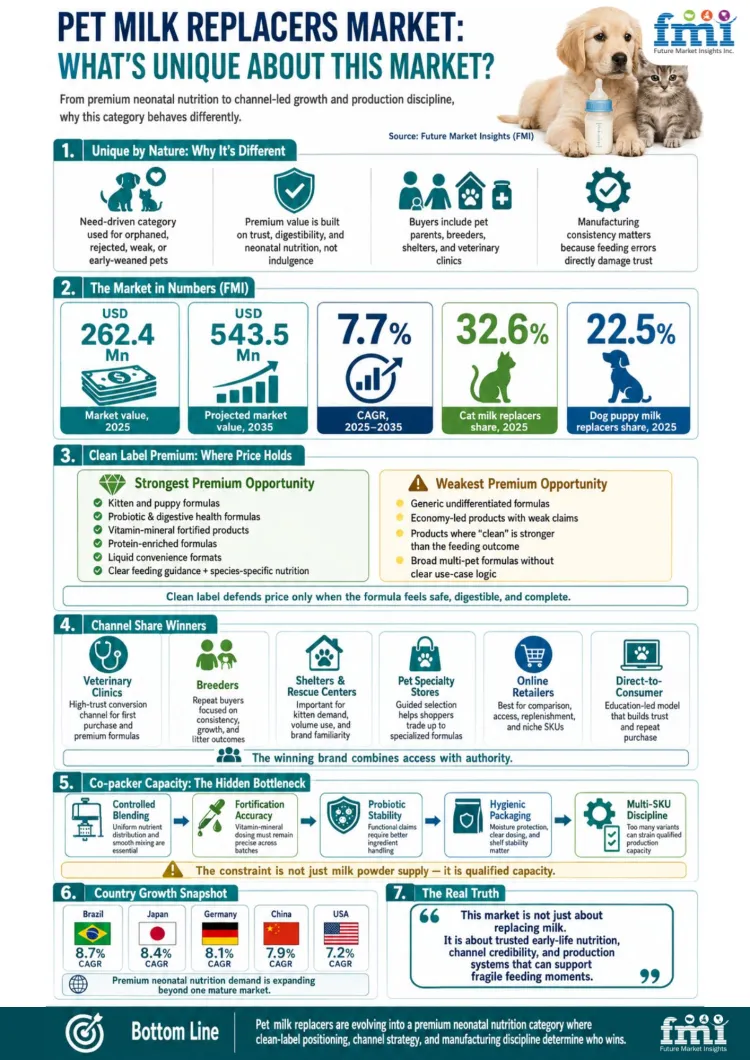
- FMI estimates the pet milk replacers market at USD 262.4 Mn in 2025, reaching USD 543.5 Mn by 2035 at a 7.7% CAGR.
- Cat milk replacers hold 32.6% share in 2025, making kitten care, rescue networks, and feline neonatal nutrition key demand pockets.
- Dog puppy milk replacers account for 22.5% share in 2025, supported by breeders, veterinary recommendations, and supplemental feeding needs.
- The strongest channel winners will be those that combine product availability, feeding education, veterinary credibility, and repeat-purchase convenience.
Channel strategy is becoming a decisive growth lever in the pet milk replacers market. This is not a category where consumers always browse casually and pick a product based on flavor, packaging, or discount. Many purchases happen under urgent conditions. A newborn kitten has been rescued. A puppy is rejected by the mother. A breeder needs to support a weak litter. A shelter needs reliable neonatal feeding stock. A veterinarian recommends supplemental nutrition.
That makes the channel structure very different from mainstream pet food. In regular pet food, brand loyalty and routine replenishment dominate. In pet milk replacers, the first purchase is often need-driven, advice-driven, and time-sensitive. The winning channel is the one that can provide trust and availability at the same time.
FMI’s outlook shows why this channel shift matters. The pet milk replacers market is valued at USD 262.4 Mn in 2025 and is projected to reach USD 543.5 Mn by 2035, growing at a 7.7% CAGR. This growth is being shaped by rising pet adoption, orphaned and early-weaned puppies and kittens, neonatal pet health awareness, functional formulations, and easier product access.
The market is not growing only because more pet owners are buying milk replacers. It is growing because different buyer groups are entering the category through different channels. Pet parents may buy online. Breeders may buy in bulk or through specialty suppliers. Veterinary clinics may recommend or dispense trusted products. Shelters may need cost-effective and reliable supply. Pet specialty stores may influence first-time buyers who need guidance.
This creates a channel share battle where no single route-to-market wins everywhere. The winners depend on urgency, trust level, pack size, product type, and buyer profile.
Veterinary clinics are one of the most important trust channels. In this market, veterinary recommendation can strongly influence purchase behavior because the buyer is often worried about survival, digestion, weight gain, or early development. A clinic-recommended milk replacer feels safer than a generic retail product, especially for underweight, weak, orphaned, or early-weaned pets.
The veterinary channel is especially important for medicated milk replacers, probiotic and digestive health formulas, and vitamin-mineral fortified products. These products require more explanation than standard formulas. A pet parent may not fully understand when to use a medicated product, how to feed a newborn, or how to identify digestive intolerance. Veterinary clinics help reduce that uncertainty.
However, veterinary clinics may not always be the largest volume channel. Their strength is influence. A clinic may trigger the first purchase, shape brand preference, and create trust in a specific formula. After that, the consumer may repeat the purchase through online retailers or pet specialty stores. This means veterinary clinics are not only a sales channel; they are a conversion channel.
Breeders represent a different type of channel opportunity. They are experienced users, repeat buyers, and highly outcome-focused. Breeders need products that support litter health, early growth, feeding consistency, and predictable performance. They are less likely to be persuaded by broad marketing claims and more likely to value reliability, bulk availability, and formula consistency.
For dog puppy milk replacers, breeders are particularly important. FMI indicates that dog puppy milk replacers account for 22.5% share in 2025. This segment is closely linked to supplemental feeding, weak puppies, rejected puppies, and early-stage growth support. Brands that can build breeder trust can create repeat demand beyond one-time emergency use.
Shelters and rescue centers are another important demand pocket, especially for kitten milk replacers. FMI indicates that cat milk replacers hold 32.6% share in 2025, making them the leading pet type segment. This leadership is strongly connected with kitten rescue, adoption, and early-life nutrition needs. Rescue organizations and shelters often care for abandoned or orphaned kittens, which makes reliable milk replacer access essential.
The shelter channel is more value-sensitive than the premium pet parent channel, but it should not be treated as low-value. Shelters can influence brand familiarity among adopters, volunteers, foster networks, and local veterinary partners. A product used by a shelter can become the product recommended to new pet parents. In that sense, shelters can work as both demand centers and awareness multipliers.
Pet specialty stores remain important because this is a guidance-heavy category. A first-time buyer may not know the difference between kitten milk replacer, puppy milk replacer, liquid formula, powder formula, fortified formula, probiotic formula, or medicated formula. Pet specialty stores can support education at the shelf through staff advice, visible claims, and proper product placement.
The pet specialty channel is strongest when the product requires comparison. If a buyer is choosing between standard powder, fortified powder, ready-to-feed liquid, and species-specific formula, the store environment can influence trade-up. Clean packaging, clear life-stage claims, and feeding instructions can help convert shoppers from basic products to premium formulas.
Supermarkets and mass retail have a different role. They can support availability and impulse access, but they may be less effective for specialized neonatal nutrition unless the category is clearly organized. In mass retail, pet milk replacers compete for attention against mainstream pet food, treats, and accessories. The buyer may compare price more aggressively, especially if the product appears generic.
This means the supermarket channel is better suited for established products, standard formulas, and high-availability SKUs. Premium and functional products may need stronger claims or shelf education to justify higher pricing in this environment.
Online retailers are becoming one of the most important growth channels because they solve two major problems: access and information. Pet milk replacers are not always available in every nearby store, especially for urgent or specialized needs. Online platforms allow buyers to compare formulas, read reviews, check feeding instructions, and access products quickly.
E-commerce also supports long-tail demand. A buyer looking for kitten formula, puppy formula, liquid format, probiotic formula, or fortified formula can search directly instead of relying on local store availability. This helps niche and premium products reach consumers more efficiently.
The online channel is also powerful because it supports repeat purchase. Pet milk replacer use may be short-term, but during the feeding period, replenishment can be urgent. Subscription options, fast delivery, bundled feeding kits, and educational content can improve retention. Brands that treat e-commerce only as a listing channel will miss the opportunity. The stronger strategy is to use online platforms as education, conversion, and replenishment channels.
Direct-to-consumer is a smaller but strategically useful route. It can help brands build trust through feeding guides, neonatal care content, formula comparison tools, and customer support. In a category where users often feel anxious, direct education can become a premium differentiator. D2C can also support bundles that include milk replacer, bottles, nipples, measuring tools, and feeding instructions.
B2B channels are equally important but often less visible. FMI includes B2B distribution across pet food manufacturers, private label producers, contract manufacturers, and bulk suppliers. This matters because pet milk replacers are not only sold as branded retail products. They can also move through private label, institutional, breeder, shelter, and manufacturing-linked channels.
Private label producers may benefit where retailers want affordable neonatal nutrition offerings. Contract manufacturers may benefit as brands develop specialized formulas without building their own production infrastructure. Bulk suppliers may support shelters, breeders, and regional distributors. These B2B channels can quietly shape supply availability and price competitiveness.
The strongest channel winners will be those that match the product to the buyer mission. A premium kitten milk replacer should win through veterinary clinics, online education, rescue networks, and pet specialty stores. A puppy growth-support formula should win through breeders, veterinary clinics, specialty stores, and bulk-friendly supply routes. A ready-to-feed liquid formula should win through convenience-led online and retail channels. A cost-efficient powder formula should win through shelters, mass retail, and bulk channels.
Country growth also affects channel strategy. FMI identifies Brazil as the fastest-growing country-level market at 8.7% CAGR through 2035, followed by Japan at 8.4%, Germany at 8.1%, China at 7.9%, and the USA at 7.2%. These markets will not develop through identical channels.
In Brazil, affordability, local availability, pet adoption, and veterinary access are likely to matter strongly. In Japan, premium neonatal care, cats, small dogs, and convenience-led purchasing can support specialized formulas. In Germany, product quality, sustainability, and pet specialty channels can influence premium demand. In China, online platforms and urban pet ownership can accelerate discovery and adoption. In the USA, veterinary influence, e-commerce, breeders, and rescue networks can all support demand.
The misconception to avoid is that e-commerce will replace all other channels. It will not. E-commerce improves access and comparison, but veterinary clinics build trust. Breeders create repeat professional demand. Shelters create volume and awareness. Pet specialty stores support guided selection. Supermarkets provide availability. B2B channels support scale and private label expansion.
For brands, the practical channel lesson is simple. Pet milk replacer buyers do not behave like ordinary pet food shoppers. They often enter the category through a problem. The brand that solves the problem fastest and most credibly wins.
The strongest brands will build a multi-channel strategy around the user journey. The first touchpoint may be a veterinarian, shelter, breeder, or rescue group. The second touchpoint may be an online search. The purchase may happen through e-commerce, pet specialty retail, clinic dispensing, or bulk procurement. The repeat purchase may happen through fast delivery or subscription.
Channel winners will also invest in education. Feeding instructions, life-stage guidance, formula selection charts, preparation videos, neonatal care content, and vet-backed recommendations can all strengthen conversion. In this category, information is not secondary. It is part of the product.
The premium channel opportunity is strongest in veterinary clinics, pet specialty stores, online retailers, breeder networks, rescue and shelter partnerships, and D2C education-led models. The weaker opportunity sits in undifferentiated mass retail shelves where the product is sold without guidance, claims, or feeding support.
Bottom line: channel share in the pet milk replacers market will be won by brands that combine access with authority. E-commerce may expand reach, but veterinary credibility, breeder trust, shelter adoption, and specialty retail education will decide which brands become preferred. In this market, the winning channel is not just the place where the product is sold. It is the place where the buyer feels confident enough to feed it.

