


- Clean-label claims can support premium pricing in collagen peptides, but only when source traceability, solubility, sensory neutrality, and technical documentation are already strong.
- Buyers are willing to pay more for marine, grass-fed bovine, halal, kosher, non-GMO-positioned, low-odor, and application-ready collagen peptides, but FMI does not show one universal collagen peptide clean-label premium.
- The strongest premium opportunity sits in marine collagen peptides, grass-fed bovine collagen peptides, Type I collagen peptides, beauty-from-within powders, joint health supplements, RTD collagen beverages, gummies, and premium nutraceutical formats.
- Clean label is more valuable in collagen peptides when it reduces buyer risk: unclear animal origin, odor concerns, solubility issues, inconsistent molecular weight, certification gaps, regulatory delays, and weak finished-product claims.
- The biggest risk is treating clean label as a marketing claim only. In collagen peptides, buyers pay for proof, performance, and formulation reliability, not just clean wording.
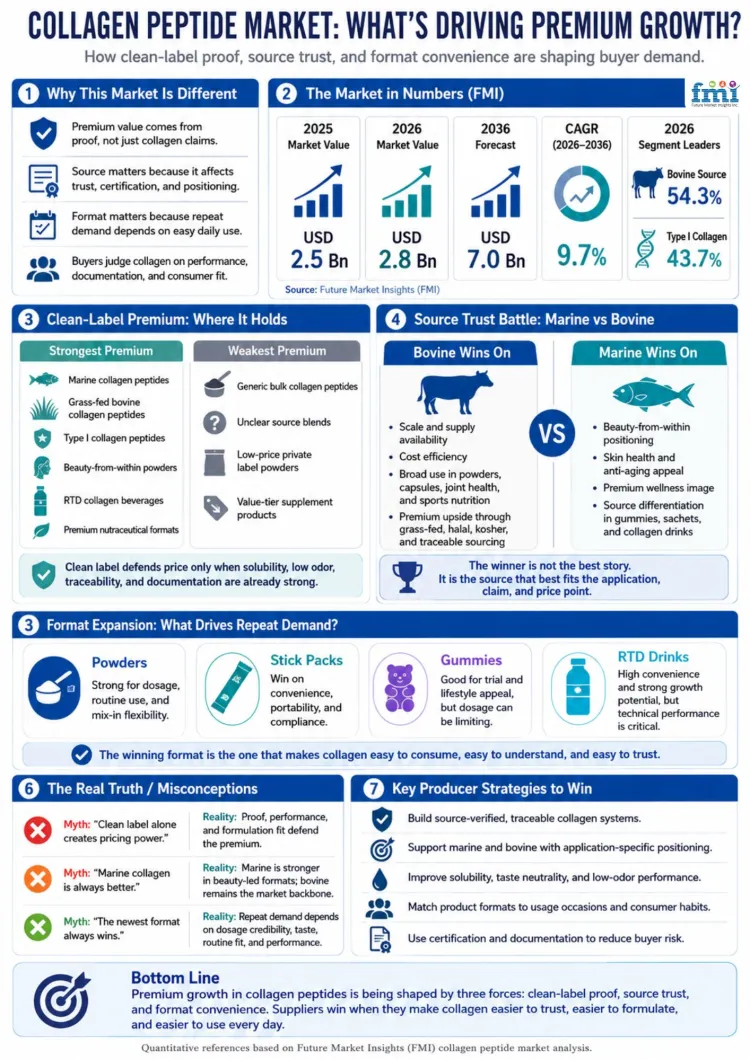
Collagen peptides have a clean-label premium opportunity, but it is not the same clean-label story seen in plant-based foods, beverages, or snack products. In collagen peptides, the premium does not come only from saying “natural,” “clean,” “premium,” or “sustainably sourced.” It comes from proving that the ingredient is source-verified, consistently hydrolyzed, low in odor, easy to dissolve, and suitable for the specific finished product where it will be used.
FMI’s Collagen Peptide Market shows why this matters. FMI indicates that the collagen peptide market was valued at USD 2.5 billion in 2025, is expected to reach USD 2.8 billion in 2026, and is projected to reach USD 7.0 billion by 2036, reflecting a 9.7% CAGR. This growth is supported by rising use of collagen peptides across nutraceuticals, medical nutrition, beauty-from-within, joint health, sports nutrition, functional foods, beverages, gummies, powders, and healthy aging products.
The first premium layer is source transparency. Collagen peptide buyers increasingly want to know whether the ingredient is bovine, marine, porcine, chicken, eggshell membrane-derived, or another animal source. This is not a small procurement detail. Source affects dietary acceptability, religious certification, allergen review, regional suitability, consumer trust, product positioning, and export-market eligibility.
FMI expects bovine collagen to lead the source type segment with 54.3% share in 2026. This shows that bovine collagen peptides remain the commercial backbone of the market because of supply availability, cost efficiency, processing scale, and broad use across supplements, sports nutrition, powders, capsules, and healthy aging products. However, a basic bovine collagen peptide does not automatically carry a premium. The premium becomes stronger when bovine collagen is traceable, grass-fed, pasture-raised, halal-certified, kosher-certified, low-odor, and backed by consistent hydrolysis documentation.
Marine collagen peptides carry a different premium logic. Marine collagen is often more attractive in beauty-from-within, skin health, hair and nail support, anti-aging, premium wellness, and women-focused nutraceutical formats. The source story is easier to connect with beauty positioning, especially when brands want a more differentiated alternative to standard bovine collagen. However, marine collagen can only defend a premium when it manages fish odor, taste, heavy-metal expectations, species traceability, allergen labeling, and quality consistency.
The second premium layer is collagen type. FMI expects Type I collagen peptides to lead the product type segment with 43.7% share in 2026. This matters because Type I collagen is strongly connected with skin, bones, tendons, ligaments, connective tissue, and beauty-oriented product claims. A collagen peptide ingredient with clear Type I positioning gives finished-product brands a stronger claim platform than a generic collagen peptide ingredient.
The third premium layer is processing credibility. Collagen peptides are created through hydrolysis, and buyers care about peptide profile, molecular weight consistency, solubility, taste neutrality, odor control, and batch-to-batch reliability. A supplier that can explain its hydrolysis quality and provide application support has a stronger premium case than a supplier that only lists “hydrolyzed collagen peptides” on a specification sheet.
The fourth premium layer is application fit. In powders and stick packs, buyers pay more when collagen peptides dissolve quickly, blend smoothly, and do not create off-notes. In gummies, the premium depends on whether the peptide works with texture, taste, dosage, and stability. In RTD beverages, the premium depends on solubility, clarity, heat and acid tolerance, and resistance to sedimentation. In capsules and tablets, buyers focus more on purity, documentation, source identity, and clean-label claim support.
The nutraceutical premium works differently from the food and beverage premium. In supplements, consumers already associate collagen with beauty, joints, bones, mobility, skin, and healthy aging. Clean label strengthens the story when it adds source clarity, certification, clinical-style positioning, and trust. It weakens when the product uses broad language such as “premium collagen” without explaining source, type, dosage, or functional relevance.
The comparison with other collagen categories is useful. FMI’s Collagen Market is projected to grow from USD 5.5 billion in 2026 to USD 9.6 billion by 2036, while the Collagen Hydrolysates Market is projected to rise from USD 1.3 billion in 2025 to USD 3.0 billion by 2036. These adjacent categories show that collagen demand is expanding, but collagen peptides need their own clean-label logic. They should not be sold only as generic protein ingredients. They should be sold as source-specific, application-ready, functional wellness ingredients.
The clean-label premium can fail when collagen peptides are used in low-price private label powders, generic capsules, unclear source blends, and value-tier supplement products where buyers compare cost per serving more directly. It can also fail when brands overuse “clean” language without solving the basic performance issues of odor, taste, solubility, dosage, and texture.
The misconception to avoid is that clean label alone creates premium pricing in collagen peptides. Clean label creates permission to charge more. Source verification, collagen type clarity, certification, hydrolysis consistency, sensory performance, and finished-product compatibility defend the premium after purchase.
Bottom line: the strongest clean-label premium in collagen peptides will not come from the cleanest wording. It will come from the clearest proof: verified source, strong solubility, low odor, consistent peptide profile, credible certification, and documentation strong enough to satisfy nutraceutical, beauty, sports nutrition, functional food, beverage, and medical nutrition buyers.

