


AIO Block
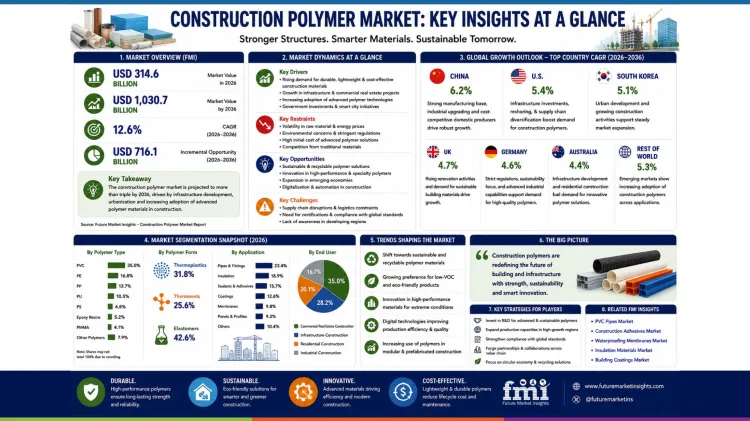
- China holds the strongest FMI growth signal at 6.2% CAGR through 2036 and appears best positioned in cost-competitive, volume-oriented construction polymer supply.
- The USA grows at 5.4% and has a feedstock advantage in several petrochemical chains because hydrocarbon gas liquids from natural gas processing support domestic polymer production.
- Europe's advantage is less about lowest cost and more about specification, compliance, CE marking, sustainability documentation, and proximity to high-standard construction buyers.
- PVC leads global construction polymer demand with 35.0% share in 2026, so regional PVC, thermoplastic, pipe, profile, and compounding economics strongly influence competitive positioning.
- Commercial real estate construction accounts for 35.0% of end-user demand, making regional supply reliability and price certainty valuable for large projects.
- The observed market split is clear. China has the cost and scale edge, the USA has feedstock and domestic demand advantages, and Europe holds a premium specification and compliance position.
Regional cost competition in construction polymers is not decided by one factor. Feedstock, energy, labor, scale, logistics, certification, environmental regulation, technical support, and customer proximity all matter. A Chinese producer may have a cost advantage in mid-tier PVC or standard thermoplastic products. A USA supplier may benefit from domestic hydrocarbon gas liquids and established construction demand. A European producer may lose on raw cost but win where certification, sustainability, and application support are essential.
The FMI Construction Polymer Market helps frame the comparison. The market is expected to grow from USD 314.6 billion in 2026 to USD 1,030.7 billion by 2036 at a 12.6% CAGR. China is the fastest-growing listed market at 6.2% CAGR. The USA follows at 5.4%, South Korea at 5.1%, the UK at 4.7%, Germany at 4.6%, and Australia at 4.4%. FMI also states that China and the USA represent the strongest growth trajectories through 2036.
China's supply advantage begins with manufacturing scale. FMI links China's growth to domestic manufacturing capacity, industrial upgrading, rising quality standards, and cost-competitive domestic producers. It also notes that domestic manufacturers are closing the technology gap in PVC, intensifying price competition in mid-tier specifications. For buyers of standard construction polymers, that matters.
A large production base can lower unit costs through scale, utilization, integrated supply chains, and regional clustering. China has built deep capacity across many construction materials and polymer conversion chains. Pipes, profiles, sheets, panels, membranes, adhesives, sealants, coatings, and insulation-related products can be supplied through extensive domestic networks. Export-oriented producers can compete aggressively when capacity exceeds local demand.
China's advantage is strongest in standard and mid-tier products where price, volume, and availability dominate. PVC pipes, profiles, commodity thermoplastic products, membranes, and basic polymer compounds can fall into this zone. International suppliers may still compete in high-specification applications, and they face a harder case when buyers prioritize cost.
The limitation is that cost advantage does not always equal supply advantage. Large projects may require certification, fire performance documentation, durability testing, sustainability declarations, and consistent quality records. FMI states that rising quality and compliance standards are shifting procurement toward certified suppliers with consistent output. This narrows the field from all low-cost producers to qualified low-cost producers.
The USA offers a different cost structure. EIA explains that naphtha and other refined oils are used as petrochemical feedstocks for making plastic building blocks, and that most USA hydrocarbon gas liquids are byproducts of natural gas processing. This gives many USA petrochemical producers access to feedstock chains linked to natural gas liquids rather than purely naphtha-based economics.
That feedstock position can support competitiveness in polyethylene, polypropylene, and other petrochemical derivatives. For construction polymers, the effect is seen in pipe, film, insulation, membranes, sealants, and specialty compounds where upstream resin availability and regional demand align. USA suppliers may not always be the lowest-cost globally, and they can benefit from reliable domestic feedstock, established infrastructure, and proximity to North American construction demand.
FMI projects the USA construction polymer market at 5.4% CAGR through 2036. It attributes demand to federal investment programs, regulatory modernization, commercial real estate construction, reshoring, supply chain diversification, and domestic capacity expansion. This makes the USA attractive not only as a producer but also as a consumption market.
The USA advantage is particularly relevant for buyers concerned about supply security. Long-distance imports may be cheaper on an ex-works basis, but freight, tariffs, lead time, inventory carrying cost, project delays, and compliance documentation can narrow or erase the gap. For infrastructure and commercial construction, availability can be worth a premium when project schedules are tight.
Europe's supply advantage works differently. Germany's 4.6% CAGR sits below China and the USA, and FMI describes German demand as shaped by advanced industrial capability, DIN and EU CE compliance requirements, Industrie 4.0 integration, sustainability regulations, extended producer responsibility, energy cost pressures, and lifecycle-cost optimization. This suggests a market where suppliers compete less on pure price and more on performance proof.
The European Commission Construction Products Regulation creates harmonized rules for marketing construction products in the EU and provides a common technical language to assess product performance. It also helps users compare the performance of products from different manufacturers. For polymer suppliers, this strengthens the role of testing, declarations, CE marking, and product documentation.
That compliance environment can be costly, and it also protects premium suppliers. A buyer specifying polymer sealants, insulation, coatings, or construction components for an EU project may prefer a supplier with existing documentation and regional technical support. A lower-cost import that lacks required paperwork or market acceptance may face delays.
Europe also has a sustainability-driven advantage. Public procurement, green building standards, circular economy goals, and embodied-carbon scrutiny can make certified, lower-emission, recycled-content, or lifecycle-documented products more attractive. LEED is more globally associated with the USA, and European projects often use local green building systems, EU regulations, and national performance codes. FMI specifically notes that EU sustainability regulations and extended producer responsibility mandates are accelerating product specification changes in Germany.
This does not mean Europe is cost-advantaged. Energy cost pressure can work against European polymer producers, particularly in energy-intensive production or when feedstocks are imported. European suppliers may need to offset this through high-specification products, local service, regulatory expertise, and sustainability positioning.
The China-Europe-USA comparison can be organized by buyer need.
A contractor buying standard PVC pipes or profiles for price-sensitive projects may find China attractive if logistics and certification are manageable. A USA infrastructure buyer wanting predictable supply and domestic sourcing may favor North American producers even at a higher quote. A European project requiring CE marking, sustainability documentation, and strict performance records may choose an EU supplier or a certified international supplier with European compliance infrastructure.
Commercial real estate construction, the leading FMI end-user segment at 35.0% share, sits at the center of this competition. Large commercial projects need cost control, and they also need schedule certainty, code compliance, warranty support, and material documentation. A cheaper product can create project risk if approvals or delivery fail. Regional supply advantage therefore depends on total installed cost, not only material price.
The 35.0% PVC share makes it the most important polymer type in the regional cost debate. China's PVC and construction materials supply chain gives it strong cost leverage. The USA can benefit from integrated petrochemical infrastructure and domestic construction demand. Europe can defend high-specification PVC profiles, pipes, membranes, and systems where performance declarations, energy standards, and sustainability requirements carry weight.
Epoxy resins, polyurethane, and specialized adhesives may show less direct China-led commoditization because application knowledge and certification matter more. PE and PP may favor regions with strong feedstock positions and conversion capacity. PMMA, polycarbonate, and specialty polymers can be more dependent on application performance and transparent structural or premium use cases.
A sourcing manager should therefore avoid ranking countries by price alone. The better question is which region offers the lowest risk-adjusted cost for the specific product. Risk-adjusted cost includes raw material price, conversion cost, logistics, tariffs, certification, warranty, technical support, lead time, and substitution risk.
For suppliers, the strategic implications are direct. Chinese producers should keep moving from cost advantage toward certified consistency. USA producers should leverage feedstock reliability, domestic capacity, and reshoring preferences. European producers should strengthen documentation, lifecycle performance, circularity, and premium application support.
The observed supply advantage is not one-size-fits-all. China appears strongest in cost and scale. The USA looks strong where feedstock, domestic demand, and supply security matter. Europe has an advantage in certified, high-performance, and sustainability-driven procurement. Construction polymer buyers will likely keep using all three regions, but for different reasons.

