


- Dental Tourism Market size is estimated to be valued at USD 11.4 billion in 2026 and is projected to reach USD 40.7 billion by 2036 at a CAGR of 13.6% during the forecast period. Increasing number of international patients seeking affordable, high-quality and digitally enabled dental care experiences is projected to drive the dental tourism market growth.
- Integration of digital health is becoming a powerful competitive differentiator; dental tourism operators are leveraging integrated technologies to ease patient journeys before, during and after treatment.
- Current trends in dental tourism are increasingly featuring cloud-based patient management systems, tele-consultation services, digital software for treatment planning, and AI-based diagnostic tools.
- Suppliers are investing in interoperability of clinical systems, imaging platforms, labs, and patient communication tools to drive efficiencies and treatment outcomes.
- International patients expect frictionless digital touchpoints, involving remote consultations, access to digital records, tracking of treatment and subsequent follow-up support.
- Facilitate cross border care coordination and operational scalability as technology partners and dental tourism vendors expand their footprint in the dental tourism ecosystem.
- Connectivity and software capabilities are shifting from optional extras to essential infrastructure as digital dentistry becomes the norm.
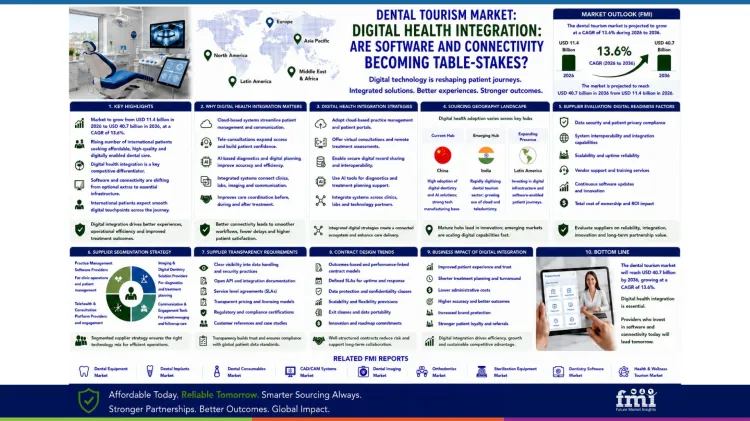
With patients seeking inexpensive dental procedures overseas without compromising quality, the dental tourism industry is expanding. The market is anticipated to grow from USD 11.4 billion in 2026 to USD 40.7 billion by 2036, at a CAGR of 13.6% during the forecast period. While affordability of treatment remains a major concern, technology adoption is increasingly impacting both patient preference and provider competitiveness.
Today, the field of dental tourism is not just about clinical skills and cost cuts. Digital health is now the heart of service delivery, transforming how providers attract patients, manage care and negotiate long-term care relationships.
In the past, dental tourism relied on manual communication. International patients had to email and upload their health records in a non-secure manner and go through complicated administrative procedures before receiving a treatment plan. These approaches worked, but often caused inefficiencies and more unease for patients and providers.
The model is changing fast as the use of digital health technologies increases.
Today, many of the leading dental tourism providers offer fully digital patient journeys that start long before the patients get on a plane. Integrated digital platforms enable potential patients to upload dental images, conduct virtual consultations, get initial treatment assessments, review cost estimates, and book appointments.
These capabilities increases convenience and assist providers to convert queries to confirmed treatment bookings more efficiently.
Especially the importance of teleconsultation technologies has increased.
But, patients considering international dental treatment often seek many opinions before agreeing to travel. Virtual consultations allow dentists to assess patients’ needs, discuss treatment options, explain expected results and build trust before physical visits. This decreases uncertainty and allows for better treatment planning.
As destinations become more competitive, clinics that are able to provide smooth digital engagement are often at an advantage over those that use traditional communication channels.
And then another significant development is integration with electronic health records,
Dental tourism patients often need their native country practitioners to liaise with overseas specialists for treatment. These are digital record-sharing platforms that allow providers to more efficiently retrieve diagnostic information, prior treatment histories, radiographic images, and clinical documentation.
Better information access cuts treatment delays and allows clinicians to make decisions based on better information.
Digital dentistry technologies are also becoming an important factor of operational efficiency.
The use of advanced imaging systems, intraoral scanners, CAD/CAM platforms and treatment planning software is becoming increasingly common in connected digital ecosystems. These systems are not stand-alone technologies, but rather, they disseminate information throughout clinical workflows for rapid diagnosis, treatment design and production of restorations.
Workflow efficiency is a major driver of profit and patient satisfaction for dental tourism providers who are working with large patient volumes in tight treatment windows.
The market is also being impacted by artificial intelligence.
AI-based diagnostic software may help with the detection of treatment needs, evaluation of radiographic images and support for clinical decision-making. Automation tools can certainly help to standardize workflows and minimize administrative tasks but they still require a human touch.
As technology continues to advance, AI-powered systems will likely play a bigger role in triaging patients, developing treatment plans, and monitoring results.
Rapid development is also being made in the connectivity between dental labs and clinics.
In conventional laboratory the primary means of communication were physical impressions and handwritten information exchange. Digital workflows now allow clinicians to send scans, treatment details and designs of restorations digitally. This improves accuracy, reduces logistical complexity and speeds up production timelines.
Such capabilities are very important in the dental tourism space where treatment time is often packed into international travel windows.
And integrated software is also transforming the way we manage patient relationships.
Many providers today utilize centralized systems that manage appointment scheduling, treatment tracking, billing, patient communications, marketing automation, and follow-up services. The systems also help clinics to keep in tune with international patients even after they are back in their home country.
Providers are focusing more on post-treatment monitoring, both in terms of patient satisfaction and referrals.
The connected platforms enable clinics to provide virtual follow up visits, observe recovery, deal with concerns and maintain continuity of care without the necessity for additional travel.
As digital adoption accelerates, cybersecurity grows more critical.
Dental tourism suppliers have access to confidential health information, financial data, travel documents and personal identification information. Funding in cyber security systems, secure cloud environments, access controls and regulatory compliance have become key operational priorities.
Patients are more aware of data privacy issues and may evaluate digital security capabilities when selecting treatment providers.
Market segmentation trends are reflecting the increasing importance of digital integration.
Dental implants are still one of the largest service segments of dental tourism and increasingly depend on digital treatment planning, guided surgery technologies and CAD/CAM restoration workflows. Providers of cosmetic dentistry are also applying digital smile design software and advanced visualization tools to boost patient engagement and acceptance of treatment.
Orthodontics is undergoing a major digital transformation with clear aligner platforms, remote monitoring technologies and AI-supported treatment management systems.
From a provider perspective, the biggest spenders on digital technologies are hospital chains and organized dental networks because of their scale and ability to spread the costs of technology across larger patient populations. More and more, these organizations are beginning to view software infrastructure as a strategic asset, not as a supporting function.
Technology adoption is also accelerated by regional competition.
Leading dental tourism destinations in Asia-Pacific, Eastern Europe, Latin America and the Middle East are investing heavily into digital capabilities in an effort to differentiate themselves from competing markets. Providers that can deliver highly connected patient experiences are often better positioned to attract international clients looking for convenience and transparency.
A misconception is that digital health integration is primarily driven by operational efficiency.
In fact, technology is becoming more important for patient trust, confidence in treatments and general satisfaction. International patients are more likely to evaluate providers on the basis of quality of communication, accessibility, transparency and convenience, all of which are improved through digital platforms.
As the market matures, connectivity expectations will only increase. Patients used to digital healthcare in their home countries will expect the same capabilities when seeking treatment abroad.
Bottom line
Digital health integration is fast becoming a baseline requirement for the dental tourism market. Competitive advantages are becoming must-have operational capabilities: software platforms, connected clinical workflows, teleconsultations, data-driven patient engagement are taking shape. Health providers that successfully embed technology throughout the patient journey will be better placed to scale operations, improve outcomes and cement their position in the increasingly competitive global dental tourism environment.

