


- Dry antioxidants are gaining stronger preference in animal feed because feed mills value easy handling, accurate dosing, better blending, storage stability, and lower operational complexity.
- Powder, granule, beadlet, and premix-compatible antioxidant formats are preferred in compound feed, poultry feed, swine feed, ruminant feed, aquafeed, and vitamin-mineral premix systems.
- Buyers are willing to prioritize dry antioxidant systems when they reduce formulation errors, storage problems, transport costs, liquid-handling needs, and feed mill disruption.
- The strongest opportunity sits in large feed mills, premix manufacturers, poultry feed producers, aquafeed formulators, rendered ingredient processors, and export-oriented feed supply chains.
- The biggest risk is assuming dry format alone is enough. Feed buyers still need proof of oxidative stability, active ingredient consistency, pelleting tolerance, and compatibility with fats, oils, vitamins, and minerals.
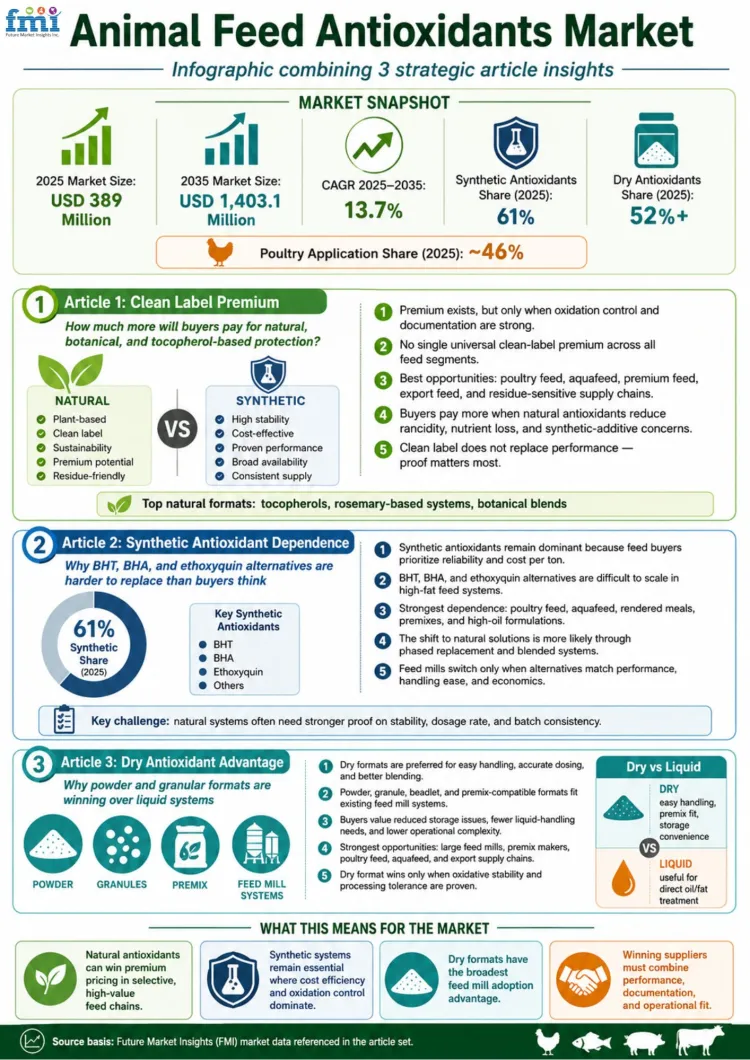
Dry antioxidants are becoming more important in the animal feed antioxidants market because feed mills do not only buy antioxidant chemistry. They buy operational convenience. A product may have strong oxidation-control properties, but if it is difficult to store, dose, mix, transport, or integrate into existing feed production systems, adoption becomes slower. This is why dry antioxidant formats, including powders, granules, beadlets, and premix-compatible carriers, are gaining strong preference across feed manufacturing environments.
Animal feed production is a high-volume, process-driven business. Feed mills handle grains, meals, oils, fats, minerals, vitamins, amino acids, enzymes, binders, and multiple functional additives. Each ingredient must move through storage, weighing, batching, mixing, pelleting, cooling, bagging, and bulk transport with minimal disruption. In this environment, dry antioxidants are attractive because they fit more easily into existing ingredient-handling systems. They can be weighed like other dry feed additives, blended into premixes, added into compound feed, and shipped without the same equipment requirements as liquid antioxidant systems.
The main advantage of dry antioxidants is ease of handling. Feed mills are already built around dry ingredient flow. Powders and granules can move through bags, bins, silos, hoppers, screw conveyors, and premix lines with fewer modifications. Liquid antioxidants may still be useful in specific applications, especially where fats and oils are treated directly, but they require tanks, pumps, spray systems, calibration, cleaning, spill control, and sometimes temperature management. For many feed mills, that extra operational burden makes dry antioxidants easier to justify.
Accurate dosing is another major reason dry antioxidants are preferred. In animal feed, small inclusion rates can make dosing accuracy critical. If an antioxidant is underdosed, oxidation protection may be weak. If it is overdosed, the feed mill may face unnecessary cost or formulation imbalance. Dry antioxidant formats allow premix manufacturers and compound feed producers to standardize dosing through established dry blending systems. This improves confidence in batch-to-batch consistency, especially in large-scale feed production.
Blending performance is also important. Feed antioxidants must distribute evenly across the formulation to protect sensitive ingredients and finished feed quality. Dry antioxidant carriers can be designed for better flowability, lower dust, improved dispersion, and compatibility with common feed ingredients. This matters in poultry feed, swine feed, ruminant feed, and aquafeed, where feed mills need consistent antioxidant distribution across large batches. A dry product that blends cleanly into premixes or compound feed reduces the risk of uneven protection.
Storage convenience gives dry antioxidants another advantage. Feed mills often operate in hot, humid, dusty, and space-constrained environments. Dry products are generally easier to store in bags, drums, cartons, or bulk containers. They are also easier to move through distribution networks, especially in regions where cold-chain or specialized liquid storage infrastructure is limited. For exporters, regional distributors, and large feed additive suppliers, dry format can reduce logistics complexity and make inventory management simpler.
Dry antioxidants are especially valuable in premix systems. Premix manufacturers need additives that can be combined with vitamins, minerals, amino acids, enzymes, and other functional ingredients without creating handling problems. Since many vitamins and pigments are oxidation-sensitive, antioxidants are often included to help protect nutritional quality. A dry antioxidant that can be incorporated into premixes allows suppliers to sell more complete solutions to feed mills. This creates a stronger value proposition than selling an antioxidant only as a separate liquid application.
Poultry feed is one of the clearest demand centers for dry antioxidants. Poultry production is highly cost-sensitive, high-volume, and dependent on feed efficiency. Feed mills serving poultry producers need additives that can be integrated quickly and consistently into compound feed. Dry antioxidants support this requirement because they reduce complexity in dosing and blending. They are particularly useful in energy-dense formulations containing oils and fats, where oxidation control is needed but production speed cannot be compromised.
Aquafeed is another important opportunity. Aquafeed formulations often include lipid-rich ingredients such as fish oil, fishmeal, and other oxidation-prone components. These feeds need strong oxidative protection, but aquafeed production also involves demanding processing conditions. Dry antioxidant formats can be useful when they are engineered for stability, uniform dispersion, and compatibility with extrusion or pelleting systems. However, aquafeed buyers will not choose dry format only for convenience. They will expect strong evidence that the antioxidant protects sensitive marine ingredients through processing and storage.
Rendered ingredient processors also create strong demand for antioxidant systems. Animal fats, meat meals, poultry meals, and other rendered ingredients can oxidize before they reach the feed mill. In these applications, liquid antioxidants may be used at the fat or ingredient treatment stage, but dry antioxidant formats may also play a role in downstream feed formulations and premix systems. The choice depends on where oxidation risk is highest and how the product is handled. Suppliers that offer both dry and liquid options may be better positioned because they can serve different points in the feed supply chain.
The dry-format advantage is not only about convenience. It also affects cost. Feed mills evaluate additives based on total cost-in-use, not just price per kilogram. A dry antioxidant may reduce costs linked to storage equipment, cleaning, spillage, dosing errors, transport restrictions, and production downtime. Even when the ingredient price is not the lowest, the operational savings may support adoption. This is especially important for large feed mills where small process improvements can affect thousands of tons of feed.
Granules and beadlets can create additional value where dust control and flowability matter. Fine powders may blend well, but they can create dusting concerns, worker exposure issues, product loss, and uneven flow if not properly formulated. Granulated or beadlet antioxidant systems may reduce these problems while improving handling and dispersion. In premium or technically demanding applications, buyers may pay more for a dry format that improves both antioxidant delivery and mill efficiency.
Dry antioxidants also support supplier differentiation. Many antioxidant active ingredients can look similar to buyers if marketed only by chemistry. Format gives suppliers another way to compete. A company that can offer stable carriers, customized particle size, low-dust granules, premix-ready systems, and species-specific antioxidant blends can stand out from generic suppliers. This is important as the market becomes more competitive and buyers ask for solutions instead of single ingredients.
However, dry format does not automatically guarantee performance. Feed buyers still need proof that the antioxidant remains active during storage, survives processing conditions, disperses evenly, and protects the targeted feed ingredients. Pelleting and extrusion can expose additives to heat, moisture, pressure, and friction. If a dry antioxidant degrades during processing, its handling advantage loses value. This is why suppliers need to provide stability data, recommended inclusion levels, feed matrix compatibility, and shelf-life evidence.
Natural antioxidants face the same challenge. A dry natural antioxidant may be easier to handle than a liquid botanical extract, but it still must perform against synthetic benchmarks. Tocopherol-based powders, rosemary-derived systems, and botanical antioxidant blends can gain interest from clean-label feed programs, but feed mills will test them for potency, consistency, and cost-in-use. Dry format may open the door, but performance keeps the buyer.
The strongest commercial opportunity lies in positioning dry antioxidants as feed mill efficiency tools. Suppliers should not only claim that dry antioxidants are easier to use. They should show how these formats reduce operational risk, improve mixing consistency, simplify logistics, and support stable feed quality. This message is especially strong for compound feed producers, premix manufacturers, poultry feed mills, aquafeed companies, and distributors serving multiple feed customers.
The risk is that suppliers oversimplify the dry-format story. Feed mills do not choose dry antioxidants because they are dry; they choose them because they work within existing operations while protecting feed quality. If a dry product cakes, dusts, separates, loses potency, or blends poorly, buyers will reject it. The best dry antioxidant systems must combine active ingredient performance with strong physical properties.
For the animal feed antioxidants market, dry formats are likely to remain important because they match the way feed mills operate. They reduce adoption barriers, simplify handling, and support integration into premixes and compound feed. Liquid systems will continue to matter in fat and oil treatment, but dry systems have a broader operational fit across many feed applications. The future advantage will belong to suppliers that can deliver dry antioxidant products with proven stability, easy blending, clean documentation, and clear cost-in-use benefits.
Dry antioxidants are therefore not just a product form. They are a feed mill adoption strategy. In a market where buyers are cautious, margins are tight, and performance expectations are high, the winning antioxidant is not always the newest chemistry. It is the system that protects feed quality while making the feed mill’s job easier.
Related Markets
- Animal Feed Additives Market: Animal feed antioxidants sit within the wider feed additives ecosystem where feed mills evaluate stability, safety, performance, and cost control.
- Natural Feed Additives Market: Natural feed antioxidants benefit from the broader shift toward chemical-free, sustainable, and cleaner livestock nutrition programs.
- Compound Feed Market: Compound feed manufacturers are key buyers because antioxidants help protect mixed feed formulations during storage, transport, and feeding.
- Pet Food Antioxidants Market: Pet food has stronger clean-label pressure, making it an important adjacent market for natural antioxidant positioning and premium claims.
- Poultry Feed Market: Poultry feed is a major application area because high-volume production, feed efficiency, and oil-rich diets increase the need for oxidation control.

