


- E-commerce is important in allergen-free food because shoppers often need specific claims, deeper assortment, ingredient transparency, and repeat replenishment.
- Retail and supermarkets still lead first-purchase conversion, but online channels help households find products that may not be available in local stores.
- Gluten-free benefits from broad search demand, while dairy-free, nut-free, soy-free, egg-free, and multi-allergen-free products benefit from more precise online filtering.
- Bakery and snacks are strong e-commerce categories because they are routine household products with repeat buying behavior.
- India and China offer strong online potential as modern retail, quick-commerce, and label-aware packaged food buying expand.
- The biggest misconception is that allergen-free food is only a supermarket shelf category. Online channels are becoming critical for discovery, trust-building, and repeat purchase.
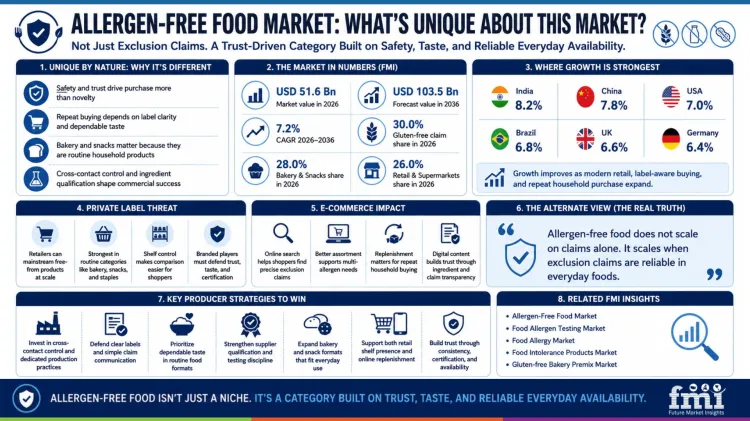
E-commerce plays a different role in the Allergen-Free Food Market than it does in ordinary packaged food. For many shoppers, allergen-free buying is not impulse-led. It is search-led, label-led, and trust-led. Consumers often need to find a product that fits a specific dietary restriction, verify the ingredient list, compare claims, and then reorder once trust is established.
According to FMI, the largest distribution channel will be retail and supermarkets, which account for 26.0% of the market share in 2026. This demonstrates that traditional retail is still very relevant. The initial purchase will be made in stores since consumers need to check the labels, see the competing brands, and become convinced of their credibility.
However, e-commerce is becoming increasingly important for deeper discovery. A local supermarket may carry gluten-free bread or biscuits, but it may not carry dairy-free, nut-free, soy-free, egg-free, and multi-allergen-free variants across enough product types. Online channels can solve this assortment gap by allowing shoppers to search more precisely.
The Food Allergy Market provides the broader consumer context. Allergy-aware households often behave differently from ordinary shoppers. They read labels carefully, check repeat availability, and avoid brands that create uncertainty. Online channels can support this by offering detailed ingredient panels, certification information, customer reviews, and product Q&A.
The best internet search anchor would be “gluten-free” since FMI states that this is the leading claim type with 30.0% share in 2026. “Gluten-free” has good recognition and strong search behavior; nevertheless, the actual power of e-commerce will grow even more among niche claims. Someone who searches for nut-free snacks, soy-free sauces, egg-free condiments, dairy-free children’s food, or multiple allergen-free products may get better deals on the Internet than locally.
The Food Intolerance Products Market is useful because online shopping often blends allergy, intolerance, and lifestyle needs. A consumer may search for gluten-free because of celiac disease, dairy-free because of intolerance, or multi-allergen-free because of family safety. E-commerce platforms can group these needs more efficiently than physical shelves.
Bakery and snacks are especially important because FMI identifies them as the leading product category with 28.0% share in 2026. The products are purchased on a continuous basis for use at different occasions like breakfast, packed lunches, snacking, school lunches, travels, and pantry stock-up. Once the family purchases a reliable brand of cookies, crackers, bread, bars, cereals, or snacks, it is convenient to purchase through the Internet.
The Gluten-free Bakery Premix Market also connects with e-commerce because baking mixes and premixes are well suited to online purchase. Consumers who cannot find suitable bakery products locally may buy premixes to bake at home. Small brands and specialty suppliers can use e-commerce to reach households that mainstream retailers do not fully serve.
Prepared foods are another opportunity. The USA Gluten-free Prepared Food Market is relevant because convenient allergen-free meals, frozen items, and prepared foods can support routine adoption. Online grocery, subscription boxes, and direct-to-consumer delivery can help brands serve consumers who want safer meal options without repeated store searching.
E-commerce is also important in faster-growing markets. FMI identifies India as the fastest-growing country-level market at 8.2% CAGR through 2036, while China is also high-growth at 7.8%. In these markets, modern retail and quick-commerce can accelerate allergen-free discovery. Urban consumers may use online platforms to access imported, premium, or niche allergen-free products before they become widely available in stores.
Trust continues to be the greatest challenge in the online environment. In physical stores, buyers have the ability to check out product packaging by themselves. In the online environment, users need to rely on product pictures, ingredient listings, allergy information, customer reviews, and the reliability of the platform itself. If there is incomplete information regarding the product, then trust can easily be shattered.
Brands need to incorporate digital information into their product safety communications. Allergen information, certifications, production, storage information, and even cross-contamination warnings need to be accurate and up-to-date. It is not enough for an e-commerce platform to offer discounts in order to be successful.
The Food Allergen Testing Market supports this because verified claims matter more when shoppers cannot physically inspect the product. Brands that communicate testing, certification, and controlled manufacturing clearly may build stronger online loyalty.
The myth that needs to be dispelled here is that allergen-free food items are confined solely to the supermarket aisle. This may remain true, but more and more, e-commerce channels are becoming instrumental in discovering, comparing, and repurchasing them. For families that need certain food items, e-commerce will emerge as the most efficient means.
Bottom line: E-commerce will not replace supermarkets in allergen-free food, but it will reshape discovery and replenishment. Brands that combine reliable products with transparent online information, deep assortment, and repeat-purchase convenience will be better positioned to build household loyalty.

