


- E-commerce can increase frozen food discovery, but frozen products cannot scale online without reliable cold-chain handling and last-mile execution.
- Frozen food behaves differently from ambient food because one poor delivery experience can damage trust in both the product and the channel.
- Online grocery works best for frozen ready meals, frozen vegetables, frozen fruits, frozen snacks, frozen bakery, desserts, and family freezer replenishment.
- FMI identifies frozen ready meals as the leading product type within the broader Frozen Food Market, confirming the importance of meal-led online basket building.
- Packaging, substitution control, freezer integrity, delivery timing, and clear product images matter as much as digital visibility.
- The biggest misconception is that online listing automatically creates frozen food growth. In this category, the cold chain must earn the repeat purchase.
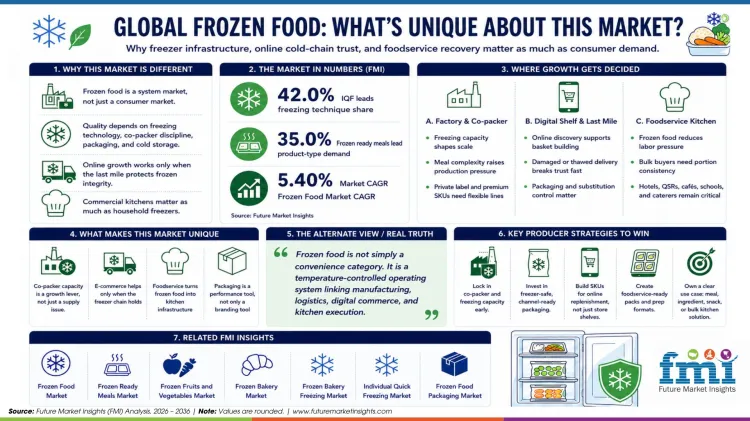
E-commerce is becoming more important in the Frozen Food Market, but its impact is often explained too simply. Online grocery does not automatically make frozen food easier to sell. It makes frozen food easier to discover. Repeat demand depends on whether the consumer trusts the product condition, delivery timing, packaging, and cooking outcome after ordering.
Frozen food is more sensitive than many packaged food categories. Ambient snacks, beverages, cereals, sauces, and shelf-stable foods can tolerate longer delivery windows and less controlled handling. Frozen products cannot. A partially thawed product, damaged pack, poor substitution, missing item, or delayed delivery can immediately reduce consumer confidence. In frozen food, the shopper does not separate the product from the delivery experience. If the product arrives poorly, the brand, retailer, and online channel all lose trust.
This is why e-commerce works best where cold-chain infrastructure is already reliable. Modern retail warehouses, freezer-equipped fulfillment centers, insulated delivery systems, trained pickers, and disciplined last-mile processes matter as much as digital assortment. A broad online frozen catalog is useful only if the retailer can deliver the product in a condition that matches consumer expectations.
FMI’s Frozen Food Market identifies frozen ready meals as the leading product type in the broader frozen food category. This matters because ready meals are naturally suited to online grocery baskets. Consumers can add dinner entrées, lunch bowls, frozen snacks, vegetables, desserts, or family trays to weekly replenishment orders. Once a product becomes part of a routine grocery basket, repeat behavior can build without the consumer visiting the freezer aisle.
The Frozen Ready Meals Market is therefore a critical adjacent reference. Frozen ready meals are not only convenience products; they are meal solutions. Online grocery helps shoppers compare cuisine type, portion size, claims, nutrition, price, pack image, preparation time, and brand. But the product must still deliver after reheating. A strong digital image can create the first purchase, but taste, texture, portion value, and heating performance decide repeat purchase.
Frozen fruits and vegetables benefit from a different online logic. The Frozen Fruits and Vegetables Market connects closely with household replenishment, smoothie routines, meal preparation, children’s meals, and reduced food waste. These products are less dependent on impulse and more dependent on regular usage. Online grocery can support this pattern by encouraging consumers to restock freezer staples such as berries, peas, spinach, broccoli, corn, mixed vegetables, and smoothie blends.
The Frozen Vegetable Market is particularly relevant because frozen vegetables often behave like planned household inputs rather than discretionary treats. Consumers may add them to online baskets for soups, curries, stir-fries, side dishes, and weekly meal preparation. In this case, e-commerce strengthens convenience not through impulse, but through habit formation.
Frozen bakery has a different e-commerce pathway. The Frozen Bakery Market includes products that serve households, cafés, bakeries, foodservice buyers, and retail bake-off operations. Online platforms can support specialty discovery, repeat ordering, and B2B supply. However, performance after thawing, proofing, baking, or reheating remains the trust point. A croissant, paratha, pizza base, pastry, or bread roll must perform reliably after the freezer stage.
Quick commerce creates another opportunity, but also a higher operational risk. It can support emergency meals, frozen snacks, ice cream, appetizers, desserts, and last-minute dinner solutions. In dense urban markets, quick commerce can make frozen food feel more immediate. However, smaller dark stores must manage freezer space, stock rotation, and temperature control carefully. A frozen product that is out of stock or substituted poorly can disappoint more than a missing ambient item because the purchase is often tied to an immediate meal occasion.
Packaging plays a larger role online than many brands assume. The Frozen Food Packaging Market is closely linked to e-commerce because packaging must protect product integrity while also communicating appetite appeal on a digital shelf. A consumer shopping online cannot inspect frost, texture, or pack condition. The image, claims, preparation instructions, portion cues, and product description must do more work.
Digital shelves also change how claims are read. In-store, shoppers may compare packs visually inside the freezer aisle. Online, they compare thumbnails, titles, ratings, price, delivery availability, and retailer recommendations. This makes product naming and claim hierarchy important. A product described only as “frozen meal” may lose to one that clearly communicates “high-protein chicken bowl,” “organic mixed vegetables,” “ready-to-bake croissant,” or “family-size frozen pizza.” E-commerce rewards clarity.
Private label can also become stronger online. Retailers can place their own frozen products near branded products in search results, recommend lower-priced substitutes, create private-label bundles, and promote own-brand freezer essentials. This means e-commerce does not only help national brands. It also gives retailers more control over frozen food choice and price comparison.
For producers, the right question is not simply, “How do we sell frozen food online?” The better question is, “Which frozen food occasions are suitable for online replenishment?” Weekly family meals, freezer staples, high-protein meals, smoothie ingredients, frozen bakery items, frozen snacks, frozen desserts, and foodservice replenishment all behave differently. The digital strategy should be built around the use case, not only the channel.
The misconception to avoid is that e-commerce removes the physical constraints of frozen food. It does not. Frozen food may be discovered digitally, but it is judged physically: frozen state, packaging quality, cooking performance, taste, texture, safety perception, and delivery integrity.
Bottom line: online grocery can expand frozen food demand, but only when cold-chain execution protects consumer trust. In frozen food, the digital shelf creates the first click; the freezer experience decides whether the product returns to the basket.
Related FMI Reports
- Frozen Food Market
- Frozen Ready Meals Market
- Frozen Fruits and Vegetables Market
- Frozen Vegetable Market
- Frozen Bakery Market
- Frozen Food Packaging Market
- Ready-to-Eat Food Market

