

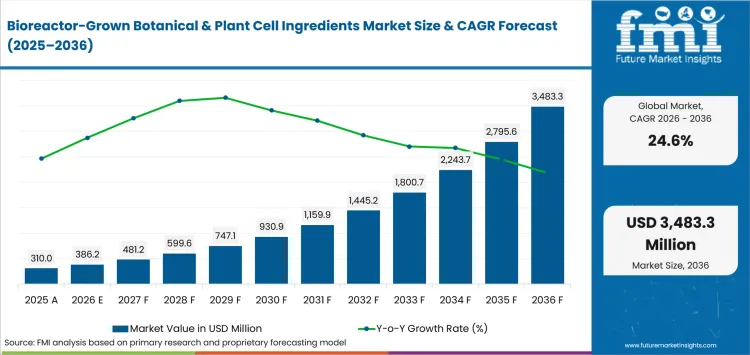
- Market Size (2026)
- USD 386.2 Mn
- Forecast (2036)
- USD 3483.3 Mn
- CAGR (2026 to 2036)
- 24.6%
How big is Bioreactor-Grown Botanical & Plant Cell Ingredients Market in 2026?
USD 386.2 million in 2026 and USD 3,483.3 million by 2036 at a 24.6% CAGR.
Demand for bioreactor-grown botanical & plant cell ingredients is projected to push valuation from USD 386.2 million in 2026 to USD 3,483.3 million by 2036 at a 24.6% CAGR, driven by broader qualification of cultured botanical compounds. Commercial output begins with authenticated cell lines and advances through cell culture media optimization and downstream purification under fixed release specifications. BioHarvest Sciences reported in February 2025 that cumulative VINIA sales exceeded USD 50 million through its plant-cell production platform. The sales record confirms recurring demand for a cultured red-grape ingredient supported by defined composition and a repeat-purchase consumer base.
European and North American ingredient developers follow different approval routes for nutraceutical ingredients produced through plant cell culture. The European Commission recorded the COCO-AI grant agreement in April 2026 for a program scaling cocoa cell production to 10,000-liter bioreactors. The program targets six secondary-metabolite formulations and includes two Israeli cultivated-cocoa developers within the commercial scale-up consortium. United States supplement commercialization requires ingredient-specific safety records through the applicable FDA pathway for each new dietary ingredient. Swiss and European food uses depend on novel-food status for the exact ingredient and production process. Cosmetic ingredient programs follow separate product-safety and claims requirements that do not rely on food authorization. Development teams therefore need technical files that connect identity and composition with every intended use instead of relying on a general platform claim.
Key Takeaways of Bioreactor-Grown Botanical And Plant Cell Ingredients Market
- Ingredient developers seek botanical compounds with repeatable composition and lower exposure to seasonal harvest variation across vulnerable agricultural supply chains.
- Plant cell culture is forecast to represent 61.7% share in 2026, shaped by direct control over cell identity and production conditions.
- Botanical actives are projected to account for 47.0% share in 2026, reflecting defined potency targets and higher value from each qualified batch.
- Supplements are estimated to capture 41.9% share in 2026, reinforced by measured serving formats and established specialty distribution channels.
- Scale-up failures and ingredient-specific approval requirements can delay repeat orders despite a technically successful laboratory culture.
- Ayana Bio and BioHarvest Sciences develop targeted actives, whereas Phyton Biotech and cultivated-cocoa specialists compete through manufacturing scale or application focus.
Analyst Perspective
"Commercial success depends on preserving a target metabolite profile from the master cell bank through reactor scale-up and downstream purification. Development teams should define release ranges for identity and potency prior to committing supplement or cosmetic launch schedules. Portfolio value improves through scarce compounds paired with stable specifications and reactor capacity that supports recurring orders across several qualified batches."
- Nandini Roy Choudhury, Principal Analyst, Future Market Insights
How is the Bioreactor-Grown Botanical And Plant Cell Ingredients Market segmented?
The bioreactor-grown botanical & plant cell ingredients industry is segmented by technology, product, application, and region.
The market is segmented by technology, product, application, and region to distinguish production routes from ingredient forms and commercial uses. Technology separates plant cell culture from the bioreactor systems used to expand biomass under controlled temperature, mixing, and oxygen conditions. Product analysis divides botanical actives, flavors, and colors according to the compound profile and release specification required by formulators. Application analysis covers supplements, food and beverage, and cosmetics through dosage, sensory, and approval requirements. Regional analysis compares legal status, manufacturing access, and technical service across the five profiled countries. Plant cell culture establishes authenticated cell banks and repeatable metabolite output, whereas bioreactor design determines whether those controls survive commercial scale-up.
What supports plant cell culture within the technology category?
Plant cell culture creates a repeatable production base through authenticated cell lines that support several controlled batches. BioHarvest Sciences received a USD 1.6 million Israel Innovation Authority grant in December 2025 to advance its second-generation botanical synthesis platform. The funded work connects data science with process control and commercial production scale-up across the platform. Ingredient manufacturers gain a stronger qualification route through stable cell identity and consistent metabolite output across pilot and commercial runs.
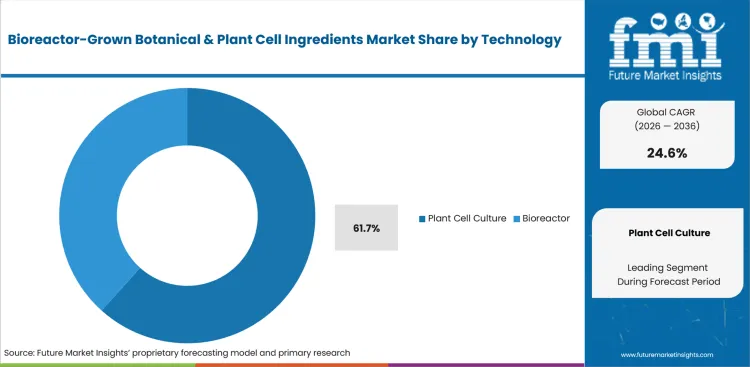
- Plant cell culture is set to lead the technology category with 61.7% share in 2026 due to direct control over cell identity and culture conditions. Developers can adjust culture media and elicitation settings without returning to field cultivation for every production batch. The platform fits botanical supplements that require repeatable composition and documented release limits across finished-product lots.
- Botanical ingredient producers adopt plant-cell platforms to reduce seasonal variation and establish traceable production records for high-value compounds. Commercial programs expand across several pilot batches that remain within the agreed metabolite range and purification yield. The record gives formulators confidence that later lots can meet the same release specification without repeated process redesign.
What drives botanical actives within the product category?
Botanical actives receive concentrated investment through measurable compound profiles that formulators can compare against finished-product specifications. Developers evaluate cultured actives through purity and functional consistency instead of relying on harvest origin during qualification. BioHarvest Sciences completed Stage 1 of its saffron composition program in May 2026 for nutraceutical and culinary applications. The program entered biomass generation for pre-commercial testing and linked cell-bank performance with a finished active-ingredient specification.
- By product, botanical actives are estimated to hold 47.0% in 2026 owing to measurable potency targets and higher value from each qualified batch. Identity and concentration give formulators a clear basis for comparing cultured actives during product qualification. Flavors and colors require broader sensory or appearance testing across several formulations and processing conditions.
- Nutraceutical and cosmetic developers favor cultured actives that maintain compound profiles despite weather or crop variability across sourcing regions. Programs targeting natural flavors must control aroma composition and processing losses inside larger bioreactors during commercial scale-up. Repeat orders depend on formulation stability and verified sensory performance across several production batches prepared for customer release.
What makes supplements central to the application category?
Supplements provide an early commercial route through measured daily servings that translate defined botanical compounds into finished consumer products. Finished-dose products require validation and clear use instructions that extend beyond production claims for the cultured ingredient. BioHarvest Sciences launched VINIA DailyChews 2X in June 2025 with Informed Sport certification for athletes. The plant-cell-derived red grape formulation demonstrates how cultured ingredients can enter measured consumer formats with independent certification and documented serving guidance.
- By application category, supplements are forecast to represent 41.9% in 2026 driven by measured servings and established channels for standardized botanical actives. Finished-product brands can retain the same dosage specification across successive lots and compare release results against a stable ingredient record. Food and beverage uses usually require larger production volumes and broader sensory testing across several formulations.
- Supplement brands adopt bioreactor-grown ingredients through safety files and dosage specifications that support the intended consumer use. Expansion across the dietary supplements market depends on ingredient identity and finished-product stability under normal storage conditions. A changed production process can increase commercial risk by altering the evidence required for an established botanical formulation.
What are the drivers, restraints, and opportunities in the Bioreactor-Grown Botanical And Plant Cell Ingredients Market?
Stable cell banks and controlled reactors support demand; ingredient-specific approval and scale-up failures restrain adoption; shared pilot infrastructure creates a commercial route for qualified plant-cell ingredients.
- Driver: Stable cell banks give ingredient developers repeatable access to scarce compounds whose field supply changes across seasons and producing regions.
- Restraint: Product-specific approval rules can extend commercial schedules following changes to the cultured cell line or intended application.
- Opportunity: Shared pilot programs can distribute scale-up costs and identify technical problems prior to investment in dedicated commercial production.
Reliable cell banks help developers produce rare plant compounds without depending on seasonal harvest quality or limited growing regions. BioHarvest Sciences reported in March 2026 that it created a stable cell culture for a rare fragrance plant under a commercial development contract. The program identified target scent molecules and prepared the cell bank for biomass production in liquid media. A repeatable cell bank gives fragrance developers consistent starting material and reduces sourcing risk for premium botanical compounds.
Product-specific approval rules create a challenge for cultured ingredients used in food and supplements. The Swiss FSVO stated in February 2026 that food businesses must document novel-food status and submit a technical safety dossier for ingredients classified as novel. The review links legal status to the exact ingredient and manufacturing process rather than the broad plant species. Process changes can therefore add safety work and delay formulation schedules across planned commercial uses.
Shared pilot programs give developers a practical route to test scale-up and market-entry requirements without building separate infrastructure for every project. VTT launched Cell2Food in February 2026 to develop plant-cell food prototypes with researchers and chefs across Finland and Brazil. The program includes industrial partners and consumers to assess technical readiness alongside market-entry factors for commercial programs. Coordinated pilots reveal processing and sensory problems early enough to prevent premature investment in dedicated manufacturing capacity.
Which country CAGRs are profiled in the Bioreactor-Grown Botanical And Plant Cell Ingredients Market?
| Country | CAGR |
|---|---|
| USA | 21.5% |
| Finland | 21.1% |
| Switzerland | 20.3% |
| Germany | 20.7% |
| Israel | 21.9% |
How do country-level CAGRs compare in the Bioreactor-Grown Botanical And Plant Cell Ingredients Market?
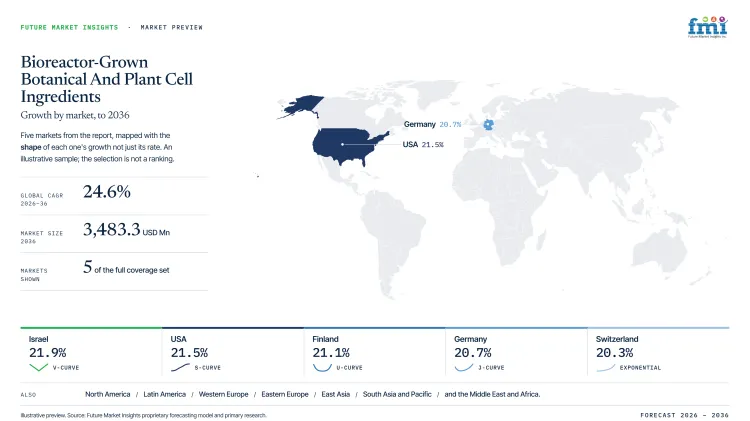
The country comparison spans 1.6 percentage points and highlights a highly concentrated growth outlook across the bioreactor-grown botanical & plant cell ingredients market. Israel, the USA and Finland create a closely aligned upper group with limited separation between their forecasts. Germany and Switzerland form a similarly compact second cluster and remain only modestly below the upper group. The narrow spacing across all five countries suggests broad alignment in industry expectations and commercialization activity. This pattern reflects increasing investment in cellular agriculture, advances in plant cell culture technologies and growing demand for sustainable sources of high-value botanical ingredients. Differences between countries are linked more to research ecosystems, scale-up capabilities and ingredient development strategies than to fundamentally different market trajectories.
- Israel shows a notable position within the comparison as its cellular agriculture ecosystem continues to support innovation in plant cell cultivation platforms and specialty ingredient production.
- The USA benefits from strong biotechnology investment and expanding partnerships between ingredient developers, consumer brands and biomanufacturing companies.
- Finland's position reflects its established bioeconomy focus and ongoing research into sustainable production methods for botanical compounds and functional ingredients.
- Germany continues to advance the market through biotechnology expertise and the integration of precision cultivation technologies into ingredient development programs.
- Switzerland maintains a meaningful presence within the comparison as life sciences capabilities and high-value ingredient manufacturing support commercial adoption of plant cell-derived materials.
Comparable CAGRs do not create identical market conditions across countries. Differences in bioprocess infrastructure, commercialization pathways, regulatory requirements and manufacturing scale can influence how quickly plant cell-derived ingredients move from development to commercial production. Similar growth forecasts therefore may reflect different routes to market and distinct competitive dynamics. The full report provides country-level CAGR analysis across North America, Latin America, Europe, East Asia, South Asia, Oceania and the Middle East and Africa.
Country-wise Analysis
- United States supplement brands must align the safety route with the exact ingredient and intended use prior to commercialization. The United States bioreactor-grown botanical ingredient market is estimated to post 21.5% CAGR over the forecast period, linked to established supplement channels and specialized contract manufacturing. FDA released new NDI educational materials in June 2025 for manufacturers preparing safety notifications for qualifying ingredients. The electronic submission system gives developers a defined route for identity and safety records ahead of commercial launch. Domestic formulation laboratories reduce technical service distance across major supplement manufacturing regions and support faster troubleshooting during early formulation work. Process changes can trigger additional evidence requirements and delay commercial release for a revised ingredient specification.
- Finnish ingredient developers operate within the European Union novel-food system and consult the national authority during early status assessment. National research organizations provide food engineering and regulatory expertise during early technical qualification for cultured ingredients. Bioreactor-grown botanical ingredient sales in Finland are forecast to expand at 21.1% CAGR by 2036, supported by public research infrastructure and coordinated food-technology programs. The Finnish Food Authority clarified in June 2026 that operators must establish novel-food status and confirm authorization prior to market placement. The operator remains responsible for product status, so uncertain consumption history can extend consultation and delay commercial release. Commercial programs therefore need regulatory plans that connect pilot work with the final food format and intended consumer use.
- Swiss ingredient developers operate under product-specific food authorization rules and maintain a separate evidence route for cosmetic actives. Mibelle Biochemistry launched SenoCellTec in November 2025 as a cosmetic active powered partly by plant-based stem cell technology. Adoption of bioreactor-grown botanical ingredients in Switzerland is estimated to expand at 20.3% CAGR through 2036, aided by specialized developers and international distribution networks. The launch demonstrates local product development that connects cultured plant material with a defined cosmetic application. Food ingredients face a separate authorization route that can extend commercial planning for each intended use. Development teams therefore need distinct technical files for cosmetic and supplement programs across Switzerland and export markets.
- German ingredient programs benefit from established industrial biotechnology services and nearby equipment specialists across major manufacturing regions. Germany's bioreactor-grown botanical ingredient outlook is anticipated to advance at 20.7% CAGR over the assessment period, reinforced by commercial fermentation expertise and regulated food channels. Local development organizations provide process transfer and downstream production through documented quality systems across pilot and commercial programs. Phyton Biotech reported in July 2025 that its plant cell fermentation operations produce phytochemicals at commercial scale for food and cosmetic applications. Supplement brands must assess novel-food status for each process rather than relying on general botanical history. Long qualification cycles constrain smaller developers that lack local regulatory and scale-up teams for commercial programs.
- Israeli developers operate within a concentrated food-technology network that connects plant-cell research with incubators and international partners. BioHarvest Sciences received a USD 1.4 million Israel Innovation Authority grant in July 2026 for AI-driven plant-cell synthesis research. Bioreactor-grown botanical ingredient demand in Israel is forecast to rise at 21.9% CAGR over the forecast period, influenced by concentrated start-up activity and cross-border research funding. The grant supports media and culture optimization through data science and high-throughput sensing across early development programs. Grant-funded development supports early optimization, but pilot-scale reproducibility remains necessary for consistent customer qualification across commercial programs. Export programs also require separate technical files that match each destination’s supplement or food rules.
Who are the notable companies in the Bioreactor-Grown Botanical And Plant Cell Ingredients Market?
Ayana Bio, BioHarvest Sciences, California Cultured, Phyton Biotech, Solabia Biochemistry AG (Mibelle Biochemistry), Brevel Ltd., Kokomodo Ltd., and Celleste Bio Ltd. are the notable companies shaping this market.
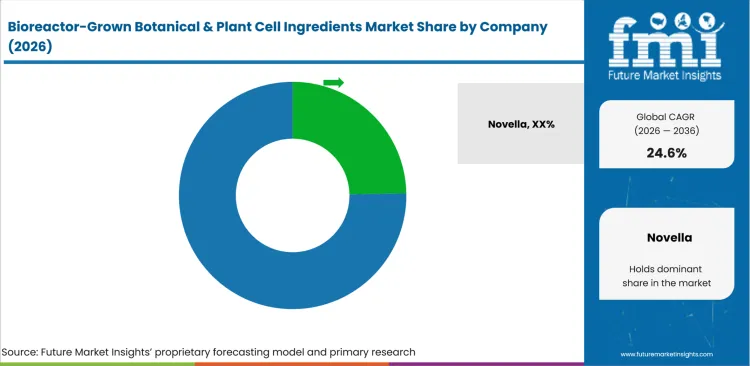
The competitive field spans proprietary plant-cell platforms and contract manufacturers that convert regulated botanical ingredients into commercial batches. Cultivated-cocoa developers form a separate route with food-specific sensory and scale-up requirements across finished applications. Companies differ in cell-bank control and downstream purification alongside reactor access and application-specific safety files. Platform ownership supports faster process changes, whereas partner-supported production can reduce capital needs during early commercialization. Finished-ingredient developers gain additional value through formulation support and established distribution across target consumer applications. Competitive advantage depends on reproducible specifications and qualified manufacturing capacity rather than the number of species tested in laboratory programs.
- Ayana Bio develops several plant-cell ingredient families through owned cultivation platforms and commercial product specifications. Brevel adds industrial illuminated-fermentation capacity through a joint scale-up program for standardized plant bioactive production. Both routes offer alternatives to conventional botanical extracts but differ in platform ownership and finished-ingredient control.
- BioHarvest Sciences and Phyton Biotech combine proprietary plant-cell processing with commercial manufacturing capacity across regulated facilities. Solabia Biochemistry adds finished plant stem cell actives and international distribution across health-oriented food and personal-care channels.
- California Cultured and Kokomodo develop cultivated cocoa ingredients through partner-supported manufacturing routes for commercial food applications. Celleste adds cocoa butter development and pilot-scale production within the broader plant-based ingredients field, although each intended geography requires separate food approval.
Competitive Benchmarking: Bioreactor-Grown Botanical & Plant Cell Ingredients Market
| Company | Plant Cell Platform | Finished Ingredient Portfolio | Scale-up and Manufacturing | Geographic Reach |
|---|---|---|---|---|
| Ayana Bio | High | High | Medium | North America and Israel |
| BioHarvest Sciences | High | High | High | North America and Israel |
| California Cultured | Medium | Medium | Medium | North America |
| Phyton Biotech | High | Medium | High | Global |
| Solabia Biochemistry AG (Mibelle Biochemistry) | High | High | Medium | Global |
| Brevel Ltd. | Medium | Low | High | Israel and North America |
| Kokomodo Ltd. | Medium | Medium | Medium | Israel and Europe |
| Celleste Bio Ltd. | Medium | Medium | Medium | Israel and Europe |
Key Developments in the Bioreactor-Grown Botanical & Plant Cell Ingredients Market
- In June 2026, Ayana Bio and Brevel announced a joint plant-cell production program selected for BIRD Foundation funding. The project combines Ayana Bio’s cultivation platform with Brevel’s illuminated fermentation system for commercial bioactive production. The partnership creates a defined scale-up route for standardized ingredients and addresses production costs that can restrict broader qualification across food and wellness applications.
- In September 2025, BioHarvest Sciences reported plant-based exosome production at scale during commercial bioreactor processing. BioHarvest recovered exosomes from liquid media containing viniferin and identified health or cosmetic applications for the controlled output. The advancement broadens the platform beyond intracellular compounds and creates another ingredient route without requiring an additional harvested plant source.
- In July 2026, Solabia completed its acquisition of Mibelle Biochemistry from Persán under the agreement announced in February 2026. Mibelle retained its Swiss plant stem cell expertise within Solabia’s network of sixteen production facilities and distribution across more than 50 countries. The transaction connects active-ingredient development with international manufacturing and creates a broader route from Swiss research into commercial distribution.
- In April 2025, Pluri completed the acquisition of approximately 71% of Kokomodo for USD 4.5 million in common shares. Kokomodo continues to operate as a Pluri subsidiary focused on cultivated cacao ingredients and production development. The transaction connects Kokomodo’s cacao cell lines with Pluri’s scalable manufacturing systems and provides a defined route beyond laboratory output.
Key Players in the Bioreactor-Grown Botanical & Plant Cell Ingredients Market
Plant-Cell Platform Developers
- Ayana Bio
- California Cultured
- Brevel
Botanical Synthesis and Manufacturing Specialists
- BioHarvest Sciences
- Phyton Biotech
- Solabia Biochemistry AG (Mibelle Biochemistry)
Cultivated Cocoa Ingredient Developers
- Kokomodo Ltd.
- Celleste Bio Ltd.
Bioreactor-Grown Botanical & Plant Cell Ingredients Market - Report Scope
| Coverage field | Report scope |
|---|---|
| Market breakdown | Technology, product, application, and region. |
| Quantitative Units | Revenue in USD Million, CAGR in %. |
| Market Definition | Botanical actives, flavors, and colors produced from plant cells in controlled bioreactors for supplements, food and beverage, or cosmetic applications. |
| Regions Covered | North America, Latin America, Western Europe, Eastern Europe, East Asia, South Asia and Pacific, and the Middle East and Africa. |
| Countries Covered | United States, Canada, Brazil, Mexico, Germany, France, United Kingdom, Italy, Spain, Finland, Switzerland, China, Japan, South Korea, India, Australia and New Zealand, GCC Countries, South Africa, Türkiye, Israel, and other assessed countries. |
| Key Companies Profiled | Ayana Bio, BioHarvest Sciences, California Cultured, Phyton Biotech, Solabia Biochemistry AG (Mibelle Biochemistry), Brevel Ltd., Kokomodo Ltd., and Celleste Bio Ltd. |
| Forecast Period | 2026 to 2036. |
| Approach | Hybrid bottom-up and top-down market sizing used primary interviews and official desk research across the defined market value chain. |
Bioreactor-Grown Botanical & Plant Cell Ingredients Market - Research Methodology
| Method | Approach |
|---|---|
| Primary Research | FMI analysts gathered input from manufacturers, service providers, technology developers, distributors, end users, procurement teams, and subject-matter experts. Interviews examined purchasing decisions, product or service evaluation, adoption barriers, approval requirements, pricing considerations, and expectations for technical or commercial support. Respondents were also asked what evidence is required before a trial, pilot, or initial order develops into regular purchasing. |
| Desk Research | Desk research covered government statistics, regulatory publications, trade data, industry associations, technical literature, standards, company filings, product information, and official corporate announcements. Sources were reviewed for relevance, publication date, geographic coverage, and consistency with the defined market scope. Claims relating to performance, applications, approvals, capacity, investment, and commercial activity were retained only when supported by credible public evidence. |
| Market Sizing and Forecasting | The market model combined the baseline value with historical performance, segment structure, pricing and volume indicators, adoption levels, company participation, and country-level demand conditions. Forecast assumptions considered economic activity, investment trends, regulatory developments, technology adoption, purchasing cycles, supply availability, and barriers to wider market use. Segment and regional estimates were reconciled before the final market total was calculated. |
| Data Validation | Estimates were checked against multiple independent indicators, including public data, company activity, trade patterns, industry developments, and findings from primary interviews. Validation also tested whether products, services, applications, and company revenues fell within the defined market boundaries. Adjacent categories, unsupported claims, overlapping revenues, and activities without direct market relevance were excluded to reduce double counting and maintain consistency across segments and countries. |
Bioreactor-Grown Botanical & Plant Cell Ingredients Market by Segments
Bioreactor-Grown Botanical & Plant Cell Ingredients Market segmented by Technology:
- Plant Cell Culture
- Bioreactor
Bioreactor-Grown Botanical & Plant Cell Ingredients Market segmented by Product:
- Botanical Actives
- Flavors
- Colors
Bioreactor-Grown Botanical & Plant Cell Ingredients Market segmented by Application:
- Supplements
- F&B
- Cosmetics
Bioreactor-Grown Botanical & Plant Cell Ingredients Market by Region:
- North America
- United States
- Canada
- Latin America
- Brazil
- Mexico
- Argentina
- Chile
- Western Europe
- Germany
- France
- United Kingdom
- Italy
- Spain
- Benelux
- Nordics
- Eastern Europe
- Poland
- Czech Republic
- Romania
- Hungary
- East Asia
- China
- Japan
- South Korea
- South Asia and Pacific
- India
- ASEAN
- Australia and New Zealand
- Middle East and Africa
- GCC Countries
- South Africa
- Türkiye
- Israel
Research Sources and Bibliography
- BioHarvest Sciences. (2025, February 18). BioHarvest Announces Sales of Flagship Product VINIA Now Exceed $50 Million USD.
- European Commission. (2026, April 24). AI-Optimised Plant Cell Culture Platform for Sustainable Production of Secondary Metabolites, Demonstrated with Cocoa.
- BioHarvest Sciences. (2025, December 18). BioHarvest Sciences Awarded $1.6 Million USD Grant from the Israeli Innovation Authority to Advance Second-Generation Botanical Synthesis Platform.
- BioHarvest Sciences. (2026, May 13). BioHarvest Sciences Announces Successful Completion of Stage 1 Development of Saffron Composition for Nutraceutical and Culinary Applications.
- BioHarvest Sciences. (2025, June 4). BioHarvest Launches Informed Sport-Certified VINIA DailyChews 2X Formula for Athletes and People with Active Lifestyles.
- BioHarvest Sciences. (2026, March 31). BioHarvest Sciences Announces First-Ever Successful Stable Cell Culture Development of Rare Fragrance-Producing Plant Using Proprietary Botanical Synthesis Platform.
- Swiss Federal Food Safety and Veterinary Office. (2026, February 17). Authorisation of novel foods.
- VTT Technical Research Centre of Finland. (2026, February 5). From lab to plate: New research initiative brings plant cell culture-based foods closer to market.
- USA Food and Drug Administration. (2025, June 11). FDA Releases Educational Materials on the New Dietary Ingredient Notification Process for Dietary Supplements.
- Finnish Food Authority. (2026, June 12). Novel Food Status Catalogue.
- Mibelle Biochemistry. (2025, November 3). New Launch: SenoCellTec™.
- Phyton Biotech. (2025, July 10). Phyton Biotech recognized as a 2025 Life Sciences BC Company to Watch.
- BioHarvest Sciences. (2026, July 15). BioHarvest Awarded $1.4M Grant from the Israel Innovation Authority to Pioneer AI-Driven Plant-Cell Synthesis.
- Ayana Bio. (2026, June 4). Ayana Bio and Brevel Awarded $1.25M BIRD Foundation Funding to Scale Plant Cell Culture Bioactive Production via Illuminated Fermentation.
- BioHarvest Sciences. (2025, September 10). BioHarvest Sciences Announces Breakthrough in Botanical Synthesis Capabilities with Plant-Based Exosome Production at Scale.
- Mibelle Biochemistry. (2026, July 2). Solabia completes the aquisiton of Mibelle Biochemistry.
- Pluri. (2025, April 28). Pluri Completes Strategic Acquisition of Leading Cultivated Cacao AgFoodTech Company, Kokomodo Ltd.
- Pow.Bio. (2025, April 30). California Cultured Leverages Pow.Bio’s Advanced Facility for Cocoa Launch, Signaling Commitment to Long-Term Collaboration.
- The Trendlines Group. (2026, April 15). Celleste Bio™ Unveils World’s First Milk Chocolate Bars Made with Cell Cultured Cocoa Butter.
This bibliography is provided for reader reference and is not exhaustive. The full report contains the complete reference list and detailed citations.
This Report Answers
- How large is the bioreactor-grown botanical & plant cell ingredients market in 2026 and 2036?
- Which technical conditions convert plant-cell cultivation into repeat commercial ingredient production?
- Why does plant cell culture represent the largest technology share during 2026?
- How do botanical actives differ from flavors and colors during qualification?
- Why do supplements account for the largest application share during 2026?
- How do country growth conditions differ across the USA, Finland, Switzerland, Germany, and Israel?
- Which companies develop plant-cell platforms or manufacture finished botanical ingredients?
- What approval and scale-up barriers limit wider adoption across food and cosmetic applications?
- How should ingredient companies compare platform depth with finished-product manufacturing capability?
Frequently Asked Questions
How big is the Bioreactor-Grown Botanical and Plant Cell Ingredients Market in 2026?
The bioreactor-grown botanical and plant cell ingredients market is valued at USD 386.2 million in 2026 and is forecast to reach USD 3,483.3 million by 2036, reflecting growing demand for authenticated cell-line production platforms that deliver repeatable botanical compound profiles with lower exposure to seasonal harvest variation.
What is the CAGR of the Bioreactor-Grown Botanical and Plant Cell Ingredients Market from 2026 to 2036?
The bioreactor-grown botanical and plant cell ingredients market is projected to grow at a CAGR of 24.6% between 2026 and 2036, supported by stable cell banks that give ingredient developers repeatable access to scarce compounds and controlled reactor conditions that preserve metabolite profiles across pilot and commercial production batches.
Which application leads the Bioreactor-Grown Botanical and Plant Cell Ingredients Market?
Supplements account for 41.9% of the bioreactor-grown botanical and plant cell ingredients market by application in 2026, driven by measured daily serving formats that translate defined botanical compounds into finished consumer products with established specialty distribution channels and documented ingredient release specifications.
Which country is growing fastest in the Bioreactor-Grown Botanical and Plant Cell Ingredients Market?
The bioreactor-grown botanical and plant cell ingredients market in Israel is projected to expand at a CAGR of 21.9% through 2036, ahead of the USA at 21.5%, Finland at 21.1%, Germany at 20.7%, and Switzerland at 20.3%, reflecting a concentrated food-technology network connecting plant-cell research with incubators, AI-driven development programs, and cross-border research funding.
Who are the leading companies in the Bioreactor-Grown Botanical and Plant Cell Ingredients Market?
Leading companies in the bioreactor-grown botanical and plant cell ingredients market include Ayana Bio, BioHarvest Sciences, California Cultured, Phyton Biotech, Solabia Biochemistry AG through Mibelle Biochemistry, Brevel Ltd., Kokomodo Ltd., and Celleste Bio Ltd., spanning proprietary plant-cell cultivation platforms, botanical synthesis and commercial manufacturing specialists, and cultivated cocoa ingredient developers.
Preview the report firsthand - request a free sample
Get SampleGet the brochure for pricing and purchase details.
Get PDFTable of Content
- Key Takeaways
- Market Size and CAGR
- Top Growth Driver
- Fastest Growing Segment
- Leading Region
- Key Companies
- Emerging Opportunities
- Executive Summary
- Global Market Outlook
- Demand-side Trends
- Supply-side Trends
- Technology Roadmap Analysis
- Analysis and Recommendations
- Analyst Perspective (What is happening? Why now? What should investors know?)
- Key Questions Answered
- How large is the market?
- What is the CAGR?
- What are key trends?
- Which region dominates?
- Who are the leaders?
- Market Overview
- Market Coverage / Taxonomy
- Market Definition / Scope / Limitations
- Research Methodology
- Chapter Orientation
- Analytical Lens and Working Hypotheses
- Market Structure, Signals, and Trend Drivers
- Benchmarking and Cross-market Comparability
- Market Sizing, Forecasting, and Opportunity Mapping
- Research Design and Evidence Framework
- Desk Research Programme (Secondary Evidence)
- Expert Input and Fieldwork (Primary Evidence)
- Tooling, Models, and Reference Databases
- Data Engineering and Model Build
- Quality Assurance and Audit Trail
- Market Background
- Market Dynamics (Drivers, Restraints, Opportunity, Trends)
- Scenario Forecast (Optimistic, Likely, Conservative)
- Impact Analysis
- AI Impact
- Sustainability Impact
- Regulatory Impact
- Technology Impact
- Consumer / Buyer Analysis
- Purchase Drivers
- Adoption Barriers
- Buyer Journey
- Opportunity Map Analysis
- Product Life Cycle Analysis
- Supply Chain Analysis
- Investment Feasibility Matrix
- Value Chain Analysis
- PESTLE and Porter's Analysis
- Regulatory Landscape
- Regional Parent Market Outlook
- Production and Consumption Statistics
- Import and Export Statistics
- Global Market Analysis and Forecast, 2021 to 2036
- Historical Market Size Value (USD Million) Analysis, 2021 to 2025
- Current and Future Market Size Value (USD Million) Projections, 2026 to 2036
- Y-o-Y Growth Trend Analysis
- Absolute $ Opportunity Analysis
- Global Market Pricing Analysis, 2021 to 2036
- Global Market Analysis and Forecast, By Technology, 2021 to 2036
- Introduction / Key Findings
- Historical Market Size Value (USD Million) Analysis By Technology, 2021 to 2025
- Current and Future Market Size Value (USD Million) Analysis and Forecast By Technology, 2026 to 2036
- Plant Cell Culture
- Bioreactor
- Plant Cell Culture
- Y-o-Y Growth Trend Analysis By Technology, 2021 to 2025
- Absolute $ Opportunity Analysis By Technology, 2026 to 2036
- Global Market Analysis and Forecast, By Product, 2021 to 2036
- Introduction / Key Findings
- Historical Market Size Value (USD Million) Analysis By Product, 2021 to 2025
- Current and Future Market Size Value (USD Million) Analysis and Forecast By Product, 2026 to 2036
- Botanical Actives
- Flavors
- Colors
- Botanical Actives
- Y-o-Y Growth Trend Analysis By Product, 2021 to 2025
- Absolute $ Opportunity Analysis By Product, 2026 to 2036
- Global Market Analysis and Forecast, By Application, 2021 to 2036
- Introduction / Key Findings
- Historical Market Size Value (USD Million) Analysis By Application, 2021 to 2025
- Current and Future Market Size Value (USD Million) Analysis and Forecast By Application, 2026 to 2036
- Supplements
- F&B
- Cosmetics
- Supplements
- Y-o-Y Growth Trend Analysis By Application, 2021 to 2025
- Absolute $ Opportunity Analysis By Application, 2026 to 2036
- Global Market Analysis and Forecast, By Region, 2021 to 2036
- Introduction
- Historical Market Size Value (USD Million) Analysis By Region, 2021 to 2025
- Current Market Size Value (USD Million) Analysis and Forecast By Region, 2026 to 2036
- North America
- Latin America
- Western Europe
- Eastern Europe
- East Asia
- South Asia and Pacific
- Middle East & Africa
- Market Attractiveness Analysis By Region
- North America Market Analysis and Forecast, By Country, 2021 to 2036
- Historical Market Size Value (USD Million) Trend Analysis By Market Taxonomy, 2021 to 2025
- Market Size Value (USD Million) Forecast By Market Taxonomy, 2026 to 2036
- By Country
- USA
- Canada
- By Technology
- By Product
- By Application
- By Country
- Market Attractiveness Analysis
- By Country
- By Technology
- By Product
- By Application
- Key Takeaways
- Latin America Market Analysis and Forecast, By Country
- Historical Market Size Value (USD Million) Trend Analysis By Market Taxonomy, 2021 to 2025
- Market Size Value (USD Million) Forecast By Market Taxonomy, 2026 to 2036
- By Country
- Brazil
- Mexico
- Chile
- Rest of Latin America
- By Technology
- By Product
- By Application
- By Country
- Market Attractiveness Analysis
- By Country
- By Technology
- By Product
- By Application
- Key Takeaways
- Western Europe Market Analysis and Forecast, By Country
- Historical Market Size Value (USD Million) Trend Analysis By Market Taxonomy, 2021 to 2025
- Market Size Value (USD Million) Forecast By Market Taxonomy, 2026 to 2036
- By Country
- Germany
- UK
- Italy
- Spain
- France
- Nordic
- BENELUX
- Rest of Western Europe
- By Technology
- By Product
- By Application
- By Country
- Market Attractiveness Analysis
- By Country
- By Technology
- By Product
- By Application
- Key Takeaways
- Eastern Europe Market Analysis and Forecast, By Country
- Historical Market Size Value (USD Million) Trend Analysis By Market Taxonomy, 2021 to 2025
- Market Size Value (USD Million) Forecast By Market Taxonomy, 2026 to 2036
- By Country
- Russia
- Poland
- Hungary
- Balkan & Baltic
- Rest of Eastern Europe
- By Technology
- By Product
- By Application
- By Country
- Market Attractiveness Analysis
- By Country
- By Technology
- By Product
- By Application
- Key Takeaways
- East Asia Market Analysis and Forecast, By Country
- Historical Market Size Value (USD Million) Trend Analysis By Market Taxonomy, 2021 to 2025
- Market Size Value (USD Million) Forecast By Market Taxonomy, 2026 to 2036
- By Country
- China
- Japan
- South Korea
- By Technology
- By Product
- By Application
- By Country
- Market Attractiveness Analysis
- By Country
- By Technology
- By Product
- By Application
- Key Takeaways
- South Asia and Pacific Market Analysis and Forecast, By Country
- Historical Market Size Value (USD Million) Trend Analysis By Market Taxonomy, 2021 to 2025
- Market Size Value (USD Million) Forecast By Market Taxonomy, 2026 to 2036
- By Country
- India
- ASEAN
- Australia & New Zealand
- Rest of South Asia and Pacific
- By Technology
- By Product
- By Application
- By Country
- Market Attractiveness Analysis
- By Country
- By Technology
- By Product
- By Application
- Key Takeaways
- Middle East & Africa Market Analysis and Forecast, By Country
- Historical Market Size Value (USD Million) Trend Analysis By Market Taxonomy, 2021 to 2025
- Market Size Value (USD Million) Forecast By Market Taxonomy, 2026 to 2036
- By Country
- Kingdom of Saudi Arabia
- Other GCC Countries
- Türkiye
- South Africa
- Other African Union
- Rest of Middle East & Africa
- By Technology
- By Product
- By Application
- By Country
- Market Attractiveness Analysis
- By Country
- By Technology
- By Product
- By Application
- Key Takeaways
- Key Countries Market Analysis
- USA
- Pricing Analysis
- Market Share Analysis, 2025
- By Technology
- By Product
- By Application
- Canada
- Pricing Analysis
- Market Share Analysis, 2025
- By Technology
- By Product
- By Application
- Mexico
- Pricing Analysis
- Market Share Analysis, 2025
- By Technology
- By Product
- By Application
- Brazil
- Pricing Analysis
- Market Share Analysis, 2025
- By Technology
- By Product
- By Application
- Chile
- Pricing Analysis
- Market Share Analysis, 2025
- By Technology
- By Product
- By Application
- Germany
- Pricing Analysis
- Market Share Analysis, 2025
- By Technology
- By Product
- By Application
- UK
- Pricing Analysis
- Market Share Analysis, 2025
- By Technology
- By Product
- By Application
- Italy
- Pricing Analysis
- Market Share Analysis, 2025
- By Technology
- By Product
- By Application
- Spain
- Pricing Analysis
- Market Share Analysis, 2025
- By Technology
- By Product
- By Application
- France
- Pricing Analysis
- Market Share Analysis, 2025
- By Technology
- By Product
- By Application
- India
- Pricing Analysis
- Market Share Analysis, 2025
- By Technology
- By Product
- By Application
- ASEAN
- Pricing Analysis
- Market Share Analysis, 2025
- By Technology
- By Product
- By Application
- Australia & New Zealand
- Pricing Analysis
- Market Share Analysis, 2025
- By Technology
- By Product
- By Application
- China
- Pricing Analysis
- Market Share Analysis, 2025
- By Technology
- By Product
- By Application
- Japan
- Pricing Analysis
- Market Share Analysis, 2025
- By Technology
- By Product
- By Application
- South Korea
- Pricing Analysis
- Market Share Analysis, 2025
- By Technology
- By Product
- By Application
- Russia
- Pricing Analysis
- Market Share Analysis, 2025
- By Technology
- By Product
- By Application
- Poland
- Pricing Analysis
- Market Share Analysis, 2025
- By Technology
- By Product
- By Application
- Hungary
- Pricing Analysis
- Market Share Analysis, 2025
- By Technology
- By Product
- By Application
- Kingdom of Saudi Arabia
- Pricing Analysis
- Market Share Analysis, 2025
- By Technology
- By Product
- By Application
- Türkiye
- Pricing Analysis
- Market Share Analysis, 2025
- By Technology
- By Product
- By Application
- South Africa
- Pricing Analysis
- Market Share Analysis, 2025
- By Technology
- By Product
- By Application
- USA
- Market Structure Analysis
- Competition Dashboard
- Competition Benchmarking
- Market Share Analysis of Top Players
- By Regional
- By Technology
- By Product
- By Application
- Emerging Startups
- Innovation Benchmarking
- Competition Analysis
- Competition Deep Dive
- Novella
- Overview
- Product Portfolio
- Profitability by Market Segments
- Sales Footprint
- Strategy Overview
- Marketing Strategy
- Product Strategy
- Channel Strategy
- Ayana Bio
- Beloved (Plantible)
- Rubi
- Kalsec
- Symrise
- Novella
- Case Studies
- Success Stories
- Recent Developments
- Competition Deep Dive
- Assumptions & Acronyms Used


