


- Bubble tea is a quick-service drink format where repeat business is driven by speed, customization, topping consistency, and execution.
- Quick-service beverage shops are the dominant outlet type for bubble tea because the format works best when drinks can be prepared, sealed, and handed over quickly.
- The black tea based beverages still have commercial value as they help in making milk tea, fruit tea, toppings, and even standardization in preparation.
- Tapioca pearls are essential for the traditional bubble tea taste but they also generate operational concerns related to cooking, holding, and consistency of taste.
- Regular sweetness level is dominant because the main recipes rely on sweetness to offset the taste of tannins from tea, milk, fruit, and toppings.
- The largest myth about the bubble tea success is that its growth is due to its attraction among the young crowd. The truth is that the best operators transform trial into repeat business.
Despite being labeled as a youth-inspired beverage trend, this can only account for initial consumption. What really sells the product in the market is its implementation in the foodservice industry. While customers might be motivated to try out bubble tea due to its novelty, flexibility, and shareability, what drives continued sales is the drink's taste, ease of ordering, and fast service.
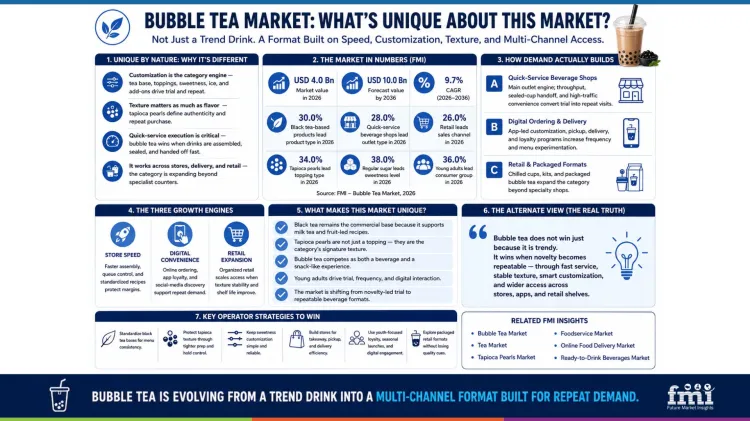
FMI's Bubble Tea Market preview shows why quick-service execution matters. The market is expected to move from USD 4.0 Bn in 2026 to USD 10.0 Bn by 2036, expanding at a 9.7% CAGR. More importantly for this article, FMI identifies quick-service beverage shops as the leading outlet type with 28.0% share in 2026. This confirms that bubble tea is not only a cafe drink; it is a speed-led beverage format.
The quick service beverages stores have an advantage due to the fact that the demand for bubble tea is centered on short buying periods. Malls, colleges, transportation routes, high streets, business districts, and places that attract young customers have high traffic flows, but consumers rarely like to wait too much. The preparation of teas, toppings, sweetness, and payments should be fast.
The Foodservice Market is relevant because bubble tea behaves like a specialized quick-service beverage category. It depends on location traffic, menu clarity, service speed, takeaway compatibility, and operational consistency. Unlike a sit-down cafe model, many bubble tea visits are impulse-led or convenience-led. This makes throughput a direct growth driver.
According to FMI, black tea-based products are the leading product type, with a 30.0% share in 2026. This is crucial considering the fact that black tea offers the best base to maintain efficiency in operations. The base can easily accommodate milk tea, fruit tea, brown sugar variants, toppings, and customization of the beverage without needing a number of different preparation systems.
The Tea Market provides useful adjacent context because bubble tea depends on tea quality, base consistency, and flavor balance. A weak tea base can damage the entire drink, even when toppings and syrups are attractive. As chains scale, tea base standardization becomes more important than novelty flavor rotation.
Another key factor is tapioca pearls. According to FMI, tapioca pearls make up the biggest segment, having a share of 34.0% in 2026. Such share demonstrates the significance of the texture factor. As for many consumers, without tapioca pearls there cannot be bubble tea. It is a technical issue that tapioca pearls need to be prepared, stored, portioned, and delivered while keeping specific texture. Bad texture may destroy the opportunity of repurchase at once.
The Tapioca Pearls Market is relevant here because toppings are part of the operating model, not just menu decoration. If pearls become too hard, too soft, too sticky, or inconsistent across outlets, the customer notices immediately. Chains that manage topping quality well can protect brand trust across high-volume store networks.
Control over the sweetness component is another important thing to consider. As noted by FMI, the standard sweet flavor has the highest market share in 2026 at 38.0%. Reduced-sugar and sugar-free variants broaden the menu, but many classic recipes still need sweetness to balance tea bitterness, milk, fruit, and chewy toppings.
The Non-Alcoholic Beverages Market is useful for positioning bubble tea within the wider beverage landscape. Bubble tea competes with iced tea, coffee, smoothies, juices, functional drinks, and cafe beverages. Its unique advantage is the combination of drink, snack, texture, and customization in one cup. The risk is that operational inconsistency makes it feel less reliable than simpler beverage formats.
Foodservice recovery in bubble tea is less about reopening stores and more about improving store efficiency. Operators require improved workflow, proper recipes, staff training, disciplined topping preparation, sealed-cup systems, and delivery-ready packaging. To meet rising online demand, shops need to serve walk-ins and deliveries without creating service delays.
The growth in India at 10.5% CAGR till 2036 further validates the expansion story in food service. FMI has pointed out that India is likely to become the fastest growing country level market as a result of rising cafe culture, youth experimentation, and urban beverage traffic. Operators will have an advantage if they can get their act right from the very beginning.
The misconception to avoid is that bubble tea grows because it is visually exciting. Visual appeal creates trial, but repeat purchase depends on taste, texture, speed, customization, and availability.
Bottom line: Bubble tea wins in foodservice when quick-service beverage shops convert novelty into routine visits. The strongest operators will combine tea-base consistency, topping discipline, sweetness control, and fast handoff across dine-in, takeaway, and delivery channels.

