


- The installed base of bone defect repair materials is going through a refresh cycle as healthcare providers are adopting advanced synthetic and engineered biomaterials instead of traditional grafting techniques.
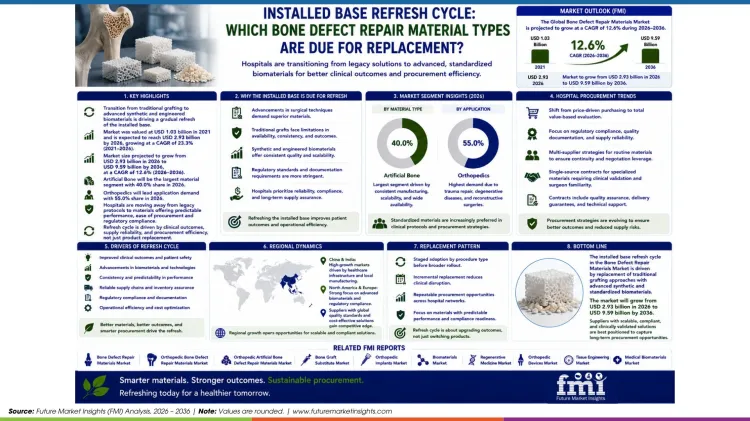
- The global Bone Defect Repair Materials Market size is estimated to reach USD 2.9 billion by 2026 and USD 9.6 billion by 2036, expanding at a CAGR of 12.6% during the forecast period (2026-2036).
- In 2026, Artificial Bone is expected to account for a share of 40.0% in overall market demand and will be the largest product segment.
- Orthopedics is projected to be the largest application segment, accounting for 55.0% of the demand in 2026, owing to rising volumes of trauma and reconstructive procedures.
- Hospitals are migrating from legacy treatment protocols to standardized biomaterials that can be relied upon for predictable performance and reliable supply.
- Increasingly, product replacement decisions are being driven by regulatory compliance, procurement efficiency and clinical consistency.
Why the Refresh Cycle Is Accelerating
Installed base refresh is no longer restricted to capital equipment. Hospitals and orthopedic centers are re-evaluating the biological materials used in surgical procedures in the Bone Defect Repair Materials Market as newer technologies are commercially available.
Healthcare providers are looking for materials that can reduce variability and support standardized surgical workflows. This is driving procurement teams to look at modern synthetic alternatives to traditional repair options.
According to Future Market Insights estimates, the Bone Defect Repair Materials Market is expected to be worth USD 2.9 billion in 2026 and further expand at USD 9.6 billion by 2036.
Artificial Bone Is Driving Product Replacement
Market segmentation shows the trend towards synthetic biomaterials. Artificial Bone is expected to account for 40.0% of the market demand in 2026, indicating the integration of engineered substitutes into regular clinical practice by a number of healthcare providers.
Engineered materials offer benefits, such as consistent production, scalable availability, and standardized quality control. This makes procurement easier and enables repeatable clinical performance across multiple healthcare facilities.
Orthopedic treatment pathways in the hospitals are being modernized where artificial bone products are replacing the conventional solutions for selected procedures.
Orthopedic Procedures Continue to Lead Demand
In 2026, orthopedics is predicted to account for 55.0% of overall application demand, the highest among all end-use segments of bone defect repair materials.
The demand for advanced repair technologies continues to grow in trauma treatment, sports injuries, spinal procedures and age-related skeletal conditions. As a result, hospitals are updating preferred material portfolios to meet changing surgical requirements.
The changeover is gradual, not all at once, and many institutions begin by using newer biomaterials on a targeted basis before they are used in a larger orthopedic programed.
Procurement Standards Are Changing
Hospital purchases are more and more being made on factors other than acquisition cost. Procurement teams evaluate suppliers on criteria such as manufacturing consistency, regulatory documentation, supply continuity and long-term availability.
Reliably operating systems and full quality documentation usually benefit the materials they support, because they reduce the risk of operations and make it easier to plan inventories.
These procurement priorities will drive a transition to advanced bone defect repair materials that are capable of providing consistent performance over long purchasing cycles.
Bottom Line
The installed base refresh cycle in the Bone Defect Repair Materials Market depicts the movement from conventional grafting techniques to novel synthetic biomaterials. The market is anticipated to grow from USD 2.9 billion in 2026 to USD 9.6 billion by 2036. Manufacturers offering standardized products, reliable supply chains and strong regulatory support are well positioned to capitalize on long-term replacement demand.

