


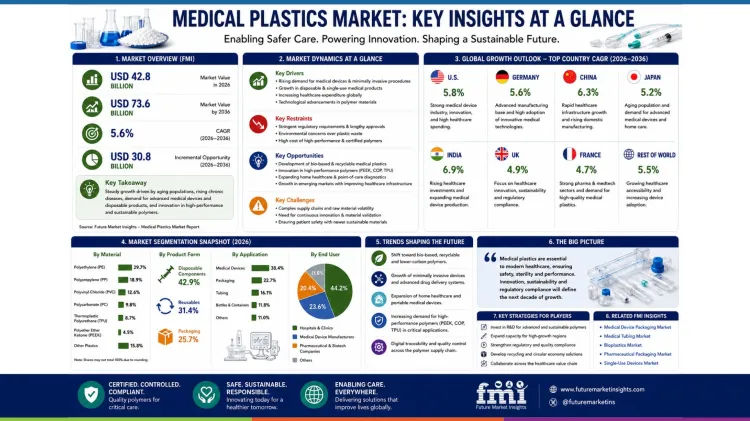
- Polyethylene remains the volume leader with 29.7% share in 2026, supported by tubing, disposables, containers, films, and high-volume healthcare products.
- Polypropylene is well placed in syringes, diagnostic consumables, containers, caps, and components that need chemical resistance and sterilization compatibility.
- Polycarbonate retains a strong position in transparent, impact-resistant device housings and diagnostic components, though substance scrutiny is encouraging buyers to assess alternative materials in selected uses.
- TPU is gaining in flexible tubing, catheters, wearable devices, and soft-touch components where elasticity and kink resistance matter.
- PEEK is expanding from a small base in implants and high-performance device parts that require strength, chemical resistance, and repeated sterilization.
- The material shift is not a wholesale move from commodity polymers to engineering plastics. It is a widening split between high-volume disposable materials and highly specified performance polymers.
Medical plastic demand is expanding in two directions at once.
Hospitals are the primary consumers of medical supplies. They require significant quantities of syringes, tubing, and sterile packaging. These products rely on high-volume polymers. Polyethylene, polypropylene, and PVC are the standard materials. This consistent demand ensures a stable market for plastic producers.
New device innovation is driving demand for specialty polymers. Materials like polycarbonate, PEEK, and TPU are becoming more common. These support advanced products like wearable systems and implantable devices. They also allow for smaller parts and clearer housings in medical equipment.
Market forecasts show significant growth ahead. FMI predicts the market will reach USD 73.6 billion by 2036. This is an increase from USD 42.8 billion in 2026. Medical devices represent 38.4% of all applications. Disposable components make up 42.9% of the product demand. Polyethylene is the leading material with a 29.7% market share.
These figures highlight the current material structure. Advanced medical devices require high-performance polymers. Meanwhile, disposable items keep cost-efficient resins like polyethylene in high demand. Healthcare sector relies heavily on these high-volume products to function.
Polyethylene Holds the Volume Centre
Films, tubing, bottles, containers, packaging, caps and disposable care products use polyethylene. It is light weight, processable, chemical resistant and available in a number of density and flexibility ranges.
According to FMI, polyethylene demand is tied directly to tubing and basic medical products. Extrusion supports fluid-transfer products, respiratory care components and infusion tubing, where smooth surfaces and tight dimensional control are important.
Alternative materials struggle to match the balance of cost and performance found in current medical plastics. The industry is focusing on cleaner materials and lower-carbon feedstocks. Improvements will likely come from better traceability and specialized formulations rather than total material replacement.
In sterile packaging, polyethylene films are essential for moisture resistance and flexibility. However, these films face sustainability challenges. Recyclability is difficult when multiple material layers are mixed together. Packaging companies are developing thinner designs and more compatible materials. Progress is slow because sterile barrier requirements are extremely strict.
Polypropylene Benefits from Sterilizable Disposables
There is a strong commercial case for polypropylene in syringes, diagnostic components, caps, laboratory products, containers and fluid handling devices. It has chemical resistance, low density, fatigue resistance and useful temperature performance.
Its resistance to selected sterilization procedures is an advantage in both disposable and reusable formats. Clear random copolymer grades are also useful for applications where product visibility is important.
Healthcare systems are increasing use of diagnostic cartridges, drug-delivery devices, specimen products and home-care components. Polypropylene can be beneficial to molded products requiring repeatable manufacturing at high volume.
The material is also suitable for injection molding, which FMI has projected to account for 34.6% of processing demand in 2026. This alignment of resin capability and the market’s leading process bodes well for continued growth.
PVC Remains Embedded in Fluid Management
PVC remains a critical material for tubing, blood bags, and IV systems. Its clarity, flexibility, and low cost make it difficult to replace. The material is also well-understood by manufacturers and performs reliably during bonding.
Current challenges for PVC are linked to its additives rather than the polymer itself. Regulators are closely scrutinizing specific plasticizers, such as phthalates. The EU Medical Device Regulation now requires strict risk assessments for these substances. Consequently, manufacturers are exploring alternative plasticizers and non-PVC materials where technically possible.
This leads to a gradual shift instead of a sudden drop. PVC is expected to stay robust in well-established fluid-handling applications, where its proven performance and track record are hard to replicate. On the other hand, TPU, polyolefin elastomers, and silicone-like alternatives might see an uptick in products where customers are willing to pay a premium or require a different level of flexibility.
TPU Is Moving with Tubing and Wearable Care
Thermoplastic polyurethane (TPU) is experiencing significant adoption within the medical tubing and flexible devices sector. The material offers a compelling performance profile, characterized by an optimal balance of elasticity, abrasion resistance, kink resistance, tactile softness, clarity, and a broad range of durometer options.
TPU is increasingly specified for critical components such as catheters, wearable drug-delivery devices, respiratory products, leads, cuffs, and flexible connectors. This adoption is particularly pronounced in applications where standard polyolefins lack sufficient flexibility and polyvinyl chloride (PVC) is deemed suboptimal.
The expansion of the home care sector serves as a primary macro driver for this material shift. Market data from Future Market Insights (FMI) indicates accelerating demand for portable housings, tubing, cartridges, and components destined for wearable devices. For body-worn applications, the material requirements are stringent: components must deliver comfort and flexibility without compromising durability or chemical resistance.
Polycarbonate Retains a Strong Device Role
Polycarbonate is valued for transparency, toughness, dimensional stability, and impact resistance. It is used in diagnostic housings, connectors, reservoirs, transparent covers, and durable device components.
FMI notes that polycarbonate supports transparent housings and higher-performance medical needs. Its continued relevance is closely tied to diagnostic and portable devices, where clear, strong parts are important.
The material faces questions around bisphenol A and regulatory scrutiny in certain contact applications. This is leading some manufacturers to evaluate copolyesters, cyclic olefin polymers, acrylics, and other alternatives.
The shift is likely to remain application-specific. A device housing with no direct patient-fluid contact presents a different risk profile from a drug-contact reservoir. Polycarbonate’s processing familiarity and performance will preserve demand in many devices, while alternatives gain where chemical resistance, regulatory positioning, or optical requirements create a stronger case.
PEEK Is Gaining from a Small, High-Value Base
PEEK does not compete with polyethylene or polypropylene on volumes. The opportunity for it is in high-performance applications where conventional polymers cannot meet strength, temperature, chemical-resistance or sterilization requirements.
The high cost of PEEK can be justified for implants, surgical instruments, dental components, minimally invasive devices, pump parts and repeated sterilization components.
FMI has found specific association of PEEK with implantable parts and high-performance requirements. This makes it one of the most commercially interesting growth materials, although the share of tonnage is still small.
PEEK value is related to replacement of metals as well. In some applications it may be lighter weight, radiolucent, and have a different mechanical profile than metal. Qualification burden is high but once qualified the programs can lead to long supplier relationships.
Cyclic Olefin Polymers and Copolyesters Are Gaining Attention
Other polymers are included in the FMI taxonomy, a category that may include some of the emerging innovation. Cyclic olefin polymers and copolymers provide high clarity, low moisture absorption, chemical purity and useful barrier characteristics. They are increasingly considered for diagnostic cartridges, syringes, vials, microfluidics devices and pharmaceutical packaging.
Copolyesters are tough and transparent and are used as alternatives to polycarbonate in selected housings and fluid contact components. Their appeal can be BPA-free positioning, chemical resistance.
These materials are still more expensive than conventional polyolefins so their use is most widespread where the performance or regulatory value is obvious.
Sterile Packaging Is Moving Toward Barrier Efficiency
The medical device packaging landscape is characterized by material diversity rather than a single resin pathway, with polymer selection strictly dictated by the functional requirements of the sterile barrier system. Polyethylene (PE) and polypropylene (PP) remain foundational for backing films, trays, containers, and sealing layers, while PET and PETG are specified for trays and blister packs requiring high clarity and structural stiffness. High-density polyethylene (HDPE) frameworks are widely deployed to support breathable sterile barriers like Tyvek, and multi-layer films are engineered to provide tailorable moisture, oxygen, puncture, and sealing performance.
Current R&D and material procurement trends are heavily focused on downgauging to create thinner films, enhancing recyclability, adopting lower-carbon-footprint feedstocks, and optimizing compatibility with modern sterilization processes. These sustainability and cost-reduction initiatives introduce critical technical trade-offs, as any material modification must absolutely maintain package integrity through the rigors of sterilization, transit, and shelf life. Because FDA guidance mandates a comprehensive assessment of sterilization effects on both the medical device and its packaging concurrently, packaging converters cannot execute simple film substitutions based solely on green metrics or cost. Any change in the resin formulation requires rigorous re-validation to ensure regulatory compliance and uncompromised barrier performance.
Tubing Will Remain a Multi-Material Market
Medical tubing is often discussed as one segment, but it includes IV lines, catheters, respiratory tubing, pump tubing, drainage products, dialysis pathways, and laboratory fluid systems.
Polyethylene makes for simple, cost-conscious tubing. PVC is still important for flexible fluid handling. TPU is being adopted for higher-performance and wearable applications. Silicone is used where flexibility, biocompatibility and temperature resistance are important, but it sits outside the thermoplastic focus of many medical plastic suppliers. Fluoropolymers and specialty elastomers meet chemical and device needs.
There is no one polymer covering the entire category. It is a good thing for broader material portfolios that device requirements are becoming more specific.
The Market Is Segmenting by Risk and Value
The clearest material observation is a widening gap between volume and value.
Polyethylene and polypropylene will continue to dominate high-volume disposables, packaging, and basic devices. PVC remains embedded in fluid systems but faces selective substitution. TPU, PEEK, cyclic olefin polymers, and specialty compounds are gaining in applications that reward performance and regulatory support. Polycarbonate remains important but will face more targeted material reviews.
The winning polymer is determined by where it sits in the device, what it touches, how it is sterilized, how long it is used, and what happens if it fails.
For suppliers, this means that breadth of portfolio is not enough. Device OEMs are looking for more application advice, processing support, regulatory documentation, change control and long-term supply. A material company which can help select the right resin for a housing, tube, cartridge, implant or sterile pack is more valuable than one selling resin by generic polymer family.
Medical plastics are therefore not moving from one dominant material to another. They are becoming more specialized. Polyolefins retain the volume base. Engineering plastics and elastomers are capturing the applications where performance, miniaturization, patient contact, and device complexity justify a higher material cost.

