


- The nanotechnology toothpaste formulations market is projected to reach USD 980.6 million by 2036 from USD 520.4 million in 2026, at a CAGR of 6.5% during the forecast period, owing to increasing demand for advanced oral care products globally.
- Dental hospitals, clinic networks and institutional healthcare providers are exploring procurement strategies for nano-enabled oral care products used in preventive and therapeutic dental programs.
- Large dental chains are considering whether to prioritize operational efficiency through single-supplier sourcing or the flexibility and risk-mitigation benefits available through multi-supplier procurement models.
- Organizations often source from multiple suppliers for a broader range of nano-hydroxyapatite, nano-calcium carbonate and specialty oral care formulations.
- Integrated dental networks are trending toward single-supplier contracts, citing benefits in inventory management, standardization and price negotiations.
- Procurement contracts are increasingly not just about the price of the product but also include training support, clinical evidence, quality assurance commitments and guarantees on the continuity of supply.
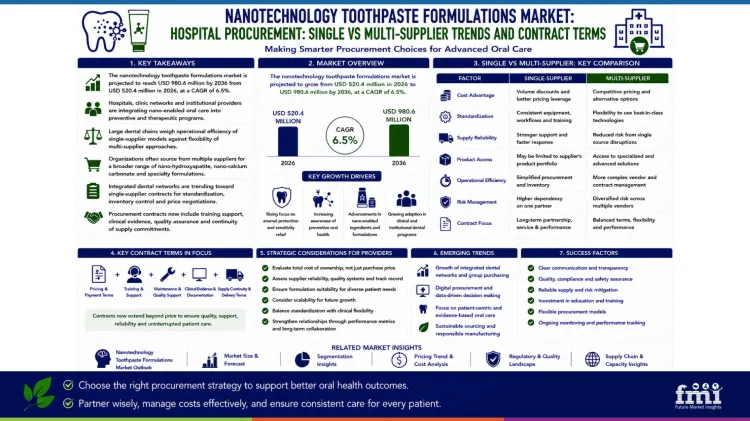
The market for nano-technology toothpaste formulations is gaining momentum, with oral healthcare providers increasingly adopting advanced preventive care products to improve patient outcomes. The market is expected to grow from USD 520.4 million in 2026 to USD 980.6 million by 2036, at a CAGR of 6.5% during the forecast period. The increasing demand for nano-enabled toothpaste formulations is owing to the growing awareness towards the protection of enamel, sensitivity management, and preventive oral care.
Procurement practices of hospitals, dental clinics and organized healthcare networks are evolving as advanced oral care products are increasingly being integrated into professional dental recommendations and preventive treatment programs. Once primarily a consumer-driven procurement category, it is now increasingly drawing the interest of institutional procurement, particularly within large dental service organizations and healthcare systems looking for standardized preventive care solutions.
The decision making process for purchasing toothpaste and other oral care products has been very decentralized in the past. Individual dentists, clinics or departments often chose products based on personal preference, brand familiarity or patient demand. The growth of organized dental networks and preventive health care programs has fostered more centralized procurement frameworks.
One of the most important strategic questions for institutional buyers today is whether to go with a single supplier for all oral care needs or to keep relationships with a handful of suppliers that have specialized formulations.
Single-supplier procurement models have a number of operational advantages. Healthcare providers can negotiate pricing agreements based on volume, reduce inventory management, streamline ordering processes and maintain consistency across multiple locations. These benefits become more and more important for large dental chains, which have a large number of clinics following standardized treatment protocols.
Standardization is especially important in situations where preventive oral care products are integrated in patient care pathways. The use of one common set of nano-enabled toothpaste formulations across facilities allows organizations to reduce staff training, improve patient education programs and increase consistency of treatment. Consistent product recommendations also enable easier tracking of patient outcomes and measurement of effectiveness of the program.
Single-source agreements often yield additional commercial benefits. They can offer dedicated account management, education resources, clinical training support, marketing assistance and preferred pricing. The advantages of these alliances can be greater than just the purchase of products for larger healthcare organizations and can lead to efficiencies in operations.
Relying on only one supplier can create one vulnerability.
Supply chain disruptions, manufacturing delays, regulatory issues, ingredient shortages, and product recalls can all directly impact product availability. Consequently, many healthcare vendors are unwilling to limit their buying to one vendor.
The nanotechnology toothpaste formulations market continues to be a key component of multi-supplier procurement strategies.
By keeping up relationships with a number of suppliers, healthcare organizations can access a wider array of technologies, ingredient platforms and treatment solutions. Manufacturers usually focus on specific applications, such as enamel remineralization, sensitivity relief, whitening, plaque control, or fluoride-free formulations.
Such flexibility is especially useful in oral healthcare where needs of the patients can be vastly different. Some patients need intensive sensitivity management, others are concerned with preventive, cosmetic or specific treatment needs. The ability for providers to tailor product recommendations to individual patient profiles is improved by multi-supplier procurement.
The argument for diversifying procurement is further supported by the growing diversity of nano-enabled ingredients. Emerging technologies such as nano-hydroxyapatite, nano-calcium carbonate and nano-silver have unique performance attributes. Health care providers usually want to be able to access a number of technology platforms rather than having treatment options limited to the portfolio of a single supplier.
Product development cycles also influence procurement strategies.
The manufacturers keep introducing new formulations aimed at improving enamel repair, reducing bacterial activity, improving whitening performance and supporting overall oral health. With multi-supplier procurement, organizations can also test new technologies and adopt promising developments without risking their current supplier relationships.
The contract structures themselves are becoming more sophisticated.
The days when procurement negotiations were solely about product pricing are long gone. Healthcare organizations are increasingly examining the total value contribution of suppliers over the life of a contract. Agreements often include clauses pertaining to education of clinicians, scientific support, product training, support in inventory management, and performance monitoring.
Clinical evidence requirements are becoming increasingly important.
As nano-enabled oral care products enter into professional healthcare procurement, procurement teams are looking for evidence of efficacy. Suppliers that can demonstrate measurable improvements in enamel remineralization, sensitivity reduction, plaque control or preventive oral health outcomes typically perform well in supplier evaluations.
Quality assurance is yet another significant factor in procurement.
Nano-ingredients are produced under strict controls, uniform particle size, formulation stability and stringent quality management systems. Healthcare groups are vetting supplier manufacturing practices, regulatory compliance records and quality certifications before signing long-term contracts.
The tracking of ingredients is also receiving increasing attention. Institutional buyers are looking for more transparency into sourcing, production and quality control processes. Suppliers who can put full documentation on the surface often increase their advantage in procurement negotiations.
Contract design is also being affected by risk management considerations.
Healthcare providers are increasingly assessing suppliers on manufacturing capacity, inventory availability, business continuity planning and distribution capabilities. With the growth of preventive oral healthcare programs, reliable supply performance has become a major competitive differentiator.
Trends in market segmentation give further insight into changing procurement priorities. Applications for sensitivity relief and caries prevention are of considerable institutional interest as these segments are very much in line with preventive dentistry initiatives. Nano-hydroxyapatite-based formulations still attract attention especially with increasing clinical acceptance of those in enamel remineralization programs.
In the next 10 years, it is expected that dental clinics and organized healthcare networks will represent an increasing share of procurement activity. These bodies have greater purchasing power and often develop formal procurement assessment procedures that impact broader market dynamics.
Procurement decisions are made more complex by expansion into regional markets. Healthcare providers operating in more than one country are accustomed to differing regulatory requirements, product registration standards and reimbursement frameworks. Procurement teams must negotiate supplier contracts to balance standardization goals against the needs of local markets.
The decision to buy only on price is becoming less and less relevant. Cost control remains important, but healthcare organizations are now evaluating suppliers on multiple dimensions, including product performance, scientific evidence, manufacturing quality, supply reliability, regulatory compliance, creativity and long-term partnership potential.
The increasing maturity of the nanotechnology toothpaste formulations market is expected to bring about a significant rise in procurement sophistication. Strategic sourcing decisions will become increasingly important in determining supplier competitiveness, adoption rates in institutions, and long-term market growth.
Bottom Line
Procurement strategies are becoming an increasingly important differentiator in the nano-technology toothpaste formulations market. Single supplier agreements offer simplification, cost savings and standardization, while multi-supplier models provide flexibility, new ideas, and supply chain resilience. The most successful organizations will be those that align procurement strategies with clinical objectives, preventive care initiatives, and evolving patient needs, while balancing cost, quality, and long-term value creation.

