


- Bakery mixes are not just convenience products; they are outcome-control systems used to reduce recipe variation and improve consistency.
- FMI identifies bread mixes as the leading product type, with 40.0% share in 2026, confirming the importance of repeat-volume baking applications.
- Industrial bakeries lead end-use demand with 46.0% share in 2026 because large bakery users need consistent dough and batter behavior across shifts.
- Foodservice operators and household consumers use mixes differently, but both value lower preparation risk and more predictable finished quality.
- The strongest suppliers are those that support mix performance through application trials, process guidance, texture control, and shelf-life validation.
- The misconception to avoid is that bakery mixes are bought mainly because they are easy. In commercial settings, they are bought because they reduce risk.
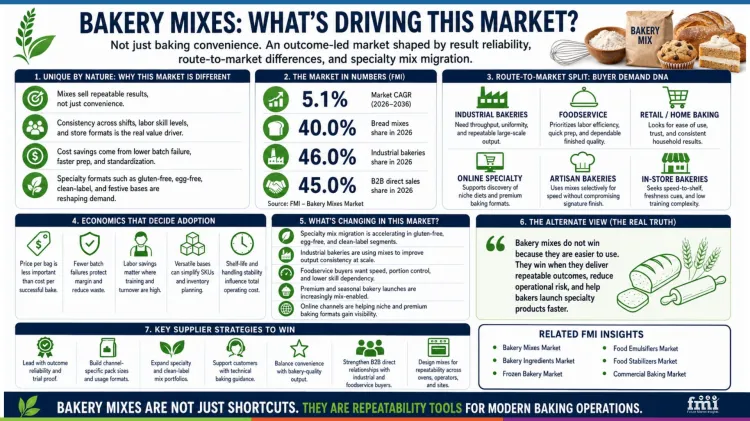
The Bakery Mixes Market is commonly described as a convenience-led category. That description is useful at the retail shelf, but incomplete for market analysis. Convenience explains why a household shopper may try a cake mix or pancake-style base. It does not fully explain why industrial bakeries, foodservice operators, and commercial kitchens keep using formulated bakery mixes after trial. In those settings, the stronger driver is outcome reliability.
A bakery mix converts multiple ingredient decisions into one controlled formulation. Flour, leavening systems, sugars, emulsifiers, stabilizers, enzymes, fats, flavor systems, and functional minor ingredients can be pre-balanced by the supplier. That reduces the number of weighing points and lowers the risk of operator error. For a bakery running repeated batches, the value is not only faster preparation. The value is fewer failed batches, tighter texture control, more predictable proofing or batter behavior, and less variation between production shifts.
This is why bakery mixes behave differently from single bakery ingredients. A bakery ingredient supplier sells functionality. A bakery mix supplier sells a controlled output. That output may be a loaf with predictable volume, a cake with uniform crumb, a muffin with stable moisture, a pastry base with repeatable handling, or a retail baking kit that helps a consumer succeed without technical knowledge. The product is judged by the finished bake, not by the ingredient list alone.
FMI’s Bakery Mixes Market identifies bread mixes as the leading product type, with 40.0% share in 2026. This makes sense because bread is a repeat-volume application where small formulation differences can affect dough absorption, proofing time, loaf volume, softness, and shelf life. Bread mixes are useful when operators want to manage flour variability and maintain consistency across daily production cycles.
Industrial bakeries are expected to hold the leading end-use share because they face the highest cost of inconsistency. A small bakery can sometimes correct a dough manually. A large plant running high-speed lines has less flexibility. If a mix performs poorly, the issue can affect line speed, waste, packaging schedules, retailer service levels, and finished product returns. For industrial users, a stable mix can protect output quality and operating efficiency at the same time.
Foodservice buyers use bakery mixes for a different but related reason. Cafes, hotels, restaurants, cloud kitchens, catering units, and quick-service operators often have limited baking skill on-site. Staff turnover can be high, menu cycles can change quickly, and kitchen time is limited. A mix allows them to offer cakes, muffins, pancakes, quick breads, cookies, dessert bases, and pastry-style products without maintaining full bakery production expertise. Here, the mix is a labor-saving and training-reduction tool.
Household retail demand is more emotion-led but still outcome-driven. Consumers may buy a mix because it feels easy, but repeat purchase depends on whether the product produces a successful bake. If the cake sinks, the bread lacks softness, the muffins are dry, or the instructions feel unclear, the mix does not build trust. Retail mixes therefore depend heavily on recipe clarity, visual expectations, pack instructions, flavor appeal, and forgiving preparation windows.
Adjacent markets help explain this logic. The Bakery Ingredients Market shows the broader role of ingredients in structure, freshness, and processing performance, while the Flour Mixes Market reinforces how pre-blended flour systems support consistent usage across bakery applications. Bakery mixes sit between these two areas: they are more complex than flour systems, but still intermediate inputs rather than finished baked goods.
Outcome reliability also depends on whether the mix is designed for the right process. A mix used in a plant mixer, a foodservice bowl, a retail home oven, or a frozen bakery line may need different hydration tolerance, leavening timing, batter viscosity, emulsifier balance, enzyme activity, flavor release, and shelf-life support. A single formulation cannot serve every process equally well. Suppliers that understand the production environment are better positioned than suppliers that only sell standard mixes.
The strongest bakery mix suppliers therefore compete through application support. They help customers set water levels, mixing times, holding windows, baking temperatures, deposit weights, proofing protocols, and troubleshooting procedures. This technical service can be more important than the headline ingredient list. A buyer may test a mix in a lab, but adoption usually depends on whether the product works under commercial conditions.
There is also a quality perception challenge. Some customers associate mixes with lower craft value or standardization. This is particularly relevant in artisan bakery, premium patisserie, and specialty bread formats. Suppliers must show that mixes do not necessarily reduce quality. A well-designed mix can protect consistency while leaving room for customization through fillings, toppings, inclusions, flavors, decorations, or fermentation steps.
The common mistake is treating bakery mixes as a low-involvement convenience category. In reality, they sit closer to process control. The mix is expected to remove uncertainty while protecting sensory performance. This is why a cheaper mix is not always better. If a lower-priced mix causes more waste, more adjustment, or weaker finished quality, the cost advantage disappears quickly.
Outcome reliability can also be measured more practically than many category discussions suggest. Buyers can track rejected batches, mixing corrections, bake loss, line stoppage, product returns, staff training time, and complaint rates. A bakery mix that improves these indicators has value even if its invoice price is higher than an internally blended alternative. This is why cost discussions should include total operating impact, not only ingredient cost.
In industrial baking, the mix also acts as a knowledge-transfer tool. Instead of requiring every plant or shift team to interpret a recipe from separate ingredients, the supplier embeds part of the formulation logic into the mix. This helps multi-site operators keep product identity consistent across locations. It also supports faster onboarding when new staff, new equipment, or new production shifts are added.
For foodservice, outcome reliability has a service-quality dimension. A hotel buffet, cafe chain, airline kitchen, or catering unit cannot afford inconsistent muffins, cakes, pancakes, or dessert bases during peak service. Mixes help operators maintain quality when preparation is handled by general kitchen staff rather than bakery specialists. This is especially important where high staff turnover or limited back-of-house space makes full scratch preparation difficult.
For household retail, reliability is linked to confidence and repeat purchase. A consumer may forgive a complex scratch recipe that fails, but they expect a boxed mix or pouch mix to work. This means instructions, visual cues, required added ingredients, preparation time, and baking tolerance become part of the product experience. A mix that performs well across ordinary home ovens and uneven user skill levels has a stronger chance of becoming a pantry repeat item.
Suppliers should therefore treat bakery mixes as platforms, not static SKUs. A strong base can support multiple flavor variants, inclusions, clean-label adaptations, seasonal kits, or foodservice menu extensions. The base must remain robust as the visible product changes. This is where application centers, pilot baking, and customer-specific adjustment become critical to long-term supplier preference.
Bottom line: bakery mixes win when they make baking more repeatable. Convenience creates interest, but outcome reliability creates adoption. The most defensible suppliers will be those that help customers deliver the same quality repeatedly across plants, stores, kitchens, and household use occasions.
Related FMI Reports
- Bakery Mixes Market: Primary market reference and benchmark source
- Bakery Ingredients Market: Use when discussing ingredient functionality and finished product performance
- Flour Mixes Market: Use when discussing flour-based pre-blended systems
- Bread Improvers Market: Use when discussing bread softness, volume, and process consistency
- Food Enzymes Market: Use when discussing enzyme-led process control
- Food Emulsifiers Market: Use when discussing cake structure and batter stability

