


- Private label is becoming a serious threat in plant-based meat because value-led retailers can use textured protein to narrow the price gap with animal meat and branded meat alternatives.
- Textured protein suppliers are likely to see stronger demand for cost-efficient soy, wheat, and blended proteins as private label buyers prioritize margin, scale, and repeatability.
- Premium plant-based brands may remain differentiated through taste, claims, and innovation, but value-tier competition will pressure ingredient cost structures.
- The biggest beneficiaries are suppliers that can deliver reliable texture at lower formulation cost without forcing brands to sacrifice bite, hydration, or cooking performance.
- The biggest risk is assuming private label will only compete on price. In mature retail categories, private label wins when acceptable quality meets better shelf economics.
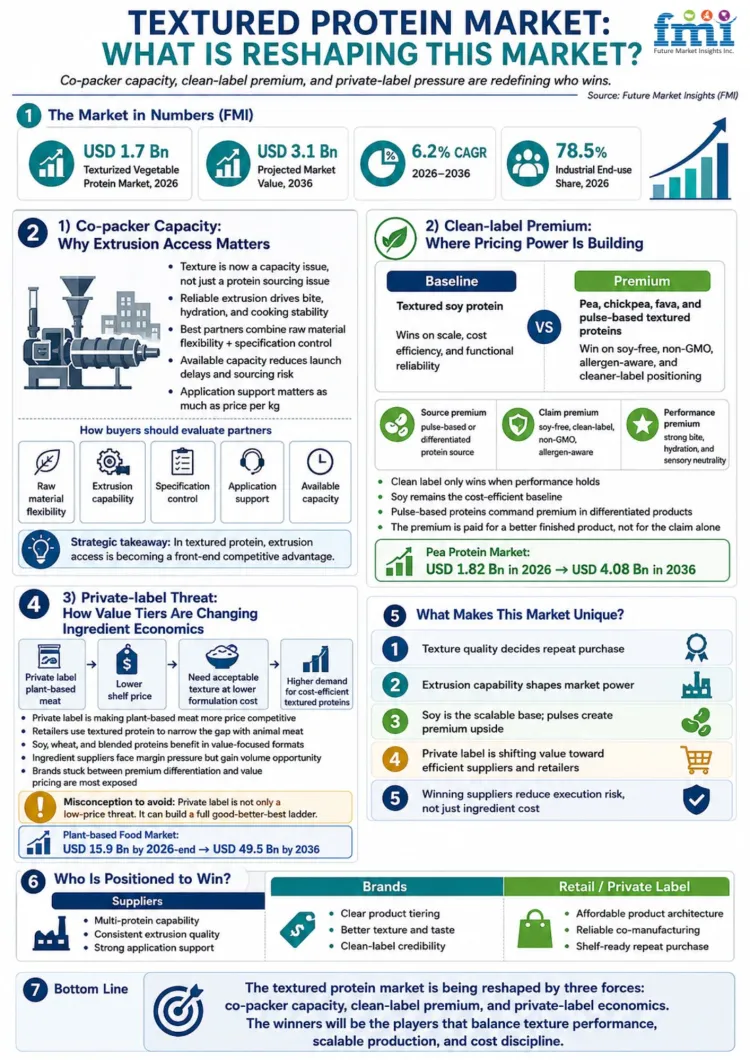
Private label is becoming one of the most important economic threats in the textured protein market. The issue is not simply that retailers may launch more plant-based products under their own labels. The deeper issue is that private label changes the ingredient economics of plant-based meat, meat substitutes, ready meals, and hybrid protein products.
For years, plant-based meat was positioned around innovation, sustainability, vegan identity, and brand storytelling. That created space for premium products and specialist brands. But as the category moves toward routine retail and foodservice use, the competitive question is changing. The market is no longer asking only, “Which brand has the best plant-based product?” It is asking, “Who can deliver acceptable taste and texture at a price point that mainstream consumers will repeat?”
That question directly affects textured protein. Textured soy protein, textured pea protein, textured wheat protein, and blended textured proteins are not only functional ingredients. They are cost levers. They help brands create bite, structure, chewiness, moisture retention, and meat-like eating experience. In private label formats, these ingredients also help control finished product pricing.
FMI’s Texturized Vegetable Protein Market shows why the ingredient is strategically important. The market is projected to expand from USD 1.7 billion in 2026 to USD 3.1 billion by 2036. FMI defines texturized vegetable proteins as functional plant derivatives extruded to create fibrous structural textures that provide chewiness and moisture retention in finished food applications. This is exactly the performance private label needs: not only protein content, but functional meat-like structure at scalable cost.
The private label threat becomes stronger when viewed through the wider plant-based food market. FMI’s Plant-based Food Market is projected to reach USD 15.9 billion by 2026-end and USD 49.5 billion by 2036. FMI also identifies food and beverage as the leading end-use share. This matters because private label tends to gain relevance when categories move from niche trial into broader grocery routines. Once plant-based food becomes part of regular shopping baskets, retailers have more incentive to create their own alternatives.
The same pattern applies to meat substitutes. FMI’s Meat Substitutes Market is projected to grow from USD 15.8 billion in 2026 to USD 125.4 billion by 2036. Plant-based chicken and nugget-style formats are identified as important category areas. These are exactly the formats where private label can become aggressive. Nuggets, patties, mince, strips, and ready-to-cook formats are easier for retailers to standardize than highly differentiated chef-style products. They are also highly exposed to price comparison.
For textured protein suppliers, this creates a clear shift in demand. Premium brands may ask for differentiated pea, fava, chickpea, or clean-label textured proteins. Private label buyers, however, are likely to ask a different question: which protein system delivers the required eating experience at the lowest acceptable formulation cost? That makes textured soy protein, wheat protein, and blended systems highly relevant. Cost efficiency becomes as important as claim value.
This does not mean private label will always choose the cheapest ingredient. The private label model still needs repeat purchase. A low-cost plant-based burger, nugget, or sausage that performs poorly will damage the retailer’s own brand. So the winning ingredient strategy is not the lowest price alone. It is the lowest total performance cost. That means acceptable bite, stable cooking behavior, good hydration, consistent particle size, manageable flavor masking, and dependable supply.
In this environment, textured protein becomes a margin management tool. For private label plant-based meat, ingredient cost can decide whether the product can sit below branded alternatives while still protecting retailer and manufacturer margins. If textured protein costs are too high, the finished product loses its price advantage. If the texture is too weak, the product loses repeat purchase. Suppliers that balance cost and function will become more valuable.
The first pressure point is the price gap between branded and private label plant-based meat. Branded plant-based meat often carries costs linked to R&D, marketing, distribution, retail promotion, and product differentiation. Private label can reduce some of those costs because retailers already control shelf access, shopper data, and store traffic. That gives private label the ability to compete aggressively on price. Textured protein suppliers will therefore face sharper pressure to support lower finished product cost.
The second pressure point is gross margin. Private label retail works best when the retailer can offer a lower price to the shopper while still capturing attractive margin. This creates pressure across the value chain. Co-packers, ingredient suppliers, flavor houses, and formulation partners may all be asked to reduce cost or improve efficiency. Textured protein suppliers that cannot show clear yield, hydration, or processing advantages may be pushed into price-based competition.
The third pressure point is supplier concentration. If only a limited number of suppliers can deliver consistent textured protein at scale, those suppliers may retain pricing power. But if private label buyers can qualify multiple suppliers across soy, wheat, pea, and blended systems, bargaining power moves toward retailers and contract manufacturers. This is why single-source versus multi-source procurement becomes important. Private label buyers will prefer supply optionality wherever the finished product specification allows it.
The fourth pressure point is value distribution by tier. In premium plant-based meat, more value may sit with brands, formulation IP, claims, and consumer experience. In private label plant-based meat, more value may shift toward retailers, efficient co-manufacturers, and low-cost ingredient platforms. This can reduce the pricing power of specialist branded meat alternative companies while increasing the importance of ingredient suppliers that can operate at scale.
The fifth pressure point is formulation simplification. Private label products often need fewer complications in manufacturing and procurement. A retailer does not want a value product that depends on a fragile, expensive, or difficult-to-source protein system. This favors textured proteins that are commercially proven, easy to hydrate, stable in cooking, and compatible with common flavor and binder systems. Textured soy and wheat proteins are likely to remain strong in this environment because they offer cost and familiarity. Pea and blended proteins can gain where soy-free or cleaner positioning is required.
The plant-based beef market highlights how this could play out. FMI’s Plant-based Beef Market is projected to grow from USD 6.99 billion in 2026 to USD 45.52 billion by 2036. Burger patties are expected to be a leading product area, and soy-based protein is identified as a leading source. This combination is important for private label. Burger patties are highly visible, price-comparable, and easy for shoppers to compare across brands. If retailers can offer acceptable plant-based patties under private label, branded players may face direct shelf pressure.
The threat is not limited to beef-style products. Plant-based chicken, nuggets, sausages, mince, and ready meals can all become private-label targets. Nuggets and strips are especially attractive because they can be standardized, frozen, portioned, and sold in family-value formats. Ready meals can also absorb textured protein as a cost-effective protein component. In these applications, the consumer may not even be buying “textured protein” consciously. They are buying convenience, price, and acceptable taste.
For ingredient suppliers, private label growth creates both risk and opportunity. The risk is margin compression. Private label buyers are disciplined and often negotiate harder than smaller emerging brands. They may demand volume pricing, stable contracts, and strict quality performance. Suppliers that rely on high margins from differentiated claims may struggle if the buyer’s main objective is affordability.
The opportunity is volume. Private label can turn plant-based foods from occasional premium purchases into repeat grocery items. If private label products gain shelf space, textured protein demand can become more stable and scalable. Suppliers that can support high-volume production, consistent specifications, and competitive pricing may benefit even if unit margins are lower. In this model, scale replaces premium as the growth engine.
For branded plant-based meat companies, the private label threat is more serious. Brands that depend only on being “plant-based” may lose relevance as retailers offer cheaper alternatives. To defend share, branded players need stronger reasons to exist: better texture, cleaner label, superior flavor, functional nutrition, chef-led formats, or strong emotional brand identity. Without those advantages, brands may be squeezed between premium innovators and retailer-owned value products.
For co-packers, private label demand can be attractive but operationally demanding. Retailers need consistency, food safety, packaging compliance, cost control, and reliable delivery. Co-packers that already work with meat alternatives, frozen foods, ready meals, and protein systems may be well positioned. However, they will also need strong control over textured protein sourcing. A private label product cannot afford frequent ingredient variation if the retailer expects stable quality.
For retailers, the strategic logic is clear. Plant-based categories can expand basket value, appeal to flexitarian consumers, and support sustainability positioning. But if branded products remain too expensive, category growth can stall. Private label allows retailers to create entry-level or mid-tier options that bring more shoppers into the category. Textured protein is one of the key ingredients that makes that possible.
The misconception to avoid is that private label always means low quality. In many food categories, private label has moved from basic value to good-better-best architecture. The same can happen in plant-based meat. A retailer may offer a value soy-based nugget, a mid-tier pea-blend burger, and a premium clean-label product. Each tier would use textured protein differently. The threat to brands is therefore not one product. It is a full private label price ladder.
Another misconception is that private label only hurts branded finished-product companies. It can also reshape suppliers. Ingredient suppliers may be asked to create private-label-ready protein systems, cost-down formulations, and custom blends for retailer-backed manufacturers. This could increase demand for textured protein while reducing pricing flexibility. Suppliers may sell more volume but face tighter margin control.
The private label threat also changes how clean label should be understood. Clean label remains important, but private label buyers will not pay premiums without clear value. A soy-free or pulse-based textured protein must support a specific shelf claim, consumer need, or premium tier. Otherwise, value-tier products will likely prioritize cost-efficient soy, wheat, or blended systems. This creates a split market: premium clean-label proteins for differentiation and baseline textured proteins for cost-led growth.
The best way to analyze this market is through a margin-spread lens. The key metrics are private label penetration by category, price gap versus branded products, gross margin by tier, ingredient cost share, supplier concentration, and value distribution across retailer, co-packer, ingredient supplier, and brand owner. These metrics show whether private label is expanding the total category or simply shifting profit away from branded players.
Bottom line: private label is not a side issue for the textured protein market. It is a structural force that can change ingredient demand, supplier bargaining power, and finished-product economics. The winners will be the textured protein suppliers that can deliver scalable, cost-efficient, application-ready texture for value and mid-tier plant-based formats. The losers will be brands and suppliers that assume plant-based positioning alone is enough to protect price. In the next phase of the market, private label will not only compete on the shelf. It will reshape the ingredient economics behind the shelf.

