


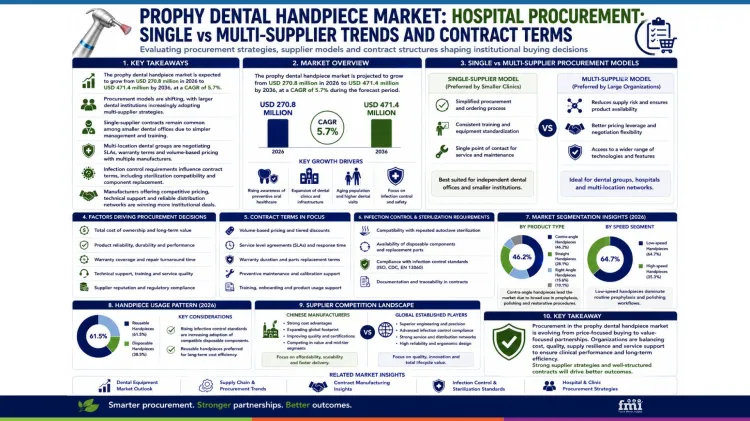
- The prophy dental handpiece market is expected to grow from USD 270.8 million in 2026 to USD 471.4 million by 2036, at a CAGR of 5.7% during the forecast period.
- Procurement models are changing, with larger dental institutions increasingly moving to multi-supplier models to balance cost efficiency, product availability and supply chain resilience.
- Single supplier contracts are still preferred by smaller dental offices due to ease of servicing, training requirements and vendor relationships.
- Multi-location dental groups are negotiating service level agreements, warranty provisions and volume-based pricing structures with multiple manufacturers and are prioritizing procurement flexibility.
- Requirements for infection control are impacting contract specifications, particularly in terms of compatibility with sterilization, frequency of component replacement and availability of disposable components.
- Manufacturers that are able to offer competitive pricing, technical support, and reliable distribution networks are increasing their share of institutional procurement channels.
The prophy dental handpiece market is witnessing a rising influence of changing procurement dynamics across dental clinics, hospitals and organized dental service networks. Product innovation and clinical performance remain important, but buying decisions are becoming more strategic as providers look to optimize costs, reduce operational risks and maintain un-interrupted access to key equipment.
The market is estimated to grow from USD 270.8 million in 2026 to USD 471.4 million by 2036, at a CAGR of 5.7% during the forecast period of 2026-2036 owing to sustained demand generated by routine prophylaxis procedures, expanding dental infrastructure, and growing awareness regarding preventive oral healthcare. The market is projected to grow at a CAGR of 5.7% during the assessment period.
Much of what procurement practices will look like has to do with the size and structure of the health care provider.
Smaller institutions and independent dental clinics tend to continue to use single-supplier models. These arrangements streamline the procurement process by integrating ordering, maintenance and technical support with a single vendor relationship. Standardization also benefits clinicians by reducing training requirements and operational complexity. But there are dangers in going with just one supplier.
Clinical operations can be directly affected by any disruption in the supply, unexpected increase in prices or availability of products. The risks have emerged with greater frequency as healthcare providers globally re-evaluated sourcing strategies in the face of broader supply chain uncertainties.
Therefore, multi-supplier procurement frameworks are becoming increasingly popular with larger organizations.
Corporate dental networks, hospital-based dental departments and group practices are increasingly diversifying their vendor relationships to improve procurement resilience. Multiple suppliers allow organizations to increase their negotiating leverage, maintain alternative sources, and lower dependency on individual manufacturers.
The contract structures themselves are changing even.
Previously, procurement contracts were based on unit price. Today buyers are looking at broader value aspects such as warranty length, preventive maintenance provisions, replacement turnaround times and technical training support.
These service-related elements are particularly important in high-volume clinical settings where equipment downtime directly impacts productivity and patient scheduling.
Infection prevention considerations are another important consideration in determining procurement requirements.
The repeated sterilization cycles impose high stress on reusable handpieces affecting their lifecycle economics and replacement frequency. As a result, procurement teams are giving more importance in supplier proposals to the durability of autoclaves, the ease of maintenance and the compatibility with disposable components.
Trends in market segmentation further illustrate these dynamics.
Contra-angle dental handpieces are expected to account for 46.2% of the product demand in 2026, supported by their widespread use in prophylaxis, polishing and restorative applications. Due to their versatility, they are the preferred choice for both centralized and decentralized procurement environments.
The low-speed handpiece represents 64.7% of the speed segment in 2026, thus illustrating its crucial function in the everyday dental workflow. Acquisition cost is increasingly not the only consideration in decisions on procurement of these products, but rather reliability and total life cycle value.
Preferences for use also influence buying behavior.
Reusable handpieces will account for 61.5% of market demand in 2026, owing to their cost savings in the long run. But the increasing expectations around infection control continue to fuel interest in complementary disposable components that support compliance objectives.
Procurement Evolution From a Supplier Perspective Opportunities and Challenges
For institutional contracts, manufacturers need to prove that they have capabilities beyond product performance. Purchasing decisions are increasingly being affected by distribution reliability, after sales service infrastructure, training programs and contract flexibility.
Organizations that can align commercial offerings with the operational priorities of dental providers are likely to gain market position.
The distinction between single and multi supplier strategies should not be seen as a binary choice.
Many health care organizations have a hybrid model, maintaining primary supplier relationships, but also developing secondary vendor relationships for contingency planning and for certain categories of products. This model allows providers to balance efficiency with resilience.
The bottom line: Purchasing trends in the prophy dental handpiece market are getting smarter all the time. Single-supplier relationships are still the most popular, because they are simpler and more standardized. But multi-supplier strategies are gaining traction, as providers seek more flexibility, negotiating power and continuity of supply. The manufacturers that can offer both product excellence and full service support will continue to be best placed to capture future institutional demand.

