


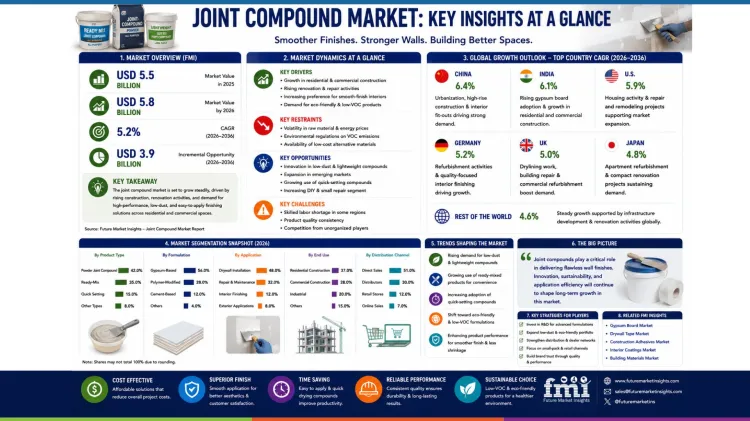
- Powder joint compound currently has the stronger market-share position, with FMI projecting it to account for 42.0% of product demand in 2026.
- Ready-mix joint compound is gaining practical preference in smaller jobs, repair work, retail channels, and projects where applicators want consistent texture without site mixing.
- Large drywall sites still prefer powder because crews can mix only what is needed each day, control consistency by stage, reduce transport weight, and manage bulk supply more efficiently.
- Contractor preference is shaped less by product format alone and more by sanding time, shrinkage, workability, finish quality, pot life, packaging, and local stock availability.
- Quick-setting compounds occupy a separate jobsite role because patching and fast-cycle repair work often needs shorter drying or setting windows.
- The strongest supplier position is likely to combine powder for volume projects, ready-mix for repair and finishing convenience, and quick-setting products for time-sensitive work.
A drywall contractor does not choose joint compound in isolation. The decision is tied to the stage of work, crew habit, wall area, sanding time, project schedule, site access, transport weight, and how soon the wall must move to paint. That is why the ready-mix versus powder question is more practical than it first appears.
FMI values the joint compound market at USD 5.5 billion in 2025 and USD 5.8 billion in 2026, with the market forecast to reach USD 9.7 billion by 2036 at a 5.2% CAGR. Powder joint compound is expected to account for 42.0% of product demand in 2026, while direct sales represent 51.0% of distribution channel demand. These figures suggest that large projects and planned supply chains still have a strong influence on the market.
Powder advantage begins at scale. On a large residential tower, commercial fit-out, hotel, hospital, school, or apartment project, crews may need to finish a large wall area over several days or weeks. Dry bags allow the crew to mix material based on the day's work, the coat being applied, and the applicator's preferred consistency. Less water, more water, a stiffer bedding mix, or a smoother finishing mix can be adjusted on site.
That control matters because joint compound is not applied once and forgotten. Taping, bedding, filling, finishing, sanding, and touch-up each place slightly different demands on the material. A product that is good for embedding tape may not be the easiest for a final skim. A compound that is easy to spread may shrink more than desired. A fast product may save time in repair and become difficult on a large wall area if crews cannot work it quickly enough.
FMI notes that powder joint compound is widely used on large sites because crews can mix the amount needed for each workday. This is a direct contractor-behavior signal. Powder is not winning only because it is cheaper. It wins because it offers jobsite control, lower transport water content, and practical inventory management for bulk work.
Ready-mix joint compound answers a different contractor need, namely consistency and convenience. A pail can be opened and used immediately. Applicators do not need to measure water, mix to a target texture, or clean mixing tools. This is valuable in smaller jobs, maintenance work, retail repair packs, occupied-home renovation, and contractor callouts where speed and simplicity matter more than bulk economics.
FMI specifically states that ready-mixed compound suits smaller interior jobs because applicators can use it without extra mixing. It also notes that commercial interiors use ready-mixed and topping compounds for offices and retail interiors. In these settings, the buyer may value reduced preparation time, fewer mixing errors, and stable texture.
Ready-mix is also more accessible for do-it-yourself and small contractor use. A homeowner repairing cracks, fastener marks, or a small damaged area is unlikely to buy dry bags and mix compound. A small pail is easier to understand, easier to store, and less intimidating. Retail channels therefore have a natural ready-mix bias.
The contractor preference picture changes again with labour. The FMI analyst commentary emphasizes that contractors judge every pail by sanding time and finish quality. A cheaper product can lose value if it needs another coat before paint. This is the central buying logic. The product that wins is the one that reduces rework, not necessarily the one with the lowest price per kilogram.
Sanding is especially important. Drywall finishing is labour-intensive, and sanding dust affects cleanup, worker comfort, and project sequencing. A compound that sands easily can reduce finishing time. A compound that creates excessive dust can be problematic in occupied renovation or indoor projects where cleanup is part of the customer experience. FMI notes that low-dust and ready-mixed products can support premium pricing because repair crews need cleaner work in occupied spaces.
This creates an opportunity for ready-mix products in renovation and maintenance. A ready-mix, low-dust, lightweight compound may be more attractive in a home, office, retail store, or healthcare interior where disruption must be minimized. The cost of the compound is small compared with the cost of labour and cleanup.
Powder still has a freight and storage advantage. Ready-mix includes water, which adds weight and limits some logistics efficiency. Dry powder can be shipped and stored more economically per unit of usable compound, particularly for large sites. It may also offer a longer shelf-life profile in certain conditions, depending on product and packaging. Contractors managing large crews and daily consumption may therefore prefer powder even when ready-mix feels more convenient.
Quick-setting compounds deserve a separate mention because they are neither simply a powder preference nor a ready-mix preference. They are selected for time. FMI states that quick-setting compound supports patching work because it reduces waiting time before sanding. In repair jobs, water damage patches, urgent rework, and phased interior tasks, time can matter more than format. Contractors may use powder for most work, ready-mix for finishing, and quick-setting compound for repairs within the same project.
Distribution channel also shapes preference. Direct sales account for 51.0% of market demand in 2026, according to FMI. Large drywall projects prefer planned supply because crews need consistent quality across several work stages. This favours system suppliers and established brands that can supply the same compound reliably over the project duration. Distributors support contractors through local availability, while online sales serve smaller repair needs and repeat orders.
System suppliers have a further advantage. Knauf, USG, Saint-Gobain Gyproc, Etex Siniat, National Gypsum, PABCO Gypsum, and CSR Gyprock compete not only through compound format but through board-system integration and contractor trust. A contractor using a gypsum board system may prefer the matching jointing compound if it reduces compatibility concerns or improves finishing confidence.
Contractor preference is also regional. In China and Brazil, FMI notes that powder formats suit larger sites because crews can mix material based on daily wall finishing needs. In the USA, retail channels and small packs matter because home repair and remodeling keep compound moving through contractor and consumer channels. In the UK, ready-mixed products suit smaller repair jobs because applicators can start without mixing. These country-level points suggest that product preference is shaped by construction practice, labour cost, retail structure, and project size.
The cleanest reading is that powder is winning the market-share battle, while ready-mix is winning convenience-led use cases. Powder leads where volume, cost control, site mixing, and direct project supply matter. Ready-mix gains where labour time, consistency, low-dust finishing, and repair convenience matter. Quick-setting compounds win where speed is the main constraint.
Suppliers should avoid treating format as a single product war. Contractors increasingly expect a portfolio of powder for large board installation, ready-mix for finishing and small jobs, lightweight or low-dust products for occupied spaces, and quick-setting products for patching. The format that wins is the one that fits the work stage.
Powder joint compound currently holds the stronger share position, and ready-mix has a clear growth path as renovation, retail repair, and cleaner indoor finishing become more important. Contractor preference is becoming more task-based than format-based. The best-positioned brands will be those that make finishing faster, smoother, and more predictable across both formats.

