


- Bakery mixes are moving beyond plain bread and cake bases into specialty systems that reduce formulation risk.
- Bread mixes lead product demand, but specialty formats such as gluten-free, egg-free, clean-label, protein-enriched, and seasonal mixes are expanding the value pool.
- Cake mixes remain important because foodservice and retail users value quick dessert bases that can be customized by flavor and occasion.
- Specialty mixes are harder to develop because texture, rise, mouthfeel, and moisture retention must be rebuilt when conventional ingredients are removed or reduced.
- The opportunity is strongest where suppliers combine sensory quality with clear instructions, reliable performance, and claim documentation.
- The misconception to avoid is that specialty mixes are just marketing variants. Many are technical formulation systems that solve real baking constraints.
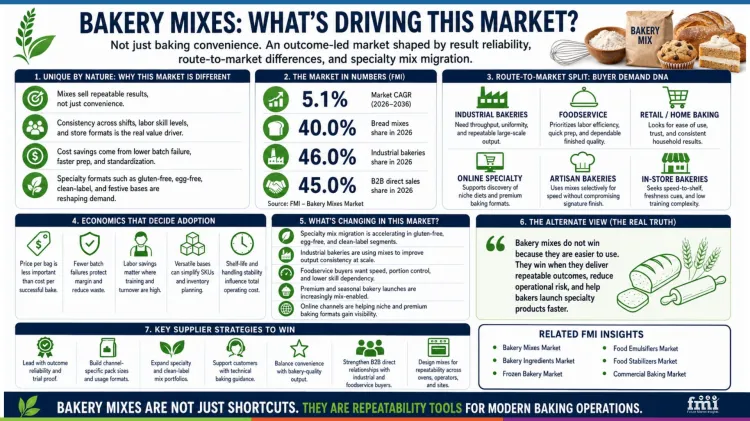
The Bakery Mixes Market is evolving from basic convenience toward specialty formulation. Bread mixes and cake mixes remain core demand pools, but the next layer of value is increasingly shaped by gluten-free, egg-free, clean-label, high-protein, whole grain, reduced sugar, vegan, and seasonal formats. These are not simple flavor extensions. They often require a complete rethinking of how structure, rise, moisture, crumb, bite, color, and shelf life are delivered.
This shift matters because bakery products are highly sensory. Consumers can quickly notice poor texture, dryness, weak volume, gumminess, aftertaste, or stale mouthfeel. Foodservice operators also notice whether a mix performs under time pressure. Industrial bakeries notice whether the mix can run on existing equipment. Specialty positioning therefore succeeds only when the finished product still behaves like a satisfying baked good.
Bread mixes are projected by FMI to lead product type demand, but specialty migration affects bread as much as cakes and pastries. A gluten-free bread mix cannot simply remove wheat flour and expect the same structure. It needs starch systems, fibers, proteins, hydrocolloids, enzymes, emulsifiers, or other functionality to rebuild volume, elasticity, softness, and slicing quality. An egg-free cake mix must replace aeration, emulsification, color, moisture, and tenderness functions normally supported by eggs.
The Gluten-free Bakery Premix Market shows why specialty premixes are important. Gluten-free baking is technically difficult because gluten provides structure and elasticity. Premixes help foodservice operators, bakeries, and retail consumers manage that complexity without building a full formulation system from scratch. This is exactly where bakery mixes become more than convenience: they become technical risk reducers.
Clean-label positioning is another force, but it must be handled carefully. Consumers may want fewer artificial-sounding ingredients, but bakery systems still need function. Removing conventional emulsifiers, preservatives, improvers, or stabilizers can weaken shelf life and texture. A clean-label bakery mix must balance label expectations with the practical needs of baking. If the product becomes dry, dense, or short-lived, the claim does not create repeat demand.
This connects bakery mixes with the Food Stabilizers Market and the Food Emulsifiers Market. Stabilizers can support moisture retention, viscosity, and freeze-thaw performance, while emulsifiers help cake volume, crumb softness, and batter stability. Specialty mixes often need these ingredient systems even when the front-of-pack message is simple.
Seasonal and flavor-led mixes are also changing the category. Retail brands use limited-edition cake kits, holiday baking mixes, brownie bases, muffin mixes, and dessert kits to create excitement. Foodservice operators use seasonal bases to refresh menus without adding complexity. In these cases, the mix must deliver both operational simplicity and novelty. The supplier must protect base performance while allowing flavor variation, inclusions, toppings, fillings, and decorations.
Cake mixes are particularly well suited to this trend. FMI indicates cake mixes hold a meaningful share of the product mix because they serve household retail, foodservice, and dessert programs. Cake bases can be customized with chocolate, fruit, cream, inclusions, frosting, colors, or seasonal themes. The challenge is that cake quality is sensitive to aeration, moisture, sweetness, fat balance, and bake tolerance. A weak base limits all downstream customization.
Pastry mixes occupy a more technical space. Pastries require flakiness, lamination support, fat distribution, crispness, and sometimes freeze-thaw stability. A pastry mix is less forgiving than a basic cake mix because handling and fat behavior are critical. Suppliers that can simplify pastry preparation while preserving texture can create value for foodservice and retail bakery users that lack highly skilled pastry staff.
Health-oriented bakery mixes are also emerging. High-fiber, protein-enriched, whole-grain, low-sugar, and functional bakery bases appeal to consumers who want indulgence with better nutritional positioning. However, these formats carry formulation trade-offs. Protein can toughen texture. Fiber can increase water absorption. Sugar reduction can affect browning, moisture, and sweetness perception. A successful specialty mix must handle these trade-offs rather than simply adding a claim.
The Flour Mixes Market is relevant because flour-system design influences many specialty products. Flour blends can manage protein level, starch behavior, hydration, and texture. Bakery mixes extend that logic by adding leavening, functional ingredients, flavor systems, and sometimes complete preparation guidance.
For suppliers, the specialty migration creates both opportunity and risk. The opportunity is margin expansion through more differentiated products. The risk is overcomplication. Too many claims can confuse buyers or weaken sensory quality. A gluten-free, vegan, high-protein, low-sugar, clean-label cake mix may sound attractive, but it is technically difficult. The supplier must decide which claim combinations are commercially realistic and which ones create performance problems.
Documentation also matters. Allergen-aware and specialty claims require careful control. Gluten-free, egg-free, dairy-free, vegan, organic, and clean-label products may need stronger ingredient traceability, facility controls, and claim support. For B2B buyers, documentation can be as important as formulation performance because the mix becomes part of their own consumer-facing product.
The misconception to avoid is that specialty bakery mixes are just marketing variants. In many cases, they are formulation systems designed to replace functions that conventional ingredients usually provide. The value sits in making complex baking easier without compromising sensory quality.
Specialty migration is also linked to premiumization. A basic cake mix competes heavily on price and brand familiarity. A gluten-free brownie mix, vegan muffin mix, high-protein pancake base, or clean-label bread mix can justify a higher price if it solves a real formulation difficulty. The premium is strongest when the buyer believes the supplier has removed technical risk rather than merely added a claim.
Foodservice operators are important in this migration because they often want menu flexibility without full recipe development. A cafe may want seasonal muffins, allergen-friendly cakes, or limited-time dessert items but may not have the technical staff to build those products from scratch. Specialty mixes let operators expand menu variety while keeping kitchen complexity manageable. The mix becomes an innovation shortcut.
Industrial bakeries use specialty mixes differently. They may adopt them to enter retailer programs, meet private-label specifications, manage claim-led product lines, or shorten development time. A gluten-free or egg-free mix can reduce development risk when the bakery lacks dedicated formulation expertise. However, these buyers will still demand process compatibility, cost discipline, supply reliability, and documentation.
Retail consumers respond to specialty mixes when the product makes a difficult recipe feel achievable. Gluten-free baking, vegan baking, and high-protein baking can be intimidating because the sensory results are often less predictable. A mix simplifies the process and reduces the chance of failure. This is why instruction design, required added ingredients, and recipe flexibility matter strongly in the specialty segment.
The next phase of the market will likely favor modular systems. Suppliers can develop base platforms that support multiple claims or flavor directions without rebuilding every formula from zero. For example, a neutral cake base can support seasonal inclusions, egg-free variants, or reduced-sugar positioning. A bread base can be adjusted for whole grain, high-fiber, or clean-label positioning. This approach improves innovation speed while protecting technical consistency.
Bottom line: bakery mixes are becoming specialty platforms. Growth will not come only from selling more basic mixes. It will come from helping industrial bakeries, foodservice operators, retailers, and consumers produce more reliable gluten-free, egg-free, clean-label, seasonal, and health-oriented baked goods with less formulation risk.
Related FMI Reports
- Bakery Mixes Market: Primary market reference and product segmentation source
- Gluten-free Bakery Premix Market: Use when discussing gluten-free and allergen-aware mixes
- Food Stabilizers Market: Use when discussing moisture retention and texture control
- Food Emulsifiers Market: Use when discussing cake volume and batter stability
- Food Enzymes Market: Use when discussing bakery process and shelf-life improvement
- Bakery Ingredients Market: Use when connecting mixes with broader ingredient systems

