


- Fermented ingredient winners are not defined only by natural positioning; they win through strain control, scale-up capability, application proof, and regulatory documentation.
- FMI identifies amino acids as the leading product group in the Fermented Ingredient Market, showing that industrial fermentation remains central to the category.
- Supplier advantage differs by product family: amino acids need yield and scale, probiotics need documented strains, postbiotics need characterization, and precision-fermented proteins need purification and food-grade validation.
- The strongest suppliers combine fermentation capacity with application labs, safety files, certification support, and customer troubleshooting.
- The biggest risk is assuming fermented ingredients are interchangeable because they share a production route. In practice, strain identity and functional proof decide value.
- The misconception to avoid is that fermentation automatically creates competitive advantage. Fermentation helps only when it produces reliable, documented, application-ready performance.
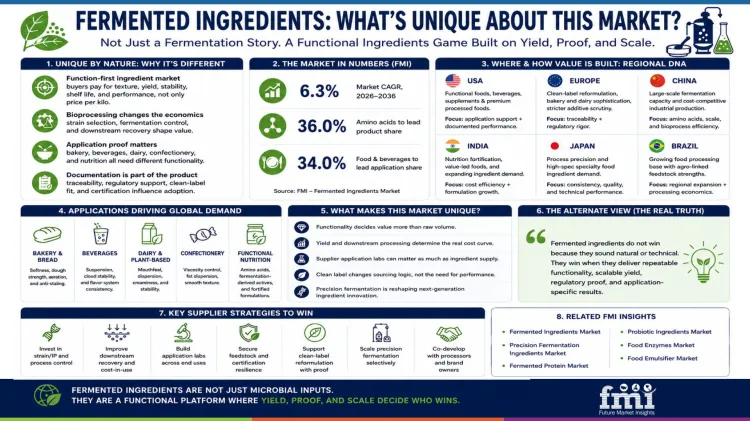
Fermented ingredients are often treated as a broad natural-food story, but the competitive reality is more specific. In the Fermented Ingredient Market, supplier advantage is not created only by selling ingredients that sound familiar to consumers. It is created by owning strains, process knowledge, scale-up capability, documentation, and application proof. Fermentation is no longer only a traditional preservation method. It is now a controlled ingredient-manufacturing platform.
That distinction matters because fermented ingredients cover several very different product families: amino acids, organic acids, vitamins, enzymes, cultures, probiotics, postbiotics, proteins, flavors, preservatives, and fermentation-derived functional compounds. A supplier that is strong in amino acid fermentation is not automatically strong in probiotic strain supply. A producer of fermented dairy ingredients may not have the same capabilities as a precision fermentation company producing proteins or enzymes. The market is connected by fermentation, but competition is decided by capability depth.
FMI identifies amino acids as the leading product group in the fermented ingredient market, while food and beverages lead by application. This benchmark is commercially important because amino acids show the industrial side of fermentation: high-volume, process-driven, specification-heavy ingredient supply. The market is not only about yogurt cultures or fermented beverages. It is also about large-scale bioprocessing routes that convert microbial performance into repeatable ingredient output.
The Amino Acids Market is a useful adjacent reference because fermented amino acids are positioned as a major production route. This supports the idea that fermentation is not a niche claim but an industrial platform. Lysine, glutamic acid, tryptophan, and other amino acids depend on yield, purity, feedstock management, downstream processing, and cost control. Supplier winners in these areas are not the companies with the best consumer-facing story. They are the companies that can produce reliably at scale.
Probiotic suppliers compete differently. In the Probiotic Ingredients Market, value is tied to documented strains, survivability, health positioning, application compatibility, and regulatory defensibility. A probiotic ingredient is not interchangeable simply because it belongs to a familiar genus. Strain identity, clinical evidence, stability, dosage, format, and application environment all matter. A strain that works in a capsule may not perform the same way in a beverage, yogurt, powder sachet, or baked product.
The Probiotic Strains Market reinforces this point. Strain ownership and strain documentation can act like competitive moats. Suppliers with validated strains, stability data, safety files, and application support can defend stronger positions than suppliers selling generic culture names. In fermented ingredients, the supplier is often selling confidence: confidence that the organism, metabolite, or fermentation-derived compound will behave as promised inside the customer's product.
Postbiotics create another competitive layer. The Postbiotic Ingredients Market is relevant because postbiotics shift value from live-cell survivability toward stability, safety, and metabolite-led functionality. This can open use in products where live probiotics face processing limits, such as heat-treated foods, shelf-stable beverages, gummies, powders, and some bakery or snack formats. Supplier advantage depends on the ability to define what the postbiotic is, how it is produced, what metabolites or cell components are present, and what benefit is being claimed.
Precision fermentation creates the most disruptive competitive frontier. The Precision Fermentation Ingredients Market shows how engineered microorganisms can produce targeted proteins, enzymes, fats, and bioactive compounds. This changes the supplier map because the competitive advantage moves toward strain engineering, fermentation optimization, purification, regulatory approval, and customer integration. Traditional ingredient suppliers, biotech startups, dairy-alternative companies, enzyme producers, and contract fermentation operators can all compete in different parts of the value chain.
The Fermented Protein Market is an example of how this shift affects food formulation. Fermented proteins may support alternative dairy, meat analogues, sports nutrition, functional beverages, and ingredient fortification. But winning does not depend only on sustainability claims. It depends on sensory performance, solubility, allergen profile, nutrition, processing behavior, and price. A protein that looks promising in a pilot plant must still work in commercial food systems.
This is why supplier winners are not defined only by product breadth. They are defined by the ability to connect three layers: fermentation production, ingredient specification, and application performance. A customer does not only ask, 'Can you supply this fermented ingredient?' The more important question is, 'Can you make it work in my beverage, bakery product, dairy alternative, supplement, savory system, or functional food without creating stability, taste, label, or cost problems?'
The Fermented Food and Beverage Market also shows why consumer demand creates pull, but supplier capability creates scale. Consumers may be attracted to fermented foods for gut health, immunity, tradition, flavor, or clean-label appeal. However, manufacturers need industrial cultures, fermentation-derived ingredients, acidulants, enzymes, and stabilizing systems that can support repeatable production. The consumer story creates demand; the supplier system determines whether that demand can be met consistently.
Documentation is becoming a major source of competitive differentiation. Fermented ingredients may require safety data, strain identity records, non-GMO statements, allergen status, halal and kosher certification, vegan suitability, organic compatibility, purity specifications, contaminant controls, and regional regulatory support. A supplier with weak documentation may lose even if the ingredient performs well. Food manufacturers increasingly need proof that can survive retailer, customer, and regulatory checks.
Regional competition is also different by product family. In mature markets, customers may prioritize strain claims, clinical support, non-GMO sourcing, natural positioning, and regulatory clarity. In high-growth processing regions, availability, price, and technical service may matter more. In precision fermentation, countries with biotechnology infrastructure, fermentation capacity, and supportive regulation may move faster. This means the competitive map is not uniform across fermented ingredients.
The suppliers most at risk are those selling undifferentiated fermentation-derived ingredients without application support or documentation depth. They may compete on price in amino acids, organic acids, or commodity fermentation outputs, but they will struggle in higher-value areas where customers need proof, stability, and formulation help. In contrast, suppliers with strain libraries, fermentation expertise, scale-up assets, application labs, and customer support are better positioned to capture premium opportunities.
Contract fermentation and toll manufacturing are also changing the competitive map. Some ingredient developers own the strain and customer relationship but do not own full-scale fermentation assets. Others own tanks, downstream systems, and food-grade quality infrastructure but rely on customers or partners for the target molecule. This creates a layered supplier ecosystem where capability is split between biology, process engineering, purification, and market access. Customers increasingly need to know not only who developed the ingredient, but who can reliably manufacture it at the scale and quality needed for launch and expansion.
Customer switching costs can be high once a fermented ingredient is validated. A beverage company, supplement brand, bakery processor, or dairy-alternative manufacturer may spend months testing stability, dosage, flavor impact, shelf life, label fit, and regulatory language. Once the ingredient passes those gates, switching to a new supplier can require renewed testing and risk. This gives strong suppliers a defensible position when they are embedded early in formulation work. It also explains why technical service can be as important as price in high-value fermented ingredients.
Application breadth creates another advantage. Suppliers that can serve beverages, dairy, plant-based foods, supplements, savory ingredients, and animal nutrition can spread fermentation assets across several demand pools. That reduces dependence on one product cycle and improves learning across applications. A strain-stability insight from supplements, a drying method from probiotics, or a purification lesson from enzymes can strengthen other parts of the portfolio. This cross-application learning is difficult for narrow suppliers to replicate.
The misconception to avoid is that fermented ingredient suppliers win mainly because fermentation sounds natural or traditional. That may help with market acceptance, but it does not create durable advantage. Durable advantage comes from strain control, process consistency, regulatory support, and proof that the ingredient performs inside real food and beverage systems.
Bottom line: supplier winners in fermented ingredients are not simply the companies with the broadest portfolios. They are the companies that can turn fermentation into reliable, documented, application-ready ingredient performance at commercial scale.
Related FMI Reports
- Fermented Ingredient Market: Primary interlink in introduction and conclusion
- Amino Acids Market: Use when discussing industrial fermentation and amino acid scale
- Probiotic Ingredients Market: Use when discussing documented strain supply
- Probiotic Strains Market: Use when discussing strain identity and supplier advantage
- Postbiotic Ingredients Market: Use when discussing postbiotic characterization and stability
- Precision Fermentation Ingredients Market: Use when discussing bio-manufacturing and engineered ingredient platforms
- Fermented Protein Market: Use when discussing fermented protein competition

