


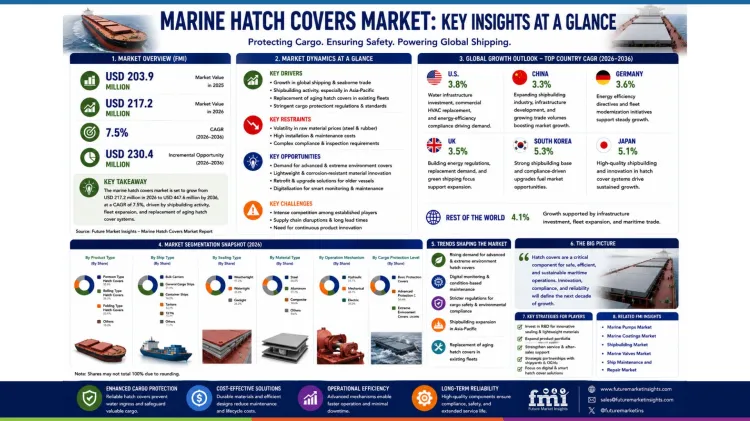
- Weathertight sealing leads the market, with FMI projecting a 41.2% sealing-type share in 2026.
- Weathertight hatch covers remain the standard requirement for many dry cargo vessels because the main operating need is protection from rain, spray, boarding seas, and green water exposure.
- Watertight sealing is more demanding and more selective, used where full water sealing or pressure-resistant protection is required.
- Cargo owners and insurers are placing more attention on hatch cover condition because water ingress can cause cargo claims, voyage delays, and survey issues.
- IMO and IACS guidance emphasizes inspection, maintenance, drainage, sealing systems, securing arrangements, and documentation.
- Procurement is shifting from basic cover supply toward tested sealing performance, maintenance planning, and cargo-risk reduction.
The phrase hatch cover sealing can sound straightforward until the vessel is at sea. A hatch cover is expected to keep cargo dry while the ship moves, flexes, rolls, pitches, and takes spray or water on deck. The sealing system has to work with the coaming, gaskets, cleats, compression bars, drains, non-return valves, panel structure, and crew maintenance routine. A good design can still fail if it is poorly maintained. A well-maintained system can still be challenged by deformation, corrosion, and heavy weather.
That is why weathertight versus watertight procurement is becoming more important.
FMI expects weathertight hatch covers to lead the sealing-type segment with 41.2% share in 2026. The report defines weathertight systems as weather-resistant hatch systems for rain and spray protection. Watertight systems are described as full water sealing hatch systems with pressure-resistant marine cover characteristics. Gastight systems form a further category for air-tight cargo protection. The segmentation itself shows that shipowners are not buying one generic seal. They are matching cargo protection level to vessel type, cargo risk, and operating environment.
Weathertight sealing is the mainstream requirement for many dry cargo and bulk applications. The goal is to prevent water from entering the cargo hold under normal seagoing exposure such as rain, spray, and boarding seas. Bulk carriers, general cargo vessels, and dry cargo ships rely heavily on weathertight hatch covers because wet cargo damage can create claims and commercial losses.
The practical challenge is that weathertightness is not permanent. IMO hatch cover maintenance standards note that lack of weathertightness can be attributed to normal use, including deformation of hatch coamings or covers, wear of friction pads, and wear and tear of cleating arrangements. It also requires owners and operators to maintain records of maintenance and component replacement. This makes sealing performance a lifecycle issue rather than a one-time specification.
Watertight sealing is more demanding. A watertight system is expected to resist water ingress under more severe conditions and may involve higher sealing standards, stronger compression, and more robust design. It is not required for every cargo hatch cover application because the cost and engineering burden can be higher. The value case is strongest where cargo, compartment arrangement, regulatory requirement, or operating environment demands more than ordinary weather protection.
Shipowners therefore evaluate sealing through cargo consequence. Moisture-sensitive cargo creates a higher protection requirement. Grain, cement, steel products, fertilizers, paper, packaged goods, and certain project cargoes can be severely damaged by water ingress. In some cargoes, even a small leak can trigger claims or discharge problems. In others, cargo may tolerate minor exposure better. The sealing system needs to reflect that risk.
P&I and marine inspection guidance makes this point repeatedly. Gard states that cargo damage due to wetting represents a significant share of claims presented to the club every year and identifies defective hatch covers as a recurring problem. The Nautical Institute also notes that claims from wetting damage due to leaking hatch covers rank high among dry cargo ship losses. This is the insurance and chartering backdrop behind more careful procurement.
Weathertight procurement is becoming more evidence-based. Shipowners, charterers, surveyors, and cargo interests increasingly ask whether covers have been inspected, whether gaskets are in good condition, whether cleats are adjusted, whether drains and non-return valves function, and whether ultrasonic or hose testing has been carried out where appropriate. A cover is no longer judged only by panel thickness or design type. It is judged by whether it can prove effective sealing.
Ultrasonic testing has become important because it can identify leakage paths without flooding the deck with water. A transmitter is placed inside the hold, and a receiver is used outside to detect ultrasonic signals passing through gaps in sealing surfaces. This allows inspection teams to locate leakage points and assess sealing condition. Hose testing remains familiar, and it can be weather-dependent and less precise for certain surfaces.
The maintenance record is now part of cargo protection. IMO guidance states that hatch cover maintenance plans should form part of the ship safety management system under the ISM Code, and that records of maintenance and component replacement should be maintained. Procurement decisions increasingly favour suppliers that provide clear manuals, spare-parts recommendations, seal replacement guidance, and support for inspection routines.
This trend benefits suppliers that offer more than panels. Rubber seals, compression bars, cleats, wheels, hinges, hydraulic systems, drainage components, corrosion protection, inspection kits, and service support all become part of the value proposition. A hatch cover supplier that helps an owner keep the system weathertight over time has a stronger proposition than one selling only the initial cover.
The FMI cargo protection segmentation reinforces this shift. The market includes basic protection covers, advanced protection covers, and extreme environment covers. Advanced covers include enhanced sealing and insulation systems, while extreme environment covers serve Arctic and harsh sea conditions. This suggests procurement is moving toward risk-tiered cargo protection. A ship trading moderate routes with standard cargo may buy a basic weathertight solution. A vessel carrying moisture-sensitive cargo or trading severe weather routes may specify advanced sealing.
Material choice also connects to sealing. Steel hatch covers dominate because they are strong and repairable, and steel can corrode and deform if not maintained. Aluminum and composites may reduce weight or improve corrosion resistance in certain cases, and sealing surfaces, gasket compression, and structural rigidity remain critical. A lighter cover that fails to maintain proper compression will not protect cargo.
Operation mechanism affects sealing reliability. Hydraulic, mechanical, and electric hatch covers each require correct alignment and closure force. A powered system may reduce crew effort and improve operating consistency, and it also needs maintenance. Manual or mechanical systems may be simpler, and they depend heavily on crew practice. In all cases, sealing performance depends on correct closing, securing, and inspection.
The strongest procurement shift is visible in three areas.
Documented weathertightness performance is the first. Buyers want test procedures, maintenance records, and evidence that sealing systems are functioning.
Better risk control is the second. Cargo owners are pushing for tighter scrutiny on hatch cover condition before loading because moisture-sensitive cargo raises the stakes.
Lower lifecycle maintenance risk is the third. Systems with durable seals, accessible spares, corrosion protection, and easier inspection can justify a higher upfront price.
Watertight systems will remain more selective because not every vessel needs full water sealing. Weathertight systems will continue to dominate because they match the operating requirement of many commercial cargo vessels. The 41.2% weathertight share shows that standard cargo-weather protection remains the largest procurement category.
The important change is not a mass shift from weathertight to watertight covers. It is an upgrade in how weathertight performance is specified, tested, maintained, and documented. Shipowners are not only buying a cover to close the hatch. They are buying a system that must stand up to charterer expectations, survey requirements, cargo claims, and heavy-weather exposure.
For suppliers, the opportunity is in sealing assurance. Products that combine robust structural design, quality gasket systems, reliable drainage, clear maintenance documentation, and service support are more likely to win. The next stage of procurement will reward hatch cover systems that can prove cargo protection over time, not just at delivery.

