

- Market Size (2026)
- USD 782.9 Bn
- Forecast (2036)
- USD 1083.6 Bn
- CAGR (2026 to 2036)
- 3.3%
Long Steel Products Market Size, Market Forecast and Outlook By FMI
Summary of the Long Steel Products Market
- Market Snapshot
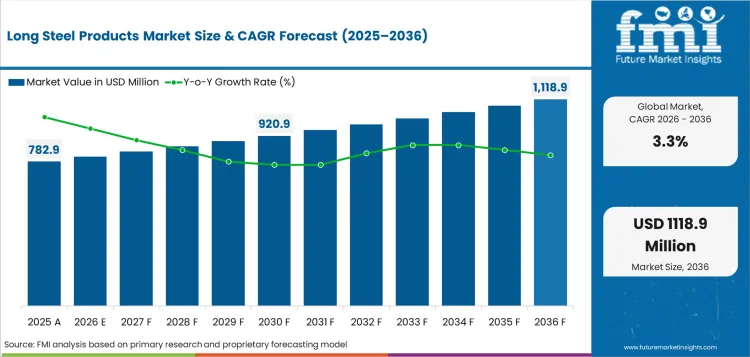
- The Long Steel Products Market is valued at USD 760.4 billion in 2025 and is expected to reach USD 782.9 billion in 2026.
- Industry value is projected to reach USD 1,083.6 billion by 2036 with a 3.3% CAGR over the assessment period.
- The market is forecast to add USD 300.7 billion in value between 2026 and 2036.
- FMI opines that long steel remains a volume category where delivery reliability often decides supplier choice.
- Demand and Growth Drivers
- Construction is projected to represent 61.0% share in 2026 as rebar demand follows concrete building activity.
- Infrastructure is expected to account for 24.0% share in 2026 as bridges and rail corridors need long steel sections.
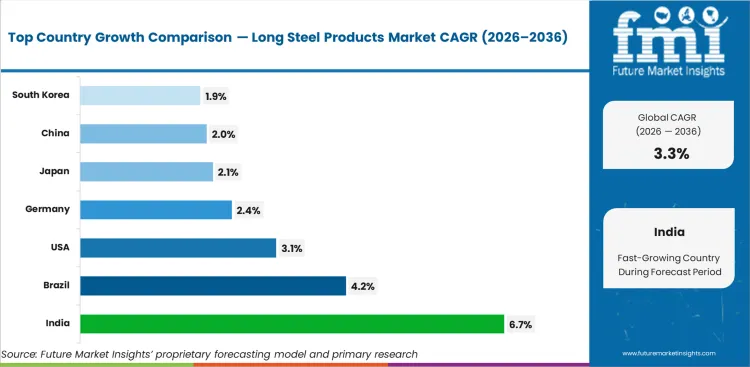
- India is forecast above the global pace at 6.7% CAGR through 2036 due to capacity expansion and public works.
- Electric arc furnace output is expected to gain share near scrap pools and urban construction demand.
- Product and Segment View
- Rebar is expected to account for 43.0% of Product Type demand in 2026 as concrete reinforcement drives volume.
- Carbon steel is projected to hold 72.0% of Steel Grade demand in 2026 due to its price fit in construction.
- Blast furnace route material is expected to represent 54.0% of Process Route demand in 2026.
- Direct mill supply is anticipated to lead Sales Channel demand with 47.0% share in 2026.
- Geography and Competitive Outlook
- China is expected to remain the largest volume market due to its steelmaking base and construction scale.
- India is projected to grow faster than the global average as domestic steel capacity moves toward the 2030 target.
- The United States is expected to remain a high-value market due to micro-mill investment and infrastructure work.
- Nucor and Steel Dynamics hold strong North American positions through rebar and fabrication-linked supply.
- Analyst Opinion
- Nikhil Kaitwade, Principal Consultant at FMI says, "I see long steel as a market where simple product labels hide difficult buying decisions. Rebar buyers watch delivered price and shipment timing first. Structural section buyers care about size availability and project approval history."
- Long Steel Products Market Value Analysis
- The market is projected to rise from USD 782.9 billion in 2026 to USD 1,083.6 billion by 2036.
- Rebar leads product demand as reinforced concrete remains the main volume pool for long steel.
- Construction remains the main end use as housing and public works keep recurring steel consumption active.
- Direct mill supply shapes channel demand since large contractors need delivery schedules tied to project milestones.
- Price sensitivity stays high because freight cost can change the delivered economics of commodity long products.
Key Takeaways
- The Long Steel Products Market was valued at USD 760.4 billion in 2025.
- The industry is expected to reach USD 1,083.6 billion by 2036 as infrastructure work keeps bulk steel demand active.
- With a projected 3.3% CAGR from 2026 to 2036, long steel remains a steady construction material category.
- Incremental opportunity is forecast at USD 300.7 billion between 2026 and 2036.
- Rebar is expected to hold 43.0% share in 2026 as reinforced concrete remains the largest use case.
- Carbon steel is projected to account for 72.0% share in 2026 due to cost fit in mass construction.
- India is projected to record 6.7% CAGR through 2036 as domestic capacity and infrastructure spending rise together.
- Direct mill supply is expected to hold 47.0% share in 2026 as large projects need secured tonnage.
Long Steel Products Market Definition
The long steel products market covers steel products with extended cross-sectional profiles used in construction and fabrication. Included products are rebar, wire rod, merchant bar, structural sections, and rail products. These products are sold to builders, fabricators, infrastructure contractors, and industrial users. The scope excludes flat steel products, pipes, tubes, forgings, castings, and finished structures.
Long Steel Products Market Inclusions
Market scope covers rebar and wire rod. It includes merchant bar and structural sections. It also includes rail products and selected special bar quality products sold as long steel for construction and industrial use. Revenue scope covers 2026 to 2036 across major regions.
Long Steel Products Market Exclusions
The scope excludes hot rolled coil and plate. It also excludes seamless pipe, welded tube, cast parts, forged parts, and fabricated structures sold as completed assemblies.
Long Steel Products Market Research Methodology
- Primary Research: FMI analysts reviewed inputs from steel mills and service centers. Discussions also covered fabricators and infrastructure contractors. The review focused on order cycles and grade preference. It also assessed delivery risk and pricing behavior.
- Desk Research: Desk research assessed steel production data and company capacity disclosures. Government steel reports and trade body publications were used to frame production scale. Public capacity data supported country-level demand checks.
- Market Sizing and Forecasting: The model combined product volume and average selling price bands. Construction activity and infrastructure spending were used to adjust country forecasts. Mill route and product mix were used to test the revenue build.
- Data Validation: Forecasts were checked against crude steel production trends and finished steel demand patterns. Company portfolios were reviewed to confirm product participation. Regional capacity announcements were used to test the competitive structure.
Why is the Long Steel Products Market Growing?
- Public infrastructure spending supports rebar and structural section demand across transport projects.
- Urban housing keeps rebar volumes active across large economies.
- Scrap-based mini mills support local supply where freight cost affects delivered steel prices.
- Rail and energy projects create selective demand for higher-specification long products.
The market is growing at a steady pace because long products remain tied to physical construction activity. OECD’s 2025 steel outlook says global steel production is expected to grow by 0.7% in 2025. It also expects China’s steel production to decline by 0.6% in 2025. That split matters for long steel because China’s softer construction cycle can raise export pressure. Buyers in import-sensitive countries then face price volatility even when local project demand is stable.
Capacity discipline is becoming a central issue for long steel producers. OECD reported that up to 165 million metric tonnes of steelmaking capacity is planned worldwide from 2025 to 2027. The same outlook says this would worsen global excess capacity if realised. This creates a margin risk for long product mills in slow-growth regions. Producers with regional delivery strength and stronger product qualification are better placed to defend price.
Market Segmentation Analysis
- Rebar is expected to account for 43.0% share in 2026 as concrete reinforcement drives bulk volume.
- With an estimated 72.0% share in 2026, carbon steel is expected to lead Steel Grade demand due to cost fit.
- Blast furnace route material is projected to represent 54.0% of Process Route demand in 2026.
- Construction buyers are expected to account for 61.0% of End Use demand in 2026 as building activity drives rebar use.
- Direct mill supply is anticipated to direct 47.0% of Sales Channel demand in 2026 with large projects needing tonnage certainty.
Segment demand is shaped by project type and mill supply route. Rebar leads because it is used across reinforced concrete work. Wire rod feeds downstream drawing and fastener production. Structural sections depend more on industrial buildings and large civil works. Rail products carry smaller volume but higher qualification needs. This makes long steel a volume market with specification pockets.
Long Steel Products Market Analysis By Product Type
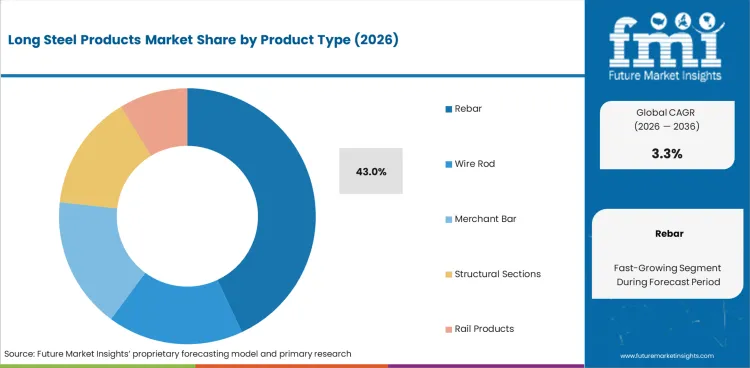
- Rebar is expected to account for 43.0% of Product Type demand in 2026 as reinforced concrete keeps the highest volume pull in building work.
- Rebar purchasing is highly local because freight can shift delivered cost quickly. Regional mills gain when construction schedules need short delivery windows.
Long Steel Products Market Analysis By Steel Grade
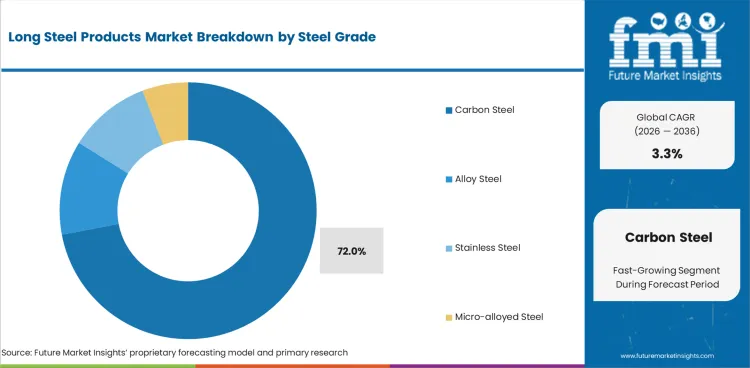
- Carbon steel is projected to represent 72.0% of Steel Grade demand in 2026 as contractors seek strength at the lowest workable cost.
- Micro-alloyed grades gain use in higher-strength rebar. Their share stays smaller as routine building work still relies on standard carbon grades.
Long Steel Products Market Analysis By Process Route
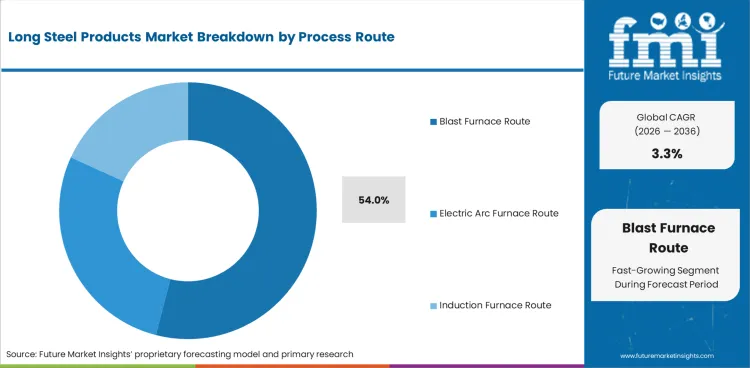
- Blast furnace route material is expected to hold 54.0% of Process Route demand in 2026 due to large integrated capacity in Asia.
- Electric arc furnace mills gain share near scrap pools and urban construction centers. Their commercial edge comes from shorter logistics for rebar supply.
Long Steel Products Market Analysis By End Use
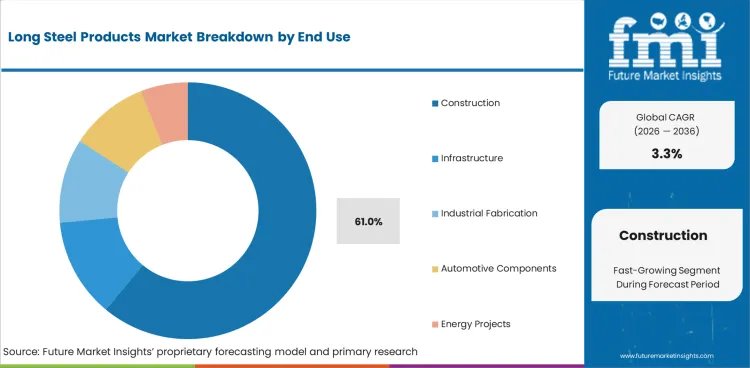
- Construction is projected to account for 61.0% of End Use demand in 2026 as rebar remains essential in building structures.
- Long steel demand weakens quickly when housing projects slow. Mills with infrastructure exposure carry better resilience during property downturns.
Long Steel Products Market Analysis By Sales Channel
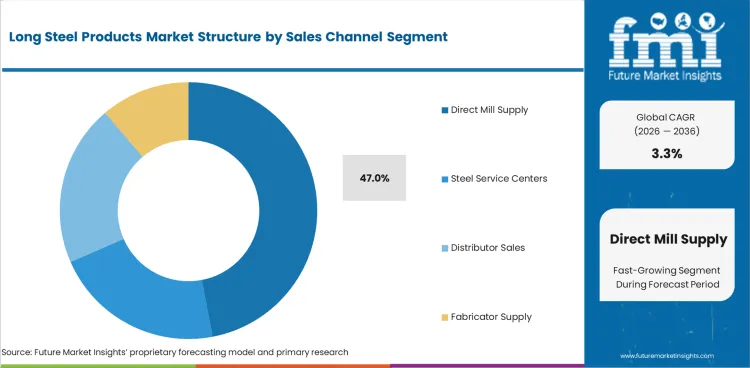
- Direct mill supply is anticipated to hold 47.0% of Sales Channel demand in 2026 as large projects need fixed delivery programs.
- Distributors remain important for smaller fabricators. They absorb inventory risk and sell mixed sizes that mills often avoid in small lots.
Long Steel Products Market Drivers, Restraints, and Opportunities
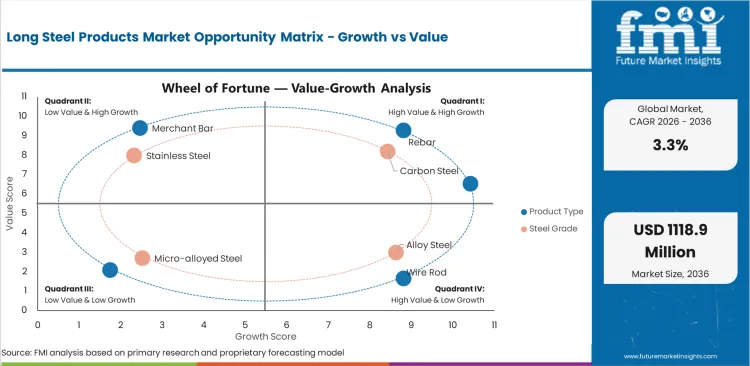
- Infrastructure budgets drive demand for rebar and sections where concrete structures dominate project design.
- Construction cycles restrain demand when property developers delay launches or reduce steel orders.
- Scrap-based mini mills create a growth route near urban demand centers.
- High-strength rebar creates value upside where codes reward lower steel intensity per structure.
Infrastructure reinforcement demand
Infrastructure spending is the clearest demand anchor for long steel products. Bridges and public buildings need rebar in large volumes. Rail corridors add structural section demand. India’s Ministry of Steel reported that crude steel capacity was 200.3 million tonnes in 2024 to 2025. It also stated that the national policy target is 300 million tonnes of crude steel capacity by 2030 to 2031. This signals long-term supply alignment with domestic building and infrastructure demand. Suppliers with regional stockyards can capture more value from scheduled project buying.
China property pressure
China remains the largest steel producer, so its construction cycle shapes global pricing. World Steel Association data put China’s crude steel production at 1,005.1 million tonnes in 2024. That level gives China major influence over long product supply and export pressure. When domestic property demand weakens, mills seek external buyers. This can reduce prices in nearby markets and raise trade friction. Local producers outside China must compete on delivery reliability and product certification.
Rebar mill localization
Localized rebar production is becoming more important in import-sensitive markets. Nucor approved USD 860 million in February 2024 for a Pacific Northwest rebar micro mill with 650,000 tons of annual capacity. The company said the project would be its fourth and largest rebar micro mill. This investment shows how producers place capacity close to construction demand. The strategy reduces transport burden and supports faster supply to fabricators.
Analysis of Long Steel Products Market By Key Countries
.webp "Top Country Growth Comparison Long Steel Products Market Cagr (2026 2036)")
| Country | CAGR |
|---|---|
| India | 6.7% |
| Brazil | 4.2% |
| United States | 3.1% |
| Germany | 2.4% |
| Japan | 2.1% |
| China | 2.0% |
| South Korea | 1.9% |
Source: FMI analysis based on primary research and proprietary forecasting model.
Long Steel Products Market CAGR Analysis By Country
- India is projected to record a 6.7% CAGR through 2036 as infrastructure work and steel capacity expansion move together.
- Brazil is expected to expand at 4.2% CAGR through 2036 as construction recovery supports rebar and merchant bar demand.
- The United States is forecast to grow at 3.1% CAGR through 2036 as micro-mill investment supports regional rebar supply.
- Germany is expected to advance at 2.4% CAGR through 2036 given mature construction demand and higher grade discipline.
- Japan is projected to rise at 2.1% CAGR through 2036 as replacement projects support selective long steel use.
- China is forecast at 2.0% CAGR through 2036 as property weakness limits growth from a very large base.
- South Korea is expected to post 1.9% CAGR through 2036 as mature construction demand keeps volume growth modest.
The global average of 3.3% hides a clear split. India and Brazil are forecast above the global pace due to construction growth and capacity addition. Germany and Japan track below the average due to mature building markets. China remains the largest volume force, but its growth rate is capped by property-sector pressure.
Demand Outlook for Long Steel Products in India
Long Steel Products Market Country Value Analysis
India is the strongest growth market in long steel products. Infrastructure projects and housing demand support rebar consumption across major states. The Ministry of Steel stated that India’s crude steel capacity was 200.3 million tonnes in 2024 to 2025. That figure supports local availability for construction steel and downstream fabrication. India is projected to record 6.7% CAGR through 2036 as public works and mill expansion advance together. The key risk is execution timing across large projects.
- Odisha and Jharkhand support steelmaking through mineral-linked industrial clusters.
- Maharashtra and Gujarat create large rebar demand through urban construction and industrial projects.
- The National Steel Policy target of 300 million tonnes by 2030 to 2031 remains a long-term supply signal.
Sales Analysis of Long Steel Products in China
Long Steel Products Market Country Value Analysis
China remains the largest volume force in long steel products. Its demand direction affects Asian pricing and trade flows. World Steel Association data show China produced 1,005.1 million tonnes of crude steel in 2024. That scale makes even small demand shifts important for global long steel prices. China is forecast at 2.0% CAGR through 2036 as infrastructure demand partly offsets property weakness. Export pressure remains the main watch point.
- Hebei remains central to steel output and construction steel supply.
- Guangdong and Jiangsu support demand through urban infrastructure and manufacturing activity.
- Property-sector weakness can push mills toward export markets during demand slowdowns.
Demand Analysis of Long Steel Products in the United States
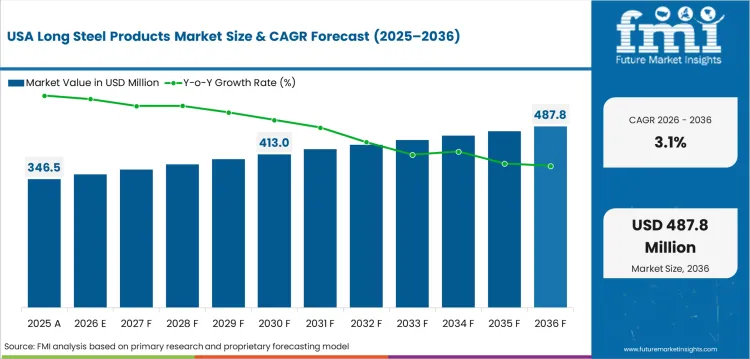
Long Steel Products Market Country Value Analysis
The United States is a high-value market with strong mini-mill participation. Rebar demand is supported by infrastructure and concrete construction. Nucor’s USD 860 million Pacific Northwest rebar micro mill approval shows that producers are still adding regional capacity where local demand supports it. The United States is projected to grow at 3.1% CAGR through 2036. Domestic mills benefit when regional delivery and project timing matter more than import price alone.
- The Pacific Northwest is gaining new rebar capacity through Nucor’s planned micro mill.
- North Carolina added a rebar fabrication investment worth more than USD 20 million in 2024.
- Texas and Florida remain large construction markets for rebar and merchant bar demand.
Opportunity Analysis of Long Steel Products in Brazil
Long Steel Products Market Country Value Analysis
Brazil is a mid-sized growth market with construction and infrastructure exposure. Rebar and merchant bars remain central to urban development and industrial building. Brazil is expected to expand at 4.2% CAGR through 2036 as construction recovery supports long product orders. Currency movement can affect imported steel and raw material costs. Local mills can gain when buyers value availability and short transport lead times.
- São Paulo remains the main commercial center for construction-linked demand.
- Minas Gerais supports steelmaking through iron ore and industrial clusters.
- Port and logistics projects create demand for rebar and structural products.
Future Outlook for Long Steel Products in Germany
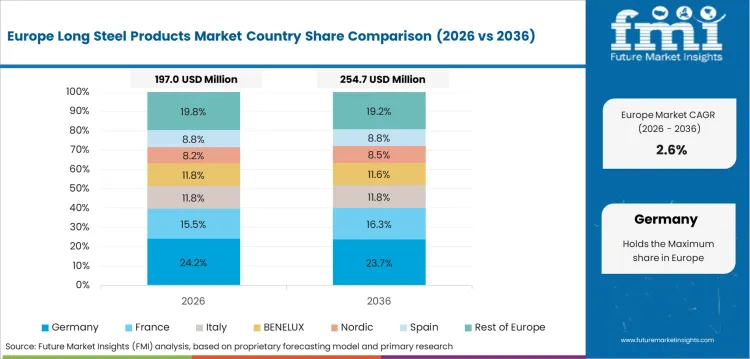
Long Steel Products Market Country Value Analysis
Germany is a mature market with high technical expectations. Structural sections and special bar quality products carry more value than commodity rebar growth. EUROFER’s December 2025 outlook said apparent steel consumption in 2026 is projected to recover by 3%. That expected recovery remains conditional on industrial demand improving. Germany is forecast at 2.4% CAGR through 2036 as replacement demand and fabrication work support steady purchases. Import pressure and energy cost remain key restraints.
- North Rhine Westphalia remains important for steel distribution and fabrication activity.
- Bavaria supports demand through machinery and industrial construction.
- German buyers place higher weight on grade consistency and delivery reliability.
Demand Outlook for Long Steel Products in Japan
Long Steel Products Market Country Value Analysis
Japan is a mature long steel market with replacement-led demand. Earthquake-resistant construction and infrastructure maintenance support rebar and sections. World Steel Association data show Japan produced 84.0 million tonnes of crude steel in 2024. The market is expected to advance at 2.1% CAGR through 2036 as aging infrastructure supports selective demand. Domestic demand growth is limited by demographics and slow construction expansion.
- Tokyo and Osaka support demand through redevelopment and infrastructure maintenance.
- Japanese mills focus on quality consistency for construction and industrial applications.
- Rail and infrastructure renewal create selective demand for qualified long products.
In-depth Analysis of Long Steel Products in South Korea
Long Steel Products Market Country Value Analysis
South Korea remains relevant through construction steel demand and export-oriented production. The market is compact but technically disciplined. World Steel Association data show South Korea produced 63.6 million tonnes of crude steel in 2024. South Korea is expected to post 1.9% CAGR through 2036 as construction demand stays mature. Producers will rely more on grade quality and regional trade than domestic volume expansion.
- Seoul-area redevelopment supports rebar demand for dense urban projects.
- Pohang and Gwangyang remain important steel production centers.
- Export exposure makes Korean producers sensitive to regional price cycles.
Competitive Landscape and Strategic Positioning
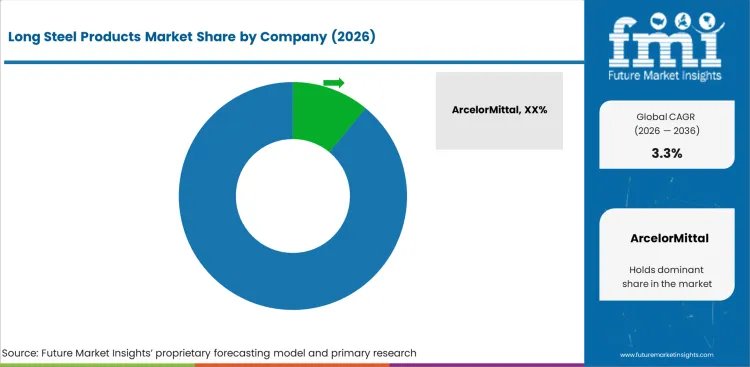
- The market is fragmented in rebar and merchant bars.
- Integrated producers hold advantage in billet cost and large project supply.
- Mini mills compete well near scrap supply and construction demand centers.
- Special bar quality producers win where automotive and machinery buyers need tighter specifications.
Competition in long steel products is strongly regional. Rebar travels poorly over long distances when margins are thin. This gives mills with local billet supply and nearby stockyards a practical edge. Nucor’s 2024 rebar micro mill approval shows this strategy clearly. The investment places capacity closer to regional construction demand and reduces freight exposure. Buyers gain shorter lead times and more reliable scheduling.
Large diversified producers defend broader accounts through product mix. ArcelorMittal’s 2024 annual report says the company produces long products including bars, rods, and structural shapes. That breadth gives large customers one supplier for several steel needs. It also lets the company shift volume across regions when demand changes. The trade-off is exposure to energy cost and import competition in Europe.
Steel Dynamics shows how long product producers build value through specialization. The company said in April 2026 that steel fabrication backlog was over 38% higher than a year earlier. It also said backlog extended through the third quarter and into October 2026. That signal supports stronger visibility in downstream fabrication demand. Mills with fabrication links can hold project access even during raw material price swings.
Key Companies in the Long Steel Products Market
Competition includes global integrated producers and regional long product specialists.
Global Integrated Producers
ArcelorMittal, China Baowu, Nippon Steel, POSCO, and Tata Steel compete through large steelmaking assets. Their strength lies in volume assurance and grade consistency. These companies are best placed where projects need large supply and cross-region account coverage.
Regional Long Product Specialists
Nucor, Steel Dynamics, Gerdau, JSW Steel, and Emirates Steel Arkan hold strong positions in regional long steel demand. Their advantage comes from local mill networks and rebar supply programs. Fabrication links support project-level demand capture.
Fabrication-linked Suppliers
Rebar fabricators and service centers shape downstream demand in large projects. Their role is important because mills depend on them for bending and cutting. Suppliers with stronger fabrication links can protect project demand during price swings.
Competitive Benchmarking: Long Steel Products Market
| Company | Rebar Supply Depth | Structural Section Range | Regional Delivery Strength | Geographic Footprint |
|---|---|---|---|---|
| ArcelorMittal | High | Strong | Strong | Global |
| China Baowu Steel Group | High | Strong | Strong | China and exports |
| Nippon Steel Corporation | Medium | Strong | Strong | Japan and exports |
| Nucor Corporation | High | Medium | Strong | North America |
| Steel Dynamics | Medium | High | Strong | North America |
| Tata Steel | High | Medium | Strong | India and Europe |
| JSW Steel | High | Medium | Strong | India |
| POSCO | Medium | Medium | Strong | South Korea and exports |
| Gerdau | High | Medium | Strong | Americas |
| Emirates Steel Arkan | Medium | Medium | Strong | Middle East |
Source: Future Market Insights competitive analysis, 2026. Ratings reflect relative positioning based on rebar supply depth, structural section range, and regional delivery strength.
Key Developments in Long Steel Products Market
- In February 2024, Nucor approved USD 860 million for a 650,000 tons per year rebar micro mill in the Pacific Northwest. The project supports regional rebar supply.
- In April 2024, Tata Steel reported FY2024 production volume of 20.76 million tonnes for Tata Steel India. This reinforced its domestic steelmaking scale.
- In December 2024, ArcelorMittal reported that it produced long products including bars, rods, and structural shapes. This confirmed broad participation across long steel categories.
- In April 2026, Steel Dynamics said steel fabrication backlog was over 38% higher than a year earlier. This signalled steady downstream project demand.
Key Players in the Long Steel Products Market
Global Integrated Producers
- ArcelorMittal
- China Baowu Steel Group
- Nippon Steel Corporation
- POSCO
- Tata Steel
Regional Long Product Specialists
- Nucor Corporation
- Steel Dynamics
- Gerdau
- JSW Steel
- Emirates Steel Arkan
Fabrication-linked Suppliers
- Rebar fabricators
- Steel service centers
- Regional distributors
Report Scope and Coverage
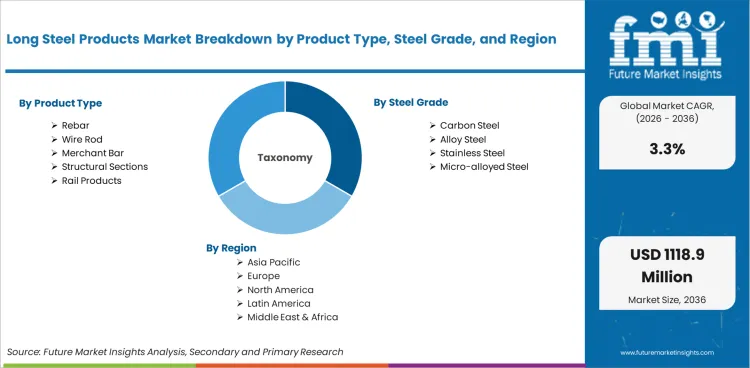
| Parameter | Details |
|---|---|
| Quantitative Units | USD 782.9 billion in 2026 to USD 1,083.6 billion by 2036 at a CAGR of 3.3% |
| Market Definition | Steel products with extended cross-sectional profiles used in construction and fabrication |
| Regions Covered | North America, Latin America, Western Europe, Eastern Europe, East Asia, South Asia and Pacific, Middle East and Africa |
| Countries Covered | India, China, United States, Brazil, Germany, Japan, South Korea |
| Key Companies Profiled | ArcelorMittal, China Baowu Steel Group, Nippon Steel Corporation, Nucor Corporation, Steel Dynamics, Tata Steel, JSW Steel, POSCO, Gerdau, Emirates Steel Arkan |
| Forecast Period | 2026 to 2036 |
| Approach | Hybrid bottom-up and top-down methodology starting with verified production and transaction indicators |
Long Steel Products Market by Segments
Long Steel Products Market Segmented by Product Type
- Rebar
- Wire Rod
- Merchant Bar
- Structural Sections
- Rail Products
Long Steel Products Market Segmented by Steel Grade
- Carbon Steel
- Alloy Steel
- Stainless Steel
- Micro-alloyed Steel
Long Steel Products Market Segmented by Process Route
- Blast Furnace Route
- Electric Arc Furnace Route
- Induction Furnace Route
Long Steel Products Market Segmented by End Use
- Construction
- Infrastructure
- Industrial Fabrication
- Automotive Components
- Energy Projects
Long Steel Products Market Segmented by Sales Channel
- Direct Mill Supply
- Steel Service Centers
- Distributor Sales
- Fabricator Supply
Long Steel Products Market by Region
- North America
- United States
- Canada
- Mexico
- Latin America
- Brazil
- Chile
- Rest of Latin America
- Western Europe
- Germany
- United Kingdom
- France
- Italy
- Spain
- Nordic
- BENELUX
- Rest of Western Europe
- Eastern Europe
- Russia
- Poland
- Balkan and Baltic
- Rest of Eastern Europe
- East Asia
- China
- Japan
- South Korea
- South Asia and Pacific
- India
- ASEAN
- Australia and New Zealand
- Rest of South Asia and Pacific
- Middle East and Africa
- Kingdom of Saudi Arabia
- Other GCC Countries
- Turkiye
- South Africa
- Other African Union
- Rest of Middle East and Africa
Research Sources and Bibliography
- World Steel Association. (2025). World Steel in Figures 2025. World Steel Association.
- Organisation for Economic Co-operation and Development. (2025). OECD Steel Outlook 2025. OECD.
- Ministry of Steel, Government of India. (2026). Annual Report 2025 to 2026. Ministry of Steel.
- Ministry of Steel, Government of India. (2025). An Overview of Steel Sector July 2025. Ministry of Steel.
- Nucor Corporation. (2024, February 21). Nucor Board of Directors Approves Funding for New Pacific Northwest Rebar Micro Mill. Nucor Corporation.
- Tata Steel. (2024, April 5). Tata Steel: 4QFY2024 and FY2024 Production and Delivery Volumes. Tata Steel.
- ArcelorMittal. (2024). Annual Report 2024. ArcelorMittal.
- Steel Dynamics. (2026, April 20). Steel Dynamics Reports First Quarter 2026 Results. Steel Dynamics.
- European Steel Association. (2025, December 2). Economic and Steel Market Outlook 2025 to 2026. EUROFER.
The bibliography is provided for reader reference and uses primary industry, company, government, and trade body sources.
This Report Answers
- What is the current and future size of the Long Steel Products Market?
- How fast is the Long Steel Products Market expected to grow from 2026 to 2036?
- Which product type is expected to lead long steel product demand in 2026?
- Why does rebar remain the largest long steel product category?
- Which end use creates the largest demand for long steel products?
- How do construction cycles affect long steel pricing and mill utilization?
- Which countries are expected to shape long steel demand during the forecast period?
- Which companies are active in long steel product production and supply?
- How does FMI define the Long Steel Products Market scope?
- How does the forecast account for steel capacity and country-level demand?
Frequently Asked Questions
What is the Long Steel Products Market value in 2026?
The Long Steel Products Market is expected to reach USD 782.9 billion in 2026 based on FMI analysis and forecast modelling.
What is the Long Steel Products Market forecast value by 2036?
The Long Steel Products Market is expected to reach USD 782.9 billion in 2026 based on FMI analysis and forecast modelling.
What CAGR is projected for the Long Steel Products Market from 2026 to 2036?
The Long Steel Products Market is projected to grow at 3.3% CAGR from 2026 to 2036.
Which product type leads the Long Steel Products Market in 2026?
Rebar is expected to lead the Product Type segment with 43.0% share in 2026 due to reinforced concrete demand.
Which end use leads the Long Steel Products Market in 2026?
Construction is projected to lead End Use demand with 61.0% share in 2026 due to building and concrete activity.
Which country records the fastest Long Steel Products Market growth?
India is projected to record the fastest growth at 6.7% CAGR through 2036 due to capacity expansion and infrastructure work.
What is included in the Long Steel Products Market?
The market includes rebar, wire rod, merchant bar, structural sections, and rail products used in construction and fabrication.
How is the Long Steel Products Market forecast prepared?
The forecast uses product volume, pricing bands, construction activity, infrastructure spending, and country-level steel production indicators.
What is the difference between long steel and flat steel?
Long steel is sold as bars, rods, rails, and sections. Flat steel is sold as sheets, coils, and plates.
Why does rebar dominate long steel demand?
Rebar dominates demand because reinforced concrete remains widely used in buildings, bridges, and public infrastructure projects.
Are electric arc furnace mills important in long steel?
Electric arc furnace mills are important because they use scrap and can serve regional rebar demand with shorter delivery distances.
What affects long steel product prices most?
Prices are affected by raw material cost, energy cost, construction demand, imports, and freight distance from the mill.
Preview the report firsthand - request a free sample
Get SampleGet the brochure for pricing and purchase details.
Get PDFTable of Content
- Executive Summary
- Global Market Outlook
- Demand-side Trends
- Supply-side Trends
- Technology Roadmap Analysis
- Analysis and Recommendations
- Market Overview
- Market Coverage / Taxonomy
- Market Definition / Scope / Limitations
- Research Methodology
- Chapter Orientation
- Analytical Lens and Working Hypotheses
- Market Structure, Signals, and Trend Drivers
- Benchmarking and Cross-market Comparability
- Market Sizing, Forecasting, and Opportunity Mapping
- Research Design and Evidence Framework
- Desk Research Programme (Secondary Evidence)
- Company Annual and Sustainability Reports
- Peer-reviewed Journals and Academic Literature
- Corporate Websites, Product Literature, and Technical Notes
- Earnings Decks and Investor Briefings
- Statutory Filings and Regulatory Disclosures
- Technical White Papers and Standards Notes
- Trade Journals, Industry Magazines, and Analyst Briefs
- Conference Proceedings, Webinars, and Seminar Materials
- Government Statistics Portals and Public Data Releases
- Press Releases and Reputable Media Coverage
- Specialist Newsletters and Curated Briefings
- Sector Databases and Reference Repositories
- FMI Internal Proprietary Databases and Historical Market Datasets
- Subscription Datasets and Paid Sources
- Social Channels, Communities, and Digital Listening Inputs
- Additional Desk Sources
- Expert Input and Fieldwork (Primary Evidence)
- Primary Modes
- Qualitative Interviews and Expert Elicitation
- Quantitative Surveys and Structured Data Capture
- Blended Approach
- Why Primary Evidence is Used
- Field Techniques
- Interviews
- Surveys
- Focus Groups
- Observational and In-context Research
- Social and Community Interactions
- Stakeholder Universe Engaged
- C-suite Leaders
- Board Members
- Presidents and Vice Presidents
- R&D and Innovation Heads
- Technical Specialists
- Domain Subject-matter Experts
- Scientists
- Physicians and Other Healthcare Professionals
- Governance, Ethics, and Data Stewardship
- Research Ethics
- Data Integrity and Handling
- Primary Modes
- Tooling, Models, and Reference Databases
- Desk Research Programme (Secondary Evidence)
- Data Engineering and Model Build
- Data Acquisition and Ingestion
- Cleaning, Normalisation, and Verification
- Synthesis, Triangulation, and Analysis
- Quality Assurance and Audit Trail
- Market Background
- Market Dynamics
- Drivers
- Restraints
- Opportunity
- Trends
- Scenario Forecast
- Demand in Optimistic Scenario
- Demand in Likely Scenario
- Demand in Conservative Scenario
- Opportunity Map Analysis
- Product Life Cycle Analysis
- Supply Chain Analysis
- Investment Feasibility Matrix
- Value Chain Analysis
- PESTLE and Porter’s Analysis
- Regulatory Landscape
- Regional Parent Market Outlook
- Production and Consumption Statistics
- Import and Export Statistics
- Market Dynamics
- Global Market Analysis 2021 to 2025 and Forecast, 2026 to 2036
- Historical Market Size Value (USD Million) Analysis, 2021 to 2025
- Current and Future Market Size Value (USD Million) Projections, 2026 to 2036
- Y-o-Y Growth Trend Analysis
- Absolute $ Opportunity Analysis
- Global Market Pricing Analysis 2021 to 2025 and Forecast 2026 to 2036
- Global Market Analysis 2021 to 2025 and Forecast 2026 to 2036, By Product Type
- Introduction / Key Findings
- Historical Market Size Value (USD Million) Analysis By Product Type , 2021 to 2025
- Current and Future Market Size Value (USD Million) Analysis and Forecast By Product Type , 2026 to 2036
- Rebar
- Wire Rod
- Merchant Bar
- Structural Sections
- Rail Products
- Rebar
- Y-o-Y Growth Trend Analysis By Product Type , 2021 to 2025
- Absolute $ Opportunity Analysis By Product Type , 2026 to 2036
- Global Market Analysis 2021 to 2025 and Forecast 2026 to 2036, By Steel Grade
- Introduction / Key Findings
- Historical Market Size Value (USD Million) Analysis By Steel Grade, 2021 to 2025
- Current and Future Market Size Value (USD Million) Analysis and Forecast By Steel Grade, 2026 to 2036
- Carbon Steel
- Alloy Steel
- Stainless Steel
- Micro-alloyed Steel
- Carbon Steel
- Y-o-Y Growth Trend Analysis By Steel Grade, 2021 to 2025
- Absolute $ Opportunity Analysis By Steel Grade, 2026 to 2036
- Global Market Analysis 2021 to 2025 and Forecast 2026 to 2036, By Process Route
- Introduction / Key Findings
- Historical Market Size Value (USD Million) Analysis By Process Route, 2021 to 2025
- Current and Future Market Size Value (USD Million) Analysis and Forecast By Process Route, 2026 to 2036
- Blast Furnace Route
- Electric Arc Furnace Route
- Induction Furnace Route
- Blast Furnace Route
- Y-o-Y Growth Trend Analysis By Process Route, 2021 to 2025
- Absolute $ Opportunity Analysis By Process Route, 2026 to 2036
- Global Market Analysis 2021 to 2025 and Forecast 2026 to 2036, By End Use
- Introduction / Key Findings
- Historical Market Size Value (USD Million) Analysis By End Use, 2021 to 2025
- Current and Future Market Size Value (USD Million) Analysis and Forecast By End Use, 2026 to 2036
- Construction
- Infrastructure
- Industrial Fabrication
- Automotive Components
- Energy Projects
- Construction
- Y-o-Y Growth Trend Analysis By End Use, 2021 to 2025
- Absolute $ Opportunity Analysis By End Use, 2026 to 2036
- Global Market Analysis 2021 to 2025 and Forecast 2026 to 2036, By Sales Channel
- Introduction / Key Findings
- Historical Market Size Value (USD Million) Analysis By Sales Channel, 2021 to 2025
- Current and Future Market Size Value (USD Million) Analysis and Forecast By Sales Channel, 2026 to 2036
- Direct Mill Supply
- Steel Service Centers
- Distributor Sales
- Fabricator Supply
- Direct Mill Supply
- Y-o-Y Growth Trend Analysis By Sales Channel, 2021 to 2025
- Absolute $ Opportunity Analysis By Sales Channel, 2026 to 2036
- Global Market Analysis 2021 to 2025 and Forecast 2026 to 2036, By Region
- Introduction
- Historical Market Size Value (USD Million) Analysis By Region, 2021 to 2025
- Current Market Size Value (USD Million) Analysis and Forecast By Region, 2026 to 2036
- North America
- Latin America
- Western Europe
- Eastern Europe
- East Asia
- South Asia and Pacific
- Middle East & Africa
- Market Attractiveness Analysis By Region
- North America Market Analysis 2021 to 2025 and Forecast 2026 to 2036, By Country
- Historical Market Size Value (USD Million) Trend Analysis By Market Taxonomy, 2021 to 2025
- Market Size Value (USD Million) Forecast By Market Taxonomy, 2026 to 2036
- By Country
- USA
- Canada
- Mexico
- By Product Type
- By Steel Grade
- By Process Route
- By End Use
- By Sales Channel
- By Country
- Market Attractiveness Analysis
- By Country
- By Product Type
- By Steel Grade
- By Process Route
- By End Use
- By Sales Channel
- Key Takeaways
- Latin America Market Analysis 2021 to 2025 and Forecast 2026 to 2036, By Country
- Historical Market Size Value (USD Million) Trend Analysis By Market Taxonomy, 2021 to 2025
- Market Size Value (USD Million) Forecast By Market Taxonomy, 2026 to 2036
- By Country
- Brazil
- Chile
- Rest of Latin America
- By Product Type
- By Steel Grade
- By Process Route
- By End Use
- By Sales Channel
- By Country
- Market Attractiveness Analysis
- By Country
- By Product Type
- By Steel Grade
- By Process Route
- By End Use
- By Sales Channel
- Key Takeaways
- Western Europe Market Analysis 2021 to 2025 and Forecast 2026 to 2036, By Country
- Historical Market Size Value (USD Million) Trend Analysis By Market Taxonomy, 2021 to 2025
- Market Size Value (USD Million) Forecast By Market Taxonomy, 2026 to 2036
- By Country
- Germany
- UK
- Italy
- Spain
- France
- Nordic
- BENELUX
- Rest of Western Europe
- By Product Type
- By Steel Grade
- By Process Route
- By End Use
- By Sales Channel
- By Country
- Market Attractiveness Analysis
- By Country
- By Product Type
- By Steel Grade
- By Process Route
- By End Use
- By Sales Channel
- Key Takeaways
- Eastern Europe Market Analysis 2021 to 2025 and Forecast 2026 to 2036, By Country
- Historical Market Size Value (USD Million) Trend Analysis By Market Taxonomy, 2021 to 2025
- Market Size Value (USD Million) Forecast By Market Taxonomy, 2026 to 2036
- By Country
- Russia
- Poland
- Hungary
- Balkan & Baltic
- Rest of Eastern Europe
- By Product Type
- By Steel Grade
- By Process Route
- By End Use
- By Sales Channel
- By Country
- Market Attractiveness Analysis
- By Country
- By Product Type
- By Steel Grade
- By Process Route
- By End Use
- By Sales Channel
- Key Takeaways
- East Asia Market Analysis 2021 to 2025 and Forecast 2026 to 2036, By Country
- Historical Market Size Value (USD Million) Trend Analysis By Market Taxonomy, 2021 to 2025
- Market Size Value (USD Million) Forecast By Market Taxonomy, 2026 to 2036
- By Country
- China
- Japan
- South Korea
- By Product Type
- By Steel Grade
- By Process Route
- By End Use
- By Sales Channel
- By Country
- Market Attractiveness Analysis
- By Country
- By Product Type
- By Steel Grade
- By Process Route
- By End Use
- By Sales Channel
- Key Takeaways
- South Asia and Pacific Market Analysis 2021 to 2025 and Forecast 2026 to 2036, By Country
- Historical Market Size Value (USD Million) Trend Analysis By Market Taxonomy, 2021 to 2025
- Market Size Value (USD Million) Forecast By Market Taxonomy, 2026 to 2036
- By Country
- India
- ASEAN
- Australia & New Zealand
- Rest of South Asia and Pacific
- By Product Type
- By Steel Grade
- By Process Route
- By End Use
- By Sales Channel
- By Country
- Market Attractiveness Analysis
- By Country
- By Product Type
- By Steel Grade
- By Process Route
- By End Use
- By Sales Channel
- Key Takeaways
- Middle East & Africa Market Analysis 2021 to 2025 and Forecast 2026 to 2036, By Country
- Historical Market Size Value (USD Million) Trend Analysis By Market Taxonomy, 2021 to 2025
- Market Size Value (USD Million) Forecast By Market Taxonomy, 2026 to 2036
- By Country
- Kingdom of Saudi Arabia
- Other GCC Countries
- Turkiye
- South Africa
- Other African Union
- Rest of Middle East & Africa
- By Product Type
- By Steel Grade
- By Process Route
- By End Use
- By Sales Channel
- By Country
- Market Attractiveness Analysis
- By Country
- By Product Type
- By Steel Grade
- By Process Route
- By End Use
- By Sales Channel
- Key Takeaways
- Key Countries Market Analysis
- USA
- Pricing Analysis
- Market Share Analysis, 2025
- By Product Type
- By Steel Grade
- By Process Route
- By End Use
- By Sales Channel
- Canada
- Pricing Analysis
- Market Share Analysis, 2025
- By Product Type
- By Steel Grade
- By Process Route
- By End Use
- By Sales Channel
- Mexico
- Pricing Analysis
- Market Share Analysis, 2025
- By Product Type
- By Steel Grade
- By Process Route
- By End Use
- By Sales Channel
- Brazil
- Pricing Analysis
- Market Share Analysis, 2025
- By Product Type
- By Steel Grade
- By Process Route
- By End Use
- By Sales Channel
- Chile
- Pricing Analysis
- Market Share Analysis, 2025
- By Product Type
- By Steel Grade
- By Process Route
- By End Use
- By Sales Channel
- Germany
- Pricing Analysis
- Market Share Analysis, 2025
- By Product Type
- By Steel Grade
- By Process Route
- By End Use
- By Sales Channel
- UK
- Pricing Analysis
- Market Share Analysis, 2025
- By Product Type
- By Steel Grade
- By Process Route
- By End Use
- By Sales Channel
- Italy
- Pricing Analysis
- Market Share Analysis, 2025
- By Product Type
- By Steel Grade
- By Process Route
- By End Use
- By Sales Channel
- Spain
- Pricing Analysis
- Market Share Analysis, 2025
- By Product Type
- By Steel Grade
- By Process Route
- By End Use
- By Sales Channel
- France
- Pricing Analysis
- Market Share Analysis, 2025
- By Product Type
- By Steel Grade
- By Process Route
- By End Use
- By Sales Channel
- India
- Pricing Analysis
- Market Share Analysis, 2025
- By Product Type
- By Steel Grade
- By Process Route
- By End Use
- By Sales Channel
- ASEAN
- Pricing Analysis
- Market Share Analysis, 2025
- By Product Type
- By Steel Grade
- By Process Route
- By End Use
- By Sales Channel
- Australia & New Zealand
- Pricing Analysis
- Market Share Analysis, 2025
- By Product Type
- By Steel Grade
- By Process Route
- By End Use
- By Sales Channel
- China
- Pricing Analysis
- Market Share Analysis, 2025
- By Product Type
- By Steel Grade
- By Process Route
- By End Use
- By Sales Channel
- Japan
- Pricing Analysis
- Market Share Analysis, 2025
- By Product Type
- By Steel Grade
- By Process Route
- By End Use
- By Sales Channel
- South Korea
- Pricing Analysis
- Market Share Analysis, 2025
- By Product Type
- By Steel Grade
- By Process Route
- By End Use
- By Sales Channel
- Russia
- Pricing Analysis
- Market Share Analysis, 2025
- By Product Type
- By Steel Grade
- By Process Route
- By End Use
- By Sales Channel
- Poland
- Pricing Analysis
- Market Share Analysis, 2025
- By Product Type
- By Steel Grade
- By Process Route
- By End Use
- By Sales Channel
- Hungary
- Pricing Analysis
- Market Share Analysis, 2025
- By Product Type
- By Steel Grade
- By Process Route
- By End Use
- By Sales Channel
- Kingdom of Saudi Arabia
- Pricing Analysis
- Market Share Analysis, 2025
- By Product Type
- By Steel Grade
- By Process Route
- By End Use
- By Sales Channel
- Turkiye
- Pricing Analysis
- Market Share Analysis, 2025
- By Product Type
- By Steel Grade
- By Process Route
- By End Use
- By Sales Channel
- South Africa
- Pricing Analysis
- Market Share Analysis, 2025
- By Product Type
- By Steel Grade
- By Process Route
- By End Use
- By Sales Channel
- USA
- Market Structure Analysis
- Competition Dashboard
- Competition Benchmarking
- Market Share Analysis of Top Players
- By Regional
- By Product Type
- By Steel Grade
- By Process Route
- By End Use
- By Sales Channel
- Competition Analysis
- Competition Deep Dive
- ArcelorMittal
- Overview
- Product Portfolio
- Profitability by Market Segments (Product/Age /Sales Channel/Region)
- Sales Footprint
- Strategy Overview
- Marketing Strategy
- Product Strategy
- Channel Strategy
- China Baowu Steel Group
- Nippon Steel Corporation
- Nucor Corporation
- Steel Dynamics
- Tata Steel
- JSW Steel
- POSCO
- Gerdau
- Emirates Steel Arkan
- ArcelorMittal
- Competition Deep Dive
- Assumptions & Acronyms Used


