

- Industry Size (2026)
- USD 2.6 Bn
- Forecast (2036)
- USD 6.9 Bn
- CAGR (2026 to 2036)
- 10.3%
Longevity Clinic Chain Infrastructure Market Size, Market Forecast and Outlook By FMI
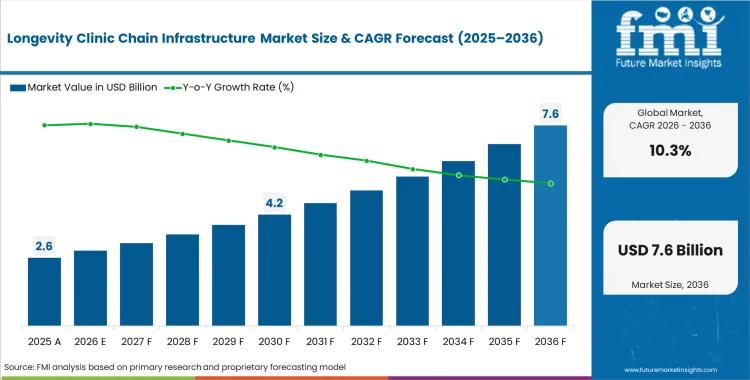
The longevity clinic chain infrastructure market crossed a valuation of USD 2.4 billion in 2025, with revenues expected to exceed USD 2.6 billion in 2026, supported by a projected 10.3% CAGR over the subsequent decade. Continued capital deployment is set to elevate cumulative market value to USD 6.9 billion by 2036, reflecting a broader transition as private equity sponsors consolidate fragmented physician‑owned practices into standardized, multi‑site preventive‑health chains.
Summary of Longevity Clinic Chain Infrastructure Market
- Market Snapshot
- The Longevity Clinic Chain Infrastructure Market stands at USD 2.4 billion in 2025 and is projected to reach USD 6.9 billion by 2036, reflecting sustained expansion of premium, physician-led preventive‑health platforms.
- The market is set to grow at a 10.3% CAGR from 2026 to 2036, generating an incremental USD 4.3 billion opportunity relative to 2026.
- Growth is anchored in premium preventive‑care chains built around standardized clinic formats, annual memberships, advanced diagnostics, and physician‑supervised healthspan programs, distinct from mass‑market wellness retail.
- Competitive advantage is increasingly shaped by network scale, diagnostic comprehensiveness, clinician credibility, and the operational ability to replicate high‑value membership models across sites, rather than by any single therapeutic modality.
- Demand and Growth Drivers
- Demand is accelerating as ageing populations, rising chronic‑disease exposure, and policy emphasis on healthier ageing shift affluent consumers toward proactive screening and optimization models.
- Adoption is highest where clinics integrate whole‑body imaging, biomarker panels, genomics, and longitudinal coaching into a unified membership, avoiding fragmented wellness propositions.
- Platform maturation and capital inflow are enabling chain expansion and reducing reliance on single‑location boutique clinics.
- Growth rates by country: India (13.1% CAGR), UAE (12.8%), Singapore (11.8%), United States (11.4%), United Kingdom (10.9%), Australia (10.4%), and Switzerland (9.6%).
- Growth remains tempered by evidence scrutiny, uneven regulatory clarity, and the category’s current dependence on premium, self‑pay consumer segments.
- Product and Segment View
- The market comprises chain‑operated longevity centers built around physician consultations, imaging, laboratory diagnostics, memberships, recovery therapies, and digital follow‑up systems.
- These services are applied across executive preventive health, metabolic optimization, hormone management, biological‑age tracking, recovery programs, and medical‑tourism‑linked assessments.
- Membership programs (44% share) lead the service‑model segment, driven by the economics of recurring annual contracts over one‑time visits.
- Imaging‑led offerings (39% share) dominate the diagnostic stack due to high-value modalities such as whole‑body MRI, DEXA, VO2 max testing, and advanced biomarker baselining.
- Urban flagships (46% share) lead the facility model, reflecting concentration of self‑pay demand in affluent metropolitan markets.
- Physician‑owned models (34% share) remain the largest ownership class, though PE‑backed platforms are gaining relevance as consolidation accelerates.
- Self‑pay consumers (57% share) dominate the customer mix, reinforcing the sector’s current positioning as a premium membership‑led health offering.
- Market scope includes clinic networks, memberships, diagnostics, and care orchestration, excluding supplements, beauty-focused anti‑aging products, general medspas, and standalone wellness devices.
- Geography and Competitive Outlook
- Growth is most pronounced in India, the UAE, and Singapore, while the United States remains the largest near‑term revenue pool due to established concierge and premium preventive‑care models.
- Competition is increasingly shaped by footprint expansion, membership‑driven retention, and capital‑supported platform rollups, rather than technology differentiation alone.
- Key operators include Fountain Life, Cenegenics, Next Health, Biograph, and Extension Health each competing through differing levels of diagnostic depth, therapeutic breadth, and hospitality‑oriented service design.
The market remains fragmented, creating headroom for regional chain scaling, franchising models, and MSO‑driven consolidation.
For hospital systems, the strategic pressure is increasing. Health networks must act quickly to retain high‑net‑worth, self‑pay patients before independent concierge longevity clinics secure them through multi‑year preventive‑medicine subscription models. Postponing investment in dedicated longevity infrastructure forces hospitals to remain dependent on lower‑margin, insurance‑reimbursed service lines, enabling well-capitalized private competitors to capture the premium economics of executive diagnostics and advanced health assessments. Senior administrators increasingly recognize that ownership of high-end diagnostic assets, particularly imaging and biomarker platforms, remains a decisive factor in patient retention long after the initial assessment.
As institutional investors consolidate regional physician groups, care pathways become more standardized across locations, reducing local variation in clinical practice. This helps operators deliver services more consistently as they expand across multiple markets. Private equity involvement also changes the cost base by centralizing procurement for expensive equipment such as advanced MRI systems. Lower equipment costs improve unit economics and support faster clinic expansion. Medical directors responsibilities extend beyond individual patient care and move toward oversight of system-wide protocols. They are increasingly expected to validate and align diagnostic and reporting workflows across states, sites, and affiliated operating entities.
Longevity clinic chain infrastructure market in America is poised to grow annually at a CAGR of 11.4% as established concierge practices upgrade baseline clinical capabilities. India is expected to follow a CAGR of 13.1% on the back of targeted healthcare travel influx targeting specialized interventions. UAE expansion tracks at 12.8%, driven by state-backed initiatives attracting elite global talent requiring premium medical access. Singapore is poised to advance at 11.8% leveraging advanced digital health ecosystems. Britain is estimated to maintain 10.9% steady expansion, while Australia is projected to capture 10.4% from visible consumerization. Switzerland is estimated to record 9.6% through hyper-specialized cellular therapy clinics. Trajectory divergence reveals Asian locations scaling pure volume whereas European centers optimize per-patient yield.
Segmental Analysis
Longevity Clinic Chain Infrastructure Market Analysis by Service Model
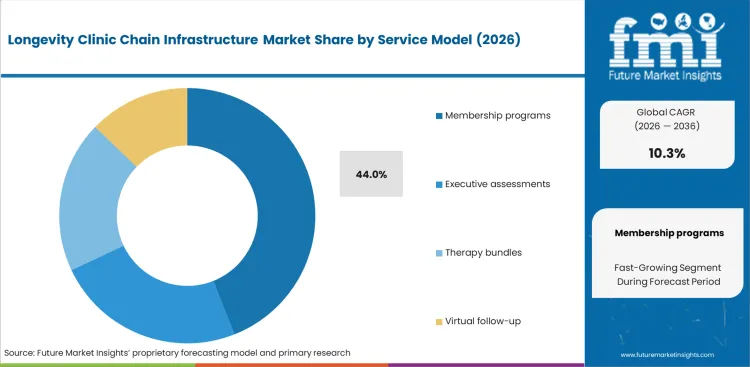
Wealthy patients increasingly evaluate the trade‑off between substantial upfront diagnostic expenditures and the long‑term value of continuous preventive‑care oversight. Membership‑based longevity clinic models provide operators with predictable recurring revenue streams that help mitigate the financial risk associated with high‑capital diagnostic infrastructure. This dependable cash flow enables clinical directors to negotiate exclusive regional vendor contracts and strategically sequence hardware investments. With membership programs projected to account for 44.0% of the service‑model share in 2026, the economics of subscription revenue remain central to underwriting multi‑million‑dollar MRI acquisitions and associated operating costs. Monthly billing structures compel clinics to maintain consistent patient engagement through routine digital biomarker updates, while annual membership renewals hinge on demonstrating measurable improvements in biological‑age metrics rather than offering generalized concierge‑style experiences. Failure to deliver quantifiable health outcomes can lead to rapid subscriber churn, undermining the ability to service equipment‑related debt obligations. To maintain continuity of care and strengthen retention, operators are increasingly integrating remote healthcare capabilities, ensuring daily digital touchpoints between major quarterly assessments.
- Initial commitment: Subscription pricing structures force clinic sales directors to justify high initial evaluation costs. Patients face significant financial lock-in once committing to a specific facility ecosystem based on established longevity clinic membership pricing.
- Qualification metrics: Medical staff validate program effectiveness through strict biomarker tracking protocols. Participants gain objective data proving biological age manipulation success.
- Renewal triggers: Showing measurable health progression motivates wealthy individuals to maintain multi-year memberships. Operators avoid costly customer acquisition cycles by retaining existing engaged client bases.
Longevity Clinic Chain Infrastructure Market Analysis by Diagnostic Stack
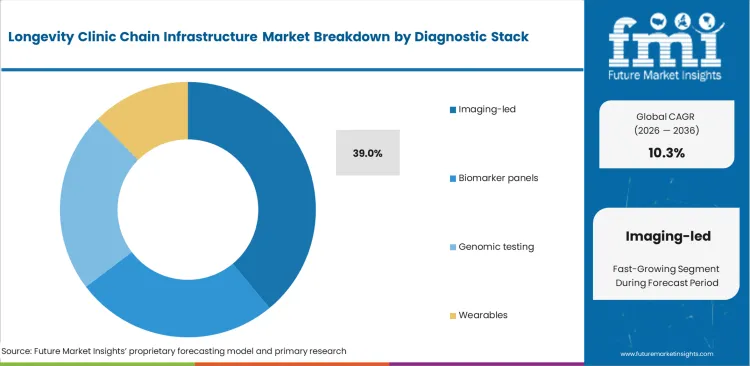
Whole-body MRI scans replace fragmented blood panels as primary patient acquisition tools. Imaging-led infrastructure is estimated to capture 39.0% share in 2026 as visual disease detection resonates powerfully with asymptomatic wealthy consumers evaluating a whole body MRI longevity clinic. FMI's analysis indicates procurement managers at global digital health focused chains prioritize imaging suites to instantly differentiate their facilities from standard primary care offices. Operating proprietary MRI machines eliminates reliance on third-party hospital radiology departments. What facility blueprints rarely show is how heavy shielding requirements and specialized power grid connections permanently lock clinics into specific commercial real estate locations. Clinic operators who underestimate structural reinforcement costs face severe budget overruns before treating single patients. Deploying healthcare digital experience platform solutions allows seamless sharing of complex imaging results directly to smartphones.
- Hardware acquisition: Procurement teams source advanced scanners capable of detecting millimeter-level abnormalities. Clinics gain immediate prestige but must absorb high initial capital expenditures.
- Hidden operational burden: Maintaining dedicated radiology staff drains monthly operating budgets significantly. Facility directors must schedule continuous scan volumes to offset high fixed salary costs.
- Lifecycle comparison: Upgrading imaging software provides better diagnostic yield than replacing physical magnetic hardware. Capital planners avoid full system replacements by subscribing to continuous algorithmic enhancement packages.
Longevity Clinic Chain Infrastructure Market Analysis by Facility Model
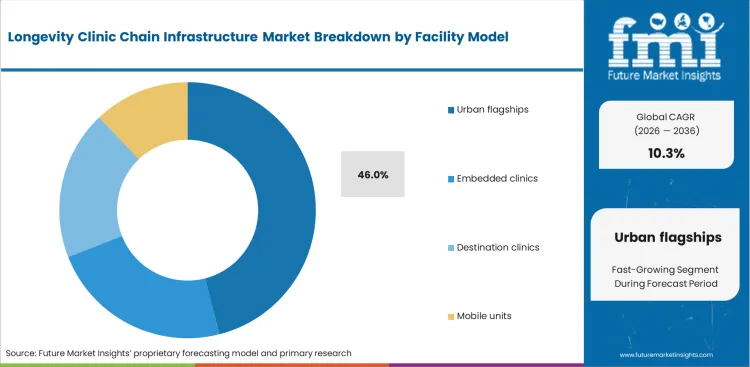
Real estate directors continually balance the advantages of high‑visibility urban locations with the specialized infrastructure required to support advanced diagnostic assets. Urban flagship facilities are typically positioned in central metropolitan zones to house high‑capital imaging hardware and manage complex clinical workflows. According to FMI’s assessment, chief medical officers rely on these large centers to perform intensive imaging procedures while routing routine biomarker testing to smaller satellite offices to optimize staff and equipment utilization. Centralizing high‑end hardware in these hubs allows operators to drive consistent daily throughput and maintain favorable unit economics. With urban flagships poised to represent 46.0% of the facility‑model share in 2026, their strategic importance is underscored by the operational efficiency they deliver. What basic square‑footage metrics often obscure is the extent to which stringent medical waste disposal regulations prevent these facilities from occupying standard class‑A office towers without extensive retrofitting. Selecting an inappropriate real estate classification can lead to regulatory non‑compliance and force immediate operational shutdowns when municipal health inspectors conduct site assessments. Expanding through on‑site preventive‑care outposts ensures a continuous patient pipeline into these central hubs, further reinforcing the flagship model’s role in sustaining high‑value diagnostic operations.
- Primary diagnostic failure: Standard office layouts lack structural floor strength required for MRI installations. Project managers face expensive structural reinforcement delays during initial build-out phases.
- Residual operational risk: Concentrating all advanced hardware in one location creates single-point failure vulnerabilities. Operations directors must rapidly reroute patients if primary urban scanners require emergency maintenance.
- Full capacity capture: Maximizing scanner uptime requires intelligent patient scheduling software algorithms. Front desk coordinators must eliminate empty time slots to ensure facility profitability.
Longevity Clinic Chain Infrastructure Market Analysis by Ownership Model
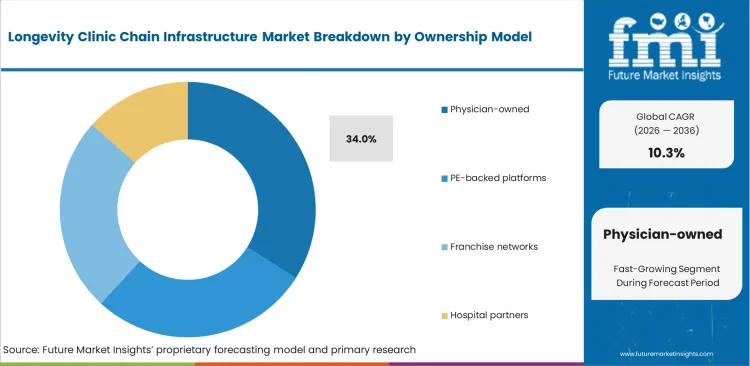
Founding doctors continue to exercise strong clinical oversight even as they gradually adopt standardized corporate operating protocols. As early longevity pioneers expand their personal practices into scalable multi‑site brands, they benefit from deep patient‑trust networks that validate high‑priced preventive‑health interventions more rapidly than anonymous corporate entities. These medical founders also integrate personalized nutrition and related therapeutic regimes directly into their practice workflows, reinforcing patient confidence and differentiating their clinical models. What capitalization tables often fail to convey is that many aging founding physicians deliberately design these emerging chains with the long‑term objective of attracting private equity acquisition offers within a defined time horizon. Physician‑owned models are estimated to account for 34.0% of the ownership‑model share, reflecting both the clinical credibility founders bring and the strategic positioning required to secure institutional exit valuations. Those who resist standardizing their proprietary treatment methodologies, frequently struggle to meet the operational and scalability thresholds necessary for competitive valuation in private markets.
- Early capacity builders: Entrepreneurial doctors leverage personal wealth to purchase initial diagnostic equipment. Founders assume total financial risk while retaining absolute control over clinical protocols.
- Supply chain realities: Independent physicians lack bulk purchasing power when negotiating with major equipment manufacturers. Procurement officers must pay premium prices compared to large institutional healthcare networks.
- Exit trajectory planning: Maturing physician-owned networks systematically replace proprietary treatments with standardized scalable procedures. Medical directors prepare operations for eventual integration into larger longevity clinic platform companies.
Longevity Clinic Chain Infrastructure Market Analysis by Customer Type
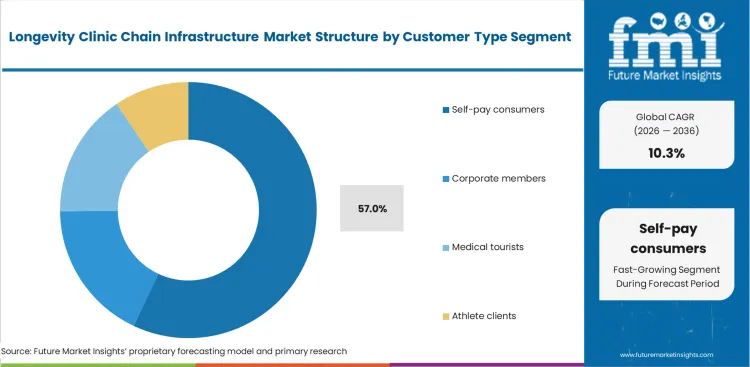
Wealthy individuals bypassing traditional insurance pathways drive immediate facility expansion. Self-pay consumers are poised to represent 57.0% share, completely altering how clinics structure internal revenue cycle management. As per FMI's projection, finance directors eliminate entire medical billing departments, redirecting those salaries toward premium hospitality staff and advanced diagnostic machinery to create an elite executive health longevity center. Relying entirely on direct cash transfers accelerates facility cash flow exponentially. FMI observes that demographic data ignores how these ultra-wealthy clients demand immediate access to experimental therapies standard clinics cannot legally provide. Refusing to offer controversial cellular interventions pushes these lucrative patients toward loosely regulated offshore outbound medical tourism destinations.
- Initial adopters: High-net-worth tech executives purchase premium memberships seeking peak cognitive performance. Clinic operators gain high upfront capital to fund further equipment purchases.
- Secondary wave: Mid-level corporate executives allocate personal savings toward annual executive health screens. Facility directors must adjust pricing tiers to capture this broader demographic segment.
- Late stage conversion: Traditional affluent patients abandon standard primary care when serious health scares occur. Concierge doctors finally convince these holdouts by demonstrating superior diagnostic imaging capabilities.
Longevity Clinic Chain Infrastructure Market Drivers, Restraints, and Opportunities
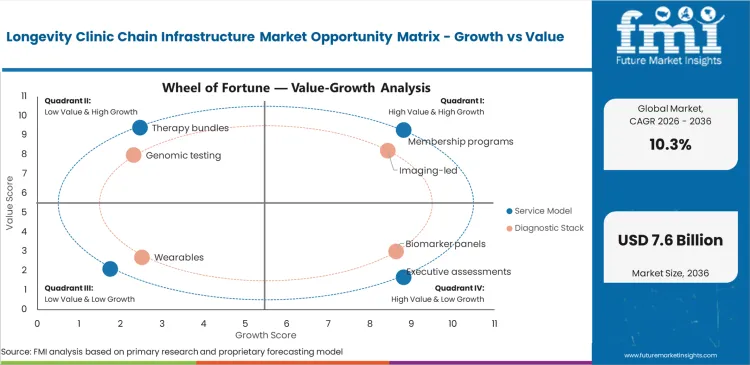
Wealthy families explicitly demand proactive disease interception rather than reactive treatment protocols. This expectation forces clinic procurement heads to acquire medical-grade diagnostic imaging hardware immediately to establish a viable preventive diagnostics clinic chain. Delaying these multi-million-dollar purchases means losing elite clientele to better-equipped regional competitors. Purchasing advanced MRI suites and genomic sequencing terminals allows facility operators to justify fifty-thousand-dollar annual membership fees. Integrating EU longevity supplements sales into daily patient routines creates additional sticky revenue streams. Rapid technological deployment outpaces traditional hospital acquisition cycles, giving agile private clinics significant competitive advantages in local affluent neighborhoods.
Severe radiologist shortages structurally limit how fast new diagnostic centers can process patients. Clinic operators purchase high-end scanners easily, but finding qualified specialists to interpret complex asymptomatic screening data remains incredibly difficult. Software vendors promise automated AI analysis, yet regulatory frameworks still require human physician sign-off on every diagnostic report. This bottleneck caps maximum daily patient throughput regardless of physical hardware capacity. Waiting weeks for specialized scan interpretations destroys premium concierge experience expectations.
Opportunities in the Longevity Clinic Chain Infrastructure Market
- AI integration workflows: Specialized algorithms sorting asymptomatic scan anomalies allow chief medical officers to triple daily radiologist productivity safely.
- Satellite deployment: Placing scaled-down diagnostic pods in luxury residential buildings helps real estate directors capture localized affluent demographics instantly.
- Targeted wellness packages: Incorporating customized older adults health supplements into post-scan treatment plans gives nutritionists actionable tools to improve patient biomarkers.
Regional Analysis
.webp "Top Country Growth Comparison Longevity Clinic Chain Infrastructure Market Cagr (2026 2036)")
Based on regional analysis, longevity clinic chain infrastructure market is segmented into North America, Latin America, Western Europe, Eastern Europe, South Asia and Pacific, East Asia, and Middle East and Africa across 40 plus countries.
| Country | CAGR (2026 to 2036) |
|---|---|
| India | 13.1% |
| United Arab Emirates | 12.8% |
| Singapore | 11.8% |
| United States | 11.4% |
| United Kingdom | 10.9% |
| Australia | 10.4% |
| Switzerland | 9.6% |
Source: Future Market Insights (FMI) analysis, based on proprietary forecasting model and primary research
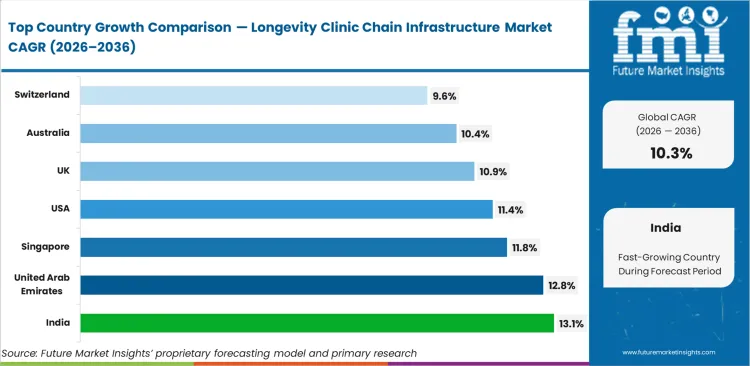
South Asia and Pacific Longevity Clinic Chain Infrastructure Market Analysis
Substantial influx of international patients seeking advanced preventive care forces aggressive facility expansion across South Asia. According to FMI's estimates, regional hospital chains rapidly construct dedicated standalone longevity centers to separate wealthy international payors from standard domestic patient populations. This strategic separation allows administrators to deploy ultra-premium diagnostic hardware without violating local public health resource guidelines. Capital allocators focus heavily on creating luxurious clinical environments matching top-tier hospitality standards.
- India: Specialized healthcare visas targeting elite Asian demographics are driving aggressive infrastructure investments in the country. To satisfy wealthy international clients expecting world-class diagnostics, facility operators in the Indian medical tourism are importing advanced imaging hardware. The longevity clinic chain infrastructure segment in India is anticipated to record a 13.1% CAGR through 2036. Expanding these luxury capacities allows domestic corporate networks to capture significant global revenue.
- Singapore: Demand for longevity clinic infrastructure in Singapore is poised to garner an 11.8% CAGR during the assessment period, as dense urban environments force architects to optimize limited space through digital diagnostic integrations. Chief medical officers now rely on continuous wearable data streams rather than numerous physical imaging suites. By adopting pure digital healthcare frameworks, operators gain high cost advantages over hardware-heavy competitors.
- Australia: Visible consumerization of preventive interventions is pushing suburban general practitioners to upgrade baseline equipment. Practice managers are installing targeted diagnostic tools to capture affluent local populations, while maturing infrastructure sets clear competitive benchmarks for intrabound medical tourism across neighboring Pacific nations. Driven by steady domestic upgrades, Australian clinic chain infrastructure revenue is set to rise at a 10.4% CAGR through 2036, fundamentally reshaping regional preventive care dynamics.
Middle East and Africa Longevity Clinic Chain Infrastructure Market Analysis
State-backed initiatives actively design dedicated free zones specifically to attract elite global healthcare talent and technologies. Based on FMI's assessment, sovereign wealth funds partner directly with established Western longevity brands to instantly import proven clinical protocols. This large-scale capital injection bypasses traditional organic growth phases, allowing immediate construction of hyper-advanced flagship facilities. Regional health ministries utilize these advanced centers to project technological supremacy across neighboring territories.
- United Arab Emirates: Sovereign health initiatives mandate the construction of considerable centralized preventive screening hubs. Here, procurement officials bypass standard bidding to secure exclusive regional rights to experimental diagnostic technologies, cementing regional medical dominance through early access to next-generation biomarker platforms. Longevity clinic infrastructure sales in the United Arab Emirates are anticipated to capture a 12.8% CAGR during the forecast, heavily leveraging integrated healthy aging supplement regimens.
North America Longevity Clinic Chain Infrastructure Market Analysis
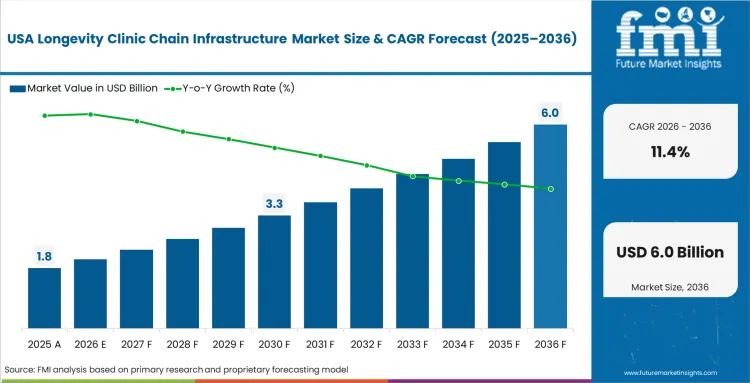
Private equity consolidation systematically transforms fragmented independent concierge practices into standardized clinical networks. FMI analysts note that institutional operators strip away proprietary physician protocols, replacing them with uniform scalable diagnostic workflows. This standardization allows financial directors to negotiate high-volume discounts on premium MRI systems across dozens of newly acquired locations, rapidly evolving the longevity medicine clinics market.
- United States: The United States longevity clinic infrastructure market is projected to rise at an 11.4% CAGR over the assessment period, driven by fierce competition. Established concierge practices aggressively upgrade capabilities to justify rising membership fees, purchasing specialized imaging suites to retain wealthy patients. Standardized multi-omic data collection creates highly valuable patient registries that large pharmaceutical companies ultimately seek to purchase.
Western Europe Longevity Clinic Chain Infrastructure Market Analysis
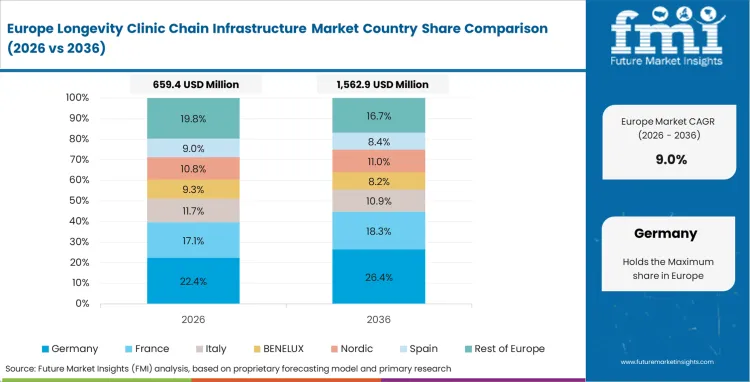
Strict medical data privacy regulations force clinic operators to build highly secure localized data storage infrastructure. In FMI's view, compliance officers prohibit transmitting sensitive genomic and imaging data to external cloud servers, requiring expensive on-premise server installations. This unique regulatory constraint significantly increases initial facility build-out costs compared to other global territories.
- United Kingdom: Clinical conservatism requires operators to produce extensive peer-reviewed evidence before adopting new diagnostic hardware. Medical advisory boards evaluate novel biomarker panels against established national health standards, validating these clinics against public scrutiny. Amidst this methodical evidence-based expansion, longevity clinic infrastructure revenue in the United Kingdom is expected to record a 10.9% CAGR through 2036, solidifying a highly regulated but lucrative clinical ecosystem.
- Switzerland: Hyper-specialized cellular therapy clinics leverage historic prestige to attract ultra-wealthy international clientele. Facility directors focus on creating discrete, highly secure environments offering controversial treatments unavailable elsewhere. Relying on these low-volume, maximum-margin business models, the Swiss longevity clinic infrastructure market is anticipated to rise at a 9.6% CAGR during the forecast. Executing flawless privacy protocols ensures continuous patronage from billionaires seeking biological age reversal.
FMI's report includes detailed analysis covering Germany, France, Japan, and Brazil. Expanding networks target Thailand medical tourism hubs and lucrative South Korea medical tourism destinations as critical future growth nodes for medical tourism longevity clinics.
Competitive Aligners for Market Players
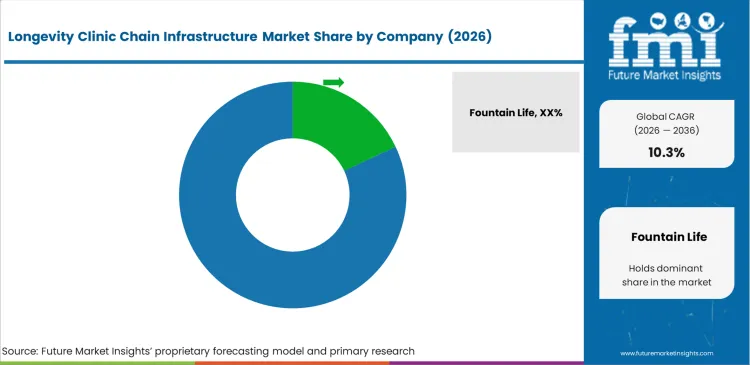
Fountain Life and Cenegenics dominate premium diagnostic facility expansions by securing exclusive regional purchasing agreements with top-tier MRI manufacturers. This dynamic prevents emerging independent clinics from acquiring identical hardware without paying major premiums or waiting out extended delivery backlogs. Procurement directors at these leading chains utilize sizeable capital backing to essentially monopolize local access to advanced anti-aging vitamins and screening technologies. Competing requires considerable upfront financial commitments before a single patient enters a consultation room.
Incumbent franchise networks possess vast longitudinal patient data registries that new entrants simply cannot replicate. Medical directors at established platforms utilize decade-long historical biomarker data to continuously refine proprietary diagnostic algorithms. Challengers must build internal data lakes from scratch, operating at a severe analytical disadvantage during initial years of operation. Connecting patients with targeted health and wellness products becomes significantly more effective when backed by extensive historical efficacy statistics.
Wealthy consumers effectively resist facility lock-in by demanding fully portable digital health records containing all genomic and imaging files. Private equity operators attempt to trap patients inside closed proprietary ecosystems, but affluent clients routinely hire independent medical concierges to aggregate data across multiple competing clinics. Successful platforms eventually realize that facilitating seamless data export builds stronger patient loyalty than creating artificial technical barriers. Facility architects now design open-architecture software systems integrating smoothly with whatever external specialists patients choose to consult.
Key Players in Longevity Clinic Chain Infrastructure Market
- Fountain Life
- Cenegenics
- Next Health
- Biograph
- Extension Health
Scope of the Report
| Metric | Value |
|---|---|
| Quantitative Units | USD 2.6 billion to USD 6.9 billion, at a CAGR of 10.3% |
| Market Definition | Commercial assets supporting multi-location preventive health facilities define this sector. Operations merge high-end medical diagnostics with continuous biomarker tracking under standardized protocols targeting biological age reversal. |
| Segmentation | Service model, Diagnostic stack, Facility model, Ownership model, Customer type, Region |
| Regions Covered | North America, Latin America, Western Europe, Eastern Europe, South Asia and Pacific, East Asia, Middle East and Africa |
| Countries Covered | United States, India, United Arab Emirates, Singapore, United Kingdom, Australia, Switzerland |
| Key Companies Profiled | Fountain Life, Cenegenics, Next Health, Biograph, Extension Health |
| Forecast Period | 2026 to 2036 |
| Approach | Paid active memberships and diagnostic equipment deployment volumes anchor valuation baselines. |
Source: Future Market Insights (FMI) analysis, based on proprietary forecasting model and primary research
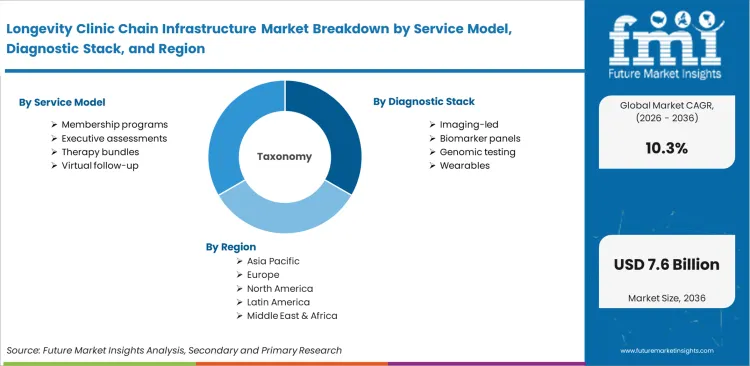
Longevity Clinic Chain Infrastructure Market Analysis by Segments
Service model
- Membership programs
- Executive assessments
- Therapy bundles
- Virtual follow-up
Diagnostic stack
- Imaging-led
- Biomarker panels
- Genomic testing
- Wearables
Facility model
- Urban flagships
- Embedded clinics
- Destination clinics
- Mobile units
Ownership model
- Physician-owned
- PE-backed platforms
- Franchise networks
- Hospital partners
Customer type
- Self-pay consumers
- Corporate members
- Medical tourists
- Athlete clients
Region:
- North America
- United States
- Canada
- Europe
- Germany
- United Kingdom
- France
- Italy
- Spain
- Asia Pacific
- China
- Japan
- South Korea
- Taiwan
- Singapore
- Latin America
- Brazil
- Mexico
- Argentina
- Middle East & Africa
- GCC Countries
- South Africa
Bibliography
- Bonnes, S. L. R., Strauss, T., Palmer, A. K., Hurt, R. T., Island, L., Goshen, A., Wang, L. Y. T., Kirkland, J. L., Bischof, E., & Maier, A. B. (2024). Establishing healthy longevity clinics in publicly funded hospitals. GeroScience, 46(5), 4217–4223.
- Cenegenics. (2025). The Cenegenics experience: Precision health with white-glove care.
- Herzog, C. M. S., Moqri, M., Poganik, J. R., Verkuilen, H. A., Sebastiano, V., Snyder, M. P., Zhavoronkov, A., Bischof, E., & Gladyshev, V. N. (2025). Recommendations for biomarker data collection in clinical trials by longevity biotechnology companies. npj Aging, 12(1), Article 16.
- Murshid, G. A. (2024). The rise of healthy longevity and healthspan in Saudi Arabia: From funding geroscience research to precision medicine and personalized digital twins. Discover Medicine, 1, Article 83.
- Osório, T. G., Robertson-Malt, S., McGrath, R., Qureshi, N., Lee-St John, T., Cassidy, L., Pena-Acuna, V., Buckley, L., Piechowski-Jozwiak, B., & Sirotin, N. (2026, January 21). The longevity medicine patient experience framework: A seven-domain model for optimizing person-centered longevity medicine. Journal of Patient Experience, 13, 23743735261415660.
This bibliography is provided for reader reference. The full FMI report contains the complete reference list with primary source documentation.
This Report Addresses
- Hardware deployment schedules impacting regional MRI procurement strategies.
- Capital requirements for urban flagship facility reinforcements.
- Subscription retention metrics linked to measurable biological age reduction.
- Specialized software integration challenges blocking multi-location data standardization.
- Radiologist interpretation bottlenecks limiting maximum daily clinic throughput.
- State-backed healthcare initiatives accelerating luxury clinic construction rates.
- Private equity consolidation tactics replacing independent physician protocols entirely.
- Wealthy consumer demands forcing immediate diagnostic technology upgrades locally.
Frequently Asked Questions
What is the longevity clinic chain infrastructure market?
This sector encompasses the physical assets, proprietary software architectures, and commercial frameworks supporting multi-location preventive health facilities. Operations merge high-end medical diagnostics with continuous biomarker tracking under standardized protocols targeting measurable biological age reversal.
How is a longevity clinic different from a medspa?
Evaluating longevity clinic vs medspa differences reveals that longevity clinics employ medical-grade diagnostic imaging (like whole-body MRIs), physician-directed biomarker tracking, and genomic sequencing to reverse biological aging. Medspas focus primarily on isolated, surface-level aesthetic and cosmetic enhancements without comprehensive internal clinical diagnostics.
How is a longevity clinic different from concierge medicine?
Comparing longevity clinic vs concierge medicine models shows that traditional concierge doctors charge retainers for enhanced primary care access and sick-care treatment. Longevity clinics charge memberships explicitly for proactive, high-tech disease interception and advanced age-management protocols utilizing diagnostic hardware not found in standard practices.
What services usually define a longevity clinic chain?
To answer what does a longevity clinic do, core services include whole-body MRI screening, advanced multi-omic biomarker testing, VO2 max and DEXA scanning, genomic profiling, and hyper-targeted cellular therapies like hyperbaric oxygen therapy and IV infusions.
Which companies are building the largest longevity clinic networks?
When determining which companies are building longevity clinic chains, industry leaders include Fountain Life, Cenegenics, Next Health, Biograph, and Extension Health. These operators are actively scaling multi-location footprints globally.
Why are memberships important in longevity clinic economics? How do longevity clinics make money?
Primarily through recurring subscription revenue. Memberships guarantee predictable cash flow, allowing facility operators to safely underwrite the multi-million-dollar capital expenditures required for advanced MRI machines and specialized clinical staff.
Which countries are growing fastest for longevity clinics?
India (13.1% CAGR), the United Arab Emirates (12.8% CAGR), and Singapore (11.8% CAGR) represent the fastest-growing geographies, driven by aggressive inbound healthcare travel, sovereign wealth investments, and elite technology-first medical infrastructure development.
What technologies matter most in longevity clinics?
When asking what tests are done at a longevity clinic, the defining technologies are advanced MRI scanners capable of detecting millimeter-level abnormalities, continuous wearable biometric trackers, and proprietary software algorithms that synthesize multi-omic data into actionable health plans.
Are longevity clinics evidence based?
Are longevity clinics evidence based? Yes, premium operators employ strict, peer-reviewed clinical protocols, utilizing FDA-cleared diagnostic hardware and relying on measurable, quantifiable biomarker progression to validate their age-management interventions to patients.
How much does a longevity clinic membership cost?
Answering how much does a longevity clinic cost varies by facility tier, but premium executive memberships often range from USD 10,000 to over USD 50,000 annually. This pricing covers comprehensive baseline diagnostics, ongoing specialist consultations, and continuous health monitoring.
Preview the report firsthand - request a free sample
Get SampleGet the brochure for pricing and purchase details.
Get PDFTable of Content
- Executive Summary
- Global Market Outlook
- Demand-side Trends
- Supply-side Trends
- Technology Roadmap Analysis
- Analysis and Recommendations
- Market Overview
- Market Coverage / Taxonomy
- Market Definition / Scope / Limitations
- Research Methodology
- Chapter Orientation
- Analytical Lens and Working Hypotheses
- Market Structure, Signals, and Trend Drivers
- Benchmarking and Cross-market Comparability
- Market Sizing, Forecasting, and Opportunity Mapping
- Research Design and Evidence Framework
- Desk Research Programme (Secondary Evidence)
- Company Annual and Sustainability Reports
- Peer-reviewed Journals and Academic Literature
- Corporate Websites, Product Literature, and Technical Notes
- Earnings Decks and Investor Briefings
- Statutory Filings and Regulatory Disclosures
- Technical White Papers and Standards Notes
- Trade Journals, Industry Magazines, and Analyst Briefs
- Conference Proceedings, Webinars, and Seminar Materials
- Government Statistics Portals and Public Data Releases
- Press Releases and Reputable Media Coverage
- Specialist Newsletters and Curated Briefings
- Sector Databases and Reference Repositories
- FMI Internal Proprietary Databases and Historical Market Datasets
- Subscription Datasets and Paid Sources
- Social Channels, Communities, and Digital Listening Inputs
- Additional Desk Sources
- Expert Input and Fieldwork (Primary Evidence)
- Primary Modes
- Qualitative Interviews and Expert Elicitation
- Quantitative Surveys and Structured Data Capture
- Blended Approach
- Why Primary Evidence is Used
- Field Techniques
- Interviews
- Surveys
- Focus Groups
- Observational and In-context Research
- Social and Community Interactions
- Stakeholder Universe Engaged
- C-suite Leaders
- Board Members
- Presidents and Vice Presidents
- R&D and Innovation Heads
- Technical Specialists
- Domain Subject-matter Experts
- Scientists
- Physicians and Other Healthcare Professionals
- Governance, Ethics, and Data Stewardship
- Research Ethics
- Data Integrity and Handling
- Primary Modes
- Tooling, Models, and Reference Databases
- Desk Research Programme (Secondary Evidence)
- Data Engineering and Model Build
- Data Acquisition and Ingestion
- Cleaning, Normalisation, and Verification
- Synthesis, Triangulation, and Analysis
- Quality Assurance and Audit Trail
- Market Background
- Market Dynamics
- Drivers
- Restraints
- Opportunity
- Trends
- Scenario Forecast
- Demand in Optimistic Scenario
- Demand in Likely Scenario
- Demand in Conservative Scenario
- Opportunity Map Analysis
- Product Life Cycle Analysis
- Supply Chain Analysis
- Investment Feasibility Matrix
- Value Chain Analysis
- PESTLE and Porter’s Analysis
- Regulatory Landscape
- Regional Parent Market Outlook
- Production and Consumption Statistics
- Import and Export Statistics
- Market Dynamics
- Global Market Analysis 2021 to 2025 and Forecast, 2026 to 2036
- Historical Market Size Value (USD Million) Analysis, 2021 to 2025
- Current and Future Market Size Value (USD Million) Projections, 2026 to 2036
- Y-o-Y Growth Trend Analysis
- Absolute $ Opportunity Analysis
- Global Market Pricing Analysis 2021 to 2025 and Forecast 2026 to 2036
- Global Market Analysis 2021 to 2025 and Forecast 2026 to 2036, By Service Model
- Introduction / Key Findings
- Historical Market Size Value (USD Million) Analysis By Service Model , 2021 to 2025
- Current and Future Market Size Value (USD Million) Analysis and Forecast By Service Model , 2026 to 2036
- Membership programs
- Executive assessments
- Therapy bundles
- Virtual follow-up
- Membership programs
- Y-o-Y Growth Trend Analysis By Service Model , 2021 to 2025
- Absolute $ Opportunity Analysis By Service Model , 2026 to 2036
- Global Market Analysis 2021 to 2025 and Forecast 2026 to 2036, By Diagnostic Stack
- Introduction / Key Findings
- Historical Market Size Value (USD Million) Analysis By Diagnostic Stack, 2021 to 2025
- Current and Future Market Size Value (USD Million) Analysis and Forecast By Diagnostic Stack, 2026 to 2036
- Imaging-led
- Biomarker panels
- Genomic testing
- Wearables
- Imaging-led
- Y-o-Y Growth Trend Analysis By Diagnostic Stack, 2021 to 2025
- Absolute $ Opportunity Analysis By Diagnostic Stack, 2026 to 2036
- Global Market Analysis 2021 to 2025 and Forecast 2026 to 2036, By Facility Model
- Introduction / Key Findings
- Historical Market Size Value (USD Million) Analysis By Facility Model, 2021 to 2025
- Current and Future Market Size Value (USD Million) Analysis and Forecast By Facility Model, 2026 to 2036
- Urban flagships
- Embedded clinics
- Destination clinics
- Mobile units
- Urban flagships
- Y-o-Y Growth Trend Analysis By Facility Model, 2021 to 2025
- Absolute $ Opportunity Analysis By Facility Model, 2026 to 2036
- Global Market Analysis 2021 to 2025 and Forecast 2026 to 2036, By Ownership Model
- Introduction / Key Findings
- Historical Market Size Value (USD Million) Analysis By Ownership Model, 2021 to 2025
- Current and Future Market Size Value (USD Million) Analysis and Forecast By Ownership Model, 2026 to 2036
- Physician-owned
- PE-backed platforms
- Franchise networks
- Hospital partners
- Physician-owned
- Y-o-Y Growth Trend Analysis By Ownership Model, 2021 to 2025
- Absolute $ Opportunity Analysis By Ownership Model, 2026 to 2036
- Global Market Analysis 2021 to 2025 and Forecast 2026 to 2036, By Customer Type
- Introduction / Key Findings
- Historical Market Size Value (USD Million) Analysis By Customer Type, 2021 to 2025
- Current and Future Market Size Value (USD Million) Analysis and Forecast By Customer Type, 2026 to 2036
- Self-pay consumers
- Corporate members
- Medical tourists
- Athlete clients
- Self-pay consumers
- Y-o-Y Growth Trend Analysis By Customer Type, 2021 to 2025
- Absolute $ Opportunity Analysis By Customer Type, 2026 to 2036
- Global Market Analysis 2021 to 2025 and Forecast 2026 to 2036, By Region
- Introduction
- Historical Market Size Value (USD Million) Analysis By Region, 2021 to 2025
- Current Market Size Value (USD Million) Analysis and Forecast By Region, 2026 to 2036
- North America
- Latin America
- Western Europe
- Eastern Europe
- East Asia
- South Asia and Pacific
- Middle East & Africa
- Market Attractiveness Analysis By Region
- North America Market Analysis 2021 to 2025 and Forecast 2026 to 2036, By Country
- Historical Market Size Value (USD Million) Trend Analysis By Market Taxonomy, 2021 to 2025
- Market Size Value (USD Million) Forecast By Market Taxonomy, 2026 to 2036
- By Country
- USA
- Canada
- Mexico
- By Service Model
- By Diagnostic Stack
- By Facility Model
- By Ownership Model
- By Customer Type
- By Country
- Market Attractiveness Analysis
- By Country
- By Service Model
- By Diagnostic Stack
- By Facility Model
- By Ownership Model
- By Customer Type
- Key Takeaways
- Latin America Market Analysis 2021 to 2025 and Forecast 2026 to 2036, By Country
- Historical Market Size Value (USD Million) Trend Analysis By Market Taxonomy, 2021 to 2025
- Market Size Value (USD Million) Forecast By Market Taxonomy, 2026 to 2036
- By Country
- Brazil
- Chile
- Rest of Latin America
- By Service Model
- By Diagnostic Stack
- By Facility Model
- By Ownership Model
- By Customer Type
- By Country
- Market Attractiveness Analysis
- By Country
- By Service Model
- By Diagnostic Stack
- By Facility Model
- By Ownership Model
- By Customer Type
- Key Takeaways
- Western Europe Market Analysis 2021 to 2025 and Forecast 2026 to 2036, By Country
- Historical Market Size Value (USD Million) Trend Analysis By Market Taxonomy, 2021 to 2025
- Market Size Value (USD Million) Forecast By Market Taxonomy, 2026 to 2036
- By Country
- Germany
- UK
- Italy
- Spain
- France
- Nordic
- BENELUX
- Rest of Western Europe
- By Service Model
- By Diagnostic Stack
- By Facility Model
- By Ownership Model
- By Customer Type
- By Country
- Market Attractiveness Analysis
- By Country
- By Service Model
- By Diagnostic Stack
- By Facility Model
- By Ownership Model
- By Customer Type
- Key Takeaways
- Eastern Europe Market Analysis 2021 to 2025 and Forecast 2026 to 2036, By Country
- Historical Market Size Value (USD Million) Trend Analysis By Market Taxonomy, 2021 to 2025
- Market Size Value (USD Million) Forecast By Market Taxonomy, 2026 to 2036
- By Country
- Russia
- Poland
- Hungary
- Balkan & Baltic
- Rest of Eastern Europe
- By Service Model
- By Diagnostic Stack
- By Facility Model
- By Ownership Model
- By Customer Type
- By Country
- Market Attractiveness Analysis
- By Country
- By Service Model
- By Diagnostic Stack
- By Facility Model
- By Ownership Model
- By Customer Type
- Key Takeaways
- East Asia Market Analysis 2021 to 2025 and Forecast 2026 to 2036, By Country
- Historical Market Size Value (USD Million) Trend Analysis By Market Taxonomy, 2021 to 2025
- Market Size Value (USD Million) Forecast By Market Taxonomy, 2026 to 2036
- By Country
- China
- Japan
- South Korea
- By Service Model
- By Diagnostic Stack
- By Facility Model
- By Ownership Model
- By Customer Type
- By Country
- Market Attractiveness Analysis
- By Country
- By Service Model
- By Diagnostic Stack
- By Facility Model
- By Ownership Model
- By Customer Type
- Key Takeaways
- South Asia and Pacific Market Analysis 2021 to 2025 and Forecast 2026 to 2036, By Country
- Historical Market Size Value (USD Million) Trend Analysis By Market Taxonomy, 2021 to 2025
- Market Size Value (USD Million) Forecast By Market Taxonomy, 2026 to 2036
- By Country
- India
- ASEAN
- Australia & New Zealand
- Rest of South Asia and Pacific
- By Service Model
- By Diagnostic Stack
- By Facility Model
- By Ownership Model
- By Customer Type
- By Country
- Market Attractiveness Analysis
- By Country
- By Service Model
- By Diagnostic Stack
- By Facility Model
- By Ownership Model
- By Customer Type
- Key Takeaways
- Middle East & Africa Market Analysis 2021 to 2025 and Forecast 2026 to 2036, By Country
- Historical Market Size Value (USD Million) Trend Analysis By Market Taxonomy, 2021 to 2025
- Market Size Value (USD Million) Forecast By Market Taxonomy, 2026 to 2036
- By Country
- Kingdom of Saudi Arabia
- Other GCC Countries
- Turkiye
- South Africa
- Other African Union
- Rest of Middle East & Africa
- By Service Model
- By Diagnostic Stack
- By Facility Model
- By Ownership Model
- By Customer Type
- By Country
- Market Attractiveness Analysis
- By Country
- By Service Model
- By Diagnostic Stack
- By Facility Model
- By Ownership Model
- By Customer Type
- Key Takeaways
- Key Countries Market Analysis
- USA
- Pricing Analysis
- Market Share Analysis, 2025
- By Service Model
- By Diagnostic Stack
- By Facility Model
- By Ownership Model
- By Customer Type
- Canada
- Pricing Analysis
- Market Share Analysis, 2025
- By Service Model
- By Diagnostic Stack
- By Facility Model
- By Ownership Model
- By Customer Type
- Mexico
- Pricing Analysis
- Market Share Analysis, 2025
- By Service Model
- By Diagnostic Stack
- By Facility Model
- By Ownership Model
- By Customer Type
- Brazil
- Pricing Analysis
- Market Share Analysis, 2025
- By Service Model
- By Diagnostic Stack
- By Facility Model
- By Ownership Model
- By Customer Type
- Chile
- Pricing Analysis
- Market Share Analysis, 2025
- By Service Model
- By Diagnostic Stack
- By Facility Model
- By Ownership Model
- By Customer Type
- Germany
- Pricing Analysis
- Market Share Analysis, 2025
- By Service Model
- By Diagnostic Stack
- By Facility Model
- By Ownership Model
- By Customer Type
- UK
- Pricing Analysis
- Market Share Analysis, 2025
- By Service Model
- By Diagnostic Stack
- By Facility Model
- By Ownership Model
- By Customer Type
- Italy
- Pricing Analysis
- Market Share Analysis, 2025
- By Service Model
- By Diagnostic Stack
- By Facility Model
- By Ownership Model
- By Customer Type
- Spain
- Pricing Analysis
- Market Share Analysis, 2025
- By Service Model
- By Diagnostic Stack
- By Facility Model
- By Ownership Model
- By Customer Type
- France
- Pricing Analysis
- Market Share Analysis, 2025
- By Service Model
- By Diagnostic Stack
- By Facility Model
- By Ownership Model
- By Customer Type
- India
- Pricing Analysis
- Market Share Analysis, 2025
- By Service Model
- By Diagnostic Stack
- By Facility Model
- By Ownership Model
- By Customer Type
- ASEAN
- Pricing Analysis
- Market Share Analysis, 2025
- By Service Model
- By Diagnostic Stack
- By Facility Model
- By Ownership Model
- By Customer Type
- Australia & New Zealand
- Pricing Analysis
- Market Share Analysis, 2025
- By Service Model
- By Diagnostic Stack
- By Facility Model
- By Ownership Model
- By Customer Type
- China
- Pricing Analysis
- Market Share Analysis, 2025
- By Service Model
- By Diagnostic Stack
- By Facility Model
- By Ownership Model
- By Customer Type
- Japan
- Pricing Analysis
- Market Share Analysis, 2025
- By Service Model
- By Diagnostic Stack
- By Facility Model
- By Ownership Model
- By Customer Type
- South Korea
- Pricing Analysis
- Market Share Analysis, 2025
- By Service Model
- By Diagnostic Stack
- By Facility Model
- By Ownership Model
- By Customer Type
- Russia
- Pricing Analysis
- Market Share Analysis, 2025
- By Service Model
- By Diagnostic Stack
- By Facility Model
- By Ownership Model
- By Customer Type
- Poland
- Pricing Analysis
- Market Share Analysis, 2025
- By Service Model
- By Diagnostic Stack
- By Facility Model
- By Ownership Model
- By Customer Type
- Hungary
- Pricing Analysis
- Market Share Analysis, 2025
- By Service Model
- By Diagnostic Stack
- By Facility Model
- By Ownership Model
- By Customer Type
- Kingdom of Saudi Arabia
- Pricing Analysis
- Market Share Analysis, 2025
- By Service Model
- By Diagnostic Stack
- By Facility Model
- By Ownership Model
- By Customer Type
- Turkiye
- Pricing Analysis
- Market Share Analysis, 2025
- By Service Model
- By Diagnostic Stack
- By Facility Model
- By Ownership Model
- By Customer Type
- South Africa
- Pricing Analysis
- Market Share Analysis, 2025
- By Service Model
- By Diagnostic Stack
- By Facility Model
- By Ownership Model
- By Customer Type
- USA
- Market Structure Analysis
- Competition Dashboard
- Competition Benchmarking
- Market Share Analysis of Top Players
- By Regional
- By Service Model
- By Diagnostic Stack
- By Facility Model
- By Ownership Model
- By Customer Type
- Competition Analysis
- Competition Deep Dive
- Fountain Life
- Overview
- Product Portfolio
- Profitability by Market Segments (Product/Age /Sales Channel/Region)
- Sales Footprint
- Strategy Overview
- Marketing Strategy
- Product Strategy
- Channel Strategy
- Cenegenics
- Next Health
- Biograph
- Extension Health
- Fountain Life
- Competition Deep Dive
- Assumptions & Acronyms Used


