

- Industry Size (2026)
- USD 1680 Mn
- Forecast (2036)
- USD 5640 Mn
- CAGR (2026 to 2036)
- 12.9%
Long-Length Architectural Components Packaging Market Forecast and Outlook By FMI
The global long-length architectural components packaging market is projected to be valued at USD 1,680 million in 2026 and is expected to reach USD 5,640 million by 2036, expanding at a CAGR of 12.9% over the forecast period. This expansion reflects a structural redefinition of packaging’s role within architectural supply chains, where protective systems are increasingly treated as finish-preservation assets and compliance enablers, rather than consumable handling materials.
Long-length architectural components include aluminum curtain wall profiles, thermally broken window systems, steel framing sections, composite façade members, and decorative architectural rails. These components are increasingly specified with zero-tolerance surface finish requirements, particularly for Class I anodized aluminum and fluoropolymer-coated profiles. As a result, packaging solutions are being engineered not only to prevent cosmetic damage, but also to preserve dimensional stability, avoid adhesive residue transfer, and withstand extended multi-stage logistics cycles involving extrusion plants, anodizers, fabricators, and final construction sites.
Growth is tied to the premiumization of commercial building envelopes. Curtain wall and storefront systems have become standard across a wider range of commercial and institutional buildings, driven by energy efficiency mandates, architectural aesthetics, and lifecycle cost optimization. These systems rely heavily on long-length aluminum profiles with complex geometries and thin wall sections, which are particularly vulnerable to surface abrasion, edge impact, and bowing during transport. This vulnerability has accelerated the shift from single-modality packaging to integrated, multi-layer protection architectures combining surface-protective films, corrugated edge protection, and polyethylene foam interleaving.
From an operational standpoint, the market is reshaped by liability redistribution across construction supply chains. General contractors and glazing subcontractors increasingly require suppliers to certify damage-free delivery of architectural components, supported by photographic documentation and transit validation protocols. This procurement evolution effectively transfers finish-damage liability upstream to extruders and fabricators, elevating packaging from a discretionary cost to a risk mitigation investment. As insurance deductibles rise and litigation related to façade defects increases, packaging systems that demonstrably reduce surface rejection rates are being institutionalized within supplier quality scorecards.
Regulatory forces reinforce this transition. In Europe, the Packaging and Packaging Waste Regulation, becoming legally binding in August 2026, establishes design-for-recycling requirements that materially restrict the use of PVC-based films and non-recyclable composite wraps. Export-oriented architectural component manufacturers supplying EU markets are therefore transitioning toward mono-material LDPE films and fiber-based corrugated systems, accelerating demand for compliant packaging solutions. Parallel pressures are emerging in North America and East Asia through EPR frameworks and industrial waste reduction mandates, further supporting long-term market growth .
Summary of Long-Length Architectural Components Packaging Market
- The long-length architectural components packaging market comprises engineered protective packaging systems designed to preserve surface integrity, prevent dimensional distortion, and enable damage-free handling and transportation of architectural components exceeding three meters in length.
- Under FMI’s defined scope, the market includes surface-protective films, corrugated profile sleeves, polyethylene foam interleaving, end caps, and hybrid protection architectures engineered for specific substrate chemistries and logistics conditions. The scope explicitly excludes short-length component packaging, bulk commodity transport solutions, non-architectural industrial profile packaging, and downstream installation services.
- FMI estimates that the market will expand from USD 1,680 million in 2026 to USD 5,640 million by 2036, registering a 12.9% CAGR. Growth is driven by the convergence of commercial building envelope intensification, zero-tolerance finish specifications, automation compatibility requirements within fabrication facilities, and regulatory enforcement favoring recyclable, mono-material packaging systems.
- Structurally, the sector is transitioning from commoditized stretch film and kraft paper toward application-engineered, certified protection systems validated for specific surface finishes, transport durations, and jobsite exposure conditions. Competitive advantage increasingly lies with suppliers capable of integrating materials science, application engineering, and compliance documentation into a single packaging solution offering.
- China is projected to be the fastest-growing country market through 2036, while North America remains the dominant regional market due to sustained commercial retrofit activity and stringent finish specification standards.
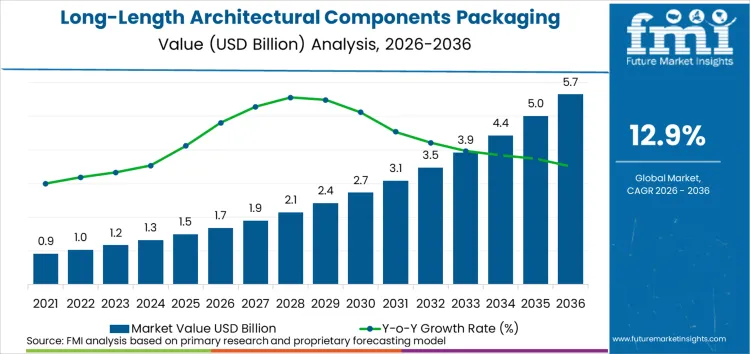
Long-Length Architectural Components Packaging Market Key Takeaways
| Metric | Value |
|---|---|
| Market Value (2026E) | USD 1,680 million |
| Market Value (2036F) | USD 5,640 million |
| CAGR (2026-2036) | 12.9% |
Source: Future Market Insights analysis, supported by a proprietary forecasting model and primary research
Why is the Long-Length Architectural Components Packaging Market Growing?
The primary growth driver is the escalation of surface quality expectations within commercial construction. Class I anodized aluminum and high-performance fluoropolymer coatings are now standard specifications for curtain wall systems, yet these finishes are inherently intolerant of scratches, adhesive residue, or abrasion. Packaging failures that once resulted in minor cosmetic repairs now trigger full component replacement, substantially increasing financial exposure for extruders and glazing contractors.
A second driver is the redistribution of risk across supply chains. Procurement standards increasingly require suppliers to guarantee damage-free delivery, supported by validated packaging systems and transit simulation testing. This shifts packaging from an operational afterthought to a strategic risk-control mechanism, driving adoption of certified, multi-layer protection systems.
Regulatory enforcement around recyclability and material transparency is accelerating the displacement of legacy packaging formats. PVC films and composite laminates face mounting restrictions, while LDPE films, corrugated board, and polyethylene foam systems aligned with established recycling streams are gaining preference. This regulatory clarity reduces specification risk and encourages long-term investment in compliant packaging architectures.
How is Long-Length Architectural Components Packaging Market Segmented?
Why do Aluminum Profiles represent the dominant component category requiring specialized long-length packaging solutions?
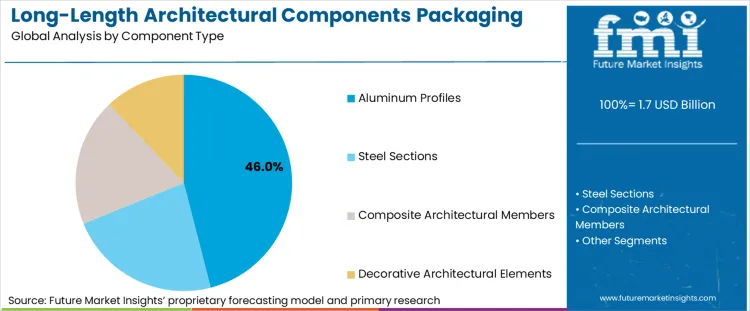
Aluminum profiles account for 46% of total market demand, making them the dominant component segment. This dominance is structural and is tied to aluminum’s role as the default material for modern building envelopes. These applications increasingly use thermally broken and geometrically complex extrusions that achieve stiffness through shape rather than thickness. This design logic increases vulnerability: slender, thin-walled extrusions are more susceptible to bowing, twist, and oil-canning if handling forces are uneven or if the component experiences point loads during stacking.
Finish sensitivity intensifies the need for specialized packaging. A large share of architectural aluminum is supplied with premium finishes—Class I anodizing, fluoropolymer coatings (e.g., PVDF), and high-performance powder coatings—where minor scratches or scuffing are not “cosmetic tolerances” but specification failures. In such cases, field repair is either technically infeasible or commercially unacceptable because color/reflectance matching is difficult and durability warranties can be compromised. This drives demand for packaging systems that minimize micro-abrasion, isolate components from debris and grit, and prevent adhesive residue or “ghosting” after extended storage.
How have End Caps + Wrap Films become the preferred protection system for architectural components?
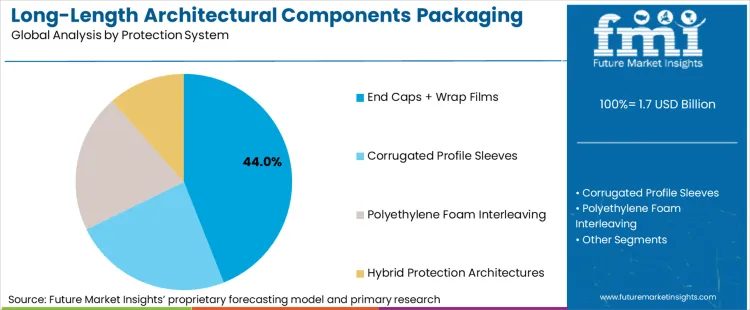
End caps combined with wrap films represent 44% of total protection system demand in 2026, making this the leading protection architecture. This dominance is driven by the ability of the system to address the three most common and expensive failure modes for long-length components: end impact, surface abrasion, and environmental exposure during transit and staging.
End damage is disproportionately common because profile ends are the most exposed during loading, unloading, forklift handling, and jobsite staging. End caps function as sacrificial impact absorbers and also reduce localized crushing that can propagate deformation along thin-walled extrusions. In high-volume extrusion plants and finishing operations, end caps can be applied rapidly and consistently, enabling integration into production flow without slowing throughput.
How does LDPE Film as the Primary Material drive Market Volume?
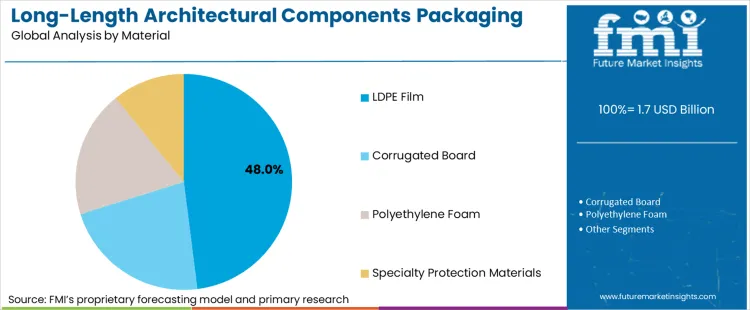
LDPE films account for 48% of material consumption, making LDPE the dominant material class in the market. LDPE’s leadership stems from performance characteristics that align closely with architectural supply chain requirements: conformability to complex extrusion geometries, optical clarity for inspection, compatibility with controlled-tack adhesive systems, and predictable removability without residue when correctly engineered for the substrate.
LDPE’s conformability is crucial because architectural profiles include cavities, ribs, and thin edges where poor film conformity can create air pockets that trap grit or allow micro-movement during vibration, both major abrasion accelerators. LDPE films can be engineered to maintain tight contact, reducing particulate intrusion. Optical clarity also matters because suppliers increasingly prefer to inspect finish condition without removing protective layers, especially where photographic evidence or quality documentation is used upstream of jobsite acceptance.
What Drivers, Restraints, Opportunities, and Trends Prevail in the Long-Length Architectural Components Packaging Market?
Drivers
The most powerful driver is the premiumization of the building envelope. As curtain wall systems and thermally broken aluminum framing expand beyond premium office towers into healthcare, education, and mixed-use construction, the installed visibility of architectural components increases and tolerance for surface defects declines. Packaging must therefore preserve not only mechanical integrity but also aesthetic uniformity. This elevates packaging into a quality-critical input rather than a logistics accessory.
A second driver is the shifting of finish-damage liability upstream. As general contractors and façade subcontractors formalize damage-free delivery expectations, suppliers are forced to adopt packaging systems that can be defended through documentation and validated performance claims. The emphasis on “condition upon arrival” elevates packaging to a compliance tool within supplier scorecards, pushing integrated protection systems into default specifications.
A third driver is the operational reality of long, multi-node supply chains. Architectural components frequently pass through extrusion, finishing, fabrication, and staging steps before installation. Each step introduces handling and abrasion risk. Integrated protection systems reduce cumulative risk exposure across these nodes, making them increasingly essential as project timelines lengthen and site staging grows more complex.
Restraints
The market’s largest restraint is SKU complexity and geometry proliferation, especially for aluminum profiles. Profile-specific end caps, fit tolerances, and application methods introduce tooling and inventory burdens. For manufacturers with extensive die libraries, creating and managing end cap tooling across thousands of profiles can be cost-intensive. This complexity can slow adoption where procurement teams cannot justify tooling investment or where production planning cannot accommodate profile-by-profile packaging variation.
A second restraint is the risk of adhesive residue, ghosting, or surface chemistry incompatibility. Protective films must be matched to coating chemistries and surface energies. If the adhesive system is poorly calibrated, long-term storage or heat exposure can cause residue transfer or differential gloss effects. In a finish-sensitive market, a packaging system that “creates defects” is unacceptable and can delay adoption until suppliers demonstrate validated performance.
Raw material volatility is another constraint. LDPE pricing is correlated with petrochemical feedstocks, while corrugated inputs face recycled fiber availability and price swings. Long-term supply agreements for packaging programs must absorb these volatilities, and some project-based construction supply chains resist multi-year pricing commitments. This can produce procurement friction, especially for mid-tier fabricators.
Opportunities
A major opportunity lies in application-engineered packaging programs offered as service-based partnerships rather than product supply alone. Packaging suppliers that provide on-site application training, substrate cleanliness protocols, adhesion validation, and standardized removal procedures can reduce customer risk and improve adoption. These services also increase switching costs, enabling suppliers to secure long-term agreements.
There is also an opportunity in recyclability-aligned substitution, particularly replacing legacy PVC films and hard-to-recycle laminates with mono-material polyolefin solutions and fiber-based protection systems. As exporters seek to reduce compliance ambiguity, packaging suppliers capable of documenting recyclability compatibility and recycled-content pathways gain strategic advantage.
Another opportunity is growth in prefabricated façade construction and export-oriented building envelope fabrication. Prefabrication increases value density per shipped unit and elevates finish risk. Engineered packaging adoption tends to increase as fabrication becomes more industrialized and export distances lengthen.
Trends
The most visible trend is the shift from commodity wrapping to hybrid protection architectures, combining controlled-tack surface films, structural corrugated sleeving, and cushioning layers designed to prevent both abrasion and deformation. This trend reflects the recognition that no single packaging modality addresses all failure modes for long-length components.
Automation is another defining trend. Extruders and finishers are investing in automated film application, edge protection integration, and standardized end cap placement to reduce variability and improve repeatability. Automated systems also reduce labor intensity and lower injury risk, strengthening the operational ROI case for engineered packaging.
The market is trending toward more formal packaging qualification. Buyers increasingly request documentation of adhesion performance, removability, and handling protocols, especially where components are exported or stored for long durations. This pushes suppliers toward validated, application-specific film and foam specifications rather than generic protective materials.
Analysis of Long-Length Architectural Components Packaging Market by Key Countries
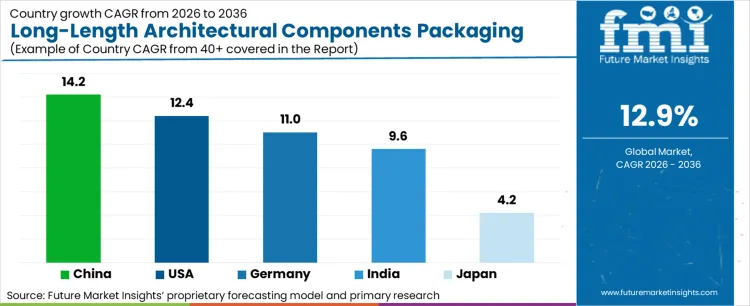
| Country | CAGR (2026-2036) |
|---|---|
| China | 14.20% |
| United States | 12.40% |
| Germany | 11.00% |
| India | 9.60% |
| Japan | 4.20% |
Source: Future Market Insights (FMI), proprietary forecasting model and primary research
How are China’s Urbanization and Manufacturing Modernization Sustaining the Fastest Growth Rate?
China is projected to expand at a 14.20% CAGR from 2026 to 2036, making it the fastest-growing country market. This growth is rooted in the scale and continuity of China’s high-rise and commercial construction pipeline, where curtain wall façades remain a default architectural expression in Tier-1 and Tier-2 cities. Long-length aluminum profiles and façade members move through dense multi-node supply chains—extrusion, finishing, prefabrication, export consolidation, and site staging—creating repeated opportunities for surface abrasion, edge impacts, and dimensional distortion. As façade systems become more premium and more finish-sensitive, packaging is increasingly specified as an engineered risk-control layer rather than a discretionary handling cost.
A second structural driver behind China’s 14.20% CAGR is the industrial upgrade cycle underway in the extrusion and fabrication base. Manufacturers are shifting toward higher-value architectural alloys, tighter tolerances, and export-grade coating systems, which elevates the commercial penalty of surface defects. This pushes demand toward integrated protection systems—surface films engineered to match coating chemistries, corrugated sleeving to stabilize long profiles, and cushioning interleaves to reduce vibration abrasion. In practical procurement terms, Chinese producers increasingly compete on damage-free delivery and installed appearance consistency, and packaging becomes a measurable contributor to that competitiveness.
Why Is the United States Experiencing Sustained Double-Digit Expansion in Long-Length Component Protection?
The United States is forecast to grow at a 12.40% CAGR from 2026 to 2036, supported by an extended cycle of commercial retrofits, modernization projects, and continued demand for high-performance building envelopes. The U.S. market’s distinguishing feature is not purely construction volume, but the combination of high finish specification intensity and high downstream liability costs. When a defect is discovered late, the remediation cost is often out of proportion to the component value. This cost asymmetry strengthens the business case for engineered protective packaging, particularly for anodized and fluoropolymer-coated aluminum profiles where touch-up quality can be difficult to standardize.
The U.S. market’s 12.40% CAGR is also reinforced by the growing institutionalization of quality documentation. Contractors and façade subcontractors increasingly emphasize pre-acceptance checks, inbound condition validation, and traceable handling procedures. As a result, packaging choices are being pulled upstream into supplier qualification—extruders and fabricators must demonstrate that their protection systems reliably prevent transport-induced scratches, adhesive residue, and warping. This encourages adoption of integrated film-and-cap architectures and profile sleeves that reduce risk exposure across long procurement lead times and multi-stage distribution.
How Is Germany’s Compliance Culture Translating Into Strong Growth Despite Market Maturity?
Germany is projected to expand at an 11.00% CAGR from 2026 to 2036, reflecting a mature construction ecosystem with a disproportionately high emphasis on engineering discipline, compliance certainty, and packaging recyclability alignment. German building envelope supply chains tend to be specification-driven, with heightened sensitivity to documentation, repeatability, and material classification. This naturally favors protective packaging systems that can be standardized and defended: mono-material polyolefin surface films, corrugated board edge protection, and fiber-aligned sleeves that integrate cleanly into established recycling streams.
Germany’s growth is not primarily volume-led; rather, it is value-led through specification upgrading. As suppliers align with EU-wide design-for-recycling expectations taking effect within the forecast window, legacy protection formats that are difficult to recycle or that complicate material separation face replacement. This replacement effect accelerates conversion toward integrated protection architectures that preserve finish quality while maintaining end-of-life clarity. In effect, German demand is driven by the intersection of finish-critical façade systems and compliance-driven packaging simplification—pushing suppliers toward engineered protection as the default baseline rather than a premium add-on.
What Is Driving India’s Steady Growth in Long-Length Architectural Packaging Solutions?
India is expected to grow at a 9.60% CAGR from 2026 to 2036, supported by expanding infrastructure construction, modernization of commercial buildings, and the gradual professionalization of façade fabrication supply chains. India’s market development is characterized by a dual structure: high-end export-oriented and metro-centric projects increasingly specify premium finishes and higher-quality packaging, while cost-sensitive segments still rely on simpler protection formats. The result is steady growth driven by a gradual shift in the mix of projects and suppliers toward higher-performance packaging requirements rather than an abrupt market-wide conversion.
India’s 9.60% CAGR also reflects the increasing importance of pre-fabrication and centralized fabrication hubs serving large projects across multiple states. As components travel longer distances and move through more handling steps, defect risk rises—and the cost of on-site remediation becomes a larger portion of project risk. This pushes demand toward protection systems that reduce abrasion and preserve geometry in transit, particularly for long-length aluminum profiles and architectural framing components that must arrive ready for installation sequencing.
Why Does Japan Show Modest Growth Despite High Finish Quality Expectations?
Japan is projected to expand at a 4.20% CAGR from 2026 to 2036, reflecting a mature market where best-practice packaging and handling discipline are already widely embedded within fabrication and construction workflows. In Japan, the emphasis on precision and finish quality has historically driven early adoption of careful protection and controlled handling processes. As a result, incremental market growth is more constrained by macro construction volume dynamics and demographic headwinds than by adoption potential.
Japan’s expansion still signals continued value growth through incremental upgrading rather than volume expansion. As projects prioritize labor efficiency and simplified jobsite handling, suppliers increasingly prefer packaging that reduces removal time, minimizes debris, and supports controlled staging. This supports ongoing demand for refined protective systems and standardization improvements, even if the market does not experience the rapid penetration dynamics seen in China or the U.S.
What Is the Competition Outlook for Long-Length Architectural Components Packaging Market?
Competition in the long-length architectural components packaging market is increasingly defined by engineering depth, application-specific validation, and risk-transfer capability, rather than by unit pricing alone. As architectural components become more finish-sensitive and supply chains extend across multiple fabrication and logistics nodes, packaging suppliers are being evaluated on their ability to prevent high-cost downstream failures, including surface rejection at installation, geometry distortion during staging, and coating damage that invalidates performance warranties.
A defining competitive dynamic is the shift from commodity wrapping toward program-level protection architectures. Leading suppliers are no longer selling individual materials (films, foams, corrugated sleeves) in isolation; instead, they deliver integrated protection systems tailored to component geometry, coating chemistry, and handling sequence. These systems are often validated through internal testing and embedded into customer standard operating procedures. This elevates switching costs and favors suppliers with technical sales teams and application engineering resources.
Automation compatibility is another major differentiator. Extrusion plants and finishing lines are increasingly automating film application, edge protection placement, and profile sleeving to improve consistency and reduce labor variability. Packaging suppliers that can support automated applicators, provide consistent material tolerances, and align with line speeds gain preferential status. Conversely, suppliers unable to guarantee repeatable performance across large production runs face erosion of share, even if their materials meet minimum protection thresholds.
Sustainability and compliance alignment further shape competition. While sustainability is not the primary purchase driver, regulatory clarity and recyclability defensibility have become essential qualifiers. Suppliers that can replace PVC-based films and composite wraps with mono-material polyolefin systems and fiber-based protection gain advantage, particularly with exporters serving EU markets. Competitive positioning increasingly rests on the ability to deliver protection performance without introducing compliance ambiguity at end of life.
The competitive environment favors packaging suppliers that operate as risk-management partners to architectural component manufacturers, integrating materials science, application engineering, and compliance documentation rather than as commodity consumables vendors.
Key Players Profiled in the Long-Length Architectural Components Packaging Market
- Intertape Polymer Group
- Berry Global Group, Inc.
- Smurfit Kappa Group plc
- DS Smith Plc
- Nitto Denko Corporation
- Pregis LLC
Market Definition
The long-length architectural components packaging market comprises engineered protective packaging systems designed to preserve surface finish, dimensional integrity, and installation readiness of architectural components exceeding three meters in length. These components include aluminum curtain wall profiles, window and storefront framing systems, steel and composite structural members, decorative rails, and façade substructures used in commercial and institutional buildings.
Packaging solutions within scope include surface-protective films, corrugated profile sleeves, polyethylene foam interleaving, end caps, and hybrid protection architectures that combine multiple materials to address abrasion, impact, and environmental exposure risks. These systems are deployed across extrusion facilities, finishing lines, fabrication plants, distribution centers, and construction sites.
The scope excludes short-length architectural components, bulk commodity transport packaging, non-architectural industrial profile packaging, installation hardware, and downstream construction services.
Scope of the Report
| Attribute | Details |
|---|---|
| Quantitative Units (USD Billion) | USD 1,680 million |
| Component Types | Aluminum Profiles, Steel Sections, Composite Members, Decorative Architectural Elements |
| Protection Systems | End Caps + Wrap Films, Corrugated Sleeves, Foam Interleaving, Hybrid Architectures |
| Materials | LDPE Films, Corrugated Board, Polyethylene Foam, Specialty Protection Materials |
| Regions Covered | North America, Europe, East Asia, South Asia, Japan, Rest of the World |
| Key Countries | United States, Germany, China, India, Japan |
Source: Future Market Insights (FMI), proprietary forecasting model and primary research
Long-Length Architectural Components Packaging Market Key Segments
By Component Type
- Aluminum Profiles
- Steel Sections
- Composite Architectural Members
- Decorative Architectural Elements
By Protection System
- End Caps + Wrap Films
- Corrugated Profile Sleeves
- Polyethylene Foam Interleaving
- Hybrid Protection Architectures
By Material
- LDPE Films
- Corrugated Board
- Polyethylene Foam
- Specialty Protection Materials
By Region
- North America
- Europe
- East Asia
- South Asia
- Japan
- Rest of the World
Bibliography
- European Union. (2024). Regulation on packaging and packaging waste (Packaging and Packaging Waste Regulation). Official Journal of the European Union.
- American Architectural Manufacturers Association. (2024). Aluminum curtain wall and storefront systems: Performance and handling guidelines. AAMA.
- International Aluminium Institute. (2025). Aluminium in building and construction: Surface finishes and durability considerations. IAI.
- Organisation for Economic Co-operation and Development. (2024). Extended producer responsibility: Implications for industrial and construction packaging. OECD Publishing.
Frequently Asked Questions
What is the projected growth outlook for the long-length architectural components packaging market?
The market is projected to expand at a 12.9% CAGR from 2026 to 2036, driven by rising finish sensitivity, longer supply chains, and regulatory alignment favoring recyclable protection systems.
How large is the market expected to be by 2036?
FMI estimates the market will reach USD 5,640 million by 2036, up from USD 1,680 million in 2026.
Which component type drives the highest demand?
Aluminum profiles dominate demand due to their widespread use in curtain wall and storefront systems and their high sensitivity to surface damage.
What protection systems are most commonly used?
Integrated systems combining end caps and wrap films lead the market, as they effectively address both surface abrasion and end-impact risks.
Which countries are expected to grow the fastest?
China leads growth with a 14.20% CAGR, followed by the United States at 12.40%, supported by large-scale construction activity and stringent finish specifications.
Preview the report firsthand - request a free sample
Get SampleGet the brochure for pricing and purchase details.
Get PDFTable of Content
- Executive Summary
- Global Market Outlook
- Demand-side Trends
- Supply-side Trends
- Technology Roadmap Analysis
- Analysis and Recommendations
- Market Overview
- Market Coverage / Taxonomy
- Market Definition / Scope / Limitations
- Research Methodology
- Chapter Orientation
- Analytical Lens and Working Hypotheses
- Market Structure, Signals, and Trend Drivers
- Benchmarking and Cross-market Comparability
- Market Sizing, Forecasting, and Opportunity Mapping
- Research Design and Evidence Framework
- Desk Research Programme (Secondary Evidence)
- Company Annual and Sustainability Reports
- Peer-reviewed Journals and Academic Literature
- Corporate Websites, Product Literature, and Technical Notes
- Earnings Decks and Investor Briefings
- Statutory Filings and Regulatory Disclosures
- Technical White Papers and Standards Notes
- Trade Journals, Industry Magazines, and Analyst Briefs
- Conference Proceedings, Webinars, and Seminar Materials
- Government Statistics Portals and Public Data Releases
- Press Releases and Reputable Media Coverage
- Specialist Newsletters and Curated Briefings
- Sector Databases and Reference Repositories
- FMI Internal Proprietary Databases and Historical Market Datasets
- Subscription Datasets and Paid Sources
- Social Channels, Communities, and Digital Listening Inputs
- Additional Desk Sources
- Expert Input and Fieldwork (Primary Evidence)
- Primary Modes
- Qualitative Interviews and Expert Elicitation
- Quantitative Surveys and Structured Data Capture
- Blended Approach
- Why Primary Evidence is Used
- Field Techniques
- Interviews
- Surveys
- Focus Groups
- Observational and In-context Research
- Social and Community Interactions
- Stakeholder Universe Engaged
- C-suite Leaders
- Board Members
- Presidents and Vice Presidents
- R&D and Innovation Heads
- Technical Specialists
- Domain Subject-matter Experts
- Scientists
- Physicians and Other Healthcare Professionals
- Governance, Ethics, and Data Stewardship
- Research Ethics
- Data Integrity and Handling
- Primary Modes
- Tooling, Models, and Reference Databases
- Desk Research Programme (Secondary Evidence)
- Data Engineering and Model Build
- Data Acquisition and Ingestion
- Cleaning, Normalisation, and Verification
- Synthesis, Triangulation, and Analysis
- Quality Assurance and Audit Trail
- Market Background
- Market Dynamics
- Drivers
- Restraints
- Opportunity
- Trends
- Scenario Forecast
- Demand in Optimistic Scenario
- Demand in Likely Scenario
- Demand in Conservative Scenario
- Opportunity Map Analysis
- Product Life Cycle Analysis
- Supply Chain Analysis
- Investment Feasibility Matrix
- Value Chain Analysis
- PESTLE and Porter’s Analysis
- Regulatory Landscape
- Regional Parent Market Outlook
- Production and Consumption Statistics
- Import and Export Statistics
- Market Dynamics
- Global Market Analysis 2021 to 2025 and Forecast, 2026 to 2036
- Historical Market Size Value (USD Million) Analysis, 2021 to 2025
- Current and Future Market Size Value (USD Million) Projections, 2026 to 2036
- Y-o-Y Growth Trend Analysis
- Absolute $ Opportunity Analysis
- Global Market Pricing Analysis 2021 to 2025 and Forecast 2026 to 2036
- Global Market Analysis 2021 to 2025 and Forecast 2026 to 2036, By Component Type
- Introduction / Key Findings
- Historical Market Size Value (USD Million) Analysis By Component Type , 2021 to 2025
- Current and Future Market Size Value (USD Million) Analysis and Forecast By Component Type , 2026 to 2036
- Aluminum Profiles
- Steel Sections
- Composite Architectural Members
- Decorative Architectural Elements
- Aluminum Profiles
- Y-o-Y Growth Trend Analysis By Component Type , 2021 to 2025
- Absolute $ Opportunity Analysis By Component Type , 2026 to 2036
- Global Market Analysis 2021 to 2025 and Forecast 2026 to 2036, By Protection System
- Introduction / Key Findings
- Historical Market Size Value (USD Million) Analysis By Protection System, 2021 to 2025
- Current and Future Market Size Value (USD Million) Analysis and Forecast By Protection System, 2026 to 2036
- End Caps + Wrap Films
- Corrugated Profile Sleeves
- Polyethylene Foam Interleaving
- Hybrid Protection Architectures
- End Caps + Wrap Films
- Y-o-Y Growth Trend Analysis By Protection System, 2021 to 2025
- Absolute $ Opportunity Analysis By Protection System, 2026 to 2036
- Global Market Analysis 2021 to 2025 and Forecast 2026 to 2036, By Material
- Introduction / Key Findings
- Historical Market Size Value (USD Million) Analysis By Material, 2021 to 2025
- Current and Future Market Size Value (USD Million) Analysis and Forecast By Material, 2026 to 2036
- LDPE Film
- Corrugated Board
- Polyethylene Foam
- Specialty Protection Materials
- LDPE Film
- Y-o-Y Growth Trend Analysis By Material, 2021 to 2025
- Absolute $ Opportunity Analysis By Material, 2026 to 2036
- Global Market Analysis 2021 to 2025 and Forecast 2026 to 2036, By Region
- Introduction
- Historical Market Size Value (USD Million) Analysis By Region, 2021 to 2025
- Current Market Size Value (USD Million) Analysis and Forecast By Region, 2026 to 2036
- North America
- Latin America
- Western Europe
- Eastern Europe
- East Asia
- South Asia and Pacific
- Middle East & Africa
- Market Attractiveness Analysis By Region
- North America Market Analysis 2021 to 2025 and Forecast 2026 to 2036, By Country
- Historical Market Size Value (USD Million) Trend Analysis By Market Taxonomy, 2021 to 2025
- Market Size Value (USD Million) Forecast By Market Taxonomy, 2026 to 2036
- By Country
- USA
- Canada
- Mexico
- By Component Type
- By Protection System
- By Material
- By Country
- Market Attractiveness Analysis
- By Country
- By Component Type
- By Protection System
- By Material
- Key Takeaways
- Latin America Market Analysis 2021 to 2025 and Forecast 2026 to 2036, By Country
- Historical Market Size Value (USD Million) Trend Analysis By Market Taxonomy, 2021 to 2025
- Market Size Value (USD Million) Forecast By Market Taxonomy, 2026 to 2036
- By Country
- Brazil
- Chile
- Rest of Latin America
- By Component Type
- By Protection System
- By Material
- By Country
- Market Attractiveness Analysis
- By Country
- By Component Type
- By Protection System
- By Material
- Key Takeaways
- Western Europe Market Analysis 2021 to 2025 and Forecast 2026 to 2036, By Country
- Historical Market Size Value (USD Million) Trend Analysis By Market Taxonomy, 2021 to 2025
- Market Size Value (USD Million) Forecast By Market Taxonomy, 2026 to 2036
- By Country
- Germany
- UK
- Italy
- Spain
- France
- Nordic
- BENELUX
- Rest of Western Europe
- By Component Type
- By Protection System
- By Material
- By Country
- Market Attractiveness Analysis
- By Country
- By Component Type
- By Protection System
- By Material
- Key Takeaways
- Eastern Europe Market Analysis 2021 to 2025 and Forecast 2026 to 2036, By Country
- Historical Market Size Value (USD Million) Trend Analysis By Market Taxonomy, 2021 to 2025
- Market Size Value (USD Million) Forecast By Market Taxonomy, 2026 to 2036
- By Country
- Russia
- Poland
- Hungary
- Balkan & Baltic
- Rest of Eastern Europe
- By Component Type
- By Protection System
- By Material
- By Country
- Market Attractiveness Analysis
- By Country
- By Component Type
- By Protection System
- By Material
- Key Takeaways
- East Asia Market Analysis 2021 to 2025 and Forecast 2026 to 2036, By Country
- Historical Market Size Value (USD Million) Trend Analysis By Market Taxonomy, 2021 to 2025
- Market Size Value (USD Million) Forecast By Market Taxonomy, 2026 to 2036
- By Country
- China
- Japan
- South Korea
- By Component Type
- By Protection System
- By Material
- By Country
- Market Attractiveness Analysis
- By Country
- By Component Type
- By Protection System
- By Material
- Key Takeaways
- South Asia and Pacific Market Analysis 2021 to 2025 and Forecast 2026 to 2036, By Country
- Historical Market Size Value (USD Million) Trend Analysis By Market Taxonomy, 2021 to 2025
- Market Size Value (USD Million) Forecast By Market Taxonomy, 2026 to 2036
- By Country
- India
- ASEAN
- Australia & New Zealand
- Rest of South Asia and Pacific
- By Component Type
- By Protection System
- By Material
- By Country
- Market Attractiveness Analysis
- By Country
- By Component Type
- By Protection System
- By Material
- Key Takeaways
- Middle East & Africa Market Analysis 2021 to 2025 and Forecast 2026 to 2036, By Country
- Historical Market Size Value (USD Million) Trend Analysis By Market Taxonomy, 2021 to 2025
- Market Size Value (USD Million) Forecast By Market Taxonomy, 2026 to 2036
- By Country
- Kingdom of Saudi Arabia
- Other GCC Countries
- Turkiye
- South Africa
- Other African Union
- Rest of Middle East & Africa
- By Component Type
- By Protection System
- By Material
- By Country
- Market Attractiveness Analysis
- By Country
- By Component Type
- By Protection System
- By Material
- Key Takeaways
- Key Countries Market Analysis
- USA
- Pricing Analysis
- Market Share Analysis, 2025
- By Component Type
- By Protection System
- By Material
- Canada
- Pricing Analysis
- Market Share Analysis, 2025
- By Component Type
- By Protection System
- By Material
- Mexico
- Pricing Analysis
- Market Share Analysis, 2025
- By Component Type
- By Protection System
- By Material
- Brazil
- Pricing Analysis
- Market Share Analysis, 2025
- By Component Type
- By Protection System
- By Material
- Chile
- Pricing Analysis
- Market Share Analysis, 2025
- By Component Type
- By Protection System
- By Material
- Germany
- Pricing Analysis
- Market Share Analysis, 2025
- By Component Type
- By Protection System
- By Material
- UK
- Pricing Analysis
- Market Share Analysis, 2025
- By Component Type
- By Protection System
- By Material
- Italy
- Pricing Analysis
- Market Share Analysis, 2025
- By Component Type
- By Protection System
- By Material
- Spain
- Pricing Analysis
- Market Share Analysis, 2025
- By Component Type
- By Protection System
- By Material
- France
- Pricing Analysis
- Market Share Analysis, 2025
- By Component Type
- By Protection System
- By Material
- India
- Pricing Analysis
- Market Share Analysis, 2025
- By Component Type
- By Protection System
- By Material
- ASEAN
- Pricing Analysis
- Market Share Analysis, 2025
- By Component Type
- By Protection System
- By Material
- Australia & New Zealand
- Pricing Analysis
- Market Share Analysis, 2025
- By Component Type
- By Protection System
- By Material
- China
- Pricing Analysis
- Market Share Analysis, 2025
- By Component Type
- By Protection System
- By Material
- Japan
- Pricing Analysis
- Market Share Analysis, 2025
- By Component Type
- By Protection System
- By Material
- South Korea
- Pricing Analysis
- Market Share Analysis, 2025
- By Component Type
- By Protection System
- By Material
- Russia
- Pricing Analysis
- Market Share Analysis, 2025
- By Component Type
- By Protection System
- By Material
- Poland
- Pricing Analysis
- Market Share Analysis, 2025
- By Component Type
- By Protection System
- By Material
- Hungary
- Pricing Analysis
- Market Share Analysis, 2025
- By Component Type
- By Protection System
- By Material
- Kingdom of Saudi Arabia
- Pricing Analysis
- Market Share Analysis, 2025
- By Component Type
- By Protection System
- By Material
- Turkiye
- Pricing Analysis
- Market Share Analysis, 2025
- By Component Type
- By Protection System
- By Material
- South Africa
- Pricing Analysis
- Market Share Analysis, 2025
- By Component Type
- By Protection System
- By Material
- USA
- Market Structure Analysis
- Competition Dashboard
- Competition Benchmarking
- Market Share Analysis of Top Players
- By Regional
- By Component Type
- By Protection System
- By Material
- Competition Analysis
- Competition Deep Dive
- Intertape Polymer Group
- Overview
- Product Portfolio
- Profitability by Market Segments (Product/Age /Sales Channel/Region)
- Sales Footprint
- Strategy Overview
- Marketing Strategy
- Product Strategy
- Channel Strategy
- Berry Global Group, Inc.
- Smurfit Kappa Group plc
- DS Smith Plc
- Nitto Denko Corporation
- Pregis LLC
- Intertape Polymer Group
- Competition Deep Dive
- Assumptions & Acronyms Used


