


The Common Narrative
Recyclability labels have become a visible part of packaging sustainability strategy. Brands use on-pack symbols, disposal instructions, certification marks, and claims such as recyclable, recycle-ready, widely recyclable, or designed for recycling to communicate progress and guide consumer behaviour.
The commercial logic appears strong. Clear labels should reduce confusion, improve sorting behaviour, demonstrate compliance, support brand trust, and differentiate the product from less sustainable alternatives. In a crowded retail environment, an easily understood claim can convert a complex packaging redesign into a simple consumer message.
Regulation is also increasing the importance of harmonised information. Regulation (EU) 2025/40 establishes packaging labelling requirements intended to help consumers sort packaging waste correctly and improve consistency across the European Union.
This has encouraged brands to treat recyclability labels as both a compliance tool and a source of market value.
The problem is that a label can communicate a recycling route. It cannot create that route.
Why That Narrative Is Incomplete
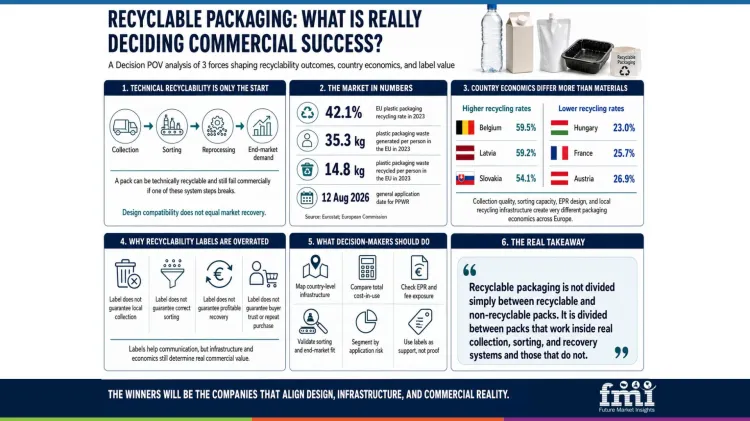
The value of a recyclability label depends on what happens after the consumer reads it.
The package must be accepted in the local collection system, placed in the correct bin, captured by sorting equipment, processed by an appropriate recycler, and converted into material with a commercial end use. If any part of that chain is missing, the label has limited influence on the actual outcome.
Consumer understanding is also constrained by competing messages. Packaging may carry material codes, recycling symbols, disposal instructions, sustainability claims, deposit information, certification marks, and country-specific text. More information does not always produce clearer behaviour.
A label can also create false confidence. Consumers may interpret recyclable as proof that the package will be recycled, even when the claim refers only to technical design compatibility. Brands then inherit a credibility risk if local infrastructure does not support the implied outcome.
The economic value of the label is frequently overstated. It may support compliance and reduce communication risk, but it does not automatically justify a price premium, improve repeat purchase, lower EPR fees, or create loyalty. Consumers usually evaluate packaging alongside price, product quality, convenience, safety, and availability.
The label is therefore an interface between the package and the system, not a substitute for either.
How the Market Actually Behaves
Recyclability labels are most useful when the instruction is simple, familiar, locally valid, and linked to an established collection route.
Deposit-marked beverage containers provide a relatively clear action because the consumer is directed to a defined return system and receives an economic incentive. Standard glass, metal, paper, and widely collected rigid-plastic formats can also benefit from straightforward instructions where infrastructure is mature.
The value weakens for small flexible packs, composite materials, coated fibre, dark or highly decorated plastics, specialist healthcare packaging, and formats whose acceptance varies by municipality. A short on-pack instruction cannot explain every local limitation.
Brands respond by using QR codes, digital pages, country-specific artwork, or generalized claims. These tools can provide more detail, but they introduce friction. Consumers must scan, read, interpret, and remember the instruction at the point of disposal.
Retailers and regulators may still value standardized labels because they improve consistency and reduce misleading claims. That compliance and governance value is real. It is different from consumer willingness to pay.
The market therefore rewards labels that make an existing recycling system easier to use. It does not reward labels that attempt to compensate for weak infrastructure or ambiguous packaging design.
Structural Constraints or Breakpoints
Local validity is a central breakpoint. A label must reflect the collection and recycling reality of the market where the package is sold. One message can become misleading when acceptance varies by country or municipality.
Consumer attention creates another constraint. Disposal instructions compete with branding, legal information, nutrition, safety, and product claims. Labels that require detailed interpretation may be ignored.
Claim substantiation is also critical. Terms such as recyclable or widely recyclable need evidence. RecyClass certification and design guidelines can support technical claims, but brands must still distinguish design compatibility from actual collection and recycling at scale.
Package size and print area limit communication. Sachets, closures, labels, and small formats cannot carry extensive sorting guidance without reducing readability.
System inconsistency creates the final breakpoint. Symbols, colours, bin systems, and terminology can differ. Harmonisation can reduce confusion, but it cannot instantly align all local infrastructure.
These constraints limit the ability of labels to deliver the broad behavioural and commercial benefits often assigned to them.
Where Decisions Commonly Break
A recurring mistake is treating the label as the final stage of a packaging sustainability project.
Teams may invest heavily in design, testing, and certification, then assume that adding a recyclability claim will convert technical progress into consumer trust. The claim can instead attract scrutiny if the actual recycling route is weak.
Another failure is using the strongest permissible claim across every market. A statement that is accurate in one country may be incomplete in another. This creates regulatory, reputational, and artwork-management risk.
Brands also overestimate willingness to pay for a recyclability label. Consumers may prefer sustainable packaging in surveys but remain highly sensitive to product price, convenience, and performance in real purchasing situations.
Digital instructions can fail when they add too many steps. A QR code may be useful for motivated consumers, yet most disposal decisions occur quickly and away from the original purchase context.
A further error is measuring label success through recognition rather than recycling behaviour. Consumers may remember the symbol without placing the package in the correct stream or without access to a suitable collection route.
What Decision-Makers Should Do Differently
Brands should define the purpose of the label before selecting the claim.
A compliance label, sorting instruction, technical certification mark, and marketing claim serve different functions. Combining them without a clear hierarchy can create confusion.
Claims should be supported at both design and market level. Technical evidence should establish compatibility with the intended recycling stream. Country-level evidence should confirm that the required collection and processing route exists at meaningful scale.
The on-pack message should focus on the immediate disposal action. Additional explanation can be placed digitally, but the primary instruction should remain readable and locally relevant.
Brands should test labels through observed behaviour, not only stated understanding. Trials should examine whether consumers choose the correct bin, distinguish components, remove sleeves or closures when required, and follow deposit instructions.
Portfolio governance is also important. Claims should be reviewed when packaging components, suppliers, recycling guidelines, or local infrastructure change. A label approved once can become outdated.
Commercial expectations should remain realistic. The primary value of a recyclability label is clearer disposal, claim discipline, and compliance support. Any price, loyalty, or differentiation benefit should be treated as application-specific rather than automatic.
The strongest label is one that accurately communicates a functioning route and helps the consumer complete one clear action.
The Misconception to Avoid
The misconception is that a recyclability label makes a package more recyclable.
The label can guide behaviour and communicate evidence. It cannot change the material structure, build collection infrastructure, improve sorting yield, or create demand for recyclate.
Bottom Line
Recyclability labels create value when they connect clear consumer action to a real local recycling system. When the system is weak or the claim is broader than the evidence, the label becomes a communication asset with limited circular impact and growing credibility risk.
Related Future Market Insights Reports
- Recyclable Packaging Market: Primary FMI report covering recyclable materials, packaging formats, end-use adoption, and supplier competition.
- Design-for-Recycling Packaging Market: Supports analysis of packaging redesign, recycling compatibility, and compliance-led innovation.
- Packaging Waste Recycling Market: Relevant for collection, sorting, reprocessing capacity, and the economics of actual recycling.
- Sustainable Packaging Market: Provides wider context on material transition, regulation, and brand packaging strategies.
- Recycled Materials Packaging Market: Supports analysis of secondary-material demand, feedstock quality, and circular supply chains.
- Flexible Plastic Packaging Market: Relevant for films, pouches, mono-material conversion, and flexible-packaging recycling constraints.
Sources
- Regulation (EU) 2025/40, EUR-Lex: https://eur-lex.europa.eu/eli/reg/2025/40/oj/eng
- EUR-Lex summary, Packaging and Packaging Waste from 2026: https://eur-lex.europa.eu/EN/legal-content/summary/packaging-and-packaging-waste-from-2026.html
- RecyClass Design for Recycling Guidelines: https://recyclass.eu/protocols-guidelines/design-for-recycling-guidelines/
- RecyClass Packaging Design Guidelines: https://recyclass.eu/protocols-guidelines/design-for-recycling-guidelines/packaging/
- CEFLEX Designing for a Circular Economy Guidelines: https://guidelines.ceflex.eu/
- CEFLEX Recyclability Guidance: https://guidelines.ceflex.eu/guidelines/recyclability/
- Future Market Insights, Recyclable Packaging Market: https://www.futuremarketinsights.com/reports/recyclable-packaging-market
- Future Market Insights, Design-for-Recycling Packaging Market: https://www.futuremarketinsights.com/reports/design-for-recycling-packaging-market
- Future Market Insights, Packaging Waste Recycling Market: https://www.futuremarketinsights.com/reports/packaging-waste-recycling-market

