


The Common Narrative
The accepted narrative around mono-material flexible packaging is that the industry has already identified the technical direction of travel. Multilayer structures are difficult to sort and recycle, while predominantly polyethylene or polypropylene structures are easier to place within established mechanical recycling streams. As recyclability rules tighten and brand commitments move closer to delivery deadlines, conversion is expected to accelerate across pouches, sachets, wraps, lidding films and form-fill-seal applications.
In many packaging strategies, the shift is presented as a material simplification exercise. Aluminium foil, PET, polyamide and other functional layers are removed or replaced, the structure is rebuilt around PE or PP, and the resulting pack is positioned as recycle-ready. Once the film has passed laboratory testing and achieved the required recyclability assessment, commercial rollout appears to be mainly a matter of converter capacity, customer approval and procurement timing.
This view is reinforced by design-for-recycling guidance. CEFLEX expresses a preference for mono-PE and mono-PP structures over mixed-material laminates because they support sortability, mechanical recycling yield and recyclate quality. RecyClass likewise evaluates packaging features against the compatibility of specific recycling streams. The strategic direction is clear: fewer incompatible materials should make flexible packaging easier to recycle.
The mistake is assuming that a common recycling objective will produce a common adoption curve.
Why That Narrative Is Incomplete
Flexible packaging is rarely designed around recyclability alone. It is designed to deliver a combination of moisture, oxygen, aroma, grease, light and contamination protection while surviving printing, lamination, filling, sealing, distribution and consumer handling.
Multilayer packaging became widespread because different materials solve different performance problems. PET can provide stiffness, heat resistance and print quality. Polyamide can improve puncture resistance. Aluminium foil or metallisation can provide strong light and gas barriers. Sealant layers support closure integrity and packing speed. Adhesives and coatings hold these functions together.
Replacing these combinations with one dominant polymer does not remove the performance requirement. It transfers that requirement into resin selection, orientation technology, coatings, compatibilizers, sealing layers and process control. A structure can become simpler in recycling terms while becoming more demanding to manufacture consistently.
Mono-material is also not a binary technical description. A package may be predominantly PE or PP and still contain inks, adhesives, coatings, tie layers, barriers, closures and labels that affect sorting and recycling behaviour. CEFLEX guidance prefers mono-polyolefin structures, while RecyClass testing shows that even functional barriers require defined thresholds. For example, RecyClass reported that EVOH up to 5% of total PE film weight had a minor recycling impact in its tests, while higher levels affected extrusion performance.
The commercial question is therefore not whether mono-material flexible packaging is possible. It is whether the required protection, machinability, appearance and shelf life can be delivered at acceptable cost and scale for each application.
How the Market Actually Behaves
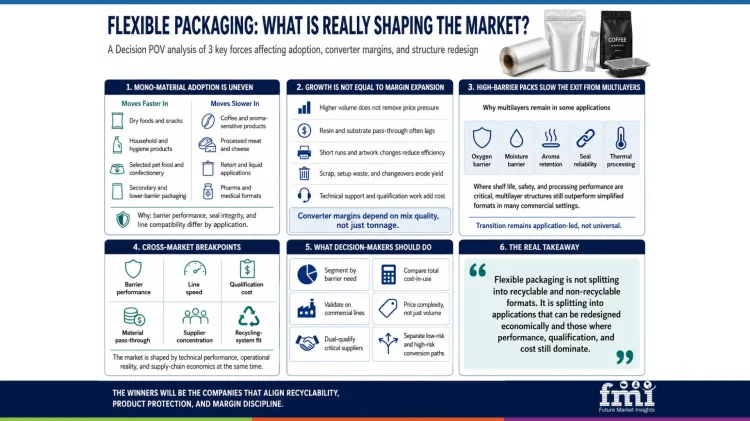
Adoption concentrates where the original structure is already close to a single-polymer design and where product protection requirements are moderate.
Dry foods, household products, pet food, selected confectionery, frozen products, hygiene items and secondary packaging can offer comparatively manageable conversion pathways. These applications may tolerate PE or PP structures with modest functional coatings, provided sealing, puncture resistance and print performance are maintained.
Conversion becomes harder as barrier sensitivity increases. Coffee, processed meat, cheese, retort products, liquid foods, medical products and pharmaceuticals may require strong oxygen, moisture, aroma, light or sterilisation performance. A small loss in barrier protection can reduce shelf life, increase food waste, affect product safety or create distribution restrictions. In these categories, removing a layer is not a packaging-only decision. It changes the economics of the product inside the package.
The market also behaves differently by production system. A film that performs well on a controlled pilot line may behave differently on older, high-speed filling equipment. Sealing windows can become narrower. Heat resistance may change. Film stiffness, curl, slip, coefficient of friction and web tension can affect machine stability. The commercial conversion is successful only when the pack works across the customer's actual equipment base, not only under converter trial conditions.
Large brands are better placed to fund repeated trials, qualify several plants and secure custom resin or coating solutions. They can concentrate volume with strategic converters and negotiate dedicated development support. Smaller brands often depend on standard film platforms and may have less influence over minimum order quantities, qualification schedules or material availability.
Converter capability also creates unevenness. Suppliers with advanced orientation, coating, metallisation, lamination, downgauging and process-control capabilities can close more of the performance gap. Commodity converters may offer a nominal mono-material solution but struggle with consistent barrier performance, sealing and high-speed conversion.
Regional recycling systems add another layer. A technically recyclable structure does not guarantee collection, sorting or recycling at scale in every country. The RecyClass technical tool explicitly notes that it evaluates recyclability using available technology but does not account for the efficiency of different collection schemes across Member States.
Structural Constraints or Breakpoints
Barrier performance is the most visible breakpoint.
Low and medium-barrier applications can often move towards mono-PE or mono-PP using orientation, specialised grades and thin functional coatings. High-barrier applications may still require EVOH, metallisation, aluminium, polyamide or other layers. Each additional feature must be assessed not only for package performance but for its compatibility with the target recycling stream.
Seal integrity is another major constraint. Flexible packaging must seal through variations in temperature, pressure, contamination and filling speed. A redesigned film may meet laboratory barrier targets but create leaks, weak seals or slower line speeds under commercial conditions. These losses appear through product rejection, downtime, complaint risk and reduced output rather than through the film purchase price.
Mechanical performance also matters. Heavy products, sharp-edged contents, vacuum packs and transport-intensive applications require puncture, tear and drop resistance. A mono-material design may need greater thickness or higher-specification resin to compensate for the removal of a functional layer. This can weaken lightweighting benefits and increase material cost.
Qualification creates a further breakpoint. Packaging changes may require migration testing, shelf-life studies, seal validation, transport trials, artwork approval and testing across several filling lines. Food, pharmaceutical and medical applications face longer and more demanding approval cycles. The cost is not limited to laboratory work. Trials consume materials, converter development capacity and production-line time.
Recycling infrastructure remains a system-level constraint. Mono-material design improves the probability of effective recycling, but collection and sorting are still necessary to supply recycling facilities with usable feedstock. CEFLEX describes collection as the foundation of a circular economy for flexible packaging because it supplies material for future recycling markets.
Where Decisions Commonly Break
A common error is setting a portfolio-wide mono-material target without separating applications by technical difficulty.
A dry snack pouch and a high-barrier coffee pack may look similar to a consumer, but their functional requirements are different. Applying one conversion deadline across both categories can force premature launches, repeated redesign or exceptions that undermine the original strategy.
Another failure occurs when recyclability becomes the dominant qualification criterion. A pack can achieve an improved recycling profile while delivering lower shelf life, weaker sealing or higher damage rates. The environmental and economic case deteriorates if product waste increases.
Teams also underestimate line compatibility. Converter trials may use ideal operating conditions and specialised support. Commercial operations involve different equipment generations, operators, speeds and maintenance standards. A film that requires a narrow sealing window can reduce efficiency across a multi-plant network.
Price comparisons can also mislead. The redesigned film may carry a moderate unit premium but create additional costs through slower throughput, higher scrap, extended trials, tooling changes, downgauging limits or increased inventory during transition.
Another mistake is assuming that mono-material means supplier flexibility. High-performance structures often depend on specific combinations of resin grades, orientation technology, coatings and converter know-how. A simpler material declaration can therefore coexist with a more concentrated qualified supplier base.
Regional expansion introduces additional risk. A structure accepted and collected in one country may face different sorting, labelling, EPR or recycling conditions elsewhere. A technically common European pack can still produce different commercial outcomes by market.
What Decision-Makers Should Do Differently
Companies should segment the portfolio by functional requirement before setting conversion priorities.
Applications should be classified by barrier need, shelf-life sensitivity, seal complexity, puncture risk, line speed, regulatory exposure, annual volume and country coverage. Low-risk, high-volume formats can move earlier. High-barrier and safety-sensitive formats require longer development paths and explicit exception criteria.
The commercial evaluation should use total cost-in-use rather than film price. The comparison should include material cost, line speed, scrap, sealing losses, trial expenditure, qualification, inventory conversion, product waste and expected EPR treatment.
Performance thresholds should be defined before development begins. The required oxygen and moisture barrier, seal strength, puncture resistance, shelf life, machine speed and recycling compatibility should be treated as simultaneous design inputs. Recyclability should not be improved by quietly transferring cost or risk into operations and product protection.
Commercial line validation should occur early enough to influence the design. Testing should include the oldest and most demanding equipment in the network, not only the best-performing line. A format that works only on selected assets is not yet a scalable portfolio solution.
Supplier strategy should reflect the concentration risk associated with advanced mono-material platforms. Critical formats should have a primary and alternative development route where possible. Buyers should assess resin access, coating capability, quality control, technical support, available capacity and the ability to reproduce performance across plants.
Companies should also distinguish between technical recyclability and market-specific recycling reality. Packaging design should align with recognised design-for-recycling guidance, while rollout plans should consider collection and sorting conditions in the countries where the pack will be sold.
The strongest strategy is application-led sequencing. It allows companies to capture early recyclability gains where conversion is commercially sound while preserving product protection in applications where technology and infrastructure are not yet ready.
The Misconception to Avoid
The misconception is that mono-material flexible packaging is one scalable solution for one packaging market.
Mono-material is a design direction, not a universal specification. Its commercial viability depends on the product being protected, the film functions being replaced, the filling equipment used, the converter's technical capability and the recycling system available after disposal.
Bottom Line
Mono-material flexible packaging will scale fastest where recyclability can improve without weakening shelf life, line performance or total cost-in-use. The market will not divide simply between recyclable and non-recyclable formats. It will divide between applications where functional complexity can be redesigned economically and those where performance remains the binding constraint.
Related Future Market Insights Reports
- Flexible Plastic Packaging Market: Primary FMI report covering flexible plastic formats, applications, material structures and competitive dynamics.
- High-Recyclability Mono-Material Flexible Packaging Market: Focused analysis of recyclable mono-material pouches, films and application-led adoption.
- Mono-Material Packaging Market: Supports analysis of PE and PP structures, format conversion and supplier strategies.
- High Barrier Packaging Films Market: Relevant for applications where shelf life, oxygen, moisture and aroma protection constrain conversion.
- Packaging Films Market: Provides broader context on film materials, end-use requirements and regional packaging demand.
- Form-Fill-Seal Films Market: Supports analysis of machinability, sealing, line speed and high-volume flexible packaging operations.
- Sustainable Packaging Market: Provides wider context on recyclability, material transition and regional sustainability strategies.
Sources
- Regulation (EU) 2025/40, EUR-Lex: https://eur-lex.europa.eu/eli/reg/2025/40/oj/eng
- CEFLEX Designing for a Circular Economy Guidelines: https://guidelines.ceflex.eu/guidelines/
- CEFLEX Design Principles: https://guidelines.ceflex.eu/guidelines/design-principles/
- CEFLEX Design Choices: https://guidelines.ceflex.eu/guidelines/design-choices/
- RecyClass Design for Recycling Guidelines: https://recyclass.eu/protocols-guidelines/design-for-recycling-guidelines/
- RecyClass PE Flexible Films Functional Barrier Findings: https://recyclass.eu/news/pe-flexible-films-recycling-new-findings-for-functional-barriers/
- RecyClass Technical Recyclability Tool: https://tool.recyclass.eu/en/plastics/tool/
- FMI Flexible Plastic Packaging Market: https://www.futuremarketinsights.com/reports/flexible-plastic-packaging-market
- FMI High-Recyclability Mono-Material Flexible Packaging Market: https://www.futuremarketinsights.com/reports/high-recyclability-mono-material-flexible-packaging-market
- FMI Mono-Material Packaging Market: https://www.futuremarketinsights.com/reports/mono-material-packaging-market
- FMI High Barrier Packaging Films Market: https://www.futuremarketinsights.com/reports/high-barrier-film-packaging-market

