


The Common Narrative
The packaging industry increasingly treats recyclability as a design qualification. A package is assessed against material composition, labels, adhesives, inks, closures, coatings, and other features to determine whether it is compatible with an established recycling stream. Once it receives a favourable design assessment or certification, the package is often described as recyclable and the redesign project is considered largely complete.
This logic is understandable. Design-for-recycling guidelines create a common technical language and help brands remove features that disrupt sorting or reprocessing. RecyClass evaluates packaging components against specific plastic recycling streams, while CEFLEX provides practical guidance intended to make flexible packaging suitable for collection, sorting, and recycling. These tools are essential because poor design can prevent a package from becoming useful secondary material.
The common assumption is that technical compatibility will translate into recycling at scale. If the package is designed correctly, collection systems will capture it, sorting facilities will identify it, recyclers will process it, and the recovered material will find a commercial buyer.
That sequence is possible, but it is not automatic.
Why That Narrative Is Incomplete
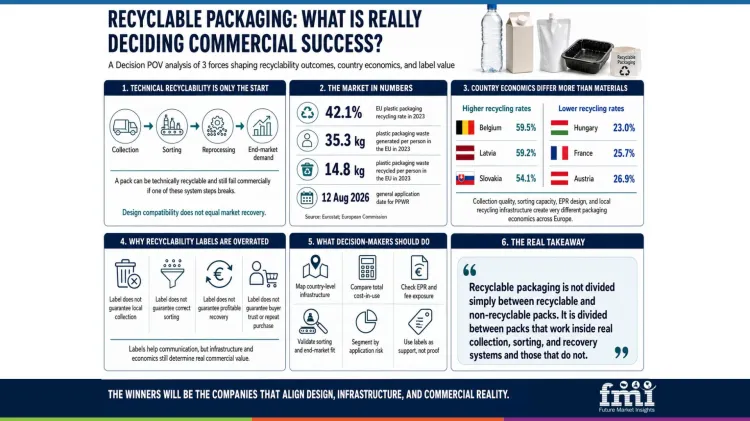
Technical recyclability addresses whether a package can be processed under defined conditions. Commercial recyclability depends on whether the entire system can collect, sort, aggregate, reprocess, and sell that package at acceptable cost and volume.
A format may perform well in laboratory or protocol testing but remain absent from household collection in an important market. It may be collected but pass through a sorting facility that lacks the required detection or separation capability. It may reach a recycler but arrive in volumes too small or too contaminated to justify a dedicated processing route. Even when technically recoverable material is produced, the output may have limited value if colour, odour, degradation, or mixed feedstock restricts end-market use.
The missing variable is system economics. Recycling requires sufficient feedstock density, dependable quality, process yield, energy, washing, labour, logistics, and a buyer willing to pay for the output. A design assessment cannot by itself create these conditions.
Commercial recyclability also varies by geography. Regulation (EU) 2025/40 aims to harmonise packaging requirements, but collection systems, EPR structures, sorting assets, recycler capacity, and secondary-material markets remain uneven. A package can therefore have one technical design and several different recycling outcomes.
How the Market Actually Behaves
Actual recycling concentrates where packaging volumes are large, collection routes are established, sorting is dependable, and the recovered material has a stable market.
Clear PET beverage bottles illustrate the importance of system alignment. Collection infrastructure, deposit-return systems in several markets, optical sorting, bottle-to-bottle processing, and demand for food-grade recycled PET create a relatively structured value chain. This does not eliminate contamination or supply constraints, but it gives the package a clearer route from disposal to secondary material.
Small flexible packs, dark or complex formats, mixed laminates, contaminated food packaging, and low-volume specialty structures face a different reality. Even when design changes improve compatibility, the pack may be too light, too small, too dispersed, or too contaminated to generate attractive recovery economics.
Rigid packaging can also face commercial limitations. A container may be made from a commonly recycled polymer but include a label, sleeve, pigment, barrier, closure, or residue that reduces sortability or recyclate quality. RecyClass guidelines reflect this component-level reality because the base material alone does not determine the outcome.
The market therefore separates packaging into more than recyclable and non-recyclable categories. Some formats are technically recyclable and commercially recycled at scale. Others are technically compatible but dependent on emerging infrastructure. A further group can be processed only through specialized or low-volume routes with uncertain economics.
Structural Constraints or Breakpoints
Collection coverage is a primary breakpoint. A package that is not accepted in the relevant collection stream cannot reach sorting and recycling assets consistently. Consumer disposal instructions do not solve the problem when collection rules vary locally or the required stream is unavailable.
Sorting performance is another constraint. Material recovery facilities must identify the format, separate it from competing materials, and produce a sufficiently clean bale. Size, shape, colour, density, labels, sleeves, metallic elements, and food residue can influence whether the package is captured or lost.
Feedstock volume determines whether the process is economically attractive. Recyclers need enough consistent input to support equipment utilization and operating cost. A technically recyclable niche format may remain commercially weak because volumes are fragmented across brands, countries, and collection routes.
Recyclate quality creates the final breakpoint. Washing, extrusion, decontamination, and compounding must produce material that buyers can use. If the output is highly degraded, strongly coloured, odorous, or inconsistent, its value may not cover collection and processing cost.
These breakpoints interact. Better design improves the probability of success, but commercial recycling appears only when the design fits a viable collection, sorting, processing, and end-market system.
Where Decisions Commonly Break
A recurring failure is approving a packaging redesign based only on a technical score or certificate. The score confirms compatibility with a defined recycling process, but it may not confirm that the package is collected and recycled in the markets where it is sold.
Another error is using national recycling rates as proof that a specific format is recycled. Aggregate rates combine materials and packaging types with very different outcomes. Strong paper, glass, metal, or bottle recycling performance can conceal weak recovery of flexible films, small formats, or specialist plastics.
Brands also misjudge the value of a material switch when the new format enters a stream with poor demand for the resulting recyclate. Moving from a complex structure to a theoretically compatible polymer may improve design credentials while producing low-value output that recyclers struggle to sell.
Pilot collection projects can create false confidence. Controlled programmes may use dedicated bins, targeted communication, subsidized logistics, or selected recyclers. Commercial scale introduces normal contamination, consumer behaviour, transport distances, and competition for facility capacity.
A further mistake is assuming that one packaging specification produces one European recycling result. A pack sold across Germany, France, Italy, Spain, Poland, and the Nordic markets encounters different systems even when the technical design is identical.
What Decision-Makers Should Do Differently
Packaging teams should separate design compatibility from market recyclability in every approval process.
The technical assessment should confirm whether the package features are compatible with the intended stream. The market assessment should establish whether the package is collected, sorted, recycled, and converted into saleable secondary material in the target countries.
Country-level mapping should include collection acceptance, sorting capability, recycler access, bale quality, process yield, and end-market demand. Where infrastructure is incomplete, the company should state that the format is designed for recycling rather than implying universal recycling at scale.
Portfolio decisions should prioritise formats where volume and infrastructure can reinforce each other. Concentrating several SKUs into a common, well-supported material family can improve feedstock density and supplier interest more effectively than isolated redesigns.
Brands should also work with recyclers and sorting operators, not only converters and material suppliers. These downstream participants can reveal whether the package is detected, captured, processed, and valued under real operating conditions.
Claims, labels, and consumer instructions should reflect the weakest material market in which the pack is sold. A cautious, evidence-based statement protects credibility better than a broad claim that cannot be supported across countries.
The strongest commercial decision is a package that combines product performance with a credible route to collection, sorting, reprocessing, and reuse of the recovered material.
The Misconception to Avoid
The misconception is that passing a design-for-recycling assessment means a package will be recycled in practice.
Technical compatibility is one condition of commercial recyclability. It does not guarantee collection coverage, sorting capture, sufficient feedstock, process economics, or demand for the recovered material.
Bottom Line
A package becomes commercially recyclable only when good design connects with functioning infrastructure and a viable secondary-material market. Technical recyclability opens the door. The economics and capacity of the recycling system determine whether the package passes through it.
Related Future Market Insights Reports
- Recyclable Packaging Market: Primary FMI report covering recyclable materials, packaging formats, end-use adoption, and supplier competition.
- Design-for-Recycling Packaging Market: Supports analysis of packaging redesign, recycling compatibility, and compliance-led innovation.
- Packaging Waste Recycling Market: Relevant for collection, sorting, reprocessing capacity, and the economics of actual recycling.
- Sustainable Packaging Market: Provides wider context on material transition, regulation, and brand packaging strategies.
- Recycled Materials Packaging Market: Supports analysis of secondary-material demand, feedstock quality, and circular supply chains.
- Flexible Plastic Packaging Market: Relevant for films, pouches, mono-material conversion, and flexible-packaging recycling constraints.
Sources
- Regulation (EU) 2025/40, EUR-Lex: https://eur-lex.europa.eu/eli/reg/2025/40/oj/eng
- EUR-Lex summary, Packaging and Packaging Waste from 2026: https://eur-lex.europa.eu/EN/legal-content/summary/packaging-and-packaging-waste-from-2026.html
- RecyClass Design for Recycling Guidelines: https://recyclass.eu/protocols-guidelines/design-for-recycling-guidelines/
- RecyClass Packaging Design Guidelines: https://recyclass.eu/protocols-guidelines/design-for-recycling-guidelines/packaging/
- CEFLEX Designing for a Circular Economy Guidelines: https://guidelines.ceflex.eu/
- CEFLEX Recyclability Guidance: https://guidelines.ceflex.eu/guidelines/recyclability/
- Future Market Insights, Recyclable Packaging Market: https://www.futuremarketinsights.com/reports/recyclable-packaging-market
- Future Market Insights, Design-for-Recycling Packaging Market: https://www.futuremarketinsights.com/reports/design-for-recycling-packaging-market
- Future Market Insights, Packaging Waste Recycling Market: https://www.futuremarketinsights.com/reports/packaging-waste-recycling-market

