


- Fermented ingredients can command value, but commercial success depends on yield, feedstock cost, fermentation time, downstream processing, and cost-in-use.
- Amino acids show how fermentation can scale when strain productivity and process economics are strong.
- Precision fermentation and fermented proteins carry high potential, but the cost curve must work against established ingredient alternatives.
- Probiotics, postbiotics, enzymes, natural preservatives, and specialty metabolites each follow different pricing logic.
- Feedstock volatility, energy intensity, purification cost, drying, and regulatory proof can all change margin structure.
- The misconception to avoid is that fermentation is automatically premium. Premium pricing holds only when performance and cost-in-use justify the switch.
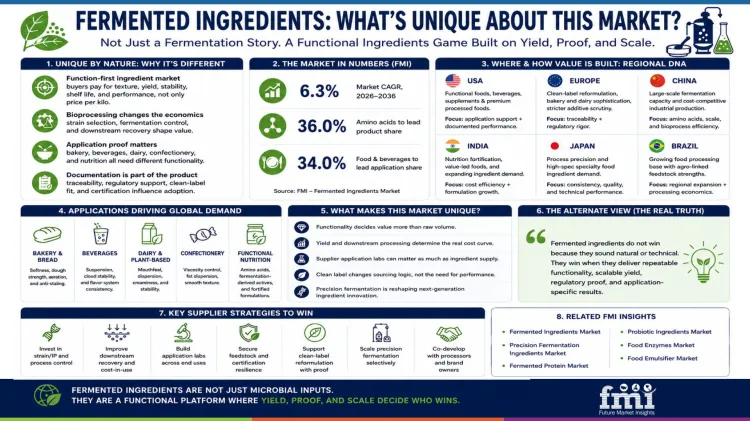
Fermented ingredients attract attention because they sound natural, functional, and aligned with modern food innovation. That framing is useful, but it can hide the economics that determine whether a fermented ingredient can scale. In the Fermented Ingredient Market, value is not created only by the ingredient name. It is created by yield, fermentation time, feedstock cost, downstream recovery, purity, stability, and cost-in-use.
This is why the economic angle is essential for fermented ingredients. A product may be exciting at lab scale but commercially difficult at industrial scale. Fermentation economics depend on how efficiently microorganisms convert sugars, oils, gases, nitrogen sources, or other feedstocks into the target compound. They also depend on how easily that compound can be separated, purified, dried, stabilized, and shipped. A high-value ingredient can still be commercially weak if yield is low or downstream processing is too expensive.
FMI identifies amino acids as the leading product type in the fermented ingredient market. That is an important signal because amino acids show how fermentation becomes competitive when scale, yield, and process optimization are strong. The Amino Acids Market indicates that fermented amino acids play a major role in production. In these categories, suppliers compete through strain productivity, feedstock efficiency, fermentation control, purification cost, and consistent specification.
The economics are very different from consumer packaged foods. A food brand may sell through marketing, packaging, and channel reach. A fermented ingredient supplier sells through performance and production reliability. The customer usually buys the ingredient because it solves a specific need: nutrition, flavor enhancement, preservation, texture, bioactivity, acidification, enzyme activity, or clean-label functionality. The supplier must deliver that function at an acceptable cost and with predictable supply.
Feedstock exposure is one of the first cost variables. Many fermentation processes depend on sugar streams, starch hydrolysates, molasses, corn, cane sugar, glycerol, vegetable oils, nitrogen sources, minerals, and process aids. Changes in agricultural prices, energy costs, logistics, water availability, or regional crop supply can affect fermentation economics. A fermentation route may appear stable scientifically but remain exposed commercially if feedstock costs move sharply.
Energy and utilities also matter. Industrial fermentation can require sterilization, aeration, agitation, cooling, heating, clean-in-place systems, wastewater treatment, drying, and downstream purification. These steps can be energy-intensive. A product positioned as sustainable still needs to pass an operating-cost test. If energy prices rise or drying costs are high, the margin structure can shift quickly.
Downstream processing is often underestimated. Producing a compound inside a fermentation tank is only part of the problem. The ingredient may need filtration, centrifugation, extraction, concentration, crystallization, chromatography, spray drying, freeze drying, encapsulation, or blending. In some cases, downstream processing can become the real cost bottleneck. This is especially relevant for proteins, enzymes, postbiotics, specialty metabolites, and high-purity functional ingredients.
The Precision Fermentation Ingredients Market is important because it shows how powerful but capital-intensive fermentation innovation can become. Precision fermentation can produce targeted proteins, enzymes, fats, and other molecules, but it also requires strain development, bioreactor scale-up, purification, regulatory review, and customer validation. The market potential is large, but the cost curve matters. The winners will be those that can move from demonstration volumes to food-grade commercial supply at a price customers can actually use.
The Fermented Protein Market illustrates this cost challenge clearly. Fermented proteins can support alternative dairy, meat analogues, sports nutrition, functional foods, and plant-based formulations, but they compete against established protein sources such as dairy proteins, soy, pea, wheat, egg, and other plant or animal proteins. A fermented protein does not win simply because it is novel. It must justify its price through functionality, nutrition, sustainability, allergen profile, supply security, or taste performance.
Probiotics have a different economic logic. In the Probiotic Ingredients Market, price is shaped by strain identity, viable count, stability, clinical support, format, and documentation. A commodity culture and a clinically supported strain are not priced the same way. The buyer is often paying for evidence and survivability, not only microbial biomass. This makes probiotic economics closer to specialty nutrition than commodity fermentation.
Postbiotics shift the economics again. The Postbiotic Ingredients Market is relevant because postbiotic systems may reduce some live-cell stability challenges while introducing new ones around characterization, standardization, and claim support. A postbiotic ingredient can be attractive in shelf-stable or heat-treated products, but it must be defined clearly enough for manufacturers to use and regulators to understand. The cost is not only production; it is proof and standardization.
Fermented ingredients also compete with chemically produced, extracted, or synthetically derived alternatives. Organic acids, amino acids, vitamins, preservatives, and flavor compounds may have multiple production routes. The buyer's decision may depend on price, purity, label preference, sustainability story, source acceptability, and regulatory status. Fermentation can win where it offers cleaner positioning, better consistency, better supply security, or lower long-term cost. It can lose where conventional routes remain cheaper and functionally adequate.
The Natural Food Preservatives Market is an adjacent example of how microbial or fermentation-linked ingredients can create value. Nisin and other preservation systems can support clean-label shelf-life extension, but processors still evaluate them by efficacy, dosage, sensory impact, regulatory acceptance, and cost. A natural preservative that requires high dosage or changes taste may not be economically attractive even if the label is better.
Cost-in-use is therefore more important than price per kilogram. A higher-priced fermented ingredient may be economically superior if it works at a lower dosage, reduces formulation complexity, improves shelf life, reduces returns, supports premium claims, or stabilizes production. A lower-priced ingredient may be more expensive in practice if it creates rework, requires additional stabilizers, or produces inconsistent results.
Scale-up risk is another economic breakpoint. Pilot fermentation success does not guarantee commercial success. Microbes behave differently at larger tank sizes because oxygen transfer, mixing, heat removal, contamination risk, foam, viscosity, and nutrient gradients can change. A process that produces excellent yields at bench scale may underperform in industrial fermentation. This is why contract fermentation capacity, process engineering, and scale-up experience matter.
Minimum economic scale is often the hidden commercial test. A customer may want a novel fermented ingredient for a premium product, but the supplier may need a certain tank size, campaign length, batch volume, or annual contract to justify production. This creates tension between innovation launches and industrial reality. Small brands may want flexibility, while fermentation assets need utilization. The best suppliers manage this gap through pilot capacity, phased scale-up, modular contracts, and application prioritization.
Validation cost also belongs in the economics. Fermented ingredients can require shelf-life testing, sensory trials, analytical method development, regulatory checks, allergen review, customer audits, and sometimes clinical or functional evidence. These costs may not appear in the ingredient invoice, but they affect adoption. A customer will not switch to a fermented ingredient only because the sustainability story is appealing. The ingredient must justify the cost of reformulation and validation against the margin potential of the finished product.
Finished-product margin decides how much fermentation cost can be absorbed. A premium supplement, medical nutrition product, or specialty beverage may tolerate a higher-cost fermented ingredient if the claim is valuable. A mainstream bakery item, sauce, or beverage may require a much tighter cost-in-use threshold. Suppliers therefore need pricing strategies by application, not one global premium story. The same fermentation-derived ingredient can be strategic in one use case and uneconomic in another.
The misconception to avoid is that fermented ingredients are automatically premium because they are natural, bio-based, or biotechnology-enabled. The market does not reward the process alone. It rewards process economics that deliver performance, supply reliability, and acceptable cost for the customer's application.
Bottom line: fermentation economics decide which ingredients scale. Yield, feedstock cost, downstream processing, documentation, and application value determine whether fermented ingredients move from innovation story to mainstream food and beverage use.
Related FMI Reports
- Fermented Ingredient Market: Primary interlink in introduction and conclusion
- Amino Acids Market: Use when discussing yield-led industrial fermentation
- Food Amino Acids Market: Use when discussing amino acids in food and supplement applications
- Precision Fermentation Ingredients Market: Use when discussing scale-up economics and bio-manufacturing cost curves
- Fermented Protein Market: Use when discussing alternative protein economics
- Probiotic Ingredients Market: Use when discussing strain value and premium pricing
- Natural Food Preservatives Market: Use when discussing fermentation-linked preservation cost-in-use

