

- Market Size (2026)
- USD 180.7 Mn
- Forecast (2036)
- USD 317.6 Mn
- CAGR (2026 to 2036)
- 5.8%
How big is Acrylic Longpass Filters Market in 2026?
USD 180.7 million in 2026 and USD 317.6 million by 2036 at a 5.8% CAGR.
Demand for acrylic longpass filters is projected to expand at 5.8% CAGR between 2026 and 2036, increasing valuation from USD 180.7 million to USD 317.6 million. Automated inspection expands the addressable base because each machine vision channel must manage unwanted wavelengths before image processing. The Association for Advancing Automation reported in February 2026 that North American robot orders rose 6.6% during 2025, sustaining new automation cells where compact wavelength-selective protection can be specified.
Country conversion differs with automation density and the engineering support available during optical qualification. The International Federation of Robotics reported in September 2025 that Japan installed 44,500 industrial robots in 2024 while the UK installed 2,500. Japan therefore offers a denser inspection base, while UK optical sensor programs depend more on specialist photonics teams and rapid sample access.
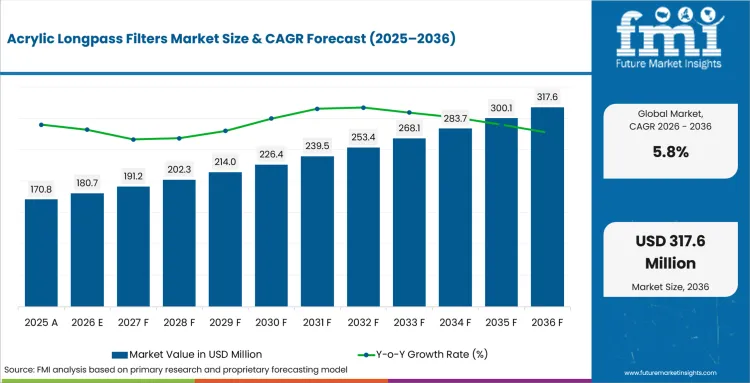
Key Takeaways of Acrylic Longpass Filters Market
- Automated inspection and embedded imaging increase acrylic longpass filter demand by adding camera channels that need wavelength control before image processing.
- Colored acrylic longpass filters are projected to hold 31.0% share in 2026 owing to broad absorptive wavelength choices that suit practical fabrication.
- The cut-on wavelength category is forecast to be led by 400-500 nm at 34.0% share in 2026 due to broad visible imaging compatibility.
- The 1-3 mm range is likely to capture 39.0% share in 2026 attributable to its balance of handling strength and compact integration.
- Acrylic loses eligibility when abrasion, heat or tight spectral tolerances exceed its documented operating range and force qualification toward glass alternatives.
- Edmund Optics, Thorlabs, Knight Optical, Newport / MKS, Kopp Glass, Abrisa Technologies, ePlastics and Plexiglas / Röhm represent the eight profiled competitive routes.
Analyst Perspective
"Acrylic longpass filters should be qualified as optical components because edge position and lot consistency determine usable contrast inside the finished camera. Commercial value rises when the same provider controls spectral documentation and cut geometry across samples and repeat OEM orders."
- Sudip saha, Principal Consultant, Future Market Insights
How is the Acrylic Longpass Filters Market segmented?
The acrylic longpass filters market is segmented by filter type, cut-on wavelength, thickness, application, sales channel and region.
Filter types include colored longpass, UV-blocking, IR-transmitting and laser safety acrylic filters plus custom-cut filters. Cut-on bands span below 400 nm, 400-500 nm, 500-700 nm and above 700 nm. Thickness spans below 1 mm, 1-3 mm, 3-6 mm and above 6 mm. Applications include machine vision, lighting & display, laser protection, analytical instruments and photography / imaging. Sales channels include optics distributors, direct custom fabrication, industrial catalog and OEM program supply.
Why do colored acrylic longpass filters lead the filter type category?
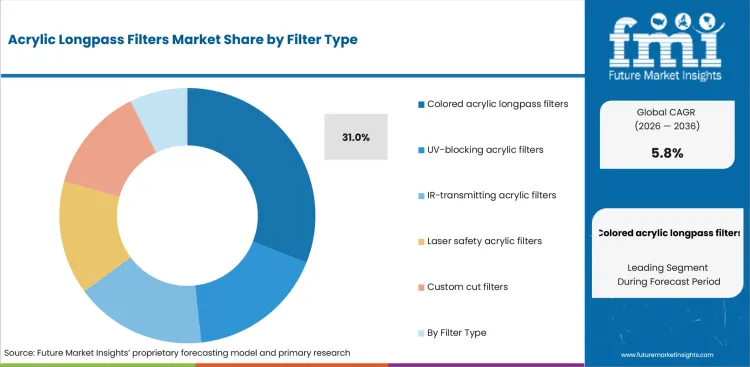
Colored acrylic longpass filters place the wavelength-selective function inside polymer optical materials, which suits broad cut-on requirements without a multilayer interference stack. Röhm reported in July 2026 that Volkswagen used colored PLEXIGLAS PMMA to replace a separate coating step, confirming that formulated PMMA can carry optical and surface functions in molded parts.
- Based on filter type, colored acrylic longpass filters are projected to account for 31.0% in 2026 due to broad absorptive wavelength choices and practical fabrication.
- Camera and sensing engineers select the format when lightweight protection and wavelength separation can be combined in one cut component, reducing assembly steps without demanding a coated-glass design.
Why does 400-500 nm lead the cut-on wavelength category?
A 400-500 nm cut-on rejects ultraviolet and shorter visible light while preserving longer wavelengths used by many inspection cameras. The range also avoids the narrower use cases associated with deeper ultraviolet or much longer infrared cut-on points.
- In 2026, the 400-500 nm range is expected to lead cut-on wavelength with 34.0% share because it serves a broad set of visible imaging tasks.
- MKS Instruments reported in January 2025 that Newport ODiate filter sets use advanced thin-film deposition systems to control transmission and reflection accuracy. System designers qualify the cut-on edge against illumination and sensor response before finalizing the optical path.
How does 1-3 mm support leadership in the thickness category?
Thickness determines whether an acrylic filter remains flat after cutting and fits inside a compact camera or instrument housing. The 1-3 mm range provides enough stiffness for routine handling without adding the package depth associated with heavier protective plates.
- By thickness, 1-3 mm is forecast to represent 39.0% in 2026 driven by its balance of handling strength and compact mechanical integration.
- Knight Optical reported in March 2025 that its in-house metrology measures dimensional accuracy and surface performance before optical components ship. Design engineers use those controls alongside optical films or protective surfaces to limit fit changes and alignment drift across repeat production batches.
What drives optics distributors to lead the sales channel category?
Stocked optical distribution turns photonics supply into a fast physical trial, which matters before an OEM freezes cut-on wavelength and mounting geometry. Edmund Optics reported in May 2025 that two European engineering firms joined its partnership network for optical design and prototype support, extending the route from component selection to validated system work.
- Optics distributors are set to lead the sales channel with 42.0% share in 2026 due to immediate stock access during prototype qualification.
- Engineering teams often buy small quantities first, then transfer repeat geometry into controlled OEM supply after wavelength performance and mounting fit are confirmed.
What are the drivers, restraints and opportunities in the Acrylic Longpass Filters Market?
Automated imaging expands demand, while optical qualification limits broader use and integrated component supply provides the clearest value-added route.
- Driver: More automated camera stations increase demand for wavelength-selective protection that removes unwanted light before inspection software evaluates an image.
- Restraint: Acrylic loses eligibility when abrasion, heat or demanding spectral edges exceed documented performance and push engineers toward glass alternatives.
- Opportunity: Cut geometry, mounting and spectral documentation shift revenue from generic sheet sales toward repeat OEM components.
Automated Inspection Expands Wavelength-Control Needs
Automated factories add camera stations that must separate useful signal from ambient or source wavelengths before software evaluates the image. Business.gov.uk reported in February 2026 that the UK industrial strategy assigned R&D funding specifically to automation and robotics in smart factories. More inspection channels enlarge the addressable pool for machine vision cameras and wavelength-control components, although automation spending does not measure acrylic filter orders directly.
Qualification Limits Acrylic in Demanding Optical Paths
Environmental qualification becomes the limiting step when acrylic must hold its spectral edge and surface condition under heat, abrasion, chemicals or repeated cleaning. Röhm reported in October 2025 that TECTON II uses molded PMMA for precise light distribution in industrial environments, making surface accuracy and durability explicit qualification conditions. Glass filters and laser safety glasses gain eligibility once abrasion or laser requirements exceed the documented polymer operating envelope.
Integrated Components Capture More OEM Value
OEM revenue rises when a fabricator supplies a finished optical component instead of leaving cutting and mounting work with the instrument engineer. Edmund Optics reported in March 2026 that its Teledyne Photometrics partnership placed scientific cameras beside compatible imaging components from one source. Acrylic filter fabricators can apply the same purchasing logic by pairing controlled geometry with mounting, functional films and documented spectral inspection for repeat production.
Which country CAGRs are profiled in the Acrylic Longpass Filters Market?
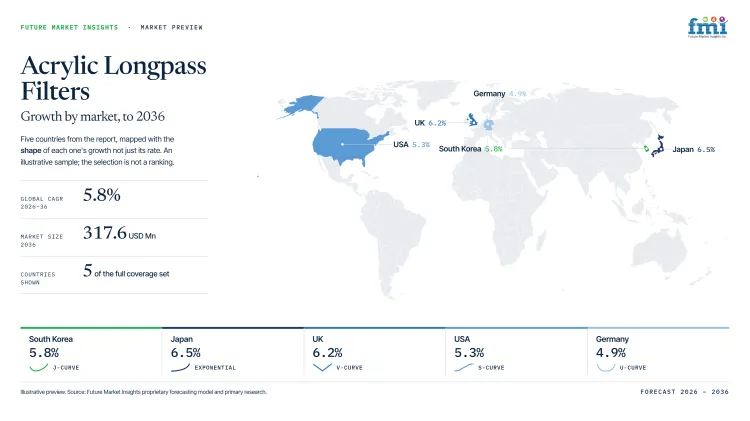
| Country | CAGR |
|---|---|
| Japan | 6.5% |
| UK | 6.2% |
| South Korea | 5.8% |
| USA | 5.3% |
| Germany | 4.9% |
How do country-level CAGRs compare in the Acrylic Longpass Filters Market?
The 1.6-point spread forms a compact upper pair in Japan and the UK, with South Korea acting as a transition market before the lower USA-Germany band. The spacing reflects different industrial inspection bases and qualification routes rather than a direct ranking of current revenue or installed acrylic filter volume today.
- Japan pairs dense automotive robotics with conservative optical change control across production programs.
- UK photonics clusters combine specialist imaging skills with rapid prototype access for manufacturers.
- South Korea combines semiconductor equipment intensity with short qualification cycles and engineering support.
- USA integrator networks reward stocked trials and flexible cutting across industrial inspection accounts.
- Germany combines automation with formal validation for color formulation and dimensional changes.
Comparable CAGRs produce different account economics as service and qualification demands vary.
The full report provides country-level CAGR analysis across North America, Latin America, Europe, East Asia, South Asia, Oceania and the Middle East and Africa.
Country-wise Analysis
- Japanese automotive and electronics plants use dense automation, and IFR reported in July 2025 that the automotive industry installed about 13,000 industrial robots during 2024 across the country. Adoption of acrylic longpass filters in Japan is estimated to expand at 6.5% CAGR through 2036, supported by local optical manufacturing that gives engineering teams access to sampling and metrology during design qualification and initial production sampling. Conservative change control raises switching costs for production programs, so manufacturers need stable lots and detailed spectral documentation to accept a revised filter without repeating line-level optical tests during scheduled equipment updates and repeat builds.
- UK optical projects often pass through specialist photonics engineering houses, so sample access and documented spectral performance influence qualification before smaller manufacturers commit to custom geometry or repeat optical orders. The Council for Science and Technology reported in March 2026 that UK photonics clusters include precision cameras and imaging systems, giving acrylic filter programs a local route into prototype design and optical integration. The UK acrylic longpass filters outlook is anticipated to advance at 6.2% CAGR over the assessment period, aided by specialist engineering skills while fragmented automation demand rewards distributors that provide samples with traceable performance records for production.
- South Korean semiconductor and electronics plants run short equipment cycles, which puts a premium on local engineering response when optical filters must be sampled or changed inside inspection tools. SEMI reported in April 2026 that South Korea’s semiconductor equipment billings rose 26% to USD 25.8 billion during 2025, reinforcing the local concentration of capital-intensive process equipment that depends on precise sensing and inspection. In South Korea, acrylic longpass filter demand is predicted to advance at 5.8% CAGR through 2036 as semiconductor inspection sustains camera use while rapid platform revisions compress qualification windows and reward firms with local stock plus responsive application engineering.
- US optical sourcing spans catalog prototyping and custom assemblies, and IFR reported in June 2026 that factories installed 38,000 industrial robots during 2025 as deployments increased 11%. Acrylic longpass filter sales in the USA are forecast to expand at 5.3% CAGR by 2036, aided by a broad integrator base that gives engineering teams several routes for testing polymer filters against glass or coated alternatives. Ready access to higher-performance substitutes raises the qualification bar for acrylic, so fabricators gain repeat production by documenting environmental limits and delivering cut geometry that stays stable across recurring industrial inspection orders nationwide for integrators.
- German machine builders operate beside mature PMMA and precision manufacturing networks, which helps optical fabricators coordinate material access with local cutting and metrology for industrial inspection programs. VDMA reported in February 2026 that Germany’s robotics and automation industry expected revenue to decline 5% during 2026, adding commercial pressure to equipment programs that already use conservative validation and formal change control. The German acrylic longpass filters sector is projected to record 4.9% CAGR during the assessment period, supported by an established automation base while longer qualification cycles favor manufacturers that keep color formulation and dimensions stable across repeat machine builds domestically.
Who are the notable companies in the Acrylic Longpass Filters Market?
Edmund Optics, Thorlabs, Knight Optical, Newport / MKS, Kopp Glass, Abrisa Technologies, ePlastics and Plexiglas / Röhm are the notable companies profiled in this market.
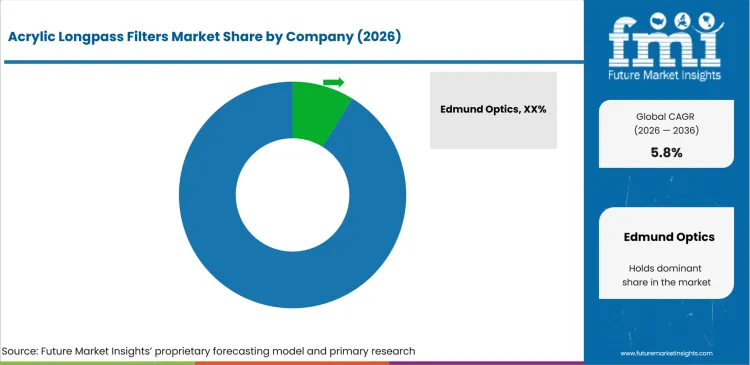
The market is fragmented across PMMA producers, optical distributors and precision-filter manufacturers that enter the specification at different points. Entry requires spectral documentation and repeatable cutting because glass and interference alternatives compete at tighter performance limits. Custom filter coatings raise the barrier for ready-to-install OEM assemblies.
- Direct acrylic and PMMA routes include Edmund Optics, Knight Optical, ePlastics and Plexiglas / Röhm across material access and fabricated component supply.
- Thorlabs, Newport / MKS and Kopp Glass set the spectral comparison against colored-glass or coated alternatives used at tighter performance limits.
- Abrisa Technologies represents custom optical integration by combining fabrication and wavelength-selective coatings closer to the finished OEM assembly.
Competitive Benchmarking: Acrylic Longpass Filters Market
| Company | Direct Acrylic / PMMA Route | Longpass Spectral Breadth | Custom / OEM Supply Support | Geographic Reach |
|---|---|---|---|---|
| Edmund Optics | High | High | High | North America, Europe, East Asia and global distribution |
| Thorlabs | Low | High | Medium | North America, Europe and Asia-Pacific |
| Knight Optical | High | High | High | UK, USA and international shipment |
| Newport / MKS | Low | High | High | North America, Europe and Asia-Pacific |
| Kopp Glass | Low | High | High | USA with international industrial supply |
| Abrisa Technologies | Low | Medium | High | USA with wider HEF Photonics reach |
| ePlastics | High | Medium | Medium | USA with international online ordering |
| Plexiglas / Röhm | High | Medium | Medium | Europe, North America and Asia |
Key Developments in the Acrylic Longpass Filters Market
- In January 2026, MKS Inc. presented Newport ODiate multiband fluorescence filters with at least 96% transmission and OD 10 or greater blocking for wavelength-selective imaging.
- In January 2025, Edmund Optics opened a distribution center in Best that increased stock and same-day shipping for European Union optical customers.
- In January 2025, Edmund Optics acquired son-x and added ultrasonic-assisted diamond turning plus multi-axis machining for complex precision optics.
Key Players in the Acrylic Longpass Filters Market
Direct Acrylic and PMMA Routes
- Edmund Optics
- Knight Optical
- ePlastics
- Plexiglas / Röhm
Spectral Filter Alternatives
- Thorlabs
- Newport / MKS
- Kopp Glass
Custom and OEM Optical Integration
- Abrisa Technologies
Acrylic Longpass Filters Market - Report Scope
| Coverage field | Report scope |
|---|---|
| Market breakdown | By filter type, cut-on wavelength, thickness, application, sales channel and region. |
| Quantitative Units | Revenue in USD million and CAGR in %. |
| Market Definition | Commercial acrylic longpass filter components supplied within the stated segmentation universe. Revenue excludes downstream finished equipment and non-acrylic substitute filters. Raw PMMA resin and general-purpose acrylic sheet are excluded unless sold as acrylic longpass filter components. |
| Regions Covered | North America, Latin America, Europe, East Asia, South Asia and Pacific, and Middle East and Africa. |
| Countries Covered | Japan, UK, South Korea, USA, Germany, and 20+ countries included in the full report. |
| Key Companies Profiled | Edmund Optics, Thorlabs, Knight Optical, Newport / MKS, Kopp Glass, Abrisa Technologies, ePlastics, Plexiglas / Röhm. |
| Forecast Period | 2026 to 2036. |
| Approach | Primary and secondary research with market triangulation. |
Acrylic Longpass Filters Market - Research Methodology
| Method | Approach |
|---|---|
| Primary Research | FMI analysts gathered input from manufacturers, service providers, technology developers, distributors, end users, procurement teams, and subject-matter experts. Interviews examined purchasing decisions, product or service evaluation, adoption barriers, approval requirements, pricing considerations, and expectations for technical or commercial support. Respondents were also asked what evidence is required before a trial, pilot, or initial order develops into regular purchasing. |
| Desk Research | Desk research covered government statistics, regulatory publications, trade data, industry associations, technical literature, standards, company filings, product information, and official corporate announcements. Sources were reviewed for relevance, publication date, geographic coverage, and consistency with the defined market scope. Claims relating to performance, applications, approvals, capacity, investment, and commercial activity were retained only when supported by credible public evidence. |
| Market Sizing and Forecasting | The market model combined the baseline value with historical performance, segment structure, pricing and volume indicators, adoption levels, company participation, and country-level demand conditions. Forecast assumptions considered economic activity, investment trends, regulatory developments, technology adoption, purchasing cycles, supply availability, and barriers to wider market use. Segment and regional estimates were reconciled before the final market total was calculated. |
| Data Validation | Estimates were checked against multiple independent indicators, including public data, company activity, trade patterns, industry developments, and findings from primary interviews. Validation also tested whether products, services, applications, and company revenues fell within the defined market boundaries. Adjacent categories, unsupported claims, overlapping revenues, and activities without direct market relevance were excluded to reduce double counting and maintain consistency across segments and countries. |
Acrylic Longpass Filters Market by Segments
Acrylic Longpass Filters Market segmented by Filter Type:
- Colored Acrylic Longpass Filters
- UV-Blocking Acrylic Filters
- IR-Transmitting Acrylic Filters
- Laser Safety Acrylic Filters
- Custom Cut Filters
Acrylic Longpass Filters Market segmented by Cut-on Wavelength:
- 400-500 nm
- Below 400 nm
- 500-700 nm
- Above 700 nm
Acrylic Longpass Filters Market segmented by Thickness:
- 1-3 mm
- Below 1 mm
- 3-6 mm
- Above 6 mm
Acrylic Longpass Filters Market segmented by Application:
- Machine Vision
- Lighting & Display
- Laser Protection
- Analytical Instruments
- Photography / Imaging
Acrylic Longpass Filters Market segmented by Sales Channel:
- Optics Distributors
- Direct Custom Fabrication
- Industrial Catalog
- OEM Program Supply
Acrylic Longpass Filters Market by Region:
- North America
- United States
- Canada
- Latin America
- Brazil
- Mexico
- Argentina
- Rest of Latin America
- Western Europe
- Germany
- United Kingdom
- Italy
- Spain
- France
- Nordics
- Benelux
- Rest of Western Europe
- Eastern Europe
- Russia
- Poland
- Hungary
- Balkan and Baltic States
- Rest of Eastern Europe
- East Asia
- China
- Japan
- South Korea
- South Asia and Pacific
- India
- ASEAN
- Australia and New Zealand
- Rest of South Asia and Pacific
- Middle East and Africa
- Kingdom of Saudi Arabia
- Other GCC Countries
- Türkiye
- South Africa
- Other African Union Countries
- Rest of Middle East and Africa
Research Sources and Bibliography
- Association for Advancing Automation. (2026, February 6). Robot Orders Grow 6.6% in 2025 as General Industries Drive Broader Automation Adoption.
- International Federation of Robotics. (2025, September 25). World Robotics 2025 report - INDUSTRIAL ROBOTS - released by IFR.
- Röhm GmbH. (2026, July 28). Colored PMMA replaces coating: Volkswagen manufactures rear spoilers for the ID. Buzz from PLEXIGLAS® molding compound in Piano Black.
- MKS Instruments, Inc. (2025, January 21). MKS Instruments Showcases Customer-Focused Photonics Innovations at SPIE’s Photonics West 2025.
- Knight Optical. (2025, March 17). 'Bringing Quality into Focus': The Knight Optical Approach.
- Edmund Optics. (2025, May 6). ASE Optics Europe and Photonics Precision Engineering Join the Edmund Optics® Trusted Optical Partnerships Program.
- UK Department for Business and Trade. (2026, February 5). Robotics and automation opportunities in the UK.
- Röhm GmbH. (2025, October 28). PLEXIGLAS® once again delivers impressive optical quality in the new edition of Zumtobel’s proven TECTON luminaire system.
- Edmund Optics. (2026, March 17). Edmund Optics® Expands Scientific Imaging Portfolio Through New Partnership with Teledyne Photometrics.
- International Federation of Robotics. (2025, July 15). Japan’s Car Industry has Highest Robot Installations in Five Years.
- Council for Science and Technology. (2026, March 9). CST advice on growth and global leadership in photonics.
- SEMI. (2026, April 7). SEMI Reports Global Semiconductor Equipment Billings Reached $135 Billion in 2025, Up 15% Year-on-Year.
- International Federation of Robotics. (2026, June 18). US Robot Industry Returns to Double Digit Growth.
- VDMA Robotics + Automation. (2026, February 24). Robotics and Automation Industry Remains Under Pressure.
- MKS Inc. (2026, January 12). MKS Inc. Unveils Photonics Solutions to Advance AI, Quantum, and Biotech at Photonics West 2026.
- Edmund Optics. (2025, January 22). Faster and Easier: Edmund Optics Opens New Distribution Hub to Enhance Customer Service in European Union.
- Edmund Optics. (2025, January 17). Edmund Optics Acquires son-x to Expand Manufacturing Capabilities and Strengthen Global Leadership in Providing Innovative Customer Solutions.
- Röhm GmbH. (2026, June 5). LiMA Technology at Full Scale Operation: Official Opening of Röhm’s Bay City MMA Plant.
- Optica. (2025, May 9). Abrisa Technologies, a HEF Photonics Company, Acquires Agama Glass to Expand East Coast Presence and Add Etching Capabilities.
- Edmund Optics. (2025, March 17). Edmund Optics® and Quartus Engineering Partner to Make Imaging System Calibration More Accessible Than Ever Before.
This bibliography is provided for reader reference and is not exhaustive. The full report contains the complete reference list and detailed citations
This Report Answers
- How large is the acrylic longpass filters market in 2026 and 2036?
- Which operating conditions convert automated imaging demand into acrylic filter purchases?
- Why do colored acrylic longpass filters lead the filter type category in 2026?
- Why does the 400-500 nm range lead the cut-on wavelength category?
- How do qualification requirements limit acrylic use against glass and interference alternatives?
- How do country growth rates differ across Japan, UK, South Korea, USA and Germany?
- Which companies compete through acrylic supply, spectral alternatives or custom optical integration?
- Which supplier capabilities matter most during OEM qualification and repeat production?
Frequently Asked Questions
How big is the Acrylic Longpass Filters Market in 2026?
The acrylic longpass filters market is expected to be valued at USD 180.7 million in 2026 and reach USD 317.6 million by 2036. Automated inspection expands demand for lightweight wavelength-control components that can protect compact optical assemblies.
What is the CAGR of the Acrylic Longpass Filters Market from 2026 to 2036?
The acrylic longpass filters market is projected to grow at a CAGR of 5.8% from 2026 to 2036. Expansion follows the spread of automated inspection points that need spectral control before cameras and imaging software evaluate the signal.
Which filter type leads the Acrylic Longpass Filters Market?
The acrylic longpass filters market is led by colored acrylic longpass filters at 31.0% of filter type revenue in 2026. Their absorptive construction offers broad wavelength choices and simple cutting for moderate-performance optical assemblies.
Which sales channel leads the Acrylic Longpass Filters Market?
The acrylic longpass filters market is led by optics distributors at 42.0% of sales channel revenue in 2026. Stock access and application support shorten prototype qualification before a successful design enters controlled OEM supply.
Which companies are active in the Acrylic Longpass Filters Market?
The acrylic longpass filters market includes Edmund Optics, Thorlabs, Knight Optical, Newport / MKS, Kopp Glass, Abrisa Technologies, ePlastics and Plexiglas / Röhm. Their competitive roles span direct acrylic supply and PMMA materials plus spectral alternatives and custom optical integration.
Preview the report firsthand - request a free sample
Get SampleGet the brochure for pricing and purchase details.
Get PDFTable of Content
- Key Takeaways
- Market Size and CAGR
- Top Growth Driver
- Fastest Growing Segment
- Leading Region
- Key Companies
- Emerging Opportunities
- Executive Summary
- Global Market Outlook
- Demand-side Trends
- Supply-side Trends
- Technology Roadmap Analysis
- Analysis and Recommendations
- Analyst Perspective (What is happening? Why now? What should investors know?)
- Key Questions Answered
- How large is the market?
- What is the CAGR?
- What are key trends?
- Which region dominates?
- Who are the leaders?
- Market Overview
- Market Coverage / Taxonomy
- Market Definition / Scope / Limitations
- Research Methodology
- Chapter Orientation
- Analytical Lens and Working Hypotheses
- Market Structure, Signals, and Trend Drivers
- Benchmarking and Cross-market Comparability
- Market Sizing, Forecasting, and Opportunity Mapping
- Research Design and Evidence Framework
- Desk Research Programme (Secondary Evidence)
- Expert Input and Fieldwork (Primary Evidence)
- Tooling, Models, and Reference Databases
- Data Engineering and Model Build
- Quality Assurance and Audit Trail
- Market Background
- Market Dynamics (Drivers, Restraints, Opportunity, Trends)
- Scenario Forecast (Optimistic, Likely, Conservative)
- Impact Analysis
- AI Impact
- Sustainability Impact
- Regulatory Impact
- Technology Impact
- Consumer / Buyer Analysis
- Purchase Drivers
- Adoption Barriers
- Buyer Journey
- Opportunity Map Analysis
- Product Life Cycle Analysis
- Supply Chain Analysis
- Investment Feasibility Matrix
- Value Chain Analysis
- PESTLE and Porter's Analysis
- Regulatory Landscape
- Regional Parent Market Outlook
- Production and Consumption Statistics
- Import and Export Statistics
- Global Market Analysis and Forecast, 2021 to 2036
- Historical Market Size Value (USD Million) Analysis, 2021 to 2025
- Current and Future Market Size Value (USD Million) Projections, 2026 to 2036
- Y-o-Y Growth Trend Analysis
- Absolute $ Opportunity Analysis
- Global Market Pricing Analysis, 2021 to 2036
- Global Market Analysis and Forecast, By Filter Type, 2021 to 2036
- Introduction / Key Findings
- Historical Market Size Value (USD Million) Analysis By Filter Type, 2021 to 2025
- Current and Future Market Size Value (USD Million) Analysis and Forecast By Filter Type, 2026 to 2036
- Colored acrylic longpass filters
- UV-blocking acrylic filters
- IR-transmitting acrylic filters
- Laser safety acrylic filters
- Custom cut filters
- By Filter Type
- Colored acrylic longpass filters
- Y-o-Y Growth Trend Analysis By Filter Type, 2021 to 2025
- Absolute $ Opportunity Analysis By Filter Type, 2026 to 2036
- Global Market Analysis and Forecast, By Cut-on Wavelength, 2021 to 2036
- Introduction / Key Findings
- Historical Market Size Value (USD Million) Analysis By Cut-on Wavelength, 2021 to 2025
- Current and Future Market Size Value (USD Million) Analysis and Forecast By Cut-on Wavelength, 2026 to 2036
- 400-500 nm
- Below 400 nm
- 500-700 nm
- Above 700 nm
- By Voltage
- 400-500 nm
- Y-o-Y Growth Trend Analysis By Cut-on Wavelength, 2021 to 2025
- Absolute $ Opportunity Analysis By Cut-on Wavelength, 2026 to 2036
- Global Market Analysis and Forecast, By Thickness, 2021 to 2036
- Introduction / Key Findings
- Historical Market Size Value (USD Million) Analysis By Thickness, 2021 to 2025
- Current and Future Market Size Value (USD Million) Analysis and Forecast By Thickness, 2026 to 2036
- 1-3 mm
- Below 1 mm
- 3-6 mm
- Above 6 mm
- By Power Rating
- 1-3 mm
- Y-o-Y Growth Trend Analysis By Thickness, 2021 to 2025
- Absolute $ Opportunity Analysis By Thickness, 2026 to 2036
- Global Market Analysis and Forecast, By Application, 2021 to 2036
- Introduction / Key Findings
- Historical Market Size Value (USD Million) Analysis By Application, 2021 to 2025
- Current and Future Market Size Value (USD Million) Analysis and Forecast By Application, 2026 to 2036
- Machine vision
- Lighting & display
- Laser protection
- Analytical instruments
- Photography / imaging
- By Application
- Machine vision
- Y-o-Y Growth Trend Analysis By Application, 2021 to 2025
- Absolute $ Opportunity Analysis By Application, 2026 to 2036
- Global Market Analysis and Forecast, By Sales Channel, 2021 to 2036
- Introduction / Key Findings
- Historical Market Size Value (USD Million) Analysis By Sales Channel, 2021 to 2025
- Current and Future Market Size Value (USD Million) Analysis and Forecast By Sales Channel, 2026 to 2036
- Optics distributors
- Direct custom fabrication
- Industrial catalog
- OEM program supply
- By Sales Channel
- Optics distributors
- Y-o-Y Growth Trend Analysis By Sales Channel, 2021 to 2025
- Absolute $ Opportunity Analysis By Sales Channel, 2026 to 2036
- Global Market Analysis and Forecast, By Region, 2021 to 2036
- Introduction
- Historical Market Size Value (USD Million) Analysis By Region, 2021 to 2025
- Current Market Size Value (USD Million) Analysis and Forecast By Region, 2026 to 2036
- North America
- Latin America
- Western Europe
- Eastern Europe
- East Asia
- South Asia and Pacific
- Middle East & Africa
- Market Attractiveness Analysis By Region
- North America Market Analysis and Forecast, By Country, 2021 to 2036
- Historical Market Size Value (USD Million) Trend Analysis By Market Taxonomy, 2021 to 2025
- Market Size Value (USD Million) Forecast By Market Taxonomy, 2026 to 2036
- By Country
- USA
- Canada
- By Filter Type
- By Cut-on Wavelength
- By Thickness
- By Application
- By Sales Channel
- By Country
- Market Attractiveness Analysis
- By Country
- By Filter Type
- By Cut-on Wavelength
- By Thickness
- By Application
- By Sales Channel
- Key Takeaways
- Latin America Market Analysis and Forecast, By Country
- Historical Market Size Value (USD Million) Trend Analysis By Market Taxonomy, 2021 to 2025
- Market Size Value (USD Million) Forecast By Market Taxonomy, 2026 to 2036
- By Country
- Brazil
- Mexico
- Chile
- Rest of Latin America
- By Filter Type
- By Cut-on Wavelength
- By Thickness
- By Application
- By Sales Channel
- By Country
- Market Attractiveness Analysis
- By Country
- By Filter Type
- By Cut-on Wavelength
- By Thickness
- By Application
- By Sales Channel
- Key Takeaways
- Western Europe Market Analysis and Forecast, By Country
- Historical Market Size Value (USD Million) Trend Analysis By Market Taxonomy, 2021 to 2025
- Market Size Value (USD Million) Forecast By Market Taxonomy, 2026 to 2036
- By Country
- Germany
- UK
- Italy
- Spain
- France
- Nordic
- BENELUX
- Rest of Western Europe
- By Filter Type
- By Cut-on Wavelength
- By Thickness
- By Application
- By Sales Channel
- By Country
- Market Attractiveness Analysis
- By Country
- By Filter Type
- By Cut-on Wavelength
- By Thickness
- By Application
- By Sales Channel
- Key Takeaways
- Eastern Europe Market Analysis and Forecast, By Country
- Historical Market Size Value (USD Million) Trend Analysis By Market Taxonomy, 2021 to 2025
- Market Size Value (USD Million) Forecast By Market Taxonomy, 2026 to 2036
- By Country
- Russia
- Poland
- Hungary
- Balkan & Baltic
- Rest of Eastern Europe
- By Filter Type
- By Cut-on Wavelength
- By Thickness
- By Application
- By Sales Channel
- By Country
- Market Attractiveness Analysis
- By Country
- By Filter Type
- By Cut-on Wavelength
- By Thickness
- By Application
- By Sales Channel
- Key Takeaways
- East Asia Market Analysis and Forecast, By Country
- Historical Market Size Value (USD Million) Trend Analysis By Market Taxonomy, 2021 to 2025
- Market Size Value (USD Million) Forecast By Market Taxonomy, 2026 to 2036
- By Country
- China
- Japan
- South Korea
- By Filter Type
- By Cut-on Wavelength
- By Thickness
- By Application
- By Sales Channel
- By Country
- Market Attractiveness Analysis
- By Country
- By Filter Type
- By Cut-on Wavelength
- By Thickness
- By Application
- By Sales Channel
- Key Takeaways
- South Asia and Pacific Market Analysis and Forecast, By Country
- Historical Market Size Value (USD Million) Trend Analysis By Market Taxonomy, 2021 to 2025
- Market Size Value (USD Million) Forecast By Market Taxonomy, 2026 to 2036
- By Country
- India
- ASEAN
- Australia & New Zealand
- Rest of South Asia and Pacific
- By Filter Type
- By Cut-on Wavelength
- By Thickness
- By Application
- By Sales Channel
- By Country
- Market Attractiveness Analysis
- By Country
- By Filter Type
- By Cut-on Wavelength
- By Thickness
- By Application
- By Sales Channel
- Key Takeaways
- Middle East & Africa Market Analysis and Forecast, By Country
- Historical Market Size Value (USD Million) Trend Analysis By Market Taxonomy, 2021 to 2025
- Market Size Value (USD Million) Forecast By Market Taxonomy, 2026 to 2036
- By Country
- Kingdom of Saudi Arabia
- Other GCC Countries
- Türkiye
- South Africa
- Other African Union
- Rest of Middle East & Africa
- By Filter Type
- By Cut-on Wavelength
- By Thickness
- By Application
- By Sales Channel
- By Country
- Market Attractiveness Analysis
- By Country
- By Filter Type
- By Cut-on Wavelength
- By Thickness
- By Application
- By Sales Channel
- Key Takeaways
- Key Countries Market Analysis
- USA
- Pricing Analysis
- Market Share Analysis, 2025
- By Filter Type
- By Cut-on Wavelength
- By Thickness
- By Application
- By Sales Channel
- Canada
- Pricing Analysis
- Market Share Analysis, 2025
- By Filter Type
- By Cut-on Wavelength
- By Thickness
- By Application
- By Sales Channel
- Mexico
- Pricing Analysis
- Market Share Analysis, 2025
- By Filter Type
- By Cut-on Wavelength
- By Thickness
- By Application
- By Sales Channel
- Brazil
- Pricing Analysis
- Market Share Analysis, 2025
- By Filter Type
- By Cut-on Wavelength
- By Thickness
- By Application
- By Sales Channel
- Chile
- Pricing Analysis
- Market Share Analysis, 2025
- By Filter Type
- By Cut-on Wavelength
- By Thickness
- By Application
- By Sales Channel
- Germany
- Pricing Analysis
- Market Share Analysis, 2025
- By Filter Type
- By Cut-on Wavelength
- By Thickness
- By Application
- By Sales Channel
- UK
- Pricing Analysis
- Market Share Analysis, 2025
- By Filter Type
- By Cut-on Wavelength
- By Thickness
- By Application
- By Sales Channel
- Italy
- Pricing Analysis
- Market Share Analysis, 2025
- By Filter Type
- By Cut-on Wavelength
- By Thickness
- By Application
- By Sales Channel
- Spain
- Pricing Analysis
- Market Share Analysis, 2025
- By Filter Type
- By Cut-on Wavelength
- By Thickness
- By Application
- By Sales Channel
- France
- Pricing Analysis
- Market Share Analysis, 2025
- By Filter Type
- By Cut-on Wavelength
- By Thickness
- By Application
- By Sales Channel
- India
- Pricing Analysis
- Market Share Analysis, 2025
- By Filter Type
- By Cut-on Wavelength
- By Thickness
- By Application
- By Sales Channel
- ASEAN
- Pricing Analysis
- Market Share Analysis, 2025
- By Filter Type
- By Cut-on Wavelength
- By Thickness
- By Application
- By Sales Channel
- Australia & New Zealand
- Pricing Analysis
- Market Share Analysis, 2025
- By Filter Type
- By Cut-on Wavelength
- By Thickness
- By Application
- By Sales Channel
- China
- Pricing Analysis
- Market Share Analysis, 2025
- By Filter Type
- By Cut-on Wavelength
- By Thickness
- By Application
- By Sales Channel
- Japan
- Pricing Analysis
- Market Share Analysis, 2025
- By Filter Type
- By Cut-on Wavelength
- By Thickness
- By Application
- By Sales Channel
- South Korea
- Pricing Analysis
- Market Share Analysis, 2025
- By Filter Type
- By Cut-on Wavelength
- By Thickness
- By Application
- By Sales Channel
- Russia
- Pricing Analysis
- Market Share Analysis, 2025
- By Filter Type
- By Cut-on Wavelength
- By Thickness
- By Application
- By Sales Channel
- Poland
- Pricing Analysis
- Market Share Analysis, 2025
- By Filter Type
- By Cut-on Wavelength
- By Thickness
- By Application
- By Sales Channel
- Hungary
- Pricing Analysis
- Market Share Analysis, 2025
- By Filter Type
- By Cut-on Wavelength
- By Thickness
- By Application
- By Sales Channel
- Kingdom of Saudi Arabia
- Pricing Analysis
- Market Share Analysis, 2025
- By Filter Type
- By Cut-on Wavelength
- By Thickness
- By Application
- By Sales Channel
- Türkiye
- Pricing Analysis
- Market Share Analysis, 2025
- By Filter Type
- By Cut-on Wavelength
- By Thickness
- By Application
- By Sales Channel
- South Africa
- Pricing Analysis
- Market Share Analysis, 2025
- By Filter Type
- By Cut-on Wavelength
- By Thickness
- By Application
- By Sales Channel
- USA
- Market Structure Analysis
- Competition Dashboard
- Competition Benchmarking
- Market Share Analysis of Top Players
- By Regional
- By Filter Type
- By Cut-on Wavelength
- By Thickness
- By Application
- By Sales Channel
- Emerging Startups
- Innovation Benchmarking
- Competition Analysis
- Competition Deep Dive
- Edmund Optics
- Overview
- Product Portfolio
- Profitability by Market Segments
- Sales Footprint
- Strategy Overview
- Marketing Strategy
- Product Strategy
- Channel Strategy
- Thorlabs
- Knight Optical
- Newport / MKS
- Kopp Glass
- Abrisa Technologies
- ePlastics
- Plexiglas / Röhm
- UQG Optics
- Shanghai Optics
- Edmund Optics
- Case Studies
- Success Stories
- Recent Developments
- Competition Deep Dive
- Assumptions & Acronyms Used


