

- Market Size (2026)
- USD 8.7 Bn
- Forecast (2036)
- USD 16.8 Bn
- CAGR (2026 to 2036)
- 6.8%
Carbon Filters Market Size, Market Forecast and Outlook By FMI
The carbon filters industry value is forecast to grow from USD 8.1 billion in 2025 to USD 16.8 billion by 2036 at 6.8% CAGR as water, air, and process buyers move activated carbon from routine consumables into compliance-linked purification assets. Direct sales are expected to secure 54.0% share in 2026 as large accounts seek media testing and reactivation support. GAC Filters are projected to account for 46.0% share in 2026, led by municipal and industrial buyers that need measurable bed life and planned changeouts.
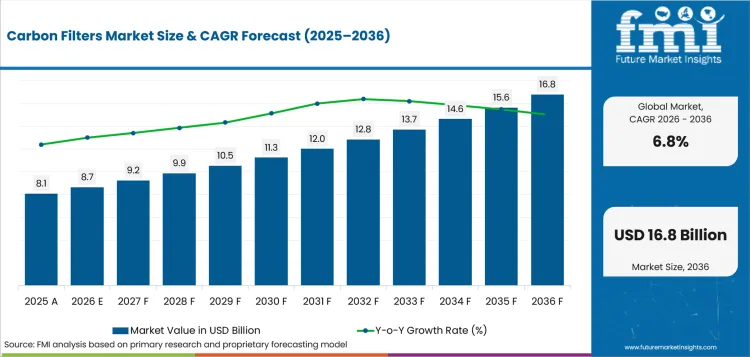
Carbon Filters Market Overview: Size and Forecast
- 2026 Market Size: USD 8.7 billion
- 2036 Market Size: USD 16.8 billion
- Forecast CAGR: 6.8% from 2026 to 2036
- Leading Sales Channel: Direct
- Direct Share in 2026: 54.0%
- Leading Product Type: GAC Filters
- GAC Filters Share in 2026: 46.0%
- Fastest-growing Country: China
- China CAGR: 7.4% by 2036
Summary of the Carbon Filters Market
- Demand and Growth Drivers
- PFAS compliance is raising demand for GAC Filters as public water systems need media with tested adsorption and clear disposal pathways.
- Industrial VOC control supports impregnated grades as buyers need carbon media tuned for acid gases, odors, and solvent vapors.
- OEM purifier programs are extending cartridge replacement revenue through branded air and water systems with scheduled refill reminders.
- Product and Segment View
- Direct sales are projected to hold 54.0% share in 2026, influenced by large users needing technical support before selecting media grade and replacement timing.
- GAC Filters are expected to account for 46.0% share in 2026, supported by utility preference for media beds that can be sampled and changed before breakthrough.
- The 6–12 Months cycle is anticipated to represent 44.0% share in 2026, guided by service plans that balance contaminant safety margins with avoidable media cost.
- Geography and Competitive Outlook
- China is forecast to record 7.4% CAGR by 2036 as industrial air treatment and water reuse projects support faster filter purchasing.
- India is expected to expand at 7.3% CAGR by 2036 as sewerage treatment capacity and purifier channels widen the application base.
- Calgon Carbon, Kuraray, Jacobi Carbons, Donau Carbon, and CarboTech compete through activated carbon media breadth and reactivation service capability.
- Xylem, 3M, Parker Hannifin, and Camfil shape downstream demand through filtration systems, cartridges, and molecular air filtration platforms.
- Analyst Opinion
- Nikhil Kaitwade, Associate Vice President at FMI, says, “Carbon filters are shifting from media buying to performance buying. Buyers want filter programs matched to contaminant profiles, service intervals, and end-of-life plans. Suppliers with reactivation assets, pilot testing depth, and application-specific media grades have the strongest commercial position.”
Compliance pressure is shaping the market outlook as official water and wastewater rules convert contaminant monitoring into treatment investment. The United States Environmental Protection Agency stated in April 2024 that its national PFAS drinking water rule would reduce exposure for about 100 million people. The European Commission reported that the revised Urban Wastewater Treatment Directive entered into force on 1 January 2025 and is expected to generate EUR 6.6 billion in annual benefits by 2045 while covering 30,354 EU urban wastewater treatment plants. The European Environment Agency reported in December 2024 that PFOS exceeded environmental quality standards in 51% to 60% of monitored rivers, 11% to 35% of monitored lakes, and 47% to 100% of monitored transitional and coastal waters during 2018 to 2022. These figures support stronger demand for carbon filters with tested adsorption life, documented changeouts, and end-of-life handling.
Which factors support expansion in the carbon filters market?
Compliance-linked water treatment, industrial gas-phase control, and recurring cartridge replacement support market value across regulated channels.
- Market value is supported by finished activated carbon media revenue before testing, changeout, and reactivation services add incremental sales.
- Supplier pricing reflects carbon source, pore structure, impregnation type, iodine number, and contaminant-specific performance before service costs are included.
- Revenue improves as utilities convert contaminant monitoring into GAC treatment projects with documented bed life and scheduled media replacement.
- Retail and OEM value rises as cartridge labels make replacement timing, filter type, and contaminant claims easier to compare.
Why is the carbon filters market growing?
PFAS treatment is creating demand for GAC Filters with tested adsorption capacity and clearer replacement schedules.
Growth outlook has become more structured as carbon filters move from general taste, odor, and polishing use into compliance-linked treatment programs. The EPA stated in May 2024 that 66,000 regulated water systems would have to conduct PFAS monitoring under the final drinking water rule. This creates a large compliance base for media testing, sampling plans, and treatment procurement. GAC suppliers gain from this shift because water systems need adsorption solutions that can be evaluated through bed-life testing and planned changeouts. Industrial users add demand by selecting carbon grades for gas-phase adsorption where particle filters cannot remove odors, solvents, and acid gases. OEM purifier brands create another demand layer as household and commercial systems generate recurring carbon block replacement.
How is the carbon filters market segmented?
The carbon filters industry is segmented by product type, application, end use, sales channel, and replacement cycle.
- GAC Filters are projected to secure 46.0% share in 2026, led by utility preference for deep-bed vessels that allow sampling and planned media replacement.
- Water Treatment is expected to hold 42.0% share in 2026, supported by PFAS, taste, odor, and organic contaminant control across municipal and commercial systems.
- Municipal end use is anticipated to account for 36.5% share in 2026, guided by public system tenders and formal changeout documentation.
- Direct sales are forecast to represent 54.0% share in 2026, influenced by large buyer demand for testing, engineering support, and reactivation planning.
- The 6-12 Months replacement cycle is estimated to hold 44.0% share in 2026, reflected by service intervals that reduce breakthrough risk without forcing excessive media waste.
Why do GAC Filters dominate the carbon filters market?
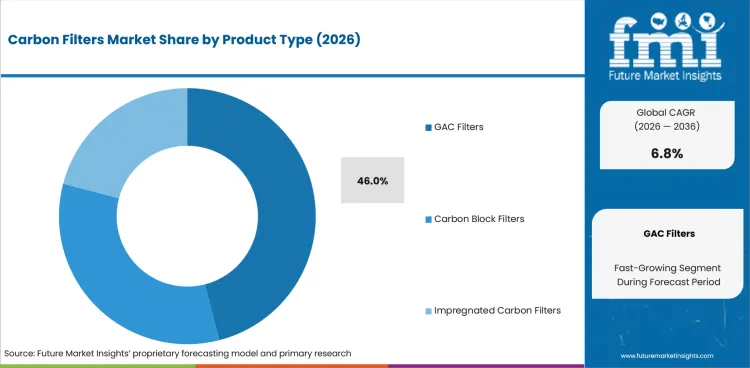
- GAC Filters are projected to account for 46.0% share in 2026 as deep-bed vessels suit municipal PFAS removal and industrial process loops with measurable adsorption life.
- Utility buyers compare empty-bed contact time and breakthrough curves before awarding GAC contracts, which makes testing data more important than simple media price.
Which application leads the carbon filters market?
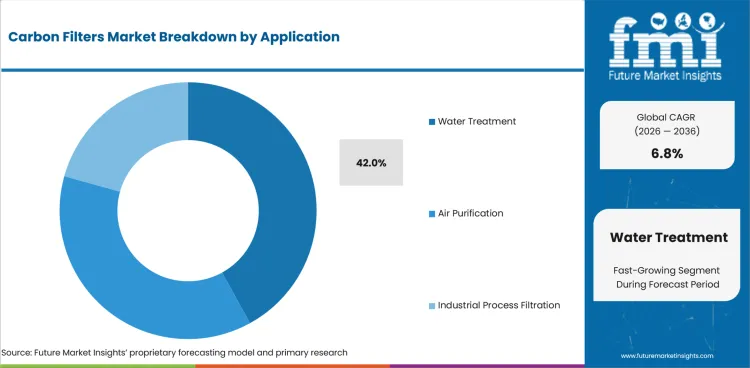
- Water Treatment is expected to represent 42.0% share in 2026 owing to drinking water and wastewater buyers needing adsorption media for PFAS, odor, and organic contaminants.
- Treatment engineers specify carbon filters alongside activated carbon fiber industry analysis when compact adsorption, rapid kinetics, and contaminant-specific design matter for tighter plant spaces.
Which end use leads the carbon filters market?
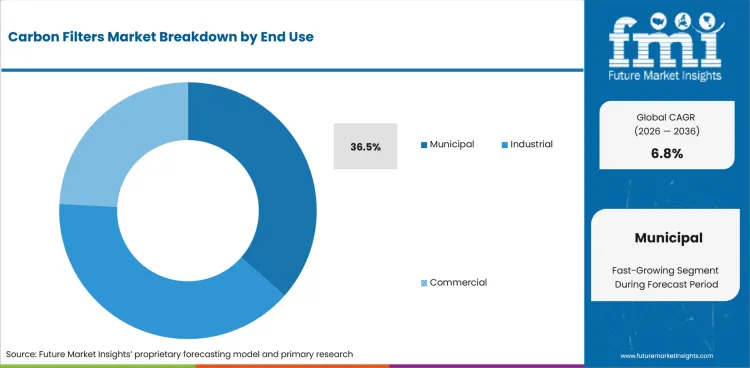
- Municipal end use is anticipated to account for 36.5% share in 2026 due to city utilities preferring supplier-backed media with lab testing and spent carbon handling.
- Public water buyers often select direct contracts for GAC media since tender terms must cover influent testing, bed changeout timing, and disposal documentation.
Which sales channel leads the carbon filters market?
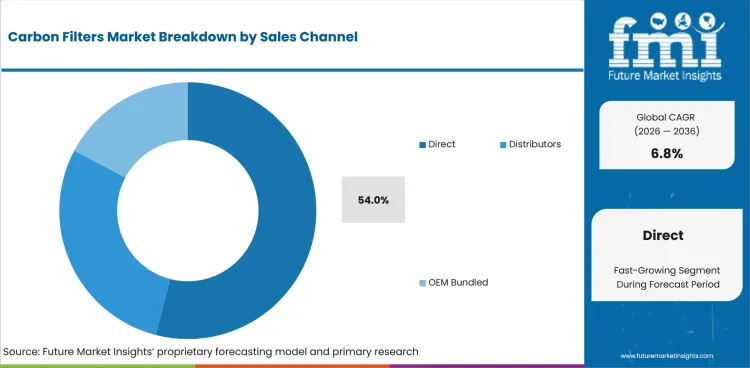
- Direct sales are projected to hold 54.0% share in 2026, attributable to large users requiring engineering support before selecting carbon grade, vessel layout, and replacement timing.
- Distributors stay important for residential cartridges and commercial HVAC filters, but direct supply gains weight when PFAS or VOC warranties are written into contracts.
Which replacement cycle leads the carbon filters market?
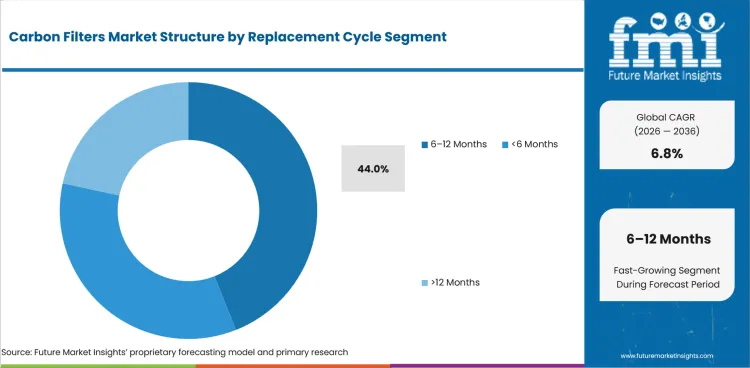
- The 6–12 Months cycle is estimated to represent 44.0% share in 2026 as buyers balance contaminant safety margins against avoidable media replacement cost.
- Shorter cycles are common in high-VOC air streams, while longer cycles work better when inlet water quality is stable and pilot testing supports confidence.
What are the driver, restraints, and opportunities in the carbon filters market?
PFAS treatment and VOC control support growth while feedstock volatility and qualification work limit faster supplier switching.
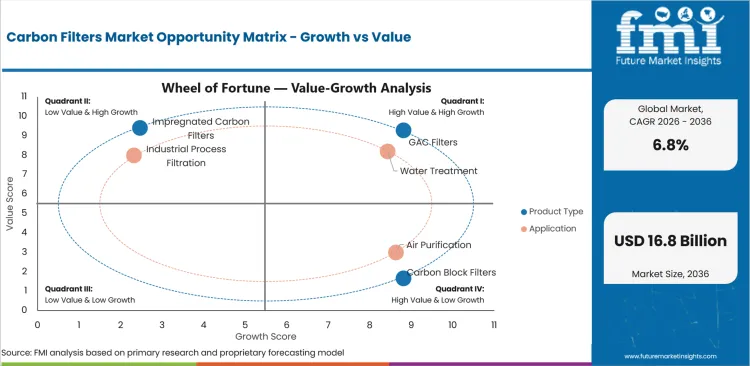
- Driver: PFAS compliance creates durable demand for GAC Filters in municipal water systems with monitored contaminant limits.
- Restraint: Feedstock volatility and qualification work can slow buying decisions for carbon block and impregnated carbon suppliers.
- Opportunity: Reactivation services can create lower-waste filter programs with stronger end-of-life documentation for large water buyers.
PFAS Bed-Life Compliance
Municipal buyers are changing carbon filter specifications around bed life and contaminant breakthrough. The EPA estimated in June 2024 that about 6% to 10% of regulated public drinking water systems subject to the final PFAS rule may need to take action to reduce PFAS. This supports pilot testing, lead-lag vessel design, and planned changeouts. The practical effect is a shift from spot media orders to service-backed contracts. Suppliers with lab support and reactivation access can protect margins because they solve both treatment performance and spent media risk.
Feedstock and Qualification Pressure
Carbon filter procurement faces restraint when buyers cannot qualify new media quickly enough for regulated water or safety-sensitive air applications. The European Environment Agency reported in December 2024 that PFOS exceeded environmental quality standards in 11% to 35% of monitored lakes during 2018 to 2022. This widens treatment attention, but it also raises testing complexity across water bodies with different contaminant profiles. Coconut-shell, coal-based, and impregnated media must be checked against contaminant targets, pressure drop, replacement cost, and disposal requirements. Buyers may delay supplier changes when documentation does not clearly connect media grade with treatment duty.
Reactivation Service Opportunity
Reactivation creates an opportunity as exhausted activated carbon becomes a cost and compliance issue for large water buyers. The European Commission stated that the revised Urban Wastewater Treatment Directive will require quaternary treatment for micropollutant removal at plants serving more than 150,000 population equivalent. This creates a stronger case for treatment technologies and service models that can manage micropollutants and spent media together. Suppliers with reactivation assets can offer lower disposal uncertainty and stronger circular service models. The opportunity is strongest where PFAS and micropollutant projects require proof of performance and clear handling of exhausted media.
Which countries are growing fastest in the carbon filters market?
China 7.4% CAGR, India 7.3% CAGR, United States 7.2% CAGR, Japan 7.1% CAGR, South Korea 7.0% CAGR, United Kingdom 6.8% CAGR, Germany 6.8% CAGR, and France 6.7% CAGR through 2036.
.webp "Top Country Growth Comparison Carbon Filters Market Cagr (2026 2036)")
| Country | CAGR |
|---|---|
| China | 7.4% |
| India | 7.3% |
| United States | 7.2% |
| Japan | 7.1% |
| South Korea | 7.0% |
| United Kingdom | 6.8% |
| Germany | 6.8% |
| France | 6.7% |
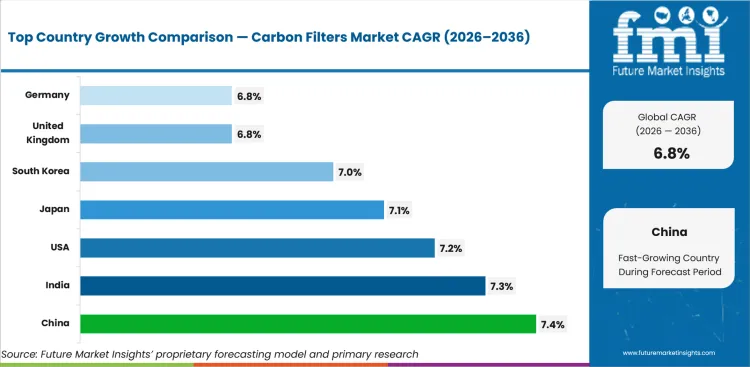
Source: Future Market Insights, 2026.
How do country-level CAGRs compare in the carbon filters market?
China leads country growth while France records the most cautious expansion outlook among profiled markets.
- China is forecast to record 7.4% CAGR by 2036 as industrial VOC control and water treatment projects support faster filter purchases.
- India is expected to expand at 7.3% CAGR from 2026 to 2036 due to wastewater investment and rising purifier replacement demand.
- The United States is projected to grow at 7.2% CAGR through 2036 as PFAS compliance creates firm utility buying schedules.
- Japan is estimated to rise at 7.1% CAGR by 2036 with compact purifier channels and upgraded PFAS standards supporting use.
- South Korea is expected to advance at 7.0% CAGR over the forecast period as fine-dust action and process filtration support demand.
- The United Kingdom and Germany are forecast to grow at 6.8% CAGR through 2036 as European water and air rules shape buying.
- France is projected to post 6.7% CAGR by 2036 as PFAS law and public water tenders support steady adoption.
What is the carbon filters market forecast for China?
A 7.4% CAGR through 2036 reflects industrial VOC control, water reuse projects, and large purifier replacement demand.
Country Market Snapshot Table
| Parameter | Value |
|---|---|
| Market Size in 2025 (Value) | USD 1,433.9 million |
| Market Size in 2026 (Value) | USD 1,540.0 million |
| Market Forecast in 2036 (Value) | USD 3,144.6 million |
| CAGR (2026 to 2036) | 7.4% |
| Years Considered | 2021 to 2036 |
| Base Year | 2025 |
| Forecast Period | 2026 to 2036 |
| Units Considered | Value (USD million) |
| Leading Sub-Region | Yangtze River Delta and industrial coastal clusters |
China Carbon Filters Market Outlook
China carbon filter demand is shaped by industrial emissions control, water treatment upgrades, and broad purifier replacement needs. Domestic production gives buyers access to standard grades, while certified water and gas-phase grades require stronger quality proof.
Engineering contractors and domestic distributors are expected to keep influencing buying decisions. Suppliers with consistent adsorption data, reliable delivery, and application-specific grades should gain stronger acceptance among factories and municipal treatment sites.
Key Growth Drivers
- Local activated carbon production gives standard GAC buyers shorter lead times and wider supplier choice for routine industrial and commercial replacements.
- High-specification impregnated grades support specialty applications where factories need media matched to solvents, odors, or acid gas exposure.
- Surface water improvement supports treatment investment. China reported that 90.4% of nationwide surface-water bodies reached excellent water quality in 2024.
- Air quality control supports gas-phase carbon demand. China reported average PM2.5 density of 29.3 micrograms per cubic meter in cities at or above prefecture level in 2024.
Key Restraints
- Price competition can compress margins for standard GAC grades when local suppliers compete on media cost rather than service proof.
- Certified water grades need stronger quality documentation before municipal buyers can approve supplier changes.
- China reported good air quality on 87.2% of days in 2024, which can moderate urgent air filtration upgrades when buyers perceive near-term air conditions as improving.
What makes China unique
China is unique due to deep activated carbon production capacity and large industrial treatment demand across air and water applications.
Key Companies
- Ningxia Huahui Activated Carbon Co. Ltd.
- Fujian Xinsen Carbon Co. Ltd.
- Calgon Carbon China
- Kuraray China
- Jacobi Carbons China
- Camfil China
- 3M China
Sales & Marketing Channels
- Engineering contractors
- Industrial distributors
- Municipal tenders
- OEM purifier programs
- Direct technical sales
- Water treatment service firms
Country Segment Breakdown Table
| Segment | Sub-Segments |
|---|---|
| By Product Type | GAC Filters · Carbon Block Filters · Impregnated Carbon Filters · Catalytic Carbon Filters |
| By Application | Water Treatment · Air Purification · Industrial Process Filtration · Food & Beverage |
| By End Use | Municipal · Industrial · Commercial · Residential |
| By Sales Channel | Direct · Distributors · OEM Bundled |
| By Replacement Cycle | <6 Months · 6–12 Months · >12 Months |
| Key Sub-Regions Covered, Major Demand Corridors | Yangtze River Delta · Pearl River Delta · Beijing-Tianjin-Hebei · Shandong · Sichuan-Chongqing · Guangdong |
Frequently Asked Questions
How fast is China carbon filters market growing?
Demand in China is expected to rise at 7.4% CAGR from 2026 to 2036, guided by water and air filtration needs.
Who leads China carbon filters market?
Ningxia Huahui Activated Carbon Co. Ltd., Fujian Xinsen Carbon Co. Ltd., Calgon Carbon China, Kuraray China compete through activated carbon media, filtration systems, and service channels.
What is driving adoption in China carbon filters market?
Adoption is driven by contaminant control, replacement planning, and buyer preference for documented adsorption performance.
How fast is the carbon filters market growing in India?
A 7.3% CAGR through 2036 is supported by wastewater investment, purifier replacement, and industrial filtration demand.
Country Market Snapshot Table
| Parameter | Value |
|---|---|
| Market Size in 2025 (Value) | USD 279.6 million |
| Market Size in 2026 (Value) | USD 300.0 million |
| Market Forecast in 2036 (Value) | USD 606.9 million |
| CAGR (2026 to 2036) | 7.3% |
| Years Considered | 2021 to 2036 |
| Base Year | 2025 |
| Forecast Period | 2026 to 2036 |
| Units Considered | Value (USD million) |
| Leading Sub-Region | Delhi NCR, Maharashtra, Gujarat, and southern industrial corridors |
India Carbon Filters Market Outlook
India carbon filter demand is influenced by wastewater capacity additions, drinking water treatment needs, and commercial purifier replacement. Buyers often compare delivered price, service availability, and cartridge compatibility before repeat orders develop.
Municipal and industrial users are expected to favor suppliers that can support site testing and routine changeout planning. OEM purifier channels should also keep carbon block cartridges relevant across urban residential and commercial installations.
Key Growth Drivers
- Sewerage treatment investment supports municipal carbon filter opportunities as the Ministry of Jal Shakti reported 218 sewerage infrastructure projects costing INR 35,698 crore with 6,610 MLD of treatment capacity in February 2026.
- Urban sanitation programs support downstream filtration demand as SBM Urban reported projects worth Rs. 11,785 crore for STPs with 4,900 MLD capacity under SBM 2.0.
- Industrial estates create demand for carbon filters in odor, solvent, and wastewater polishing applications where local service support matters.
- Residential purifier replacement supports carbon block cartridge sales as households and small businesses seek taste and odor control.
Key Restraints
- Used-water pressure can stretch project execution as urban India generates about 52,644 MLD of used water according to a December 2025 SBM technical advisory.
- Price sensitivity can slow movement from basic cartridges to higher-grade carbon blocks when buyers focus on upfront appliance cost.
- Small utilities may lack testing budgets needed to compare GAC life across influent water conditions.
What makes India unique
India is unique due to fast wastewater investment and a large purifier aftermarket that creates both municipal and household demand.
Key Companies
- Ion Exchange India Ltd.
- Thermax Limited
- Tata Chemicals Ltd.
- Eureka Forbes Ltd.
- Kent RO Systems Ltd.
- 3M India Ltd.
- Camfil India
Sales & Marketing Channels
- Municipal tenders
- Water treatment EPC firms
- Appliance retail
- Industrial distributors
- Direct institutional sales
- Service replacement networks
Country Segment Breakdown Table
| Segment | Sub-Segments |
|---|---|
| By Product Type | GAC Filters · Carbon Block Filters · Impregnated Carbon Filters · Catalytic Carbon Filters |
| By Application | Water Treatment · Air Purification · Industrial Process Filtration · Food & Beverage |
| By End Use | Municipal · Industrial · Commercial · Residential |
| By Sales Channel | Direct · Distributors · OEM Bundled |
| By Replacement Cycle | <6 Months · 6–12 Months · >12 Months |
| Key Sub-Regions Covered, Major Demand Corridors | Delhi NCR · Maharashtra · Gujarat · Tamil Nadu · Karnataka · Telangana |
Frequently Asked Questions
How fast is India carbon filters market growing?
Demand in India is expected to rise at 7.3% CAGR from 2026 to 2036, guided by water and air filtration needs.
Who leads India carbon filters market?
Ion Exchange India Ltd., Thermax Limited, Tata Chemicals Ltd., Eureka Forbes Ltd. compete through activated carbon media, filtration systems, and service channels.
What is driving adoption in India carbon filters market?
Adoption is driven by contaminant control, replacement planning, and buyer preference for documented adsorption performance.
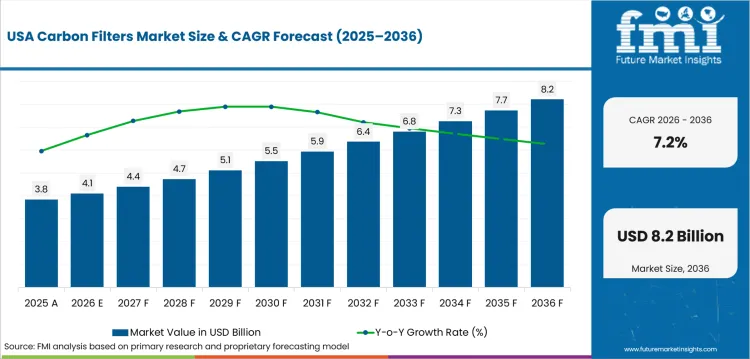
What is driving carbon filters growth in the United States?
A 7.2% CAGR through 2036 is supported by PFAS compliance and national reactivation capacity.
Country Market Snapshot Table
| Parameter | Value |
|---|---|
| Market Size in 2025 (Value) | USD 1,959.0 million |
| Market Size in 2026 (Value) | USD 2,100.0 million |
| Market Forecast in 2036 (Value) | USD 4,208.9 million |
| CAGR (2026 to 2036) | 7.2% |
| Years Considered | 2021 to 2036 |
| Base Year | 2025 |
| Forecast Period | 2026 to 2036 |
| Units Considered | Value (USD million) |
| Leading Sub-Region | Midwest, Great Lakes, and national municipal water networks |
United States Carbon Filters Market Outlook
United States buyers treat carbon filters as compliance equipment when PFAS is the target. Public water systems are moving toward GAC vessels, pilot testing, and reactivation service contracts as treatment duties become more formal.
Direct sales are expected to dominate large projects since utilities need bed-life modeling, influent testing, and spent media plans. Industrial users add demand through VOC control and process filtration requirements.
Key Growth Drivers
- EPA PFAS limits support municipal GAC projects as the final rule set 4.0 ppt maximum contaminant levels for PFOA and PFOS.
- Treatment planning supports wider GAC use as EPA identified granular activated carbon as an affordable option for systems serving 25 to 500 people and all larger systems.
- Domestic reactivation service supports public water buyers by giving spent carbon a clearer handling route after PFAS treatment.
- Industrial VOC and odor control demand supports impregnated carbon filters in manufacturing, energy, and commercial building applications.
Key Restraints
- Long utility bids can delay media switching when engineering tests and public procurement approvals must be completed.
- Implementation timelines can pressure smaller systems. EPA proposed a 2-year extension framework for eligible systems facing PFOA and PFOS compliance challenges.
- Feedstock price swings can alter GAC contract economics before suppliers secure replacement volumes.
What makes United States unique
The United States is unique due to enforceable PFAS drinking water limits, domestic GAC supply, and large reactivation investments.
Key Companies
- Calgon Carbon Corporation
- Kuraray America Inc.
- Arq, Inc.
- Xylem Inc.
- 3M Company
- Ingevity Corporation
- Parker Hannifin Corporation
Sales & Marketing Channels
- Direct utility contracts
- Industrial engineering sales
- Water treatment distributors
- OEM purifier programs
- Municipal tenders
- Service-backed reactivation contracts
Country Segment Breakdown Table
| Segment | Sub-Segments |
|---|---|
| By Product Type | GAC Filters · Carbon Block Filters · Impregnated Carbon Filters · Catalytic Carbon Filters |
| By Application | Water Treatment · Air Purification · Industrial Process Filtration · Food & Beverage |
| By End Use | Municipal · Industrial · Commercial · Residential |
| By Sales Channel | Direct · Distributors · OEM Bundled |
| By Replacement Cycle | <6 Months · 6–12 Months · >12 Months |
| Key Sub-Regions Covered, Major Demand Corridors | Midwest · Great Lakes · South Atlantic · Texas · California · Northeast |
Frequently Asked Questions
How fast is United States carbon filters market growing?
Demand in United States is expected to rise at 7.2% CAGR from 2026 to 2036, guided by water and air filtration needs.
Who leads United States carbon filters market?
Calgon Carbon Corporation, Kuraray America Inc., Arq, Inc., Xylem Inc. compete through activated carbon media, filtration systems, and service channels.
What is driving adoption in United States carbon filters market?
Adoption is driven by contaminant control, replacement planning, and buyer preference for documented adsorption performance.
What is the carbon filters market forecast for Japan?
A 7.1% CAGR through 2036 reflects compact purifier channels and upgraded PFAS standards.
Country Market Snapshot Table
| Parameter | Value |
|---|---|
| Market Size in 2025 (Value) | USD 541.5 million |
| Market Size in 2026 (Value) | USD 580.0 million |
| Market Forecast in 2036 (Value) | USD 1,151.7 million |
| CAGR (2026 to 2036) | 7.1% |
| Years Considered | 2021 to 2036 |
| Base Year | 2025 |
| Forecast Period | 2026 to 2036 |
| Units Considered | Value (USD million) |
| Leading Sub-Region | Tokyo, Kansai, and compact purifier replacement corridors |
Japan Carbon Filters Market Outlook
Japan demand is shaped by compact systems and strict quality expectations. Buyers place high weight on documented filter life, low dust, stable pressure drop, and cartridge compatibility.
Corporate links to global activated carbon supply improve product availability. OEM bundled channels remain important as residential and commercial users replace cartridges through appliance and service networks.
Key Growth Drivers
- PFAS standards support water treatment demand as Japan elevated the 50 ng/L provisional target for total PFOS and PFOA into drinking water quality standards in April 2026.
- Chemical control widens supplier attention. Japan’s environment ministry material lists 39 Class I specified chemical substances under national chemical management.
- Compact purifier designs favor carbon block cartridges and OEM bundled refills in homes, offices, and service locations.
- High-specification process filtration supports premium carbon grades in electronics, food processing, and precision manufacturing applications.
Key Restraints
- Mandatory testing can raise supplier workload as Japan’s April 2026 change requires drinking water suppliers to follow inspection and compliance duties.
- Compact systems limit media volume and may shorten replacement intervals when inlet water quality varies.
- Additional PFAS review can slow product qualification. Japan’s Ministry of the Environment stated in 2025 that 8 other PFAS substances had been designated as items requiring consideration.
What makes Japan unique
Japan is unique due to compact purifier design needs and corporate links to global activated carbon supply chains.
Key Companies
- Kuraray Co. Ltd.
- Calgon Carbon Japan
- Osaka Gas Chemicals Co. Ltd.
- Jacobi Carbons Japan
- 3M Japan Limited
- Toray Industries Inc.
- Organo Corporation
Sales & Marketing Channels
- OEM bundled cartridges
- Direct industrial sales
- Water utility procurement
- Home appliance retail
- Technical distributors
- Service replacement networks
Country Segment Breakdown Table
| Segment | Sub-Segments |
|---|---|
| By Product Type | GAC Filters · Carbon Block Filters · Impregnated Carbon Filters · Catalytic Carbon Filters |
| By Application | Water Treatment · Air Purification · Industrial Process Filtration · Food & Beverage |
| By End Use | Municipal · Industrial · Commercial · Residential |
| By Sales Channel | Direct · Distributors · OEM Bundled |
| By Replacement Cycle | <6 Months · 6–12 Months · >12 Months |
| Key Sub-Regions Covered, Major Demand Corridors | Tokyo · Osaka · Nagoya · Yokohama · Fukuoka · Sapporo |
Frequently Asked Questions
How fast is Japan carbon filters market growing?
Demand in Japan is expected to rise at 7.1% CAGR from 2026 to 2036, guided by water and air filtration needs.
Who leads Japan carbon filters market?
Kuraray Co. Ltd., Calgon Carbon Japan, Osaka Gas Chemicals Co. Ltd., Jacobi Carbons Japan compete through activated carbon media, filtration systems, and service channels.
What is driving adoption in Japan carbon filters market?
Adoption is driven by contaminant control, replacement planning, and buyer preference for documented adsorption performance.
How is the carbon filters market performing in South Korea?
A 7.0% CAGR through 2036 is supported by fine-dust action, purifier use, and process filtration.
Country Market Snapshot Table
| Parameter | Value |
|---|---|
| Market Size in 2025 (Value) | USD 308.4 million |
| Market Size in 2026 (Value) | USD 330.0 million |
| Market Forecast in 2036 (Value) | USD 649.2 million |
| CAGR (2026 to 2036) | 7.0% |
| Years Considered | 2021 to 2036 |
| Base Year | 2025 |
| Forecast Period | 2026 to 2036 |
| Units Considered | Value (USD million) |
| Leading Sub-Region | Seoul metropolitan area and industrial southern corridors |
South Korea Carbon Filters Market Outlook
South Korea demand is shaped by air quality programs, compact purifier adoption, and precision industrial filtration. Buyers often seek cartridge reliability, low odor, and supplier consistency in indoor and process applications.
Industrial plants and building managers are expected to keep using carbon media where gases and odors cannot be handled by particle filters alone. Domestic service channels can help replacement programs remain regular.
Key Growth Drivers
- Air quality action supports gas-phase filtration as the Ministry of Environment said its fifth seasonal plan aimed to reduce fine dust and precursors by about 108,000 tons.
- Indoor air management supports purifier and HVAC demand as March has averaged nine bad PM2.5 days during 2016 to 2023 in official ministry reporting.
- Electronics and chemical manufacturing support process filtration where carbon media removes odor, solvents, and trace organic contaminants.
- Service networks support recurring cartridge sales across apartment, office, school, and commercial purifier installations.
Key Restraints
- Seasonal demand can fluctuate as public concern rises during high fine-dust periods and softens during cleaner months.
- High replacement expectations can raise cost pressure when building managers compare carbon cartridges with lower-cost particle filters.
- The same ministry release noted March PM2.5 averaged 27.7㎍/㎥ during 2016 to 2023, which keeps purifier demand seasonal and sensitive to weather patterns.
What makes South Korea unique
South Korea is unique due to indoor air quality sensitivity and dense urban purifier replacement channels.
Key Companies
- Coway Co. Ltd.
- LG Electronics Inc.
- Samsung Electronics Co. Ltd.
- Kuraray Korea
- Camfil Korea
- 3M Korea
- Kolon Industries Inc.
Sales & Marketing Channels
- Appliance service networks
- HVAC distributors
- Industrial direct sales
- Online replacement stores
- Municipal procurement
- Building facility managers
Country Segment Breakdown Table
| Segment | Sub-Segments |
|---|---|
| By Product Type | GAC Filters · Carbon Block Filters · Impregnated Carbon Filters · Catalytic Carbon Filters |
| By Application | Water Treatment · Air Purification · Industrial Process Filtration · Food & Beverage |
| By End Use | Municipal · Industrial · Commercial · Residential |
| By Sales Channel | Direct · Distributors · OEM Bundled |
| By Replacement Cycle | <6 Months · 6–12 Months · >12 Months |
| Key Sub-Regions Covered, Major Demand Corridors | Seoul · Incheon · Gyeonggi · Busan · Ulsan · Daegu |
Frequently Asked Questions
How fast is South Korea carbon filters market growing?
Demand in South Korea is expected to rise at 7.0% CAGR from 2026 to 2036, guided by water and air filtration needs.
Who leads South Korea carbon filters market?
Coway Co. Ltd., LG Electronics Inc., Samsung Electronics Co. Ltd., Kuraray Korea compete through activated carbon media, filtration systems, and service channels.
What is driving adoption in South Korea carbon filters market?
Adoption is driven by contaminant control, replacement planning, and buyer preference for documented adsorption performance.
What is the carbon filters market outlook in the United Kingdom?
A 6.8% CAGR through 2036 reflects PFAS planning, utility frameworks, and industrial treatment demand.
Country Market Snapshot Table
| Parameter | Value |
|---|---|
| Market Size in 2025 (Value) | USD 383.9 million |
| Market Size in 2026 (Value) | USD 410.0 million |
| Market Forecast in 2036 (Value) | USD 791.6 million |
| CAGR (2026 to 2036) | 6.8% |
| Years Considered | 2021 to 2036 |
| Base Year | 2025 |
| Forecast Period | 2026 to 2036 |
| Units Considered | Value (USD million) |
| Leading Sub-Region | England water utility frameworks and national industrial clusters |
United Kingdom Carbon Filters Market Outlook
United Kingdom demand is shaped by risk management before statutory PFAS drinking water limits are fully defined. Utilities and industrial sites are using monitoring, consultant input, and framework buying to decide where GAC filtration is needed.
Carbon filter adoption is expected to be site-specific, especially where source water, landfill leachate, or industrial effluent risk creates treatment pressure. Suppliers with clear testing evidence and UK service access should gain stronger acceptance.
Key Growth Drivers
- PFAS planning supports monitoring-led demand as the UK Government stated in February 2026 that England and Wales require water companies to monitor and report the sum of 48 named PFAS.
- Reporting discipline supports treatment planning because 0.1 µg/L and above must be reported to the Drinking Water Inspectorate under updated guidance.
- Utility framework agreements create repeat buying opportunities once GAC filtration and service models are approved for specific sites.
- Landfill leachate and industrial effluent risks create targeted demand for carbon filters in high-risk water and wastewater applications.
Key Restraints
- Non-statutory PFAS standards can delay full treatment investment at lower-risk sites while utilities wait for clearer national requirements.
- Public budget cycles can stretch project timing when carbon filtration competes with other water network investments.
- Ofwat’s PR24 final determinations set expenditure allowances up to GBP 104 billion, making carbon filtration compete inside a large but closely reviewed water investment plan.
What makes United Kingdom unique
The United Kingdom is unique due to monitoring-led PFAS planning and utility framework procurement.
Key Companies
- Camfil UK
- Xylem Water Solutions UK Ltd.
- Jacobi Carbons UK
- Kuraray Europe UK channels
- 3M United Kingdom PLC
- Parker Hannifin UK
- Veolia Water Technologies UK
Sales & Marketing Channels
- Utility framework agreements
- Engineering consultant specifications
- Industrial water service firms
- HVAC filtration distributors
- Public procurement channels
- OEM replacement networks
Country Segment Breakdown Table
| Segment | Sub-Segments |
|---|---|
| By Product Type | GAC Filters · Carbon Block Filters · Impregnated Carbon Filters · Catalytic Carbon Filters |
| By Application | Water Treatment · Air Purification · Industrial Process Filtration · Food & Beverage |
| By End Use | Municipal · Industrial · Commercial · Residential |
| By Sales Channel | Direct · Distributors · OEM Bundled |
| By Replacement Cycle | <6 Months · 6–12 Months · >12 Months |
| Key Sub-Regions Covered, Major Demand Corridors | London · Midlands · North West · Yorkshire · Scotland · Wales |
Frequently Asked Questions
How fast is United Kingdom carbon filters market growing?
Demand in United Kingdom is expected to rise at 6.8% CAGR from 2026 to 2036, guided by water and air filtration needs.
Who leads United Kingdom carbon filters market?
Camfil UK, Xylem Water Solutions UK Ltd., Jacobi Carbons UK, Kuraray Europe UK channels compete through activated carbon media, filtration systems, and service channels.
What is driving adoption in United Kingdom carbon filters market?
Adoption is driven by contaminant control, replacement planning, and buyer preference for documented adsorption performance.
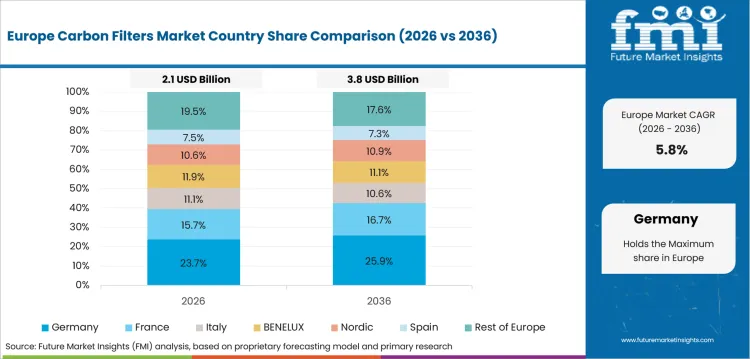
What is driving carbon filters growth in Germany?
A 6.8% CAGR through 2036 reflects European water rules, industrial air treatment, and local carbon expertise.
Country Market Snapshot Table
| Parameter | Value |
|---|---|
| Market Size in 2025 (Value) | USD 580.5 million |
| Market Size in 2026 (Value) | USD 620.0 million |
| Market Forecast in 2036 (Value) | USD 1,197.0 million |
| CAGR (2026 to 2036) | 6.8% |
| Years Considered | 2021 to 2036 |
| Base Year | 2025 |
| Forecast Period | 2026 to 2036 |
| Units Considered | Value (USD million) |
| Leading Sub-Region | North Rhine-Westphalia and national industrial water networks |
Germany Carbon Filters Market Outlook
Germany uses carbon filters in a technical procurement environment where certification and documentation carry high weight. Municipal and industrial buyers compare service reliability, test data, and reactivation options before supplier changes.
Local activated carbon and reactivation expertise supports a stronger service base than in many European markets. Industrial users often select direct technical sales when contaminant profiles are complex.
Key Growth Drivers
- EU drinking water limits support treatment checks as the recast directive sets total PFAS at 0.5 µg/L and 20 individual PFAS at 0.1 µg/L.
- Urban wastewater duties support advanced treatment planning as the revised directive requires collection and treatment of wastewater in urban areas above 1,000 inhabitants.
- German reactivation capability supports circular handling of spent carbon where buyers need disposal documentation.
- Industrial VOC and odor control demand supports impregnated carbon use in chemicals, automotive, food processing, and building ventilation.
Key Restraints
- Buyers need clear waste classification before accepting spent carbon reactivation routes in public or industrial contracts.
- Supplier qualification can slow when tenders require certification, testing data, and service references before contract awards.
- EEA reported that 51% to 60% of monitored European rivers exceeded PFOS environmental quality standards, which increases treatment scrutiny but also raises testing complexity.
What makes Germany unique
Germany is unique due to local activated carbon expertise and strict documentation habits across water and industrial buyers.
Key Companies
- Donau Carbon GmbH
- CarboTech AC GmbH
- Kuraray Europe GmbH
- Camfil GmbH
- 3M Deutschland GmbH
- Xylem Water Solutions Deutschland GmbH
- Parker Hannifin GmbH
Sales & Marketing Channels
- Direct industrial sales
- Municipal utility tenders
- Technical distributors
- Reactivation service contracts
- HVAC filtration channels
- Engineering contractor specifications
Country Segment Breakdown Table
| Segment | Sub-Segments |
|---|---|
| By Product Type | GAC Filters · Carbon Block Filters · Impregnated Carbon Filters · Catalytic Carbon Filters |
| By Application | Water Treatment · Air Purification · Industrial Process Filtration · Food & Beverage |
| By End Use | Municipal · Industrial · Commercial · Residential |
| By Sales Channel | Direct · Distributors · OEM Bundled |
| By Replacement Cycle | <6 Months · 6–12 Months · >12 Months |
| Key Sub-Regions Covered, Major Demand Corridors | North Rhine-Westphalia · Bavaria · Baden-Württemberg · Hesse · Lower Saxony · Berlin-Brandenburg |
Frequently Asked Questions
North Rhine-Westphalia · Bavaria · Baden-Württemberg · Hesse · Lower Saxony · Berlin-Brandenburg
Demand in Germany is expected to rise at 6.8% CAGR from 2026 to 2036, guided by water and air filtration needs.
Who leads Germany carbon filters market?
Donau Carbon GmbH, CarboTech AC GmbH, Kuraray Europe GmbH, Camfil GmbH compete through activated carbon media, filtration systems, and service channels.
What is driving adoption in Germany carbon filters market?
Adoption is driven by contaminant control, replacement planning, and buyer preference for documented adsorption performance.
How is the carbon filters market performing in France?
A 6.7% CAGR through 2036 is supported by PFAS law, public water tenders, and industrial discharge control.
Country Market Snapshot Table
| Parameter | Value |
|---|---|
| Market Size in 2025 (Value) | USD 365.5 million |
| Market Size in 2026 (Value) | USD 390.0 million |
| Market Forecast in 2036 (Value) | USD 745.9 million |
| CAGR (2026 to 2036) | 6.7% |
| Years Considered | 2021 to 2036 |
| Base Year | 2025 |
| Forecast Period | 2026 to 2036 |
| Units Considered | Value (USD million) |
| Leading Sub-Region | Paris Basin and national public water tender corridors |
France Carbon Filters Market Outlook
France is moving toward stronger PFAS monitoring and public water accountability. Carbon filters become attractive where operators need a proven adsorption step before drinking water supply, wastewater discharge, or process reuse.
French buyers often use formal tender documents and consultant approval before changing filter suppliers. Technical dossiers, contaminant proof, and service coverage therefore influence carbon filter sales.
Key Growth Drivers
- PFAS discharge checks support industrial water treatment. France’s PFAS monitoring campaign requires analysis of 20 PFAS substances in aqueous discharges from selected classified installations.
- Air emission monitoring supports gas-phase filtration review. France’s waste thermal treatment campaign requires systematic analysis of 49 PFAS substances in air emissions.
- Food and beverage processing supports carbon filters for color, odor, and taste control where product quality depends on polishing steps.
- Public water tenders create demand for suppliers that can document adsorption performance and provide replacement support.
Key Restraints
- Implementation timing can push treatment spending into later budget cycles when public buyers wait for detailed enforcement steps.
- Formal procurement can lengthen supplier changes when dossiers, samples, and consultant approval are required.
- EU wastewater rules require quaternary treatment at plants serving more than 150,000 population equivalent, which can raise project cost and delay procurement sequencing.
What makes France unique
France is unique due to PFAS law linking public water monitoring with industrial discharge cost exposure.
Key Companies
- Camfil France
- Xylem France
- Kuraray Europe France channels
- Jacobi Carbons France channels
- Veolia Water Technologies
- Suez Water Technologies
- 3M France
Sales & Marketing Channels
- Public water tenders
- Industrial treatment contractors
- HVAC distributors
- Food processing equipment channels
- Direct technical sales
- Environmental service firms
Country Segment Breakdown Table
| Segment | Sub-Segments |
|---|---|
| By Product Type | GAC Filters · Carbon Block Filters · Impregnated Carbon Filters · Catalytic Carbon Filters |
| By Application | Water Treatment · Air Purification · Industrial Process Filtration · Food & Beverage |
| By End Use | Municipal · Industrial · Commercial · Residential |
| By Sales Channel | Direct · Distributors · OEM Bundled |
| By Replacement Cycle | <6 Months · 6–12 Months · >12 Months |
| Key Sub-Regions Covered, Major Demand Corridors | Paris · Auvergne-Rhône-Alpes · Hauts-de-France · Nouvelle-Aquitaine · Grand Est · Occitanie |
Frequently Asked Questions
How fast is France carbon filters market growing?
Demand in France is expected to rise at 6.7% CAGR from 2026 to 2036, guided by water and air filtration needs.
Who leads France carbon filters market?
Camfil France, Xylem France, Kuraray Europe France channels, Jacobi Carbons France channels compete through activated carbon media, filtration systems, and service channels.
What is driving adoption in France carbon filters market?
Adoption is driven by contaminant control, replacement planning, and buyer preference for documented adsorption performance.
Who are the leading companies in the carbon filters market?
Calgon Carbon, Kuraray, Jacobi Carbons, Donau Carbon and CarboTech lead with Xylem, 3M, Parker Hannifin and Camfil among other suppliers.
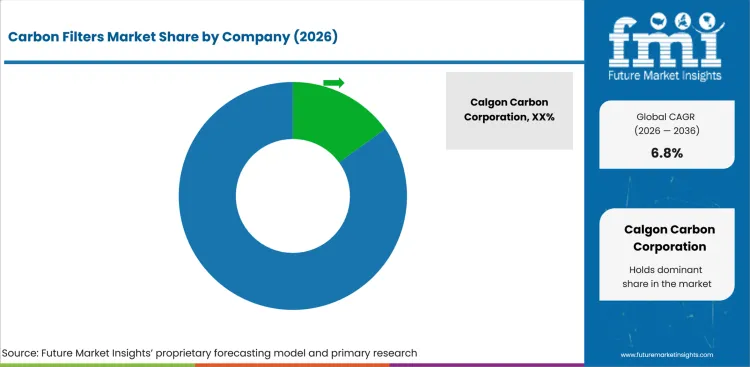
- Established activated carbon suppliers hold an advantage through media grade breadth and reactivation service access.
- System suppliers gain buyer trust by integrating carbon filters into water treatment, HVAC, and process filtration platforms.
- Regional carbon specialists compete through technical support, reactivation knowledge, and faster service availability.
- OEM-linked suppliers gain recurring sales by designing cartridges with clear replacement timing and fit-specific formats.
Competition in the carbon filters market is shaped by activated carbon supply, reactivation capacity, cartridge design, and application-specific media performance. Suppliers with proof of contaminant removal, reliable media sourcing, and service networks are better positioned than sellers offering only commodity carbon. Municipal and industrial buyers evaluate pilot data, spent media handling, and technical support before awarding large contracts. OEM purifier brands evaluate fit, dust control, taste performance, and repeat replacement economics before selecting cartridge partners.
Calgon Carbon and Kuraray hold strong positions through GAC media, PFAS treatment credibility, and reactivation assets. Jacobi Carbons and Donau Carbon compete through carbon grade breadth and regional supply programs. CarboTech supports technical European applications with activated carbon expertise. Xylem, 3M, Parker Hannifin, and Camfil influence specification through treatment systems, cartridges, and molecular filtration platforms. Suppliers that combine certified media, reactivation access, and application engineering should be best positioned to win longer service contracts.
How do top carbon filters companies compare?
Calgon Carbon and Kuraray score strongest on reactivation depth while Jacobi Carbons and Donau Carbon show strong regional media positions.
| Company | Relevance to Market Title | Activated Carbon Portfolio | Reactivation Capability | Water Treatment Exposure | Air Filtration Exposure | Geographic Footprint |
|---|---|---|---|---|---|---|
| Calgon Carbon Corporation | Very High | Very Strong | Very Strong | Very Strong | Strong | Global |
| Kuraray Co. Ltd. | Very High | Very Strong | Very Strong | Very Strong | Strong | Global |
| Jacobi Carbons | High | Very Strong | Strong | Strong | Strong | Global |
| Donau Carbon GmbH | High | Strong | Strong | Strong | Strong | Europe |
| CarboTech AC GmbH | High | Strong | Strong | Strong | Moderate | Europe |
| Xylem Inc. | High | Moderate | Moderate | Very Strong | Moderate | Global |
| 3M Company | High | Strong | Limited | Strong | Strong | Global |
| Parker Hannifin Corporation | Moderate | Moderate | Limited | Strong | Strong | Global |
| Camfil AB | High | Strong | Limited | Moderate | Very Strong | Global |
| Ingevity Corporation | Moderate | Strong | Limited | Moderate | Strong | United States |
Source: Future Market Insights competitive analysis, 2026.
Key Developments in Carbon Filters Market
- In February 2026, Calgon Carbon announced nearly USD 100 million of investment to add about 27 million pounds per year of drinking water carbon reactivation capacity in Ohio, with operations expected in Q1 2028.
- In December 2025, Calgon Carbon announced USA Patent No. 12,478,948 for using reactivated carbon to remove PFAS from water, strengthening its service-backed PFAS treatment position.
- In February 2026, Kemira announced plans to build an activated carbon reactivation plant in Tarragona, Spain, supporting drinking water and wastewater treatment customers in Iberia.
Who are the key players in the carbon filters market?
Calgon Carbon, Kuraray and Jacobi Carbons are listed with Donau Carbon and CarboTech among other suppliers.
Key global companies leading the carbon filters market include:
- Calgon Carbon Corporation
- Kuraray Co. Ltd.
- Jacobi Carbons AB
- Donau Carbon GmbH
- CarboTech AC GmbH
- Xylem Inc.
- 3M Company
- Parker Hannifin Corporation
- Camfil AB
- Ingevity Corporation
- Kemira Oyj
- Ion Exchange India Ltd.
- Thermax Limited
- Coway Co. Ltd.
- Eureka Forbes Ltd.
Carbon Filters Market - Report Scope
| Parameter | Details |
|---|---|
| Forecast period | 2026 to 2036 |
| Base year | 2025 |
| Historical period | 2021 to 2025 |
| Market size in 2026 | USD 8.7 billion |
| Market forecast in 2036 | USD 16.8 billion |
| Forecast CAGR | 6.8% |
| Units considered | Value (USD million) |
| Segments covered | Product Type, Application, End Use, Sales Channel, Replacement Cycle, and Region |
| Regions covered | North America, Latin America, Europe, East Asia, South Asia and Pacific, and Middle East and Africa |
| Countries profiled | United States, United Kingdom, Germany, France, Japan, China, South Korea, and India |
| Companies profiled | Calgon Carbon, Kuraray, Jacobi Carbons, Donau Carbon, CarboTech, Xylem, 3M, Parker Hannifin, Camfil, Ingevity, and other participants |
Source: Future Market Insights, 2026.
Carbon Filters Market - Scope & Definition
| Attribute | Detail |
|---|---|
| Market Definition | Activated carbon media and filter assemblies that remove contaminants by adsorption in water, air, and process streams. |
| Product Scope | GAC Filters, Carbon Block Filters, Impregnated Carbon Filters, and Catalytic Carbon Filters. |
| Application Scope | Water Treatment, Air Purification, Industrial Process Filtration, and Food & Beverage. |
| Revenue Scope | Replacement media, cartridge formats, system-bundled carbon elements, and service-backed filter programs. |
| Exclusions | Reverse osmosis membranes, UV units, ion exchange resins, sediment-only cartridges, ceramic filters, HEPA-only filters, and non-carbon filtration equipment. |
| Stakeholders | Activated carbon suppliers, water utilities, industrial users, OEM purifier brands, distributors, service providers, and regulators. |
Carbon Filters Market - Research Methodology
| Method | Description |
|---|---|
| Primary Research | FMI analyst interviews with water utility buyers, industrial filtration users, OEM purifier teams, distributors, and activated carbon suppliers. |
| Desk Research | Review of water quality guidance, PFAS treatment references, company product information, and public statements on activated carbon capacity. |
| Market Sizing and Forecasting | Modeling based on media volume, cartridge replacement pricing, regulatory exposure, country-level demand, and application use rates. |
| Data Validation | Cross-checks across water treatment demand, air purification use, industrial VOC control needs, and supplier portfolio depth. |
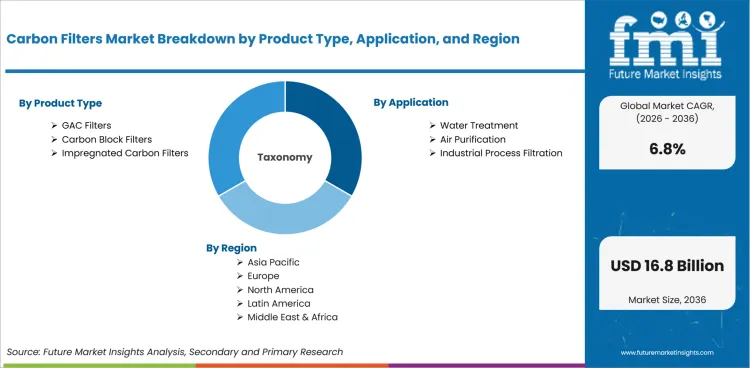
Carbon Filters Market Breakdown by Product Type, Application, End Use, Sales Channel, Replacement Cycle, and Region
Carbon Filters Market Segmented by Product Type
- GAC Filters
- Carbon Block Filters
- Impregnated Carbon Filters
- Catalytic Carbon Filters
Carbon Filters Market Segmented by Application
- Water Treatment
- Air Purification
- Industrial Process Filtration
- Food & Beverage
Carbon Filters Market Segmented by End Use
- Municipal
- Industrial
- Commercial
- Residential
Carbon Filters Market Segmented by Sales Channel
- Direct
- Distributors
- OEM Bundled
Carbon Filters Market Segmented by Replacement Cycle
- <6 Months
- 6–12 Months
- >12 Months
Carbon Filters Market by Region
- North America
- Latin America
- Europe
- East Asia
- South Asia and Pacific
- Middle East and Africa
Research Sources and Bibliography
- Calgon Carbon Corporation. (2025, December 9). Calgon Carbon announces USA patent covering reactivated carbon for PFAS removal from water.
- Calgon Carbon Corporation. (2026, February 26). Calgon Carbon announces nearly $100 million investment to expand drinking water carbon reactivation capacity in Ohio.
- European Commission. (2025, January 1). Urban wastewater.
- European Environment Agency. (2024, April 22). Treatment of drinking water to remove PFAS.
- European Environment Agency. (2024, December 9). PFAS pollution in European waters.
- Government of the United Kingdom, Department for Environment, Food & Rural Affairs. (2026, February 3). PFAS: Per- and polyfluoroalkyl substances.
- Kemira Oyj. (2026, February 17). Kemira plans to build activated carbon reactivation plant in Tarragona, Spain.
- Kuraray Co., Ltd. (2026, February 27). Calgon Carbon to expand activated carbon reactivation capacity in the United States.
- Ministry of Climate, Energy and Environment, Republic of Korea. (2024, February 27). Reducing fine dust during the spring season: Protecting public health through cross-agency comprehensive response.
- Ministry of Ecology and Environment of the People’s Republic of China. (2025, January). China’s policies and actions for addressing climate change 2024 annual report.
- Ministry of Housing and Urban Affairs. (2025, December). Technical advisory on used water management under Swachh Bharat Mission Urban 2.0.
- Ministry of Jal Shakti. (2026, February 6). Projects sanctioned under Namami Gange and sewerage infrastructure development.
- Organisation for Economic Co-operation and Development. (2025, February 27). France passes law to regulate PFAS in consumer products, industrial discharges and drinking water.
- Organisation for Economic Co-operation and Development. (2026, April). Per- and polyfluoroalkyl substances and alternatives in Japan: Country information file.
- Ministry of the Environment, Government of Japan. (2025, May). Progress and latest developments in Japan’s chemical management policy.
- USA Environmental Protection Agency. (2024, April). Water treatment technologies for PFAS.
- USA Environmental Protection Agency. (2024, April 10). Final PFAS National Primary Drinking Water Regulation.
- USA Environmental Protection Agency. (2026, April 23). Interim guidance on the destruction and disposal of PFAS and PFAS-containing materials.
- USA Environmental Protection Agency. (2026, May 20). Proposed PFOA and PFOS compliance extension rule.
- USA Environmental Protection Agency. (2026). Fifth Unregulated Contaminant Monitoring Rule.
- USA Environmental Protection Agency. (2024, May). Final PFAS National Primary Drinking Water Regulation: General overview webinar presentation.
This bibliography is provided for reader reference and is not exhaustive. The full report contains the complete reference list and detailed citations.
This Report Answers
- Market size estimates for 2026 and forecasts through 2036 for the carbon filters market.
- Insights across more than 30 regional and country-level markets.
- Analysis of demand drivers, contaminant control requirements, replacement cycles, and purchasing behavior.
- Evaluation of product types, applications, end uses, sales channels, and replacement cycle dynamics.
- Assessment of PFAS rules, wastewater treatment programs, VOC control needs, and reactivation service opportunities.
- Identification of opportunities across GAC Filters, carbon block cartridges, impregnated carbon filters, and catalytic grades.
- Evaluation of supply chain dynamics, activated carbon sourcing, technical support, and service contract structures.
- Country-level growth analysis covering the United States, United Kingdom, Germany, France, Japan, China, South Korea, and India.
- Assessment of the competitive landscape, including activated carbon manufacturers, filtration system suppliers, and service providers.
- Analysis of buyer preferences, media qualification requirements, and recurring replacement revenue opportunities.
- Regional outlooks across North America, Europe, East Asia, South Asia and Pacific, and other covered regions.
- Delivery of market data, forecasts, and supporting analysis in PDF and Excel formats.
Frequently Asked Questions
What is the growth prospect for carbon filters?
Demand for carbon filters is expected to rise at a considerable pace as PFAS compliance, industrial VOC control, and purifier replacement cycles increase filter use.
Which companies are expected to shape the carbon filters market?
Calgon Carbon, Kuraray, Jacobi Carbons, Donau Carbon, CarboTech, Xylem, 3M, Camfil, and Parker Hannifin are expected to shape competitive activity.
Why are leading suppliers investing in carbon filters?
Leading suppliers are investing in carbon filters to serve compliance-linked water treatment, gas-phase air filtration, and recurring cartridge replacement programs.
Why is reactivation important in the carbon filters market?
Reactivation is important since large buyers need spent carbon handling, lower waste exposure, and clearer end-of-life documentation.
Which product format leads the carbon filters market?
GAC Filters lead the market as utilities and industrial buyers can test bed exhaustion and plan changeouts before contaminant breakthrough.
Which application supports the largest demand?
Water Treatment supports the largest demand as PFAS, taste, odor, and organic contaminant control require adsorption media.
How do regulations influence carbon filter purchases?
Regulations influence purchases by converting monitoring, reporting, and treatment duties into structured filter specification and replacement programs.
Why do direct sales lead the market?
Direct sales lead the market as large accounts need engineering support, media testing, and reactivation planning before contract awards.
What role do OEM purifier programs play?
OEM purifier programs support recurring revenue by linking branded cartridges with appliance service reminders and replacement schedules.
Preview the report firsthand - request a free sample
Get SampleGet the brochure for pricing and purchase details.
Get PDFTable of Content
- Executive Summary
- Global Market Outlook
- Demand-side Trends
- Supply-side Trends
- Technology Roadmap Analysis
- Analysis and Recommendations
- Market Overview
- Market Coverage / Taxonomy
- Market Definition / Scope / Limitations
- Research Methodology
- Chapter Orientation
- Analytical Lens and Working Hypotheses
- Market Structure, Signals, and Trend Drivers
- Benchmarking and Cross-market Comparability
- Market Sizing, Forecasting, and Opportunity Mapping
- Research Design and Evidence Framework
- Desk Research Programme (Secondary Evidence)
- Company Annual and Sustainability Reports
- Peer-reviewed Journals and Academic Literature
- Corporate Websites, Product Literature, and Technical Notes
- Earnings Decks and Investor Briefings
- Statutory Filings and Regulatory Disclosures
- Technical White Papers and Standards Notes
- Trade Journals, Industry Magazines, and Analyst Briefs
- Conference Proceedings, Webinars, and Seminar Materials
- Government Statistics Portals and Public Data Releases
- Press Releases and Reputable Media Coverage
- Specialist Newsletters and Curated Briefings
- Sector Databases and Reference Repositories
- FMI Internal Proprietary Databases and Historical Market Datasets
- Subscription Datasets and Paid Sources
- Social Channels, Communities, and Digital Listening Inputs
- Additional Desk Sources
- Expert Input and Fieldwork (Primary Evidence)
- Primary Modes
- Qualitative Interviews and Expert Elicitation
- Quantitative Surveys and Structured Data Capture
- Blended Approach
- Why Primary Evidence is Used
- Field Techniques
- Interviews
- Surveys
- Focus Groups
- Observational and In-context Research
- Social and Community Interactions
- Stakeholder Universe Engaged
- C-suite Leaders
- Board Members
- Presidents and Vice Presidents
- R&D and Innovation Heads
- Technical Specialists
- Domain Subject-matter Experts
- Scientists
- Physicians and Other Healthcare Professionals
- Governance, Ethics, and Data Stewardship
- Research Ethics
- Data Integrity and Handling
- Primary Modes
- Tooling, Models, and Reference Databases
- Desk Research Programme (Secondary Evidence)
- Data Engineering and Model Build
- Data Acquisition and Ingestion
- Cleaning, Normalisation, and Verification
- Synthesis, Triangulation, and Analysis
- Quality Assurance and Audit Trail
- Market Background
- Market Dynamics
- Drivers
- Restraints
- Opportunity
- Trends
- Scenario Forecast
- Demand in Optimistic Scenario
- Demand in Likely Scenario
- Demand in Conservative Scenario
- Opportunity Map Analysis
- Product Life Cycle Analysis
- Supply Chain Analysis
- Investment Feasibility Matrix
- Value Chain Analysis
- PESTLE and Porter’s Analysis
- Regulatory Landscape
- Regional Parent Market Outlook
- Production and Consumption Statistics
- Import and Export Statistics
- Market Dynamics
- Global Market Analysis 2021 to 2025 and Forecast, 2026 to 2036
- Historical Market Size Value (USD Million) Analysis, 2021 to 2025
- Current and Future Market Size Value (USD Million) Projections, 2026 to 2036
- Y to o to Y Growth Trend Analysis
- Absolute $ Opportunity Analysis
- Global Market Pricing Analysis 2021 to 2025 and Forecast 2026 to 2036
- Global Market Analysis 2021 to 2025 and Forecast 2026 to 2036, By Product Type
- Introduction / Key Findings
- Historical Market Size Value (USD Million) Analysis By Product Type , 2021 to 2025
- Current and Future Market Size Value (USD Million) Analysis and Forecast By Product Type , 2026 to 2036
- GAC Filters
- Carbon Block Filters
- Impregnated Carbon Filters
- GAC Filters
- Y to o to Y Growth Trend Analysis By Product Type , 2021 to 2025
- Absolute $ Opportunity Analysis By Product Type , 2026 to 2036
- Global Market Analysis 2021 to 2025 and Forecast 2026 to 2036, By Application
- Introduction / Key Findings
- Historical Market Size Value (USD Million) Analysis By Application, 2021 to 2025
- Current and Future Market Size Value (USD Million) Analysis and Forecast By Application, 2026 to 2036
- Water Treatment
- Air Purification
- Industrial Process Filtration
- Water Treatment
- Y to o to Y Growth Trend Analysis By Application, 2021 to 2025
- Absolute $ Opportunity Analysis By Application, 2026 to 2036
- Global Market Analysis 2021 to 2025 and Forecast 2026 to 2036, By End Use
- Introduction / Key Findings
- Historical Market Size Value (USD Million) Analysis By End Use, 2021 to 2025
- Current and Future Market Size Value (USD Million) Analysis and Forecast By End Use, 2026 to 2036
- Municipal
- Industrial
- Commercial
- Municipal
- Y to o to Y Growth Trend Analysis By End Use, 2021 to 2025
- Absolute $ Opportunity Analysis By End Use, 2026 to 2036
- Global Market Analysis 2021 to 2025 and Forecast 2026 to 2036, By Sales Channel
- Introduction / Key Findings
- Historical Market Size Value (USD Million) Analysis By Sales Channel, 2021 to 2025
- Current and Future Market Size Value (USD Million) Analysis and Forecast By Sales Channel, 2026 to 2036
- Direct
- Distributors
- OEM Bundled
- Direct
- Y to o to Y Growth Trend Analysis By Sales Channel, 2021 to 2025
- Absolute $ Opportunity Analysis By Sales Channel, 2026 to 2036
- Global Market Analysis 2021 to 2025 and Forecast 2026 to 2036, By Replacement Cycle
- Introduction / Key Findings
- Historical Market Size Value (USD Million) Analysis By Replacement Cycle, 2021 to 2025
- Current and Future Market Size Value (USD Million) Analysis and Forecast By Replacement Cycle, 2026 to 2036
- 6–12 Months
- <6 Months
- >12 Months
- 6–12 Months
- Y to o to Y Growth Trend Analysis By Replacement Cycle, 2021 to 2025
- Absolute $ Opportunity Analysis By Replacement Cycle, 2026 to 2036
- Global Market Analysis 2021 to 2025 and Forecast 2026 to 2036, By Region
- Introduction
- Historical Market Size Value (USD Million) Analysis By Region, 2021 to 2025
- Current Market Size Value (USD Million) Analysis and Forecast By Region, 2026 to 2036
- North America
- Latin America
- Western Europe
- Eastern Europe
- East Asia
- South Asia and Pacific
- Middle East & Africa
- Market Attractiveness Analysis By Region
- North America Market Analysis 2021 to 2025 and Forecast 2026 to 2036, By Country
- Historical Market Size Value (USD Million) Trend Analysis By Market Taxonomy, 2021 to 2025
- Market Size Value (USD Million) Forecast By Market Taxonomy, 2026 to 2036
- By Country
- USA
- Canada
- Mexico
- By Product Type
- By Application
- By End Use
- By Sales Channel
- By Replacement Cycle
- By Country
- Market Attractiveness Analysis
- By Country
- By Product Type
- By Application
- By End Use
- By Sales Channel
- By Replacement Cycle
- Key Takeaways
- Latin America Market Analysis 2021 to 2025 and Forecast 2026 to 2036, By Country
- Historical Market Size Value (USD Million) Trend Analysis By Market Taxonomy, 2021 to 2025
- Market Size Value (USD Million) Forecast By Market Taxonomy, 2026 to 2036
- By Country
- Brazil
- Chile
- Rest of Latin America
- By Product Type
- By Application
- By End Use
- By Sales Channel
- By Replacement Cycle
- By Country
- Market Attractiveness Analysis
- By Country
- By Product Type
- By Application
- By End Use
- By Sales Channel
- By Replacement Cycle
- Key Takeaways
- Western Europe Market Analysis 2021 to 2025 and Forecast 2026 to 2036, By Country
- Historical Market Size Value (USD Million) Trend Analysis By Market Taxonomy, 2021 to 2025
- Market Size Value (USD Million) Forecast By Market Taxonomy, 2026 to 2036
- By Country
- Germany
- UK
- Italy
- Spain
- France
- Nordic
- BENELUX
- Rest of Western Europe
- By Product Type
- By Application
- By End Use
- By Sales Channel
- By Replacement Cycle
- By Country
- Market Attractiveness Analysis
- By Country
- By Product Type
- By Application
- By End Use
- By Sales Channel
- By Replacement Cycle
- Key Takeaways
- Eastern Europe Market Analysis 2021 to 2025 and Forecast 2026 to 2036, By Country
- Historical Market Size Value (USD Million) Trend Analysis By Market Taxonomy, 2021 to 2025
- Market Size Value (USD Million) Forecast By Market Taxonomy, 2026 to 2036
- By Country
- Russia
- Poland
- Hungary
- Balkan & Baltic
- Rest of Eastern Europe
- By Product Type
- By Application
- By End Use
- By Sales Channel
- By Replacement Cycle
- By Country
- Market Attractiveness Analysis
- By Country
- By Product Type
- By Application
- By End Use
- By Sales Channel
- By Replacement Cycle
- Key Takeaways
- East Asia Market Analysis 2021 to 2025 and Forecast 2026 to 2036, By Country
- Historical Market Size Value (USD Million) Trend Analysis By Market Taxonomy, 2021 to 2025
- Market Size Value (USD Million) Forecast By Market Taxonomy, 2026 to 2036
- By Country
- China
- Japan
- South Korea
- By Product Type
- By Application
- By End Use
- By Sales Channel
- By Replacement Cycle
- By Country
- Market Attractiveness Analysis
- By Country
- By Product Type
- By Application
- By End Use
- By Sales Channel
- By Replacement Cycle
- Key Takeaways
- South Asia and Pacific Market Analysis 2021 to 2025 and Forecast 2026 to 2036, By Country
- Historical Market Size Value (USD Million) Trend Analysis By Market Taxonomy, 2021 to 2025
- Market Size Value (USD Million) Forecast By Market Taxonomy, 2026 to 2036
- By Country
- India
- ASEAN
- Australia & New Zealand
- Rest of South Asia and Pacific
- By Product Type
- By Application
- By End Use
- By Sales Channel
- By Replacement Cycle
- By Country
- Market Attractiveness Analysis
- By Country
- By Product Type
- By Application
- By End Use
- By Sales Channel
- By Replacement Cycle
- Key Takeaways
- Middle East & Africa Market Analysis 2021 to 2025 and Forecast 2026 to 2036, By Country
- Historical Market Size Value (USD Million) Trend Analysis By Market Taxonomy, 2021 to 2025
- Market Size Value (USD Million) Forecast By Market Taxonomy, 2026 to 2036
- By Country
- Kingdom of Saudi Arabia
- Other GCC Countries
- Turkiye
- South Africa
- Other African Union
- Rest of Middle East & Africa
- By Product Type
- By Application
- By End Use
- By Sales Channel
- By Replacement Cycle
- By Country
- Market Attractiveness Analysis
- By Country
- By Product Type
- By Application
- By End Use
- By Sales Channel
- By Replacement Cycle
- Key Takeaways
- Key Countries Market Analysis
- USA
- Pricing Analysis
- Market Share Analysis, 2025
- By Product Type
- By Application
- By End Use
- By Sales Channel
- By Replacement Cycle
- Canada
- Pricing Analysis
- Market Share Analysis, 2025
- By Product Type
- By Application
- By End Use
- By Sales Channel
- By Replacement Cycle
- Mexico
- Pricing Analysis
- Market Share Analysis, 2025
- By Product Type
- By Application
- By End Use
- By Sales Channel
- By Replacement Cycle
- Brazil
- Pricing Analysis
- Market Share Analysis, 2025
- By Product Type
- By Application
- By End Use
- By Sales Channel
- By Replacement Cycle
- Chile
- Pricing Analysis
- Market Share Analysis, 2025
- By Product Type
- By Application
- By End Use
- By Sales Channel
- By Replacement Cycle
- Germany
- Pricing Analysis
- Market Share Analysis, 2025
- By Product Type
- By Application
- By End Use
- By Sales Channel
- By Replacement Cycle
- UK
- Pricing Analysis
- Market Share Analysis, 2025
- By Product Type
- By Application
- By End Use
- By Sales Channel
- By Replacement Cycle
- Italy
- Pricing Analysis
- Market Share Analysis, 2025
- By Product Type
- By Application
- By End Use
- By Sales Channel
- By Replacement Cycle
- Spain
- Pricing Analysis
- Market Share Analysis, 2025
- By Product Type
- By Application
- By End Use
- By Sales Channel
- By Replacement Cycle
- France
- Pricing Analysis
- Market Share Analysis, 2025
- By Product Type
- By Application
- By End Use
- By Sales Channel
- By Replacement Cycle
- India
- Pricing Analysis
- Market Share Analysis, 2025
- By Product Type
- By Application
- By End Use
- By Sales Channel
- By Replacement Cycle
- ASEAN
- Pricing Analysis
- Market Share Analysis, 2025
- By Product Type
- By Application
- By End Use
- By Sales Channel
- By Replacement Cycle
- Australia & New Zealand
- Pricing Analysis
- Market Share Analysis, 2025
- By Product Type
- By Application
- By End Use
- By Sales Channel
- By Replacement Cycle
- China
- Pricing Analysis
- Market Share Analysis, 2025
- By Product Type
- By Application
- By End Use
- By Sales Channel
- By Replacement Cycle
- Japan
- Pricing Analysis
- Market Share Analysis, 2025
- By Product Type
- By Application
- By End Use
- By Sales Channel
- By Replacement Cycle
- South Korea
- Pricing Analysis
- Market Share Analysis, 2025
- By Product Type
- By Application
- By End Use
- By Sales Channel
- By Replacement Cycle
- Russia
- Pricing Analysis
- Market Share Analysis, 2025
- By Product Type
- By Application
- By End Use
- By Sales Channel
- By Replacement Cycle
- Poland
- Pricing Analysis
- Market Share Analysis, 2025
- By Product Type
- By Application
- By End Use
- By Sales Channel
- By Replacement Cycle
- Hungary
- Pricing Analysis
- Market Share Analysis, 2025
- By Product Type
- By Application
- By End Use
- By Sales Channel
- By Replacement Cycle
- Kingdom of Saudi Arabia
- Pricing Analysis
- Market Share Analysis, 2025
- By Product Type
- By Application
- By End Use
- By Sales Channel
- By Replacement Cycle
- Turkiye
- Pricing Analysis
- Market Share Analysis, 2025
- By Product Type
- By Application
- By End Use
- By Sales Channel
- By Replacement Cycle
- South Africa
- Pricing Analysis
- Market Share Analysis, 2025
- By Product Type
- By Application
- By End Use
- By Sales Channel
- By Replacement Cycle
- USA
- Market Structure Analysis
- Competition Dashboard
- Competition Benchmarking
- Market Share Analysis of Top Players
- By Regional
- By Product Type
- By Application
- By End Use
- By Sales Channel
- By Replacement Cycle
- Competition Analysis
- Competition Deep Dive
- Calgon Carbon Corporation
- Overview
- Product Portfolio
- Profitability by Market Segments (Product/Age /Sales Channel/Region)
- Sales Footprint
- Strategy Overview
- Marketing Strategy
- Product Strategy
- Channel Strategy
- Kuraray Co. Ltd.
- Jacobi Carbons AB
- Donau Carbon GmbH
- CarboTech AC GmbH
- Xylem Inc.
- Calgon Carbon Corporation
- Competition Deep Dive
- Assumptions & Acronyms Used


