

- Market Size (2026)
- USD 5.7 Bn
- Forecast (2036)
- USD 10.5 Bn
- CAGR (2026 to 2036)
- 6.3%
How big is Carbon Nanofibers Market in 2026?
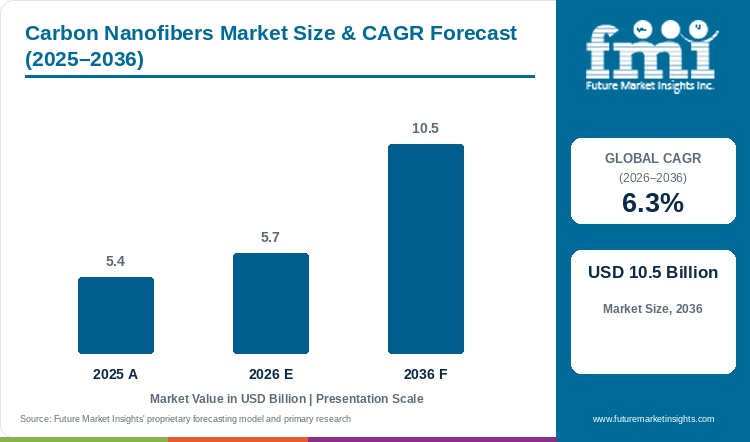
Registering an anticipated 6.3% ten-year CAGR, worldwide carbon nanofibers shipments are estimated to grow above USD 5.4 Billion for 2025 toward a projected USD 5.7 Billion across 2026 and are expected to total USD 10.5 Billion in 2036.
Published in January 2026, the U.S. Department of Energy Vehicle Technologies Office 2025 Annual Merit Review Report examined 388 peer-reviewed battery and materials projects aimed at stabilizing electric vehicle electrodes when silicon anodes swell [1]. Because conventional carbon black networks fracture under repeated volumetric anode expansion, FMI material audits estimate that global carbon nanofibers turnover will climb past USD 5.4 Billion recorded in 2025 toward a projected 2026 total of USD 5.7 Billion before reaching an expected USD 10.5 Billion by 2036 on a 6.3% CAGR, creating USD 4.8 Billion in added revenue. Vapor-grown carbon nanofibers are forecast to account for 35.9% within the 2026 product-type category, owing to catalytic gas-phase synthesis that yields low-defect graphitic filaments for lithium-ion slurries. While high induction furnace electricity tariffs and van der Waals clumping restrain commodity plastic adoption, regional CAGRs through 2036 are anticipated to run from 5.7% across Japan up to 7.3% inside South Korea.
Key Market Trends & Insights
- By product type: Vapor-grown carbon nanofibers (expected to secure 35.9% during 2026) form rigid graphitic bridges that preserve electrical percolation across expanding silicon anodes.
- By form: Powder formats (forecast at 34.5% during 2026) support bulk container transport economics and solvent-free dry battery electrode calendering trials.
- By application: Polymer reinforcement (estimated at 40.6% during 2026) improves multi-axial modulus and interlaminar shear strength in structural composite moldings.
- By end use: Automotive applications (anticipated at 41.1% during 2026) specify conductive resins for electrostatic-dissipative fuel connectors and EMI-shielded battery enclosures.
Regional Highlights
- East Asian gigafactory frontrunner: South Korea is projected to outpace major industrial nations by posting 7.3% annual expansion through 2036 on surging silicon-anode slurry procurement.
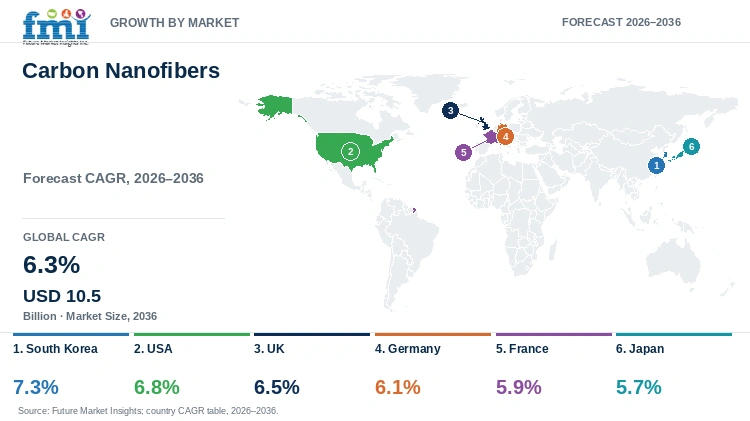
- Western and Japanese synthesis corridors: American consumption is expected to climb 6.8% alongside British demand at 6.5%, outpacing Germany (6.1%) and France (5.9%) as Japanese VGCF exports are forecast to rise 5.7%.
Market Size & Forecast
Table 1: Market Size and Forecast for the Carbon Nanofibers Market (USD billion and CAGR percentage), 2025 to 2036
| Metric | Value |
|---|---|
| 2025 Market Size | USD 5.4 Billion |
| Estimated Market Size in 2026 | USD 5.7 Billion |
| Projected Market Size by 2036 | USD 10.5 Billion |
| CAGR, 2026 to 2036 | 6.3% |
| Added Revenue, 2026 to 2036 | USD 4.8 Billion |
Thermoplastic compounders and battery cell manufacturers confront slurry viscosity spikes and respirable dust rules when dosing raw dry nanomaterials. Under European Commission Regulation (EU) 2018/1881 and the EU Observatory for Nanomaterials hosted by ECHA, strict REACH chemical safety and dust-handling rules govern carbon nanomaterials used in battery anodes and polymer composites [2]. FMI analysts observe that workplace nanoform exposure limits are reshaping raw material purchasing across European and North American molding halls. Processors are replacing open-hopper dry blending with twin-screw compounded carbon fiber composites and aqueous anode dispersions to guarantee uniform filament distribution.
Reactor Synthesis Capacity and Anode Loading Sizing
Table 2: Reactor Synthesis Capacity and Anode Loading Sizing Indicators for the Carbon Nanofibers Market (USD Billion and operational ranges), 2025 to 2036
| Metric | 2025 | 2026 | 2036 |
|---|---|---|---|
| Market size (USD Billion) | 5.4 | 5.7 | 10.5 |
| Installed CVD and electrospinning capacity (kilotons) | 42.0 to 48.5 | 44.5 to 51.2 | 81.0 to 94.0 |
| Typical loading in battery anodes (weight percent) | 0.8 to 2.2 | 1.0 to 2.5 | 1.5 to 3.2 |
| Typical loading in conductive thermoplastics (weight percent) | 2.5 to 6.0 | 2.5 to 5.8 | 2.0 to 4.5 |
Operational note: Capacity estimates cover commercial catalytic chemical vapor deposition reactors and industrial electrospinning lines across East Asia and Europe alongside North America. Weight-percent loading ranges reflect formulation thresholds required for electrical percolation in lithium-ion anodes and conductive engineering resins.
Induction graphitization furnaces operating above 2,800 degrees Celsius convert catalytic hydrocarbon precursors into highly crystalline carbon filaments. Unlike entangled global carbon nanotubes that require aggressive ultrasonic dispersion, rigid cup-stacked nanofibers wet out evenly during twin-screw extrusion.
Compounding Line & Cell Gigafactory Procurement Sizing
Table 3: Compounding Line & Gigafactory Procurement Indicators for the Carbon Nanofibers Market (USD), 2025 to 2036
| Metric | 2025 | 2026 | 2036 |
|---|---|---|---|
| Qualified industrial compounding & cell plants (thousand) | 3.80 | 4.05 | 6.90 |
| Average annual carbon nanofiber spend per plant (USD) | 1,421,050 | 1,407,400 | 1,521,740 |
| Standard industrial VGCF powder price band (USD/kg) | 85 to 145 | 82 to 140 | 64 to 110 |
| High-purity battery dispersion price band (USD/kg) | 160 to 290 | 155 to 280 | 120 to 215 |
Table 4: End-Use Sector Revenue Indicators for the Carbon Nanofibers Market (USD Billion and percentages), 2026
| Metric | Value | Basis |
|---|---|---|
| Market size, 2026 | USD 5.7 Billion | 2026 global material valuation |
| Automotive sector revenue, 2026 | USD 2.3 Billion | 41.1% end-use share |
| Polymer reinforcement revenue, 2026 | USD 2.3 Billion | 40.6% application share |
| Vapor-grown carbon nanofibers revenue, 2026 | USD 2.0 Billion | 35.9% product type share |
Battery slurry formulators qualify nanofiber lots based on aspect ratio retention after high-shear mixing and residual iron levels below twenty parts per million. Cell manufacturers also blend graphitized nanofibers with battery materials to reduce ionic transport resistance and suppress high-temperature degradation.
Analyst Perspective
"Compounders and battery cell engineers no longer treat carbon nanofibers as an experimental additive for niche aerospace laminates. Procurement teams demand low-iron graphitized filaments and dust-free thermoplastic masterbatches that survive high-shear extrusion."
- Nikhil Kaitwade, Principal Consultant, Future Market Insights.
How is the carbon nanofibers market segmented?
The carbon nanofibers market is segmented by product type, form, application, and end use. In 2026, vapor-grown carbon nanofibers are projected at 35.9%, powder at 34.5%, polymer reinforcement at 40.6%, and automotive at 41.1%.
By product type: vapor-grown carbon nanofibers, electrospun carbon nanofibers, platelet nanofibers, and herringbone nanofibers.
By form: powder, dispersion, masterbatch, and nonwoven mat.
By application: polymer reinforcement, battery electrodes, conductive coatings, and catalyst supports.
By end use: automotive, energy storage, electronics, and aerospace.
How do catalytic gas-phase reactors place vapor-grown carbon nanofibers ahead in product type?
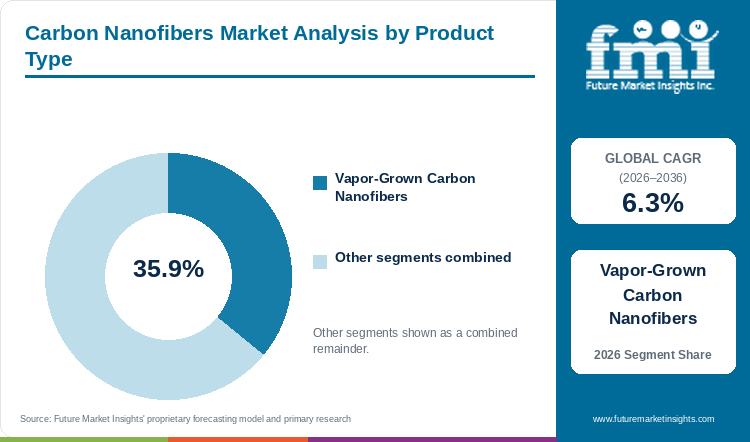
Vapor-grown carbon nanofibers are expected to claim 35.9% of product type volume in 2026, reflecting continuous catalytic synthesis.
Table 5: Product Type Share for the Carbon Nanofibers Market (percentage share), 2026
| Product Type | Share (2026) |
|---|---|
| Vapor-Grown Carbon Nanofibers | 35.9% |
| Other Segments Combined | 64.1%* |
| Total | 100.0% |
*Note: Combined share of remaining product type categories totaling 100.0% of 2026 market demand.
Table 6: Product Type Leadership and Market Growth for the Carbon Nanofibers Market (segment and CAGR percentage), 2026 to 2036
| Metric | Value |
|---|---|
| Global CAGR (2026 to 2036) | 6.3% |
| Leading Segment | Vapor-Grown Carbon Nanofibers |
Catalytic gas-phase reactors synthesize sub-micron cup-stacked carbon filaments at commercial multi-ton yields with high structural crystallinity. FMI reactor evaluations confirm that rigid vapor-grown filaments disperse uniformly across aqueous anode slurries and epoxy resins without severe bundling. Three-dimensional conductive networks prevent localized hot spots across fast-charging pouch cells and static-dissipative molded parts. However, removing residual iron catalyst particles requires post-synthesis halogen purification above 2,800 degrees Celsius.
- Vapor-grown carbon nanofibers are expected to reach 35.9% during 2026 because cup-stacked graphitic filaments bridge conductive gaps in silicon anodes.
- In June 2025, Oak Ridge National Laboratory researchers demonstrated that electrospinning 200-nanometer polyacrylonitrile nanofibers onto carbon fiber fabric yielded a 50% improvement in tensile strength and a nearly two-fold increase in composite toughness [3].
Why do compounders favor dry powder formats on twin-screw extrusion lines?
Powder forms are projected to represent 34.5% of the form category in 2026, aided by direct dry-blending flexibility.
Free-flowing de-aired carbon nanofiber powders allow custom resin formulators to tailor additive weight percentages directly on twin-screw extruders without carrier solvents. Masterbatch producers dose dry powders into polyamide and PEEK matrices to manufacture static-dissipative semiconductor wafer trays. Dry powder shipments also avoid the freight weight and shelf-life limits of liquid dispersions. Nevertheless, plants handling loose nanopowders must install closed vacuum-conveying hoppers to satisfy workplace inhalation standards.
- Powder formats are estimated to secure 34.5% of form revenue in 2026 due to bulk shipping economics and solvent-free dry electrode calendering trials.
- Resonac Holdings Corporation synthesizes its VGCF and VGCF-H vapor-grown carbon nanofibers via vapor-phase growth and high-temperature graphitization to form rigid conductive paths that extend lithium-ion battery cycle life [4].
What enables polymer reinforcement to capture the largest application share in 2026?
Polymer reinforcement is forecast to reach 40.6% of application share in 2026, benefiting from interlaminar shear strength gains.
Dispersing low weight percentages of sub-micron carbon filaments into epoxy and thermoplastic matrices arrests micro-crack propagation between primary fiber plies. Within thermoplastic prepreg airframe panels and wind turbine spars, nanofibers bridge resin-rich interlaminar zones to boost fracture toughness and z-axis thermal conductivity. Molders achieve higher flexural modulus without increasing component wall thickness or weight. Even so, excessive screw shear during compounding can fracture filament aspect ratios if extruder temperatures are not tightly controlled.
- Polymer reinforcement is anticipated to command 40.6% of application demand in 2026 by improving multi-axial stiffness without adding part weight.
- In January 2026, Applied Sciences and MilliporeSigma documented that dispersing 20 weight percent of 2900°C graphitized Pyrograf-III PR-25-XT-HHT carbon nanofibers (125 to 150 nm outer diameter) raises epoxy composite thermal conductivity from 0.2 W/m-K to 2.8 W/m-K while achieving lightning-strike resistivity below 10 ohm-cm [5].
Which electric powertrain and fuel-line specifications anchor automotive end use demand?
Automotive applications are anticipated to capture 41.1% of end-use revenue in 2026, accompanied by static-dissipative fuel connectors.
Tier-one automotive molders compound nanofibers into nylon fuel lines and quick-connects to bleed off static charges safely during high-pressure fuel flow. Electric vehicle platform engineers also specify conductive plastics reinforced with carbon nanofibers for lightweight battery module covers that shield cabin electronics from inverter electromagnetic interference. Replacing cast aluminum brackets with conductive engineering plastics cuts vehicle curb weight across electric platforms. However, automotive OEMs enforce strict batch resistivity tolerances before qualifying new masterbatch suppliers.
- Automotive end users are predicted to generate 41.1% of market revenue in 2026 through EMI-shielded battery enclosures and conductive fluid routing components.
- US Research Nanomaterials supplies Stock US4450 chemical vapor deposition carbon nanofibers (200 to 600 nm outer diameter and over 100 S/cm electrical conductivity) in PVP- and silane-coated grades alongside 3 weight percent liquid dispersions for automotive EMI shielding and conductive polymers [6].
What are the drivers, restraints, and opportunities in the carbon nanofibers market?
Silicon-anode electric vehicle battery scale and automotive EMI shielding are expected to drive carbon nanofibers adoption, whereas high graphitization power costs restrain pricing and pelletized masterbatches create compounding growth.
- Driver: Rapid gigafactory transition toward silicon-rich battery anodes and lightweight EMI-shielded automotive housings compels engineers to specify three-dimensional conductive nanofiber networks.
- Restraint: High graphitization furnace electricity consumption and van der Waals filament clumping during high-shear mixing elevate processing costs.
- Opportunity: Pre-dispersed thermoplastic masterbatches and electrospun freestanding nonwoven mats enable dust-free dosing and high-surface-area fuel cell catalyst supports.
Growth Analysis and Future Potential: Silicon-Anode Bridging and Structural Toughening Catalysts
Expanding electric vehicle battery pack capacities and airframe weight-reduction targets are driving multi-ton supply contracts for vapor-grown carbon nanofibers. Standard carbon black particles lose electrical contact when silicon-rich anodes swell by up to 300% during fast charging. In May 2026, the International Energy Agency reported in its Global EV Outlook 2026 that global electric vehicle battery deployment grew nearly 30% in 2025 to reach 1.2 terawatt-hours while global manufacturing capacity exceeded 4 terawatt-hours [7]. Incorporating graphitized nanofibers into silicon anode battery electrodes preserves conductive pathways and extends cell cycle life.
Risk Assessment and Operational Hurdles: Furnace Energy Intensity and Agglomeration Friction
Intense electricity consumption during high-temperature thermal annealing and van der Waals filament clumping represent primary operational restraints. Graphitizing catalytic filaments above 2,800 degrees Celsius under inert argon atmospheres makes industrial power tariffs a major production cost driver. In July 2026, the German Chemical Industry Association reported that first-half 2026 chemical output stood 3% below prior-year levels on EUR 106 Billion in sales while plant investment sat 15% below 2023 levels due to high energy costs [8]. Furthermore, untreated nanofibers agglomerate during resin mixing and create structural voids when compounders benchmark them against graphene nanocomposites.
Commercial Opportunity Analysis: Pre-Dispersed Masterbatches and Electrospun Nonwoven Mats
Specialty compounders are winning high-margin supply contracts by delivering dust-free pelletized masterbatches and freestanding electrospun carbon mats. Stringent occupational inhalation limits discourage open-hopper nanopowder dosing, prompting injection molders to buy pre-compounded 15% to 20% masterbatch pellets. Meanwhile, electrospinning creates binder-free porous carbon mats for proton-exchange membrane fuel cells. In October 2026, Hydrogen Europe published its Clean Hydrogen Monitor 2026 documenting that 822 megawatts of European electrolyser capacity reached final investment decision in 2025 [9]. Formulators also blend nanofibers with toughening nanoparticle additives for epoxy composites to prevent delamination in high-pressure hydrogen vessels.
Carbon Nanofibers Market by Country (2026 to 2036)
Battery gigafactory anode chemistry roadmaps and aerospace composite qualification programs govern demand dispersion across major industrial nations. Future Market Insights capacity tracking places South Korea at the forefront with a projected 7.3% yearly growth rate through 2036, whereas Japanese consumption is anticipated to increase 5.7% per year as domestic producers prioritize high-purity export grades.
Table 7: Country CAGR and Primary Growth Levers for the Carbon Nanofibers Market (CAGR percentage and operational drivers), 2026 to 2036
| Country | CAGR (2026 to 2036) | Primary Growth Lever |
|---|---|---|
| South Korea | 7.3% | High-silicon EV pouch and cylindrical battery anode slurries and semiconductor ESD trays |
| USA | 6.8% | Defense airframe lightning-strike prepregs and DOE-funded silicon-anode gigafactory lines |
| UK | 6.5% | Motorsport structural prepreg tooling and Faraday battery challenge electrode scale-up |
| Germany | 6.1% | Electric powertrain EMI-shielded engineering plastics and Type IV hydrogen tank liners |
| France | 5.9% | Civil aviation cabin composite brackets and DecarbonAero lightweighting programs |
| Japan | 5.7% | Thermal-annealed VGCF conductive additives for solid-state and high-nickel cells |
Source: Future Market Insights analysis
South Korea Carbon Nanofibers Market Outlook (2026 to 2036)
South Korean consumption differs from Western aerospace-heavy markets because domestic demand is overwhelmingly concentrated in high-silicon electric vehicle battery anode slurries and semiconductor cleanroom wafer trays. In May 2026, the International Energy Agency documented that South Korean battery makers led by LG Energy Solution invested USD 7.5 Billion in annual capital expenditure in 2025 while anchoring midstream anode and cathode supply [10]. South Korea is projected to pace global carbon nanofibers adoption with 7.3% annual expansion through 2036 as domestic cell makers scale fast-charging pouch formats. However, battery quality directors enforce metallic iron impurity ceilings below 20 parts per million, compelling Korean chemical suppliers to operate halogen purification kilns and deliver pre-dispersed anode slurries across Ochang and Ulsan.
Key takeaway: In South Korea, rapid gigafactory adoption of silicon-composite anodes and semiconductor cleanroom tray standards drives high-purity carbon nanofiber dispersion contracts.
USA Carbon Nanofibers Market Outlook (2026 to 2036)
American demand is uniquely anchored by defense airframe lightning-strike qualification programs alongside federal Significant New Use Rules that restrict loose dry nanopowders on factory floors. From its Pasadena facility in 2026, ACS Material supplies chemical vapor deposition carbon nanofibers (SKU CNFS00B1 with 100 to 300 nm outer diameters and 100 S/cm electrical conductivity) for domestic lithium-battery anodes and polymer composites [11]. Commercial consumption across the United States is anticipated to advance at 6.8% yearly growth through 2036 as domestic battery gigafactories scale silicon-dominant anodes. To comply with Environmental Protection Agency inhalation audits without slowing production, domestic producers including Pyrograf Products and ACS Material supply surface-treated wet cakes and pre-dispersed masterbatch concentrates that eliminate airborne dust exposure during downstream aerospace resin compounding.
Key takeaway: In the USA, defense airframe lightning-strike standards and domestic battery gigafactory investments sustain high-margin demand for functionalized carbon nanofibers.
UK Carbon Nanofibers Market Outlook (2026 to 2036)
Unlike mass-volume Asian battery hubs, the British market revolves around Midlands Formula 1 composite tooling clusters and national pouch-cell prototyping labs that formulate custom prepregs from imported base filaments. By October 2025, the Faraday Institution had published over 1,200 battery research contributions and 157 cited patent families across its Nextrode electrode manufacturing and solid-state battery programs [12]. United Kingdom demand is expected to register 6.5% annual growth through 2036 across motorsport and defense programs. Because elevated UK industrial electricity tariffs make domestic 2,800-degree graphitization furnace operation uneconomical, British compounders import graphitized filaments and focus on high-margin aerospace prepregs and conductive elastomer masterbatches tailored for high-margin defense airframes and specialty automotive fluid routing assemblies across British manufacturing corridors.
Key takeaway: In the UK, Formula 1 composite tooling clusters and national battery prototyping grants prioritize custom nanofiber-toughened prepregs and conductive electrode inks.
Germany Carbon Nanofibers Market Outlook (2026 to 2036)
German adoption is distinguished by tier-one automotive suppliers replacing cast aluminum inverter housings with EMI-shielded engineering thermoplastics under strict EU REACH nanoform registration rules. In February 2026, the German Association of the Automotive Industry reported that domestic electric car output hit a record 1.67 million units in 2025 (a 40% electric production share) and is projected to reach 1.76 million units in 2026 [13]. Electric powertrain rollouts across German manufacturing plants are forecast to sustain 6.1% yearly expansion for carbon nanofibers through 2036. To overcome high domestic furnace power tariffs and workplace dust audits across Bavaria and Baden-Wuerttemberg, suppliers such as SGL Carbon SE deliver REACH-certified pelletized masterbatches with validated dust-free dosing documentation for injection molding halls across Southern Germany.
Key takeaway: In Germany, electric vehicle inverter EMI shielding mandates and REACH nanoform compliance drive tier-one suppliers toward certified carbon nanofiber masterbatches.
France Carbon Nanofibers Market Outlook (2026 to 2036)
French nanomaterial consumption centers on civil airframe cabin lightweighting and cryogenic liquid-hydrogen storage liners in Toulouse and Nantes rather than consumer electronics. In May 2026, the French Aerospace Industries Association (GIFAS) reported that French aerospace revenues reached EUR 85.6 Billion in 2025 alongside EUR 59.4 Billion in exports and EUR 88.6 Billion in orders across 400+ member firms [14]. French carbon nanofibers demand is estimated to advance 5.9% per year through 2036 across commercial aviation programs. Because European Union Aviation Safety Agency airworthiness qualification spans up to 36 months, resin formulators supply drop-in nanofiber-modified PEEK and epoxy prepregs compatible with certified autoclave curing cycles used on narrow-body fuselage brackets and filament-wound liquid hydrogen storage tanks across French aviation hubs.
Key takeaway: In France, commercial airframe lightweighting and cryogenic hydrogen tank programs sustain multi-year supply agreements for nanofiber-toughened aerospace resins.
Japan Carbon Nanofibers Market Outlook (2026 to 2036)
Japan occupies a unique position as the global synthesis and thermal-annealing exporter of ultra-pure vapor-grown carbon nanofibers for solid-state batteries, even as mature domestic car output moderates local volume growth. In January 2025, Toray Industries advanced its NANOALLOY microstructure technology to form 100-to-300-nanometer co-continuous nylon networks delivering four-fold higher vibration damping for downstream fiber-reinforced automotive housings where sub-micron carbon nanofibers serve as conductive matrix additives [15]. Domestic demand is predicted to expand 5.7% annually through 2036 while Japanese producers led by Resonac and UBE anchor global exports of low-iron battery filaments and pair VGCF additives with hard carbon anode materials across high-density power modules and traction batteries, protecting long-term Japanese specialty export margins.
Key takeaway: In Japan, advanced solid-state battery electrode engineering and ultra-high-purity thermal annealing capabilities anchor global export leadership in battery-grade carbon nanofibers.
Full report country CAGRs cover: North America; Latin America; Western Europe; Eastern Europe; East Asia; South Asia and Pacific; Middle East and Africa.
Who are the notable companies in the carbon nanofibers market?
Pyrograf Products, Inc. (Applied Sciences, Inc.), Resonac Holdings Corporation (VGCF), Merck KGaA (MilliporeSigma), ACS Material LLC, Nanografi Advanced Materials, US Research Nanomaterials, Inc., SGL Carbon SE, and UBE Corporation are the notable companies in the carbon nanofibers market.
Supplier competition across the carbon nanofibers industry separates dedicated catalytic chemical vapor deposition producers from specialty nanomaterial dispersion and conductive media manufacturers. Specialized reactor operators focus on high-temperature graphitization kilns and surface oxidation treatments for aqueous battery slurries. Specialty chemical and nanomaterial formulators combine sub-micron nanofiber synthesis with surface-coated powders and NMP-free polymer dispersions. Cell engineers and compounders qualify vendors on residual iron catalyst levels below 100 ppm and consistent sub-micron filament morphology.
- Vapor-Grown & Catalytic Nanofiber Specialists: Pyrograf Products, Inc. (Applied Sciences, Inc.) and Resonac Holdings Corporation (VGCF) run dedicated catalytic CVD and thermal-annealing reactors producing 125 to 150 nm filaments for lithium-ion anodes and conductive elastomers.
- Specialty Nanofiber & Functionalized Dispersion Suppliers: Merck KGaA (MilliporeSigma) and ACS Material LLC alongside Nanografi Advanced Materials and US Research Nanomaterials supply graphitized conical platelet nanofibers as well as silane-coated nanopowders and liquid dispersions.
- Conductive Carbon Media & Nanocomposite Varnish Producers: SGL Carbon SE and UBE Corporation manufacture microporous carbon fuel cell gas diffusion layers and NMP-free carbon-nanomaterial polyimide dispersions.
Competitive Benchmarking: Carbon Nanofibers Market
Table 8: Competitive Benchmarking for the Carbon Nanofibers Market (qualitative capability ratings), 2026
| Company | CVD & Graphitization Purity | Battery Slurry & Dispersion Depth | Polymer & Fuel Cell Media Access | Geographic Reach |
|---|---|---|---|---|
| Pyrograf Products, Inc. (Applied Sciences, Inc.) | High | High | High | Medium |
| Resonac Holdings Corporation (VGCF) | High | High | High | High |
| Merck KGaA (MilliporeSigma) | High | High | Medium | High |
| ACS Material LLC | Medium | High | Medium | Medium |
| Nanografi Advanced Materials | High | Medium | High | High |
| US Research Nanomaterials, Inc. | Medium | High | Medium | Medium |
| SGL Carbon SE | Medium | High | High | High |
| UBE Corporation | Medium | High | Medium | Medium |
Scoring basis: CVD and graphitization purity is rated High when specifications confirm thermal annealing between 1,500 and 2,900 degrees Celsius with >98% carbon purity and residual iron below 100 ppm. Battery slurry and dispersion depth is High when the manufacturer supplies ready-to-dose electrode suspensions or surface-functionalized nanofiber grades compatible with downstream tow prepreg and thermoplastic compounding lines. Polymer and fuel cell media access is High when the supplier holds qualified automotive or electrochemical material specifications.
Key Developments in the Carbon Nanofibers Market
- MilliporeSigma (Merck KGaA) expanded catalog distribution of conical platelet carbon nanofibers (Product No. 719803 / Pyrograf PR-25-XT-LHT) thermally treated at 1500°C with >98% carbon purity and 100 nm outer diameter for battery and polymer compounding [16].
- Applied Sciences, Inc. (Pyrograf Products) scaled its Pyrograf-III stacked-cup vapor-grown carbon nanofibers with 125 to 150 nm outer diameters including pyrolytically stripped PR-25-XT-PS (54 m2/g) and 2900°C catalyst-free PR-25-XT-HHT grades below 100 ppm iron [17].
- SGL Carbon SE expanded reel-to-reel manufacturing of its SIGRACET 22BB and 36BB bilayer carbon paper gas diffusion layers incorporating 20% to 25% PTFE microporous carbon sub-layers for PEM fuel cells [18].
Key Players in the Carbon Nanofibers Market
Vapor-Grown & Catalytic Nanofiber Specialists
- Pyrograf Products, Inc. (Applied Sciences, Inc.)
- Resonac Holdings Corporation (VGCF)
Specialty Nanofiber & Functionalized Dispersion Suppliers
- Merck KGaA (MilliporeSigma)
- ACS Material LLC
- Nanografi Advanced Materials
- US Research Nanomaterials, Inc.
Conductive Carbon Media & Nanocomposite Varnish Producers
- SGL Carbon SE
- UBE Corporation
Carbon Nanofibers Market - Report Scope
Table 9: Report Scope for the Carbon Nanofibers Market (coverage fields and definitions), 2026 to 2036
| Coverage field | Report scope |
|---|---|
| Market breakdown | Product Type; Form; Application; End Use |
| Quantitative Units | USD Billion |
| Market Definition | Includes producer revenue from vapor-grown, electrospun, platelet, and herringbone carbon nanofibers (50 to 600 nm outer diameter) sold as powders, liquid dispersions, thermoplastic masterbatches, and nonwoven mats. Supply Scope Note: Excludes continuous micron-diameter polyacrylonitrile carbon fiber tow (5 to 7 µm), bulk furnace carbon black, and unrefined coal pitch. |
| Regions Covered | North America; Latin America; Western Europe; Eastern Europe; East Asia; South Asia and Pacific; Middle East and Africa |
| Countries Covered | South Korea, USA, UK, Germany, France, Japan, and additional countries in the full report |
| Key Companies Covered | Pyrograf Products, Inc. (Applied Sciences, Inc.), Resonac Holdings Corporation (VGCF), Merck KGaA (MilliporeSigma), ACS Material LLC, Nanografi Advanced Materials, US Research Nanomaterials, Inc., SGL Carbon SE, UBE Corporation |
| Forecast Period | 2026 to 2036 |
| Approach | Primary and secondary research with market triangulation. |
Carbon Nanofibers Market - Research Methodology
Table 10: Research Methodology for the Carbon Nanofibers Market (research methods and approach), 2026 edition
| Method | Approach |
|---|---|
| Primary Research | Primary interviews were conducted with chemical vapor deposition reactor operators, battery slurry formulators, thermoplastic compounders, and aerospace materials engineers to validate loading percentages and qualification cycles. |
| Secondary Research | Secondary research included company annual reports, battery and composite association publications, technical patent filings, trade journals, and nanomaterial safety dossiers relevant to the market. |
| Market Sizing and Forecasting | Market sizing and forecasting for the 2026 to 2036 forecast period were developed using top-down and bottom-up approaches to assess installed synthesis capacity and grade price bands. |
| Country Forecasting Model | Country CAGRs from 2026 to 2036 are derived from national gigafactory GWh capacity announcements, aerospace composite build rates, and REACH/EPA nanomaterial regulatory filings. |
| Operational Benchmark Traceability | Reactor capacity, weight-percent percolation loadings, and kilogram price bands in Tables 2, 3, and 4 are traced to DOE's 2025 Annual Merit Review battery benchmarks, ORNL carbon nanofiber composite testing, and Pyrograf/Resonac technical datasheets. |
| Data Triangulation and Validation | Data is validated against electric vehicle gigafactory output, commercial airframe build rates, and workplace nanomaterial handling directives without double counting continuous micron-diameter carbon fiber tow. |
Carbon Nanofibers Market by Segments
Carbon Nanofibers Market segmented by Product Type:
- Vapor-Grown Carbon Nanofibers
- Electrospun Carbon Nanofibers
- Platelet Nanofibers
- Herringbone Nanofibers
Carbon Nanofibers Market segmented by Form:
- Powder
- Dispersion
- Masterbatch
- Nonwoven Mat
Carbon Nanofibers Market segmented by Application:
- Polymer Reinforcement
- Battery Electrodes
- Conductive Coatings
- Catalyst Supports
Carbon Nanofibers Market segmented by End Use:
- Automotive
- Energy Storage
- Electronics
- Aerospace
Carbon Nanofibers Market by Region
- North America
- United States
- Canada
- Latin America
- Brazil
- Mexico
- Argentina
- Chile
- Western Europe
- Germany
- France
- United Kingdom
- Italy
- Spain
- Benelux
- Nordics
- Eastern Europe
- Poland
- Czech Republic
- Romania
- Hungary
- East Asia
- China
- Japan
- South Korea
- South Asia and Pacific
- India
- ASEAN
- Australia and New Zealand
- Middle East and Africa
- GCC Countries
- South Africa
- Türkiye
- Israel
Research Sources and Bibliography
- [1] U.S. Department of Energy (DOE). (2026, January 23). 2025 Annual Merit Review Report | Department of Energy. DOE Transportation Technologies Office (Vehicle Technologies Office).
- [2] European Commission & European Chemicals Agency (ECHA). (2025, December 10). Nanomaterials - Internal Market, Industry, Entrepreneurship and SMEs. Directorate-General for Internal Market, Industry, Entrepreneurship and SMEs.
- [3] Oak Ridge National Laboratory (ORNL). (2025, June 17). Nanofibers yield stronger, tougher carbon fiber composites. U.S. Department of Energy Office of Science.
- [4] Resonac Holdings Corporation. (2026, January 15). VGCF | 製品情報 | レゾナック - Resonac. Resonac Lithium-Ion Battery Materials.
- [5] Burton, D., Lake, P., & Palmer, A. (Applied Sciences, Inc. / MilliporeSigma). (2026, January 14). Carbon Nanofiber Applications & Properties - Sigma-Aldrich. MilliporeSigma Technical Documents.
- [6] US Research Nanomaterials, Inc. (2026, February 08). Carbon NanoFibers, Purity: >95%, Diameter 200-600nm, length 20-50um. US Research Nanomaterials Catalog.
- [7] International Energy Agency (IEA). (2026, May 20). Electric vehicle batteries - Global EV Outlook 2026 - IEA. IEA Publications Paris.
- [8] German Chemical Industry Association (VCI). (2026, July 16). First-Half 2026 Review | VCI. VCI Frankfurt.
- [9] Hydrogen Europe. (2026, October 15). Reports | Hydrogen Europe. Hydrogen Europe Brussels.
- [10] International Energy Agency (IEA). (2026, May 20). Manufacturing and trade - Global EV Outlook 2026 - IEA. IEA Publications Paris.
- [11] ACS Material LLC. (2026, March 12). Carbon Nanofibers | Carbon Series Products | ACS Material. ACS Material Pasadena.
- [12] The Faraday Institution. (2025, October 15). Scientific Publications - The Faraday Institution. Faraday Institution Didcot.
- [13] German Association of the Automotive Industry (VDA). (2026, February 03). Production and market in January 2026 | VDA. VDA Berlin.
- [14] French Aerospace Industries Association (GIFAS). (2026, May 11). GIFAS. GIFAS Observatory Paris.
- [15] Toray Industries, Inc. (2025, January 21). Toray Advances NANOALLOY™ Technology to Develop Nylon Resin with 4X Greater Damping than Conventional Materials and Improved Quietness and Moldability | Newsroom | TORAY. Toray Industries Newsroom.
- [16] Merck KGaA (MilliporeSigma). (2026, February 19). Carbon nanofibers graphitized, platelets(conical), >98% carbon basis, D × L 100 nm × 20-200 μm - Sigma-Aldrich. Sigma-Aldrich Materials Science.
- [17] Applied Sciences, Inc. (Pyrograf Products, Inc.). (2026, January 18). Pyrograf-III Vapor-Grown Carbon Nanofibers (PR-25-XT-PS, PR-25-XT-LHT, PR-25-XT-HHT) Technical Data. Pyrograf Products Cedarville.
- [18] SGL Carbon SE. (2026, February 16). SIGRACET® Fuel Cell Components | SGL Carbon. SGL Carbon Markets & Solutions.
- [19] Nanografi Advanced Materials. (2026, March 04). Carbon Nanofibers, Purity: > 95%, Outside Diameter: 50-100 nm. Nanografi Advanced Materials.
- [20] Merck KGaA (MilliporeSigma). (2026, March 15). Carbon nanofibers pyrolitically stripped, platelets(conical), >98% carbon basis, D × L 100 nm × 20-200 μm - Sigma-Aldrich. Sigma-Aldrich Materials Science.
- [21] UBE Corporation. (2026, February 20). UPIA®-NF | UBE Corporation. UBE Specialty Products Division.
- [22] SGL Carbon SE. (2026, October 06). SGL financial publications ad hoc - news for investors | SGL Carbon. SGL Carbon Investor Relations.
This bibliography is provided for reader reference and is not exhaustive. The full report contains the complete reference list and detailed citations.
This Report Answers
- How large is the carbon nanofibers market in 2026 and what is forecast for 2036?
- Which electric vehicle anode and automotive lightweighting pressures support demand for carbon nanofibers?
- Why do vapor-grown carbon nanofibers lead the product type category?
- Why does polymer reinforcement lead the application category globally?
- How do material growth rates differ across South Korea, the USA, the UK, Germany, France, and Japan?
- Which leading companies supply vapor-grown filaments, masterbatches, and electrospun mats today?
- What limits adoption or supplier switching in the carbon nanofibers market?
- What should buyers evaluate before purchasing carbon nanofibers?
Frequently Asked Questions
How big is the carbon nanofibers market in 2026, and what is forecast for 2036?
Future Market Insights estimates global carbon nanofibers demand at USD 5.7 Billion in 2026 after reaching USD 5.4 Billion in 2025. Annual material revenue is projected to climb to USD 10.5 Billion by 2036 on silicon-anode battery and aerospace composite adoption.
What is the CAGR for the carbon nanofibers market from 2026 to 2036?
Global sales are expected to progress at a 6.3% compound annual rate from 2026 through 2036, which is forecast to add USD 4.8 Billion in annual market revenue. Electric vehicle cell production and airframe lightning-strike protection films sustain long-term procurement.
Which product type segment leads the carbon nanofibers market?
Vapor-grown carbon nanofibers are anticipated to command 35.9% of product type volume in 2026. Catalytic gas-phase synthesis and cup-stacked graphitic conductivity make vapor-grown grades the benchmark for lithium-ion battery slurries.
Which application segment leads the carbon nanofibers market?
FMI supply chain tracking shows that polymer reinforcement is projected to account for 40.6% of application demand in 2026. Sub-micron filaments prevent micro-crack propagation and provide static dissipation across molded structural parts.
Which country has a notable growth outlook during the assessment period?
South Korea is predicted to pace major national markets at 7.3% yearly growth through 2036. Domestic battery gigafactories scaling high-silicon pouch and cylindrical anodes drive recurring dispersion contracts.
Who are the key players in the market?
Prominent producers include Pyrograf Products, Inc. (Applied Sciences, Inc.), Resonac Holdings Corporation (VGCF), and Merck KGaA (MilliporeSigma). Other key suppliers include ACS Material LLC, Nanografi Advanced Materials, US Research Nanomaterials, Inc., SGL Carbon SE, and UBE Corporation.
Preview the report firsthand - request a free sample
Get SampleGet the brochure for pricing and purchase details.
Get PDFTable of Content
- Key Takeaways
- Market Size and CAGR
- Top Growth Driver
- Fastest Growing Segment
- Leading Region
- Key Companies
- Emerging Opportunities
- Executive Summary
- Global Market Outlook
- Demand-side Trends
- Supply-side Trends
- Technology Roadmap Analysis
- Analysis and Recommendations
- Analyst Perspective (What is happening? Why now? What should investors know?)
- Key Questions Answered
- How large is the market?
- What is the CAGR?
- What are key trends?
- Which region dominates?
- Who are the leaders?
- Market Overview
- Market Coverage / Taxonomy
- Market Definition / Scope / Limitations
- Research Methodology
- Chapter Orientation
- Analytical Lens and Working Hypotheses
- Market Structure, Signals, and Trend Drivers
- Benchmarking and Cross-market Comparability
- Market Sizing, Forecasting, and Opportunity Mapping
- Research Design and Evidence Framework
- Desk Research Programme (Secondary Evidence)
- Expert Input and Fieldwork (Primary Evidence)
- Tooling, Models, and Reference Databases
- Data Engineering and Model Build
- Quality Assurance and Audit Trail
- Market Background
- Market Dynamics (Drivers, Restraints, Opportunity, Trends)
- Scenario Forecast (Optimistic, Likely, Conservative)
- Impact Analysis
- AI Impact
- Sustainability Impact
- Regulatory Impact
- Technology Impact
- Consumer / Buyer Analysis
- Purchase Drivers
- Adoption Barriers
- Buyer Journey
- Opportunity Map Analysis
- Product Life Cycle Analysis
- Supply Chain Analysis
- Investment Feasibility Matrix
- Value Chain Analysis
- PESTLE and Porter's Analysis
- Regulatory Landscape
- Regional Parent Market Outlook
- Production and Consumption Statistics
- Import and Export Statistics
- Global Market Analysis and Forecast, 2021 to 2036
- Historical Market Size Value (USD Billion) Analysis, 2021 to 2025
- Current and Future Market Size Value (USD Billion) Projections, 2026 to 2036
- Y-o-Y Growth Trend Analysis
- Absolute $ Opportunity Analysis
- Global Market Pricing Analysis, 2021 to 2036
- Global Market Analysis and Forecast, By Product Type, 2021 to 2036
- Introduction / Key Findings
- Historical Market Size Value (USD Billion) Analysis By Product Type, 2021 to 2025
- Current and Future Market Size Value (USD Billion) Analysis and Forecast By Product Type, 2026 to 2036
- Vapor-Grown Carbon Nanofibers
- Electrospun Carbon Nanofibers
- Platelet Nanofibers
- Herringbone Nanofibers
- Y-o-Y Growth Trend Analysis By Product Type, 2021 to 2025
- Absolute $ Opportunity Analysis By Product Type, 2026 to 2036
- Global Market Analysis and Forecast, By Form, 2021 to 2036
- Introduction / Key Findings
- Historical Market Size Value (USD Billion) Analysis By Form, 2021 to 2025
- Current and Future Market Size Value (USD Billion) Analysis and Forecast By Form, 2026 to 2036
- Powder
- Dispersion
- Masterbatch
- Nonwoven Mat
- Y-o-Y Growth Trend Analysis By Form, 2021 to 2025
- Absolute $ Opportunity Analysis By Form, 2026 to 2036
- Global Market Analysis and Forecast, By Application, 2021 to 2036
- Introduction / Key Findings
- Historical Market Size Value (USD Billion) Analysis By Application, 2021 to 2025
- Current and Future Market Size Value (USD Billion) Analysis and Forecast By Application, 2026 to 2036
- Polymer Reinforcement
- Battery Electrodes
- Conductive Coatings
- Catalyst Supports
- Y-o-Y Growth Trend Analysis By Application, 2021 to 2025
- Absolute $ Opportunity Analysis By Application, 2026 to 2036
- Global Market Analysis and Forecast, By End Use, 2021 to 2036
- Introduction / Key Findings
- Historical Market Size Value (USD Billion) Analysis By End Use, 2021 to 2025
- Current and Future Market Size Value (USD Billion) Analysis and Forecast By End Use, 2026 to 2036
- Automotive
- Energy Storage
- Electronics
- Aerospace
- Y-o-Y Growth Trend Analysis By End Use, 2021 to 2025
- Absolute $ Opportunity Analysis By End Use, 2026 to 2036
- Global Market Analysis and Forecast, By Region, 2021 to 2036
- Introduction
- Historical Market Size Value (USD Billion) Analysis By Region, 2021 to 2025
- Current Market Size Value (USD Billion) Analysis and Forecast By Region, 2026 to 2036
- North America
- Latin America
- Western Europe
- Eastern Europe
- East Asia
- South Asia and Pacific
- Middle East and Africa
- Market Attractiveness Analysis By Region
- North America Market Analysis and Forecast, By Country, 2021 to 2036
- Historical Market Size Value (USD Billion) Trend Analysis By Market Taxonomy, 2021 to 2025
- Market Size Value (USD Billion) Forecast By Market Taxonomy, 2026 to 2036
- By Country
- United States
- Canada
- By Product Type
- By Form
- By Application
- By End Use
- By Country
- Market Attractiveness Analysis
- By Country
- By Product Type
- By Form
- By Application
- By End Use
- Key Takeaways
- Latin America Market Analysis and Forecast, By Country
- Historical Market Size Value (USD Billion) Trend Analysis By Market Taxonomy, 2021 to 2025
- Market Size Value (USD Billion) Forecast By Market Taxonomy, 2026 to 2036
- By Country
- Brazil
- Mexico
- Argentina
- Chile
- By Product Type
- By Form
- By Application
- By End Use
- By Country
- Market Attractiveness Analysis
- By Country
- By Product Type
- By Form
- By Application
- By End Use
- Key Takeaways
- Western Europe Market Analysis and Forecast, By Country
- Historical Market Size Value (USD Billion) Trend Analysis By Market Taxonomy, 2021 to 2025
- Market Size Value (USD Billion) Forecast By Market Taxonomy, 2026 to 2036
- By Country
- Germany
- France
- United Kingdom
- Italy
- Spain
- Benelux
- Nordics
- By Product Type
- By Form
- By Application
- By End Use
- By Country
- Market Attractiveness Analysis
- By Country
- By Product Type
- By Form
- By Application
- By End Use
- Key Takeaways
- Eastern Europe Market Analysis and Forecast, By Country
- Historical Market Size Value (USD Billion) Trend Analysis By Market Taxonomy, 2021 to 2025
- Market Size Value (USD Billion) Forecast By Market Taxonomy, 2026 to 2036
- By Country
- Poland
- Czech Republic
- Romania
- Hungary
- By Product Type
- By Form
- By Application
- By End Use
- By Country
- Market Attractiveness Analysis
- By Country
- By Product Type
- By Form
- By Application
- By End Use
- Key Takeaways
- East Asia Market Analysis and Forecast, By Country
- Historical Market Size Value (USD Billion) Trend Analysis By Market Taxonomy, 2021 to 2025
- Market Size Value (USD Billion) Forecast By Market Taxonomy, 2026 to 2036
- By Country
- China
- Japan
- South Korea
- By Product Type
- By Form
- By Application
- By End Use
- By Country
- Market Attractiveness Analysis
- By Country
- By Product Type
- By Form
- By Application
- By End Use
- Key Takeaways
- South Asia and Pacific Market Analysis and Forecast, By Country
- Historical Market Size Value (USD Billion) Trend Analysis By Market Taxonomy, 2021 to 2025
- Market Size Value (USD Billion) Forecast By Market Taxonomy, 2026 to 2036
- By Country
- India
- ASEAN
- Australia and New Zealand
- By Product Type
- By Form
- By Application
- By End Use
- By Country
- Market Attractiveness Analysis
- By Country
- By Product Type
- By Form
- By Application
- By End Use
- Key Takeaways
- Middle East and Africa Market Analysis and Forecast, By Country
- Historical Market Size Value (USD Billion) Trend Analysis By Market Taxonomy, 2021 to 2025
- Market Size Value (USD Billion) Forecast By Market Taxonomy, 2026 to 2036
- By Country
- GCC Countries
- South Africa
- Türkiye
- Israel
- By Product Type
- By Form
- By Application
- By End Use
- By Country
- Market Attractiveness Analysis
- By Country
- By Product Type
- By Form
- By Application
- By End Use
- Key Takeaways
- Key Countries Market Analysis
- United States
- Pricing Analysis
- Market Share Analysis, 2025
- By Product Type
- By Form
- By Application
- By End Use
- Canada
- Pricing Analysis
- Market Share Analysis, 2025
- By Product Type
- By Form
- By Application
- By End Use
- Mexico
- Pricing Analysis
- Market Share Analysis, 2025
- By Product Type
- By Form
- By Application
- By End Use
- Brazil
- Pricing Analysis
- Market Share Analysis, 2025
- By Product Type
- By Form
- By Application
- By End Use
- Chile
- Pricing Analysis
- Market Share Analysis, 2025
- By Product Type
- By Form
- By Application
- By End Use
- Germany
- Pricing Analysis
- Market Share Analysis, 2025
- By Product Type
- By Form
- By Application
- By End Use
- United Kingdom
- Pricing Analysis
- Market Share Analysis, 2025
- By Product Type
- By Form
- By Application
- By End Use
- Italy
- Pricing Analysis
- Market Share Analysis, 2025
- By Product Type
- By Form
- By Application
- By End Use
- Spain
- Pricing Analysis
- Market Share Analysis, 2025
- By Product Type
- By Form
- By Application
- By End Use
- France
- Pricing Analysis
- Market Share Analysis, 2025
- By Product Type
- By Form
- By Application
- By End Use
- India
- Pricing Analysis
- Market Share Analysis, 2025
- By Product Type
- By Form
- By Application
- By End Use
- ASEAN
- Pricing Analysis
- Market Share Analysis, 2025
- By Product Type
- By Form
- By Application
- By End Use
- Australia and New Zealand
- Pricing Analysis
- Market Share Analysis, 2025
- By Product Type
- By Form
- By Application
- By End Use
- China
- Pricing Analysis
- Market Share Analysis, 2025
- By Product Type
- By Form
- By Application
- By End Use
- Japan
- Pricing Analysis
- Market Share Analysis, 2025
- By Product Type
- By Form
- By Application
- By End Use
- South Korea
- Pricing Analysis
- Market Share Analysis, 2025
- By Product Type
- By Form
- By Application
- By End Use
- Poland
- Pricing Analysis
- Market Share Analysis, 2025
- By Product Type
- By Form
- By Application
- By End Use
- Hungary
- Pricing Analysis
- Market Share Analysis, 2025
- By Product Type
- By Form
- By Application
- By End Use
- Türkiye
- Pricing Analysis
- Market Share Analysis, 2025
- By Product Type
- By Form
- By Application
- By End Use
- South Africa
- Pricing Analysis
- Market Share Analysis, 2025
- By Product Type
- By Form
- By Application
- By End Use
- United States
- Market Structure Analysis
- Competition Dashboard
- Competition Benchmarking
- Market Share Analysis of Top Players
- By Regional
- By Product Type
- By Form
- By Application
- By End Use
- Emerging Startups
- Innovation Benchmarking
- Competition Analysis
- Competition Deep Dive
- Pyrograf Products, Inc. (Applied Sciences, Inc.)
- Overview
- Product Portfolio
- Profitability by Market Segments
- Sales Footprint
- Strategy Overview
- Marketing Strategy
- Product Strategy
- Channel Strategy
- Resonac Holdings Corporation (VGCF)
- Merck KGaA (MilliporeSigma)
- ACS Material LLC
- Nanografi Advanced Materials
- US Research Nanomaterials, Inc.
- SGL Carbon SE
- UBE Corporation
- Pyrograf Products, Inc. (Applied Sciences, Inc.)
- Case Studies
- Success Stories
- Recent Developments
- Competition Deep Dive
- Assumptions & Acronyms Used


