

- Market Size (2026)
- USD 416.5 Mn
- Forecast (2036)
- USD 842.6 Mn
- CAGR (2026 to 2036)
- 7.3%
How big is Active Powertrain Hydromounts Market in 2026?
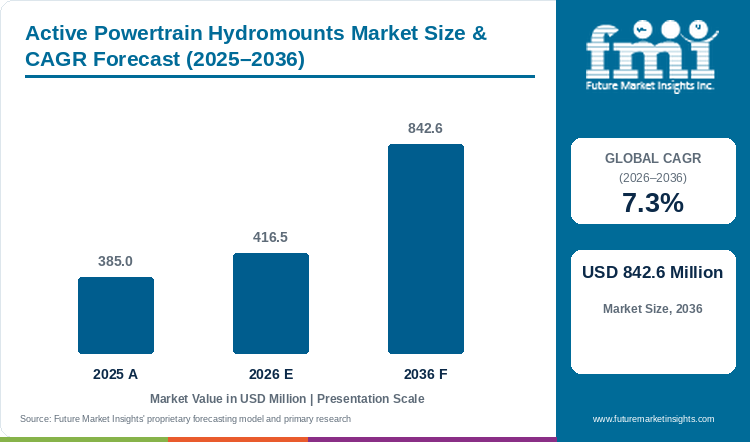
Assessed at USD 385.0 million in 2025 and progressing to USD 416.5 million in 2026, the active powertrain hydromounts market valuation is on course to reach USD 842.6 million by 2036, supported by a forecast-period CAGR of 7.3%.
Automakers are stepping up adoption of electronically controlled fluid mounts as plug-in hybrid and start-stop vehicles create cabin vibration challenges that ordinary rubber blocks cannot absorb. Production figures in the U.S. Environmental Protection Agency's February 2026 Automotive Trends Report confirm that strong-hybrid vehicle manufacturing rose 36% to reach 7.8% of light-vehicle output, increasing OEM orders for mounts that smooth out frequent engine restarts [1]. To isolate low-frequency engine shake while blocking high-frequency motor noise, Electromagnetic Active Hydromounts are projected to capture 49.5% of actuation demand in 2026 across premium SUVs and electrified platforms linked to the hybrid drivetrain supply chain. Global active powertrain hydromounts valuation advanced from USD 385.0 million in 2025 to an estimated USD 416.5 million in 2026 and is forecast by FMI to reach USD 842.6 million by 2036, recording a 7.3% CAGR. Nevertheless, a three-fold unit price premium over passive hydraulic mounts remains a major cost hurdle that restricts adoption on entry-level compact cars.
Key Market Trends & Insights
- By actuation technology: Electromagnetic Active Hydromounts are projected to capture 49.5% in 2026 because closed-loop voice-coil actuators cancel cylinder-deactivation and restart vibrations in milliseconds.
- By damping fluid type: Glycol-Water Damping Fluid is estimated to command 76.4% in 2026 as low-cost 50/50 ethylene-glycol mixtures maintain linear inertia-track flow from -40°C to +125°C.
- By vehicle application: PHEV & Start-Stop ICE applications are expected to concentrate 56.8% in 2026 because automatic engine cranking while driving creates severe low-frequency cabin shudder.
- By housing material: Die-Cast Aluminum Housings are expected to secure 68.2% in 2026 because high-pressure A380 castings withstand severe engine bracket crash loads.
- By sales channel: OEM Factory Installation is forecast to generate 88.4% in 2026 owing to CAN-bus and crank-angle sensor integration tied directly into factory powertrain control units.
Regional Highlights
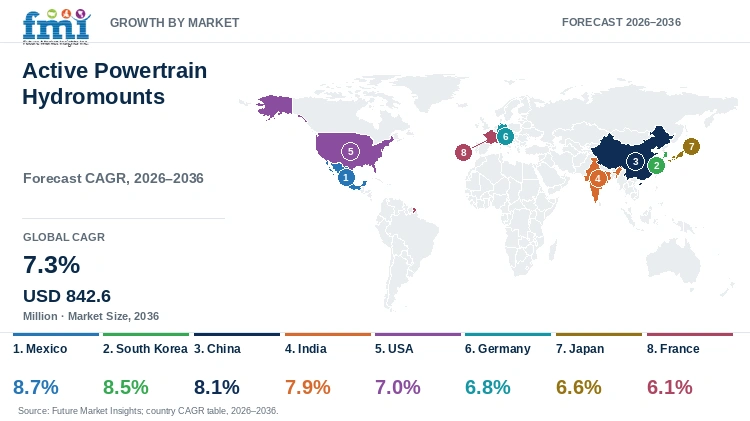
- Top national expansion: Mexico is projected to lead national growth at an 8.7% CAGR through 2036 under USMCA luxury SUV and plug-in hybrid export assembly.
- Broader country progression: South Korea is expected to expand at 8.5% CAGR ahead of China at 8.1% and India at 7.9%, while the USA is forecast to advance at a 7.0% CAGR.
Market Size & Forecast
Table 1: Market Size and Forecast for the Active Powertrain Hydromounts Market (USD million and CAGR percentage), 2025 to 2036
| Metric | Value |
|---|---|
| 2025 Market Size | USD 385.0 million |
| Estimated Market Size in 2026 | USD 416.5 million |
| Projected Market Size by 2036 | USD 842.6 million |
| CAGR, 2026 to 2036 | 7.3% |
| Added Valuation, 2026 to 2036 | USD 426.1 million |
Plug-in hybrid and battery-electric vehicle programs confront an acute acoustic paradox because eliminating steady combustion masking noise exposes passengers to abrupt engine restart jolts and high-frequency electric motor whine. Conventional passive elastomeric mounts tuned for stiff 8 Hz to 15 Hz rough-road engine control become acoustically rigid above 150 Hz, transmitting gear-mesh and pulse-width-modulation harmonics directly into the cabin. In September 2026, Schaeffler Group USA highlighted its expanded portfolio of integrated hybrid and electric powertrain NVH damping technologies at the North America Propulsion Symposium [2]. So OEM acoustic engineers are deploying electronically controlled hydromounts with hybrid drivetrain modules so vehicles switch smoothly between ultra-soft idle decoupling and firm cornering restraint.
Electrified Vehicle-Pool and Hydromount Sizing
Table 2: Electrified Vehicle-Pool and Hydromount Sizing for the Active Powertrain Hydromounts Market (USD million and operational ranges), 2025 to 2036
| Metric | 2025 | 2026 | 2036 |
|---|---|---|---|
| Market size (USD million) | 385.0 | 416.5 | 842.6 |
| Global PHEV, EREV & luxury BEV build (million vehicles) | 14.2 to 15.5 | 15.8 to 17.2 | 31.5 to 34.8 |
| Active hydromount units installed per year (million units) | 4.8 to 5.3 | 5.2 to 5.7 | 10.6 to 11.8 |
| Average factory-gate value per active mount (USD) | 73.0 to 80.0 | 74.0 to 81.0 | 72.0 to 79.0 |
Operational note: Vehicle-pool ranges apply global plug-in hybrid and range-extender electric builds with cylinder-deactivation and luxury battery-electric vehicle production against documented active subframe installation rates.
Multi-mode hybrid powertrains require sub-10-millisecond dynamic stiffness modulation across both cranking resonance and highway cruising. Tier-1 NVH specialists co-design active engine hydromounts with driveline torsional vibration dampers and couplings to suppress driveline booming before subframe transfer.
Per Vehicle & OEM Plant Sizing
Table 3: Per Vehicle and Plant Spending Indicators for the Active Powertrain Hydromounts Market (USD), 2025 to 2036
| Metric | 2025 | 2026 | 2036 |
|---|---|---|---|
| Global passenger vehicle production (million units) | 89.8 | 91.4 | 103.5 |
| Active hydromount spend per 1,000 vehicles built (USD) | 4,287.3 | 4,556.9 | 8,141.1 |
| OEM switchable vacuum hydromount shipset (2 mounts, USD) | 96.0 to 130.0 | 98.0 to 132.0 | 104.0 to 140.0 |
| OEM electromagnetic / MR active shipset (2-3 mounts, USD) | 170.0 to 360.0 | 175.0 to 365.0 | 165.0 to 345.0 |
Table 4: OEM Plant & Channel Procurement Indicators for the Active Powertrain Hydromounts Market (USD and percentages), 2026
| Metric | Value | Industry Reference Basis |
|---|---|---|
| Market size, 2026 | USD 416.5 million | 2026 global valuation baseline |
| Global PHEV, luxury ICE & e-axle assembly plants | 210 facilities | Active OEM premium & hybrid vehicle plants |
| Annual active hydromount spend per plant | USD 1.75 million | OEM factory-installed channel allocation |
| OEM factory installation valuation, 2026 | USD 368.2 million | 88.4% sales-channel segment allocation |
Calibrating active engine mounts across cylinder-deactivation firing orders requires real-time crank-angle phase synchronization. Powertrain engineers pair active hydromounts with automotive torque converter dampers to allow lower lock-up clutch engagement speeds without cabin drone.
Analyst Perspective
"Extended OEM lifecycles for plug-in hybrids and range-extender electric vehicles have transformed active hydromounts from a niche V8 luxury feature into core electrified NVH infrastructure. Suppliers that package glass-fiber-reinforced polyamide housings with closed-loop electromagnetic decouplers and hall-effect stroke sensors will capture the fastest-growing PHEV and e-axle contracts through 2036."
- Nikhil Kaitwade, Principal Consultant, Future Market Insights.
How is the active powertrain hydromounts market segmented?
The active powertrain hydromounts market is segmented by actuation technology, damping fluid type, housing material, vehicle application, and sales channel. In 2026, Electromagnetic Active Hydromounts are projected at 49.5%, Glycol-Water Damping Fluid at 76.4%, Die-Cast Aluminum Housings at 68.2%, PHEV & Start-Stop ICE at 56.8%, and OEM Factory Installation at 88.4%.
By actuation technology: Electromagnetic Active Hydromounts, Switchable Vacuum Hydromounts, and Magnetorheological Fluid Mounts.
By damping fluid type: Glycol-Water Damping Fluid, and Magnetorheological Iron Suspension.
By housing material: Die-Cast Aluminum Housings, and Polyamide Composite Housings.
By vehicle application: PHEV & Start-Stop ICE, BEV E-Axle Isolation, and Luxury Cabin NVH Mounts.
By sales channel: OEM Factory Installation, and Independent Aftermarket Replacement.
Why do Electromagnetic Active Hydromounts lead the actuation technology category?
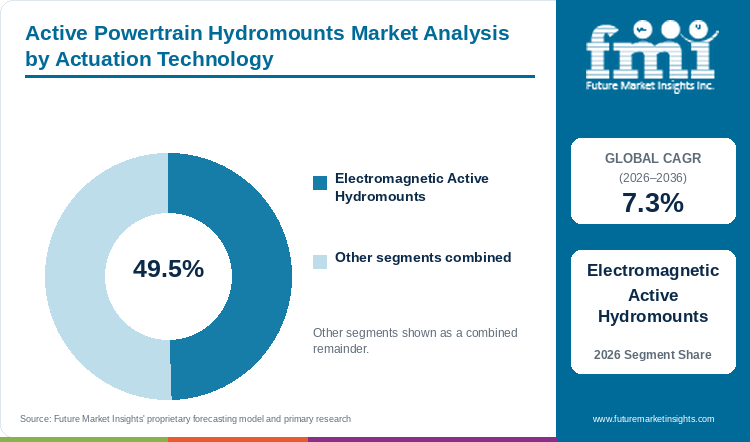
Electromagnetic Active Hydromounts are projected to capture 49.5% of actuation technology demand in 2026, supported by real-time phase cancellation.
Table 5: Actuation Technology Share for the Active Powertrain Hydromounts Market (percentage share), 2026
| Actuation Technology | Share (2026) |
|---|---|
| Electromagnetic Active Hydromounts | 49.5% |
| Other Segments Combined | 50.5%* |
| Total | 100.0% |
*Note: Switchable Vacuum Hydromounts (31.5%) and Magnetorheological Fluid Mounts (19.0%) complete 100.0% of 2026 actuation demand.
Table 6: Actuation Technology Leadership and Market Growth for the Active Powertrain Hydromounts Market (segment and CAGR percentage), 2026 to 2036
| Metric | Value |
|---|---|
| Global CAGR (2026 to 2036) | 7.3% |
| Leading Segment | Electromagnetic Active Hydromounts |
Driving an internal neodymium-iron-boron permanent magnet and copper voice-coil actuator at 20 Hz to 250 Hz in opposite phase to engine firing pulses creates instantaneous dynamic pressure cancellation inside the upper fluid chamber. Unlike vacuum-switched valves that only toggle between two fixed states, electromagnetic mounts lower dynamic stiffness below 15 N/mm across variable RPM bands while complementing active stabilizer bar actuator systems on premium chassis.
- Electromagnetic Active Hydromounts are projected to secure 49.5% of actuation market value (USD 206.2 million) in 2026 and expand at a 7.6% CAGR to USD 429.0 million by 2036.
- Structural-acoustic powertrain research published on PubMed Central in 2026 documented how metamaterial panel treatment attenuates low-frequency structure-borne engine force across idle and firing transitions [3].
Why does Glycol-Water Damping Fluid define the largest damping fluid segment?
Glycol-Water Damping Fluid formulations are estimated to secure 76.4% of the damping fluid category in 2026, driven by thermal viscosity stability and low cost.
Formulating 50/50 or 60/40 blends of high-purity ethylene glycol or propylene glycol with deionized water and corrosion-inhibiting carboxylate packages delivers Newtonian fluid flow across helical inertia tracks from -40°C to +125°C. Zero abrasive particle content prevents internal rubber diaphragm wear over 200,000 kilometers while costing 85% less per liter than carbonyl-iron suspensions used in specialized automotive suspension systems.
- Glycol-Water Damping Fluid options are estimated to command 76.4% of the damping fluid segment (USD 318.2 million) in 2026 across both electromagnetic and switchable vacuum hydromounts.
- In March 2026, Trelleborg Group published its 2025 Annual and Sustainability Report detailing expanded fluid-damped anti-vibration elastomer solutions across global automotive and industrial platforms [4].
What keeps Die-Cast Aluminum Housings ahead by housing material?
Die-Cast Aluminum Housings are expected to command 68.2% of housing material demand in 2026, reflecting front-end crash load standards.
High-pressure die-cast A380 and AlSi9Cu3 aluminum housings provide high thread pull-out strength and thermal conductivity near hot turbocharger manifolds. Polyamide Composite Housings (31.8% share) grow faster at an 8.1% CAGR as battery-electric and hybrid SUVs prioritize 35% housing weight reduction.
- Die-Cast Aluminum Housings are expected to hold 68.2% of housing material market value (USD 284.1 million) in 2026 because metallic brackets resist subframe shear during frontal crash tests.
- In February 2026, Cooper Standard Holdings Inc. Reported USD 2,740.0 million in FY2025 revenue while expanding lightweight fluid-isolated mount and sealing assemblies across North America truck and hybrid platforms [19].
What keeps PHEV & Start-Stop ICE ahead by vehicle application?
PHEV & Start-Stop ICE platforms are expected to command 56.8% of vehicle application volume in 2026, reflecting frequent combustion restart vibration demands.
Series-parallel plug-in hybrids and 48-volt mild-hybrid engines automatically crank and shut down the internal combustion engine dozens of times per urban trip while the cabin is otherwise silent. Active hydromounts open their bypass or energize the voice coil during the 300-millisecond starter pass-through window (8 Hz to 18 Hz) using real-time automotive semiconductors to eliminate steering-wheel and seat-rail shudder.
- PHEV & Start-Stop ICE applications are expected to hold 56.8% of vehicle application market value (USD 236.6 million) in 2026 and advance at a 7.4% CAGR through 2036.
- In August 2026, Schaeffler AG reported EUR 11,800.0 million in first-half 2026 revenue as demand for plug-in hybrid and range-extender powertrain modules accelerated across global OEM hubs [5].
Why does OEM Factory Installation lead the sales channel category?
OEM Factory Installation channels are forecast to generate 88.4% of sales channel market value in 2026, owing to closed-loop ECU and wiring-use integration.
Active powertrain hydromounts require dedicated pulse-width-modulation power drivers, crank-angle position inputs, and chassis-subframe accelerometer feedback loops calibrated on the OEM assembly line. Unlike passive rubber mounts that independent repair shops can swap with generic aftermarket blocks, active mounts must match factory impedance and CAN-bus diagnostic codes to prevent dashboard fault lights.
- OEM Factory Installation is forecast to account for 88.4% of sales channel demand (USD 368.2 million) in 2026, while Independent Aftermarket Replacement (11.6% share) grows at an 8.0% CAGR as 2018-2024 luxury hybrids age.
- In July 2025, Vibracoustic SE announced a new strategic partnership with RepXpert to expand technical training and OE-grade replacement engine-mount distribution across the independent aftermarket [6].
What are the drivers, restraints, and opportunities in the active powertrain hydromounts market?
In the active powertrain hydromounts market, surging plug-in hybrid and e-axle production is projected to expand multi-mount shipsets whereas 3x bill-of-materials cost premiums restrain economy-car adoption and magnetorheological smart mounts create luxury chassis opportunities.
- Driver: Plug-in hybrid restart shock and 400-2,000 Hz e-axle gear whine compel OEMs to upgrade from passive rubber blocks to active fluid mounts.
- Restraint: Unit pricing of USD 85 to USD 145 per active mount plus ECU use complexity restricts fitment on price-sensitive A/B-segment cars.
- Opportunity: Magnetorheological carbonyl-iron fluid mounts and glass-fiber polyamide housings open lightweight semi-active damping on electric SUVs.
Growth Analysis and Future Potential: Qualitative Demand Catalysts
Global automakers are extending plug-in hybrid (PHEV), range-extender electric (EREV), and cylinder-deactivation powertrain production schedules through the 2030s while simultaneously raising acoustic comfort standards on battery electric vehicles (BEVs). In a BEV or electric-mode PHEV, removing steady 65 dBA combustion masking noise makes high-frequency 400 Hz to 2,000 Hz e-axle gear-mesh whine and inverter switching tones immediately audible inside the cabin. Future Market Insights notes that OEMs are consequently installing active dual-stage and electromagnetic hydromounts on electric drive units with automotive suspension control arms to decouple structure-borne subframe vibration. In February 2025, Vibracoustic India inaugurated expanded production and high-frequency elastomer testing equipment at its Punawale facility in Pune to serve global and domestic electrified platforms [7]. Multi-year platform awards across North America and Europe with East Asia consequently lock in strong unit growth for active e-axle and PHEV hydromounts.
Risk Assessment of the Active Powertrain Hydromounts Market: Operational and Engineering Friction
High bill-of-materials cost multiples, thermal elastomer aging near turbochargers, and carbonyl-iron particle sedimentation in magnetorheological fluids represent the primary barriers restricting universal adoption. Whereas a passive hydraulic engine mount costs an OEM USD 24 to USD 35, an electromagnetic active hydromount with an integrated voice-coil actuator and hall-effect sensor costs USD 85 to USD 130 per unit. In December 2025, materials research led by Kanamori et al. Published in Scientific Reports documented the challenge of maintaining reversible magnetorheological damping response through elastomeric treatment cycles [8]. OEM purchasing committees consequently restrict active electromagnetic and magnetorheological mounts to vehicles priced above USD 38,000 while retaining passive bushings from the control arm and suspension joint bearings sector on budget models. In addition, under-hood radiant heat exceeding 135°C near compact turbo-hybrid exhaust manifolds requires expensive fluorosilicone or Vamac ethylene-acrylic elastomer diaphragms.
Commercial Opportunity Analysis: Architecture Differentiation and Value-Add Formats
Powertrain mounting economics reward Tier-1 suppliers that replace heavy die-cast aluminum mount housings with injection-molded glass-fiber-reinforced polyamide (`PA66-GF50`) and integrate plug-and-play micro-ECU drivers directly onto the mount body. Reducing mount housing mass by 30% to 38% helps electric and hybrid SUV engineers offset battery-pack weight penalties while meeting strict front-crash crush-zone requirements. Suppliers capturing premium margins also engineer magnetorheological (MR) mounts filled with 6 µm to 10 µm surface-coated carbonyl-iron microspheres that vary yield stress continuously within 5 milliseconds with automotive steering dampers. An experimental semi-active suspension damping study published in Sensors documented reversible magnetorheological control strategies across low-to-mid frequency road-and-engine excitation [9]. Co-packaging active engine and e-axle hydromounts with predictive road-preview camera algorithms enables Tier-1 vendors to increase content per vehicle above USD 280.
Active Powertrain Hydromounts Market by Country (2026 to 2036)
As per FMI, Mexico is projected to lead active powertrain hydromounts expansion across major automotive production hubs at an 8.7% CAGR through 2036, whereas France is forecast to progress at a 6.1% CAGR. Commercial performance across North America and East Asian hybrid/EV manufacturing corridors with European luxury OEM plants depends on plug-in hybrid output, e-axle acoustic specifications, and localized elastomer molding capacity.
Table 7: Country CAGR and Primary Growth Levers for the Active Powertrain Hydromounts Market (CAGR percentage and operational drivers), 2026 to 2036
| Country | CAGR (2026 to 2036) | Primary Growth Lever |
|---|---|---|
| Mexico | 8.7% | USMCA luxury SUV, PHEV & e-axle export assembly across a record light-vehicle base |
| South Korea | 8.5% | Hyundai-Kia E-GMP electric & Genesis turbo-hybrid active NVH standardization |
| China | 8.1% | World's largest PHEV & range-extender (EREV) SUV production volume |
| India | 7.9% | Sumitomo Riko & Vibracoustic R&D/testing expansions & premium SUV surge |
| USA | 7.0% | +36% strong-hybrid jump, cylinder-deactivation V8 pickups & luxury EV assembly |
| Germany | 6.8% | 450,000 PHEV output (+54%) & BMW/Mercedes/Audi/Porsche active mount leadership |
| Japan | 6.6% | Toyota/Lexus & Honda e:HEV flagship hybrid NVH and Sumitomo Riko/Toyo Tire R&D |
| France | 6.1% | Stellantis STLA Medium PHEV/BEV assembly & Hutchinson active NVH engineering |
Source: Future Market Insights analysis
Mexico Active Powertrain Hydromounts Market Outlook (2026 to 2036)
Nearshore assembly of premium Germany, the USA, and Japan crossovers and plug-in hybrids for duty-free North America export positions Mexico as the fastest-growing national market globally. According to INEGI's January 2026 RAIAVL registry, Mexico OEM plants sustained record 2025 light-vehicle output (77.2% in light trucks and SUVs) and maintained strong momentum through the first eight months of 2026 [10]. Valuation of the active powertrain hydromounts market in Mexico is projected to climb at an 8.7% CAGR from USD 18.5 million in 2026 to USD 42.6 million by 2036 as European and U.S. Automakers scale electrified SUV lines. Tight USMCA regional chemical and elastomer origin audits nonetheless compel Tier-1 NVH suppliers in Querétaro and Guanajuato to localize natural-rubber compounding and aluminum die-casting.
Key takeaway: In Mexico, nearshoring of North America luxury SUV and plug-in hybrid production is projected to drive rapid Tier-1 localization of active hydromount assembly.
South Korea Active Powertrain Hydromounts Market Outlook (2026 to 2036)
Whereas European OEMs historically restricted active mounts to low-volume V8 flagships, South Korea rapidly standardized active electromagnetic and switchable solenoid hydromounts across high-volume domestic hybrid and electric SUVs. A powertrain structural-acoustic isolation review published in Materials in 2026 documented how vibroacoustic suspension panels attenuate low-frequency gear whine in multi-motor electric vehicles [11]. South Korea active powertrain hydromounts market size is expected to advance at an 8.5% CAGR from USD 28.4 million in 2026 to USD 64.2 million by 2036. Domestic union wage negotiations and export tariff exposure in the U.S. Market encourage South Korea Tier-1 supplier DN Automotive (formerly DTR) to expand dual-shore manufacturing.
Key takeaway: In South Korea, aggressive standardization of active NVH mounts across flagship domestic hybrid and EV platforms is expected to sustain high national growth.
China Active Powertrain Hydromounts Market Outlook (2026 to 2036)
China's distinct market driver is its world-leading volume of extended-range electric vehicles (EREVs) and plug-in hybrid SUVs where 1.5L turbo range-extender generators start and stop automatically while passengers expect pure-EV silence. In March 2026, Anhui Zhongding Sealing Parts Co., Ltd. (parent of Germany NVH specialist WEGU) reported continued expansion of its active air-suspension and fluid-damped powertrain mount contracts across China new-energy vehicle OEMs [12]. China demand for active powertrain hydromounts is forecast to rise at an 8.1% CAGR from USD 112.5 million in 2026 to USD 245.1 million by 2036. Fierce domestic OEM price wars squeeze Tier-1 gross margins by 5% to 8% annually, forcing global suppliers Vibracoustic and Continental to localize coil winding and glycol-filling lines in Wuxi and Changshu.
Key takeaway: In China, massive EREV and PHEV sport-utility volume where range-extender engines must restart imperceptibly is forecast to anchor global unit demand.
India Active Powertrain Hydromounts Market Outlook (2026 to 2036)
India is transitioning from basic passive rubber engine mounts to switchable hydraulic and active mounts as domestic buyers shift toward premium midsize SUVs and global Tier-1s turn India into an engineering export hub. In February 2025, Vibracoustic India expanded production and dynamic testing equipment at its Punawale plant in Maharashtra, followed in June 2026 by Sumitomo Riko's launch of a new automotive R&D center in Haryana [16]. India's active powertrain hydromounts industry valuation is anticipated to grow at a 7.9% CAGR from USD 14.2 million in 2026 to USD 30.4 million by 2036. High price sensitivity in sub-4-meter compact cars still restricts active mounts to flagship SUVs and luxury assembly lines, making export engineering a critical revenue pillar for India plants.
Key takeaway: In India, multi-million-dollar R&D and dynamic testing investments by Vibracoustic and Sumitomo Riko are anticipated to accelerate local active hydromount adoption.
USA Active Powertrain Hydromounts Market Outlook (2026 to 2036)
What sets the USA apart is the simultaneous combination of a 36% surge in gasoline strong-hybrid production, widespread cylinder-deactivation V8 pickup engines (GM Dynamic Fuel Management and Ram HEMI/Hurricane), and high-torque electric trucks requiring active subframe mounts. In February 2026, Toyo Tire Corporation reported JPY 595,000.0 million in FY2025 consolidated net sales while expanding its North America automotive anti-vibration rubber and fluid-mount operations [13]. Commercial active powertrain hydromounts market value in the USA is predicted to climb at a 7.0% CAGR from USD 88.6 million in 2026 to USD 174.3 million by 2036. Skilled mechatronics technician shortages at Midwest elastomer molding plants remain an operational constraint, driving automation in fluid-chamber crimped-seal assembly.
Key takeaway: In the USA, strong-hybrid SUV expansion and cylinder-deactivation pickup trucks are predicted to keep North America active hydromount lines at high use.
Germany Active Powertrain Hydromounts Market Outlook (2026 to 2036)
Germany remains Europe's premier engineering and consumption hub for electromagnetic and magnetorheological active hydromounts because flagship Germany luxury OEMs specify active mounts across both plug-in hybrid and electric models. Germany domestic plug-in hybrid (PHEV) passenger car production jumped 54% in 2025 to roughly 450,000 units and sustained second-place global electrified manufacturing output [14]. Germany active powertrain hydromounts market valuation is estimated to progress at a 6.8% CAGR from USD 64.5 million in 2026 to USD 124.6 million by 2036, led by Darmstadt-headquartered Vibracoustic SE and Hanover-based Continental AG (ContiTech). Elevated Germany industrial electricity tariffs and restructuring across legacy combustion parts plants nonetheless compel Tier-1s to automate high-margin active mechatronic lines.
Key takeaway: In Germany, a 54% surge in domestic plug-in hybrid output and flagship luxury OEM specifications are estimated to sustain leadership in electromagnetic active mounts.
Japan Active Powertrain Hydromounts Market Outlook (2026 to 2036)
Global leadership in series-parallel strong hybrids (Toyota 5th-generation THS and Honda e:HEV) and luxury Lexus models underpins steady demand for active vacuum-solenoid and electromagnetic hydromounts in Japan. In May 2026, Sumitomo Riko Company Limited reported JPY 635,200.0 million in FY2025 consolidated net sales with its Automotive Anti-Vibration rubber and active hydromount division serving as the core earnings pillar [17]. Japan active powertrain hydromounts market size is slated to expand at a 6.6% CAGR from USD 42.0 million in 2026 to USD 79.6 million by 2036. A mature domestic vehicle parcel caps local unit volume growth, so Japan Tier-1s focus on ultra-lightweight polyamide-housed active mounts for global hybrid platforms.
Key takeaway: In Japan, next-generation domestic strong-hybrid and luxury vehicle platforms are slated to drive continuous innovation in compact low-power active hydromounts.
France Active Powertrain Hydromounts Market Outlook (2026 to 2036)
France anchors Western European non-Germany demand through Stellantis's localized STLA Medium plug-in hybrid and electric SUV assembly (Peugeot 3008/5008, DS N°8) with Paris-headquartered NVH leader Hutchinson SA (TotalEnergies Group). In February 2026, TotalEnergies SE reported full-year 2025 results showing Hutchinson's precision anti-vibration and active mechatronic sealing/mounting systems across European automotive and aerospace programs [18]. France demand for active powertrain hydromounts is likely to increase at a 6.1% CAGR from USD 16.8 million in 2026 to USD 30.4 million by 2036. Strict France CO2 malus weight taxes penalize vehicles above 1,600 kg, strong Hutchinson and Stellantis engineers to specify composite-housed active mounts that save 1.2 kg per shipset.
Key takeaway: In France, weight-based CO2 malus regulations and Stellantis PHEV/BEV crossover production are likely to favor lightweight composite-housed active hydromounts.
Full report country CAGRs cover: North America; Latin America; Western Europe; Eastern Europe; East Asia; South Asia and Pacific; Middle East and Africa.
Who are the notable companies in the active powertrain hydromounts market?
Vibracoustic SE, Sumitomo Riko Company Limited, Continental AG (ContiTech), Hutchinson SA, BOGE Rubber & Plastics Group, Cooper Standard Holdings Inc., Marelli Holdings Co., Ltd., and BWI Group are the notable companies in the active powertrain hydromounts market.
FMI analysis indicates that the competitive arena divides between global Tier-1 automotive anti-vibration elastomer conglomerates and specialized magnetorheological / mechatronic suspension innovators. Global anti-vibration leaders engineer switchable vacuum-solenoid and voice-coil electromagnetic hydromounts with proprietary natural-rubber and Vamac diaphragms for OEM hybrid and e-axle lines. Specialized mechatronic and magnetorheological suppliers formulate carbonyl-iron fluid suspensions and closed-loop PWM controllers for ultra-luxury and sports platforms.
- Global Tier-1 Anti-Vibration Leaders: Vibracoustic SE and Sumitomo Riko Company Limited with Continental AG (ContiTech) and Hutchinson SA command over 62% of global OEM active hydromount supply.
- Asian & European Elastomer-Mechatronic Platforms: BOGE Rubber & Plastics Group and Anhui Zhongding (WEGU) with DN Automotive supply lightweight composite-housed and switchable hydromounts across Europe, China, and South Korea.
- Magnetorheological & Specialty Isolation Innovators: BWI Group and Marelli Holdings Co. Ltd. With Cooper Standard Holdings Inc. Engineer magnetorheological fluid mounts and specialized fluid-isolated cradle bushings.
Competitive Benchmarking: Active Powertrain Hydromounts Market
Table 8: Competitive Benchmarking for the Active Powertrain Hydromounts Market (qualitative capability ratings), 2026
| Company | Electromagnetic Voice-Coil IP | E-Axle & PHEV Tuning Depth | Composite Housing Lightweighting | Geographic Reach |
|---|---|---|---|---|
| Vibracoustic SE | High | High | High | High |
| Sumitomo Riko Co., Ltd. | High | High | High | High |
| Continental AG (ContiTech) | High | High | High | High |
| Hutchinson SA | High | High | High | High |
| BOGE Rubber & Plastics | Medium | High | High | High |
| Cooper Standard Holdings | Medium | Medium | High | High |
| Marelli Holdings Co., Ltd. | High | High | Medium | High |
| BWI Group | High | Medium | Medium | Medium |
Scoring basis: Capability tiers evaluate documented voice-coil electromagnetic and magnetorheological patent portfolios with high-frequency 400-2,000 Hz e-axle acoustic test rigs. Lightweighting and geographic ratings reflect verified PA66-GF50 composite housing production and multi-region OEM plant footprints.
Key Developments in the Active Powertrain Hydromounts Market
- Sumitomo Riko Company Limited opened a new automotive anti-vibration R&D base in Haryana, India in June 2026 following JPY 635,200.0 million in FY2025 net sales to accelerate localized hybrid and EV mount development [15].
- Vibracoustic SE expanded dynamic testing and production equipment at its Pune, India plant in February 2025 and partnered with RepXpert in July 2025 to scale OE-grade replacement mount support [20].
- Continental AG completed the spin-off of its automotive electronics sector (Aumovio) in September 2025 while establishing ContiTech as a dedicated rubber and anti-vibration systems specialist ahead of its planned 2026 carve-out [21].
Key Players in the Active Powertrain Hydromounts Market
Global Tier-1 Anti-Vibration & Active Hydromount Leaders
- Vibracoustic SE (Freudenberg Group)
- Sumitomo Riko Company Limited
- Continental AG (ContiTech)
European & Asian Elastomer-Mechatronic Platforms
- Hutchinson SA
- BOGE Rubber & Plastics Group (Zhuzhou Times New Material Technology)
- Cooper Standard Holdings Inc.
Magnetorheological & Mechatronic Isolation Specialists
- Marelli Holdings Co., Ltd.
- BWI Group (BeijingWest Industries)
Active Powertrain Hydromounts Market - Report Scope
Table 9: Report Scope for the Active Powertrain Hydromounts Market (coverage fields and definitions), 2026 to 2036
| Coverage field | Report scope |
|---|---|
| Market breakdown | Actuation Technology; Damping Fluid Type; Housing Material; Vehicle Application; Sales Channel |
| Quantitative Units | USD Million |
| Market Definition | Includes commercial supplier valuation from electronically controlled active and semi-active fluid-filled powertrain and e-axle mounts (electromagnetic voice-coil, switchable vacuum/solenoid, and magnetorheological fluid mounts). Category Scope Note: Excludes purely passive solid rubber blocks and non-switchable passive hydraulic mounts. |
| Regions Covered | North America; Latin America; Western Europe; Eastern Europe; East Asia; South Asia and Pacific; Middle East and Africa |
| Countries Covered | Mexico, South Korea, China, India, USA, Germany, Japan, France, and additional countries in the full report |
| Key Companies Covered | Vibracoustic SE, Sumitomo Riko Company Limited, Continental AG (ContiTech), Hutchinson SA, BOGE Rubber & Plastics Group, Cooper Standard Holdings Inc., Marelli Holdings Co., Ltd., BWI Group |
| Forecast Period | 2026 to 2036 |
| Approach | Primary and secondary research with top-down and bottom-up market triangulation. |
Active Powertrain Hydromounts Market - Research Methodology
Table 10: Research Methodology for the Active Powertrain Hydromounts Market (research methods and approach), 2026 edition
| Method | Approach |
|---|---|
| Primary Research | Structured interviews with Tier-1 NVH acoustic engineers, OEM plug-in hybrid platform directors, e-axle subframe leads, and magnetorheological fluid formulators to validate shipset pricing and attachment rates. |
| Secondary Research | Analysis of U.S. EPA Automotive Trends reports, VDA and INEGI vehicle production statistics, corporate annual filings (Freudenberg/Vibracoustic, Sumitomo Riko, Continental, Cooper Standard), and peer-reviewed NVH journals. |
| Market Sizing and Forecasting | Top-down global automotive chassis bushings and anti-vibration mounts models (USD 12,450.0 million sub-sector in 2026) reconciled against bottom-up PHEV, EREV, cylinder-deactivation ICE, and luxury BEV build volumes from 2026 to 2036. |
| Country Forecasting Model | Econometric country projections weight national plug-in hybrid and luxury electric vehicle assembly, multi-cylinder pickup production, and localized Tier-1 mechatronic capacity across eight key automotive countries. |
| Operational Benchmark Traceability | Electrified vehicle-pool and plant spending indicators in Tables 2, 3, and 4 trace to U.S. EPA hybrid growth records, VDA Germany PHEV output, and Tier-1 divisional revenue disclosures. |
| Data Triangulation and Validation | Demand estimates are cross-checked against voice-coil actuator and glycol/MR fluid shipsets without double counting passive hydraulic or solid elastomer bushings. |
Active Powertrain Hydromounts Market by Segments
Active Powertrain Hydromounts Market segmented by Actuation Technology:
- Electromagnetic Active Hydromounts
- Switchable Vacuum Hydromounts
- Magnetorheological Fluid Mounts
- Solenoid-Switched Hydromounts
Active Powertrain Hydromounts Market segmented by Damping Fluid Type:
- Glycol-Water Damping Fluid
- Magnetorheological Iron Suspension
- Silicone-Fluid Damping Blends
Active Powertrain Hydromounts Market segmented by Housing Material:
- Die-Cast Aluminum Housings
- Polyamide Composite Housings
- Hybrid Aluminum-Composite Shells
Active Powertrain Hydromounts Market segmented by Vehicle Application:
- PHEV & Start-Stop ICE
- BEV E-Axle Isolation
- Luxury Cabin NVH Mounts
- Range-Extender SUV Mounts
Active Powertrain Hydromounts Market segmented by Sales Channel:
- OEM Factory Installation
- Independent Aftermarket Replacement
- Authorized Dealer Service
- Tier-1 OES Programs
- Performance Chassis Upfitters
Active Powertrain Hydromounts Market by Region
- North America
- United States
- Canada
- Latin America
- Brazil
- Mexico
- Argentina
- Chile
- Western Europe
- Germany
- France
- United Kingdom
- Italy
- Spain
- Benelux
- Nordics
- Eastern Europe
- Poland
- Czech Republic
- Romania
- Hungary
- East Asia
- China
- Japan
- South Korea
- South Asia and Pacific
- India
- ASEAN
- Australia and New Zealand
- Middle East and Africa
- GCC Countries
- South Africa
- Türkiye
- Israel
Research Sources and Bibliography
- [1] U.S. Environmental Protection Agency (EPA). (2026, February 20). The 2025 EPA Automotive Trends Report: Greenhouse Gas Emissions, Fuel Economy, and Technology since 1975 — Executive Summary (EPA-420-S-26-001). U.S. Environmental Protection Agency.
- [2] Schaeffler Group USA Inc. (2026, September 10). Schaeffler's Integrated Powertrain Technologies Provide Flexible Solutions for Next Generation Battery Electric and Hybrid Vehicles. Schaeffler Media Relations.
- [3] Horvath, K. (2026). Vibroacoustic Metamaterials for Low-Frequency Sound and Vibration Attenuation in Electric Vehicles: A Review.. Materials (Basel, Switzerland), 19(15), 3259 (PMC13468135).
- [4] Trelleborg AB. (2026, March 20). Trelleborg's 2025 Annual and Sustainability Report Published. Trelleborg Group Corporate Communications.
- [5] Schaeffler AG. (2026, August 5). Schaeffler Improves Profitability in First Half of 2026. Schaeffler Press Office.
- [6] Vibracoustic SE. (2025, July 15). Vibracoustic Enters Into a New Partnership with RepXpert to Expand Aftermarket Technical Support. Vibracoustic Corporate News.
- [7] Vibracoustic SE. (2025, February 12). Vibracoustic Invests in Production and Testing Equipment in India. Vibracoustic Corporate News.
- [8] Krishna, K., et al. (2024). Enhancement of rider comfort by magnetorheological elastomer based damping treatment at strategic locations of an electric two wheeler.. Scientific reports, 14(1), 20107 (PMC11362590).
- [9] Jia, W., et al. (2026). Semi-Active Suspension Systems: From Advanced Control Algorithms to Emerging Off-Road and Agricultural Applications.. Sensors (Basel, Switzerland), 26(15), 4736 (PMC13468885).
- [10] Instituto Nacional de Estadística y Geografía (INEGI). (2026, January 9). Registro Administrativo de la Industria Automotriz de Vehículos Ligeros (RAIAVL), Diciembre de 2025. INEGI.
- [11] Schreiner, V., & Maas, J. (2025). Magnetorheological Fluid Utilized for Online Rotor Balancing.. Micromachines, 16(10), 1083 (PMC12566150).
- [12] Anhui Zhongding Sealing Parts Co., Ltd. (2026, March 25). Zhongding Group Global NVH Anti-Vibration and Active Chassis Systems Investor Overview. Zhongding Group.
- [13] Toyo Tire Corporation. (2026, February 13). Consolidated Financial Results for the Fiscal Year Ended December 31, 2025. Toyo Tire Investor Relations.
- [14] Schaeffler AG. (2025, August 19). Schaeffler to Demonstrate Expanded Portfolio of Electrification, Chassis, and Software Solutions at IAA MOBILITY. Schaeffler Press Office.
- [15] Continental AG. (2026, March 4). Continental Achieves Adjusted EBIT Target in Fiscal 2025 and Advances ContiTech Carve-Out Preparation. Continental Investor Relations.
- [16] Sumitomo Riko Company Limited. (2026, May 14). IR Library: Consolidated Financial Results for the Fiscal Year Ended March 31, 2026. Sumitomo Riko Investor Relations.
- [17] TotalEnergies SE (Hutchinson SA). (2026, February 11). TotalEnergies Full-Year 2025 Results and Hutchinson Precision Anti-Vibration Operations. TotalEnergies Investor Relations.
- [18] Aumovio SE (formerly Continental Automotive). (2025, September 2). Continental Automotive Completes Spin-Off Launch as Aumovio at IAA Mobility 2025. Continental Investor Relations.
- [19] Cooper Standard Holdings Inc. (2026, February 13). Form 10-K Annual Report for the Fiscal Year Ended December 31, 2025. U.S. Securities and Exchange Commission.
- [20] Freudenberg SE (Vibracoustic). (2026, March 26). Freudenberg Group 2025 Annual Report: Vibracoustic Automotive NVH and E-Mobility Performance. Freudenberg Group.
- [21] BWI Group (BeijingWest Industries). (2025, October 16). BWI Group Solutions: Controlled Suspension and Magnetorheological Actuator Portfolio. BWI Group.
- [22] BOGE Rubber & Plastics Group. (2025, November 12). BOGE Engine and Powertrain Mounts: Active and Switchable NVH Solutions. BOGE Rubber & Plastics.
- [23] Marelli Holdings Co., Ltd. (2025, September 9). Marelli Demonstrates Electromechanical and Active Damping Actuators for Software-Defined Vehicles. Marelli Corporate Communications.
This bibliography is provided for reader reference and is not exhaustive. The full report contains the complete reference list and detailed citations.
This Report Answers
- How large is the active powertrain hydromounts market in 2026 and what is forecast for 2036?
- Which plug-in hybrid and e-axle acoustic pressures support demand for active powertrain hydromounts?
- Why do Electromagnetic Active Hydromounts lead the actuation technology category?
- Why does Glycol-Water Damping Fluid lead the damping fluid category globally?
- How do growth rates differ across Mexico, South Korea, China, India, and the USA?
- Which leading companies supply voice-coil, switchable solenoid, and magnetorheological hydromounts today?
- What limits adoption or supplier switching in the active powertrain hydromounts market?
- What should buyers evaluate before purchasing an active powertrain hydromount?
Frequently Asked Questions
How big is the active powertrain hydromounts market in 2026, and what is forecast for 2036?
According to FMI, the global active powertrain hydromounts market size is estimated to reach USD 416.5 million in 2026 from USD 385.0 million in 2025. Valuation of the market is forecast to hit USD 842.6 million by 2036 as OEMs scale plug-in hybrid and e-axle acoustic isolation.
What is the CAGR for the active powertrain hydromounts market from 2026 to 2036?
Future Market Insights projects a 7.3% compound annual growth rate between 2026 and 2036, representing an anticipated USD 426.1 million increase in annual market valuation across OEM and replacement channels.
Which actuation technology segment leads the active powertrain hydromounts market?
Electromagnetic Active Hydromounts are projected to capture 49.5% of actuation technology demand in 2026 because closed-loop voice-coil actuators cancel 20-250 Hz engine firing and restart vibrations in real time.
Which damping fluid segment leads the active powertrain hydromounts market?
Glycol-Water Damping Fluid formulations are estimated to secure 76.4% of the fluid category in 2026 as 50/50 ethylene-glycol blends deliver stable low-temperature flow without abrasive diaphragm wear.
Which country has a notable growth outlook during the assessment period?
Mexico is projected to lead national growth at an 8.7% CAGR through 2036, supported by nearshore USMCA assembly of luxury SUVs and plug-in hybrids.
Who are the key players in the market?
Vibracoustic SE, Sumitomo Riko Company Limited, Continental AG (ContiTech), Hutchinson SA, BOGE Rubber & Plastics Group, Cooper Standard Holdings Inc., Marelli Holdings Co., Ltd., and BWI Group lead global supply.
Preview the report firsthand - request a free sample
Get SampleGet the brochure for pricing and purchase details.
Get PDFTable of Content
- Key Takeaways
- Market Size and CAGR
- Top Growth Driver
- Fastest Growing Segment
- Leading Region
- Key Companies
- Emerging Opportunities
- Executive Summary
- Global Market Outlook
- Demand-side Trends
- Supply-side Trends
- Technology Roadmap Analysis
- Analysis and Recommendations
- Analyst Perspective (What is happening? Why now? What should investors know?)
- Key Questions Answered
- How large is the market?
- What is the CAGR?
- What are key trends?
- Which region dominates?
- Who are the leaders?
- Market Overview
- Market Coverage / Taxonomy
- Market Definition / Scope / Limitations
- Research Methodology
- Chapter Orientation
- Analytical Lens and Working Hypotheses
- Market Structure, Signals, and Trend Drivers
- Benchmarking and Cross-market Comparability
- Market Sizing, Forecasting, and Opportunity Mapping
- Research Design and Evidence Framework
- Desk Research Programme (Secondary Evidence)
- Expert Input and Fieldwork (Primary Evidence)
- Tooling, Models, and Reference Databases
- Data Engineering and Model Build
- Quality Assurance and Audit Trail
- Market Background
- Market Dynamics (Drivers, Restraints, Opportunity, Trends)
- Scenario Forecast (Optimistic, Likely, Conservative)
- Impact Analysis
- AI Impact
- Sustainability Impact
- Regulatory Impact
- Technology Impact
- Consumer / Buyer Analysis
- Purchase Drivers
- Adoption Barriers
- Buyer Journey
- Opportunity Map Analysis
- Product Life Cycle Analysis
- Supply Chain Analysis
- Investment Feasibility Matrix
- Value Chain Analysis
- PESTLE and Porter's Analysis
- Regulatory Landscape
- Regional Parent Market Outlook
- Production and Consumption Statistics
- Import and Export Statistics
- Global Market Analysis and Forecast, 2021 to 2036
- Historical Market Size Value (USD Million) Analysis, 2021 to 2025
- Current and Future Market Size Value (USD Million) Projections, 2026 to 2036
- Y-o-Y Growth Trend Analysis
- Absolute $ Opportunity Analysis
- Global Market Pricing Analysis, 2021 to 2036
- Global Market Analysis and Forecast, By Actuation Technology, 2021 to 2036
- Introduction / Key Findings
- Historical Market Size Value (USD Million) Analysis By Actuation Technology, 2021 to 2025
- Current and Future Market Size Value (USD Million) Analysis and Forecast By Actuation Technology, 2026 to 2036
- Electromagnetic Active Hydromounts
- Switchable Vacuum Hydromounts
- Magnetorheological Fluid Mounts
- Solenoid-Switched Hydromounts
- Y-o-Y Growth Trend Analysis By Actuation Technology, 2021 to 2025
- Absolute $ Opportunity Analysis By Actuation Technology, 2026 to 2036
- Global Market Analysis and Forecast, By Damping Fluid Type, 2021 to 2036
- Introduction / Key Findings
- Historical Market Size Value (USD Million) Analysis By Damping Fluid Type, 2021 to 2025
- Current and Future Market Size Value (USD Million) Analysis and Forecast By Damping Fluid Type, 2026 to 2036
- Glycol-Water Damping Fluid
- Magnetorheological Iron Suspension
- Silicone-Fluid Damping Blends
- Y-o-Y Growth Trend Analysis By Damping Fluid Type, 2021 to 2025
- Absolute $ Opportunity Analysis By Damping Fluid Type, 2026 to 2036
- Global Market Analysis and Forecast, By Housing Material, 2021 to 2036
- Introduction / Key Findings
- Historical Market Size Value (USD Million) Analysis By Housing Material, 2021 to 2025
- Current and Future Market Size Value (USD Million) Analysis and Forecast By Housing Material, 2026 to 2036
- Die-Cast Aluminum Housings
- Polyamide Composite Housings
- Hybrid Aluminum-Composite Shells
- Y-o-Y Growth Trend Analysis By Housing Material, 2021 to 2025
- Absolute $ Opportunity Analysis By Housing Material, 2026 to 2036
- Global Market Analysis and Forecast, By Vehicle Application, 2021 to 2036
- Introduction / Key Findings
- Historical Market Size Value (USD Million) Analysis By Vehicle Application, 2021 to 2025
- Current and Future Market Size Value (USD Million) Analysis and Forecast By Vehicle Application, 2026 to 2036
- PHEV & Start-Stop ICE
- BEV E-Axle Isolation
- Luxury Cabin NVH Mounts
- Range-Extender SUV Mounts
- Y-o-Y Growth Trend Analysis By Vehicle Application, 2021 to 2025
- Absolute $ Opportunity Analysis By Vehicle Application, 2026 to 2036
- Global Market Analysis and Forecast, By Sales Channel, 2021 to 2036
- Introduction / Key Findings
- Historical Market Size Value (USD Million) Analysis By Sales Channel, 2021 to 2025
- Current and Future Market Size Value (USD Million) Analysis and Forecast By Sales Channel, 2026 to 2036
- OEM Factory Installation
- Independent Aftermarket Replacement
- Authorized Dealer Service
- Tier-1 OES Programs
- Performance Chassis Upfitters
- Y-o-Y Growth Trend Analysis By Sales Channel, 2021 to 2025
- Absolute $ Opportunity Analysis By Sales Channel, 2026 to 2036
- Global Market Analysis and Forecast, By Region, 2021 to 2036
- Introduction
- Historical Market Size Value (USD Million) Analysis By Region, 2021 to 2025
- Current Market Size Value (USD Million) Analysis and Forecast By Region, 2026 to 2036
- North America
- Latin America
- Western Europe
- Eastern Europe
- East Asia
- South Asia and Pacific
- Middle East and Africa
- Market Attractiveness Analysis By Region
- North America Market Analysis and Forecast, By Country, 2021 to 2036
- Historical Market Size Value (USD Million) Trend Analysis By Market Taxonomy, 2021 to 2025
- Market Size Value (USD Million) Forecast By Market Taxonomy, 2026 to 2036
- By Country
- United States
- Canada
- By Actuation Technology
- By Damping Fluid Type
- By Housing Material
- By Vehicle Application
- By Sales Channel
- By Country
- Market Attractiveness Analysis
- By Country
- By Actuation Technology
- By Damping Fluid Type
- By Housing Material
- By Vehicle Application
- By Sales Channel
- Key Takeaways
- Latin America Market Analysis and Forecast, By Country
- Historical Market Size Value (USD Million) Trend Analysis By Market Taxonomy, 2021 to 2025
- Market Size Value (USD Million) Forecast By Market Taxonomy, 2026 to 2036
- By Country
- Brazil
- Mexico
- Argentina
- Chile
- By Actuation Technology
- By Damping Fluid Type
- By Housing Material
- By Vehicle Application
- By Sales Channel
- By Country
- Market Attractiveness Analysis
- By Country
- By Actuation Technology
- By Damping Fluid Type
- By Housing Material
- By Vehicle Application
- By Sales Channel
- Key Takeaways
- Western Europe Market Analysis and Forecast, By Country
- Historical Market Size Value (USD Million) Trend Analysis By Market Taxonomy, 2021 to 2025
- Market Size Value (USD Million) Forecast By Market Taxonomy, 2026 to 2036
- By Country
- Germany
- France
- United Kingdom
- Italy
- Spain
- Benelux
- Nordics
- By Actuation Technology
- By Damping Fluid Type
- By Housing Material
- By Vehicle Application
- By Sales Channel
- By Country
- Market Attractiveness Analysis
- By Country
- By Actuation Technology
- By Damping Fluid Type
- By Housing Material
- By Vehicle Application
- By Sales Channel
- Key Takeaways
- Eastern Europe Market Analysis and Forecast, By Country
- Historical Market Size Value (USD Million) Trend Analysis By Market Taxonomy, 2021 to 2025
- Market Size Value (USD Million) Forecast By Market Taxonomy, 2026 to 2036
- By Country
- Poland
- Czech Republic
- Romania
- Hungary
- By Actuation Technology
- By Damping Fluid Type
- By Housing Material
- By Vehicle Application
- By Sales Channel
- By Country
- Market Attractiveness Analysis
- By Country
- By Actuation Technology
- By Damping Fluid Type
- By Housing Material
- By Vehicle Application
- By Sales Channel
- Key Takeaways
- East Asia Market Analysis and Forecast, By Country
- Historical Market Size Value (USD Million) Trend Analysis By Market Taxonomy, 2021 to 2025
- Market Size Value (USD Million) Forecast By Market Taxonomy, 2026 to 2036
- By Country
- China
- Japan
- South Korea
- By Actuation Technology
- By Damping Fluid Type
- By Housing Material
- By Vehicle Application
- By Sales Channel
- By Country
- Market Attractiveness Analysis
- By Country
- By Actuation Technology
- By Damping Fluid Type
- By Housing Material
- By Vehicle Application
- By Sales Channel
- Key Takeaways
- South Asia and Pacific Market Analysis and Forecast, By Country
- Historical Market Size Value (USD Million) Trend Analysis By Market Taxonomy, 2021 to 2025
- Market Size Value (USD Million) Forecast By Market Taxonomy, 2026 to 2036
- By Country
- India
- ASEAN
- Australia and New Zealand
- By Actuation Technology
- By Damping Fluid Type
- By Housing Material
- By Vehicle Application
- By Sales Channel
- By Country
- Market Attractiveness Analysis
- By Country
- By Actuation Technology
- By Damping Fluid Type
- By Housing Material
- By Vehicle Application
- By Sales Channel
- Key Takeaways
- Middle East and Africa Market Analysis and Forecast, By Country
- Historical Market Size Value (USD Million) Trend Analysis By Market Taxonomy, 2021 to 2025
- Market Size Value (USD Million) Forecast By Market Taxonomy, 2026 to 2036
- By Country
- GCC Countries
- South Africa
- Türkiye
- Israel
- By Actuation Technology
- By Damping Fluid Type
- By Housing Material
- By Vehicle Application
- By Sales Channel
- By Country
- Market Attractiveness Analysis
- By Country
- By Actuation Technology
- By Damping Fluid Type
- By Housing Material
- By Vehicle Application
- By Sales Channel
- Key Takeaways
- Key Countries Market Analysis
- United States
- Pricing Analysis
- Market Share Analysis, 2025
- By Actuation Technology
- By Damping Fluid Type
- By Housing Material
- By Vehicle Application
- By Sales Channel
- Canada
- Pricing Analysis
- Market Share Analysis, 2025
- By Actuation Technology
- By Damping Fluid Type
- By Housing Material
- By Vehicle Application
- By Sales Channel
- Mexico
- Pricing Analysis
- Market Share Analysis, 2025
- By Actuation Technology
- By Damping Fluid Type
- By Housing Material
- By Vehicle Application
- By Sales Channel
- Brazil
- Pricing Analysis
- Market Share Analysis, 2025
- By Actuation Technology
- By Damping Fluid Type
- By Housing Material
- By Vehicle Application
- By Sales Channel
- Chile
- Pricing Analysis
- Market Share Analysis, 2025
- By Actuation Technology
- By Damping Fluid Type
- By Housing Material
- By Vehicle Application
- By Sales Channel
- Germany
- Pricing Analysis
- Market Share Analysis, 2025
- By Actuation Technology
- By Damping Fluid Type
- By Housing Material
- By Vehicle Application
- By Sales Channel
- United Kingdom
- Pricing Analysis
- Market Share Analysis, 2025
- By Actuation Technology
- By Damping Fluid Type
- By Housing Material
- By Vehicle Application
- By Sales Channel
- Italy
- Pricing Analysis
- Market Share Analysis, 2025
- By Actuation Technology
- By Damping Fluid Type
- By Housing Material
- By Vehicle Application
- By Sales Channel
- Spain
- Pricing Analysis
- Market Share Analysis, 2025
- By Actuation Technology
- By Damping Fluid Type
- By Housing Material
- By Vehicle Application
- By Sales Channel
- France
- Pricing Analysis
- Market Share Analysis, 2025
- By Actuation Technology
- By Damping Fluid Type
- By Housing Material
- By Vehicle Application
- By Sales Channel
- India
- Pricing Analysis
- Market Share Analysis, 2025
- By Actuation Technology
- By Damping Fluid Type
- By Housing Material
- By Vehicle Application
- By Sales Channel
- ASEAN
- Pricing Analysis
- Market Share Analysis, 2025
- By Actuation Technology
- By Damping Fluid Type
- By Housing Material
- By Vehicle Application
- By Sales Channel
- Australia and New Zealand
- Pricing Analysis
- Market Share Analysis, 2025
- By Actuation Technology
- By Damping Fluid Type
- By Housing Material
- By Vehicle Application
- By Sales Channel
- China
- Pricing Analysis
- Market Share Analysis, 2025
- By Actuation Technology
- By Damping Fluid Type
- By Housing Material
- By Vehicle Application
- By Sales Channel
- Japan
- Pricing Analysis
- Market Share Analysis, 2025
- By Actuation Technology
- By Damping Fluid Type
- By Housing Material
- By Vehicle Application
- By Sales Channel
- South Korea
- Pricing Analysis
- Market Share Analysis, 2025
- By Actuation Technology
- By Damping Fluid Type
- By Housing Material
- By Vehicle Application
- By Sales Channel
- Poland
- Pricing Analysis
- Market Share Analysis, 2025
- By Actuation Technology
- By Damping Fluid Type
- By Housing Material
- By Vehicle Application
- By Sales Channel
- Hungary
- Pricing Analysis
- Market Share Analysis, 2025
- By Actuation Technology
- By Damping Fluid Type
- By Housing Material
- By Vehicle Application
- By Sales Channel
- Türkiye
- Pricing Analysis
- Market Share Analysis, 2025
- By Actuation Technology
- By Damping Fluid Type
- By Housing Material
- By Vehicle Application
- By Sales Channel
- South Africa
- Pricing Analysis
- Market Share Analysis, 2025
- By Actuation Technology
- By Damping Fluid Type
- By Housing Material
- By Vehicle Application
- By Sales Channel
- United States
- Market Structure Analysis
- Competition Dashboard
- Competition Benchmarking
- Market Share Analysis of Top Players
- By Regional
- By Actuation Technology
- By Damping Fluid Type
- By Housing Material
- By Vehicle Application
- By Sales Channel
- Emerging Startups
- Innovation Benchmarking
- Competition Analysis
- Competition Deep Dive
- Vibracoustic SE
- Overview
- Product Portfolio
- Profitability by Market Segments
- Sales Footprint
- Strategy Overview
- Marketing Strategy
- Product Strategy
- Channel Strategy
- Sumitomo Riko Co., Ltd.
- Continental AG (ContiTech)
- Hutchinson SA
- BOGE Rubber & Plastics
- Cooper Standard Holdings
- Marelli Holdings Co., Ltd.
- BWI Group
- Vibracoustic SE (Freudenberg Group)
- Sumitomo Riko Company Limited
- BOGE Rubber & Plastics Group (Zhuzhou Times New Material Technology)
- BWI Group (BeijingWest Industries)
- Vibracoustic SE
- Case Studies
- Success Stories
- Recent Developments
- Competition Deep Dive
- Assumptions & Acronyms Used


