

- Market Size (2026)
- USD 1.2 Bn
- Forecast (2036)
- USD 2.1 Bn
- CAGR (2026 to 2036)
- 6.0%
How big is Aerodynamic Roofline Systems Market in 2026?
USD 1.2 Billion in 2026 and USD 2.1 Billion by 2036 at a 6.0% CAGR.
Demand for aerodynamic roofline systems is projected to expand at 6.0% CAGR between 2026 and 2036, increasing valuation from USD 1.2 billion to USD 2.1 billion. Fleets using heavy-duty truck platforms can justify roofline hardware when sustained highway mileage turns drag reduction into recurring energy savings. Volvo Trucks reported in March 2025 that its redesigned VNR improved fuel efficiency by up to 7.5% with enhanced aerodynamics among several vehicle changes.
Country conditions change the route from efficiency interest to purchase. Mexico presents frequent specification points during semi-truck replacement cycles because heavy vehicles pass through domestic manufacturing and dealer channels. INEGI reported 12,306 heavy vehicles produced in April 2026, giving roofline manufacturers a larger stream of locally assembled configurations to qualify. Germany places semi-trailer platforms inside a different approval route shaped by CO2-linked operating costs and mature fleet replacement planning.
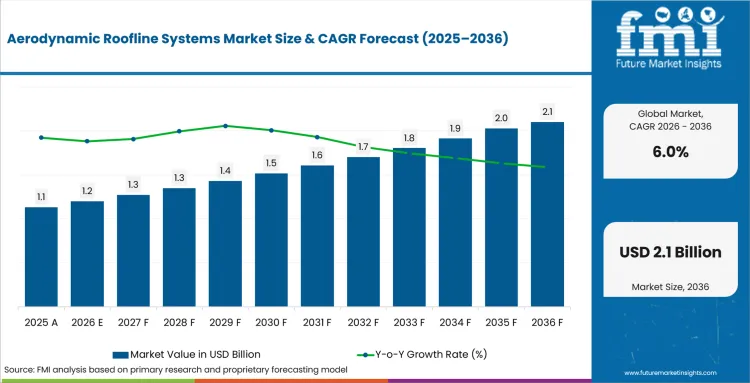
Key Takeaways of Aerodynamic Roofline Systems Market
- Fleet operating costs support aerodynamic roofline systems demand because reduced drag lowers fuel or electricity use across repeated highway mileage.
- Based on product type, cab roof fairings are projected to account for 29.0% in 2026 because they control upper-cab airflow directly.
- In 2026, heavy-duty trucks are expected to lead vehicle type with 43.0% share as sustained highway mileage makes aerodynamic payback easier to measure.
- By material, thermoplastic composites are forecast to represent 31.0% in 2026 as lightweight molded forms preserve aerodynamic shape under exposed fleet duty.
- Configuration-specific payback restrains wider adoption because vehicle geometry and annual highway mileage change realized savings from the same device.
- Daimler Truck and Volvo Trucks join Kenworth Truck Company and Peterbilt Motors Company alongside Wabash and Great Dane plus Transtex and FlowBelow Aero.
Analyst Perspective
"Fleet engineers should compare roofline systems against route speed, cab-to-trailer height mismatch and annual mileage before discussing unit price. Stronger offers preserve measured drag savings after installation without complicating service access or fairing repair during routine fleet operation."
- Nikhil Kaitwade, Principal Consultant, Future Market Insights
How is the Aerodynamic Roofline Systems Market segmented?
The aerodynamic roofline systems market is segmented by product type, vehicle type, material, sales channel, end use and region.
Taxonomy covers five commercial axes and region. Product types include cab roof fairings, roof deflectors, integrated roofline kits, adjustable aero systems and trailer gap roof extenders. Vehicle types cover heavy-duty trucks, medium-duty trucks, LCVs, buses and coaches and specialty fleets. Materials include thermoplastic composites, SMC / FRP, aluminum, ABS / PP blends and carbon fiber premium. Sales channels cover OEM fitment, fleet retrofit, aftermarket distributors and body builders. End uses include long-haul logistics, regional distribution, cold chain fleets, e-commerce delivery and public transport.
What makes cab roof fairings central to the product type category?
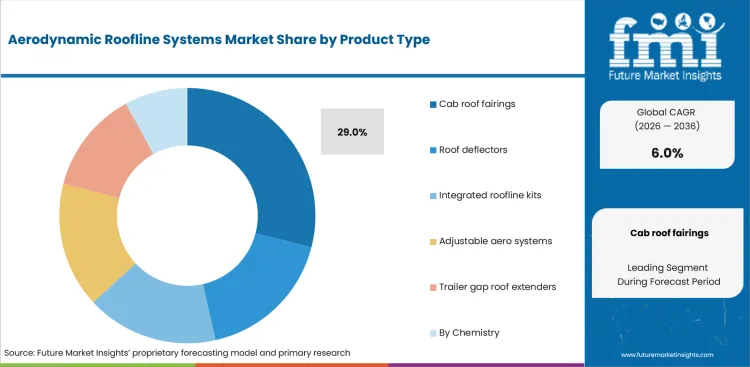
EPA SmartWay tractor criteria published in January 2026 require an aerodynamically integrated high-roof fairing or cab compartment on qualifying high-roof tractor configurations. Cab roof fairings address that requirement by managing airflow across the height transition between the tractor cab and a taller body. Adjustable designs also help fleets match changing trailer heights without redesigning unrelated vehicle systems.
- Based on product type, cab roof fairings are projected to account for 29.0% in 2026 because they control the upper-cab transition directly.
- Fleet engineers match fairing height with trailer roof position and tractor gap before approving repeatable configurations while active spoilers manage a separate airflow zone.
Why do heavy-duty trucks lead the vehicle type category?
Heavy-duty trucks spend enough time at highway speed for small drag reductions to become measurable across annual fuel or electricity budgets. High-mileage fleets therefore evaluate roofline hardware as part of the tractor specification instead of treating it as decorative bodywork. Route speed and sleeper-cab geometry make that comparison especially relevant in long-haul service.
- In 2026, heavy-duty trucks are expected to lead vehicle type with 43.0% share as long-distance operation makes aerodynamic payback easier to measure.
- Volvo Trucks reported in May 2025 that cab airflow stabilizers, extended air deflectors, and modified chassis fairings together improve fuel efficiency by up to 2% on top of already achieved efficiencies.
How do thermoplastic composites shape the material category?
Thermoplastic composites suit exposed roofline parts because molded curves keep added mass low and can recover from routine impacts without thick metal reinforcement. That balance matters on fairings exposed to loading activity and roadside obstacles during routine fleet service.
- By material, thermoplastic composites are forecast to represent 31.0% in 2026 as lightweight molded forms preserve the intended aerodynamic profile.
- FlowBelow Aero reported in November 2025 that its Flex Fairing replaced the original AeroKit after more than twelve months of fleet trials. That field history aligns with automotive composites and lightweight body panels used where shape recovery limits repair work.
What supports OEM fitment within the sales channel category?
OEM fitment places roofline hardware inside the original vehicle build so attachment points and warranty responsibility are resolved before fleet delivery. The same route places installation cost inside the vehicle acquisition decision instead of a later maintenance budget.
- OEM fitment is set to lead the sales channel with 46.0% share in 2026 because factory specification keeps geometry consistent across repeated vehicle orders. Daimler Truck reported in September 2025 that the aerodynamically optimized Actros L ProCabin reduces fuel consumption by up to 3% during operation.
- Platform engineers coordinate fairings with electric drive axles before later modifications introduce clearance conflicts or divide warranty responsibility during retrofit work.
What are the drivers, restraints and opportunities in the Aerodynamic Roofline Systems Market?
Measured energy savings support demand while configuration limits restrain fleet-wide approval and adaptable retrofit designs widen the addressable installed base.
- Driver: Fleet operators approve roofline devices more readily when verified drag reduction translates into measurable fuel or electricity savings.
- Restraint: Device interactions and trailer geometry can weaken expected savings or prevent installation on specific fleet configurations.
- Opportunity: Adaptable mounting systems can extend aerodynamic fairings into fleet configurations that previously faced clearance or installation conflicts.
Highway fleets can approve aerodynamic hardware more consistently when test data turns drag reduction into a fuel or electricity cost case. EPA's April 2026 SmartWay guidance states that verified trailer aerodynamic devices reduce fuel use by lowering drag and smoothing airflow. The Elite category requires at least 9% tested fuel savings from qualifying device combinations, so roofline devices must be evaluated inside the full aerodynamic package.
Device interactions can erase expected savings even when each component performs well on its own vehicle configuration. EPA examples updated in November 2025 state that some aerodynamic devices cannot be installed together and gap reducers are unsuitable for refrigerated trailers. Mixed fleets therefore need configuration reviews before broad deployment because trailer geometry and service requirements change which roofline devices can operate together.
Retrofit specialists can reach older tractors by solving clearance problems that previously prevented aerodynamic hardware from fitting common chassis configurations. FlowBelow Aero expanded Tractor AeroKit bracketry in October 2025 to accommodate intermodal chassis that had landing-gear conflicts with earlier mounting arrangements. That change gives installed fleets another efficiency route without requiring a complete tractor replacement cycle.
Which country CAGRs are profiled in the Aerodynamic Roofline Systems Market?
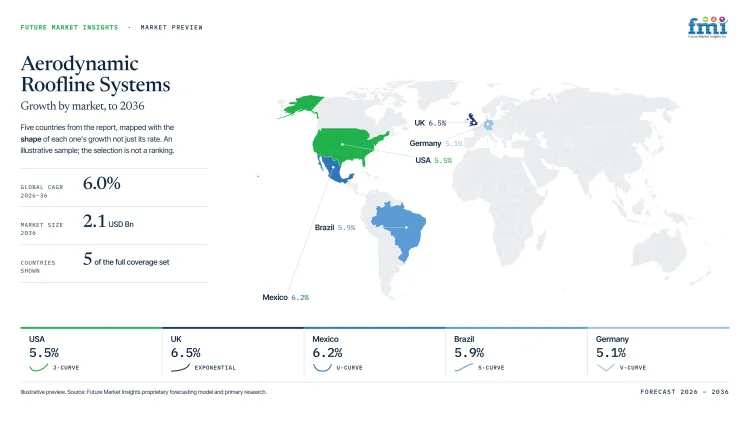
| Country | CAGR |
|---|---|
| UK | 6.5% |
| Mexico | 6.2% |
| Brazil | 5.9% |
| USA | 5.5% |
| Germany | 5.1% |
How do country-level CAGRs compare in the aerodynamic roofline systems market?
The 1.4 percentage-point spread forms a narrow growth band rather than a clear divide between mature and developing truck markets. UK and Mexico occupy the upper pair because fleet transition and manufacturing channels produce frequent specification decisions. Brazil sits between them and the USA-Germany pair, where established fleet economics place greater weight on qualification and replacement timing.
- UK fleets coordinate diesel-efficiency spending with the scheduled zero-emission HGV transition.
- Mexico links active heavy-vehicle production with OEM and body-builder fitment.
- Brazil places truck energy efficiency inside MOVER commercialization rules.
- USA fleets use established SmartWay verification during aerodynamic equipment reviews.
- Germany embeds truck efficiency inside a CO2-differentiated national toll system.
Comparable CAGRs therefore conceal different routes from technical interest to fleet approval. The full report provides country-level CAGR analysis across North America, Latin America, Europe, East Asia, South Asia, Oceania and the Middle East and Africa.
Country-wise Analysis
- UK fleet planners balance present diesel-efficiency spending against a scheduled shift toward zero-emission heavy trucks across long-haul assets with different remaining service lives and annual mileage. The Department for Transport opened its HGV CO2 framework consultation in January 2026 and retained phase-out dates of 2035 for new non-zero-emission HGVs up to 26 tonnes and 2040 for all such HGVs. Adoption of aerodynamic roofline systems in the UK is estimated to expand at 6.5% CAGR through 2036 as fleets value lower energy use across powertrains, but manufacturers must match fairing fitment with replacement timing and established service routines across mixed fleet ages.
- Mexico gives roofline-system manufacturers direct access to OEM and body-builder channels around major truck production corridors, which places aerodynamic fitment close to the original vehicle specification. INEGI reported 3,194 heavy vehicles sold at retail in June 2026, and aerodynamic roofline systems sales in Mexico are forecast to expand at 6.2% CAGR by 2036 as fleet renewal sustains regular configuration work. Local installation capacity can convert that activity into orders, but model-specific cab geometry and uneven parts coverage require entrants to prove repeatable fitment and field support before national freight fleets standardize the same fairing package across different truck platforms.
- Brazilian truck manufacturers now evaluate aerodynamic hardware inside the MOVER framework, which places vehicle energy efficiency inside new-model commercialization and import requirements. The Brazilian aerodynamic roofline systems sector is projected to record 5.9% CAGR during the assessment period as OEM integration gives component manufacturers access to factory vehicle programs. MDIC states that mandatory vehicle energy-efficiency requirements have applied since June 2025, but MOVER does not prescribe a specific roofline device for trucks and manufacturers therefore need local validation linking selected fairing geometry to measurable savings before fleets accept the same component across mixed freight duty cycles in Brazilian long-haul service.
- USA fleet engineers use SmartWay verification language across established retrofit programs, and EPA reported in March 2026 that SmartWay Elite trailers require at least two aerodynamic devices with at least 9% fuel savings. Aerodynamic roofline systems demand in USA is forecast to rise at 5.5% CAGR over the forecast period as familiar verification routes help fleets compare integrated device packages nationally. That common test language reduces evaluation friction, but roofline specialists still need configuration-specific evidence separating upper-body gains from skirts or tails before fleet engineering teams approve broad deployment across mixed tractor and trailer combinations operating on different routes nationwide.
- German hauliers evaluate truck efficiency inside a road-cost system that makes vehicle emissions visible across motorway operations and long-distance fleet replacement decisions. Germany is estimated to post 5.1% CAGR over the forecast period as CO2-linked operating costs keep aerodynamic efficiency commercially relevant across diesel and electric platforms. The Federal Ministry of Transport confirmed in February 2026 that CO2 differentiation has applied to the HGV toll since December 2023 and zero-emission HGVs remain exempt through June 2031, so manufacturers must prove roofline savings that survive the powertrain transition without depending on one propulsion technology or a single vehicle replacement schedule alone.
Who are the notable companies in the aerodynamic roofline systems market?
Daimler Truck, Volvo Trucks, Kenworth Truck Company, Peterbilt Motors Company, Wabash, Transtex, FlowBelow Aero and Great Dane are the notable companies profiled in this market.
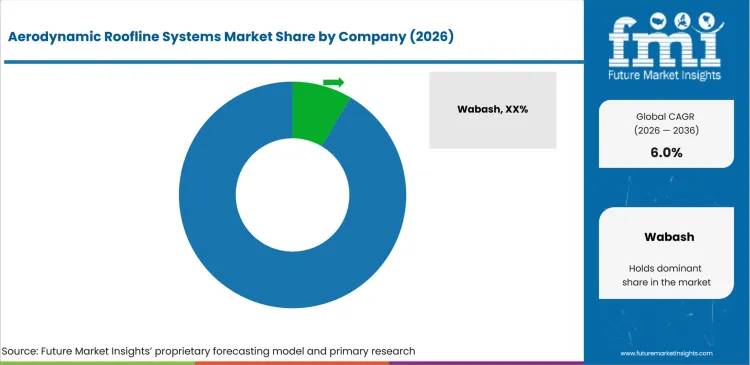
Competition spans truck OEMs with factory geometry control, trailer manufacturers with integrated aerodynamic packages and specialists serving installed fleets. Entry barriers come from verified performance and vehicle-specific fitment rather than company scale alone. Adjacent technologies such as active air dams and automotive roof rails do not establish direct participation without documented heavy-vehicle roofline hardware.
- Daimler Truck and Volvo Trucks combine integrated cab aerodynamics with factory vehicle specification across heavy-duty platforms.
- Kenworth Truck Company and Peterbilt Motors Company compete from SmartWay-designated tractor platforms while Wabash and Great Dane connect aerodynamic hardware to trailer or body specification.
- Transtex and FlowBelow Aero focus on aerodynamic components and retrofit routes that address installed-fleet geometry and maintenance constraints.
Competitive Benchmarking: Aerodynamic Roofline Systems Market
| Company | Roofline Integration | Factory Specification Access | Retrofit and Service Flexibility | Geographic Reach |
|---|---|---|---|---|
| Daimler Truck | High | High | Medium | Global |
| Volvo Trucks | High | High | Medium | Global |
| Kenworth Truck Company | High | High | Medium | North America |
| Peterbilt Motors Company | High | High | Medium | North America |
| Wabash | Medium | High | High | North America |
| Transtex | High | Medium | High | North America, Europe and Australia |
| FlowBelow Aero | Medium | Medium | High | North America |
| Great Dane | Medium | High | High | North America |
Key Developments in the Aerodynamic Roofline Systems Market
- In March 2026, Transtex acquired FleetAero assets from Knight-Swift Transportation Holdings Inc. and announced a long-term partnership focused on fleet-efficiency innovation.
- In March 2026, Great Dane presented a Sahara C-Series aerodynamic package with a flush-mounted top fairing and dual side fairings for longer routes.
- In March 2026, Daimler Truck agreed to deliver 500 Actros L ProCabin trucks to Girteka in phases during 2026 for European long-haul operations.
Key Players in the Aerodynamic Roofline Systems Market
Integrated Heavy-Truck Platforms
- Daimler Truck
- Volvo Trucks
- Kenworth Truck Company
- Peterbilt Motors Company
Trailer and Factory-Fit Platforms
- Wabash
- Great Dane
Specialist Aerodynamic and Retrofit Systems
- Transtex
- FlowBelow Aero
Aerodynamic Roofline Systems Market - Report Scope
| Coverage field | Report scope |
|---|---|
| Market breakdown | By product type, vehicle type, material, sales channel, end use and region. |
| Quantitative Units | Revenue in USD billion and CAGR in %. |
| Market Definition | Commercial aerodynamic components and integrated roofline systems used on trucks, trailers, buses and specialty fleet vehicles to manage upper-body airflow and reduce drag. |
| Regions Covered | North America, Latin America, Europe, East Asia, South Asia and Pacific, and Middle East and Africa. |
| Countries Covered | UK, Mexico, Brazil, USA, Germany, and 20+ countries included in the full report. |
| Key Companies Profiled | Daimler Truck, Volvo Trucks, Kenworth Truck Company, Peterbilt Motors Company, Wabash, Transtex, FlowBelow Aero, Great Dane. |
| Forecast Period | 2026 to 2036. |
| Approach | Primary and secondary research with market triangulation. |
Aerodynamic Roofline Systems Market - Research Methodology
| Method | Approach |
|---|---|
| Primary Research | FMI analysts gathered input from manufacturers, service providers, technology developers, distributors, end users, procurement teams, and subject-matter experts. Interviews examined purchasing decisions, product or service evaluation, adoption barriers, approval requirements, pricing considerations, and expectations for technical or commercial support. Respondents were also asked what evidence is required before a trial, pilot, or initial order develops into regular purchasing. |
| Desk Research | Desk research covered government statistics, regulatory publications, trade data, industry associations, technical literature, standards, company filings, product information, and official corporate announcements. Sources were reviewed for relevance, publication date, geographic coverage, and consistency with the defined market scope. Claims relating to performance, applications, approvals, capacity, investment, and commercial activity were retained only when supported by credible public evidence. |
| Market Sizing and Forecasting | The market model combined the baseline value with historical performance, segment structure, pricing and volume indicators, adoption levels, company participation, and country-level demand conditions. Forecast assumptions considered economic activity, investment trends, regulatory developments, technology adoption, purchasing cycles, supply availability, and barriers to wider market use. Segment and regional estimates were reconciled before the final market total was calculated. |
| Data Validation | Estimates were checked against multiple independent indicators, including public data, company activity, trade patterns, industry developments, and findings from primary interviews. Validation also tested whether products, services, applications, and company revenues fell within the defined market boundaries. Adjacent categories, unsupported claims, overlapping revenues, and activities without direct market relevance were excluded to reduce double counting and maintain consistency across segments and countries. |
Aerodynamic Roofline Systems Market by Segments
Aerodynamic Roofline Systems Market segmented by Product Type:
- Cab roof fairings
- Roof deflectors
- Integrated roofline kits
- Adjustable aero systems
- Trailer gap roof extenders
Aerodynamic Roofline Systems Market segmented by Vehicle Type:
- Heavy-duty trucks
- Medium-duty trucks
- LCVs
- Buses & coaches
- Specialty fleets
Aerodynamic Roofline Systems Market segmented by Material:
- Thermoplastic composites
- SMC / FRP
- Aluminum
- ABS / PP blends
- Carbon fiber premium
Aerodynamic Roofline Systems Market segmented by Sales Channel:
- OEM fitment
- Fleet retrofit
- Aftermarket distributors
- Body builders
Aerodynamic Roofline Systems Market segmented by End Use:
- Long-haul logistics
- Regional distribution
- Cold chain fleets
- E-commerce delivery
- Public transport
Aerodynamic Roofline Systems Market by Region:
- North America
- United States
- Canada
- Latin America
- Brazil
- Mexico
- Chile
- Rest of Latin America
- Western Europe
- Germany
- United Kingdom
- Italy
- Spain
- France
- Nordics
- Benelux
- Rest of Western Europe
- Eastern Europe
- Russia
- Poland
- Hungary
- Balkan and Baltic States
- Rest of Eastern Europe
- East Asia
- China
- Japan
- South Korea
- South Asia and Pacific
- India
- ASEAN
- Australia and New Zealand
- Rest of South Asia and Pacific
- Middle East and Africa
- Kingdom of Saudi Arabia
- Other GCC Countries
- Türkiye
- South Africa
- Other African Union Countries
- Rest of Middle East and Africa
Research Sources and Bibliography
- Volvo Trucks. (2025, March 11). Volvo Trucks unveils the all-new Volvo VNR in North America.
- Instituto Nacional de Estadística y Geografía. (2026, May 13). Reporte de resultados: Registro Administrativo de la Industria Automotriz de Vehículos Pesados, abril de 2026.
- USA Environmental Protection Agency. (2026, January 26). SmartWay Designated Tractors.
- Volvo Trucks. (2025, May 12). Volvo Trucks takes aerodynamics one step further - inspired by the aerospace industry.
- FlowBelow Aero. (2025, November 6). FlowBelow’s AeroKit with Flex Fairing Proves Its Toughness as Product Approaches One-Year Anniversary.
- Daimler Truck. (2025, September 30). Mercedes-Benz Actros L ProCabin: Focus on Aerodynamics, Efficiency, and Driver Comfort.
- USA Environmental Protection Agency. (2026, April 6). Learn About SmartWay Verified Aerodynamic Devices.
- USA Environmental Protection Agency. (2025, November 14). Examples of SmartWay Designated Trailer Configurations.
- FlowBelow Aero. (2025, October 14). FlowBelow Expands Market Reach with Universal Bracketry for Tractor AeroKit™ with Flex Fairing.
- Department for Transport and Office for Zero Emission Vehicles. (2026, January 6). New HGV CO2 emissions regulatory framework for the UK.
- Instituto Nacional de Estadística y Geografía. (2026, July 10). Se vendieron en México 3 194 vehículos pesados al menudeo y 3 278 al mayoreo, en junio de 2026.
- Ministério do Desenvolvimento, Indústria, Comércio e Serviços. (2026, July 6). Programa MOVER.
- USA Environmental Protection Agency. (2026, March 10). SmartWay Designated Tractors and Trailers.
- Federal Ministry of Transport. (2026, February 27). The HGV (Heavy Goods Vehicle) tolling scheme.
- USA Environmental Protection Agency. (2026, July 24). SmartWay Verified List of Aerodynamic Devices.
- Transtex. (2026, March 18). TRANSTEX Acquires FleetAero Assets from Knight-Swift Transportation Holdings Inc. and Announces Long-Term Partnership to Advance Fleet Efficiency Innovation.
- Great Dane. (2026, March). Great Dane’s Truck Body Solutions On Display at NTEA Work Truck Week 2026.
- Daimler Truck. (2026, March 3). Mercedes-Benz Trucks and Girteka Agree on the Delivery of 500 Actros L ProCabin.
- Volvo Trucks. (2025, August 21). Volvo Trucks lands major order in North America.
- Daimler Truck. (2025, February 6). Tevex Logistics modernises its fleet with 150 new Mercedes-Benz Actros L vehicles for greater efficiency and safety.
- Wabash. (2026, May 1). Wabash Announces First Quarter 2026 Results.
- Transtex. (2026, March 11). ATA MCE25.
This bibliography is provided for reader reference and is not exhaustive. The full report contains the complete reference list and detailed citations
This Report Answers
- What operating conditions make roofline drag reduction commercially measurable for heavy fleets?
- Why do cab roof fairings retain the leading product type share in 2026?
- How does heavy-duty highway mileage change the payback case for aerodynamic hardware?
- Which material properties matter most for exposed aerodynamic fairings?
- How does OEM fitment differ from retrofit in qualification and warranty ownership?
- Why do country growth rates diverge across the five profiled markets?
- Which fitment and durability constraints delay fleet-wide approval?
- How do major companies differ by platform access and service model?
- What evidence should fleet engineering teams require before broad aerodynamic deployment?
Frequently Asked Questions
How big is the Aerodynamic Roofline Systems Market in 2026?
The aerodynamic roofline systems market is expected to be valued at USD 1.2 billion in 2026 and reach USD 2.1 billion by 2036. Growth reflects fleet efforts to reduce highway energy use with roofline hardware matched to specific vehicle geometry.
What is the CAGR of the Aerodynamic Roofline Systems Market from 2026 to 2036?
The aerodynamic roofline systems market is forecast to grow at a 6.0% CAGR from 2026 to 2036. Expansion depends on verified drag savings becoming repeatable across new-vehicle specifications and installed-fleet retrofit programs.
Which product type leads the Aerodynamic Roofline Systems Market?
The cab roof fairings is expected to record a 29.0% product type share in 2026. Their position reflects direct control of upper-cab airflow across the height transition between a tractor and taller body.
Which sales channel leads the Aerodynamic Roofline Systems Market?
OEM fitment is expected to account for 46.0% of sales channel revenue in 2026. Factory specification reduces geometry variation by resolving attachment points and warranty responsibility before vehicle delivery.
Which companies are active in the Aerodynamic Roofline Systems Market?
The aerodynamic roofline systems market profiles Daimler Truck, Volvo Trucks, Kenworth Truck Company and Peterbilt Motors Company among its active participants. Wabash, Great Dane, Transtex and FlowBelow Aero compete through trailer platforms or focused aerodynamic components and retrofit routes.
Preview the report firsthand - request a free sample
Get SampleGet the brochure for pricing and purchase details.
Get PDFTable of Content
- Key Takeaways
- Market Size and CAGR
- Top Growth Driver
- Fastest Growing Segment
- Leading Region
- Key Companies
- Emerging Opportunities
- Executive Summary
- Global Market Outlook
- Demand-side Trends
- Supply-side Trends
- Technology Roadmap Analysis
- Analysis and Recommendations
- Analyst Perspective (What is happening? Why now? What should investors know?)
- Key Questions Answered
- How large is the market?
- What is the CAGR?
- What are key trends?
- Which region dominates?
- Who are the leaders?
- Market Overview
- Market Coverage / Taxonomy
- Market Definition / Scope / Limitations
- Research Methodology
- Chapter Orientation
- Analytical Lens and Working Hypotheses
- Market Structure, Signals, and Trend Drivers
- Benchmarking and Cross-market Comparability
- Market Sizing, Forecasting, and Opportunity Mapping
- Research Design and Evidence Framework
- Desk Research Programme (Secondary Evidence)
- Expert Input and Fieldwork (Primary Evidence)
- Tooling, Models, and Reference Databases
- Data Engineering and Model Build
- Quality Assurance and Audit Trail
- Market Background
- Market Dynamics (Drivers, Restraints, Opportunity, Trends)
- Scenario Forecast (Optimistic, Likely, Conservative)
- Impact Analysis
- AI Impact
- Sustainability Impact
- Regulatory Impact
- Technology Impact
- Consumer / Buyer Analysis
- Purchase Drivers
- Adoption Barriers
- Buyer Journey
- Opportunity Map Analysis
- Product Life Cycle Analysis
- Supply Chain Analysis
- Investment Feasibility Matrix
- Value Chain Analysis
- PESTLE and Porter's Analysis
- Regulatory Landscape
- Regional Parent Market Outlook
- Production and Consumption Statistics
- Import and Export Statistics
- Global Market Analysis and Forecast, 2021 to 2036
- Historical Market Size Value (USD Billion) Analysis, 2021 to 2025
- Current and Future Market Size Value (USD Billion) Projections, 2026 to 2036
- Y-o-Y Growth Trend Analysis
- Absolute $ Opportunity Analysis
- Global Market Pricing Analysis, 2021 to 2036
- Global Market Analysis and Forecast, By Product Type, 2021 to 2036
- Introduction / Key Findings
- Historical Market Size Value (USD Billion) Analysis By Product Type, 2021 to 2025
- Current and Future Market Size Value (USD Billion) Analysis and Forecast By Product Type, 2026 to 2036
- Cab roof fairings
- Roof deflectors
- Integrated roofline kits
- Adjustable aero systems
- Trailer gap roof extenders
- By Chemistry
- Cab roof fairings
- Y-o-Y Growth Trend Analysis By Product Type, 2021 to 2025
- Absolute $ Opportunity Analysis By Product Type, 2026 to 2036
- Global Market Analysis and Forecast, By Vehicle Type, 2021 to 2036
- Introduction / Key Findings
- Historical Market Size Value (USD Billion) Analysis By Vehicle Type, 2021 to 2025
- Current and Future Market Size Value (USD Billion) Analysis and Forecast By Vehicle Type, 2026 to 2036
- Heavy-duty trucks
- Medium-duty trucks
- LCVs
- Buses & coaches
- Specialty fleets
- By Form
- Heavy-duty trucks
- Y-o-Y Growth Trend Analysis By Vehicle Type, 2021 to 2025
- Absolute $ Opportunity Analysis By Vehicle Type, 2026 to 2036
- Global Market Analysis and Forecast, By Material, 2021 to 2036
- Introduction / Key Findings
- Historical Market Size Value (USD Billion) Analysis By Material, 2021 to 2025
- Current and Future Market Size Value (USD Billion) Analysis and Forecast By Material, 2026 to 2036
- Thermoplastic composites
- SMC / FRP
- Aluminum
- ABS / PP blends
- Carbon fiber premium
- By Application
- Thermoplastic composites
- Y-o-Y Growth Trend Analysis By Material, 2021 to 2025
- Absolute $ Opportunity Analysis By Material, 2026 to 2036
- Global Market Analysis and Forecast, By Sales Channel, 2021 to 2036
- Introduction / Key Findings
- Historical Market Size Value (USD Billion) Analysis By Sales Channel, 2021 to 2025
- Current and Future Market Size Value (USD Billion) Analysis and Forecast By Sales Channel, 2026 to 2036
- OEM fitment
- Fleet retrofit
- Aftermarket distributors
- Body builders
- By Platform
- OEM fitment
- Y-o-Y Growth Trend Analysis By Sales Channel, 2021 to 2025
- Absolute $ Opportunity Analysis By Sales Channel, 2026 to 2036
- Global Market Analysis and Forecast, By End Use, 2021 to 2036
- Introduction / Key Findings
- Historical Market Size Value (USD Billion) Analysis By End Use, 2021 to 2025
- Current and Future Market Size Value (USD Billion) Analysis and Forecast By End Use, 2026 to 2036
- Long-haul logistics
- Regional distribution
- Cold chain fleets
- E-commerce delivery
- Public transport
- By Sales Channel
- Long-haul logistics
- Y-o-Y Growth Trend Analysis By End Use, 2021 to 2025
- Absolute $ Opportunity Analysis By End Use, 2026 to 2036
- Global Market Analysis and Forecast, By Region, 2021 to 2036
- Introduction
- Historical Market Size Value (USD Billion) Analysis By Region, 2021 to 2025
- Current Market Size Value (USD Billion) Analysis and Forecast By Region, 2026 to 2036
- North America
- Latin America
- Western Europe
- Eastern Europe
- East Asia
- South Asia and Pacific
- Middle East & Africa
- Market Attractiveness Analysis By Region
- North America Market Analysis and Forecast, By Country, 2021 to 2036
- Historical Market Size Value (USD Billion) Trend Analysis By Market Taxonomy, 2021 to 2025
- Market Size Value (USD Billion) Forecast By Market Taxonomy, 2026 to 2036
- By Country
- USA
- Canada
- By Product Type
- By Vehicle Type
- By Material
- By Sales Channel
- By End Use
- By Country
- Market Attractiveness Analysis
- By Country
- By Product Type
- By Vehicle Type
- By Material
- By Sales Channel
- By End Use
- Key Takeaways
- Latin America Market Analysis and Forecast, By Country
- Historical Market Size Value (USD Billion) Trend Analysis By Market Taxonomy, 2021 to 2025
- Market Size Value (USD Billion) Forecast By Market Taxonomy, 2026 to 2036
- By Country
- Brazil
- Mexico
- Chile
- Rest of Latin America
- By Product Type
- By Vehicle Type
- By Material
- By Sales Channel
- By End Use
- By Country
- Market Attractiveness Analysis
- By Country
- By Product Type
- By Vehicle Type
- By Material
- By Sales Channel
- By End Use
- Key Takeaways
- Western Europe Market Analysis and Forecast, By Country
- Historical Market Size Value (USD Billion) Trend Analysis By Market Taxonomy, 2021 to 2025
- Market Size Value (USD Billion) Forecast By Market Taxonomy, 2026 to 2036
- By Country
- Germany
- UK
- Italy
- Spain
- France
- Nordic
- BENELUX
- Rest of Western Europe
- By Product Type
- By Vehicle Type
- By Material
- By Sales Channel
- By End Use
- By Country
- Market Attractiveness Analysis
- By Country
- By Product Type
- By Vehicle Type
- By Material
- By Sales Channel
- By End Use
- Key Takeaways
- Eastern Europe Market Analysis and Forecast, By Country
- Historical Market Size Value (USD Billion) Trend Analysis By Market Taxonomy, 2021 to 2025
- Market Size Value (USD Billion) Forecast By Market Taxonomy, 2026 to 2036
- By Country
- Russia
- Poland
- Hungary
- Balkan & Baltic
- Rest of Eastern Europe
- By Product Type
- By Vehicle Type
- By Material
- By Sales Channel
- By End Use
- By Country
- Market Attractiveness Analysis
- By Country
- By Product Type
- By Vehicle Type
- By Material
- By Sales Channel
- By End Use
- Key Takeaways
- East Asia Market Analysis and Forecast, By Country
- Historical Market Size Value (USD Billion) Trend Analysis By Market Taxonomy, 2021 to 2025
- Market Size Value (USD Billion) Forecast By Market Taxonomy, 2026 to 2036
- By Country
- China
- Japan
- South Korea
- By Product Type
- By Vehicle Type
- By Material
- By Sales Channel
- By End Use
- By Country
- Market Attractiveness Analysis
- By Country
- By Product Type
- By Vehicle Type
- By Material
- By Sales Channel
- By End Use
- Key Takeaways
- South Asia and Pacific Market Analysis and Forecast, By Country
- Historical Market Size Value (USD Billion) Trend Analysis By Market Taxonomy, 2021 to 2025
- Market Size Value (USD Billion) Forecast By Market Taxonomy, 2026 to 2036
- By Country
- India
- ASEAN
- Australia & New Zealand
- Rest of South Asia and Pacific
- By Product Type
- By Vehicle Type
- By Material
- By Sales Channel
- By End Use
- By Country
- Market Attractiveness Analysis
- By Country
- By Product Type
- By Vehicle Type
- By Material
- By Sales Channel
- By End Use
- Key Takeaways
- Middle East & Africa Market Analysis and Forecast, By Country
- Historical Market Size Value (USD Billion) Trend Analysis By Market Taxonomy, 2021 to 2025
- Market Size Value (USD Billion) Forecast By Market Taxonomy, 2026 to 2036
- By Country
- Kingdom of Saudi Arabia
- Other GCC Countries
- Türkiye
- South Africa
- Other African Union
- Rest of Middle East & Africa
- By Product Type
- By Vehicle Type
- By Material
- By Sales Channel
- By End Use
- By Country
- Market Attractiveness Analysis
- By Country
- By Product Type
- By Vehicle Type
- By Material
- By Sales Channel
- By End Use
- Key Takeaways
- Key Countries Market Analysis
- USA
- Pricing Analysis
- Market Share Analysis, 2025
- By Product Type
- By Vehicle Type
- By Material
- By Sales Channel
- By End Use
- Canada
- Pricing Analysis
- Market Share Analysis, 2025
- By Product Type
- By Vehicle Type
- By Material
- By Sales Channel
- By End Use
- Mexico
- Pricing Analysis
- Market Share Analysis, 2025
- By Product Type
- By Vehicle Type
- By Material
- By Sales Channel
- By End Use
- Brazil
- Pricing Analysis
- Market Share Analysis, 2025
- By Product Type
- By Vehicle Type
- By Material
- By Sales Channel
- By End Use
- Chile
- Pricing Analysis
- Market Share Analysis, 2025
- By Product Type
- By Vehicle Type
- By Material
- By Sales Channel
- By End Use
- Germany
- Pricing Analysis
- Market Share Analysis, 2025
- By Product Type
- By Vehicle Type
- By Material
- By Sales Channel
- By End Use
- UK
- Pricing Analysis
- Market Share Analysis, 2025
- By Product Type
- By Vehicle Type
- By Material
- By Sales Channel
- By End Use
- Italy
- Pricing Analysis
- Market Share Analysis, 2025
- By Product Type
- By Vehicle Type
- By Material
- By Sales Channel
- By End Use
- Spain
- Pricing Analysis
- Market Share Analysis, 2025
- By Product Type
- By Vehicle Type
- By Material
- By Sales Channel
- By End Use
- France
- Pricing Analysis
- Market Share Analysis, 2025
- By Product Type
- By Vehicle Type
- By Material
- By Sales Channel
- By End Use
- India
- Pricing Analysis
- Market Share Analysis, 2025
- By Product Type
- By Vehicle Type
- By Material
- By Sales Channel
- By End Use
- ASEAN
- Pricing Analysis
- Market Share Analysis, 2025
- By Product Type
- By Vehicle Type
- By Material
- By Sales Channel
- By End Use
- Australia & New Zealand
- Pricing Analysis
- Market Share Analysis, 2025
- By Product Type
- By Vehicle Type
- By Material
- By Sales Channel
- By End Use
- China
- Pricing Analysis
- Market Share Analysis, 2025
- By Product Type
- By Vehicle Type
- By Material
- By Sales Channel
- By End Use
- Japan
- Pricing Analysis
- Market Share Analysis, 2025
- By Product Type
- By Vehicle Type
- By Material
- By Sales Channel
- By End Use
- South Korea
- Pricing Analysis
- Market Share Analysis, 2025
- By Product Type
- By Vehicle Type
- By Material
- By Sales Channel
- By End Use
- Russia
- Pricing Analysis
- Market Share Analysis, 2025
- By Product Type
- By Vehicle Type
- By Material
- By Sales Channel
- By End Use
- Poland
- Pricing Analysis
- Market Share Analysis, 2025
- By Product Type
- By Vehicle Type
- By Material
- By Sales Channel
- By End Use
- Hungary
- Pricing Analysis
- Market Share Analysis, 2025
- By Product Type
- By Vehicle Type
- By Material
- By Sales Channel
- By End Use
- Kingdom of Saudi Arabia
- Pricing Analysis
- Market Share Analysis, 2025
- By Product Type
- By Vehicle Type
- By Material
- By Sales Channel
- By End Use
- Türkiye
- Pricing Analysis
- Market Share Analysis, 2025
- By Product Type
- By Vehicle Type
- By Material
- By Sales Channel
- By End Use
- South Africa
- Pricing Analysis
- Market Share Analysis, 2025
- By Product Type
- By Vehicle Type
- By Material
- By Sales Channel
- By End Use
- USA
- Market Structure Analysis
- Competition Dashboard
- Competition Benchmarking
- Market Share Analysis of Top Players
- By Regional
- By Product Type
- By Vehicle Type
- By Material
- By Sales Channel
- By End Use
- Emerging Startups
- Innovation Benchmarking
- Competition Analysis
- Competition Deep Dive
- Wabash
- Overview
- Product Portfolio
- Profitability by Market Segments
- Sales Footprint
- Strategy Overview
- Marketing Strategy
- Product Strategy
- Channel Strategy
- Transtex
- FlowBelow Aero
- Utility Trailer
- Great Dane
- Aero Industries
- Fleet Engineers
- Kögel Trailer
- Stoughton Trailers
- Daimler Truck
- Wabash
- Case Studies
- Success Stories
- Recent Developments
- Competition Deep Dive
- Assumptions & Acronyms Used


